What is ARPA?
•A marine radar with automatic radar plotting aid (ARPA)
capability can create tracks using radar contacts. The system
can calculate the tracked object's course, speed and closest
point of approach (CPA), thereby knowing if there is a danger
of collision with the other ship or landmass. the following
functions are usually provided:
1.) True or relative motion radar presentation.
2.) Automatic acquisition of targets plus manual acquisition.
3.) Digital read-out of acquired targets which provides
course, speed, range, bearing, closest point of approach
(CPA, and time to CPA (TCPA).
4.) The ability to display collision assessment information directly
on the Plan Position Indicator (PPI), using vectors (true or
relative) or a graphical Predicted Area of Danger (PAD) display.
5.) The ability to perform trial maneuvers, including course
changes, speed changes, and combined course/speed changes.
6.) Automatic ground stabilization for navigation purposes. ARPA
processes radar information much more rapidly than
conventional radar but is still subject to the same limitations.
ARPA data is only as accurate as the data that comes from inputs
such as the gyro and speed log.
How ARPA used ?
 The ARPA is connected to the radar from which it automatically
extracts data, processes it and displays it along with graphics and
possibly alphanumeric. A computer forms the heart of the system
which plots the targets and displays the vector associated with each
tracked target.
The first set up of the ARPA:
1.) Range scale
2.) Plot Relative Bearing
3.) Mode North up
4.) Mark the targets to be tracked
5.)Set the vector length in minutes
6.) Check the course and speed input
General Features
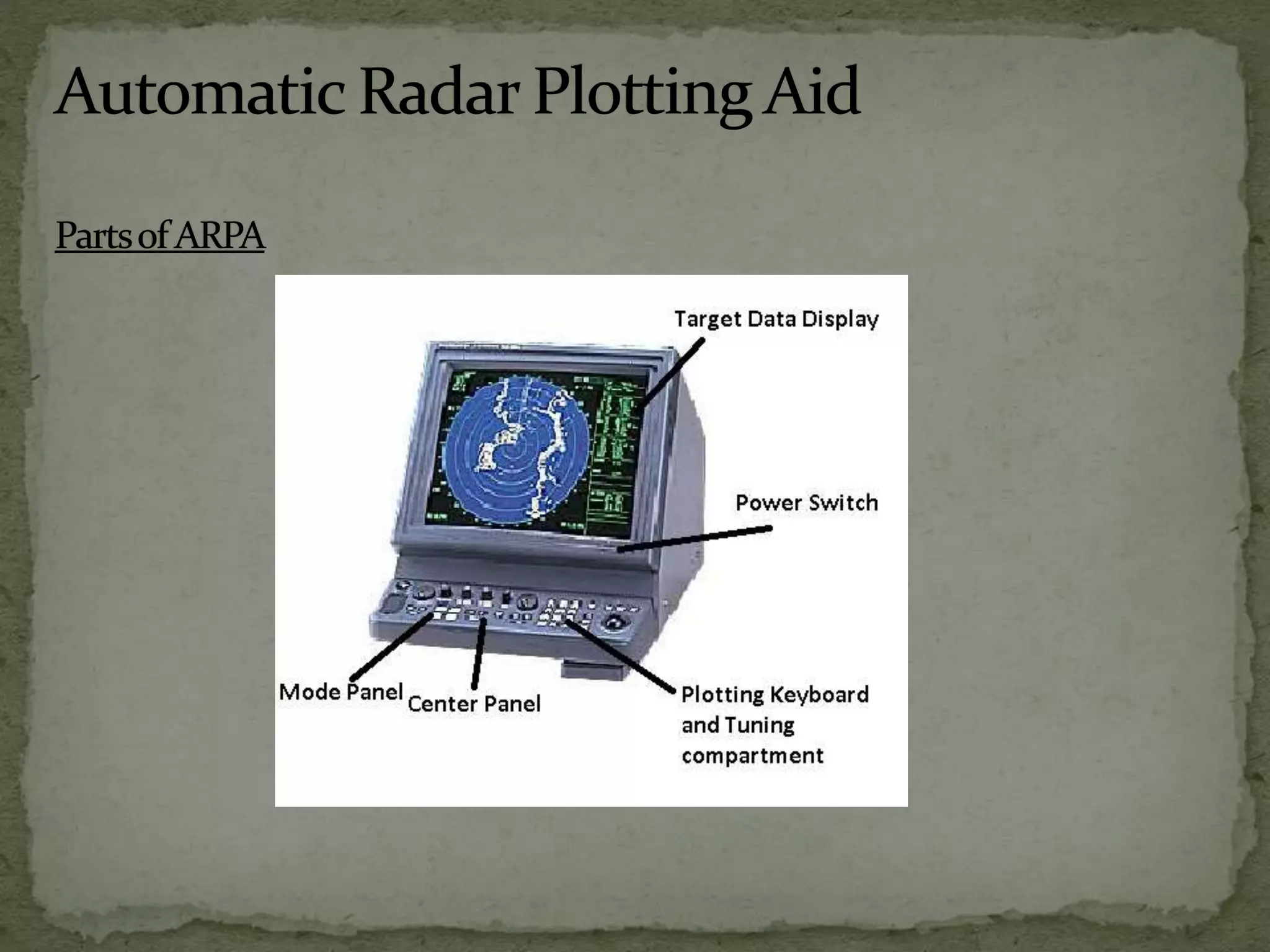
 Daylight-bright high-resolution display
 28 inch diagonal CRT presents radar picture of 360 mm
effective diameter with alphanumeric data area around it
 User friendly operation by combination of tactile backlit
touchpads, a trackball and rotary controls
 Audio-visual alert for targets in guard zone
 Echo trail to assess targets’ speed and course by simulated
afterglow • Electronic plotting of up to 10 targets in
different symbols (This function is disabled when ARPA is
activated)
General Features
 Electronic parallel index lines
 Interswitch (optional) built in radar or ARPA display unit •
 Enhanced visual target detection by Echo Average, Echo
Stretch, Interference Rejector, and multi-level quantization
 Stylish display
 Choice of 10, 25 or 50 KW output for X-band; 30 KW output
for S-band, either in the transceiver aloft (gearbox) or RF
down (transceiver in bridge)
 Exclusive FURUNO MIC low noise receiver
ARPA Features
 Acquires up to 20 targets automatically
 Movement of tracked targets shown by true or relative vectors
(Vector length 1 to 99 min. selected in 1 min steps)
 Setting of nav lines, buoy marks and other symbols to enhance
navigation safety
 On-screen digital readouts of range, bearing, course, speed,
CPA, TCPA, BCR (Bow Crossing Range) and BCT (Bow Crossing
Time) of two targets out of all tracked targets.
 Audible and visual alarms against threatening targets coming
into operator-selected CPA/TCPA limits, lost targets, two guard
rings, visual alarm against system failure and target full situation
ARPA Features
 Electronic plotting of up to 10 targets in different symbols (This
function is disabled when ARPA is activated)
 Electronic parallel index lines
 Interswitching (optional) built in radar or ARPA display unit
 Enhanced visual target detection by Echo Average, Echo Stretch,
Interference Rejector, and multi-level quantization
 Stylish display
 Choice of 10,25 or 50 kW output for X-band; 30kw output for S-
band, either in the transceiver aloft (gearbox) or RF down
(transceiver in bridge) • Exclusive FURUNO MIC low noise
receiver

REPORT IN NAV 6 RADAR ARPA

  • 1.
    What is ARPA? •Amarine radar with automatic radar plotting aid (ARPA) capability can create tracks using radar contacts. The system can calculate the tracked object's course, speed and closest point of approach (CPA), thereby knowing if there is a danger of collision with the other ship or landmass. the following functions are usually provided: 1.) True or relative motion radar presentation. 2.) Automatic acquisition of targets plus manual acquisition. 3.) Digital read-out of acquired targets which provides course, speed, range, bearing, closest point of approach (CPA, and time to CPA (TCPA).
  • 2.
    4.) The abilityto display collision assessment information directly on the Plan Position Indicator (PPI), using vectors (true or relative) or a graphical Predicted Area of Danger (PAD) display. 5.) The ability to perform trial maneuvers, including course changes, speed changes, and combined course/speed changes. 6.) Automatic ground stabilization for navigation purposes. ARPA processes radar information much more rapidly than conventional radar but is still subject to the same limitations. ARPA data is only as accurate as the data that comes from inputs such as the gyro and speed log.
  • 3.
    How ARPA used?  The ARPA is connected to the radar from which it automatically extracts data, processes it and displays it along with graphics and possibly alphanumeric. A computer forms the heart of the system which plots the targets and displays the vector associated with each tracked target. The first set up of the ARPA: 1.) Range scale 2.) Plot Relative Bearing 3.) Mode North up 4.) Mark the targets to be tracked 5.)Set the vector length in minutes 6.) Check the course and speed input
  • 5.
    General Features  Daylight-brighthigh-resolution display  28 inch diagonal CRT presents radar picture of 360 mm effective diameter with alphanumeric data area around it  User friendly operation by combination of tactile backlit touchpads, a trackball and rotary controls  Audio-visual alert for targets in guard zone  Echo trail to assess targets’ speed and course by simulated afterglow • Electronic plotting of up to 10 targets in different symbols (This function is disabled when ARPA is activated)
  • 6.
    General Features  Electronicparallel index lines  Interswitch (optional) built in radar or ARPA display unit •  Enhanced visual target detection by Echo Average, Echo Stretch, Interference Rejector, and multi-level quantization  Stylish display  Choice of 10, 25 or 50 KW output for X-band; 30 KW output for S-band, either in the transceiver aloft (gearbox) or RF down (transceiver in bridge)  Exclusive FURUNO MIC low noise receiver
  • 7.
    ARPA Features  Acquiresup to 20 targets automatically  Movement of tracked targets shown by true or relative vectors (Vector length 1 to 99 min. selected in 1 min steps)  Setting of nav lines, buoy marks and other symbols to enhance navigation safety  On-screen digital readouts of range, bearing, course, speed, CPA, TCPA, BCR (Bow Crossing Range) and BCT (Bow Crossing Time) of two targets out of all tracked targets.  Audible and visual alarms against threatening targets coming into operator-selected CPA/TCPA limits, lost targets, two guard rings, visual alarm against system failure and target full situation
  • 8.
    ARPA Features  Electronicplotting of up to 10 targets in different symbols (This function is disabled when ARPA is activated)  Electronic parallel index lines  Interswitching (optional) built in radar or ARPA display unit  Enhanced visual target detection by Echo Average, Echo Stretch, Interference Rejector, and multi-level quantization  Stylish display  Choice of 10,25 or 50 kW output for X-band; 30kw output for S- band, either in the transceiver aloft (gearbox) or RF down (transceiver in bridge) • Exclusive FURUNO MIC low noise receiver