Click to edit Master title style
• Edit Master text styles
• Second level
• Third level
• Fourth level
• Fifth level
Obsessive Compulsive disorders &
Related Disorders
By Heba Essawy MD., CEDS.,
Prof of Psychiatry
International Chapter chair –Egypt Iaedps
Head of Eating Disorders Clinics
Ohasha Institute - Medical school
Ain Shams University
Cairo- Egypt
Click to edit Master title style
• Edit Master text styles
• Second level
• Third level
• Fourth level
• Fifth level
OCD &Related Disorders
Roadmap
• 1-Characteristics of OCD and Related Disorders by ICD11
• 2- Risk factors for OCD and Related Disorders
• 3 – Diagnostic Criteria for OCD Related disorders ( DSM-% &
ICD11)
• 4- Epidemiology of OCD and related disorders
• 5-Measuring OCD
• 6- Cognitive theory of OCD
• 7- Management of OCD and Related Disorders
Click to edit Master title style
• Edit Master text styles
• Second level
• Third level
• Fourth level
• Fifth level
OCD &Related Disorders
Roadmap
• 1-Characteristics of OCD and Related Disorders by ICD11
• 2- Risk factors for OCD and Related D isorders
• 3-Measuring OCD
• 4- Cognitive theory of OCD
• 5- Management of OCD and Related Disorders
Click to edit Master title style
• Edit Master text styles
• Second level
• Third level
• Fourth level
• Fifth level
OCD &Related Disorders
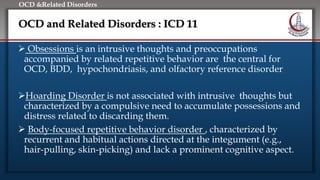
OCD and Related Disorders : ICD 11
 Obsessions is an intrusive thoughts and preoccupations
accompanied by related repetitive behavior are the central for
OCD, BDD, hypochondriasis, and olfactory reference disorder
Hoarding Disorder is not associated with intrusive thoughts but
characterized by a compulsive need to accumulate possessions and
distress related to discarding them.
 Body-focused repetitive behavior disorder , characterized by
recurrent and habitual actions directed at the integument (e.g.,
hair-pulling, skin-picking) and lack a prominent cognitive aspect.
Click to edit Master title style
• Edit Master text styles
• Second level
• Third level
• Fourth level
• Fifth level
OCD &Related Disorders
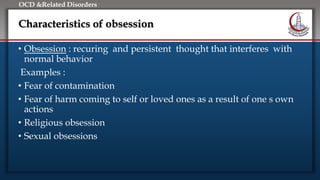
Characteristics of obsession
• Obsession : recuring and persistent thought that interferes with
normal behavior
Examples :
• Fear of contamination
• Fear of harm coming to self or loved ones as a result of one s own
actions
• Religious obsession
• Sexual obsessions
Click to edit Master title style
• Edit Master text styles
• Second level
• Third level
• Fourth level
• Fifth level
OCD &Related Disorders
Characteristics of Compulsion
• Compulsion : Recuring action a person is forced to act
- washing
- Checking
- Doubting –an action
- Touching repeatedly
- Ordering and Organizing
- Repeating words ( may be simultaneous with touching /tapping)
• Obsession may lead to compulsion
• The individual will do the compulsive act to reduce the anxiety
Click to edit Master title style
• Edit Master text styles
• Second level
• Third level
• Fourth level
• Fifth level
OCD &Related Disorders
Roadmap
• 2- Risk factors for OCD and Related Disorders
• 3-Measuring OCD
• 4- Cognitive theory of OCD
• 5- Management of OCD and Related Disorders
Click to edit Master title style
• Edit Master text styles
• Second level
• Third level
• Fourth level
• Fifth level
OCD &Related Disorders
Risk Factors of OCD & Related Disorders
• Temperamental:
- Greater internalizing symptoms
- Higher negative emotionality
- Behavioral inhibition in childhood
•
Environmental.:
- Physical and sexual abuse in childhood
- Stressful and traumatic events in childhood .
- Infectious agents and a post-infectious autoimmune syndrome.
Click to edit Master title style
• Edit Master text styles
• Second level
• Third level
• Fourth level
• Fifth level
OCD &Related Disorders
Risk Factors of OCD & Related Disorders
Genetic and physiological
- The rate of OCO among first-degree relatives of adults with
OCD is approximately two times that among first-degree relatives of
those without the disorder
- Among first-degree relatives of individuals with onset of OCD in
childhood or adolescence, the rate is increased I0-fold.
- Familial transmission is due in part to genetic factors ,
concordance rate of 0.57 for monozygotic vs. 0.22 for dizygotic
twins).
- Dysfunction in the orbitofrontal cortex, anterior cingulate cortex,
and striatum have been most strongly implicated.
Click to edit Master title style
• Edit Master text styles
• Second level
• Third level
• Fourth level
• Fifth level
OCD &Related Disorders
Risk Factors of OCD & Related Disorders
• Culture-Related Diagnostic Issues
- There is similarity across cultures in
 Gender distribution,
 Age at onset
 Comorbidity of OCD.
 Similar symptom structure involving cleaning, symmetry,
hoarding, taboo thoughts, or fear of harm.
However, regional variation in symptom expression exists, and cultural
factors may shape the content of obsessions and compulsions.
Click to edit Master title style
• Edit Master text styles
• Second level
• Third level
• Fourth level
• Fifth level
OCD &Related Disorders
Risk Factors of OCD & Related Disorders
• Gender-Related symptoms
*Males have an earlier age at onset of OCD than females
*Symptom dimensions have been reported :
-females more likely to have symptoms in the cleaning dimension
- males more likely to have symptoms in the forbidden thoughts
and symmetry dimensions.
Click to edit Master title style
• Edit Master text styles
• Second level
• Third level
• Fourth level
• Fifth level
OCD &Related Disorders
Risk Factors of OCD & Related Disorders
• Suicide Risk
- Suicidal thoughts occur at some point in as many as about half
of individuals with OCD.
• Suicide attempts are also reported in up to one-quarter of
individuals with OCD
• the presence of comorbid major depressive disorder increases the
risk
Click to edit Master title style
• Edit Master text styles
• Second level
• Third level
• Fourth level
• Fifth level
OCD &Related Disorders
Roadmap
• 1-Characteristics of OCD and Related Disorders by ICD11
• 2- Risk factors for OCD and Related Disorders
• 3 – Diagnostic Criteria for OCD Related disorders ( DSM-% &
ICD11)
• 4-Measuring OCD
• 5- Cognitive theory of OCD
• 6- Management of OCD and Related Disorders
Click to edit Master title style
• Edit Master text styles
• Second level
• Third level
• Fourth level
• Fifth level
OCD &Related Disorders
OCD and Related Disorders ICD11
• Body Dysmorphic Disorder
• Hoarding
• Olfactory reference disorder
• Hypochondriasis
• Body-focused repetitive behavior disorders
- Trichotillomania
- Excoriation disorder
Click to edit Master title style
• Edit Master text styles
• Second level
• Third level
• Fourth level
• Fifth level
OCD &Related Disorders
OCD and Realted disorders :DSM-5
• Obsessive Compulsive Disorder (OCD)
• Body Dysmorphic Disorder (BDD)
• Hoarding Disorder
• Trichotillomania
• Excoriation (Skin Picking) Disorder
• Substance/Medication-induced Obsessive-Compulsive and related
Disorder
• Obsessive-Compulsive and Related Disorder due to another medical
condition
• Other specified Obsessive-Compulsive and Related Disorder
• Unspecified Obsessive-Compulsive and Related Disorder
Click to edit Master title style
• Edit Master text styles
• Second level
• Third level
• Fourth level
• Fifth level
OCD &Related Disorders
Body Dysmorphic Disorder ICD11
• Characterized by
• Persistent preoccupation with one or more perceived defects or flaws in
appearance that are either unnoticeable or only slightly noticeable to others.
• Individuals experience excessive self-consciousness
• Often with ideas of reference
• Engage in repeated examination of the appearance of the perceived
defect or flaw
• Excessive attempts to camouflage or alter the perceived defect
As , the conviction that people are taking notice, judging, or talking
about the perceived defect or flaw.
Click to edit Master title style
• Edit Master text styles
• Second level
• Third level
• Fourth level
• Fifth level
OCD &Related Disorders
Body Dysmorphic Disorder : ICD 11
• Body dysmorphic disorder with fair to good insight
-Disorder-specific beliefs may not be true and is willing to accept
an alternative explanation for his or her experience.
• Body dysmorphic disorder with poor to absent insight
- Disorder-specific beliefs are true and cannot accept an
alternative explanation for their experience.
• Body dysmorphic disorder Unsprcified
Click to edit Master title style
• Edit Master text styles
• Second level
• Third level
• Fourth level
• Fifth level
OCD &Related Disorders
Body Dysmorphic Disorder ICD11
Most popular areas of focus
- skin (73%), hair (56%), nose (37%)
- Other common areas of focus- eyes, feet, hands, ears, chest,
stomach
• Common physical characteristics :Mirror gazing (constantly
checking your appearance) or mirror avoiding
• Camouflaging the area of focus with makeup, posturing, clothing,
• Comparing one’s area of focus with another person’s (such as eyes)
• Excessive grooming (washing hair, brushing teeth, makeup)
• Plastic surgery
Click to edit Master title style
• Edit Master text styles
• Second level
• Third level
• Fourth level
• Fifth level
OCD &Related Disorders
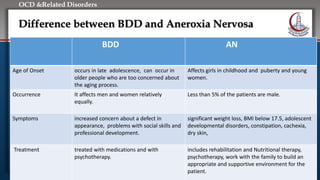
Difference between BDD and Aneroxia Nervosa
BDD AN
Age of Onset occurs in late adolescence, can occur in
older people who are too concerned about
the aging process.
Affects girls in childhood and puberty and young
women.
Occurrence It affects men and women relatively
equally.
Less than 5% of the patients are male.
Symptoms increased concern about a defect in
appearance, problems with social skills and
professional development.
significant weight loss, BMI below 17.5, adolescent
developmental disorders, constipation, cachexia,
dry skin,
Treatment treated with medications and with
psychotherapy.
includes rehabilitation and Nutritional therapy,
psychotherapy, work with the family to build an
appropriate and supportive environment for the
patient.
Click to edit Master title style
• Edit Master text styles
• Second level
• Third level
• Fourth level
• Fifth level
OCD &Related Disorders
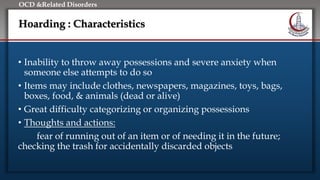
Hoarding : Characteristics
• Inability to throw away possessions and severe anxiety when
someone else attempts to do so
• Items may include clothes, newspapers, magazines, toys, bags,
boxes, food, & animals (dead or alive)
• Great difficulty categorizing or organizing possessions
• Thoughts and actions:
fear of running out of an item or of needing it in the future;
checking the trash for accidentally discarded objects
Click to edit Master title style
• Edit Master text styles
• Second level
• Third level
• Fourth level
• Fifth level
OCD &Related Disorders
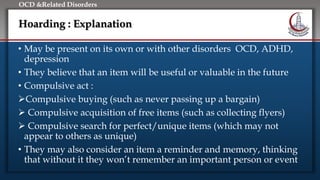
Hoarding : Explanation
• May be present on its own or with other disorders OCD, ADHD,
depression
• They believe that an item will be useful or valuable in the future
• Compulsive act :
Compulsive buying (such as never passing up a bargain)
 Compulsive acquisition of free items (such as collecting flyers)
 Compulsive search for perfect/unique items (which may not
appear to others as unique)
• They may also consider an item a reminder and memory, thinking
that without it they won’t remember an important person or event
Click to edit Master title style
• Edit Master text styles
• Second level
• Third level
• Fourth level
• Fifth level
OCD &Related Disorders
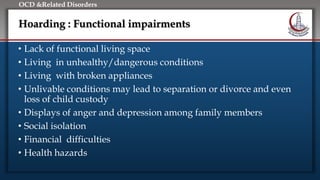
Hoarding : Functional impairments
• Lack of functional living space
• Living in unhealthy/dangerous conditions
• Living with broken appliances
• Unlivable conditions may lead to separation or divorce and even
loss of child custody
• Displays of anger and depression among family members
• Social isolation
• Financial difficulties
• Health hazards
Click to edit Master title style
• Edit Master text styles
• Second level
• Third level
• Fourth level
• Fifth level
OCD &Related Disorders
Olfactory reference disorder ICD11
Characterized by
• Persistent preoccupation that one is emitting a perceived foul or
offensive body odour or breath that is either unnoticeable or only
slightly noticeable to others.
• Individuals experience excessive self-consciousness about the
perceived odour
• Often with ideas of reference (i.e., the conviction that people are
taking notice, judging, or talking about the odour).
Click to edit Master title style
• Edit Master text styles
• Second level
• Third level
• Fourth level
• Fifth level
OCD &Related Disorders
Olfactory reference Disorder ICD11
• In response to their preoccupation, individuals engage in
- Repetitive behaviors such as repeatedly
 Checking for body odour
 Repeatedly seeking reassurance
 Excessive attempts to camouflage and prevent the perceived
odour
 Avoidance of social situations that increase distress about the
offensive odour.
** The symptoms are sufficiently severe to result in significant
distress or significant impairment in personal, family, social,
educational, occupational or other important areas of functioning.
Click to edit Master title style
• Edit Master text styles
• Second level
• Third level
• Fourth level
• Fifth level
OCD &Related Disorders
Olfactory reference Disorder ICD11
• Olfactory reference disorder with fair to good insight
-Disorder-specific beliefs may not be true and is willing to accept
an alternative explanation for his or her experience.
- At circumscribed times (e.g., when highly anxious), the
individual may demonstrate no insight.
• Olfactory reference disorder with poor to absent insight
- Disorder-specific beliefs are true and cannot accept an
alternative explanation
- The lack of insight exhibited by the individual does not vary
markedly as a function of anxiety level.
• Olfactory reference disorder, unspecified
Click to edit Master title style
• Edit Master text styles
• Second level
• Third level
• Fourth level
• Fifth level
OCD &Related Disorders
Hypochondriasis ICD11 : Characteristics
 Persistent preoccupation with or fear about the possibility of
having one or more serious, progressive or life-threatening
diseases.
 The preoccupation is associated with catastrophic
misinterpretation of bodily signs or symptoms
Manifested by
- repetitive and excessive health-related behaviors
- maladaptive avoidance behaviors related to health.
 The symptoms result in significant distress or significant
impairment in personal, family, social, educational, occupational or
other important areas of functioning.
Click to edit Master title style
• Edit Master text styles
• Second level
• Third level
• Fourth level
• Fifth level
OCD &Related Disorders
Hypochondriasis ICD11
Exclusions:
• Hypochondriacal neurosis
• Nosophobia
• Illness anxiety disorder
• Body dysmorphic disorder
• Fear of cancer
Click to edit Master title style
• Edit Master text styles
• Second level
• Third level
• Fourth level
• Fifth level
OCD &Related Disorders
Hypochondriasis ICD11
• Hypochondriasis with fair to good insight
The individual is able to entertain the possibility that his or her
disorder-specific beliefs may not be true and is willing to accept an
alternative explanation for his or her experience.
• Hypochondriasis with poor to absent insight
• Hypochondriasis unspecified
Click to edit Master title style
• Edit Master text styles
• Second level
• Third level
• Fourth level
• Fifth level
OCD &Related Disorders
Body-focused repetitive behavior disorders ICD11
Characterized by
 Recurrent and habitual actions directed at the integument (e.g.
hair-pulling, skin-picking, lip-biting)
 Accompanied by unsuccessful attempts to decrease or stop the
behavior involved
 lead to dermatological sequelae (e.g., hair loss, skin lesions, lip
abrasions).
• Trichotillomania
• Excoriation disorder
Click to edit Master title style
• Edit Master text styles
• Second level
• Third level
• Fourth level
• Fifth level
OCD &Related Disorders
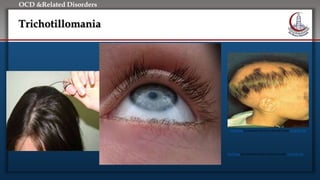
Trichotillomania ICD11
Characterized by
• Recurrent pulling of one’s own hair leading to significant hair loss
• With unsuccessful attempts to decrease or stop the behavior.
• Hair pulling may occur from any region of the body in which hair
grows
• Most common sites are the scalp, eyebrows, and eyelids.
• Occur in brief episodes scattered throughout the day .
• The symptoms result in significant distress or significant
impairment in personal, family, social, educational, occupational or
other important areas of functioning.
Click to edit Master title style
• Edit Master text styles
• Second level
• Third level
• Fourth level
• Fifth level
OCD &Related Disorders
Trichotillomania
This Photo by Unknown Author is licensed under CC BY-NC-ND
Click to edit Master title style
• Edit Master text styles
• Second level
• Third level
• Fourth level
• Fifth level
OCD &Related Disorders
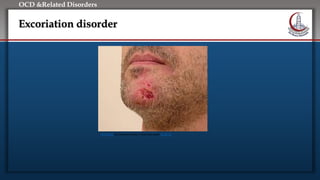
Excoriation disorder ICD11
Characterized by:
• Recurrent picking of one’s own skin leading to skin lesions
• Accompanied by unsuccessful attempts to decrease or stop the
behavior.
• The most commonly picked sites are the face, arms and hands, but
many individuals pick from multiple body sites.
• Skin picking may occur in brief episodes scattered throughout the
day or in less frequent but more sustained periods.
Click to edit Master title style
• Edit Master text styles
• Second level
• Third level
• Fourth level
• Fifth level
OCD &Related Disorders
Excoriation disorder
This Photo by Unknown Author is licensed under CC BY-SA
Click to edit Master title style
• Edit Master text styles
• Second level
• Third level
• Fourth level
• Fifth level
OCD &Related Disorders
Roadmap
• 1-Characteristics of OCD and Related Disorders by ICD11
• 2- Risk factors for OCD and Related Disorders
• 3 – Diagnostic Criteria for OCD Related disorders ( DSM-% &
ICD11)
• 4- Epidemiology of OCD and related disorders
• 5-Measuring OCD
• 6- Cognitive theory of OCD
• 7- Management of OCD and Related Disorders
Click to edit Master title style
• Edit Master text styles
• Second level
• Third level
• Fourth level
• Fifth level
OCD &Related Disorders
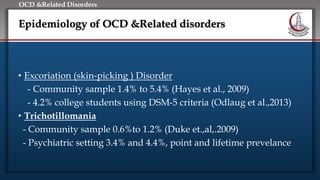
Epidemiology of OCD &Related disorders
• OCD
- 12-month prevelance is 1.2%: Lifetime prevelence is 1%.
(Ruscio et.,al.,2010)
• Body dysmorphic disorders
- Point prevelance of BDD is 2.4%(Koran et.,al., 2008)
• Hoarding Disorder
- Community prevalence is 5.3%(Samuels et., al., 2008)
Click to edit Master title style
• Edit Master text styles
• Second level
• Third level
• Fourth level
• Fifth level
OCD &Related Disorders
Epidemiology of OCD &Related disorders
• Excoriation (skin-picking ) Disorder
- Community sample 1.4% to 5.4% (Hayes et al., 2009)
- 4.2% college students using DSM-5 criteria (Odlaug et al.,2013)
• Trichotillomania
- Community sample 0.6%to 1.2% (Duke et.,al,.2009)
- Psychiatric setting 3.4% and 4.4%, point and lifetime prevelance
Click to edit Master title style
• Edit Master text styles
• Second level
• Third level
• Fourth level
• Fifth level
OCD &Related Disorders
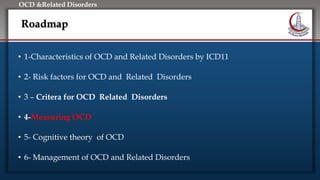
Roadmap
• 1-Characteristics of OCD and Related Disorders by ICD11
• 2- Risk factors for OCD and Related Disorders
• 3 – Critera for OCD Related Disorders
• 4-Measuring OCD
• 5- Cognitive theory of OCD
• 6- Management of OCD and Related Disorders
Click to edit Master title style
• Edit Master text styles
• Second level
• Third level
• Fourth level
• Fifth level
OCD &Related Disorders
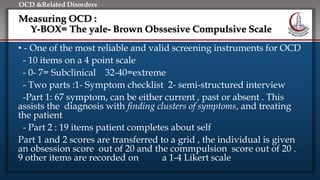
Measuring OCD :
Y-BOX= The yale- Brown Obssesive Compulsive Scale
• - One of the most reliable and valid screening instruments for OCD
- 10 items on a 4 point scale
- 0- 7= Subclinical 32-40=extreme
- Two parts :1- Symptom checklist 2- semi-structured interview
-Part 1: 67 symptom, can be either current , past or absent . This
assists the diagnosis with finding clusters of symptoms, and treating
the patient
- Part 2 : 19 items patient completes about self
Part 1 and 2 scores are transferred to a grid , the individual is given
an obsession score out of 20 and the commpulsion score out of 20 .
9 other items are recorded on a 1-4 Likert scale
Click to edit Master title style
• Edit Master text styles
• Second level
• Third level
• Fourth level
• Fifth level
OCD &Related Disorders
Y-BOX= The yale- Brown Obssesive Compulsive
Scale
• There is a children s version of the test, CY-BOX
• Using the Y-BOX, symptoms are separeted into clusters or groups
(6 in total)
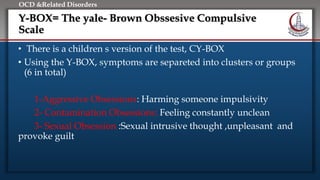
1-Aggressive Obsessions: Harming someone impulsivity
2- Contamination Obsessions: Feeling constantly unclean
3- Sexual Obsession :Sexual intrusive thought ,unpleasant and
provoke guilt
Click to edit Master title style
• Edit Master text styles
• Second level
• Third level
• Fourth level
• Fifth level
OCD &Related Disorders
Y-BOX= The yale- Brown Obssesive Compulsive
Scale ( cont)
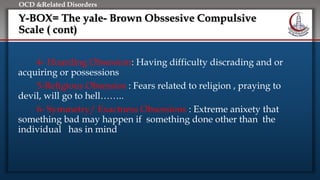
4- Hoarding Obsession: Having difficulty discrading and or
acquiring or possessions
5-Religious Obsessios : Fears related to religion , praying to
devil, will go to hell……..
6- Symmetry/ Exactness Obsessions : Extreme anixety that
something bad may happen if something done other than the
individual has in mind
Click to edit Master title style
• Edit Master text styles
• Second level
• Third level
• Fourth level
• Fifth level
OCD &Related Disorders
Roadmap
• 1-Characteristics of OCD and Related Disorders by ICD11
• 2- Risk factors for OCD and Related Disorders
• 3 – Critera for OCD Related Disorders
• 4-Measuring OCD
• 5- Cognitive theory of OCD
• 6- Management of OCD and Related Disorders
Click to edit Master title style
• Edit Master text styles
• Second level
• Third level
• Fourth level
• Fifth level
OCD &Related Disorders
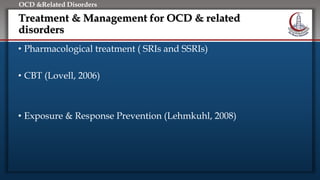
Treatment & Management for OCD & related
disorders
• Pharmacological treatment ( SRIs and SSRIs)
• CBT (Lovell, 2006)
• Exposure & Response Prevention (Lehmkuhl, 2008)
Click to edit Master title style
• Edit Master text styles
• Second level
• Third level
• Fourth level
• Fifth level
OCD &Related Disorders
Treatment & Management for OCD
Pharmacological Treatments : Tips
• Basis of low levels of serotonin lead to OCD
• Clomipramine has been shown to be effective in roughly 60% of
patients with OCD
• SSRIs lessen the anxiety associated with obsessive thoughts
• Used to treat OCD with or without depression, but usually in higher
doses
• Soomro et al (2008) meta-analysis of 17 studies on SSRIs Looked at SSRI
effectiveness vs placebo from 3,097 Ps Found that after 6-13 weeks of
usage, that Ps’ Y-BOCS score was reduced
Click to edit Master title style
• Edit Master text styles
• Second level
• Third level
• Fourth level
• Fifth level
OCD &Related Disorders
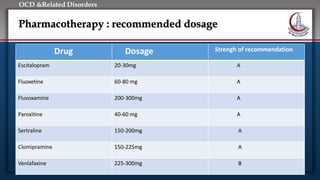
Pharmacotherapy : recommended dosage
Drug Dosage Strengh of recommendation
Escitalopram 20-30mg A
Fluoxetine 60-80 mg A
Fluvoxamine 200-300mg A
Paroxitine 40-60 mg A
Sertraline 150-200mg A
Clomipramine 150-225mg A
Venlafaxine 225-300mg B
Click to edit Master title style
• Edit Master text styles
• Second level
• Third level
• Fourth level
• Fifth level
OCD &Related Disorders
Medical Treatments : Adjuvant treatment
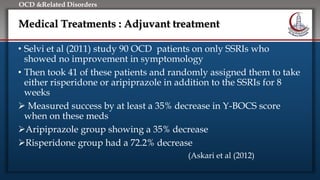
• Selvi et al (2011) study 90 OCD patients on only SSRIs who
showed no improvement in symptomology
• Then took 41 of these patients and randomly assigned them to take
either risperidone or aripiprazole in addition to the SSRIs for 8
weeks
 Measured success by at least a 35% decrease in Y-BOCS score
when on these meds
Aripiprazole group showing a 35% decrease
Risperidone group had a 72.2% decrease
(Askari et al (2012)
Click to edit Master title style
• Edit Master text styles
• Second level
• Third level
• Fourth level
• Fifth level
OCD &Related Disorders
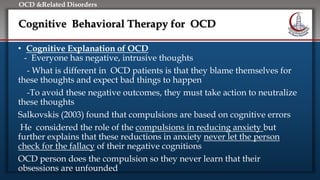
Cognitive Behavioral Therapy for OCD
• Cognitive Explanation of OCD
- Everyone has negative, intrusive thoughts
- What is different in OCD patients is that they blame themselves for
these thoughts and expect bad things to happen
-To avoid these negative outcomes, they must take action to neutralize
these thoughts
Salkovskis (2003) found that compulsions are based on cognitive errors
He considered the role of the compulsions in reducing anxiety but
further explains that these reductions in anxiety never let the person
check for the fallacy of their negative cognitions
OCD person does the compulsion so they never learn that their
obsessions are unfounded
Click to edit Master title style
• Edit Master text styles
• Second level
• Third level
• Fourth level
• Fifth level
OCD &Related Disorders
Cognitive Behavioral Therapy for OCD
-Help to identify faulty thinking patterns involved in obsessions and
compulsions
• 1. Focus on how patients interpret their obsession including
-why they have it
- what will happen if they don’t find some way to relieve it.
• 2. Ask the person to challenge the thoughts.
For example, not washing your hands after picking up trash doesn’t
lead to you getting sick
Click to edit Master title style
• Edit Master text styles
• Second level
• Third level
• Fourth level
• Fifth level
OCD &Related Disorders
Cognitive Behavioral Therapy of OCD
• 3. Patients fill out ‘thought record’
• Where was I/
• what was I doing when the obsession began?
• What intrusive thought or ideas did I have?
• What meaning did I apply to the obsession?
• What did I do about the obsession?
Click to edit Master title style
• Edit Master text styles
• Second level
• Third level
• Fourth level
• Fifth level
OCD &Related Disorders
Cognitive Behavioral Therapy for OCD
Example of a ‘thought record’ situation
• Sitting at home watching television.
• Intrusive Thought: "God doesn't care.”
• Appraisal of Intrusive Thought:
1. “I am a bad person for thinking blasphemous thoughts”
2. “God will punish my family and me”
3. “I must be losing my mind if I can't stop these thoughts from
happening”
Ritual: Engage in prayer
Engage in behaviors of atonement
Click to edit Master title style
• Edit Master text styles
• Second level
• Third level
• Fourth level
• Fifth level
OCD &Related Disorders
Cognitive Behavioral Therapy of OCD
4. learn to identify their intrusive thoughts and the meanings they
apply to them
5.Examine the evidence that supports and does not support the
obsession.
6. Identify cognitive distortions in the appraisals of the obsession.
7. Begin to develop a less threatening and alternative response to the
intrusive thought/image/idea.
Click to edit Master title style
• Edit Master text styles
• Second level
• Third level
• Fourth level
• Fifth level
OCD &Related Disorders
Cognitive Behavioral Therapy for OCD : Difficulties
• 25% of people refuse to engage in CBT
• CBT alone is ineffective when there is
 Severe comorbid major depression
 Over valued ideation
 Tic disorder
 Schizoid personality disorder
• There is limited availability of therapists trained in CBT for OCD
Click to edit Master title style
• Edit Master text styles
• Second level
• Third level
• Fourth level
• Fifth level
OCD &Related Disorders
Treatment of OCD: Exposure and Response
prevention
• Exposure- facing the feared stimuli repeatedly until the
anxiousness/fear subsides
• Response Prevention- making a choice not to carry out the
compulsive behavior
• Works on the behavioral concept of habituation
• Twohig (2016)- meta-analysis noted that ERP is one of the most
efficacious treatments for OCD
Click to edit Master title style
• Edit Master text styles
• Second level
• Third level
• Fourth level
• Fifth level
OCD &Related Disorders
Treatment of OCD: Exposure and Response
prevention
To ‘recondition’ obsessions and compulsions by facing them head-
on
- the patient is exposed directly to his anxiety-causing stimulus
(for example, you must pickup trash without washing your hands)
- Begins with creating a hierarchy (from seeing to picking up the
trash)
-Therapy starts with the most mild item in the hierarchy and
them moves to more difficult items
- Once you are exposed and prevented from responding,
- Patients will become habituated to the anxiety and it will then
diminish
Click to edit Master title style
• Edit Master text styles
• Second level
• Third level
• Fourth level
• Fifth level
OCD &Related Disorders
Habit Reversal Training for Trichotillomania
• Medical treatments are helpful but rarely 100% effective
• Habit Reversal Training (HRT) is a behavioral protocol created in
1973 to treat tics and nervous habits
• In 1980, studies showed that HRT has a 90% symptom reduction
rate
• - Depend on : draw the patient’s attention to their own behavior.
Most TTMs are distracted (eg. by television or in ‘trance’), and do
not notice the hair-pulling until it is over
Click to edit Master title style
• Edit Master text styles
• Second level
• Third level
• Fourth level
• Fifth level
OCD &related disorders
Habit Reversal Training for Trichotillomania
Three stages :
• Functional analysis for TTM
• HRT Self-Monitoring
• Synthesizing HRT
Click to edit Master title style
• Edit Master text styles
• Second level
• Third level
• Fourth level
• Fifth level
OCD &Related Disorders
1- Habit Reversal Training :Functional analysis
• This requires different phases to help maintain the behavior
1. Psychoeducate about the disorder
2. Identify the impulses
--Finding the times and places that urges occur (e.g. observing
self in the mirror)
3. Select strategies
--Gloves and ice have been helpful in treating those with TTM
--Throw away tweezers
4. Maintenance
--Client and therapist work on a plan together to manage hair
pulling
--Client should be able to define relapse and lapse
Click to edit Master title style
• Edit Master text styles
• Second level
• Third level
• Fourth level
• Fifth level
OCD &Related Disorders
2-Habit Reversal Training : Self-Monitoring:
• Self-monitoring sheets: Fill these out between weekly sessions. Track the
following information about the hair-pulling episode:
• When it occurred
• How long it lasted
• How many hairs were pulled (most important to monitor)
• How strong the urge was
• Where it occurred
• What they were doing at the time
• Emotional state at the time
Monitoring these episodes allows experts to learn when to anticipate the
next time an individual will experience an episode of hair pulling .
Click to edit Master title style
• Edit Master text styles
• Second level
• Third level
• Fourth level
• Fifth level
OCD &Related Disorders
3- Habit Reversal Training :Synthesizing HRT
• Use relaxation techniques to complete habit reversal response.
• Patients are instructed that they get the urge to pull should :
1. Relax themselves, and simultaneously
2. Breathe from the diaphragm for 60 seconds, and when this is
done
3. Clench their fist and press their arm to their side for 60 seconds
Click to edit Master title style
• Edit Master text styles
• Second level
• Third level
• Fourth level
• Fifth level
Thank you

OCD or related disorders 2022.pptx

  • 1.
    Click to editMaster title style • Edit Master text styles • Second level • Third level • Fourth level • Fifth level Obsessive Compulsive disorders & Related Disorders By Heba Essawy MD., CEDS., Prof of Psychiatry International Chapter chair –Egypt Iaedps Head of Eating Disorders Clinics Ohasha Institute - Medical school Ain Shams University Cairo- Egypt
  • 2.
    Click to editMaster title style • Edit Master text styles • Second level • Third level • Fourth level • Fifth level OCD &Related Disorders Roadmap • 1-Characteristics of OCD and Related Disorders by ICD11 • 2- Risk factors for OCD and Related Disorders • 3 – Diagnostic Criteria for OCD Related disorders ( DSM-% & ICD11) • 4- Epidemiology of OCD and related disorders • 5-Measuring OCD • 6- Cognitive theory of OCD • 7- Management of OCD and Related Disorders
  • 3.
    Click to editMaster title style • Edit Master text styles • Second level • Third level • Fourth level • Fifth level OCD &Related Disorders Roadmap • 1-Characteristics of OCD and Related Disorders by ICD11 • 2- Risk factors for OCD and Related D isorders • 3-Measuring OCD • 4- Cognitive theory of OCD • 5- Management of OCD and Related Disorders
  • 4.
    Click to editMaster title style • Edit Master text styles • Second level • Third level • Fourth level • Fifth level OCD &Related Disorders OCD and Related Disorders : ICD 11  Obsessions is an intrusive thoughts and preoccupations accompanied by related repetitive behavior are the central for OCD, BDD, hypochondriasis, and olfactory reference disorder Hoarding Disorder is not associated with intrusive thoughts but characterized by a compulsive need to accumulate possessions and distress related to discarding them.  Body-focused repetitive behavior disorder , characterized by recurrent and habitual actions directed at the integument (e.g., hair-pulling, skin-picking) and lack a prominent cognitive aspect.
  • 5.
    Click to editMaster title style • Edit Master text styles • Second level • Third level • Fourth level • Fifth level OCD &Related Disorders Characteristics of obsession • Obsession : recuring and persistent thought that interferes with normal behavior Examples : • Fear of contamination • Fear of harm coming to self or loved ones as a result of one s own actions • Religious obsession • Sexual obsessions
  • 6.
    Click to editMaster title style • Edit Master text styles • Second level • Third level • Fourth level • Fifth level OCD &Related Disorders Characteristics of Compulsion • Compulsion : Recuring action a person is forced to act - washing - Checking - Doubting –an action - Touching repeatedly - Ordering and Organizing - Repeating words ( may be simultaneous with touching /tapping) • Obsession may lead to compulsion • The individual will do the compulsive act to reduce the anxiety
  • 7.
    Click to editMaster title style • Edit Master text styles • Second level • Third level • Fourth level • Fifth level OCD &Related Disorders Roadmap • 2- Risk factors for OCD and Related Disorders • 3-Measuring OCD • 4- Cognitive theory of OCD • 5- Management of OCD and Related Disorders
  • 8.
    Click to editMaster title style • Edit Master text styles • Second level • Third level • Fourth level • Fifth level OCD &Related Disorders Risk Factors of OCD & Related Disorders • Temperamental: - Greater internalizing symptoms - Higher negative emotionality - Behavioral inhibition in childhood • Environmental.: - Physical and sexual abuse in childhood - Stressful and traumatic events in childhood . - Infectious agents and a post-infectious autoimmune syndrome.
  • 9.
    Click to editMaster title style • Edit Master text styles • Second level • Third level • Fourth level • Fifth level OCD &Related Disorders Risk Factors of OCD & Related Disorders Genetic and physiological - The rate of OCO among first-degree relatives of adults with OCD is approximately two times that among first-degree relatives of those without the disorder - Among first-degree relatives of individuals with onset of OCD in childhood or adolescence, the rate is increased I0-fold. - Familial transmission is due in part to genetic factors , concordance rate of 0.57 for monozygotic vs. 0.22 for dizygotic twins). - Dysfunction in the orbitofrontal cortex, anterior cingulate cortex, and striatum have been most strongly implicated.
  • 10.
    Click to editMaster title style • Edit Master text styles • Second level • Third level • Fourth level • Fifth level OCD &Related Disorders Risk Factors of OCD & Related Disorders • Culture-Related Diagnostic Issues - There is similarity across cultures in  Gender distribution,  Age at onset  Comorbidity of OCD.  Similar symptom structure involving cleaning, symmetry, hoarding, taboo thoughts, or fear of harm. However, regional variation in symptom expression exists, and cultural factors may shape the content of obsessions and compulsions.
  • 11.
    Click to editMaster title style • Edit Master text styles • Second level • Third level • Fourth level • Fifth level OCD &Related Disorders Risk Factors of OCD & Related Disorders • Gender-Related symptoms *Males have an earlier age at onset of OCD than females *Symptom dimensions have been reported : -females more likely to have symptoms in the cleaning dimension - males more likely to have symptoms in the forbidden thoughts and symmetry dimensions.
  • 12.
    Click to editMaster title style • Edit Master text styles • Second level • Third level • Fourth level • Fifth level OCD &Related Disorders Risk Factors of OCD & Related Disorders • Suicide Risk - Suicidal thoughts occur at some point in as many as about half of individuals with OCD. • Suicide attempts are also reported in up to one-quarter of individuals with OCD • the presence of comorbid major depressive disorder increases the risk
  • 13.
    Click to editMaster title style • Edit Master text styles • Second level • Third level • Fourth level • Fifth level OCD &Related Disorders Roadmap • 1-Characteristics of OCD and Related Disorders by ICD11 • 2- Risk factors for OCD and Related Disorders • 3 – Diagnostic Criteria for OCD Related disorders ( DSM-% & ICD11) • 4-Measuring OCD • 5- Cognitive theory of OCD • 6- Management of OCD and Related Disorders
  • 14.
    Click to editMaster title style • Edit Master text styles • Second level • Third level • Fourth level • Fifth level OCD &Related Disorders OCD and Related Disorders ICD11 • Body Dysmorphic Disorder • Hoarding • Olfactory reference disorder • Hypochondriasis • Body-focused repetitive behavior disorders - Trichotillomania - Excoriation disorder
  • 15.
    Click to editMaster title style • Edit Master text styles • Second level • Third level • Fourth level • Fifth level OCD &Related Disorders OCD and Realted disorders :DSM-5 • Obsessive Compulsive Disorder (OCD) • Body Dysmorphic Disorder (BDD) • Hoarding Disorder • Trichotillomania • Excoriation (Skin Picking) Disorder • Substance/Medication-induced Obsessive-Compulsive and related Disorder • Obsessive-Compulsive and Related Disorder due to another medical condition • Other specified Obsessive-Compulsive and Related Disorder • Unspecified Obsessive-Compulsive and Related Disorder
  • 16.
    Click to editMaster title style • Edit Master text styles • Second level • Third level • Fourth level • Fifth level OCD &Related Disorders Body Dysmorphic Disorder ICD11 • Characterized by • Persistent preoccupation with one or more perceived defects or flaws in appearance that are either unnoticeable or only slightly noticeable to others. • Individuals experience excessive self-consciousness • Often with ideas of reference • Engage in repeated examination of the appearance of the perceived defect or flaw • Excessive attempts to camouflage or alter the perceived defect As , the conviction that people are taking notice, judging, or talking about the perceived defect or flaw.
  • 17.
    Click to editMaster title style • Edit Master text styles • Second level • Third level • Fourth level • Fifth level OCD &Related Disorders Body Dysmorphic Disorder : ICD 11 • Body dysmorphic disorder with fair to good insight -Disorder-specific beliefs may not be true and is willing to accept an alternative explanation for his or her experience. • Body dysmorphic disorder with poor to absent insight - Disorder-specific beliefs are true and cannot accept an alternative explanation for their experience. • Body dysmorphic disorder Unsprcified
  • 18.
    Click to editMaster title style • Edit Master text styles • Second level • Third level • Fourth level • Fifth level OCD &Related Disorders Body Dysmorphic Disorder ICD11 Most popular areas of focus - skin (73%), hair (56%), nose (37%) - Other common areas of focus- eyes, feet, hands, ears, chest, stomach • Common physical characteristics :Mirror gazing (constantly checking your appearance) or mirror avoiding • Camouflaging the area of focus with makeup, posturing, clothing, • Comparing one’s area of focus with another person’s (such as eyes) • Excessive grooming (washing hair, brushing teeth, makeup) • Plastic surgery
  • 19.
    Click to editMaster title style • Edit Master text styles • Second level • Third level • Fourth level • Fifth level OCD &Related Disorders Difference between BDD and Aneroxia Nervosa BDD AN Age of Onset occurs in late adolescence, can occur in older people who are too concerned about the aging process. Affects girls in childhood and puberty and young women. Occurrence It affects men and women relatively equally. Less than 5% of the patients are male. Symptoms increased concern about a defect in appearance, problems with social skills and professional development. significant weight loss, BMI below 17.5, adolescent developmental disorders, constipation, cachexia, dry skin, Treatment treated with medications and with psychotherapy. includes rehabilitation and Nutritional therapy, psychotherapy, work with the family to build an appropriate and supportive environment for the patient.
  • 20.
    Click to editMaster title style • Edit Master text styles • Second level • Third level • Fourth level • Fifth level OCD &Related Disorders Hoarding : Characteristics • Inability to throw away possessions and severe anxiety when someone else attempts to do so • Items may include clothes, newspapers, magazines, toys, bags, boxes, food, & animals (dead or alive) • Great difficulty categorizing or organizing possessions • Thoughts and actions: fear of running out of an item or of needing it in the future; checking the trash for accidentally discarded objects
  • 21.
    Click to editMaster title style • Edit Master text styles • Second level • Third level • Fourth level • Fifth level OCD &Related Disorders Hoarding : Explanation • May be present on its own or with other disorders OCD, ADHD, depression • They believe that an item will be useful or valuable in the future • Compulsive act : Compulsive buying (such as never passing up a bargain)  Compulsive acquisition of free items (such as collecting flyers)  Compulsive search for perfect/unique items (which may not appear to others as unique) • They may also consider an item a reminder and memory, thinking that without it they won’t remember an important person or event
  • 22.
    Click to editMaster title style • Edit Master text styles • Second level • Third level • Fourth level • Fifth level OCD &Related Disorders Hoarding : Functional impairments • Lack of functional living space • Living in unhealthy/dangerous conditions • Living with broken appliances • Unlivable conditions may lead to separation or divorce and even loss of child custody • Displays of anger and depression among family members • Social isolation • Financial difficulties • Health hazards
  • 23.
    Click to editMaster title style • Edit Master text styles • Second level • Third level • Fourth level • Fifth level OCD &Related Disorders Olfactory reference disorder ICD11 Characterized by • Persistent preoccupation that one is emitting a perceived foul or offensive body odour or breath that is either unnoticeable or only slightly noticeable to others. • Individuals experience excessive self-consciousness about the perceived odour • Often with ideas of reference (i.e., the conviction that people are taking notice, judging, or talking about the odour).
  • 24.
    Click to editMaster title style • Edit Master text styles • Second level • Third level • Fourth level • Fifth level OCD &Related Disorders Olfactory reference Disorder ICD11 • In response to their preoccupation, individuals engage in - Repetitive behaviors such as repeatedly  Checking for body odour  Repeatedly seeking reassurance  Excessive attempts to camouflage and prevent the perceived odour  Avoidance of social situations that increase distress about the offensive odour. ** The symptoms are sufficiently severe to result in significant distress or significant impairment in personal, family, social, educational, occupational or other important areas of functioning.
  • 25.
    Click to editMaster title style • Edit Master text styles • Second level • Third level • Fourth level • Fifth level OCD &Related Disorders Olfactory reference Disorder ICD11 • Olfactory reference disorder with fair to good insight -Disorder-specific beliefs may not be true and is willing to accept an alternative explanation for his or her experience. - At circumscribed times (e.g., when highly anxious), the individual may demonstrate no insight. • Olfactory reference disorder with poor to absent insight - Disorder-specific beliefs are true and cannot accept an alternative explanation - The lack of insight exhibited by the individual does not vary markedly as a function of anxiety level. • Olfactory reference disorder, unspecified
  • 26.
    Click to editMaster title style • Edit Master text styles • Second level • Third level • Fourth level • Fifth level OCD &Related Disorders Hypochondriasis ICD11 : Characteristics  Persistent preoccupation with or fear about the possibility of having one or more serious, progressive or life-threatening diseases.  The preoccupation is associated with catastrophic misinterpretation of bodily signs or symptoms Manifested by - repetitive and excessive health-related behaviors - maladaptive avoidance behaviors related to health.  The symptoms result in significant distress or significant impairment in personal, family, social, educational, occupational or other important areas of functioning.
  • 27.
    Click to editMaster title style • Edit Master text styles • Second level • Third level • Fourth level • Fifth level OCD &Related Disorders Hypochondriasis ICD11 Exclusions: • Hypochondriacal neurosis • Nosophobia • Illness anxiety disorder • Body dysmorphic disorder • Fear of cancer
  • 28.
    Click to editMaster title style • Edit Master text styles • Second level • Third level • Fourth level • Fifth level OCD &Related Disorders Hypochondriasis ICD11 • Hypochondriasis with fair to good insight The individual is able to entertain the possibility that his or her disorder-specific beliefs may not be true and is willing to accept an alternative explanation for his or her experience. • Hypochondriasis with poor to absent insight • Hypochondriasis unspecified
  • 29.
    Click to editMaster title style • Edit Master text styles • Second level • Third level • Fourth level • Fifth level OCD &Related Disorders Body-focused repetitive behavior disorders ICD11 Characterized by  Recurrent and habitual actions directed at the integument (e.g. hair-pulling, skin-picking, lip-biting)  Accompanied by unsuccessful attempts to decrease or stop the behavior involved  lead to dermatological sequelae (e.g., hair loss, skin lesions, lip abrasions). • Trichotillomania • Excoriation disorder
  • 30.
    Click to editMaster title style • Edit Master text styles • Second level • Third level • Fourth level • Fifth level OCD &Related Disorders Trichotillomania ICD11 Characterized by • Recurrent pulling of one’s own hair leading to significant hair loss • With unsuccessful attempts to decrease or stop the behavior. • Hair pulling may occur from any region of the body in which hair grows • Most common sites are the scalp, eyebrows, and eyelids. • Occur in brief episodes scattered throughout the day . • The symptoms result in significant distress or significant impairment in personal, family, social, educational, occupational or other important areas of functioning.
  • 31.
    Click to editMaster title style • Edit Master text styles • Second level • Third level • Fourth level • Fifth level OCD &Related Disorders Trichotillomania This Photo by Unknown Author is licensed under CC BY-NC-ND This Photo by Unknown Author is licensed under CC BY-NC-ND
  • 32.
    Click to editMaster title style • Edit Master text styles • Second level • Third level • Fourth level • Fifth level OCD &Related Disorders Excoriation disorder ICD11 Characterized by: • Recurrent picking of one’s own skin leading to skin lesions • Accompanied by unsuccessful attempts to decrease or stop the behavior. • The most commonly picked sites are the face, arms and hands, but many individuals pick from multiple body sites. • Skin picking may occur in brief episodes scattered throughout the day or in less frequent but more sustained periods.
  • 33.
    Click to editMaster title style • Edit Master text styles • Second level • Third level • Fourth level • Fifth level OCD &Related Disorders Excoriation disorder This Photo by Unknown Author is licensed under CC BY-SA
  • 34.
    Click to editMaster title style • Edit Master text styles • Second level • Third level • Fourth level • Fifth level OCD &Related Disorders Roadmap • 1-Characteristics of OCD and Related Disorders by ICD11 • 2- Risk factors for OCD and Related Disorders • 3 – Diagnostic Criteria for OCD Related disorders ( DSM-% & ICD11) • 4- Epidemiology of OCD and related disorders • 5-Measuring OCD • 6- Cognitive theory of OCD • 7- Management of OCD and Related Disorders
  • 35.
    Click to editMaster title style • Edit Master text styles • Second level • Third level • Fourth level • Fifth level OCD &Related Disorders Epidemiology of OCD &Related disorders • OCD - 12-month prevelance is 1.2%: Lifetime prevelence is 1%. (Ruscio et.,al.,2010) • Body dysmorphic disorders - Point prevelance of BDD is 2.4%(Koran et.,al., 2008) • Hoarding Disorder - Community prevalence is 5.3%(Samuels et., al., 2008)
  • 36.
    Click to editMaster title style • Edit Master text styles • Second level • Third level • Fourth level • Fifth level OCD &Related Disorders Epidemiology of OCD &Related disorders • Excoriation (skin-picking ) Disorder - Community sample 1.4% to 5.4% (Hayes et al., 2009) - 4.2% college students using DSM-5 criteria (Odlaug et al.,2013) • Trichotillomania - Community sample 0.6%to 1.2% (Duke et.,al,.2009) - Psychiatric setting 3.4% and 4.4%, point and lifetime prevelance
  • 37.
    Click to editMaster title style • Edit Master text styles • Second level • Third level • Fourth level • Fifth level OCD &Related Disorders Roadmap • 1-Characteristics of OCD and Related Disorders by ICD11 • 2- Risk factors for OCD and Related Disorders • 3 – Critera for OCD Related Disorders • 4-Measuring OCD • 5- Cognitive theory of OCD • 6- Management of OCD and Related Disorders
  • 38.
    Click to editMaster title style • Edit Master text styles • Second level • Third level • Fourth level • Fifth level OCD &Related Disorders Measuring OCD : Y-BOX= The yale- Brown Obssesive Compulsive Scale • - One of the most reliable and valid screening instruments for OCD - 10 items on a 4 point scale - 0- 7= Subclinical 32-40=extreme - Two parts :1- Symptom checklist 2- semi-structured interview -Part 1: 67 symptom, can be either current , past or absent . This assists the diagnosis with finding clusters of symptoms, and treating the patient - Part 2 : 19 items patient completes about self Part 1 and 2 scores are transferred to a grid , the individual is given an obsession score out of 20 and the commpulsion score out of 20 . 9 other items are recorded on a 1-4 Likert scale
  • 39.
    Click to editMaster title style • Edit Master text styles • Second level • Third level • Fourth level • Fifth level OCD &Related Disorders Y-BOX= The yale- Brown Obssesive Compulsive Scale • There is a children s version of the test, CY-BOX • Using the Y-BOX, symptoms are separeted into clusters or groups (6 in total) 1-Aggressive Obsessions: Harming someone impulsivity 2- Contamination Obsessions: Feeling constantly unclean 3- Sexual Obsession :Sexual intrusive thought ,unpleasant and provoke guilt
  • 40.
    Click to editMaster title style • Edit Master text styles • Second level • Third level • Fourth level • Fifth level OCD &Related Disorders Y-BOX= The yale- Brown Obssesive Compulsive Scale ( cont) 4- Hoarding Obsession: Having difficulty discrading and or acquiring or possessions 5-Religious Obsessios : Fears related to religion , praying to devil, will go to hell…….. 6- Symmetry/ Exactness Obsessions : Extreme anixety that something bad may happen if something done other than the individual has in mind
  • 41.
    Click to editMaster title style • Edit Master text styles • Second level • Third level • Fourth level • Fifth level OCD &Related Disorders Roadmap • 1-Characteristics of OCD and Related Disorders by ICD11 • 2- Risk factors for OCD and Related Disorders • 3 – Critera for OCD Related Disorders • 4-Measuring OCD • 5- Cognitive theory of OCD • 6- Management of OCD and Related Disorders
  • 42.
    Click to editMaster title style • Edit Master text styles • Second level • Third level • Fourth level • Fifth level OCD &Related Disorders Treatment & Management for OCD & related disorders • Pharmacological treatment ( SRIs and SSRIs) • CBT (Lovell, 2006) • Exposure & Response Prevention (Lehmkuhl, 2008)
  • 43.
    Click to editMaster title style • Edit Master text styles • Second level • Third level • Fourth level • Fifth level OCD &Related Disorders Treatment & Management for OCD Pharmacological Treatments : Tips • Basis of low levels of serotonin lead to OCD • Clomipramine has been shown to be effective in roughly 60% of patients with OCD • SSRIs lessen the anxiety associated with obsessive thoughts • Used to treat OCD with or without depression, but usually in higher doses • Soomro et al (2008) meta-analysis of 17 studies on SSRIs Looked at SSRI effectiveness vs placebo from 3,097 Ps Found that after 6-13 weeks of usage, that Ps’ Y-BOCS score was reduced
  • 44.
    Click to editMaster title style • Edit Master text styles • Second level • Third level • Fourth level • Fifth level OCD &Related Disorders Pharmacotherapy : recommended dosage Drug Dosage Strengh of recommendation Escitalopram 20-30mg A Fluoxetine 60-80 mg A Fluvoxamine 200-300mg A Paroxitine 40-60 mg A Sertraline 150-200mg A Clomipramine 150-225mg A Venlafaxine 225-300mg B
  • 45.
    Click to editMaster title style • Edit Master text styles • Second level • Third level • Fourth level • Fifth level OCD &Related Disorders Medical Treatments : Adjuvant treatment • Selvi et al (2011) study 90 OCD patients on only SSRIs who showed no improvement in symptomology • Then took 41 of these patients and randomly assigned them to take either risperidone or aripiprazole in addition to the SSRIs for 8 weeks  Measured success by at least a 35% decrease in Y-BOCS score when on these meds Aripiprazole group showing a 35% decrease Risperidone group had a 72.2% decrease (Askari et al (2012)
  • 46.
    Click to editMaster title style • Edit Master text styles • Second level • Third level • Fourth level • Fifth level OCD &Related Disorders Cognitive Behavioral Therapy for OCD • Cognitive Explanation of OCD - Everyone has negative, intrusive thoughts - What is different in OCD patients is that they blame themselves for these thoughts and expect bad things to happen -To avoid these negative outcomes, they must take action to neutralize these thoughts Salkovskis (2003) found that compulsions are based on cognitive errors He considered the role of the compulsions in reducing anxiety but further explains that these reductions in anxiety never let the person check for the fallacy of their negative cognitions OCD person does the compulsion so they never learn that their obsessions are unfounded
  • 47.
    Click to editMaster title style • Edit Master text styles • Second level • Third level • Fourth level • Fifth level OCD &Related Disorders Cognitive Behavioral Therapy for OCD -Help to identify faulty thinking patterns involved in obsessions and compulsions • 1. Focus on how patients interpret their obsession including -why they have it - what will happen if they don’t find some way to relieve it. • 2. Ask the person to challenge the thoughts. For example, not washing your hands after picking up trash doesn’t lead to you getting sick
  • 48.
    Click to editMaster title style • Edit Master text styles • Second level • Third level • Fourth level • Fifth level OCD &Related Disorders Cognitive Behavioral Therapy of OCD • 3. Patients fill out ‘thought record’ • Where was I/ • what was I doing when the obsession began? • What intrusive thought or ideas did I have? • What meaning did I apply to the obsession? • What did I do about the obsession?
  • 49.
    Click to editMaster title style • Edit Master text styles • Second level • Third level • Fourth level • Fifth level OCD &Related Disorders Cognitive Behavioral Therapy for OCD Example of a ‘thought record’ situation • Sitting at home watching television. • Intrusive Thought: "God doesn't care.” • Appraisal of Intrusive Thought: 1. “I am a bad person for thinking blasphemous thoughts” 2. “God will punish my family and me” 3. “I must be losing my mind if I can't stop these thoughts from happening” Ritual: Engage in prayer Engage in behaviors of atonement
  • 50.
    Click to editMaster title style • Edit Master text styles • Second level • Third level • Fourth level • Fifth level OCD &Related Disorders Cognitive Behavioral Therapy of OCD 4. learn to identify their intrusive thoughts and the meanings they apply to them 5.Examine the evidence that supports and does not support the obsession. 6. Identify cognitive distortions in the appraisals of the obsession. 7. Begin to develop a less threatening and alternative response to the intrusive thought/image/idea.
  • 51.
    Click to editMaster title style • Edit Master text styles • Second level • Third level • Fourth level • Fifth level OCD &Related Disorders Cognitive Behavioral Therapy for OCD : Difficulties • 25% of people refuse to engage in CBT • CBT alone is ineffective when there is  Severe comorbid major depression  Over valued ideation  Tic disorder  Schizoid personality disorder • There is limited availability of therapists trained in CBT for OCD
  • 52.
    Click to editMaster title style • Edit Master text styles • Second level • Third level • Fourth level • Fifth level OCD &Related Disorders Treatment of OCD: Exposure and Response prevention • Exposure- facing the feared stimuli repeatedly until the anxiousness/fear subsides • Response Prevention- making a choice not to carry out the compulsive behavior • Works on the behavioral concept of habituation • Twohig (2016)- meta-analysis noted that ERP is one of the most efficacious treatments for OCD
  • 53.
    Click to editMaster title style • Edit Master text styles • Second level • Third level • Fourth level • Fifth level OCD &Related Disorders Treatment of OCD: Exposure and Response prevention To ‘recondition’ obsessions and compulsions by facing them head- on - the patient is exposed directly to his anxiety-causing stimulus (for example, you must pickup trash without washing your hands) - Begins with creating a hierarchy (from seeing to picking up the trash) -Therapy starts with the most mild item in the hierarchy and them moves to more difficult items - Once you are exposed and prevented from responding, - Patients will become habituated to the anxiety and it will then diminish
  • 54.
    Click to editMaster title style • Edit Master text styles • Second level • Third level • Fourth level • Fifth level OCD &Related Disorders Habit Reversal Training for Trichotillomania • Medical treatments are helpful but rarely 100% effective • Habit Reversal Training (HRT) is a behavioral protocol created in 1973 to treat tics and nervous habits • In 1980, studies showed that HRT has a 90% symptom reduction rate • - Depend on : draw the patient’s attention to their own behavior. Most TTMs are distracted (eg. by television or in ‘trance’), and do not notice the hair-pulling until it is over
  • 55.
    Click to editMaster title style • Edit Master text styles • Second level • Third level • Fourth level • Fifth level OCD &related disorders Habit Reversal Training for Trichotillomania Three stages : • Functional analysis for TTM • HRT Self-Monitoring • Synthesizing HRT
  • 56.
    Click to editMaster title style • Edit Master text styles • Second level • Third level • Fourth level • Fifth level OCD &Related Disorders 1- Habit Reversal Training :Functional analysis • This requires different phases to help maintain the behavior 1. Psychoeducate about the disorder 2. Identify the impulses --Finding the times and places that urges occur (e.g. observing self in the mirror) 3. Select strategies --Gloves and ice have been helpful in treating those with TTM --Throw away tweezers 4. Maintenance --Client and therapist work on a plan together to manage hair pulling --Client should be able to define relapse and lapse
  • 57.
    Click to editMaster title style • Edit Master text styles • Second level • Third level • Fourth level • Fifth level OCD &Related Disorders 2-Habit Reversal Training : Self-Monitoring: • Self-monitoring sheets: Fill these out between weekly sessions. Track the following information about the hair-pulling episode: • When it occurred • How long it lasted • How many hairs were pulled (most important to monitor) • How strong the urge was • Where it occurred • What they were doing at the time • Emotional state at the time Monitoring these episodes allows experts to learn when to anticipate the next time an individual will experience an episode of hair pulling .
  • 58.
    Click to editMaster title style • Edit Master text styles • Second level • Third level • Fourth level • Fifth level OCD &Related Disorders 3- Habit Reversal Training :Synthesizing HRT • Use relaxation techniques to complete habit reversal response. • Patients are instructed that they get the urge to pull should : 1. Relax themselves, and simultaneously 2. Breathe from the diaphragm for 60 seconds, and when this is done 3. Clench their fist and press their arm to their side for 60 seconds
  • 59.
    Click to editMaster title style • Edit Master text styles • Second level • Third level • Fourth level • Fifth level Thank you

Editor's Notes

  • #26 Elise in 2021, research done over 177 AN pat, were asessed for MDD, Ocd, social phobia , anexiety dis