Obsessive compulsive
disorder
Vipul Sharma
M.Pharm (pharmacy practice)
Manipal college of pharmaceutical
sciences (MAHE), MANIPAL
DSM IV criteria
• To be diagnosed with OCD, a person must
have obsessions and/or compulsions,
according to the DSM-IV-TR diagnostic
criteria.
• Moreover, the obsessions or compulsions
must be time-consuming (taking up more
than one hour per day), cause distress, or
cause impairment in social, occupational,
or school functioning
Obsession
• An obsession is a recurrent, persistent
idea, thought, impulse, or image that is
experienced as intrusive and inappropriate
and produces marked anxiety or distress
• Common obsessions involve thoughts
about contamination (e.g., concern with
germs, dirt, or toxic chemicals), repeated
doubts, and needing to have things in a
particular order
Obsessions
• The thoughts, impulses, or images are not
simply excessive worries of real-life problems.
• The person attempts to ignore or suppress such
thoughts, impulses, or images, or to neutralize
them with some other thought or action.
• The person recognizes that the obsessional
thoughts, impulses, or images are a product of
his or her own mind, and are not based in
reality.
• Excessive or unreasonable worry about real life
situations
Compulsion
• A compulsion is defined as a repetitive
behavior or mental act generally
performed in response to an obsession.
• The most common compulsions involve
washing and cleaning, counting, checking,
and requesting or demanding assurances
Compulsions
• Repetitive behaviors or mental acts that the
person feels driven to perform in response to an
obsession, or according to rules that must be
applied rigidly.
• Behaviors or mental acts are not pleasurable -
aimed at preventing or reducing distress or
• preventing some dreaded event or situation;
• Not actually connected to the issue, or they are
excessive
• typical OCD sufferer performs tasks (or
compulsions) to seek relief from obsession-
related anxiety
• To others, these tasks may appear odd and
unnecessary.
• But for the sufferer, such tasks can feel critically
important, and must be performed in particular
ways to ward off dire consequences and to stop
the stress from building up.
Compulsive actions
• Repeatedly checking that one's parked car
has been locked before leaving it,
• Turning lights on and off a set number of
times before exiting a room,
• Repeatedly washing hands at regular
intervals throughout the day,
• Touching objects a certain number of
times before leaving a room,
• Walking in a certain routine way
• Repetitive activities (e.g., hand washing,
checking, ordering, need to ask, need to
confess)
• Repetitive mental acts (e.g., counting,
repeating words silently praying)
Prevalence
• prevalence between one and three
percent, although the prevalence of
clinically recognized OCD is much lower
• many individuals with the disorder may not
be diagnosed
• Patients may be secretive about
symptoms and purposefully refuse to
report or deny symptoms.
Screening questions
• Do you have repetitive thoughts that make
you anxious and that
• you cannot get rid of?
• Do you check things excessively?
• Do you feel the need to wash your hands
frequently?
• Do you keep things exceptionally clean?
Diagnosis
• The diagnostic criteria for OCD requires
the presence of either
• obsessions and/or compulsions (although
most patients have both)
• that are severe enough to cause marked
distress, to be time-consuming
• (occupy more than 1 hour per day), or
• to cause significant impairment in social
or occupational functioning
Diagnosis tools
• Rating scales may be used to measure
symptom severity, and a baseline
determination is indicated if these tools are
used
• The most widely used scale is the Yale-
Brown Obsessive Compulsive Scale
(YBOCS).
Other comorbid illness related to
OCD
• Patients often have comorbid depression,
anxiety disorders, and alcohol abuse or
dependence.
• Generalized anxiety disorder, Social anxiety
disorder,
• Anorexia nervosa, (decreased eating followed
by anxiety and even ISH)
• Bulimia nervosa (repeated eating within 2 hours
and anxiety and even ISH)
Other illness associated
• Tourette syndrome (Repeated body activities)
blinking head shoulder jerking Simple
vocalizations might include repetitive throat-
clearing, sniffing, or grunting sounds
• Asperger syndrome, (difficulty in understanding
body behaviour) Impaired social behaviour,
social impairment with extreme obtuseness,
limited interests and/or unusual preoccupations,
repetitive routines or rituals, speech and
language peculiarities, and non-verbal
communication problems
Contd…
• Compulsive skin picking,
• Body dysmorphic disorder, Being preoccupied
with minor or imaginary physical flaws, usually of
the skin, hair, and nose, such as acne, scarring,
facial lines, marks, pale skin, thinning hair,
excessive body hair, large nose, or crooked
nose, excessive checking in Mirror
• Having a lot of anxiety and stress about the
perceived flaw and spending a lot of time
focusing on it,
• Trichotillomania – pull out their own hair, Nail-
biting, skin-picking, and thumb-sucking
Obsessive-compulsive personality
disorder
• A pervasive pattern of preoccupation with
orderliness, perfectionism, and mental and
interpersonal control, at the expense of
flexibility, openness, and efficiency,
beginning by early adulthood and present
in a variety of contexts,
• Overconscious
• Miserly saving money
• stubern
Goal
• Reduction in the frequency of obsessive
thoughts
• Time spent performing compulsive acts
• Reduction in the degree of anxiety
• Provide optimal level of psychosocial
occupational functioning and an overall
improved QOL.
In adolescents and adults
• Cognitive Behavioral Therapy (CBT)
generally selected first for mild OCD,
• CBT + SSRI (e.g., fluoxetine, fluvoxamine,
sertraline, or paroxetine) are used for
more severe OCD
• In adults, CBT is the initial choice for mild
OCD, and CBT plus an SSRI or an SSRI
alone is selected for more severe OCD
Drugs approved by FDA
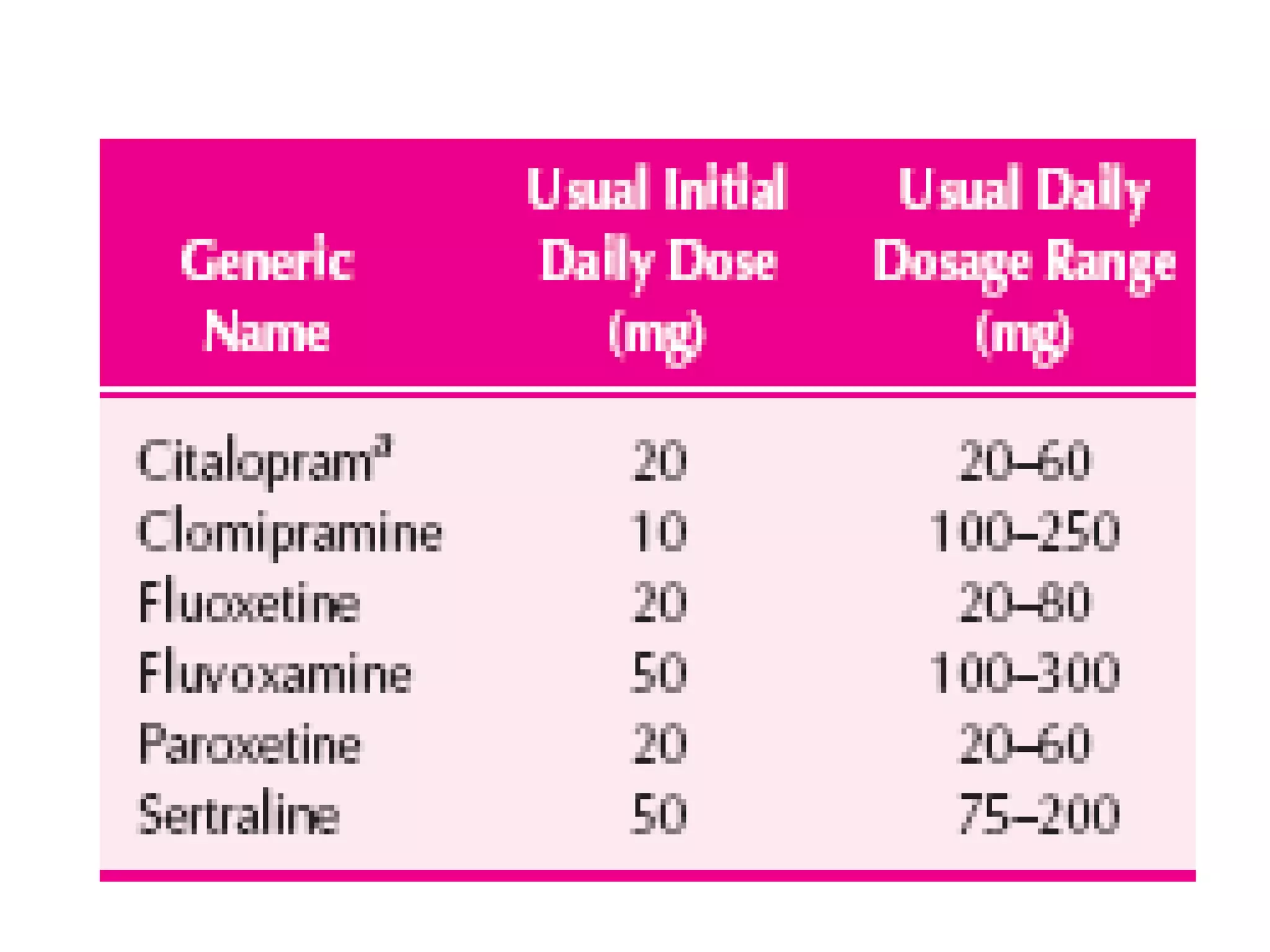
• Five antidepressants
• clomipramine,- TCA
• fluoxetine,- SSRI
• fluvoxamine,
• paroxetine,
• sertraline
Clinical trials on TCA and SSRI
• TCA like Clomipramine-
• SSRIs fluoxetine, fluvoxamine, paroxetine,
and sertraline.
• 65-75% response
• consistently demonstrated efficacy 25-
60% in controlled trials
• Obsessive-compulsive symptoms improve
over a 4- to 10-week treatment period
SSRIs
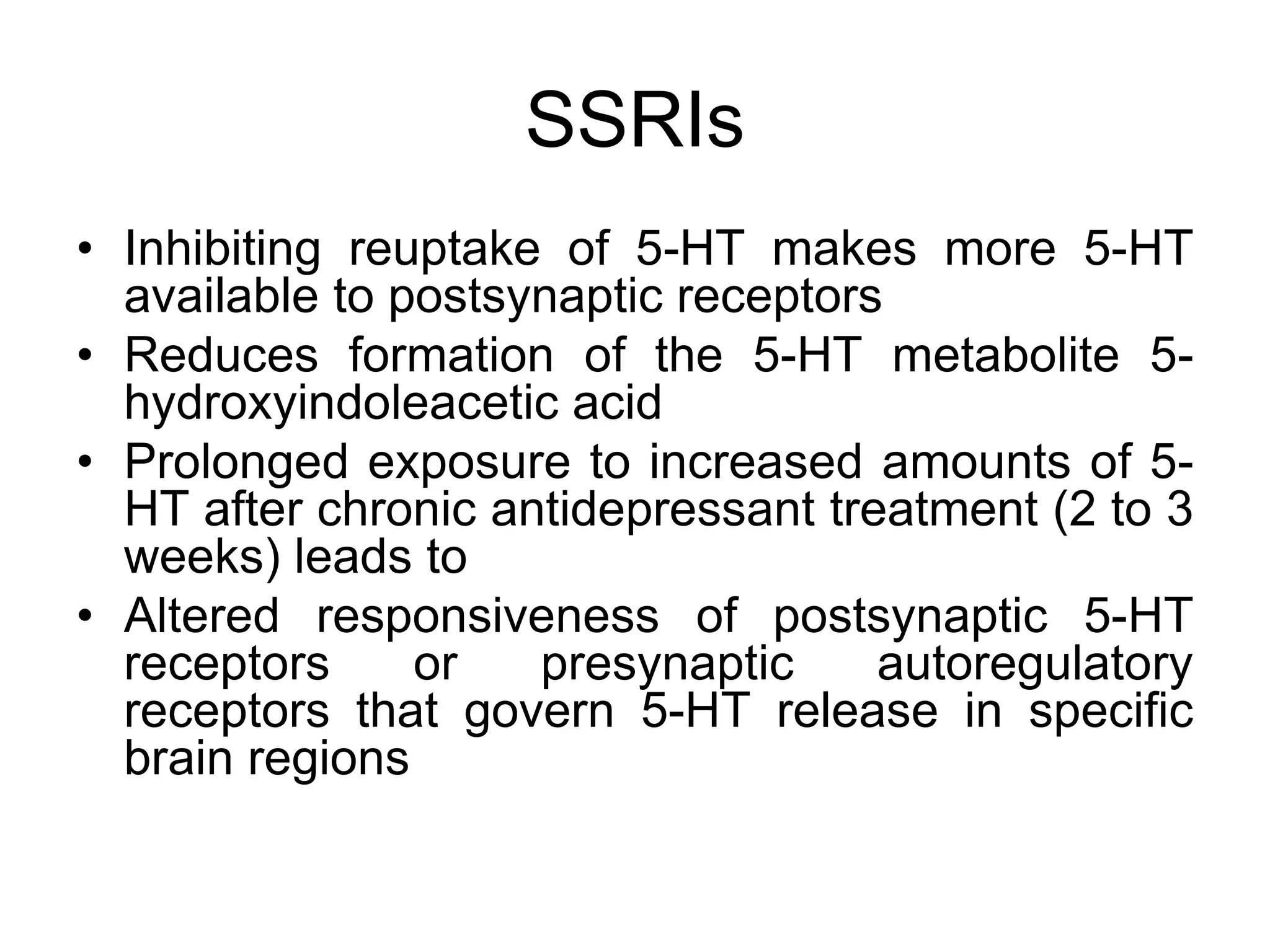
• Inhibiting reuptake of 5-HT makes more 5-HT
available to postsynaptic receptors
• Reduces formation of the 5-HT metabolite 5-
hydroxyindoleacetic acid
• Prolonged exposure to increased amounts of 5-
HT after chronic antidepressant treatment (2 to 3
weeks) leads to
• Altered responsiveness of postsynaptic 5-HT
receptors or presynaptic autoregulatory
receptors that govern 5-HT release in specific
brain regions
Side effects of SSRIs
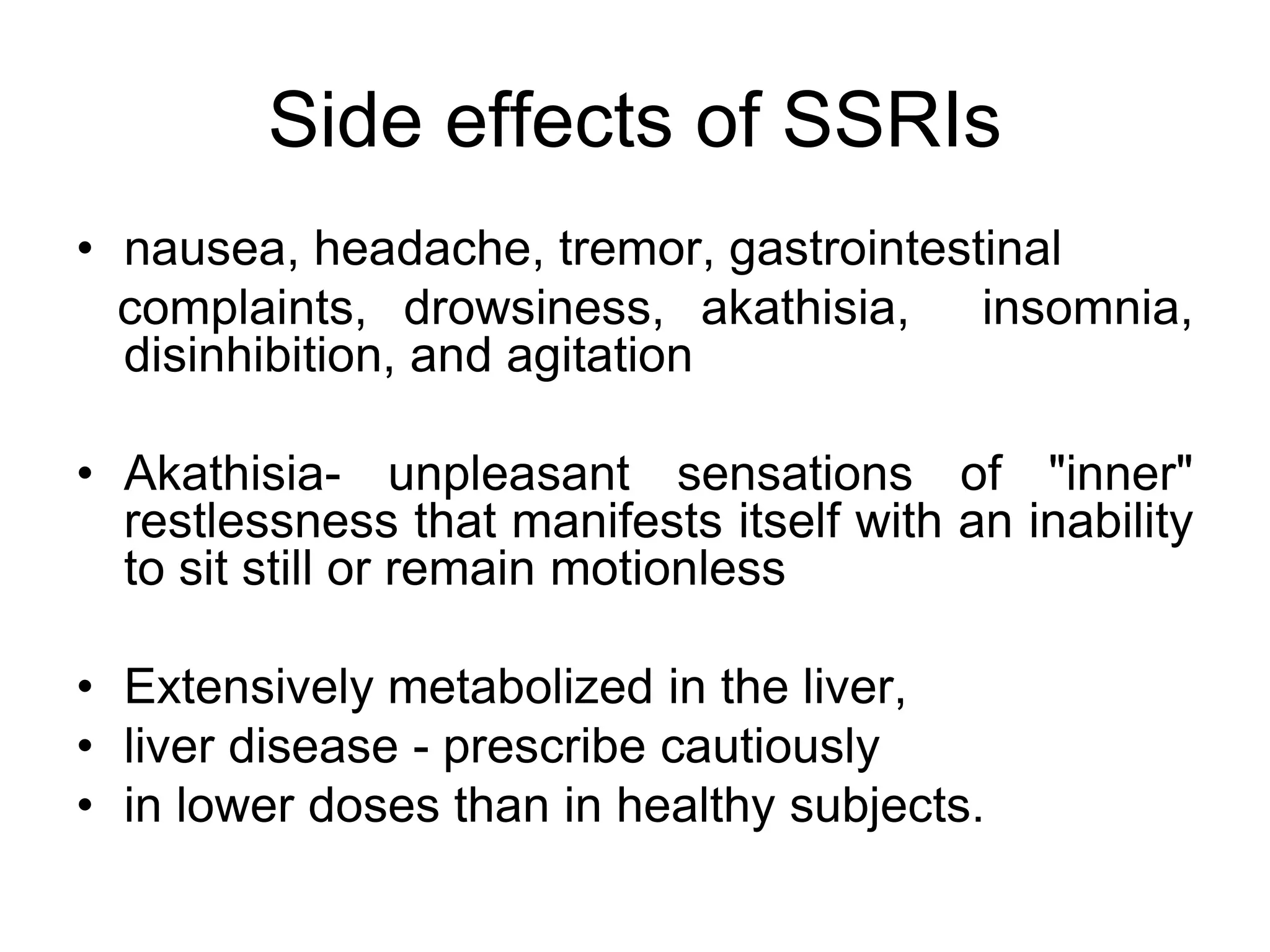
• nausea, headache, tremor, gastrointestinal
complaints, drowsiness, akathisia, insomnia,
disinhibition, and agitation
• Akathisia- unpleasant sensations of "inner"
restlessness that manifests itself with an inability
to sit still or remain motionless
• Extensively metabolized in the liver,
• liver disease - prescribe cautiously
• in lower doses than in healthy subjects.
Pregnancy
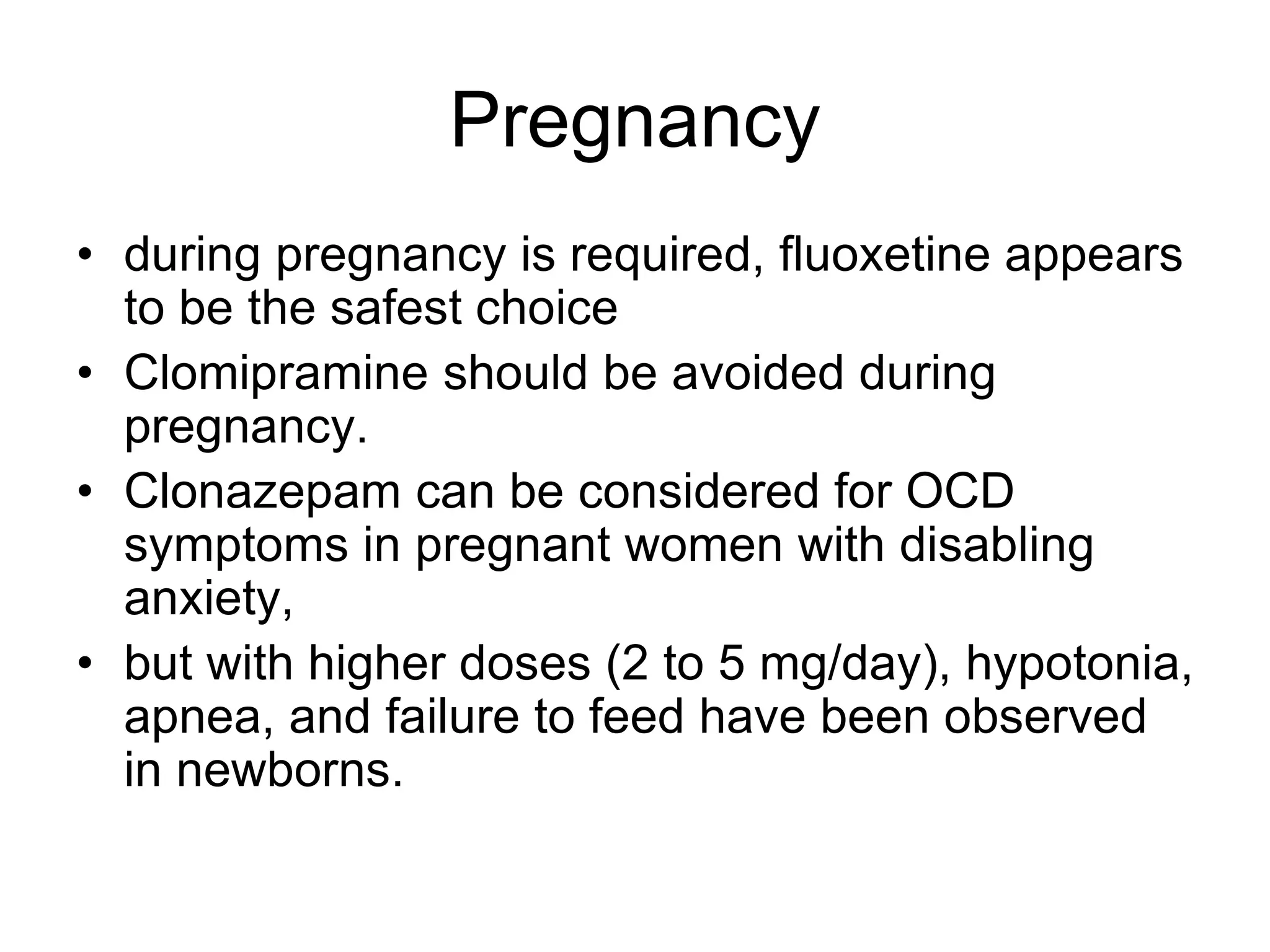
• during pregnancy is required, fluoxetine appears
to be the safest choice
• Clomipramine should be avoided during
pregnancy.
• Clonazepam can be considered for OCD
symptoms in pregnant women with disabling
anxiety,
• but with higher doses (2 to 5 mg/day), hypotonia,
apnea, and failure to feed have been observed
in newborns.
Alternatives
• Venlafaxine, which acts as a serotonin and
norepinephrine reuptake inhibitor, may be
effective for OCD.
• Intensive CBT augmentation with another drug
and more intensive CBT can be tried
• Buspirone is used as augmentation therapy, the
initial dose is 5 mg three times daily, and the
target dose should be 60 to 90 mg/day.
• In RCT citalopram (40 mg/day) + clomipramine
(150 mg/day) was effective in refractory pts
Thank you!

Obsessive compulsion disorder

  • 1.
    Obsessive compulsive disorder Vipul Sharma M.Pharm(pharmacy practice) Manipal college of pharmaceutical sciences (MAHE), MANIPAL
  • 2.
    DSM IV criteria •To be diagnosed with OCD, a person must have obsessions and/or compulsions, according to the DSM-IV-TR diagnostic criteria. • Moreover, the obsessions or compulsions must be time-consuming (taking up more than one hour per day), cause distress, or cause impairment in social, occupational, or school functioning
  • 3.
    Obsession • An obsessionis a recurrent, persistent idea, thought, impulse, or image that is experienced as intrusive and inappropriate and produces marked anxiety or distress • Common obsessions involve thoughts about contamination (e.g., concern with germs, dirt, or toxic chemicals), repeated doubts, and needing to have things in a particular order
  • 4.
    Obsessions • The thoughts,impulses, or images are not simply excessive worries of real-life problems. • The person attempts to ignore or suppress such thoughts, impulses, or images, or to neutralize them with some other thought or action. • The person recognizes that the obsessional thoughts, impulses, or images are a product of his or her own mind, and are not based in reality. • Excessive or unreasonable worry about real life situations
  • 5.
    Compulsion • A compulsionis defined as a repetitive behavior or mental act generally performed in response to an obsession. • The most common compulsions involve washing and cleaning, counting, checking, and requesting or demanding assurances
  • 6.
    Compulsions • Repetitive behaviorsor mental acts that the person feels driven to perform in response to an obsession, or according to rules that must be applied rigidly. • Behaviors or mental acts are not pleasurable - aimed at preventing or reducing distress or • preventing some dreaded event or situation; • Not actually connected to the issue, or they are excessive
  • 7.
    • typical OCDsufferer performs tasks (or compulsions) to seek relief from obsession- related anxiety • To others, these tasks may appear odd and unnecessary. • But for the sufferer, such tasks can feel critically important, and must be performed in particular ways to ward off dire consequences and to stop the stress from building up.
  • 8.
    Compulsive actions • Repeatedlychecking that one's parked car has been locked before leaving it, • Turning lights on and off a set number of times before exiting a room, • Repeatedly washing hands at regular intervals throughout the day, • Touching objects a certain number of times before leaving a room, • Walking in a certain routine way
  • 9.
    • Repetitive activities(e.g., hand washing, checking, ordering, need to ask, need to confess) • Repetitive mental acts (e.g., counting, repeating words silently praying)
  • 10.
    Prevalence • prevalence betweenone and three percent, although the prevalence of clinically recognized OCD is much lower • many individuals with the disorder may not be diagnosed • Patients may be secretive about symptoms and purposefully refuse to report or deny symptoms.
  • 11.
    Screening questions • Doyou have repetitive thoughts that make you anxious and that • you cannot get rid of? • Do you check things excessively? • Do you feel the need to wash your hands frequently? • Do you keep things exceptionally clean?
  • 12.
    Diagnosis • The diagnosticcriteria for OCD requires the presence of either • obsessions and/or compulsions (although most patients have both) • that are severe enough to cause marked distress, to be time-consuming • (occupy more than 1 hour per day), or • to cause significant impairment in social or occupational functioning
  • 13.
    Diagnosis tools • Ratingscales may be used to measure symptom severity, and a baseline determination is indicated if these tools are used • The most widely used scale is the Yale- Brown Obsessive Compulsive Scale (YBOCS).
  • 14.
    Other comorbid illnessrelated to OCD • Patients often have comorbid depression, anxiety disorders, and alcohol abuse or dependence. • Generalized anxiety disorder, Social anxiety disorder, • Anorexia nervosa, (decreased eating followed by anxiety and even ISH) • Bulimia nervosa (repeated eating within 2 hours and anxiety and even ISH)
  • 15.
    Other illness associated •Tourette syndrome (Repeated body activities) blinking head shoulder jerking Simple vocalizations might include repetitive throat- clearing, sniffing, or grunting sounds • Asperger syndrome, (difficulty in understanding body behaviour) Impaired social behaviour, social impairment with extreme obtuseness, limited interests and/or unusual preoccupations, repetitive routines or rituals, speech and language peculiarities, and non-verbal communication problems
  • 16.
    Contd… • Compulsive skinpicking, • Body dysmorphic disorder, Being preoccupied with minor or imaginary physical flaws, usually of the skin, hair, and nose, such as acne, scarring, facial lines, marks, pale skin, thinning hair, excessive body hair, large nose, or crooked nose, excessive checking in Mirror • Having a lot of anxiety and stress about the perceived flaw and spending a lot of time focusing on it, • Trichotillomania – pull out their own hair, Nail- biting, skin-picking, and thumb-sucking
  • 17.
    Obsessive-compulsive personality disorder • Apervasive pattern of preoccupation with orderliness, perfectionism, and mental and interpersonal control, at the expense of flexibility, openness, and efficiency, beginning by early adulthood and present in a variety of contexts, • Overconscious • Miserly saving money • stubern
  • 18.
    Goal • Reduction inthe frequency of obsessive thoughts • Time spent performing compulsive acts • Reduction in the degree of anxiety • Provide optimal level of psychosocial occupational functioning and an overall improved QOL.
  • 19.
    In adolescents andadults • Cognitive Behavioral Therapy (CBT) generally selected first for mild OCD, • CBT + SSRI (e.g., fluoxetine, fluvoxamine, sertraline, or paroxetine) are used for more severe OCD • In adults, CBT is the initial choice for mild OCD, and CBT plus an SSRI or an SSRI alone is selected for more severe OCD
  • 20.
    Drugs approved byFDA • Five antidepressants • clomipramine,- TCA • fluoxetine,- SSRI • fluvoxamine, • paroxetine, • sertraline
  • 22.
    Clinical trials onTCA and SSRI • TCA like Clomipramine- • SSRIs fluoxetine, fluvoxamine, paroxetine, and sertraline. • 65-75% response • consistently demonstrated efficacy 25- 60% in controlled trials • Obsessive-compulsive symptoms improve over a 4- to 10-week treatment period
  • 23.
    SSRIs • Inhibiting reuptakeof 5-HT makes more 5-HT available to postsynaptic receptors • Reduces formation of the 5-HT metabolite 5- hydroxyindoleacetic acid • Prolonged exposure to increased amounts of 5- HT after chronic antidepressant treatment (2 to 3 weeks) leads to • Altered responsiveness of postsynaptic 5-HT receptors or presynaptic autoregulatory receptors that govern 5-HT release in specific brain regions
  • 24.
    Side effects ofSSRIs • nausea, headache, tremor, gastrointestinal complaints, drowsiness, akathisia, insomnia, disinhibition, and agitation • Akathisia- unpleasant sensations of "inner" restlessness that manifests itself with an inability to sit still or remain motionless • Extensively metabolized in the liver, • liver disease - prescribe cautiously • in lower doses than in healthy subjects.
  • 25.
    Pregnancy • during pregnancyis required, fluoxetine appears to be the safest choice • Clomipramine should be avoided during pregnancy. • Clonazepam can be considered for OCD symptoms in pregnant women with disabling anxiety, • but with higher doses (2 to 5 mg/day), hypotonia, apnea, and failure to feed have been observed in newborns.
  • 26.
    Alternatives • Venlafaxine, whichacts as a serotonin and norepinephrine reuptake inhibitor, may be effective for OCD. • Intensive CBT augmentation with another drug and more intensive CBT can be tried • Buspirone is used as augmentation therapy, the initial dose is 5 mg three times daily, and the target dose should be 60 to 90 mg/day. • In RCT citalopram (40 mg/day) + clomipramine (150 mg/day) was effective in refractory pts
  • 27.