Obsessive-
Compulsive and
Related Disorders
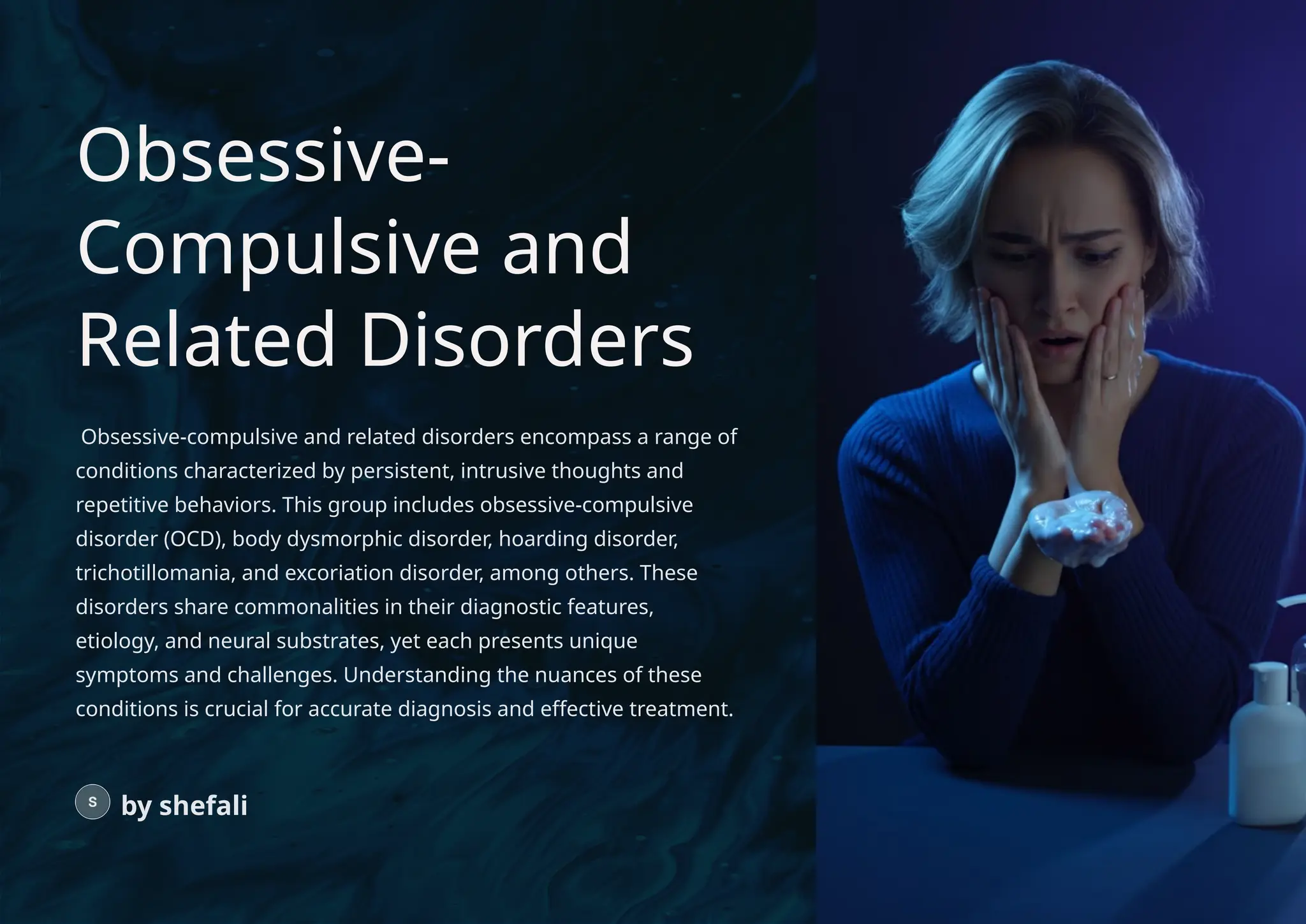
Obsessive-compulsive and related disorders encompass a range of
conditions characterized by persistent, intrusive thoughts and
repetitive behaviors. This group includes obsessive-compulsive
disorder (OCD), body dysmorphic disorder, hoarding disorder,
trichotillomania, and excoriation disorder, among others. These
disorders share commonalities in their diagnostic features,
etiology, and neural substrates, yet each presents unique
symptoms and challenges. Understanding the nuances of these
conditions is crucial for accurate diagnosis and effective treatment.
by shefali
Obsessive-Compulsive Disorder
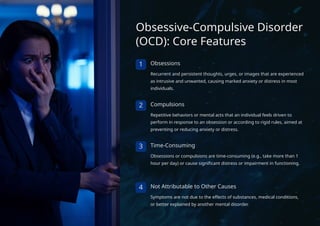
(OCD): Core Features
1 Obsessions
Recurrent and persistent thoughts, urges, or images that are experienced
as intrusive and unwanted, causing marked anxiety or distress in most
individuals.
2 Compulsions
Repetitive behaviors or mental acts that an individual feels driven to
perform in response to an obsession or according to rigid rules, aimed at
preventing or reducing anxiety or distress.
3 Time-Consuming
Obsessions or compulsions are time-consuming (e.g., take more than 1
hour per day) or cause significant distress or impairment in functioning.
4 Not Attributable to Other Causes
Symptoms are not due to the effects of substances, medical conditions,
or better explained by another mental disorder.
Common Themes in OCD
Cleaning
Contamination obsessions
and cleaning compulsions,
often involving excessive
hand washing or sanitizing.
Symmetry
Obsessions about order
and symmetry, leading to
repeating, ordering, and
counting compulsions.
Forbidden Thoughts
Aggressive, sexual, or
religious obsessions and
related compulsions, often
causing significant distress.
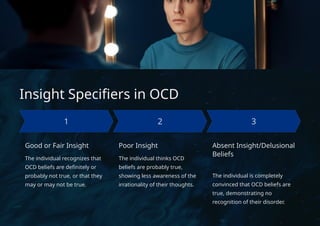
Insight Specifiers in OCD
Good or Fair Insight
The individual recognizes that
OCD beliefs are definitely or
probably not true, or that they
may or may not be true.
Poor Insight
The individual thinks OCD
beliefs are probably true,
showing less awareness of the
irrationality of their thoughts.
Absent Insight/Delusional
Beliefs
The individual is completely
convinced that OCD beliefs are
true, demonstrating no
recognition of their disorder.
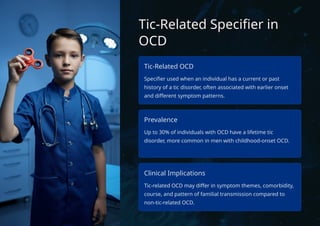
Tic-Related Specifier in
OCD
Tic-Related OCD
Specifier used when an individual has a current or past
history of a tic disorder, often associated with earlier onset
and different symptom patterns.
Prevalence
Up to 30% of individuals with OCD have a lifetime tic
disorder, more common in men with childhood-onset OCD.
Clinical Implications
Tic-related OCD may differ in symptom themes, comorbidity,
course, and pattern of familial transmission compared to
non-tic-related OCD.
Associated Features of OCD
1 Sensory Phenomena
Physical experiences that precede compulsions, such as physical
sensations or feelings of incompleteness, reported by up to 60%
of individuals with OCD.
2 Affective Responses
Range from marked anxiety, including panic attacks, to strong
feelings of disgust when confronted with triggering situations.
3 Avoidance
Common avoidance of people, places, and things that trigger
obsessions and compulsions, potentially leading to significant life
restrictions.
4 Dysfunctional Beliefs
May include an inflated sense of responsibility, overestimation of
threat, perfectionism, and overimportance of thoughts.
Prevalence and Onset of
OCD
1 12-Month Prevalence
1.2% in the United States, with similar rates
internationally (1.1%–1.8%).
2 Gender Differences
Slightly higher rates in women during
adulthood, but more common in men during
childhood.
3 Age of Onset
Mean age at onset in the U.S. is 19.5 years,
with 25% of cases starting by age 14. Onset
after age 35 is unusual but does occur.
Course of OCD
Onset
Typically gradual, but acute onset can occur.
Men often have earlier onset than women.
Progression
Usually chronic with waxing and waning
symptoms if untreated. Some individuals have
an episodic course, while a minority experience
deterioration.
Long-Term Outcomes
Low remission rates without treatment (e.g.,
20% after 40 years). 40% of
childhood/adolescent-onset cases may remit by
early adulthood.
Risk Factors for OCD
Temperamental
Factors
Greater internalizing
symptoms, higher negative
emotionality, and
behavioral inhibition in
childhood may increase
risk.
Environmental
Factors
Adverse perinatal events,
premature birth, maternal
tobacco use during
pregnancy, childhood
abuse, and other stressful
events may contribute.
Genetic and
Physiological Factors
Increased risk among first-
degree relatives, with
higher concordance in
monozygotic twins.
Dysfunction in specific
brain regions implicated.
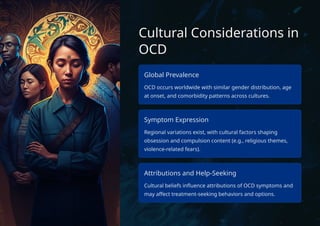
Cultural Considerations in
OCD
Global Prevalence
OCD occurs worldwide with similar gender distribution, age
at onset, and comorbidity patterns across cultures.
Symptom Expression
Regional variations exist, with cultural factors shaping
obsession and compulsion content (e.g., religious themes,
violence-related fears).
Attributions and Help-Seeking
Cultural beliefs influence attributions of OCD symptoms and
may affect treatment-seeking behaviors and options.
Gender Differences in OCD
Age of Onset
Men typically have earlier
onset, often in childhood,
while women more
commonly experience
onset in adolescence.
Comorbidity
Men are more likely to
have comorbid tic
disorders.
Symptom
Dimensions
Women more likely to have
cleaning-related
symptoms, men more likely
to have forbidden thoughts
and symmetry-related
symptoms.
OCD in the
Peripartum Period
1 Onset or Exacerbation
Some women experience onset or worsening of
OCD symptoms during pregnancy or postpartum.
2 Specific Concerns
Symptoms may interfere with mother-infant
relationship, such as aggressive obsessions about
harming the infant.
3 Premenstrual Exacerbation
Some women report worsening of OCD symptoms
premenstrually.
Suicidal Behavior in
OCD
Lifetime suicide
attempts
14.2%
Lifetime suicidal
ideation
44.1%
Current suicidal
ideation
25.9%
Risk Factors for Suicidal Behavior in OCD
1 Symptom Severity
Greater OCD severity is associated with
increased suicide risk.
2 Symptom Dimensions
The unacceptable thoughts dimension is
particularly linked to suicidal behavior.
3 Comorbidities
Severity of comorbid depressive and anxiety
symptoms, as well as substance use disorders,
increase risk.
4 History
Past suicidal behavior is a significant predictor
of future risk.
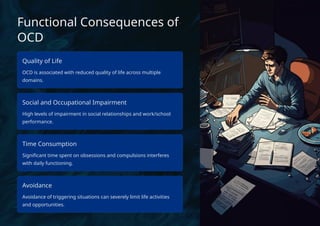
Functional Consequences of
OCD
Quality of Life
OCD is associated with reduced quality of life across multiple
domains.
Social and Occupational Impairment
High levels of impairment in social relationships and work/school
performance.
Time Consumption
Significant time spent on obsessions and compulsions interferes
with daily functioning.
Avoidance
Avoidance of triggering situations can severely limit life activities
and opportunities.
Specific Functional Impacts of OCD
Relationships
Obsessions about harm
can make relationships feel
hazardous, leading to
social isolation.
Work/School
Performance
Perfectionism and
symmetry obsessions can
impede task completion,
risking academic or job
failure.
Health
Contamination fears may
lead to avoidance of
medical care or cause skin
problems from excessive
washing.
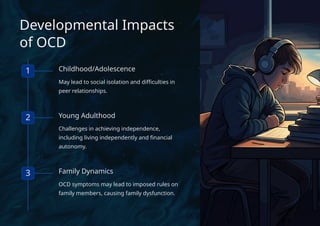
Developmental Impacts
of OCD
1 Childhood/Adolescence
May lead to social isolation and difficulties in
peer relationships.
2 Young Adulthood
Challenges in achieving independence,
including living independently and financial
autonomy.
3 Family Dynamics
OCD symptoms may lead to imposed rules on
family members, causing family dysfunction.
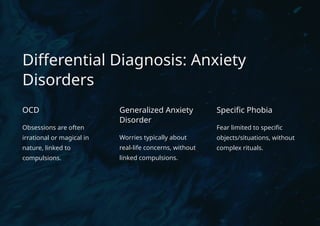
Differential Diagnosis: Anxiety
Disorders
OCD
Obsessions are often
irrational or magical in
nature, linked to
compulsions.
Generalized Anxiety
Disorder
Worries typically about
real-life concerns, without
linked compulsions.
Specific Phobia
Fear limited to specific
objects/situations, without
complex rituals.
Differential Diagnosis:
Other Disorders
1 Major Depressive Disorder
Ruminations are mood-congruent, not intrusive, and not
linked to compulsions.
2 Body Dysmorphic Disorder
Obsessions and compulsions limited to concerns about
physical appearance.
3 Hoarding Disorder
Focuses on difficulty discarding possessions and excessive
accumulation.
4 Tic Disorders
Tics are typically less complex than compulsions and not
aimed at neutralizing obsessions.
OCD with Poor Insight vs.
Psychotic Disorders
OCD with Poor Insight
Presence of obsessions and compulsions, even if beliefs
seem delusional.
Psychotic Disorders
Presence of hallucinations, disorganized speech, or other
psychotic features not typical in OCD.
Diagnostic Approach
Focus on core OCD symptoms rather than degree of insight
when distinguishing from psychotic disorders.
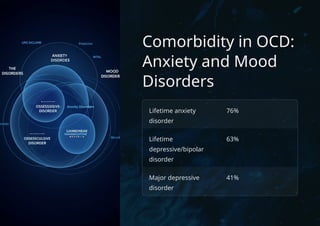
Comorbidity in OCD:
Anxiety and Mood
Disorders
Lifetime anxiety
disorder
76%
Lifetime
depressive/bipolar
disorder
63%
Major depressive
disorder
41%
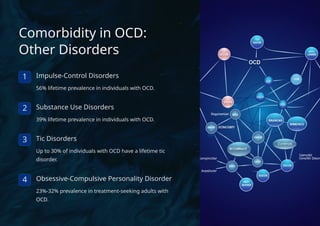
Comorbidity in OCD:
Other Disorders
1 Impulse-Control Disorders
56% lifetime prevalence in individuals with OCD.
2 Substance Use Disorders
39% lifetime prevalence in individuals with OCD.
3 Tic Disorders
Up to 30% of individuals with OCD have a lifetime tic
disorder.
4 Obsessive-Compulsive Personality Disorder
23%-32% prevalence in treatment-seeking adults with
OCD.
OCD in Other Disorders
Schizophrenia/
Schizoaffective
Disorder
Approximately 12%
prevalence of OCD.
Other Elevated Risk
Disorders
Higher rates of OCD in
bipolar disorder, eating
disorders, body
dysmorphic disorder, and
Tourette's disorder.
Clinical Implication
Importance of assessing
for OCD when these other
disorders are diagnosed.
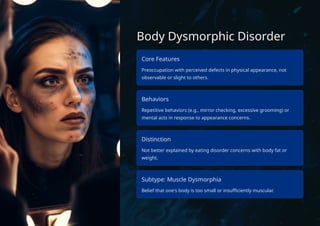
Body Dysmorphic Disorder
Core Features
Preoccupation with perceived defects in physical appearance, not
observable or slight to others.
Behaviors
Repetitive behaviors (e.g., mirror checking, excessive grooming) or
mental acts in response to appearance concerns.
Distinction
Not better explained by eating disorder concerns with body fat or
weight.
Subtype: Muscle Dysmorphia
Belief that one's body is too small or insufficiently muscular.
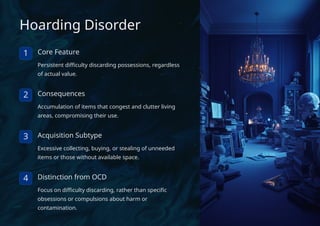
Hoarding Disorder
1 Core Feature
Persistent difficulty discarding possessions, regardless
of actual value.
2 Consequences
Accumulation of items that congest and clutter living
areas, compromising their use.
3 Acquisition Subtype
Excessive collecting, buying, or stealing of unneeded
items or those without available space.
4 Distinction from OCD
Focus on difficulty discarding, rather than specific
obsessions or compulsions about harm or
contamination.

Obsessive-Compulsive-and-Related-Disorders.pptx

  • 1.
    Obsessive- Compulsive and Related Disorders Obsessive-compulsiveand related disorders encompass a range of conditions characterized by persistent, intrusive thoughts and repetitive behaviors. This group includes obsessive-compulsive disorder (OCD), body dysmorphic disorder, hoarding disorder, trichotillomania, and excoriation disorder, among others. These disorders share commonalities in their diagnostic features, etiology, and neural substrates, yet each presents unique symptoms and challenges. Understanding the nuances of these conditions is crucial for accurate diagnosis and effective treatment. by shefali
  • 2.
    Obsessive-Compulsive Disorder (OCD): CoreFeatures 1 Obsessions Recurrent and persistent thoughts, urges, or images that are experienced as intrusive and unwanted, causing marked anxiety or distress in most individuals. 2 Compulsions Repetitive behaviors or mental acts that an individual feels driven to perform in response to an obsession or according to rigid rules, aimed at preventing or reducing anxiety or distress. 3 Time-Consuming Obsessions or compulsions are time-consuming (e.g., take more than 1 hour per day) or cause significant distress or impairment in functioning. 4 Not Attributable to Other Causes Symptoms are not due to the effects of substances, medical conditions, or better explained by another mental disorder.
  • 3.
    Common Themes inOCD Cleaning Contamination obsessions and cleaning compulsions, often involving excessive hand washing or sanitizing. Symmetry Obsessions about order and symmetry, leading to repeating, ordering, and counting compulsions. Forbidden Thoughts Aggressive, sexual, or religious obsessions and related compulsions, often causing significant distress.
  • 4.
    Insight Specifiers inOCD Good or Fair Insight The individual recognizes that OCD beliefs are definitely or probably not true, or that they may or may not be true. Poor Insight The individual thinks OCD beliefs are probably true, showing less awareness of the irrationality of their thoughts. Absent Insight/Delusional Beliefs The individual is completely convinced that OCD beliefs are true, demonstrating no recognition of their disorder.
  • 5.
    Tic-Related Specifier in OCD Tic-RelatedOCD Specifier used when an individual has a current or past history of a tic disorder, often associated with earlier onset and different symptom patterns. Prevalence Up to 30% of individuals with OCD have a lifetime tic disorder, more common in men with childhood-onset OCD. Clinical Implications Tic-related OCD may differ in symptom themes, comorbidity, course, and pattern of familial transmission compared to non-tic-related OCD.
  • 6.
    Associated Features ofOCD 1 Sensory Phenomena Physical experiences that precede compulsions, such as physical sensations or feelings of incompleteness, reported by up to 60% of individuals with OCD. 2 Affective Responses Range from marked anxiety, including panic attacks, to strong feelings of disgust when confronted with triggering situations. 3 Avoidance Common avoidance of people, places, and things that trigger obsessions and compulsions, potentially leading to significant life restrictions. 4 Dysfunctional Beliefs May include an inflated sense of responsibility, overestimation of threat, perfectionism, and overimportance of thoughts.
  • 7.
    Prevalence and Onsetof OCD 1 12-Month Prevalence 1.2% in the United States, with similar rates internationally (1.1%–1.8%). 2 Gender Differences Slightly higher rates in women during adulthood, but more common in men during childhood. 3 Age of Onset Mean age at onset in the U.S. is 19.5 years, with 25% of cases starting by age 14. Onset after age 35 is unusual but does occur.
  • 8.
    Course of OCD Onset Typicallygradual, but acute onset can occur. Men often have earlier onset than women. Progression Usually chronic with waxing and waning symptoms if untreated. Some individuals have an episodic course, while a minority experience deterioration. Long-Term Outcomes Low remission rates without treatment (e.g., 20% after 40 years). 40% of childhood/adolescent-onset cases may remit by early adulthood.
  • 9.
    Risk Factors forOCD Temperamental Factors Greater internalizing symptoms, higher negative emotionality, and behavioral inhibition in childhood may increase risk. Environmental Factors Adverse perinatal events, premature birth, maternal tobacco use during pregnancy, childhood abuse, and other stressful events may contribute. Genetic and Physiological Factors Increased risk among first- degree relatives, with higher concordance in monozygotic twins. Dysfunction in specific brain regions implicated.
  • 10.
    Cultural Considerations in OCD GlobalPrevalence OCD occurs worldwide with similar gender distribution, age at onset, and comorbidity patterns across cultures. Symptom Expression Regional variations exist, with cultural factors shaping obsession and compulsion content (e.g., religious themes, violence-related fears). Attributions and Help-Seeking Cultural beliefs influence attributions of OCD symptoms and may affect treatment-seeking behaviors and options.
  • 11.
    Gender Differences inOCD Age of Onset Men typically have earlier onset, often in childhood, while women more commonly experience onset in adolescence. Comorbidity Men are more likely to have comorbid tic disorders. Symptom Dimensions Women more likely to have cleaning-related symptoms, men more likely to have forbidden thoughts and symmetry-related symptoms.
  • 12.
    OCD in the PeripartumPeriod 1 Onset or Exacerbation Some women experience onset or worsening of OCD symptoms during pregnancy or postpartum. 2 Specific Concerns Symptoms may interfere with mother-infant relationship, such as aggressive obsessions about harming the infant. 3 Premenstrual Exacerbation Some women report worsening of OCD symptoms premenstrually.
  • 13.
    Suicidal Behavior in OCD Lifetimesuicide attempts 14.2% Lifetime suicidal ideation 44.1% Current suicidal ideation 25.9%
  • 14.
    Risk Factors forSuicidal Behavior in OCD 1 Symptom Severity Greater OCD severity is associated with increased suicide risk. 2 Symptom Dimensions The unacceptable thoughts dimension is particularly linked to suicidal behavior. 3 Comorbidities Severity of comorbid depressive and anxiety symptoms, as well as substance use disorders, increase risk. 4 History Past suicidal behavior is a significant predictor of future risk.
  • 15.
    Functional Consequences of OCD Qualityof Life OCD is associated with reduced quality of life across multiple domains. Social and Occupational Impairment High levels of impairment in social relationships and work/school performance. Time Consumption Significant time spent on obsessions and compulsions interferes with daily functioning. Avoidance Avoidance of triggering situations can severely limit life activities and opportunities.
  • 16.
    Specific Functional Impactsof OCD Relationships Obsessions about harm can make relationships feel hazardous, leading to social isolation. Work/School Performance Perfectionism and symmetry obsessions can impede task completion, risking academic or job failure. Health Contamination fears may lead to avoidance of medical care or cause skin problems from excessive washing.
  • 17.
    Developmental Impacts of OCD 1Childhood/Adolescence May lead to social isolation and difficulties in peer relationships. 2 Young Adulthood Challenges in achieving independence, including living independently and financial autonomy. 3 Family Dynamics OCD symptoms may lead to imposed rules on family members, causing family dysfunction.
  • 18.
    Differential Diagnosis: Anxiety Disorders OCD Obsessionsare often irrational or magical in nature, linked to compulsions. Generalized Anxiety Disorder Worries typically about real-life concerns, without linked compulsions. Specific Phobia Fear limited to specific objects/situations, without complex rituals.
  • 19.
    Differential Diagnosis: Other Disorders 1Major Depressive Disorder Ruminations are mood-congruent, not intrusive, and not linked to compulsions. 2 Body Dysmorphic Disorder Obsessions and compulsions limited to concerns about physical appearance. 3 Hoarding Disorder Focuses on difficulty discarding possessions and excessive accumulation. 4 Tic Disorders Tics are typically less complex than compulsions and not aimed at neutralizing obsessions.
  • 20.
    OCD with PoorInsight vs. Psychotic Disorders OCD with Poor Insight Presence of obsessions and compulsions, even if beliefs seem delusional. Psychotic Disorders Presence of hallucinations, disorganized speech, or other psychotic features not typical in OCD. Diagnostic Approach Focus on core OCD symptoms rather than degree of insight when distinguishing from psychotic disorders.
  • 21.
    Comorbidity in OCD: Anxietyand Mood Disorders Lifetime anxiety disorder 76% Lifetime depressive/bipolar disorder 63% Major depressive disorder 41%
  • 22.
    Comorbidity in OCD: OtherDisorders 1 Impulse-Control Disorders 56% lifetime prevalence in individuals with OCD. 2 Substance Use Disorders 39% lifetime prevalence in individuals with OCD. 3 Tic Disorders Up to 30% of individuals with OCD have a lifetime tic disorder. 4 Obsessive-Compulsive Personality Disorder 23%-32% prevalence in treatment-seeking adults with OCD.
  • 23.
    OCD in OtherDisorders Schizophrenia/ Schizoaffective Disorder Approximately 12% prevalence of OCD. Other Elevated Risk Disorders Higher rates of OCD in bipolar disorder, eating disorders, body dysmorphic disorder, and Tourette's disorder. Clinical Implication Importance of assessing for OCD when these other disorders are diagnosed.
  • 24.
    Body Dysmorphic Disorder CoreFeatures Preoccupation with perceived defects in physical appearance, not observable or slight to others. Behaviors Repetitive behaviors (e.g., mirror checking, excessive grooming) or mental acts in response to appearance concerns. Distinction Not better explained by eating disorder concerns with body fat or weight. Subtype: Muscle Dysmorphia Belief that one's body is too small or insufficiently muscular.
  • 25.
    Hoarding Disorder 1 CoreFeature Persistent difficulty discarding possessions, regardless of actual value. 2 Consequences Accumulation of items that congest and clutter living areas, compromising their use. 3 Acquisition Subtype Excessive collecting, buying, or stealing of unneeded items or those without available space. 4 Distinction from OCD Focus on difficulty discarding, rather than specific obsessions or compulsions about harm or contamination.