

Introduction
• The Occupational Therapy Practice Framework:
Domain and Process, 3rd edition (hereinafter
referred to as “the Framework”), is an official
document of the American Occupational Therapy
Association (AOTA).
• Intended for occupational therapy practitioners and
students, other health care professionals,
educators, researchers, payers, and consumers, the
Framework presents a summary of interrelated
constructs that describe occupational therapy
practice.
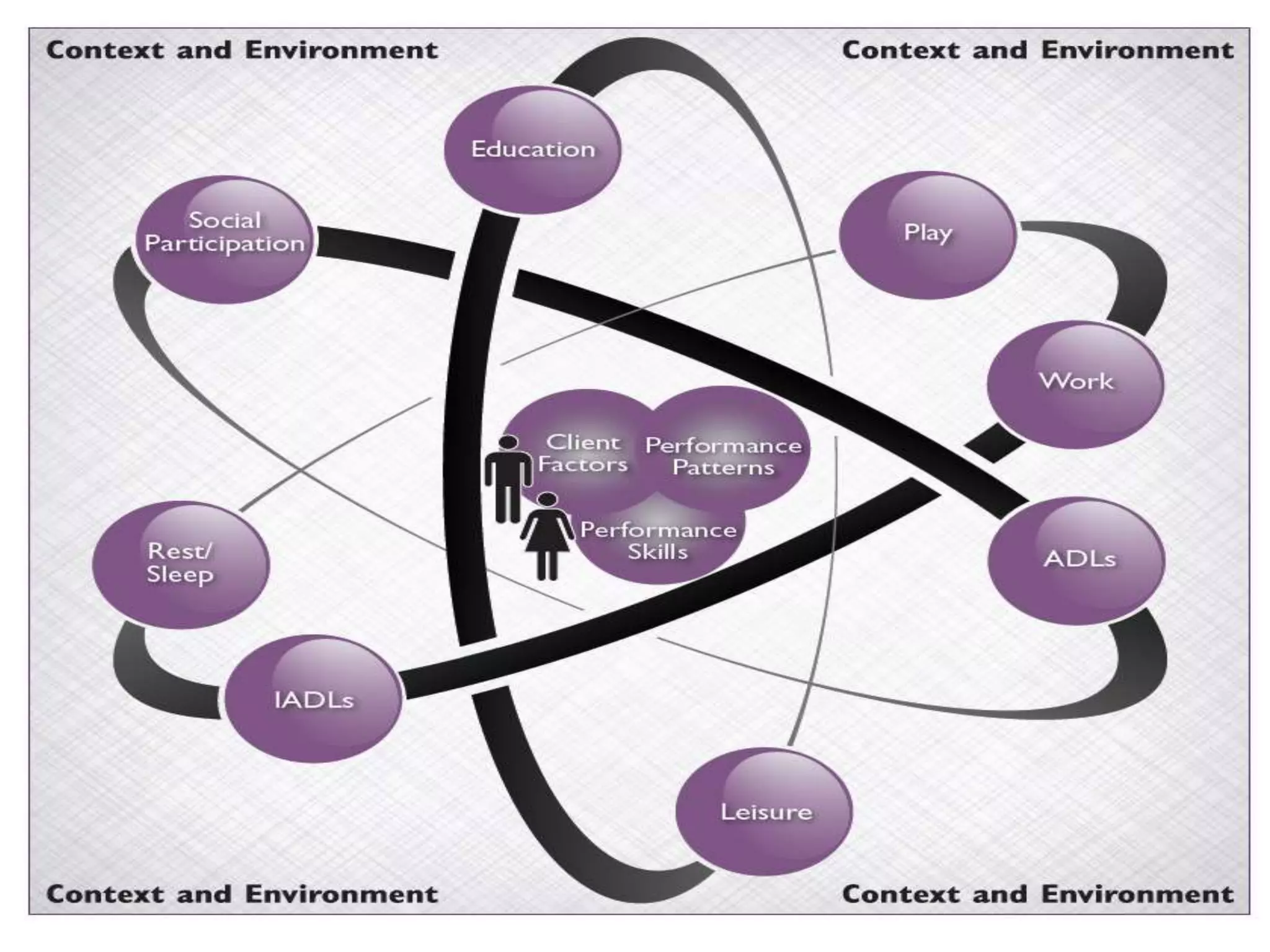
Occupations
• Activities of
daily living
(ADLs)
• Instrumental
activities of
daily living
(IADLs)
• Rest and
sleep
• Education
• Work
• Play
• Leisure
• Social
participation
Client factors
• Values,
beliefs, and
• spirituality
• Body
functions
• Body
structures
Performance
skills
• Motor skills
• Process skills
• Social
interaction
skills
Performance
patterns
• Habits
• Routines
• Rituals
• Roles
Contexts and
environments
• Cultural
• Personal
• Physical
• Social
• Temporal
• Virtual
Occupation
• “Occupation is used to mean all the things people
want, need, or have to do, whether of physical,
mental, social, sexual, political, or spiritual nature
and is inclusive of sleep and rest. It refers to all
aspects of actual human doing, being, becoming,
and belonging.
• The practical, everyday medium of self-expression or
of making or experiencing meaning, occupation is
the activist element of human existence whether
occupations are contemplative, reflective, and
meditative or action based” (Wilcock & Townsend,
2014, p. 542).
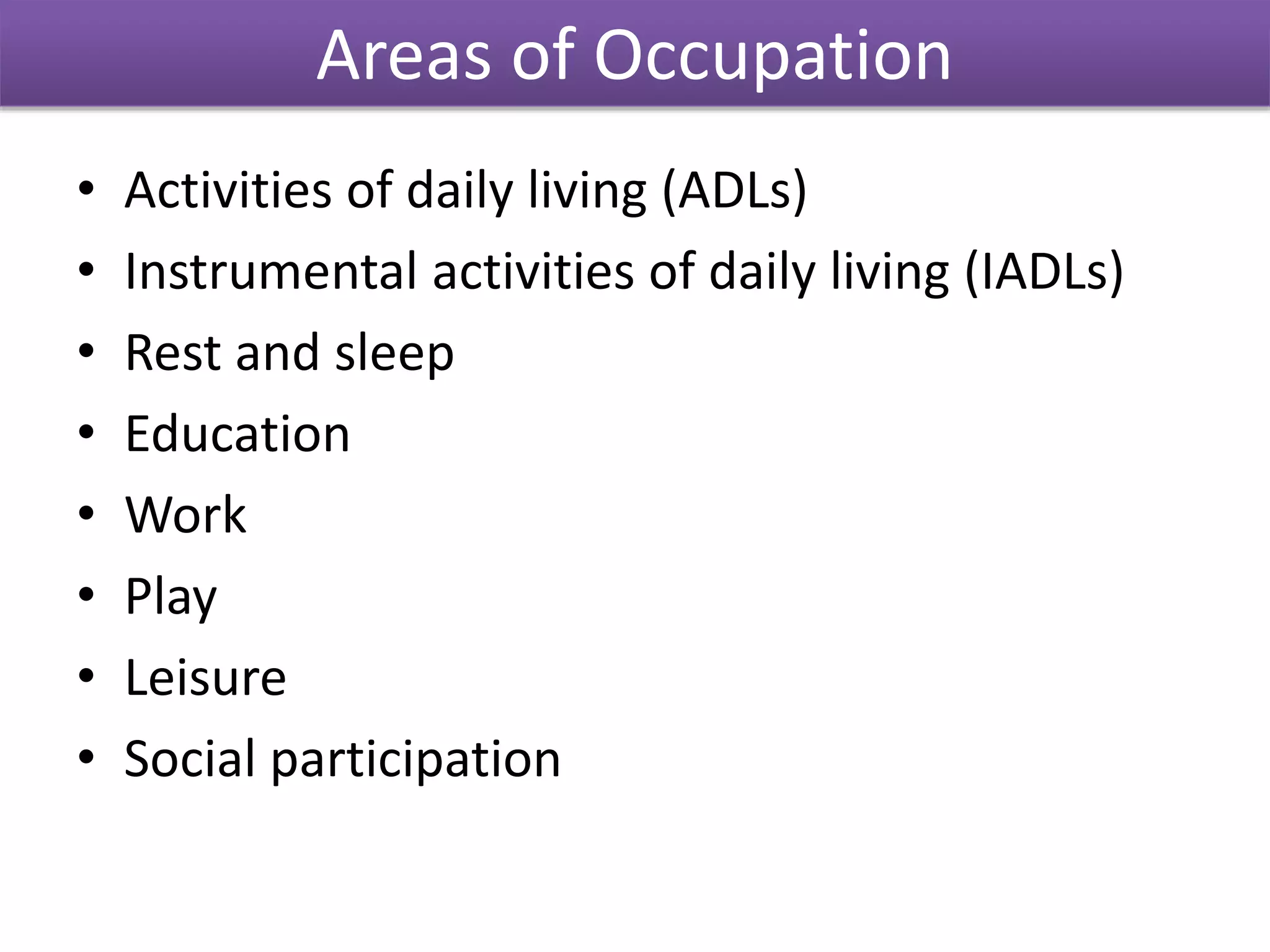
Areas of Occupation
• Activities of daily living (ADLs)
• Instrumental activities of daily living (IADLs)
• Rest and sleep
• Education
• Work
• Play
• Leisure
• Social participation
Client factors
• Client factors are specific capacities, characteristics, or
beliefs that reside within the person and that influence
performance in occupations.
• Client factors are affected by the presence or absence of
illness, disease, deprivation, disability, and life experiences.
• Although client factors are not to be confused with
performance skills, client factors can affect performance
skills.
• Thus, client factors may need to be present in whole or in
part for a person to complete an action (skill) used in the
execution of an occupation.
• In addition, client factors are affected by performance skills,
performance patterns, contexts and environments, and
performance and participation in activities and occupations.
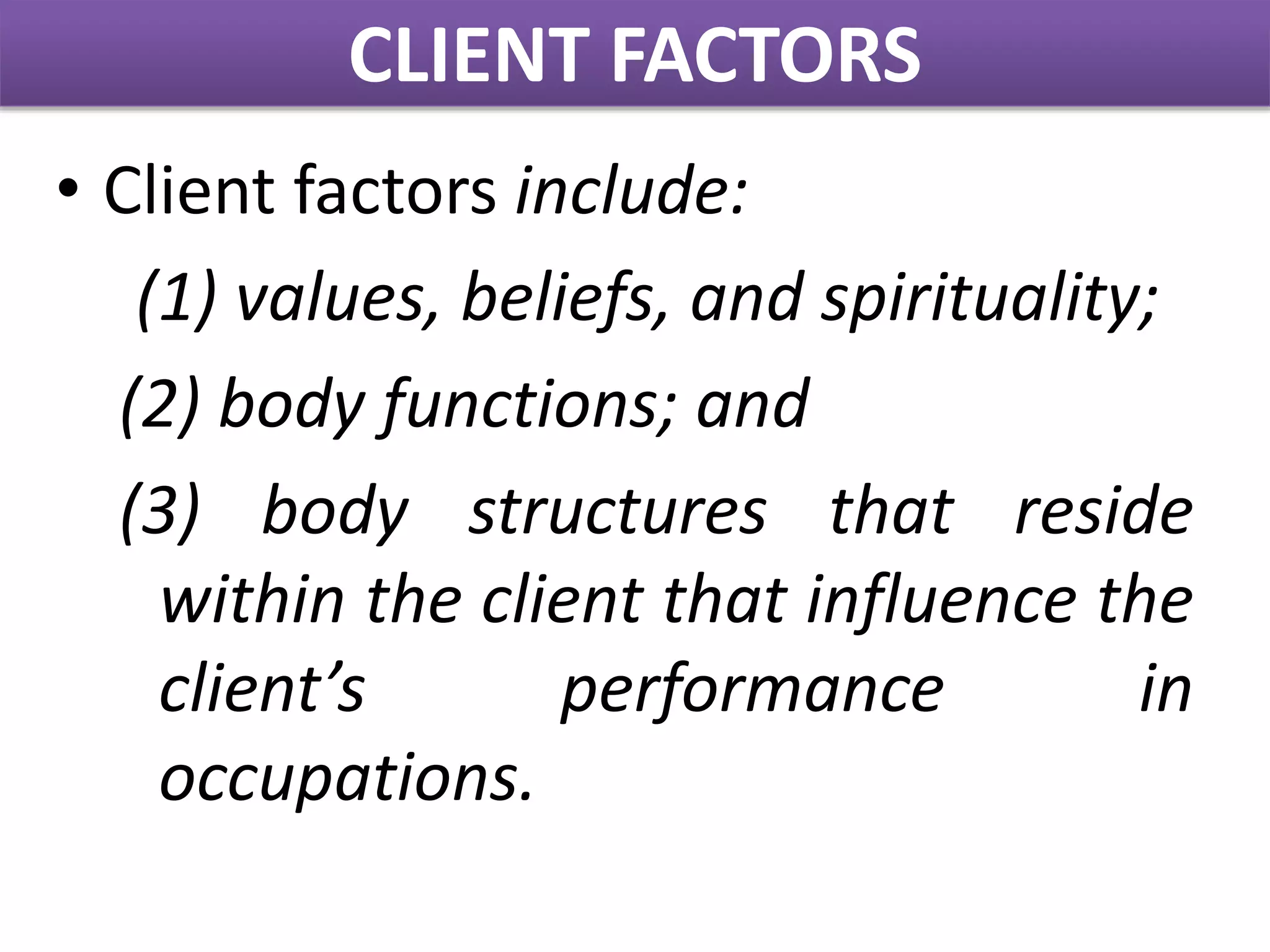
CLIENT FACTORS
• Client factors include:
(1) values, beliefs, and spirituality;
(2) body functions; and
(3) body structures that reside
within the client that influence the
client’s performance in
occupations.
Performance Skills
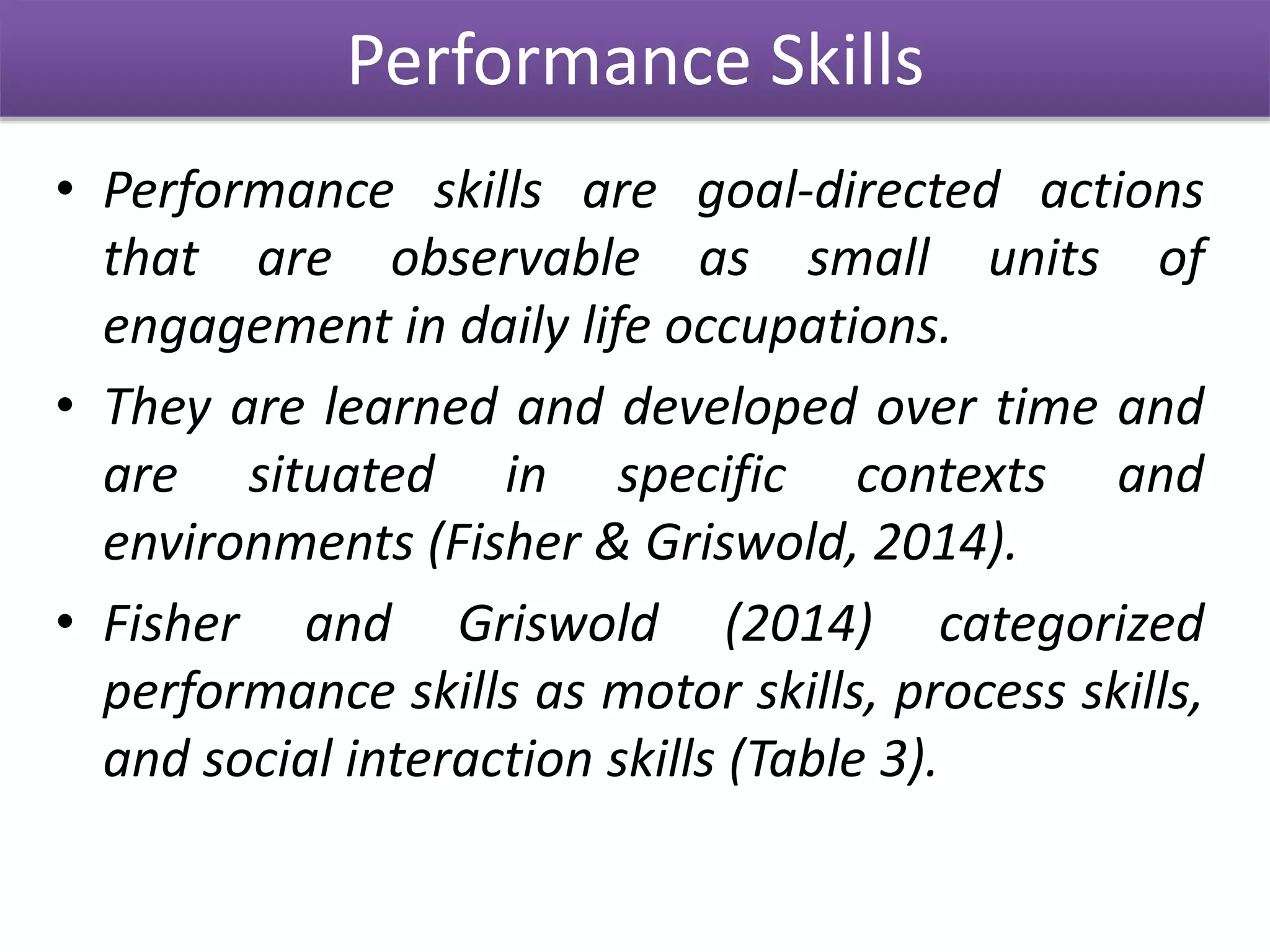
• Performance skills are goal-directed actions
that are observable as small units of
engagement in daily life occupations.
• They are learned and developed over time and
are situated in specific contexts and
environments (Fisher & Griswold, 2014).
• Fisher and Griswold (2014) categorized
performance skills as motor skills, process skills,
and social interaction skills (Table 3).
List of performance skills
Motor skills Process skills Social interaction skills
Aligns Paces Gathers Approaches/Starts Thanks
Stabilizes Attends Terminates Concludes/disengages Transitions
Positions Heeds Searches Produces speech Time response
Reaches Choose Organizes Gesticulates Time duration
Bends Uses Restores Speaks fluently Takes turns
Grips Handles Navigates Turns toward Matches
languageManipulates Inquires Notices Looks
Coordinates Initiates Adjust Places sell Acknowledges &
encouragesMoves Continues Accommodates Touches
Lifts Sequences Benefits Regulates Empathizes
Walks Questions Heeds
Transports Replies Accommodates
Paces Discloses Benefits
Express emotion Disagrees
Clarifies
Performance pattern
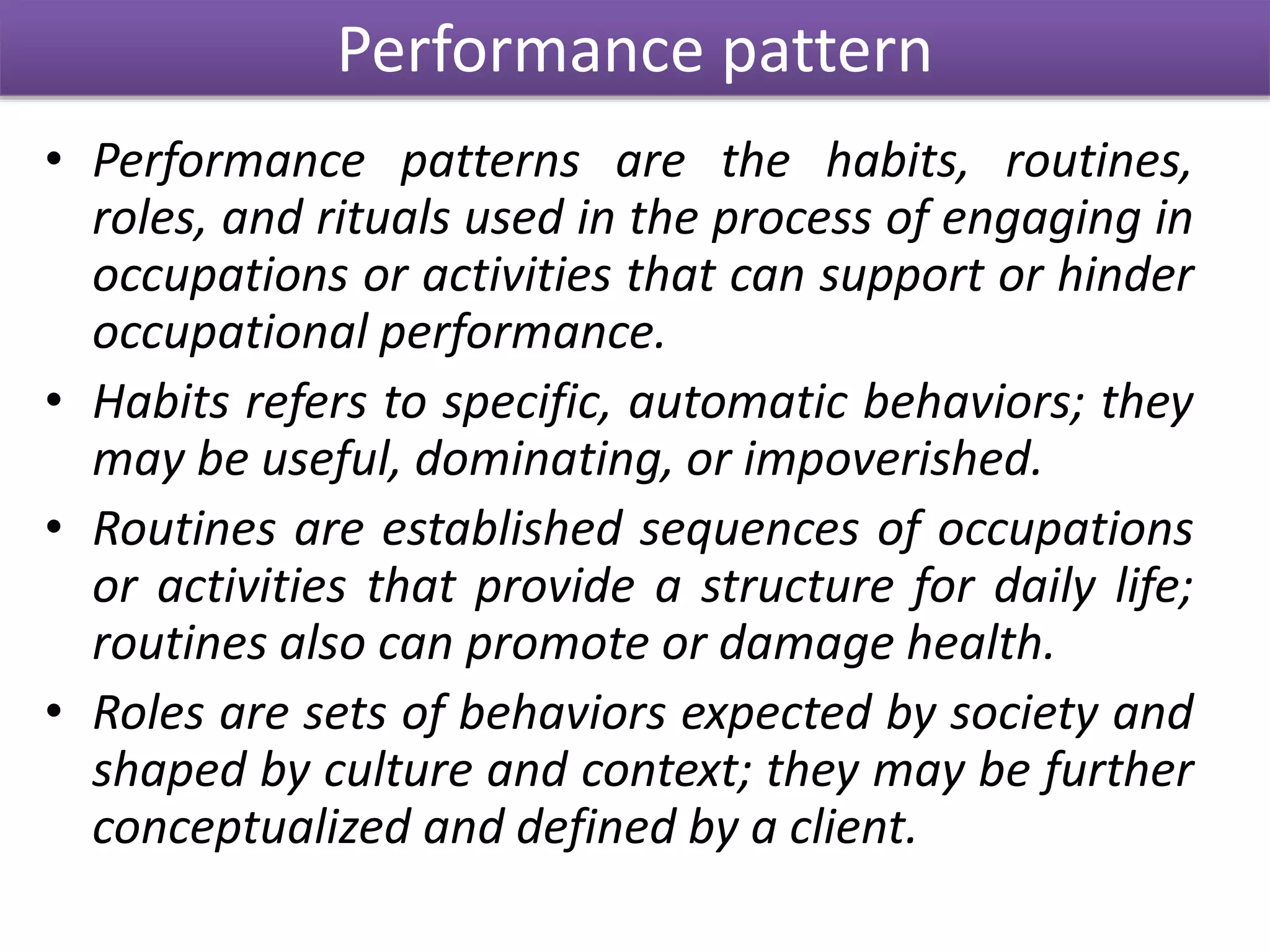
• Performance patterns are the habits, routines,
roles, and rituals used in the process of engaging in
occupations or activities that can support or hinder
occupational performance.
• Habits refers to specific, automatic behaviors; they
may be useful, dominating, or impoverished.
• Routines are established sequences of occupations
or activities that provide a structure for daily life;
routines also can promote or damage health.
• Roles are sets of behaviors expected by society and
shaped by culture and context; they may be further
conceptualized and defined by a client.
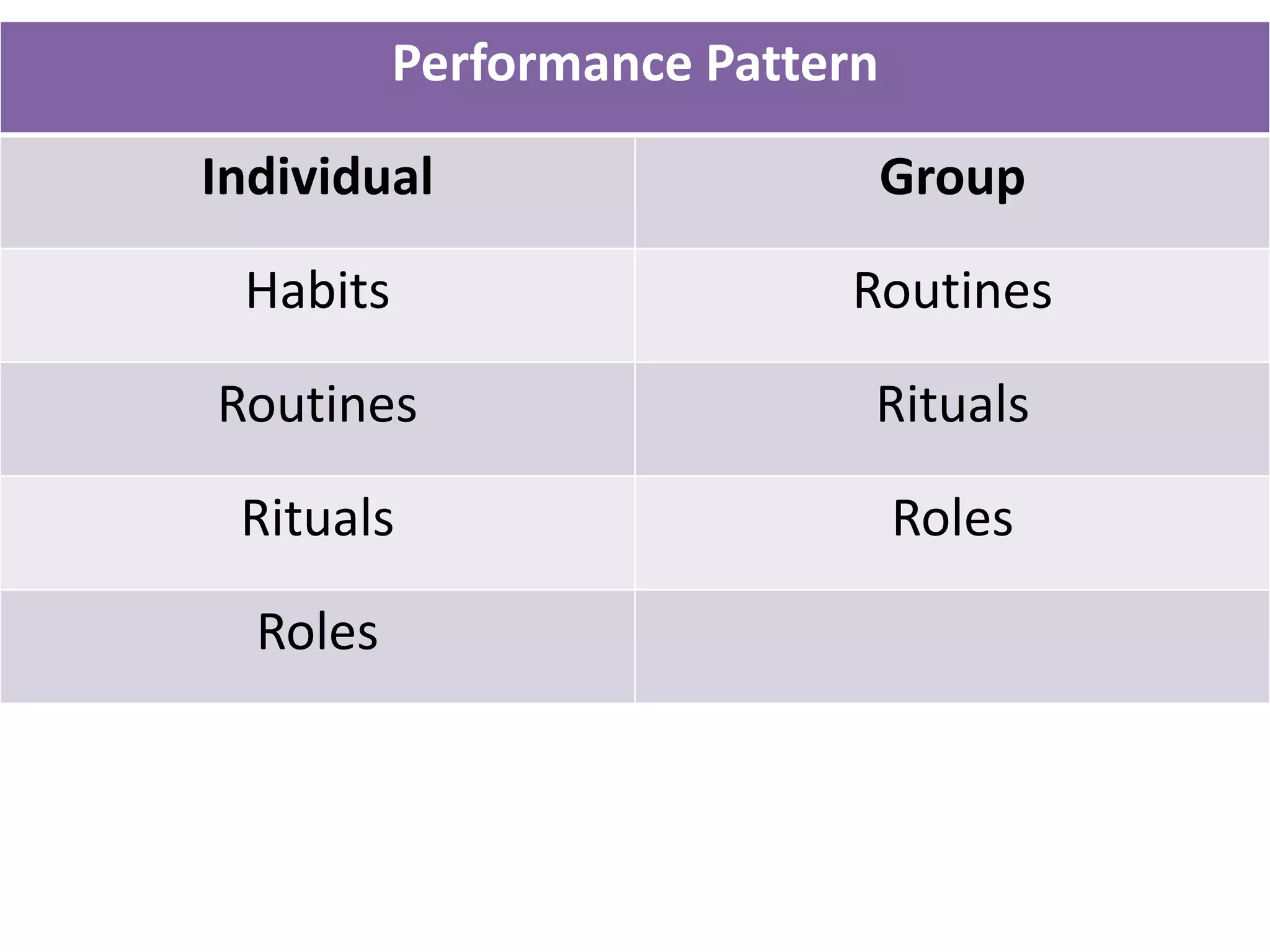
Performance Pattern
Individual Group
Habits Routines
Routines Rituals
Rituals Roles
Roles
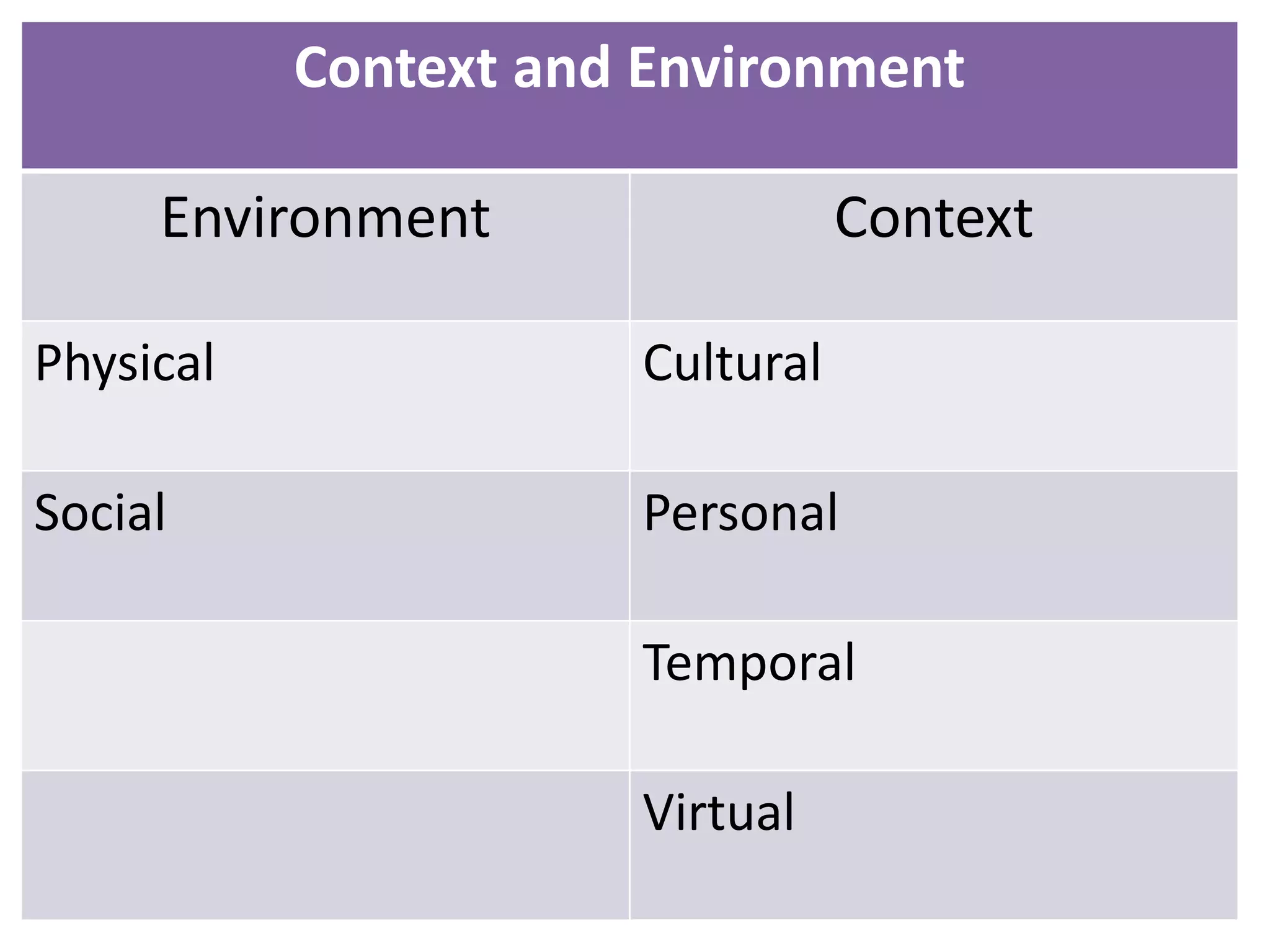
Context and environment
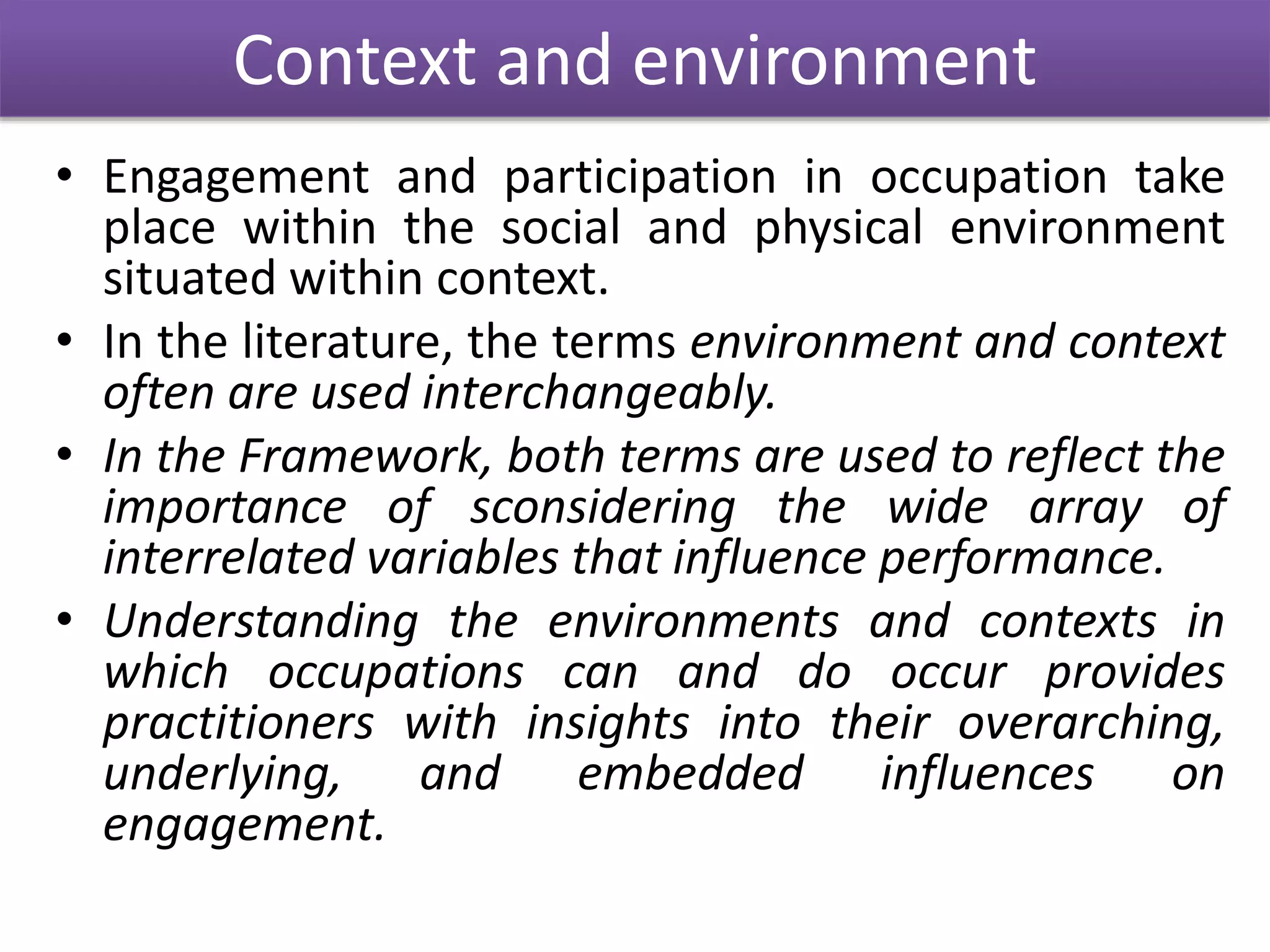
• Engagement and participation in occupation take
place within the social and physical environment
situated within context.
• In the literature, the terms environment and context
often are used interchangeably.
• In the Framework, both terms are used to reflect the
importance of sconsidering the wide array of
interrelated variables that influence performance.
• Understanding the environments and contexts in
which occupations can and do occur provides
practitioners with insights into their overarching,
underlying, and embedded influences on
engagement.
Context and Environment
Environment Context
Physical Cultural
Social Personal
Temporal
Virtual
Occupational Therapy Practice Framework- American Occupational Therapy Association

Occupational Therapy Practice Framework- American Occupational Therapy Association

  • 2.
    Introduction • The OccupationalTherapy Practice Framework: Domain and Process, 3rd edition (hereinafter referred to as “the Framework”), is an official document of the American Occupational Therapy Association (AOTA). • Intended for occupational therapy practitioners and students, other health care professionals, educators, researchers, payers, and consumers, the Framework presents a summary of interrelated constructs that describe occupational therapy practice.
  • 4.
    Occupations • Activities of dailyliving (ADLs) • Instrumental activities of daily living (IADLs) • Rest and sleep • Education • Work • Play • Leisure • Social participation Client factors • Values, beliefs, and • spirituality • Body functions • Body structures Performance skills • Motor skills • Process skills • Social interaction skills Performance patterns • Habits • Routines • Rituals • Roles Contexts and environments • Cultural • Personal • Physical • Social • Temporal • Virtual
  • 5.
    Occupation • “Occupation isused to mean all the things people want, need, or have to do, whether of physical, mental, social, sexual, political, or spiritual nature and is inclusive of sleep and rest. It refers to all aspects of actual human doing, being, becoming, and belonging. • The practical, everyday medium of self-expression or of making or experiencing meaning, occupation is the activist element of human existence whether occupations are contemplative, reflective, and meditative or action based” (Wilcock & Townsend, 2014, p. 542).
  • 6.
    Areas of Occupation •Activities of daily living (ADLs) • Instrumental activities of daily living (IADLs) • Rest and sleep • Education • Work • Play • Leisure • Social participation
  • 7.
    Client factors • Clientfactors are specific capacities, characteristics, or beliefs that reside within the person and that influence performance in occupations. • Client factors are affected by the presence or absence of illness, disease, deprivation, disability, and life experiences. • Although client factors are not to be confused with performance skills, client factors can affect performance skills. • Thus, client factors may need to be present in whole or in part for a person to complete an action (skill) used in the execution of an occupation. • In addition, client factors are affected by performance skills, performance patterns, contexts and environments, and performance and participation in activities and occupations.
  • 8.
    CLIENT FACTORS • Clientfactors include: (1) values, beliefs, and spirituality; (2) body functions; and (3) body structures that reside within the client that influence the client’s performance in occupations.
  • 9.
    Performance Skills • Performanceskills are goal-directed actions that are observable as small units of engagement in daily life occupations. • They are learned and developed over time and are situated in specific contexts and environments (Fisher & Griswold, 2014). • Fisher and Griswold (2014) categorized performance skills as motor skills, process skills, and social interaction skills (Table 3).
  • 10.
    List of performanceskills Motor skills Process skills Social interaction skills Aligns Paces Gathers Approaches/Starts Thanks Stabilizes Attends Terminates Concludes/disengages Transitions Positions Heeds Searches Produces speech Time response Reaches Choose Organizes Gesticulates Time duration Bends Uses Restores Speaks fluently Takes turns Grips Handles Navigates Turns toward Matches languageManipulates Inquires Notices Looks Coordinates Initiates Adjust Places sell Acknowledges & encouragesMoves Continues Accommodates Touches Lifts Sequences Benefits Regulates Empathizes Walks Questions Heeds Transports Replies Accommodates Paces Discloses Benefits Express emotion Disagrees Clarifies
  • 11.
    Performance pattern • Performancepatterns are the habits, routines, roles, and rituals used in the process of engaging in occupations or activities that can support or hinder occupational performance. • Habits refers to specific, automatic behaviors; they may be useful, dominating, or impoverished. • Routines are established sequences of occupations or activities that provide a structure for daily life; routines also can promote or damage health. • Roles are sets of behaviors expected by society and shaped by culture and context; they may be further conceptualized and defined by a client.
  • 12.
    Performance Pattern Individual Group HabitsRoutines Routines Rituals Rituals Roles Roles
  • 13.
    Context and environment •Engagement and participation in occupation take place within the social and physical environment situated within context. • In the literature, the terms environment and context often are used interchangeably. • In the Framework, both terms are used to reflect the importance of sconsidering the wide array of interrelated variables that influence performance. • Understanding the environments and contexts in which occupations can and do occur provides practitioners with insights into their overarching, underlying, and embedded influences on engagement.
  • 14.
    Context and Environment EnvironmentContext Physical Cultural Social Personal Temporal Virtual