Model of Human Occupation, Fourth Edition offers a complete and current presentation of the most widely used model in occupational therapy, and delivers the latest in MOHO theory, research, and application to practice.
The Model ofHuman Occupation
Kielhofner,2008
Forsyth&Kielhofner,2006
Kielhofner&Forsyth,1997
Occupational Therapy Division
University of Cape Town
‘Matumo Ramafikeng
2.
The Focus ofthe Model
The motivation for occupation
The patterning of occupational behaviour/
performance into routines and lifestyles
The nature of skilled performance
The influence of the environment on
occupational performance
3.
Fundamental concepts
1. Humanoccupation is complex
2. A person is made up of components
3. The environment influences performance
4. Occupational performance
4.
Human occupation iscomplex
Basic assumptions:
The human is a dynamic system- elements of
the system work together to produce
behaviour.
Behaviour is dynamic and context dependent.
Occupations are central to human
experience, survival and satisfaction
Therapy enables people to reshape their
occupational abilities and identities,
therefore becoming more adaptive.
5.
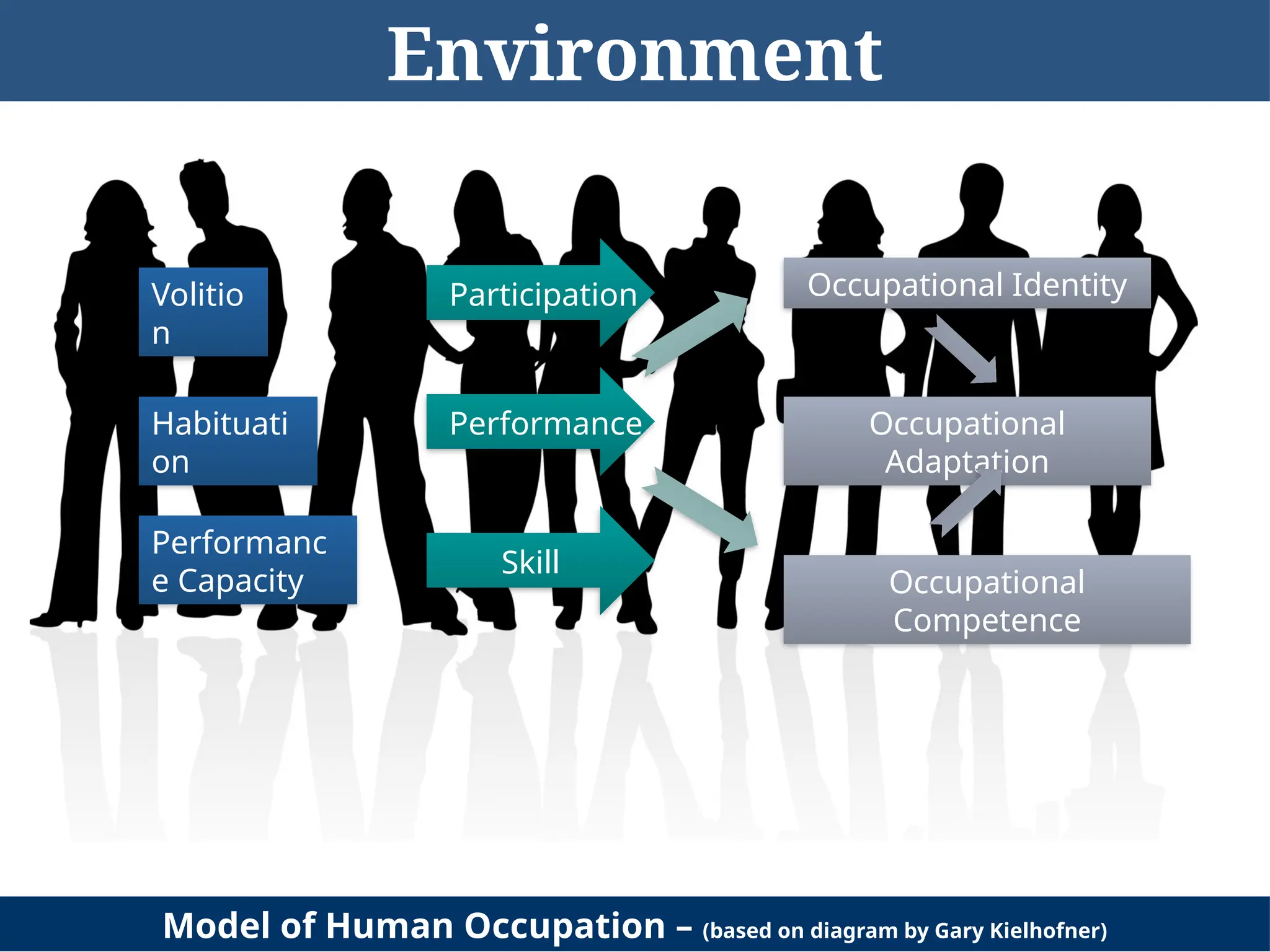
Components of theperson
Volition- values, interests and personal causation
Habituation- habits and roles
Performance capacity- the mental and physical
attributes and lived experiences
6.
Volition
A systemof dispositions (cognitive and emotive)
for particular occupations
A system of self-knowledge
Allows people to anticipate, choose, experience and
interpret occupational behaviour
Three underlying factors: values, interests and
personal causation
The process of motivation that guides choice of
activity and occupation
Personal narratives – storytelling and story making
7.
Values
Informed bybeliefs, commitments and
significance attached to occupation
Create a disposition to perform according to
what is good, right and important as determined
by culture
Determines the kinds of occupations chosen
based on importance and meaningfulness
Occupational goals
Personal standards
Consequences for acting against values
8.
Interests
Dispositions associatedwith pleasure and
satisfaction
Generated from experience or based on
anticipation of enjoyment
Pleasurable experiences can lead to attraction
and preference of certain occupations or
performances
Potency – degree to which interests influence
9.
Personal Causation
Knowledgeof self as being able to affect changes
in the environment effectively
Dynamic process of unfolding thoughts and
feelings about own capabilities to act
Internal vs. external control
Influences anticipation, choice, experience and
interpretation of activities, hence motivation for
action.
Expectancy of success or failure
10.
Habituation
Triggers andguides the performance of routine
behaviour
Integration into rhythms of our temporal, social,
physical and cultural environment is through
patterns of behaviour
Looks at familiar and automatic aspects of daily
occupational behaviour
Consists of habits and roles
11.
Habits
Automatic learnedways of acting or responding
in familiar situations
Repetition of actions or behaviour in a consistent
environment is crucial for habits to develop
Operate at a preconscious level
Influence a wide range of behaviour patterns
Regulate how time is used, generate styles of
behaviour, influence how an activity is
performed regularly
Habit Maps: Recognise familiar events and
environments to construct appropriate
behaviour to achieve an implicit goal
12.
Roles
A positionin a social group that has expectations
for particular behaviours and actions related to
the status
Internalised and learnt
Behaviour and actions are constructed according
to a social identity
Habits regulate routine behaviour within roles
Role scripts: guide understanding of social
13.
Performance Capacity
Relatesto physical and mental capabilities and
lived experiences that shape performance
Ability to perform, based on the status of
objective (capabilities) and subjective (lived
experiences) components
Musculoskeletal, neurological, cardiopulmonary,
symbolic (perceptual and cognitive)
Ability to receive – plan – programme plans of
action and effect action through the body
Performance components are important for
performance, but do not cause or produce
behaviour directly
14.
The Environment
Theenvironment provides opportunities for
performance and presses for certain behaviour
Press and provides concurrently – synergy of
influences to channel behaviour
Comprises of physical, social, cultural,
economic and political aspects
Impacts on how occupations are motivated,
organised and performed
People seek to explore and master their
environments
Contains objects, spaces, occupational tasks
and culture, economic and political influences.
15.
Occupational Performance
Resultsfrom a heterarchical contribution from the
components of the person and the environment
Occupational performance is dynamic- influenced
and shaped by external environment
Spontaneous and must be understood in the context
of emerging action and contextual conditions
All elements of the system contribute together to
determine occupational performance (human, task,
environment)
16.
Occupational performance
Describesthe actual doing at different levels:
skill, performance, occupational identity,
competence and adaptation
Skill- purposeful, observable actions that are
used while performing.
Three types of skill: motor, process and
communication and interaction skills
Skills can be influenced by both environmental
and personal factors.
17.
Occupational performance
Performance-completing an occupational
form
Participation- engagement in occupations
that are desired or crucial for health and
well-being within one’s sociocultural context.
Occupations relate to work, play or activities
of daily living.
18.
Occupational performance
OccupationalIdentity- sense of who we are and
who we want to be as occupational beings as
derived from occupational participation history
Includes sense of capacity and effectiveness in
performing in relation to components of volition
and habituation.
19.
Occupational performance
OccupationalCompetence- degree of sustaining a
pattern of occupational participation that reflects
who we are
Competence motivates for continuation of
exploration, achievement and control over doing
Constitutes putting identity into action, by
fulfilling expectations of roles, maintaining
routine and pursuing values and acting in order
to achieve desired goals.
Mastery – adds to feelings of competence
Inability to master leads to reduction in
exploration – implications for health with
decrease in occupational involvement
20.
Occupational performance
OccupationalAdaptation- the result of
developing a positive occupational identity
and reaching a level of occupational
competence
A dynamic process that takes place overtime
and is context dependant.
Through occupational therapy there is a
potential for all clients to become more
Understanding function-
dysfunction
Providesa perspective on adaptive functioning –
how occupations are motivated, organised,
performed and influenced by the environment
A framework for understanding the interrelated
factors that are part of a dysfunctional state
Personal – unique ways in which factors interact
to affect dysfunctional states
23.
Using the Modelin Practice
Therapeutic occupations can transform people
into healthier and adaptive beings
Therapeutic occupations restore, reorganise or
maintain motivation, patterning and
performance capacity, therefore occupational
lives of clients
Guides gathering and interpretation of clinical
information – seek out information to answer
questions that have been generated by the
theoretical perspective of the model
Appreciation of the life that the individual has
lived and might live
24.
Dialectic emergesbetween information gathered
and theory used to make sense of the
information – create an explanation of the
client’s circumstances
Understand client’s narrative in relation to
theoretical basis of the model
Need to enable human system to achieve a new
dynamic order – bridge between the past and the
future
Using the Model in Practice
References
Kielhofner, G.2008. Model of Human Occupation
Theory and Application. 4th
Ed. Baltimore:
Lippincott Williams & Wilkins.
Forsyth, K. & Keilhofner. 2006. The Model of
Human Occupation: Integrating theory into
practice. In Duncan, E.A.S. (ed). 2006.
Foundations for practice in occupational Therapy.
4th
Edition. Elsevier Limited: London.
MOHO Clearing House. [Online] Available:
http://www.moho.uic.edu/mohorelatedrsrcs.html
#OtherMOHOproducts
27.
This work islicensed under the
Creative Commons Attribution-Non
commercial-Share Alike 2.5 South
Africa License. To view a copy of this
license, visit
http://creativecommons.org/licenses/by
-sa/2.5/za/
![References
Kielhofner, G. 2008. Model of Human Occupation
Theory and Application. 4th
Ed. Baltimore:
Lippincott Williams & Wilkins.
Forsyth, K. & Keilhofner. 2006. The Model of
Human Occupation: Integrating theory into
practice. In Duncan, E.A.S. (ed). 2006.
Foundations for practice in occupational Therapy.
4th
Edition. Elsevier Limited: London.
MOHO Clearing House. [Online] Available:
http://www.moho.uic.edu/mohorelatedrsrcs.html
#OtherMOHOproducts](https://image.slidesharecdn.com/modelofhumanoccupation-250531084905-9226430b/75/Model-of-Human-Occupation-in-Occupational-Therapy-26-2048.jpg)



![Number_Guessing_Game_Dsbsbssbzboc[1].pptx](https://cdn.slidesharecdn.com/ss_thumbnails/numberguessinggamedoc1-251206215042-a076fc05-thumbnail.jpg?width=640&height=640&fit=bounds)


