ACTIVITYANALYSIS
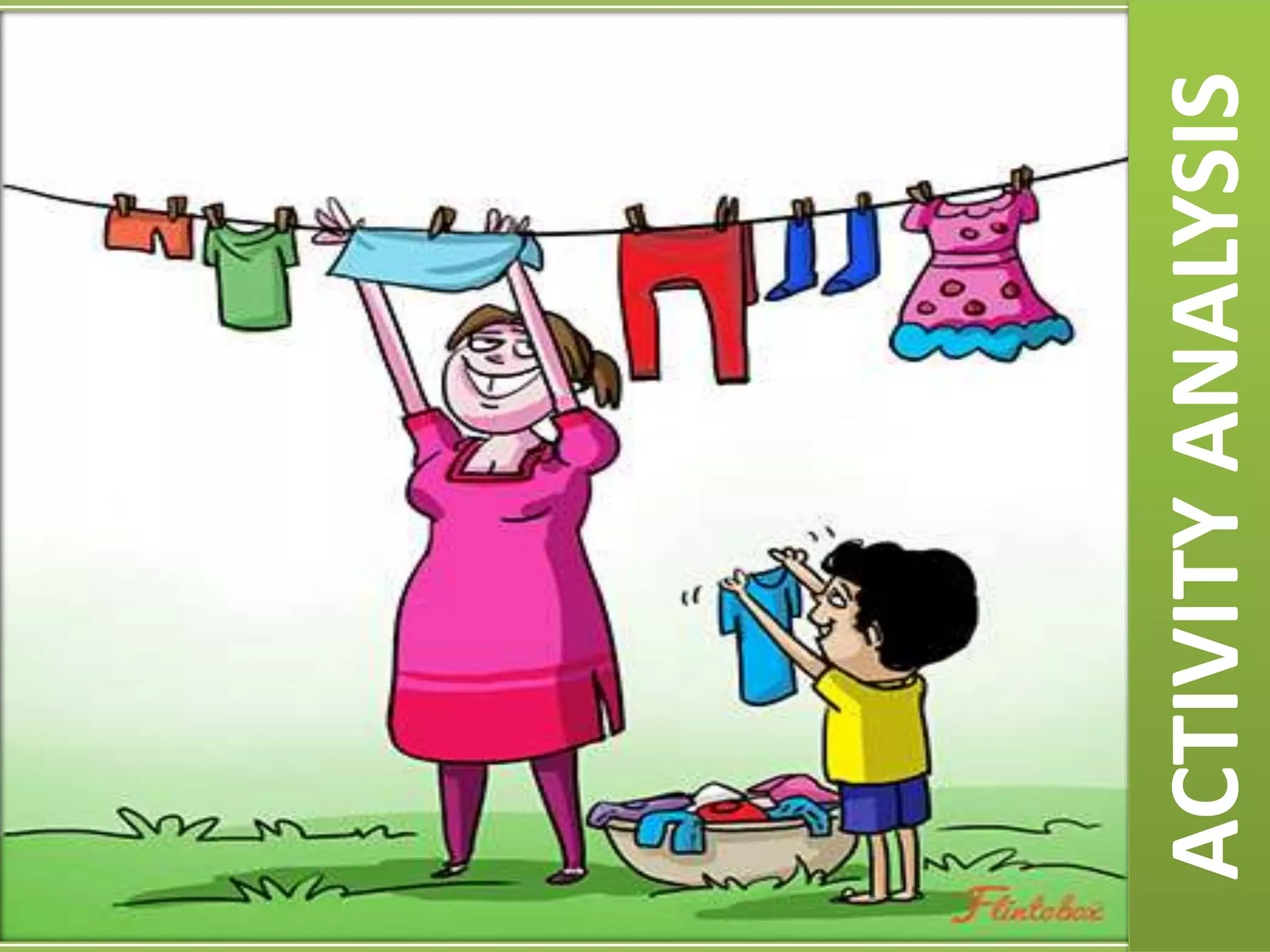
ACTIVITY ANALYSIS
Shamima Akter
B. Sc (Honors) in Occupational Therapy
& M. Sc in Rehabilitation Science
Assistant Professor,
Department of Occupational Therapy
Bangladesh Health Professions Institute (BHPI)
Centre for the Rehabilitation of the Paralysed (CRP)
Chapain, Savar
Activity Analysis
Activity analysis is a fundamental skill of
occupational therapists. A process used to identify
the inherent properties is a given occupation, task,
or activity as well as skills, abilities or capacities
required to complete it. (Trombly, 5th ed.). There
are three different perspectives of activity analysis:
• Activity- Focused Analysis
• Client-Focused Activity Analysis
• Environment-Client-Focused Activity Analysis
TS1_Shamima_2018
• Task- focused activity analysis/ Activity- focused
analysis- Deconstruction of activity itself outside of
the client-specific application to build student’s or
clinician’s repertoire of therapeutic occupations.
• Client- focused activity analysis- Description of the
reasoning used in the therapeutic use of occupation-
as-means for a particular therapeutic goal for a
particular person.
• Client-environment fit analysis- Deconstruction of
the specific activity-environment-person fit to
determine and/or optimize the likelihood of
successful performance of occupation-as-end.
TS1_Shamima_2018
REASON OF USING ACTIVITY ANALYSIS
• To contribute to the clinical reasoning of
Occupational Therapy practitioner.
• To break the activity down to small steps.
• To whether or not a person can perform an
activity.
• Therapist analyses the activity to understand the
functional requirements (performance
components are needed to perform the activity).
Then compares the requirements of the activity
and tries to find out the answer of – Does the
client has the necessary performance components
to perform this activity?TS1_Shamima_2018
Continue
• To determine the appropriateness of activity for a
particular client in terms of developmental needs,
age, personal interests, gender, cultural
relevance.
• To determine the potential use of activity as a
treatment tool.
• To identify required resources, both intrinsic
(related to person’s abilities) and extrinsic (cost,
space, environment, time, skills, staffs).
• To identify an activity potential for modification.
• To identify risk, hazards and precautions.TS1_Shamima_2018
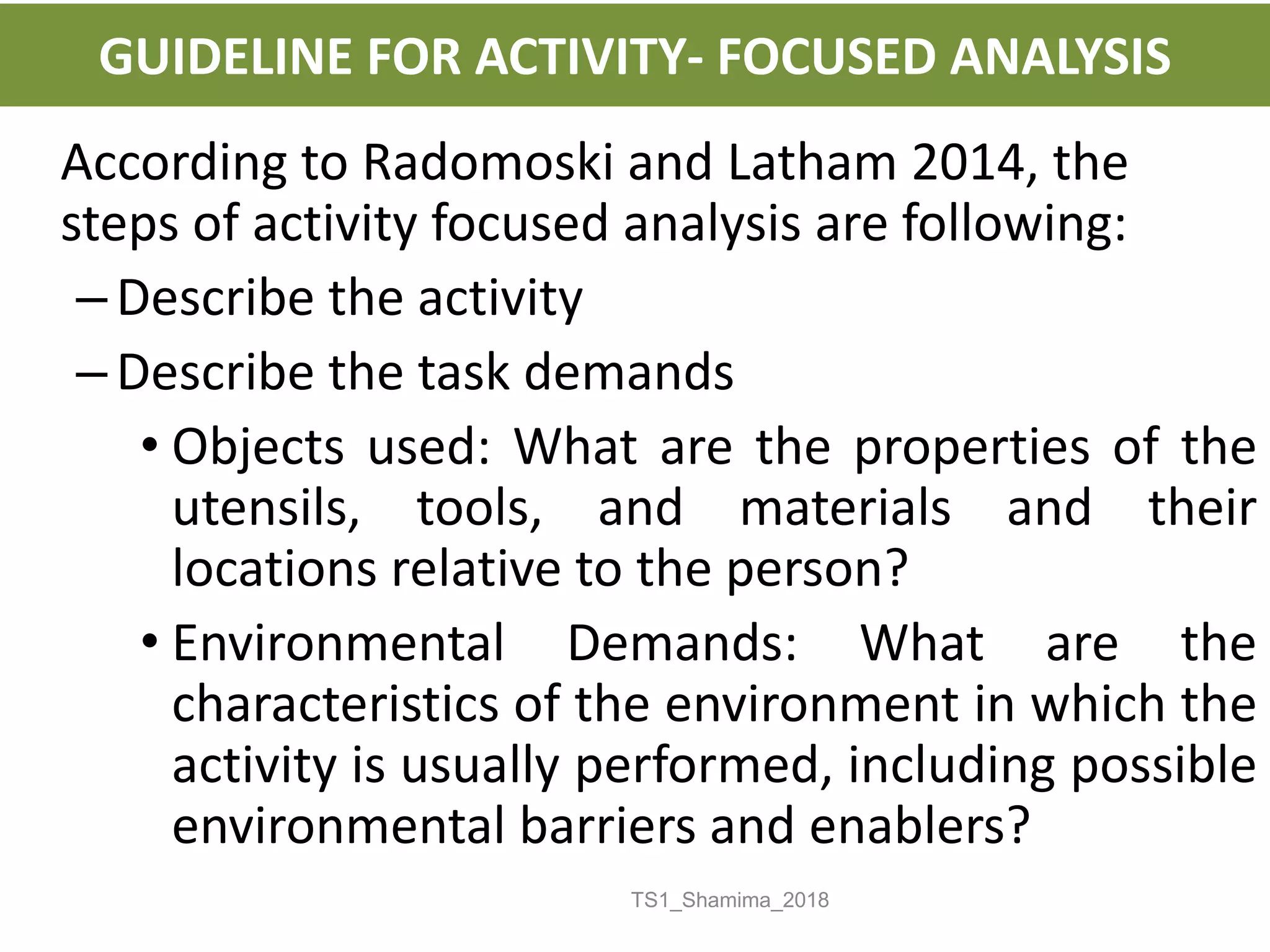
GUIDELINE FOR ACTIVITY- FOCUSED ANALYSIS
According to Radomoski and Latham 2014, the
steps of activity focused analysis are following:
–Describe the activity
–Describe the task demands
• Objects used: What are the properties of the
utensils, tools, and materials and their
locations relative to the person?
• Environmental Demands: What are the
characteristics of the environment in which the
activity is usually performed, including possible
environmental barriers and enablers?
TS1_Shamima_2018
Continue…
– Social Demands: What is the nature of and
extent to which the activity involves others and
/or holds particular meaning associated with
social roles?
– Contextual demands
– Sequencing and timing
– Required actions: What are the steps of activity?
– Prerequisite capabilities, abilities, and skills
(sensorimotor, visual-perceptual, cognitive, or
psychosocial)
– Safety Precautions
TS1_Shamima_2018
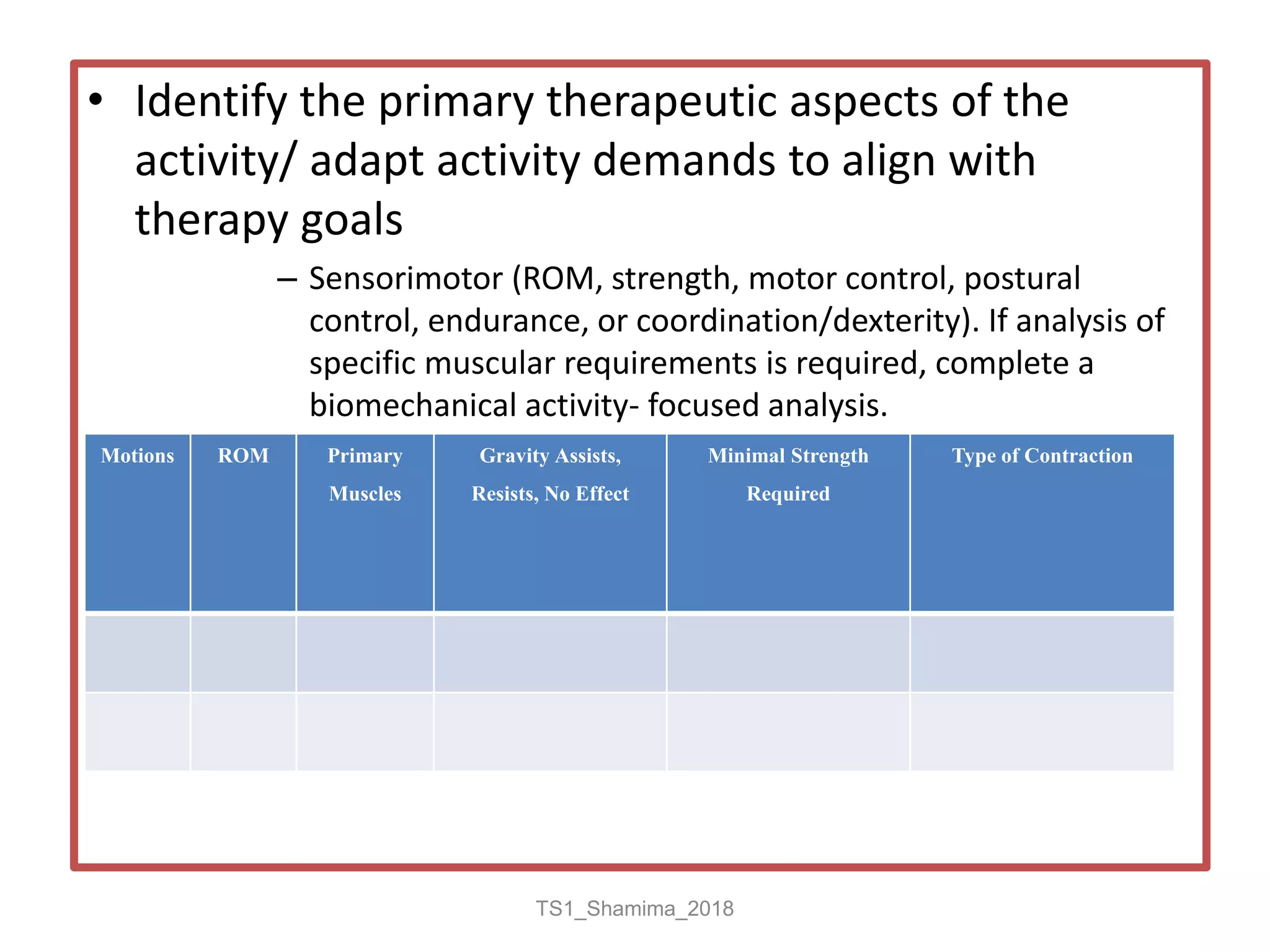
• Identify the primary therapeutic aspects of the
activity/ adapt activity demands to align with
therapy goals
– Sensorimotor (ROM, strength, motor control, postural
control, endurance, or coordination/dexterity). If analysis of
specific muscular requirements is required, complete a
biomechanical activity- focused analysis.
TS1_Shamima_2018
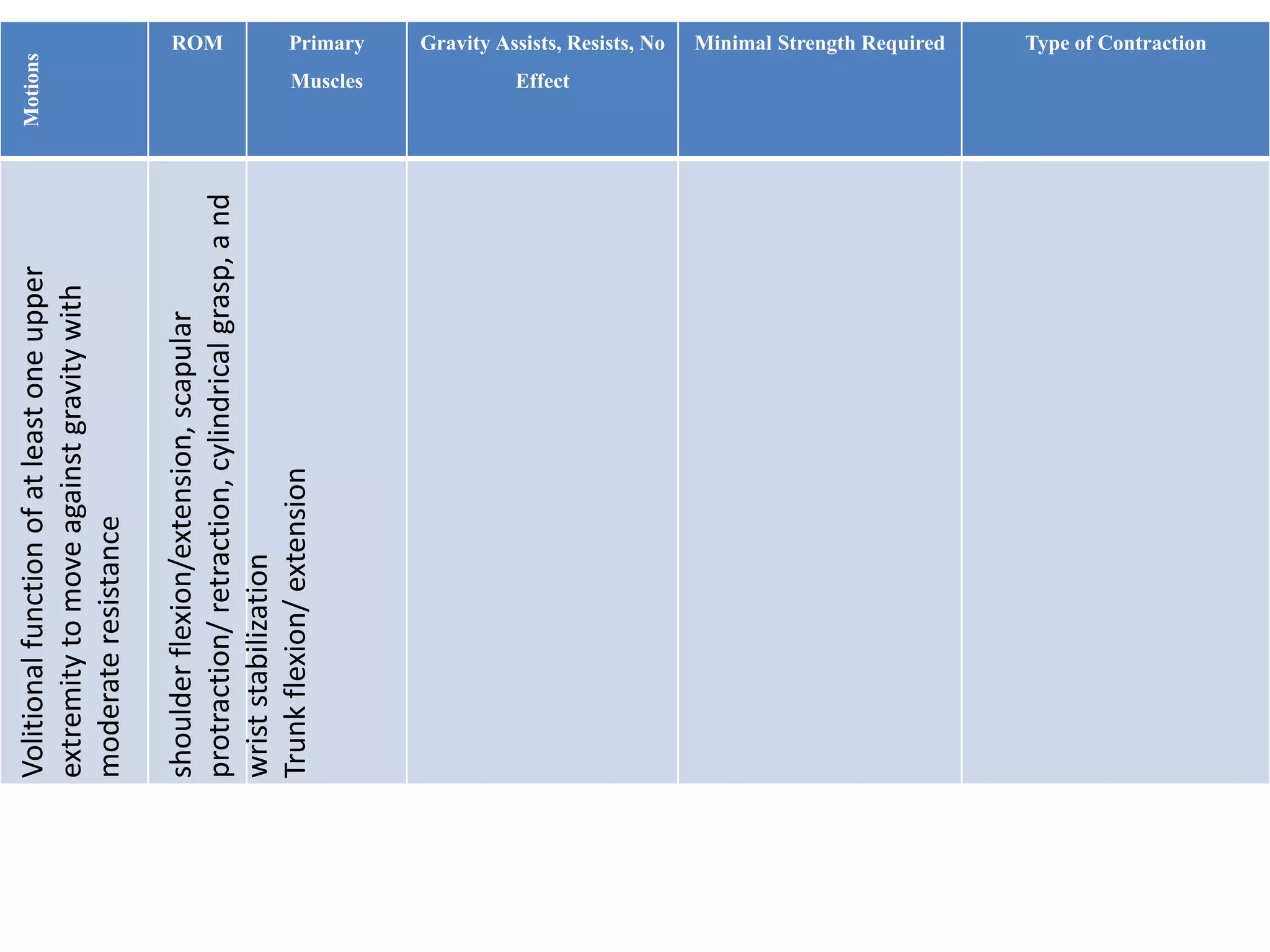
Motions ROM Primary
Muscles
Gravity Assists,
Resists, No Effect
Minimal Strength
Required
Type of Contraction
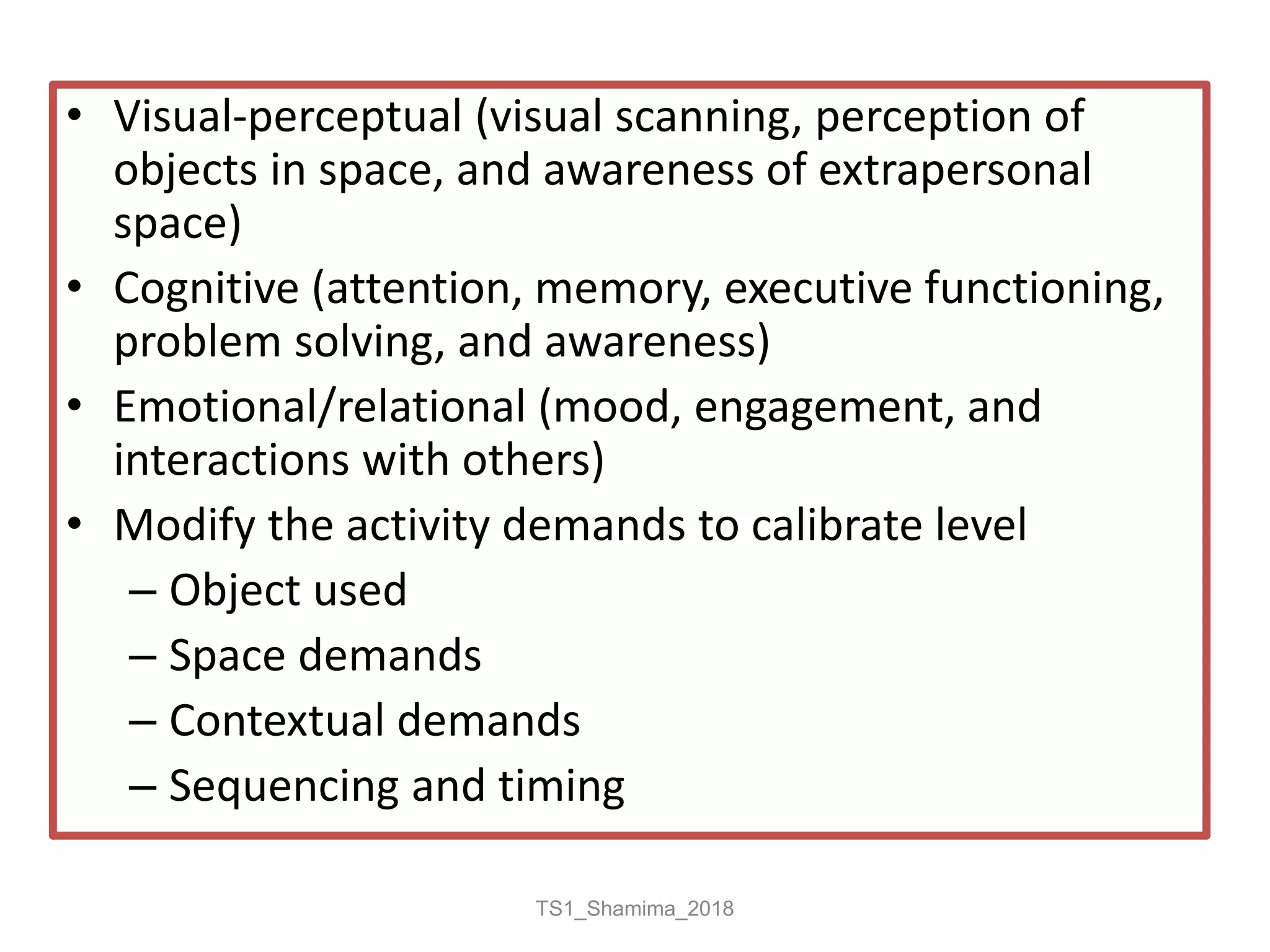
• Visual-perceptual (visual scanning, perception of
objects in space, and awareness of extrapersonal
space)
• Cognitive (attention, memory, executive functioning,
problem solving, and awareness)
• Emotional/relational (mood, engagement, and
interactions with others)
• Modify the activity demands to calibrate level
– Object used
– Space demands
– Contextual demands
– Sequencing and timing
TS1_Shamima_2018
Name of activity: Vacuuming the
Halfway Carpet
TS1_Shamima_2018
Task Analysis
Process
ExampleDescribethetaskdemands
ObjectUsed Light weight upright vacuum cleaner with
25- foot cord
Stored in closet next to the area to be
cleaned
TS1_Shamima_2018
Task Analysis
Process
ExampleDescribethetaskdemands
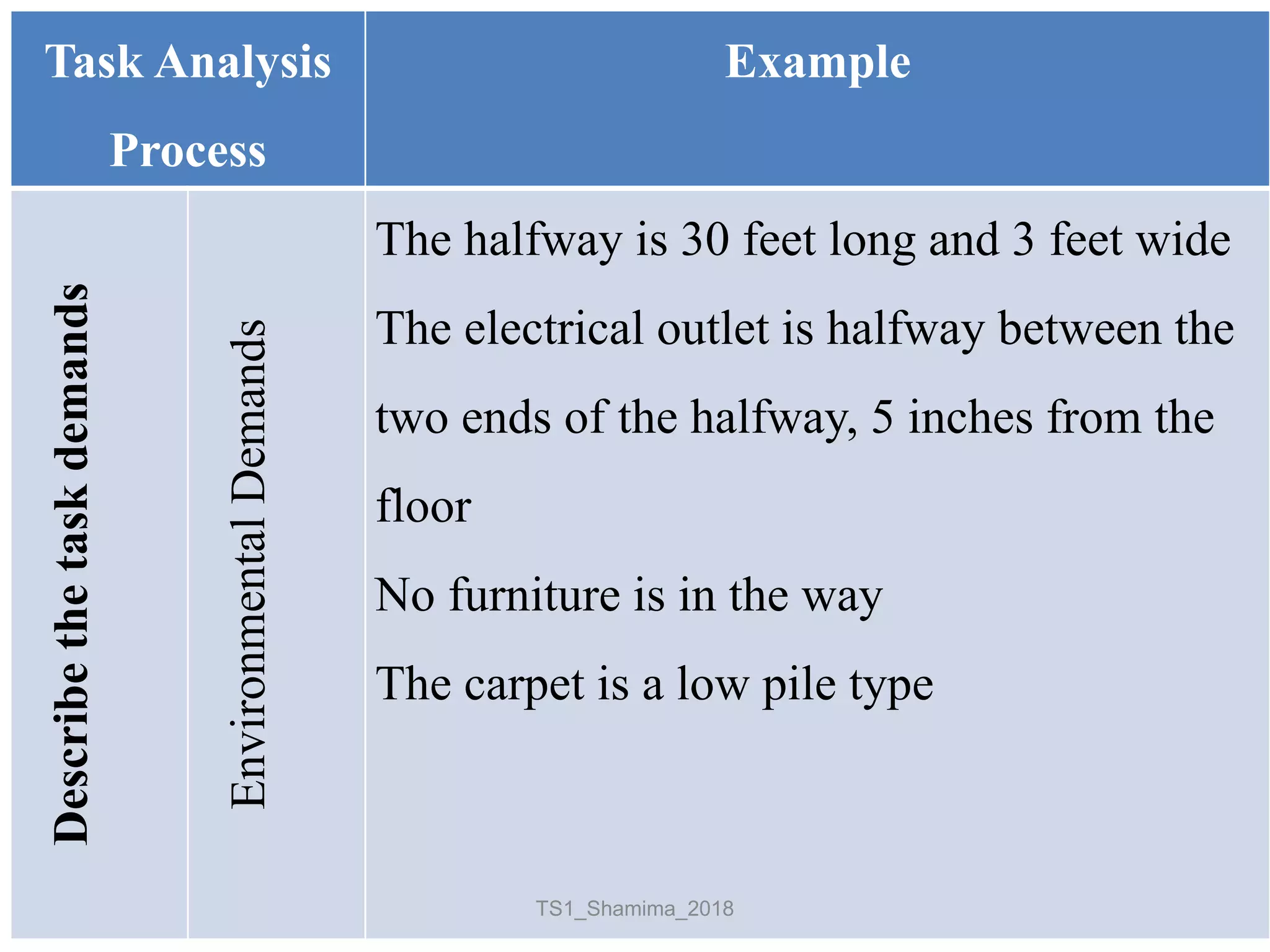
EnvironmentalDemands The halfway is 30 feet long and 3 feet wide
The electrical outlet is halfway between the
two ends of the halfway, 5 inches from the
floor
No furniture is in the way
The carpet is a low pile type
TS1_Shamima_2018
Task Analysis
Process
ExampleDescribethetaskdemands
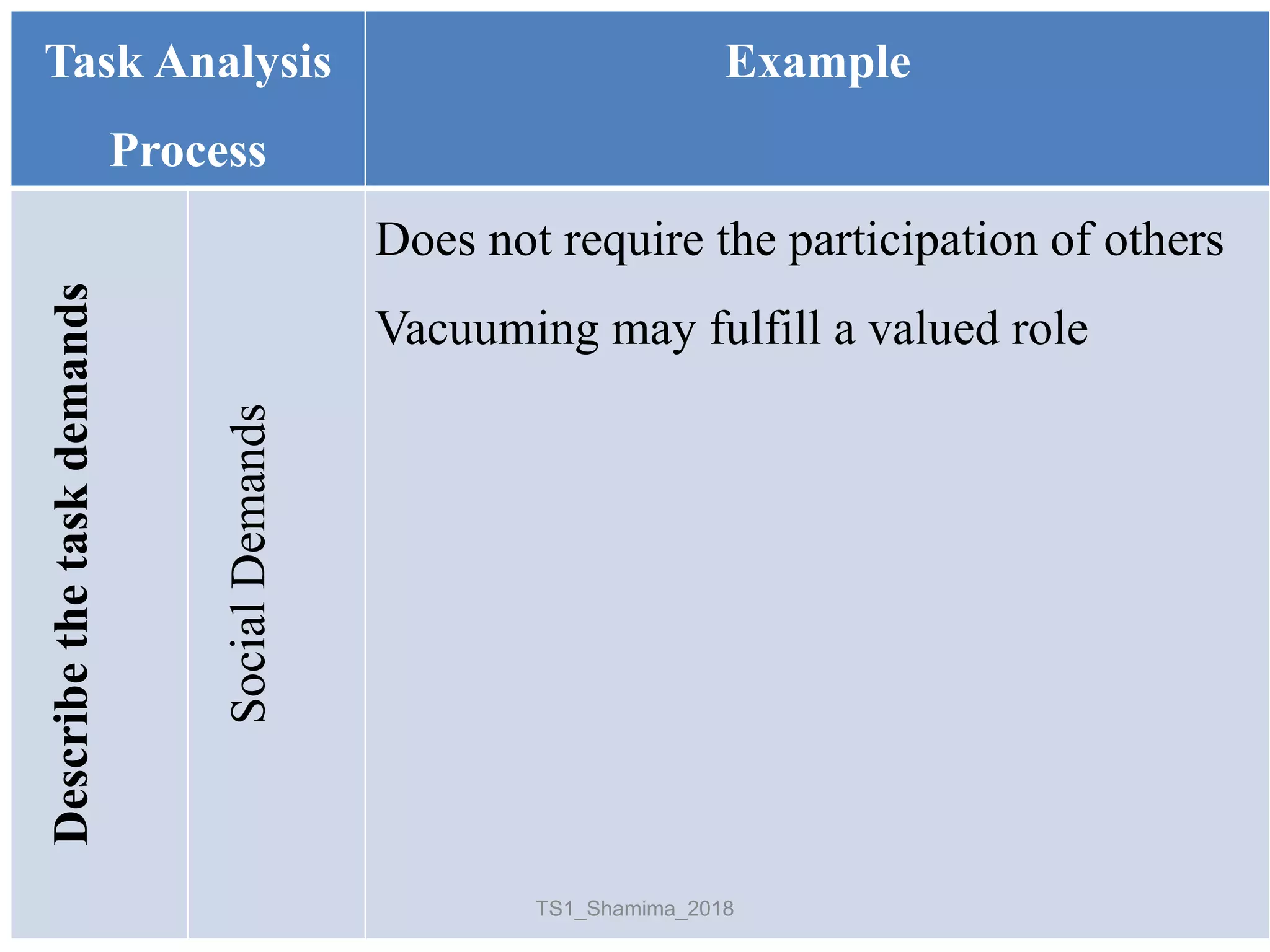
SocialDemands Does not require the participation of others
Vacuuming may fulfill a valued role
TS1_Shamima_2018
Task Analysis
Process
ExampleDescribethetaskdemands
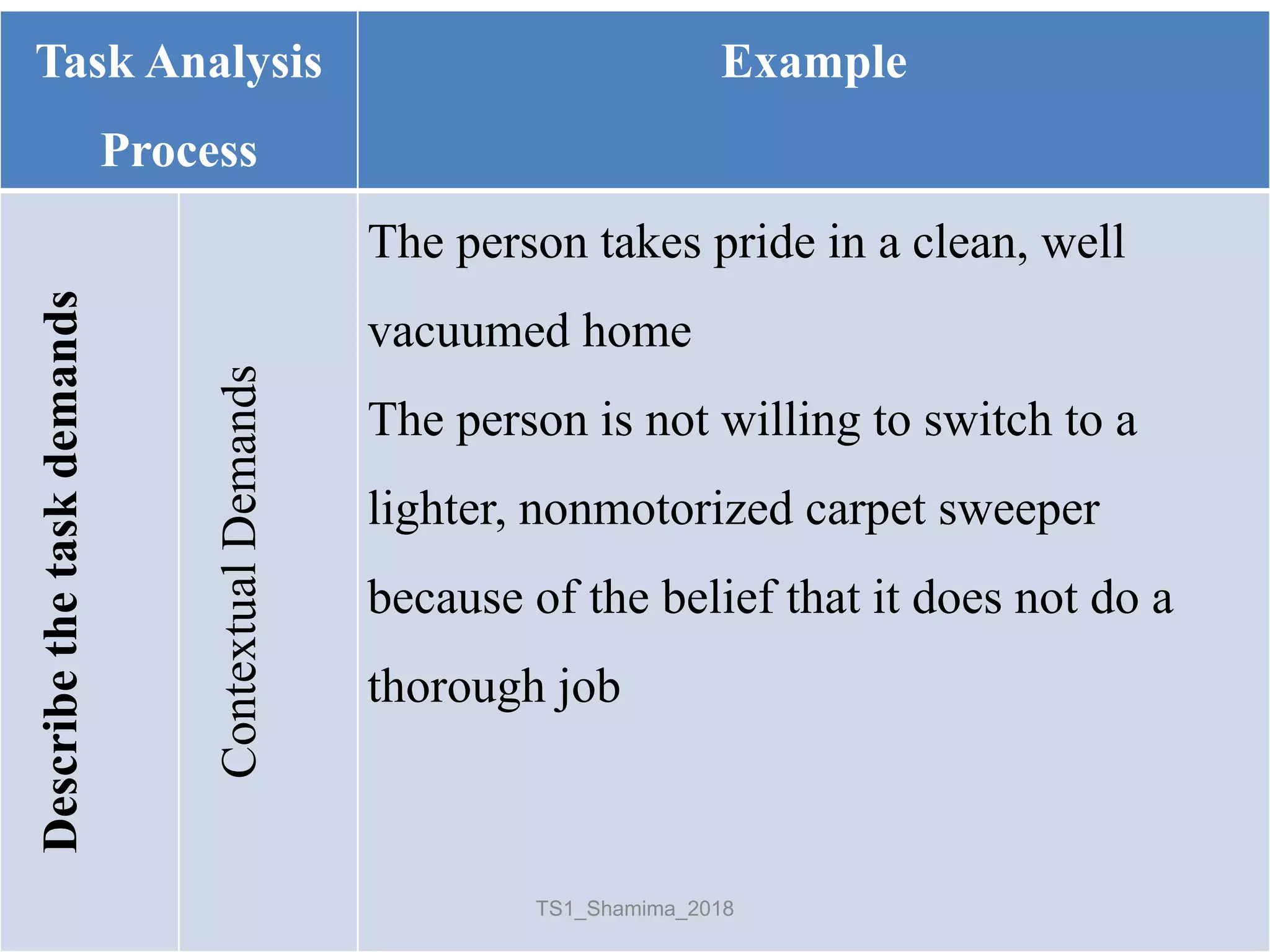
ContextualDemands The person takes pride in a clean, well
vacuumed home
The person is not willing to switch to a
lighter, nonmotorized carpet sweeper
because of the belief that it does not do a
thorough job
TS1_Shamima_2018
Task Analysis
Process
ExampleDescribethetaskdemands
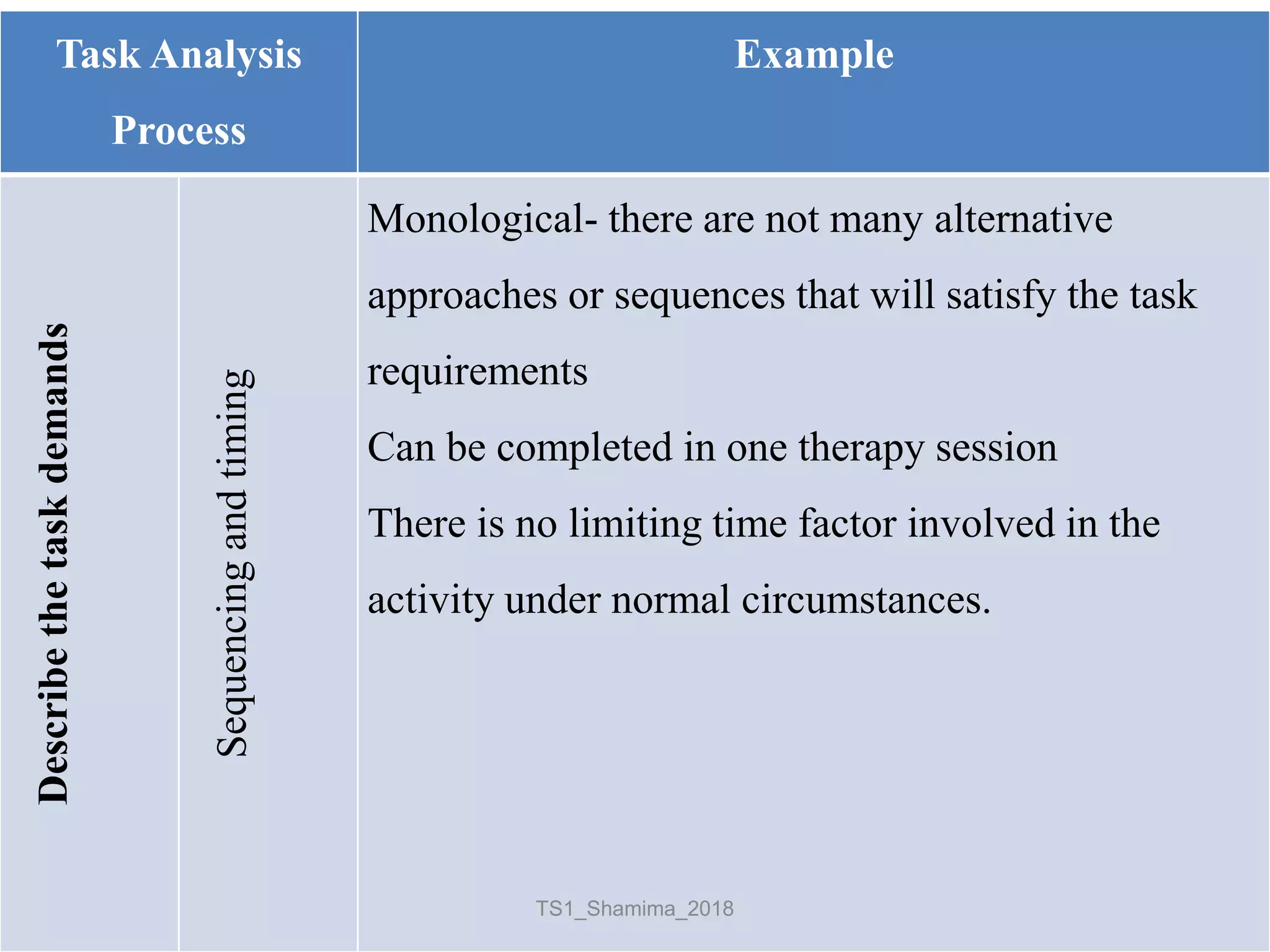
Sequencingandtiming Monological- there are not many alternative
approaches or sequences that will satisfy the task
requirements
Can be completed in one therapy session
There is no limiting time factor involved in the
activity under normal circumstances.
TS1_Shamima_2018
Analysis
Process
ExampleDescribethetaskdemands
Requiredactions
Stepsthatcomprisetheactivity 1. Retrieve the vacuum cleaner from the closet
2. Unwind the electric cord
3. Plug cord into wall outlet
4. Adjust height of vacuum cleaner for carpet use
5. Turn on vacuum cleaner
6. Push vacuum cleaner back and forth
7. Move vacuum on carpet to complete entire carpet
8. Unplug cord from outlet
9. Wind cord on vacuum cleaner
10.Place vacuum cleaner in closet
Identify the primary therapeutic
aspects of the activity/ adapt activity
demands to align with therapy goals
TS1_Shamima_2018
Motions
ROM Primary
Muscles
Gravity Assists, Resists, No
Effect
Minimal Strength Required Type of ContractionVolitionalfunctionofatleastoneupper
extremitytomoveagainstgravitywith
moderateresistance
shoulderflexion/extension,scapular
protraction/retraction,cylindricalgrasp,and
wriststabilization
Trunkflexion/extension
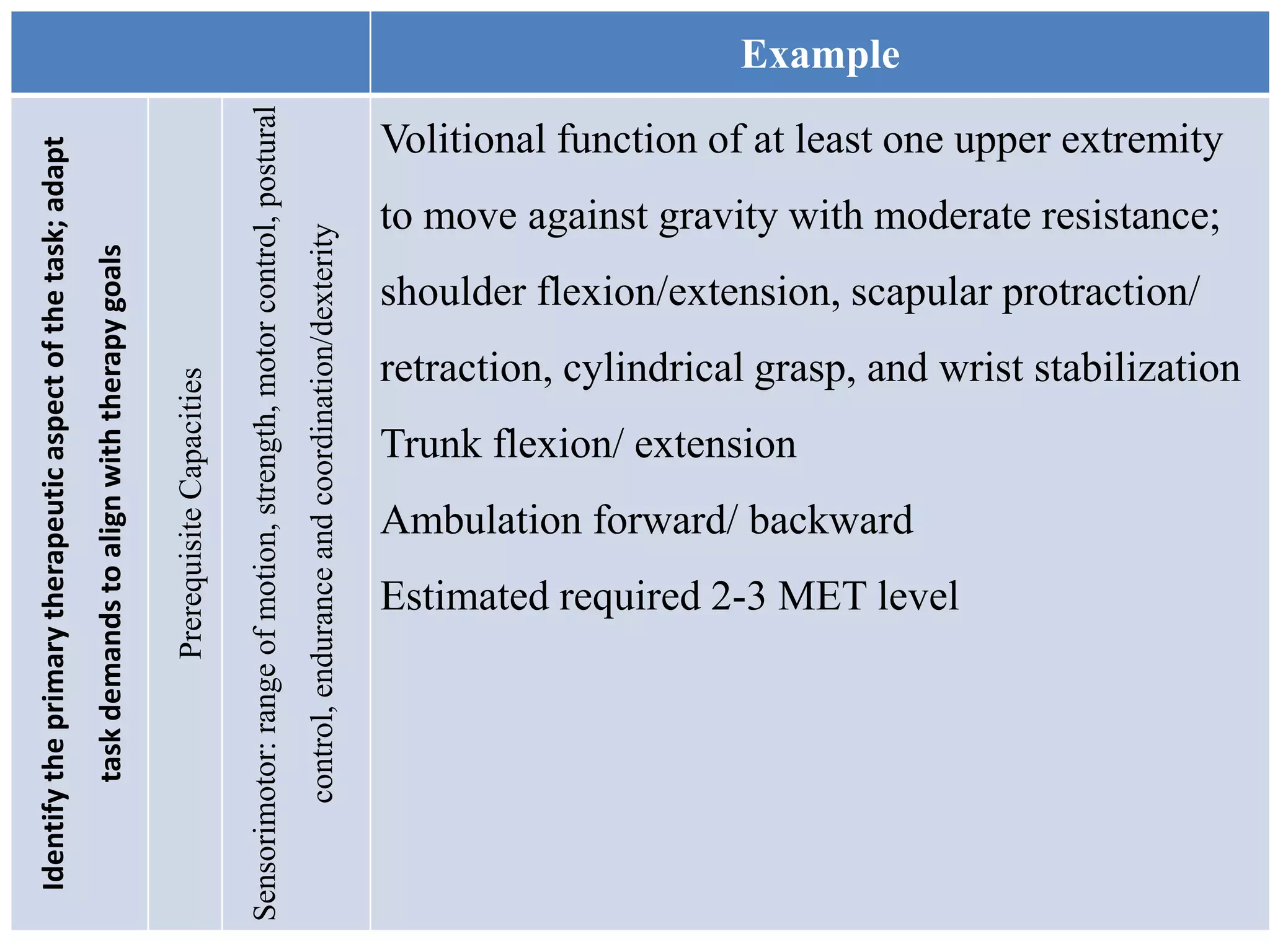
ExampleIdentifytheprimarytherapeuticaspectofthetask;adapt
taskdemandstoalignwiththerapygoals
PrerequisiteCapacities
Sensorimotor:rangeofmotion,strength,motorcontrol,postural
control,enduranceandcoordination/dexterity
Volitional function of at least one upper extremity
to move against gravity with moderate resistance;
shoulder flexion/extension, scapular protraction/
retraction, cylindrical grasp, and wrist stabilization
Trunk flexion/ extension
Ambulation forward/ backward
Estimated required 2-3 MET level
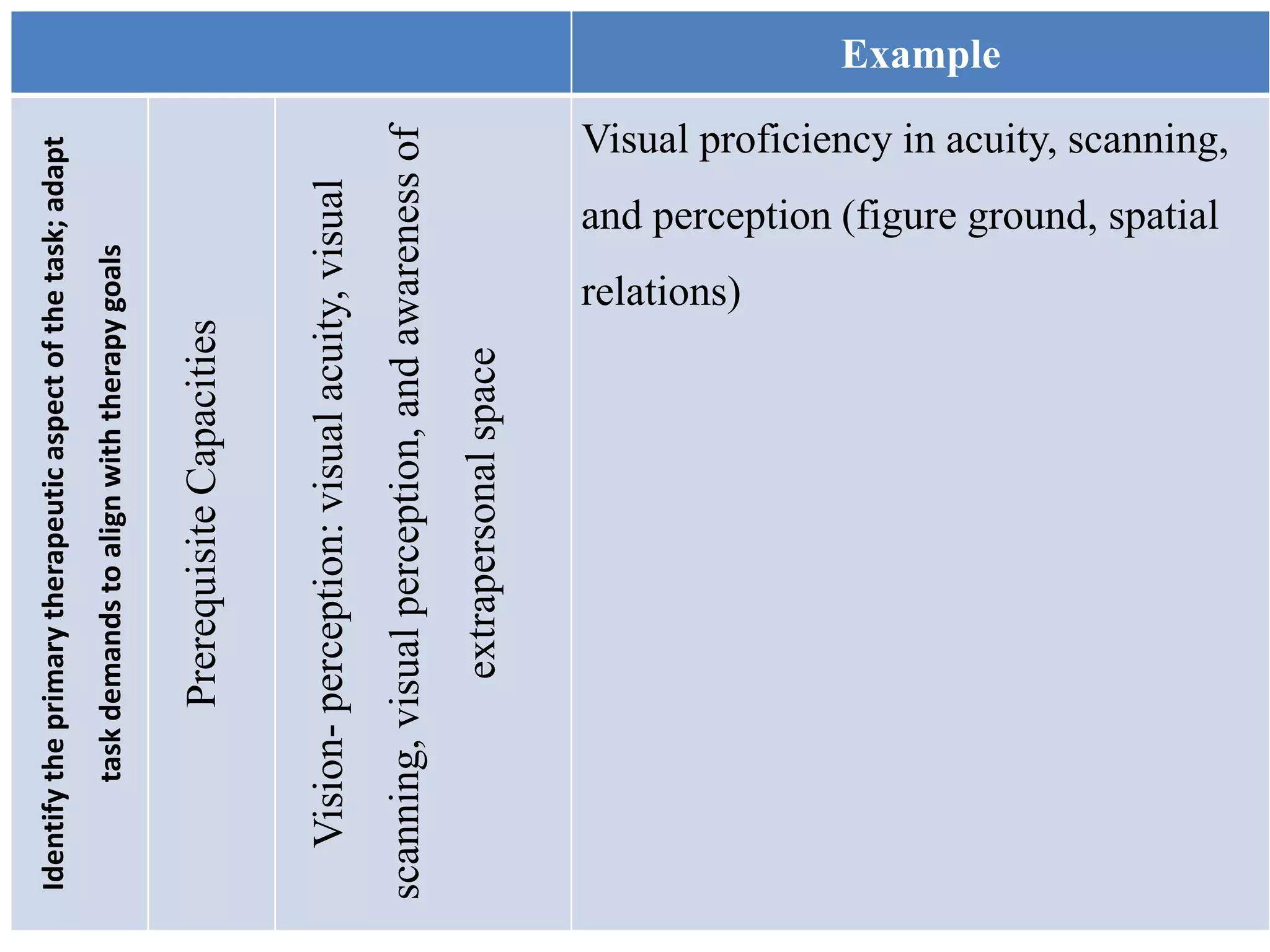
ExampleIdentifytheprimarytherapeuticaspectofthetask;adapt
taskdemandstoalignwiththerapygoals
PrerequisiteCapacities
Vision-perception:visualacuity,visual
scanning,visualperception,andawarenessof
extrapersonalspace
Visual proficiency in acuity, scanning,
and perception (figure ground, spatial
relations)
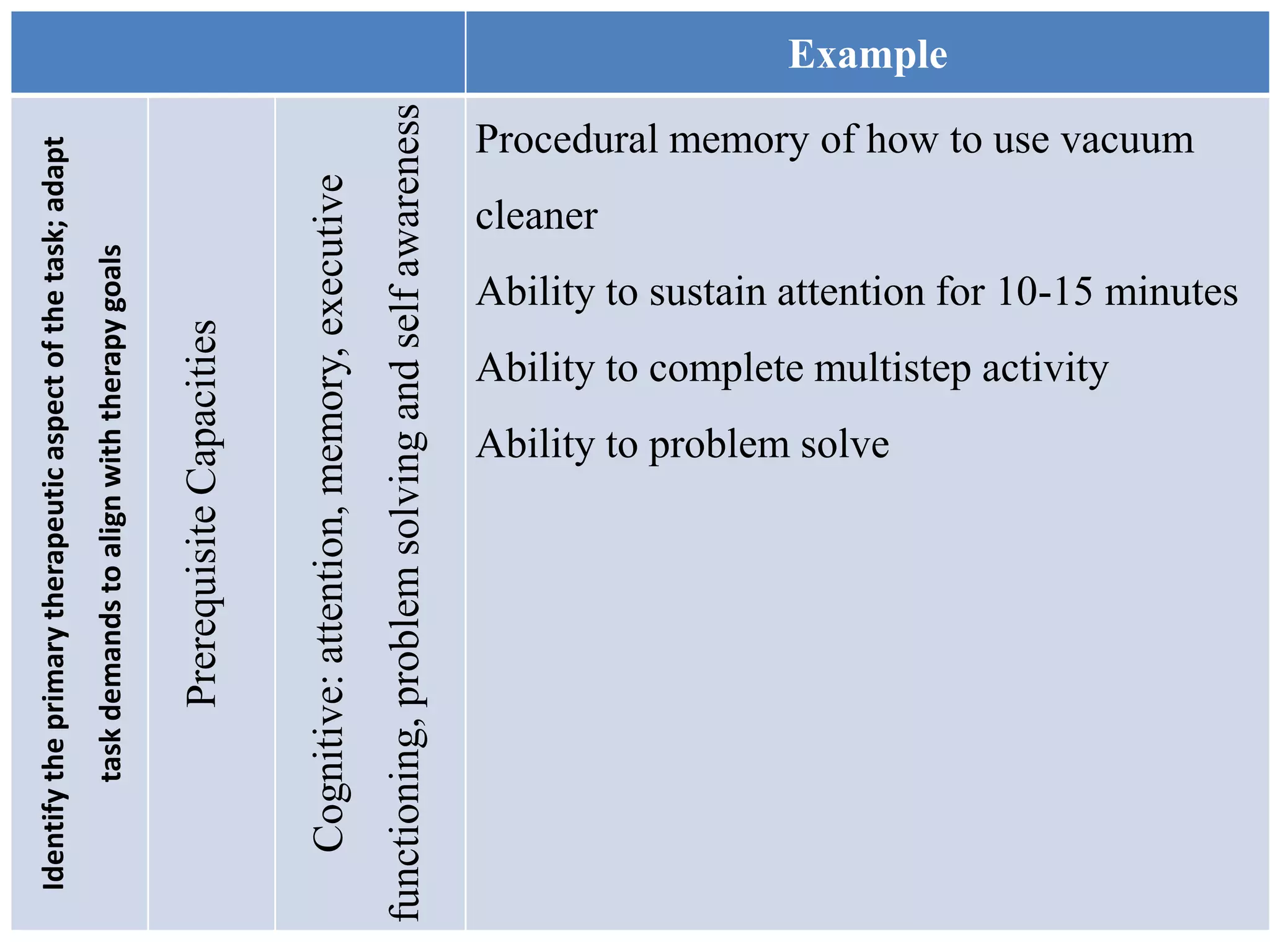
ExampleIdentifytheprimarytherapeuticaspectofthetask;adapt
taskdemandstoalignwiththerapygoals
PrerequisiteCapacities
Cognitive:attention,memory,executive
functioning,problemsolvingandselfawareness
Procedural memory of how to use vacuum
cleaner
Ability to sustain attention for 10-15 minutes
Ability to complete multistep activity
Ability to problem solve
ExampleIdentifytheprimarytherapeuticaspectofthetask;adapt
taskdemandstoalignwiththerapygoals
PrerequisiteCapacities
Cognitive:attention,memory,executive
functioning,problemsolvingandselfawareness
Procedural memory of how to use vacuum
cleaner
Ability to sustain attention for 10-15 minutes
Ability to complete multistep activity
Ability to problem solve
ExampleIdentifytheprimarytherapeuticaspectofthetask;adapt
taskdemandstoalignwiththerapygoals
PrerequisiteCapacities
Emotional,rational
The person takes pride in a clean, well
vacuumed home
Performed without social interaction
ExampleIdentifytheprimarytherapeuticaspectofthetask;adapt
taskdemandstoalignwiththerapygoals
SafetyPrecaution
Natureofsafetyconsiderationsifperformedin
atherapycontext
Patient may need guarding/ supervision
and rest periods related to balance and/or
endurance
Patient may need cueing related to
cognition
Patient my need adaptations because of
low back pain
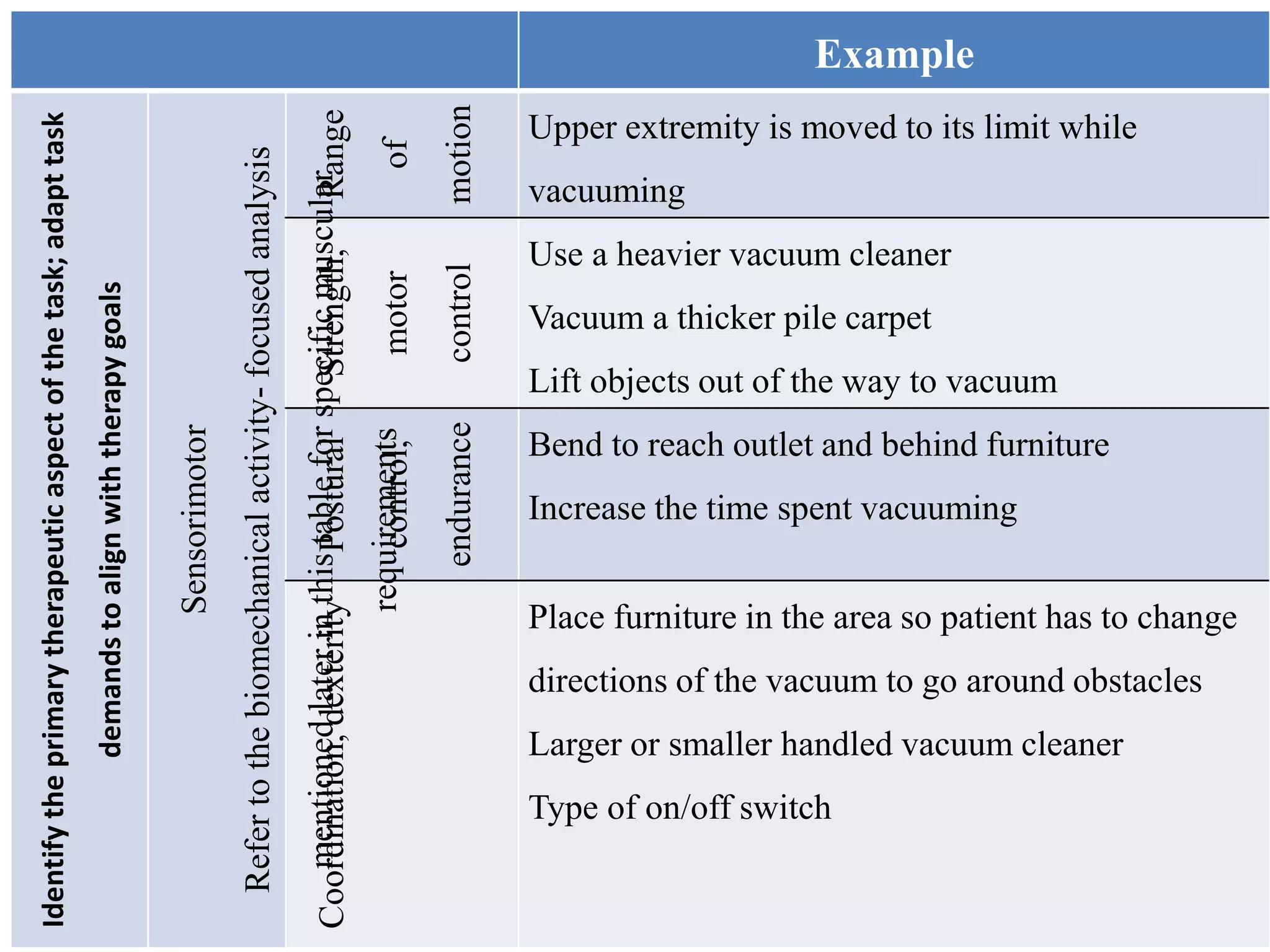
ExampleIdentifytheprimarytherapeuticaspectofthetask;adapttask
demandstoalignwiththerapygoals
Sensorimotor
Refertothebiomechanicalactivity-focusedanalysis
mentionedlaterinthistableforspecificmuscular
requirements
Range
of
motion
Upper extremity is moved to its limit while
vacuuming
Strength,
motor
control
Use a heavier vacuum cleaner
Vacuum a thicker pile carpet
Lift objects out of the way to vacuum
Postural
control,
endurance Bend to reach outlet and behind furniture
Increase the time spent vacuuming
Coordination,dexterity
Place furniture in the area so patient has to change
directions of the vacuum to go around obstacles
Larger or smaller handled vacuum cleaner
Type of on/off switch
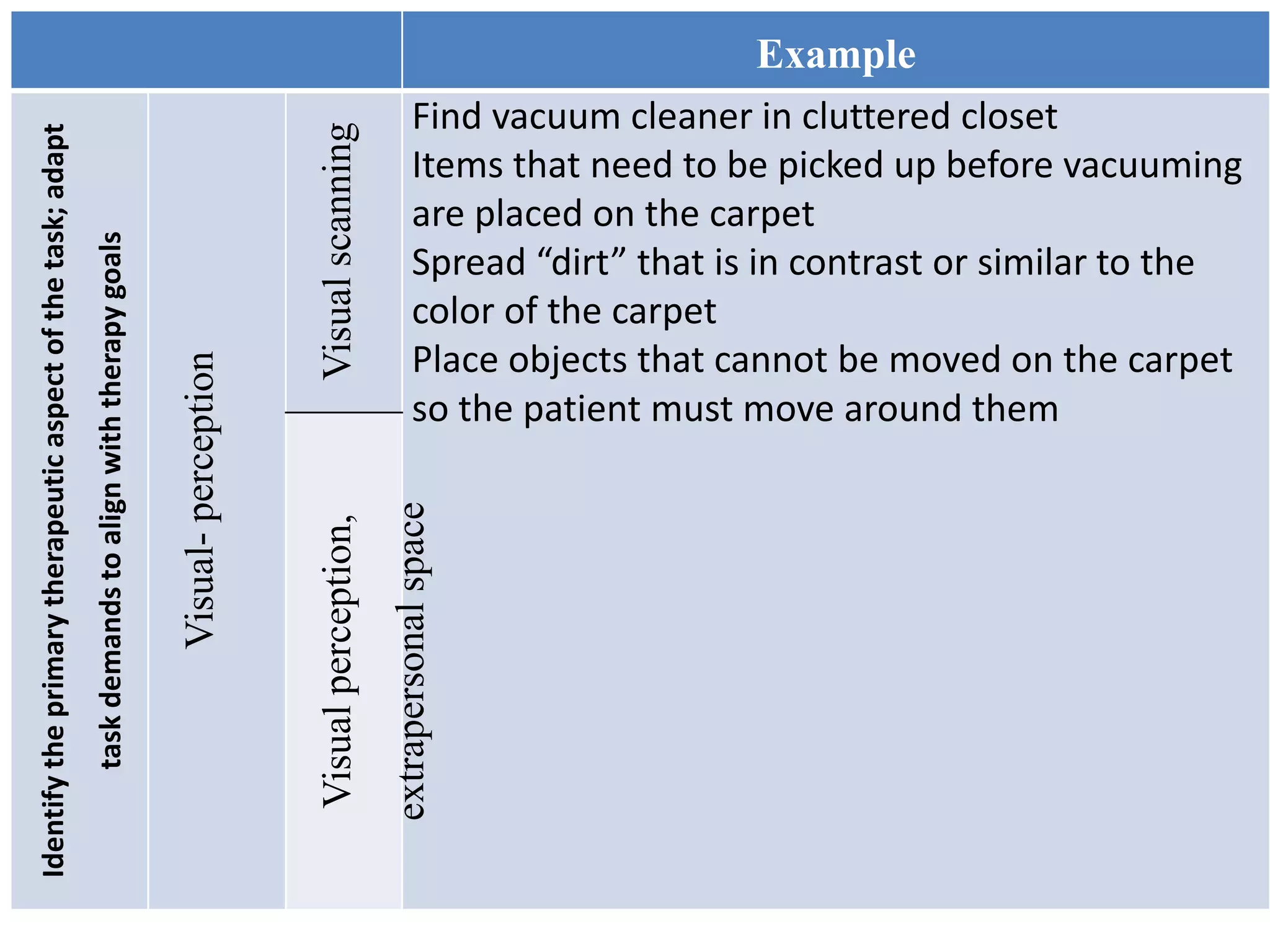
ExampleIdentifytheprimarytherapeuticaspectofthetask;adapt
taskdemandstoalignwiththerapygoals
Visual-perception
Visualscanning
Find vacuum cleaner in cluttered closet
Items that need to be picked up before vacuuming
are placed on the carpet
Spread “dirt” that is in contrast or similar to the
color of the carpet
Place objects that cannot be moved on the carpet
so the patient must move around them
Visualperception,
extrapersonalspace
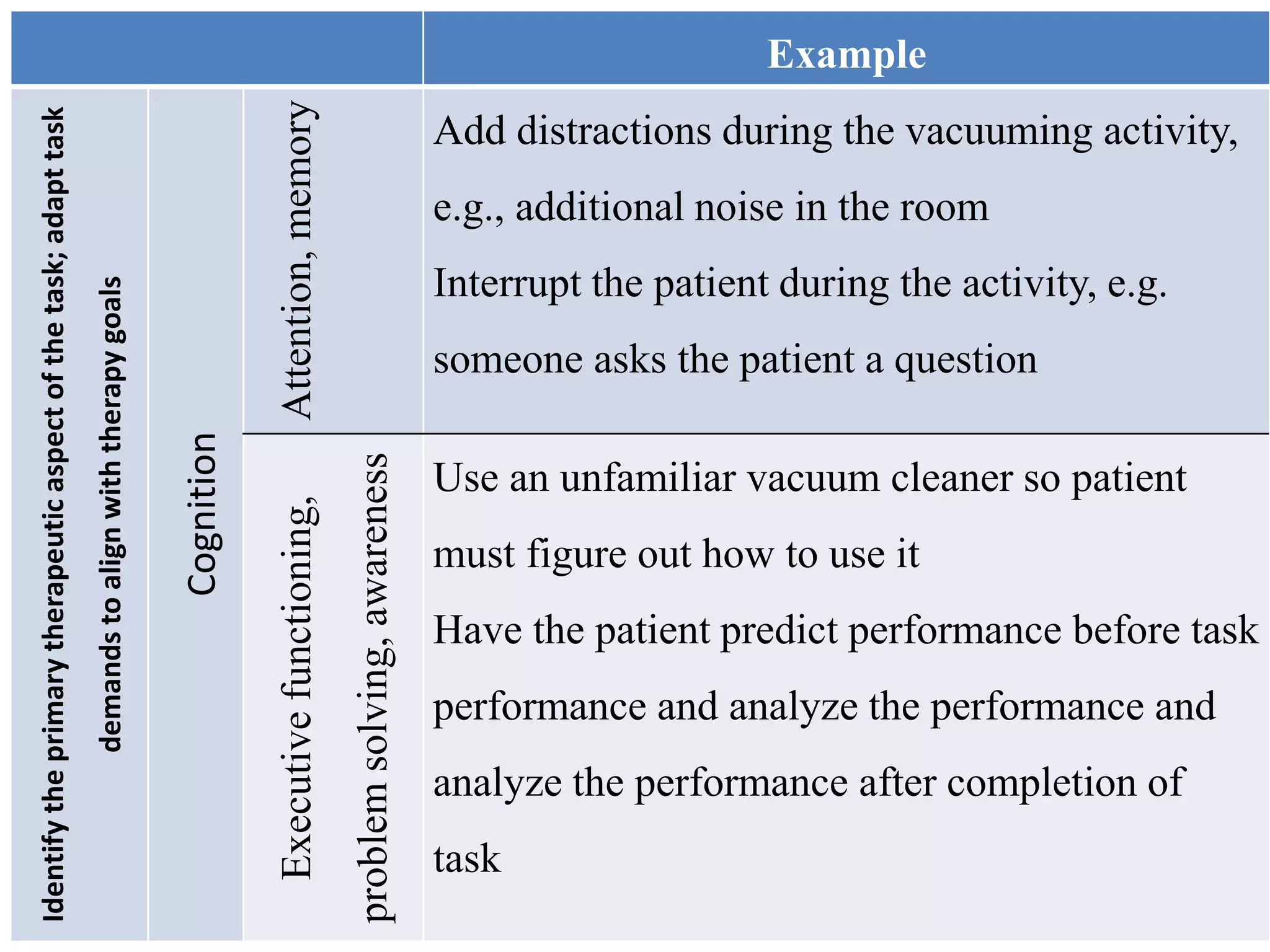
ExampleIdentifytheprimarytherapeuticaspectofthetask;adapttask
demandstoalignwiththerapygoals
Cognition
Attention,memory
Add distractions during the vacuuming activity,
e.g., additional noise in the room
Interrupt the patient during the activity, e.g.
someone asks the patient a question
Executivefunctioning,
problemsolving,awareness
Use an unfamiliar vacuum cleaner so patient
must figure out how to use it
Have the patient predict performance before task
performance and analyze the performance and
analyze the performance after completion of
task
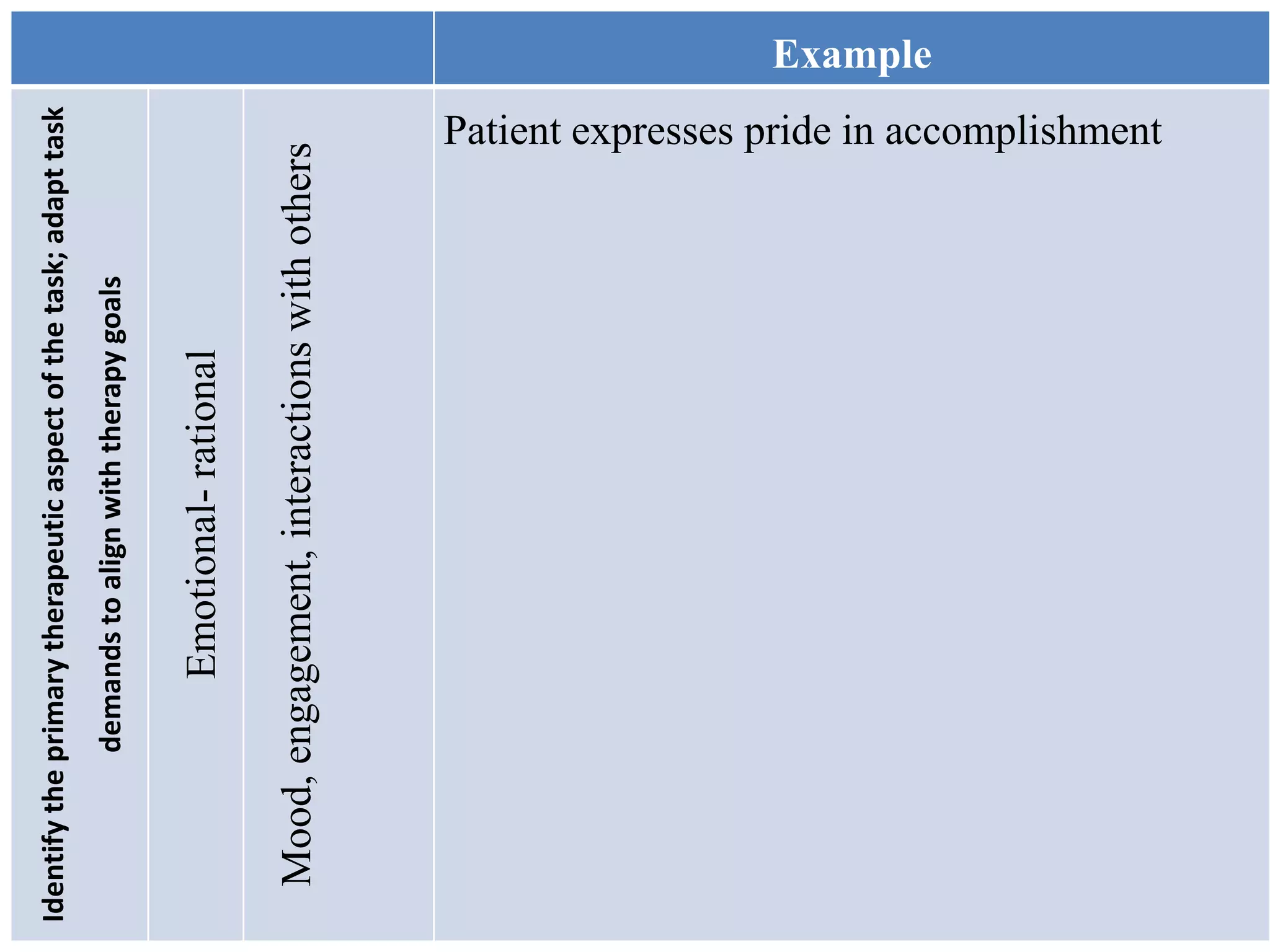
ExampleIdentifytheprimarytherapeuticaspectofthetask;adapttask
demandstoalignwiththerapygoals
Emotional-rational
Mood,engagement,interactionswithothers
Patient expresses pride in accomplishment
Identifytheprimarytherapeuticaspectofthetask;adapttask
demandstoalignwiththerapygoals
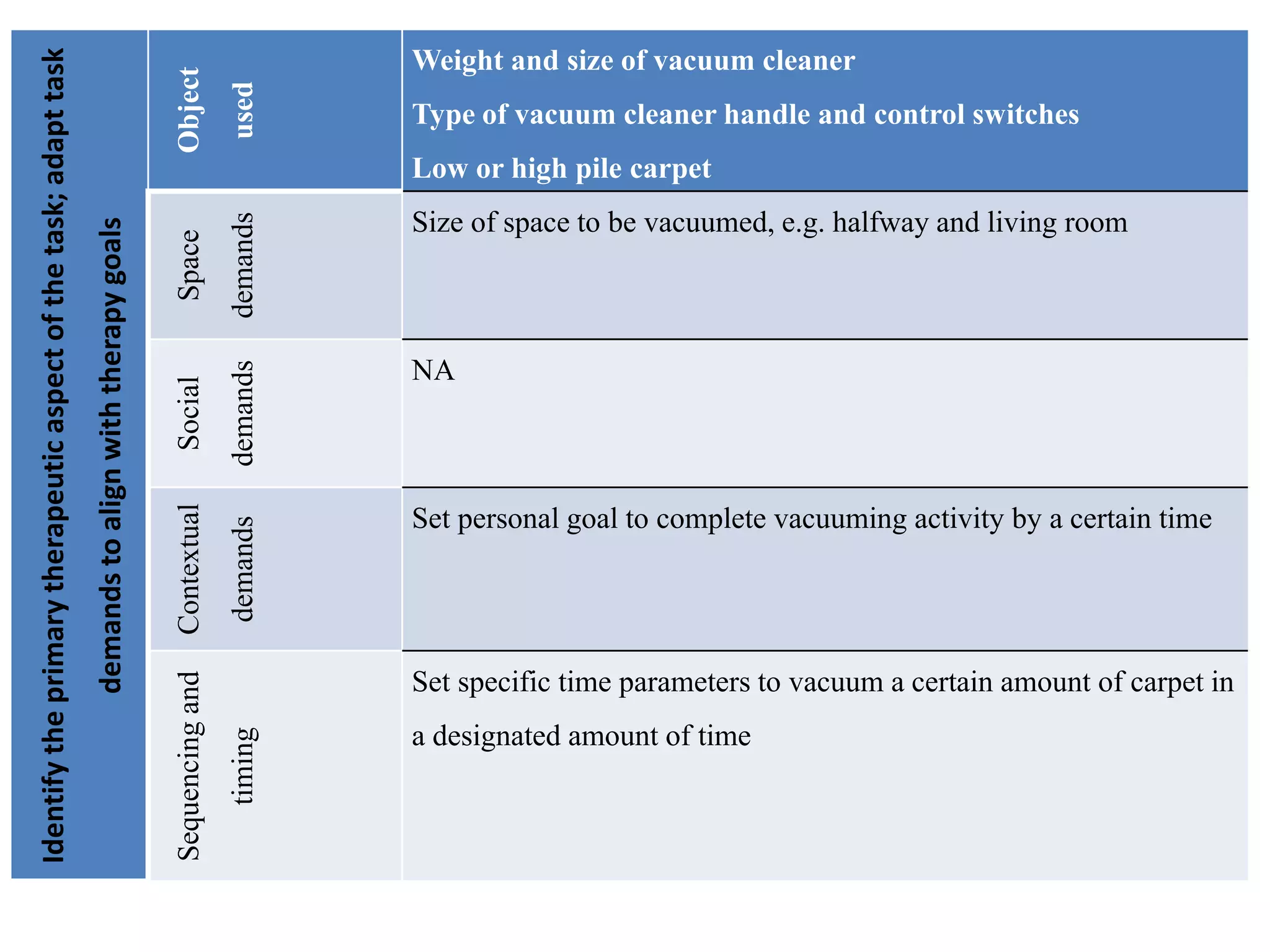
Object
used
Weight and size of vacuum cleaner
Type of vacuum cleaner handle and control switches
Low or high pile carpet
Space
demands
Size of space to be vacuumed, e.g. halfway and living room
Social
demands
NA
Contextual
demands
Set personal goal to complete vacuuming activity by a certain time
Sequencingand
timing
Set specific time parameters to vacuum a certain amount of carpet in
a designated amount of time
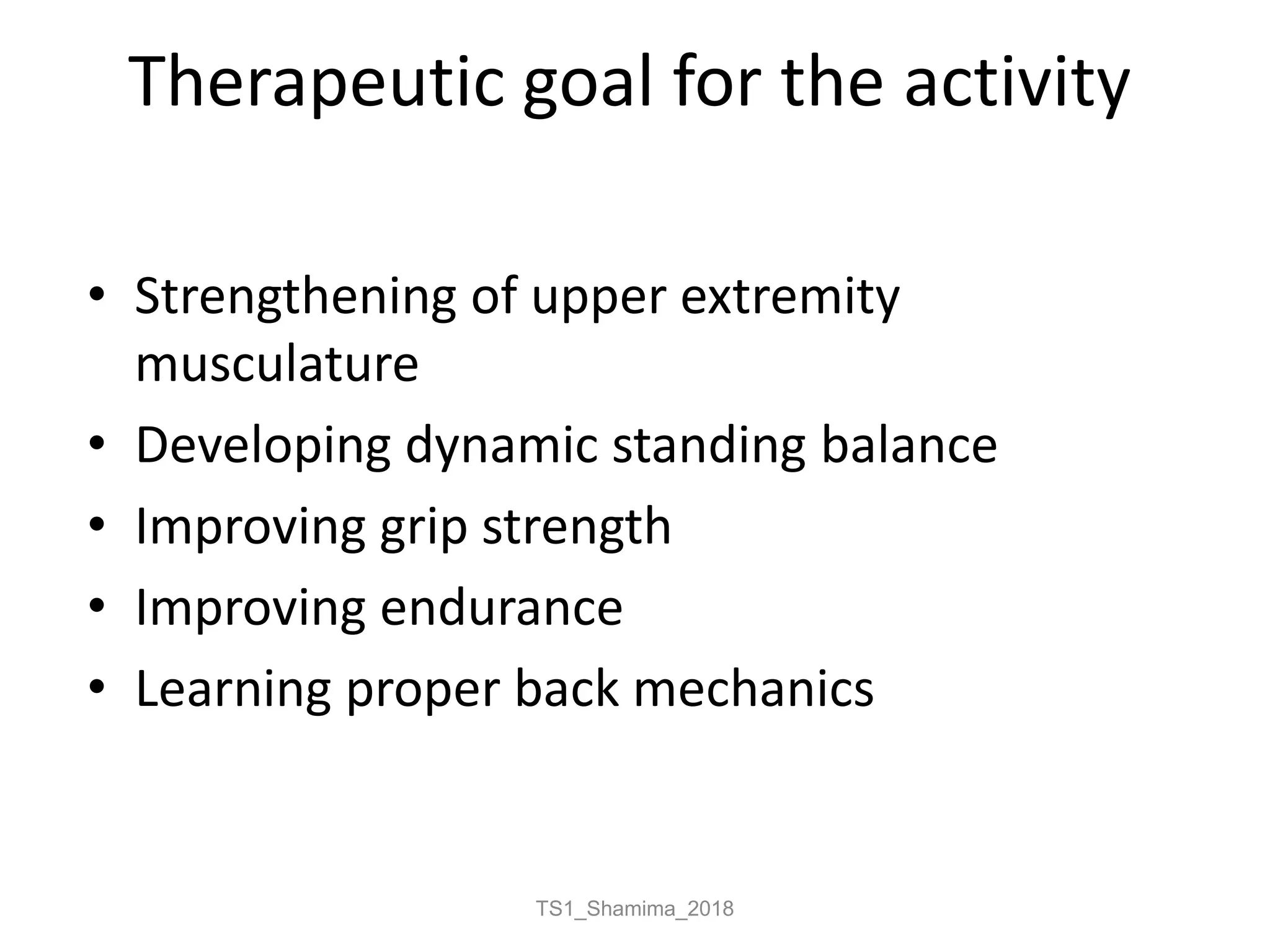
Therapeutic goal for the activity
• Strengthening of upper extremity
musculature
• Developing dynamic standing balance
• Improving grip strength
• Improving endurance
• Learning proper back mechanics
TS1_Shamima_2018
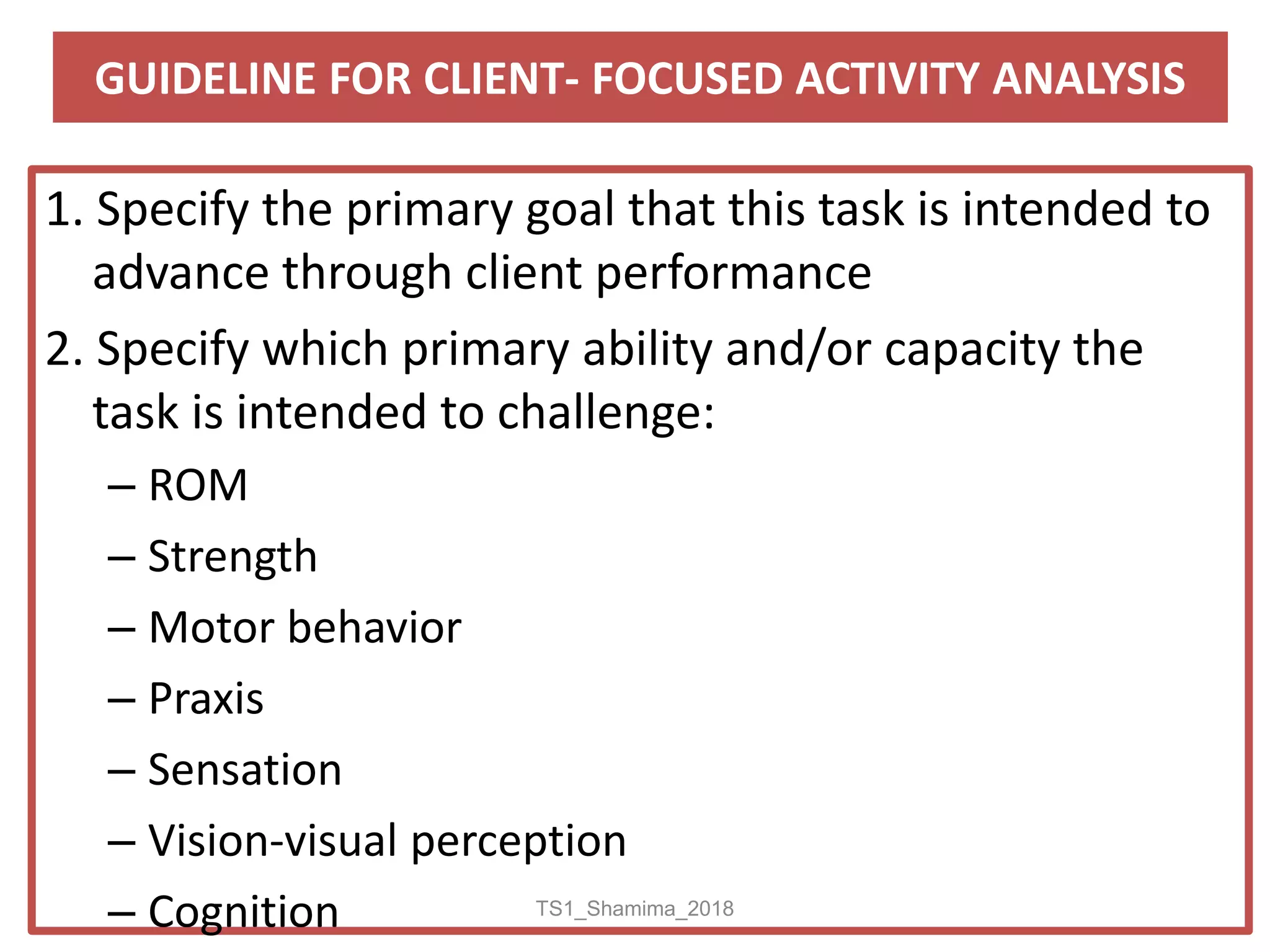
GUIDELINE FOR CLIENT- FOCUSED ACTIVITY ANALYSIS
1. Specify the primary goal that this task is intended to
advance through client performance
2. Specify which primary ability and/or capacity the
task is intended to challenge:
– ROM
– Strength
– Motor behavior
– Praxis
– Sensation
– Vision-visual perception
– Cognition TS1_Shamima_2018
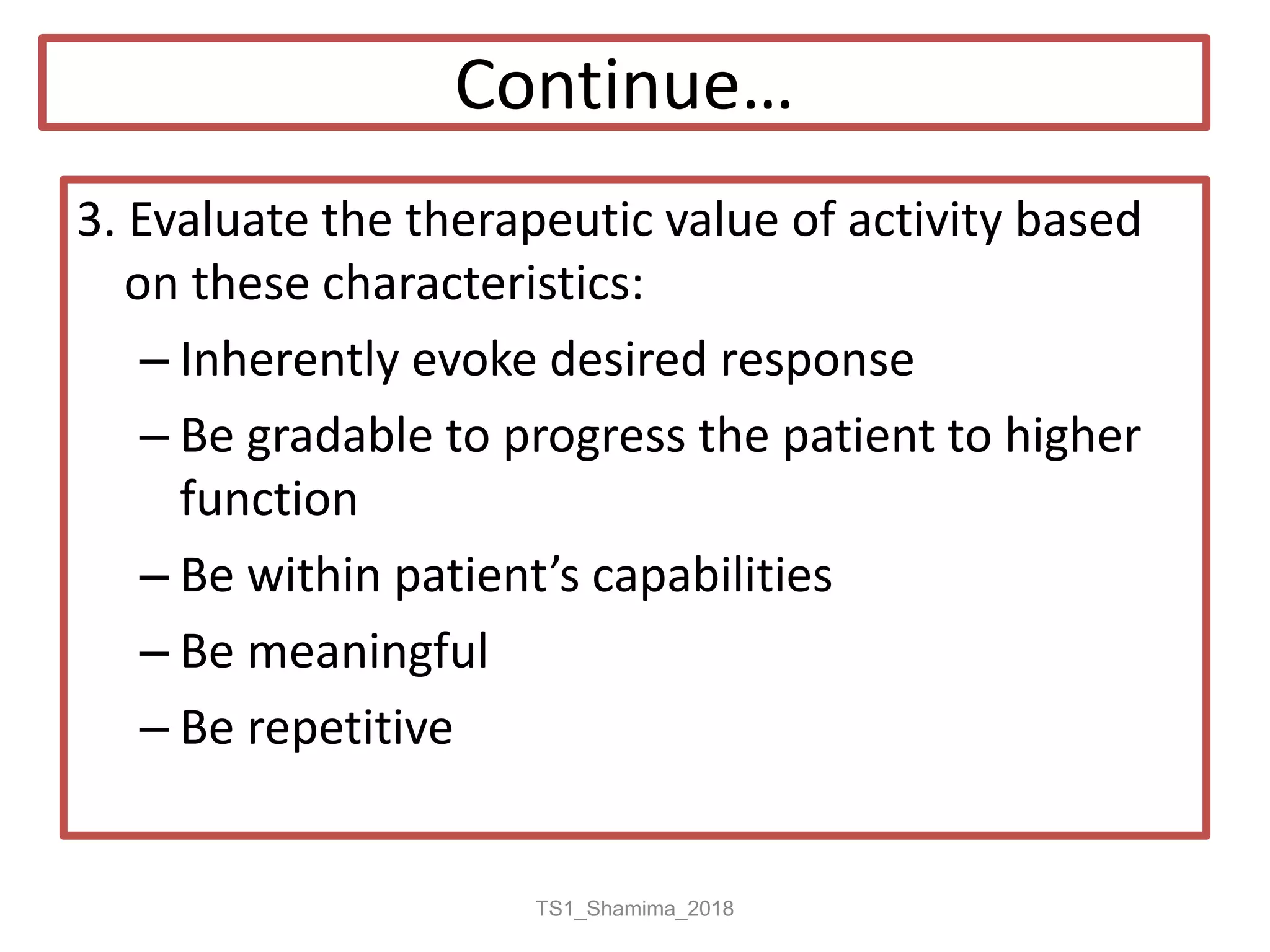
Continue…
3. Evaluate the therapeutic value of activity based
on these characteristics:
– Inherently evoke desired response
– Be gradable to progress the patient to higher
function
– Be within patient’s capabilities
– Be meaningful
– Be repetitive
TS1_Shamima_2018
Continue…
4. Specify task parameters to calibrate difficulty level of the task:
• Method of instruction
• Nature and level of cueing
• Objects and their properties (materials and equipment)
• Environment Demands
• Sequence and timing
• Required actions and performance skills
• Required body functions
• Required body structures
• Context or environment
TS1_Shamima_2018
GUIDELINES FOR ENVIRONMENT-CLIENT-FOCUSED ANALYSIS
1. Specify the task that the person wants or needs to perform in a given
environment
2. Specify the performance environments (e.g., environment in which
the client will perform the desired activity or environment in which
the therapy session with occur).
3. Evaluate the barriers or enablers to performance of this activity in
this environment:
– Task
– Environment
– Person
4. Determine solutions that will enable performance:
– Person
– Environment
– Task TS1_Shamima_2018
Continue…
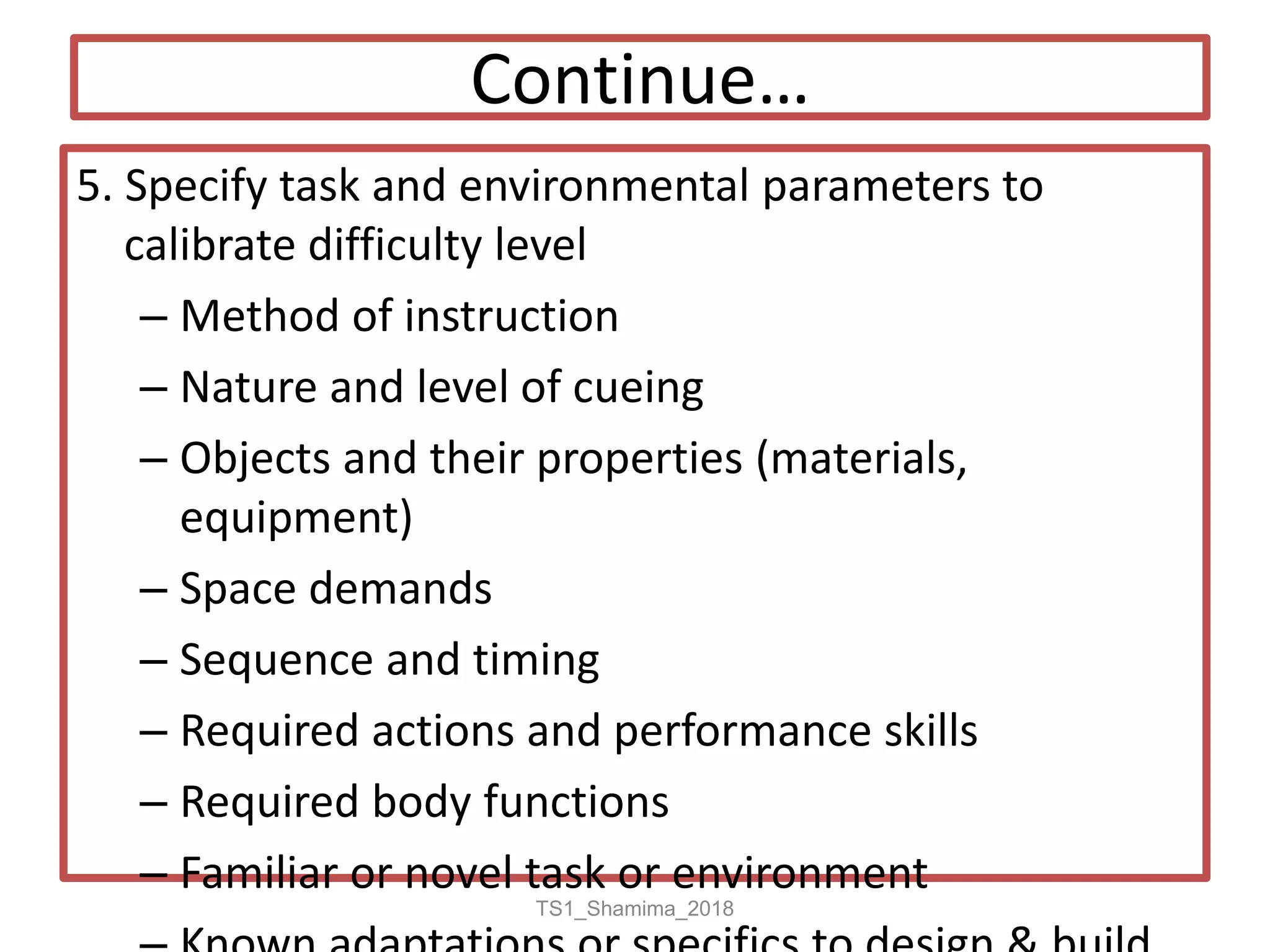
5. Specify task and environmental parameters to
calibrate difficulty level
– Method of instruction
– Nature and level of cueing
– Objects and their properties (materials,
equipment)
– Space demands
– Sequence and timing
– Required actions and performance skills
– Required body functions
– Familiar or novel task or environment
TS1_Shamima_2018
TS1_Shamima_2018
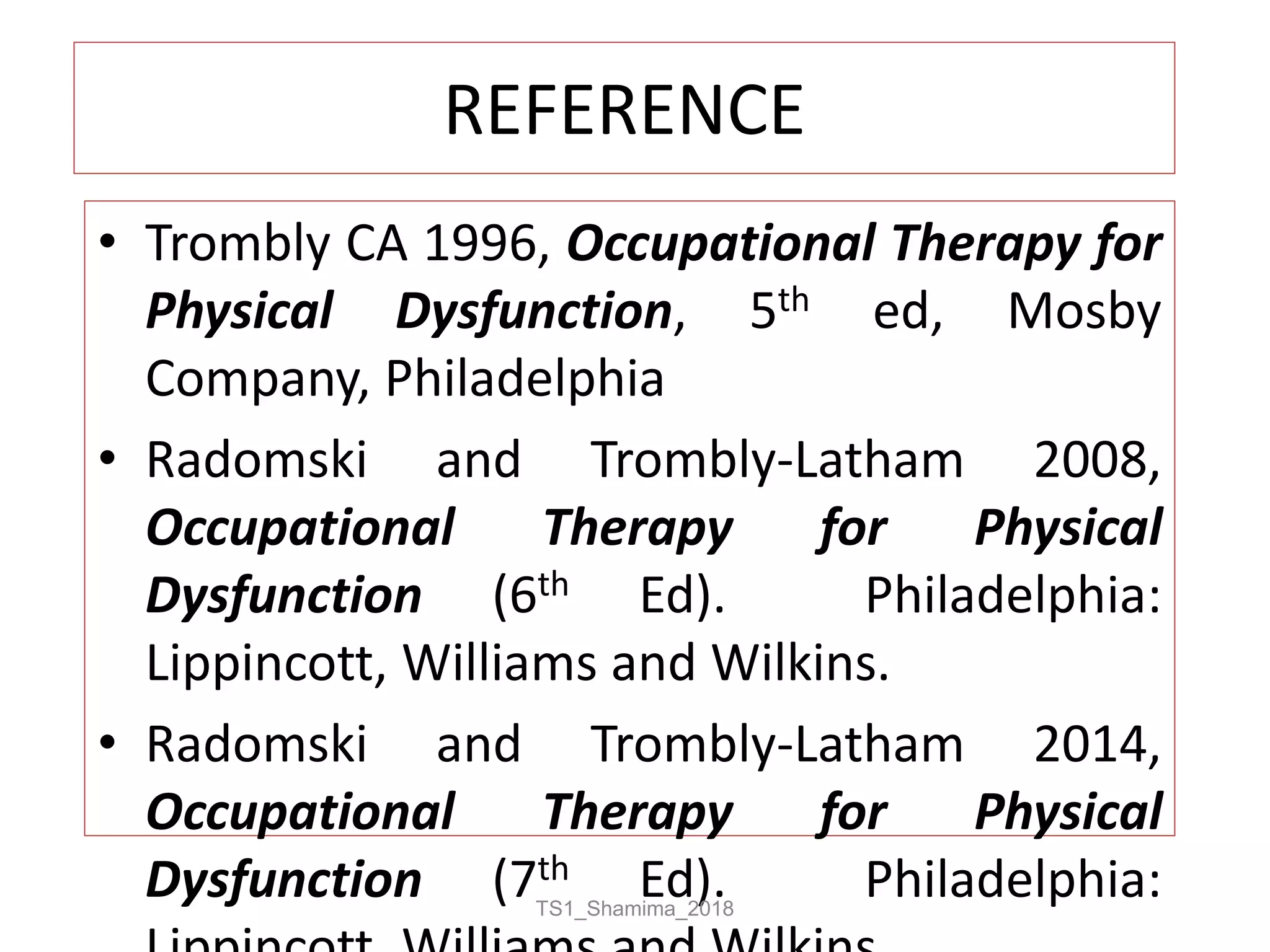
REFERENCE
• Trombly CA 1996, Occupational Therapy for
Physical Dysfunction, 5th ed, Mosby
Company, Philadelphia
• Radomski and Trombly-Latham 2008,
Occupational Therapy for Physical
Dysfunction (6th Ed). Philadelphia:
Lippincott, Williams and Wilkins.
• Radomski and Trombly-Latham 2014,
Occupational Therapy for Physical
Dysfunction (7th Ed). Philadelphia:TS1_Shamima_2018

activity analysis in occupational therapy