Occupational Therapy is……
“ The art and science of enabling engagement in everyday living,
through occupation; of enabling people to perform their
occupations that foster health and well-being”
Daily life activities should be purposeful and meaningful and
therefore enhance quality of life “
Occupations are:
◦ The things we do in our life roles
◦ The things we do to be who we are
◦ The things we do to create life and world into all it can
become.
The primary goal of occupational therapy is to enable people to
participate in the activities they chose for everyday life.
Occupational therapists achieve this outcome by enabling
people to do things that will enhance their ability to participate
or by modifying the environment to better support
participation.
Occupation is an activity or set of activities that is performed
with some consistency and regularity, that brings structure, and
is given value and meaning by individuals and a culture.
Activity is a set of tasks with a specific end point or outcome
that is greater that of any constituent task.
Task is a set of actions having an end point or a specific outcome
Action is a set of voluntary movements or mental processes that
form a recognizable and purposeful pattern (grasping, holding,
pulling, pushing, turning, kneeling, standing, walking, thinking,
remembering, smiling, chewing, winking, etc)
Occupation affects health and well-being, organizes time and
brings structure to living, brings meaning to life.
Occupation-active engagement (doing, physical & mental/cognitive)
Occupation-purpose (all endeavours have some reason or purpose)
Occupation-meaning (unique & dynamic, meaning motivates)
Occupation-contextual (environment, personal history, culture, social norms)
Occupation-human (innate & in-born, characteristic of humanity)
Occupational performance-“The ability to ... carry out roles,
routines, tasks and sub-tasks for the purpose of self-
maintenance, productivity, leisure and rest in response to
demands of the internal and/or external environment.
Performance results from complex interactions between the
person and the environment in which he or she carries out
activities, tasks and roles.
‘ability to choose, organize and carry out occupations in
interaction with the environment’
Occupation by their purpose of
–Self care or self maintenance
-Productivity/play
-Leisure
-Rest
Self care
Personal care (eating, showering, medication)
Home maintenance (clothing, cleaning, household maintenance,
shopping, money management, health management)
Productivity ( employment, school, homemaking, parenting)
Leisure (sport, music, reading)
Rest (relaxation, meditation, sleep)
Occupational roles “...defined as a set of behaviours expected by
society and shaped by culture”. “...the function or behaviour
expected of a person occupying a particular position”. self image
and sense of identity positions in society that have expected
responsibilities (obligations) and privileges (rights)
"Occupational roles are patterns of occupational behaviour
composed of configurations of self- maintenance, productivity,
leisure and rest activity. They are established through choice and
need and are modified with age, ability, experience, circumstance
and time"
Development, performance and maintenance of occupational
roles is influenced by the past and present; internal and external
factors and the expectation of change.
Occupational roles are developed through a balance of choice
and need. Occupation, activities and tasks are specific
behaviours which form subsets of occupational roles.
Occupational roles, occupations, activities and tasks change with
chronological and developmental age, life stage and life
circumstances. (student, teacher, worker, father, son, team member, homemaker,
friend..etc)
Our behaviours are different depending on:
◦ What role we are undertaking and who we are interacting with
◦ Expectations from society and culture which impact on role
performance
Roles give our occupations meaning
Occupational role participation An individual:
May be unable to perform the activities and tasks they see as
important /necessary to a particular role or roles;
May be able to carrying out some aspects of role, but may
require
assistance to carry out the entire role;
May find inability to perform a role very distressing;
May be able to experience role performance satisfaction out of
participating with others
Models provide the “big picture” perspective that is all
encompassing and creates a vision for intervening from either an
individual or a larger contextual perspective.
“…accomplishment of routines and tasks in occupational
performance is predicated on the ability to sustain efficient
physical, psychological and social function”
Core elements of occupational performance are the body, mind
and spirit
Body Element: is defined as all of the tangible physical components of
human structure.
Mind Element: is defined as the core of our conscious and unconscious
intellect that forms the basis of our ability to understand and reason.
Spirit Element: is defined loosely as that aspect of humans which seeks a
sense of harmony within self and between self, nature, others and in some
cases an ultimate other; seeks an existing mystery to life; inner conviction;
hope and meaning.
OCCUPATIONAL PERFORMANCE: The ability to perceive,
desire, recall, plan and carry out roles, routines, tasks and sub-
tasks for the purpose of self-maintenance, productivity, leisure
and rest in response to demands of the internal and/or external
environment.
OCCUPATIONAL PERFORMANCE ROLES: are patterns of
occupational behaviour composed of configurations of self-
maintenance, productivity, leisure and rest occupations.
Roles are determined by individual person-environment-
performance relationships.
Rest Occupations: refer to the purposeful pursuit of non-activity
Self-Maintenance Occupations: are routines, tasks and sub-tasks
done to preserve a person’s health and well being in the
environment. These routines, tasks and sub-tasks can be in the
form of habitual routines (dressing, eating) or occasional non-
habitual tasks (taking medication).
Productivity/School Occupations: are routines, tasks and sub-
tasks which are done to enable a person to provide support for
self, family or community through the production of goods or
provision of services
Leisure/Play Occupations: are those routines, tasks and sub-
tasks for purposes of entertainment and self expression,
creativity and celebration, for example gardening, sewing, games.
Sensory-Motor Performance Component: From the perspective
of the performer, this component refers to the operation and
interaction of and between sensory input and motor responses of
the body during task performance. This can include regulation of
muscle tone during activity, generation of appropriate motor
responses, registration of sensory stimuli and coordination.
From the perspective of the task or sub-task, this component
refers to the sensory aspects of the task; for example, color,
texture, temperature, movement, sound, smell and taste.
Cognitive Performance Component: From the perspective of the
performer, this component refers to the operation and
interaction of and between mental processes used during task
performance. This can include: thinking, perceiving, recognising,
remembering, judging, learning, knowing, attending and
problem solving.
From the perspective of the task or sub-task, this component
refers to the cognitive dimensions of the task or sub-task. These
are usually determined by the complexity of the task eg memory,
attention, problem solving.
Intrapersonal Performance Component: From the perspective of
the performer, this component refers to the operation and
interaction of and between internal psychological processes used
during task performance. This can include emotions, self-
esteem, mood, affect, rationality and defence mechanisms.
From the perspective of the task or sub-task, this component
refers to the intrapersonal attributes that can be stimulated by
the task or sub-task and are required for effective task
performance, such as, valuing, satisfaction and motivation.
Interpersonal Performance Component: From the perspective of
the performer, this component refers to the continuing and
changing interaction between a person and others during task
performance that contributes to the development of the
individual as a participant in society. This can include interaction
among individuals in relationships such as marriages, families,
communities and organizations both formal and informal.
Interactive examples include sharing, cooperation, empathy,
verbal and non-verbal communication.
From the perspective of the task or sub-task, this component
refers to the nature and degree of interpersonal interaction
required for effective task performance.
-EXTERNAL ENVIRONMENT: is an interactive
◦ Sensory ◦ Physical ◦ Social ◦ Cultural ◦ Institutional
phenomenon within which occupational performance occurs.
The interaction of these four dimensions creates further sub-
dimensions such as political and economic environments that
profoundly affect occupational performance.
The occupational performance environment shapes the nature of
occupational performance and is also modified by
Physical Environment: refers to the natural and constructed surroundings
of a person that form physical boundaries and contribute to shaping
behaviour.
Sensory Environment: refers to the sensory surroundings of a person.
Sensory aspects of the environment give a person information about the
physical-socio-cultural aspects of the environment and its survivability
Institutional Environment: refers to the political aspects such as laws that
affect access to resources and affirm personal rights. Also includes
opportunities for education, employment and economic support
Cultural Environment: refers to an organised structure composed
of systems of values, beliefs, ideals and customs which contribute
to the behavioural boundaries of a person or group of people.
Social Environment: refers to an organized structure created by
the patterns of relationships between people who function in a
group which in turn contributes to establishing the boundaries
of behaviour.
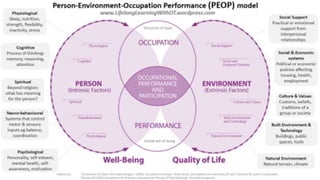
Person-Environment-Occupation Model (PEO)
Person – ◦ Unique being –assumes variety of roles
Environment - ◦ Cultural, socioeconomic, institutional, physical and social
considerations
Occupation – ◦ Groups of self directed functional tasks and activities (over
lifespan)
Occupational Performance – ◦ Dynamic experience of a person engaged
◦Purposeful activities & tasks within an environment
Person-Environment-Occupation fit
What is the OT Process?
Series of actions initiated to provide services to clients. Various
representations of this process, but all have similar formats and
content. Process is not unique to OT. A form of problem

identification, analysis & solution used by various health
professions.
Occupational Therapy Process
1.Referral
2.Screening
3.Assessment
4.Intervention planning
5.Intervention
6.Re-assessment (Re-assessment ---Intervention planning)
7.Transititional services
8.Discharge from service
A goal is a desired result that a person or a system envisions,
plans and commits to achieve a personal or organizational
desired end-point in some sort of assumed development it is
roughly similar to purpose or aim, the anticipated result which
guides action, or an end, which is an object, either a physical
object or an abstract object, that has intrinsic value.
Types of goals, Personal, Organizational, Short Term, Long Term)
Short-term goals ◦ More immediate goals of therapy; stepping
stones to achieving longer-term goal
Short-term goals expect accomplishment in a short period of
time such as paying a bill in the next few days. The definition of a
short-term goal needs to relate to a specific length of time Eg;
one may achieve a short-term goal in a day, week, month.
The time-frame for a short-term goal relates to its context in the
overall time line that it is being applied to. The most amount of
time for a short term goal to be achieved would be around year
Long-term goals
Long-term goals usually take anywhere between 1 year to up to five
years to accomplish and require a disciplined strategy over a long time
period.
Major goals, final destination where both client & therapist view therapy
has been successful. Also referred to as “aims”.
The distinction between the categories is usually related to the
amount of time it takes to accomplish the goal and the commitment to
achieve them.
SMART Goals
Specific Measurable Attainable Realistic Timely
Specific (who, what, where, when, why, which) define the goal as
much as possible
-Who is involved
-What do I want to accomplish
-Where will it be done
-Why am I doing this, reasons, purpose
-Which constraints and/or requirements do I have
Measurable, can you track the progress and measure the
outcome ?
How much, how many, how will I know when my goals is
accomplished ?
Attainable, is the goal reasonable enough to be accomplished ?
How so ? Make sure the goals is not out reach or below standard
performance.
Relevant, is the goal worthwhile and will it meet your needs ?
Is each goals you have established and fits with your immediate
and long term plans?
Timely, your objective should include a time limit, I will
complete this step by month/day/year
It will establish a sense of urgency and prompt you to have better
time management.
Occupational Therapy Documentation is: Written
communication reporting on the services and actions employed
by the occupational therapist which describe interventions and
plans over the period of time the person/client engages with that
service. Reports are legible, objective and concise. Necessary
whenever professional services are provided to a client.
Occupational therapists and occupational therapy assistants
determine the appropriate type of documentation and document
the services provided within their scope of practice.
Each occupational therapy client has a client record maintained
as a permanent file. The record is maintained in a professional
and legal fashion (i.e., organized, legible, concise, clear, accurate,
complete, current, grammatically correct, and objective) an
occupational therapy practitioner documents the occupational
therapy services and “abides by the time frames, format, and
standards established by the practice settings, government
agencies, external accreditation programs, payers, etc. Client
may refer to an individual, an organization, or population.
The Purpose of Documentation Articulate the rationale for
provision of occupational therapy services and the relationship
of this service to the client’s outcomes Reflect the occupational
therapy practitioners’ clinical reasoning and professional
judgment Communicate information about the client from the
occupational therapy perspective Create a chronological record
of client status, occupational therapy services provided to the
client, and client outcomes.
Elements Present in all Documentation Client’s full name and
case number (if applicable) on each page of documentation. Date
and type of occupational therapy contact. Identification of type
of documentation, agency, and department name. Occupational
therapy practitioners’ signature with a minimum of first name or
initial, last name, and professional designation.
When applicable on notes or reports, signature of the recorder
directly at the end of the note without space left between the
body of the note and the signature. Acceptable terminology
defined within the boundaries of setting.
Abbreviations usage as acceptable within the boundaries of
setting.
When no facility requirements are listed, errors corrected by
drawing a single line through an error and by initialing the
correction (liquid correction fluid and erasures are not
acceptable).
Adherence to professional standards of technology, when used to
document occupational therapy services.
Disposal of records within law or agency requirements.
Compliance with confidentiality standards.
Compliance with agency or legal requirements of storage of
records.
What does being person centered mean?
Treating all people with dignity and respect; building on their
strengths and talents; helping people connect to their
community and develop relationships; listening and acting on
what the person communicates; taking time to know and
understand people and the things that make them unique.
involves a deep respect for person and their equality.
You (Leisure and lifestyle, Family and friends, Spiritual and cultural,
Housing, Skill building/work, Health and wellbeing)
The Whole person (Career developmental cycle, Abilities, Skills,
Interests, Personal Style, Family, Values, Goals)
Occupational Therapy

Occupational Therapy

  • 2.
    Occupational Therapy is…… “The art and science of enabling engagement in everyday living, through occupation; of enabling people to perform their occupations that foster health and well-being” Daily life activities should be purposeful and meaningful and therefore enhance quality of life “
  • 4.
    Occupations are: ◦ Thethings we do in our life roles ◦ The things we do to be who we are ◦ The things we do to create life and world into all it can become.
  • 5.
    The primary goalof occupational therapy is to enable people to participate in the activities they chose for everyday life. Occupational therapists achieve this outcome by enabling people to do things that will enhance their ability to participate or by modifying the environment to better support participation.
  • 6.
    Occupation is anactivity or set of activities that is performed with some consistency and regularity, that brings structure, and is given value and meaning by individuals and a culture. Activity is a set of tasks with a specific end point or outcome that is greater that of any constituent task. Task is a set of actions having an end point or a specific outcome
  • 7.
    Action is aset of voluntary movements or mental processes that form a recognizable and purposeful pattern (grasping, holding, pulling, pushing, turning, kneeling, standing, walking, thinking, remembering, smiling, chewing, winking, etc)
  • 8.
    Occupation affects healthand well-being, organizes time and brings structure to living, brings meaning to life. Occupation-active engagement (doing, physical & mental/cognitive) Occupation-purpose (all endeavours have some reason or purpose) Occupation-meaning (unique & dynamic, meaning motivates) Occupation-contextual (environment, personal history, culture, social norms) Occupation-human (innate & in-born, characteristic of humanity)
  • 9.
    Occupational performance-“The abilityto ... carry out roles, routines, tasks and sub-tasks for the purpose of self- maintenance, productivity, leisure and rest in response to demands of the internal and/or external environment. Performance results from complex interactions between the person and the environment in which he or she carries out activities, tasks and roles. ‘ability to choose, organize and carry out occupations in interaction with the environment’
  • 10.
    Occupation by theirpurpose of –Self care or self maintenance -Productivity/play -Leisure -Rest
  • 11.
    Self care Personal care(eating, showering, medication) Home maintenance (clothing, cleaning, household maintenance, shopping, money management, health management) Productivity ( employment, school, homemaking, parenting) Leisure (sport, music, reading) Rest (relaxation, meditation, sleep)
  • 12.
    Occupational roles “...definedas a set of behaviours expected by society and shaped by culture”. “...the function or behaviour expected of a person occupying a particular position”. self image and sense of identity positions in society that have expected responsibilities (obligations) and privileges (rights)
  • 13.
    "Occupational roles arepatterns of occupational behaviour composed of configurations of self- maintenance, productivity, leisure and rest activity. They are established through choice and need and are modified with age, ability, experience, circumstance and time"
  • 14.
    Development, performance andmaintenance of occupational roles is influenced by the past and present; internal and external factors and the expectation of change. Occupational roles are developed through a balance of choice and need. Occupation, activities and tasks are specific behaviours which form subsets of occupational roles. Occupational roles, occupations, activities and tasks change with chronological and developmental age, life stage and life circumstances. (student, teacher, worker, father, son, team member, homemaker, friend..etc)
  • 15.
    Our behaviours aredifferent depending on: ◦ What role we are undertaking and who we are interacting with ◦ Expectations from society and culture which impact on role performance Roles give our occupations meaning
  • 16.
    Occupational role participationAn individual: May be unable to perform the activities and tasks they see as important /necessary to a particular role or roles; May be able to carrying out some aspects of role, but may require assistance to carry out the entire role; May find inability to perform a role very distressing; May be able to experience role performance satisfaction out of participating with others
  • 17.
    Models provide the“big picture” perspective that is all encompassing and creates a vision for intervening from either an individual or a larger contextual perspective. “…accomplishment of routines and tasks in occupational performance is predicated on the ability to sustain efficient physical, psychological and social function”
  • 18.
    Core elements ofoccupational performance are the body, mind and spirit Body Element: is defined as all of the tangible physical components of human structure. Mind Element: is defined as the core of our conscious and unconscious intellect that forms the basis of our ability to understand and reason. Spirit Element: is defined loosely as that aspect of humans which seeks a sense of harmony within self and between self, nature, others and in some cases an ultimate other; seeks an existing mystery to life; inner conviction; hope and meaning.
  • 19.
    OCCUPATIONAL PERFORMANCE: Theability to perceive, desire, recall, plan and carry out roles, routines, tasks and sub- tasks for the purpose of self-maintenance, productivity, leisure and rest in response to demands of the internal and/or external environment.
  • 20.
    OCCUPATIONAL PERFORMANCE ROLES:are patterns of occupational behaviour composed of configurations of self- maintenance, productivity, leisure and rest occupations. Roles are determined by individual person-environment- performance relationships.
  • 21.
    Rest Occupations: referto the purposeful pursuit of non-activity Self-Maintenance Occupations: are routines, tasks and sub-tasks done to preserve a person’s health and well being in the environment. These routines, tasks and sub-tasks can be in the form of habitual routines (dressing, eating) or occasional non- habitual tasks (taking medication).
  • 22.
    Productivity/School Occupations: areroutines, tasks and sub- tasks which are done to enable a person to provide support for self, family or community through the production of goods or provision of services Leisure/Play Occupations: are those routines, tasks and sub- tasks for purposes of entertainment and self expression, creativity and celebration, for example gardening, sewing, games.
  • 23.
    Sensory-Motor Performance Component:From the perspective of the performer, this component refers to the operation and interaction of and between sensory input and motor responses of the body during task performance. This can include regulation of muscle tone during activity, generation of appropriate motor responses, registration of sensory stimuli and coordination. From the perspective of the task or sub-task, this component refers to the sensory aspects of the task; for example, color, texture, temperature, movement, sound, smell and taste.
  • 24.
    Cognitive Performance Component:From the perspective of the performer, this component refers to the operation and interaction of and between mental processes used during task performance. This can include: thinking, perceiving, recognising, remembering, judging, learning, knowing, attending and problem solving. From the perspective of the task or sub-task, this component refers to the cognitive dimensions of the task or sub-task. These are usually determined by the complexity of the task eg memory, attention, problem solving.
  • 25.
    Intrapersonal Performance Component:From the perspective of the performer, this component refers to the operation and interaction of and between internal psychological processes used during task performance. This can include emotions, self- esteem, mood, affect, rationality and defence mechanisms. From the perspective of the task or sub-task, this component refers to the intrapersonal attributes that can be stimulated by the task or sub-task and are required for effective task performance, such as, valuing, satisfaction and motivation.
  • 26.
    Interpersonal Performance Component:From the perspective of the performer, this component refers to the continuing and changing interaction between a person and others during task performance that contributes to the development of the individual as a participant in society. This can include interaction among individuals in relationships such as marriages, families, communities and organizations both formal and informal. Interactive examples include sharing, cooperation, empathy, verbal and non-verbal communication. From the perspective of the task or sub-task, this component refers to the nature and degree of interpersonal interaction required for effective task performance.
  • 27.
    -EXTERNAL ENVIRONMENT: isan interactive ◦ Sensory ◦ Physical ◦ Social ◦ Cultural ◦ Institutional phenomenon within which occupational performance occurs. The interaction of these four dimensions creates further sub- dimensions such as political and economic environments that profoundly affect occupational performance.
  • 28.
    The occupational performanceenvironment shapes the nature of occupational performance and is also modified by Physical Environment: refers to the natural and constructed surroundings of a person that form physical boundaries and contribute to shaping behaviour. Sensory Environment: refers to the sensory surroundings of a person. Sensory aspects of the environment give a person information about the physical-socio-cultural aspects of the environment and its survivability Institutional Environment: refers to the political aspects such as laws that affect access to resources and affirm personal rights. Also includes opportunities for education, employment and economic support
  • 29.
    Cultural Environment: refersto an organised structure composed of systems of values, beliefs, ideals and customs which contribute to the behavioural boundaries of a person or group of people. Social Environment: refers to an organized structure created by the patterns of relationships between people who function in a group which in turn contributes to establishing the boundaries of behaviour.
  • 30.
    Person-Environment-Occupation Model (PEO) Person– ◦ Unique being –assumes variety of roles Environment - ◦ Cultural, socioeconomic, institutional, physical and social considerations Occupation – ◦ Groups of self directed functional tasks and activities (over lifespan) Occupational Performance – ◦ Dynamic experience of a person engaged ◦Purposeful activities & tasks within an environment Person-Environment-Occupation fit
  • 32.
    What is theOT Process? Series of actions initiated to provide services to clients. Various representations of this process, but all have similar formats and content. Process is not unique to OT. A form of problem identification, analysis & solution used by various health professions.
  • 33.
    Occupational Therapy Process 1.Referral 2.Screening 3.Assessment 4.Interventionplanning 5.Intervention 6.Re-assessment (Re-assessment ---Intervention planning) 7.Transititional services 8.Discharge from service
  • 34.
    A goal isa desired result that a person or a system envisions, plans and commits to achieve a personal or organizational desired end-point in some sort of assumed development it is roughly similar to purpose or aim, the anticipated result which guides action, or an end, which is an object, either a physical object or an abstract object, that has intrinsic value. Types of goals, Personal, Organizational, Short Term, Long Term)
  • 35.
    Short-term goals ◦More immediate goals of therapy; stepping stones to achieving longer-term goal Short-term goals expect accomplishment in a short period of time such as paying a bill in the next few days. The definition of a short-term goal needs to relate to a specific length of time Eg; one may achieve a short-term goal in a day, week, month. The time-frame for a short-term goal relates to its context in the overall time line that it is being applied to. The most amount of time for a short term goal to be achieved would be around year
  • 36.
    Long-term goals Long-term goalsusually take anywhere between 1 year to up to five years to accomplish and require a disciplined strategy over a long time period. Major goals, final destination where both client & therapist view therapy has been successful. Also referred to as “aims”. The distinction between the categories is usually related to the amount of time it takes to accomplish the goal and the commitment to achieve them.
  • 37.
    SMART Goals Specific MeasurableAttainable Realistic Timely Specific (who, what, where, when, why, which) define the goal as much as possible -Who is involved -What do I want to accomplish -Where will it be done -Why am I doing this, reasons, purpose -Which constraints and/or requirements do I have
  • 38.
    Measurable, can youtrack the progress and measure the outcome ? How much, how many, how will I know when my goals is accomplished ? Attainable, is the goal reasonable enough to be accomplished ? How so ? Make sure the goals is not out reach or below standard performance.
  • 39.
    Relevant, is thegoal worthwhile and will it meet your needs ? Is each goals you have established and fits with your immediate and long term plans? Timely, your objective should include a time limit, I will complete this step by month/day/year It will establish a sense of urgency and prompt you to have better time management.
  • 40.
    Occupational Therapy Documentationis: Written communication reporting on the services and actions employed by the occupational therapist which describe interventions and plans over the period of time the person/client engages with that service. Reports are legible, objective and concise. Necessary whenever professional services are provided to a client. Occupational therapists and occupational therapy assistants determine the appropriate type of documentation and document the services provided within their scope of practice.
  • 41.
    Each occupational therapyclient has a client record maintained as a permanent file. The record is maintained in a professional and legal fashion (i.e., organized, legible, concise, clear, accurate, complete, current, grammatically correct, and objective) an occupational therapy practitioner documents the occupational therapy services and “abides by the time frames, format, and standards established by the practice settings, government agencies, external accreditation programs, payers, etc. Client may refer to an individual, an organization, or population.
  • 42.
    The Purpose ofDocumentation Articulate the rationale for provision of occupational therapy services and the relationship of this service to the client’s outcomes Reflect the occupational therapy practitioners’ clinical reasoning and professional judgment Communicate information about the client from the occupational therapy perspective Create a chronological record of client status, occupational therapy services provided to the client, and client outcomes.
  • 43.
    Elements Present inall Documentation Client’s full name and case number (if applicable) on each page of documentation. Date and type of occupational therapy contact. Identification of type of documentation, agency, and department name. Occupational therapy practitioners’ signature with a minimum of first name or initial, last name, and professional designation.
  • 44.
    When applicable onnotes or reports, signature of the recorder directly at the end of the note without space left between the body of the note and the signature. Acceptable terminology defined within the boundaries of setting.
  • 45.
    Abbreviations usage asacceptable within the boundaries of setting. When no facility requirements are listed, errors corrected by drawing a single line through an error and by initialing the correction (liquid correction fluid and erasures are not acceptable). Adherence to professional standards of technology, when used to document occupational therapy services. Disposal of records within law or agency requirements. Compliance with confidentiality standards. Compliance with agency or legal requirements of storage of records.
  • 46.
    What does beingperson centered mean? Treating all people with dignity and respect; building on their strengths and talents; helping people connect to their community and develop relationships; listening and acting on what the person communicates; taking time to know and understand people and the things that make them unique. involves a deep respect for person and their equality. You (Leisure and lifestyle, Family and friends, Spiritual and cultural, Housing, Skill building/work, Health and wellbeing) The Whole person (Career developmental cycle, Abilities, Skills, Interests, Personal Style, Family, Values, Goals)