Shamima Akter
B. Sc (Honours) in Occupational Therapy
& M. Sc in Rehabilitation Science
Assistant Professor,
Department of Occupational Therapy
Bangladesh Health Professions Institute (BHPI)
Centre for the Rehabilitation of the Paralysed (CRP)
Chapain, Savar
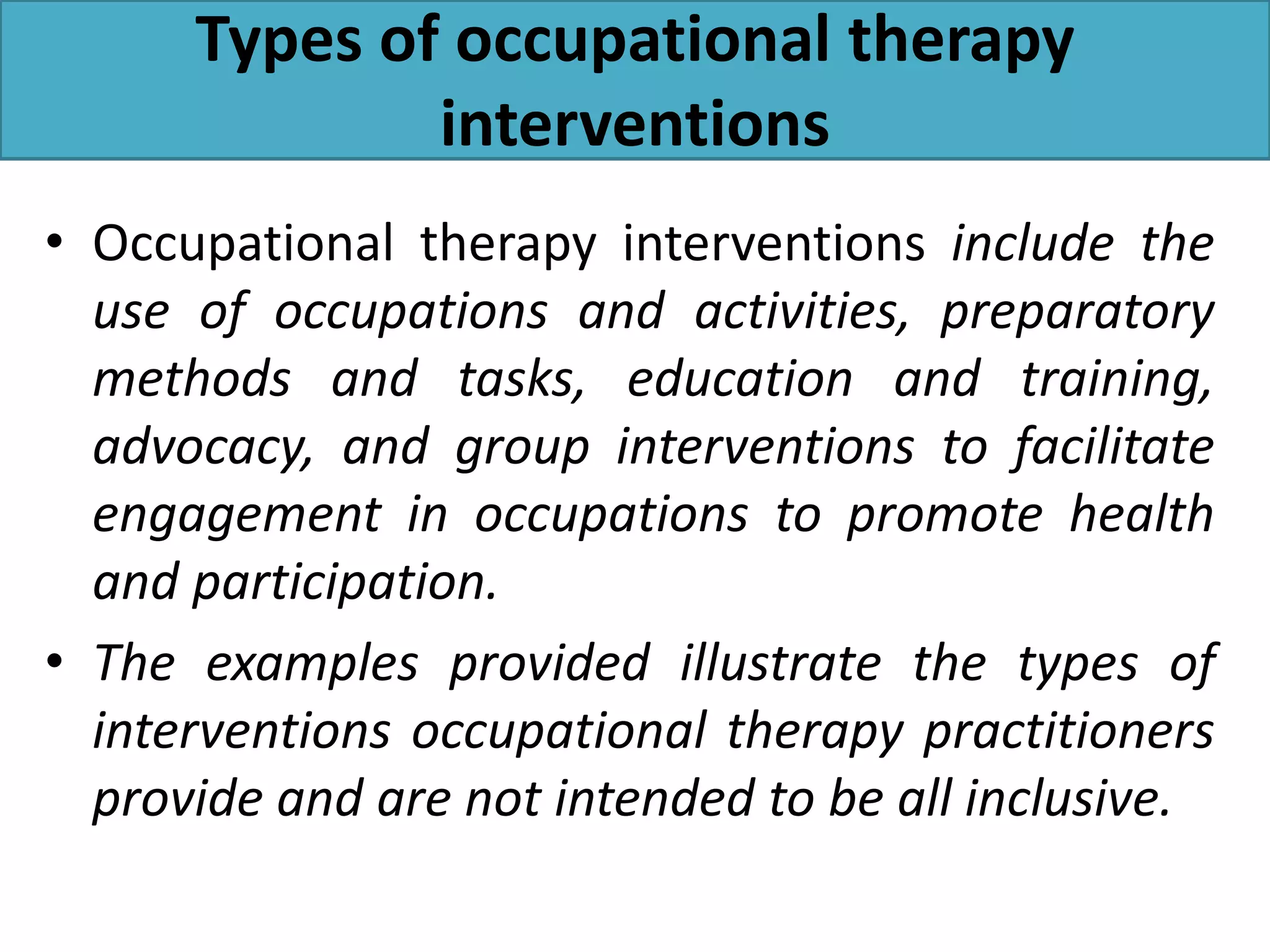
Types of occupational therapy
interventions
• Occupational therapy interventions include the
use of occupations and activities, preparatory
methods and tasks, education and training,
advocacy, and group interventions to facilitate
engagement in occupations to promote health
and participation.
• The examples provided illustrate the types of
interventions occupational therapy practitioners
provide and are not intended to be all inclusive.
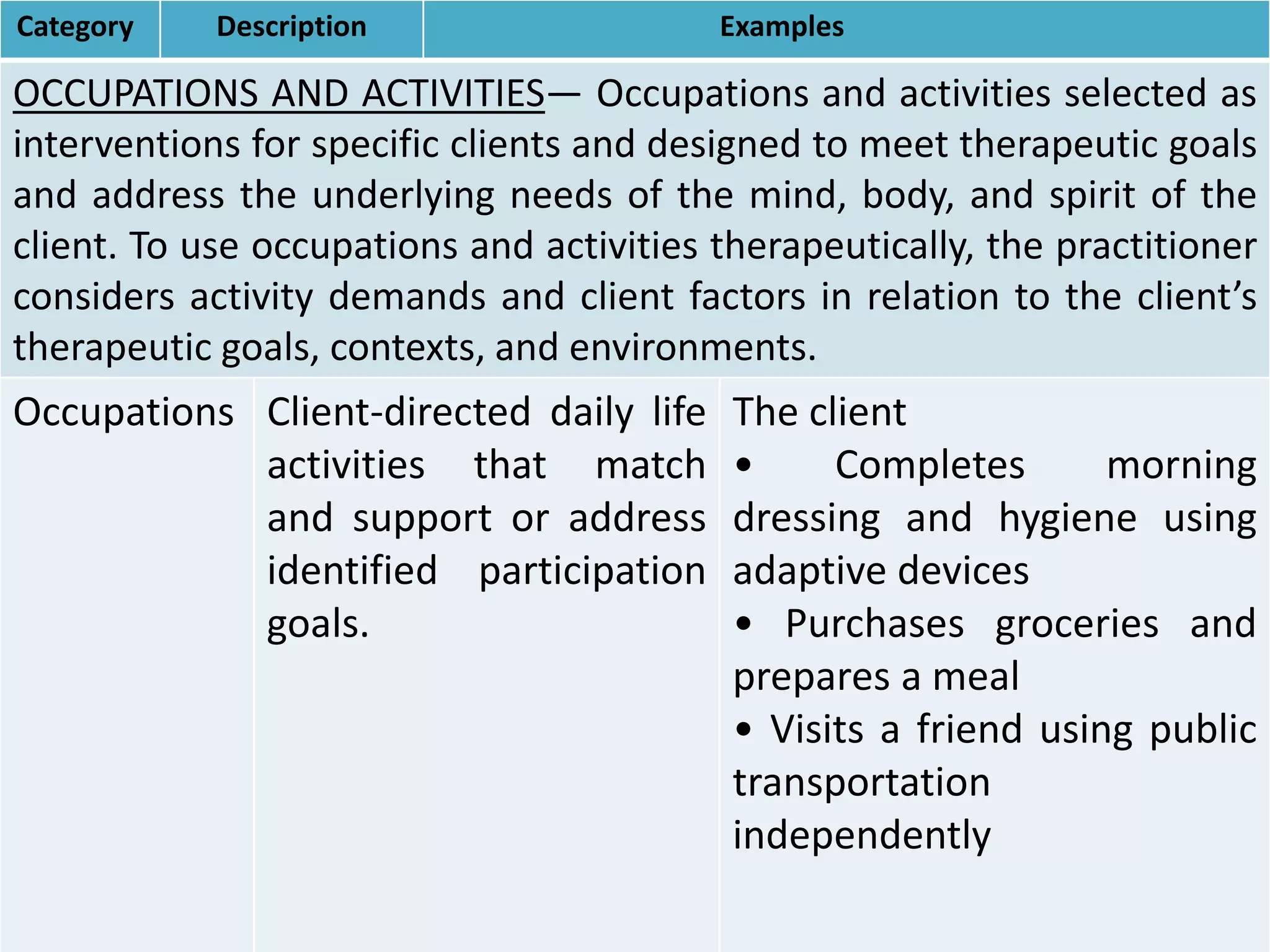
Category Description Examples
OCCUPATIONS AND ACTIVITIES— Occupations and activities selected as
interventions for specific clients and designed to meet therapeutic goals
and address the underlying needs of the mind, body, and spirit of the
client. To use occupations and activities therapeutically, the practitioner
considers activity demands and client factors in relation to the client’s
therapeutic goals, contexts, and environments.
Occupations Client-directed daily life
activities that match
and support or address
identified participation
goals.
The client
• Completes morning
dressing and hygiene using
adaptive devices
• Purchases groceries and
prepares a meal
• Visits a friend using public
transportation
independently
Category
Description
ExamplesOccupations
- • Applies for a job in the retail industry
• Plays on a playground with children and adults
• Participates in a community festival by setting up
a booth to sell baked goods
• Engages in a pattern of self-care and relaxation
activities in preparation for sleep
• Engages in a statewide advocacy program to
improve services to people with mental illness
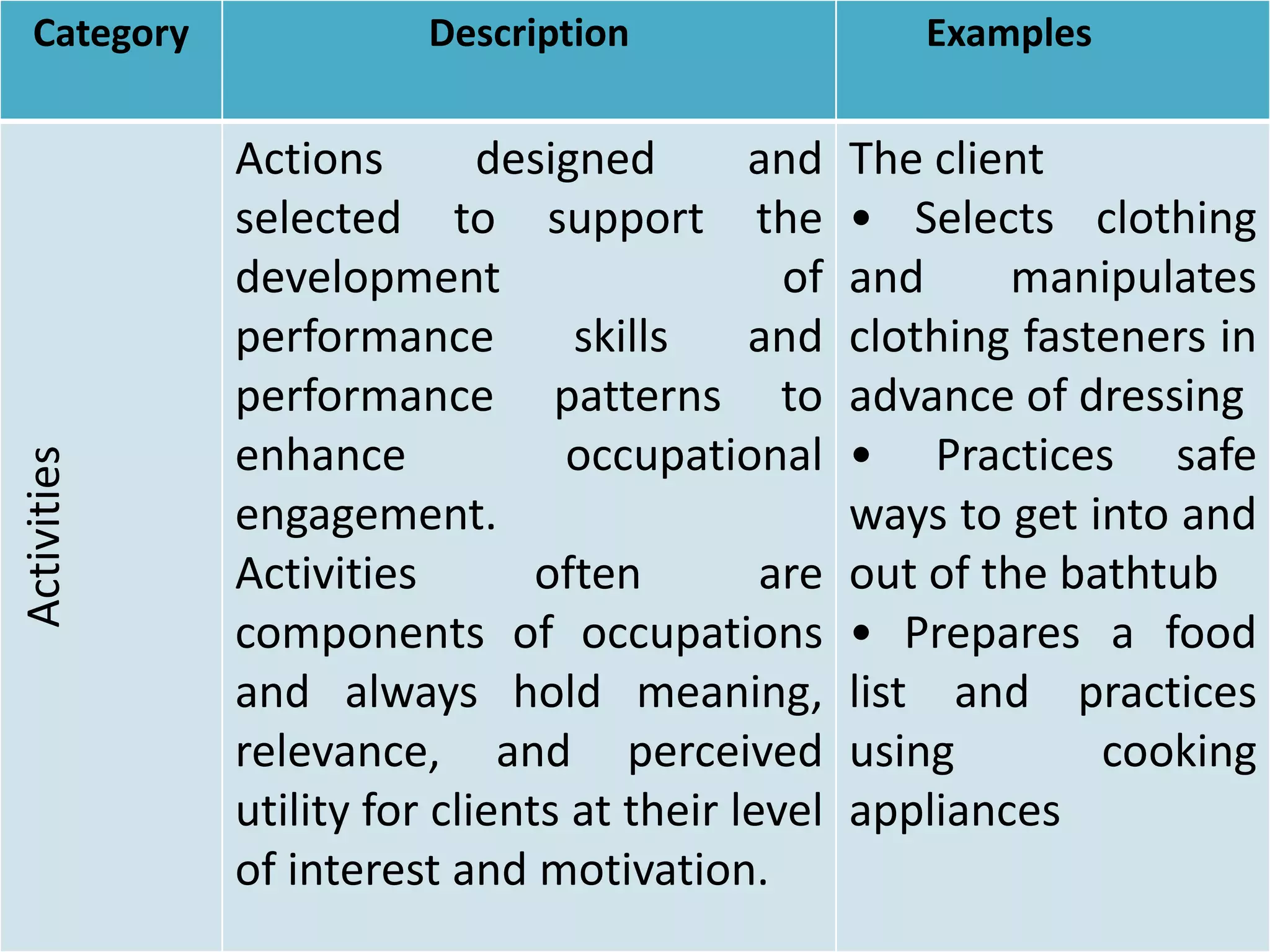
Category Description ExamplesActivities
Actions designed and
selected to support the
development of
performance skills and
performance patterns to
enhance occupational
engagement.
Activities often are
components of occupations
and always hold meaning,
relevance, and perceived
utility for clients at their level
of interest and motivation.
The client
• Selects clothing
and manipulates
clothing fasteners in
advance of dressing
• Practices safe
ways to get into and
out of the bathtub
• Prepares a food
list and practices
using cooking
appliances
Category
Des
ExamplesActivities
The client
• Reviews how to use a map and transportation schedule
•Writes answers on an application form
• Climbs on and off playground and recreation equipment
• Greets people and initiates conversation in a role-play
situation
Develops a weekly schedule to manage time and organize
daily and weekly responsibilities required to live
independently
• Uses adaptive switches to operate the home
environmental control system
• Completes a desired expressive activity (e.g., art, craft,
dance) that is not otherwise classified
Category Description Examples
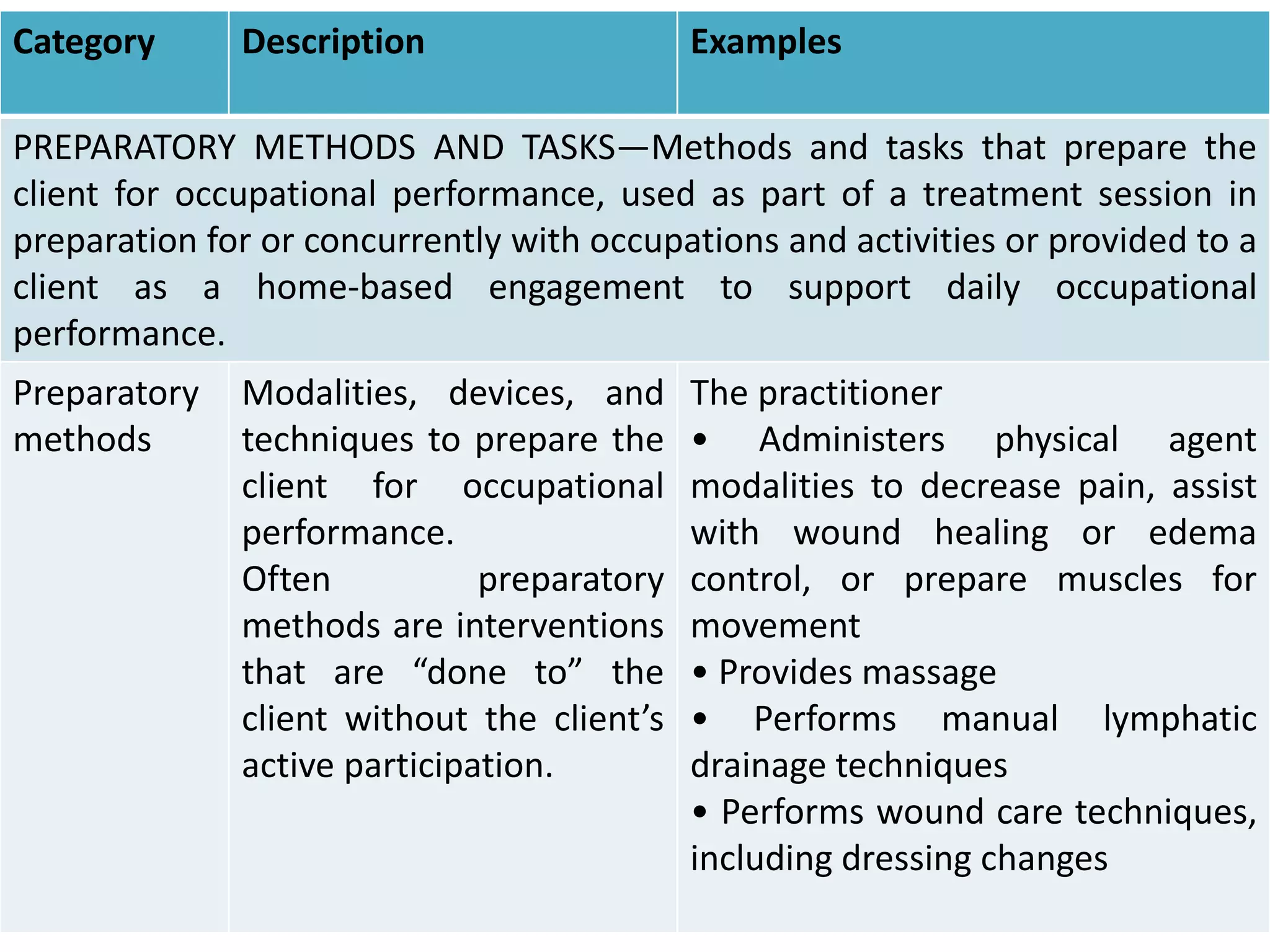
PREPARATORY METHODS AND TASKS—Methods and tasks that prepare the
client for occupational performance, used as part of a treatment session in
preparation for or concurrently with occupations and activities or provided to a
client as a home-based engagement to support daily occupational
performance.
Preparatory
methods
Modalities, devices, and
techniques to prepare the
client for occupational
performance.
Often preparatory
methods are interventions
that are “done to” the
client without the client’s
active participation.
The practitioner
• Administers physical agent
modalities to decrease pain, assist
with wound healing or edema
control, or prepare muscles for
movement
• Provides massage
• Performs manual lymphatic
drainage techniques
• Performs wound care techniques,
including dressing changes
Preparatory
methods
Description Examples
Splints Construction and
use of devices to
mobilize,
immobilize, and
support body
structures to
enhance
participation in
occupations.
The practitioner
• Fabricates and issues a splint
or orthotic to support a
weakened hand and decrease
pain
• Fabricates and issues a wrist
splint to facilitate movement
and enhance participation in
household activities
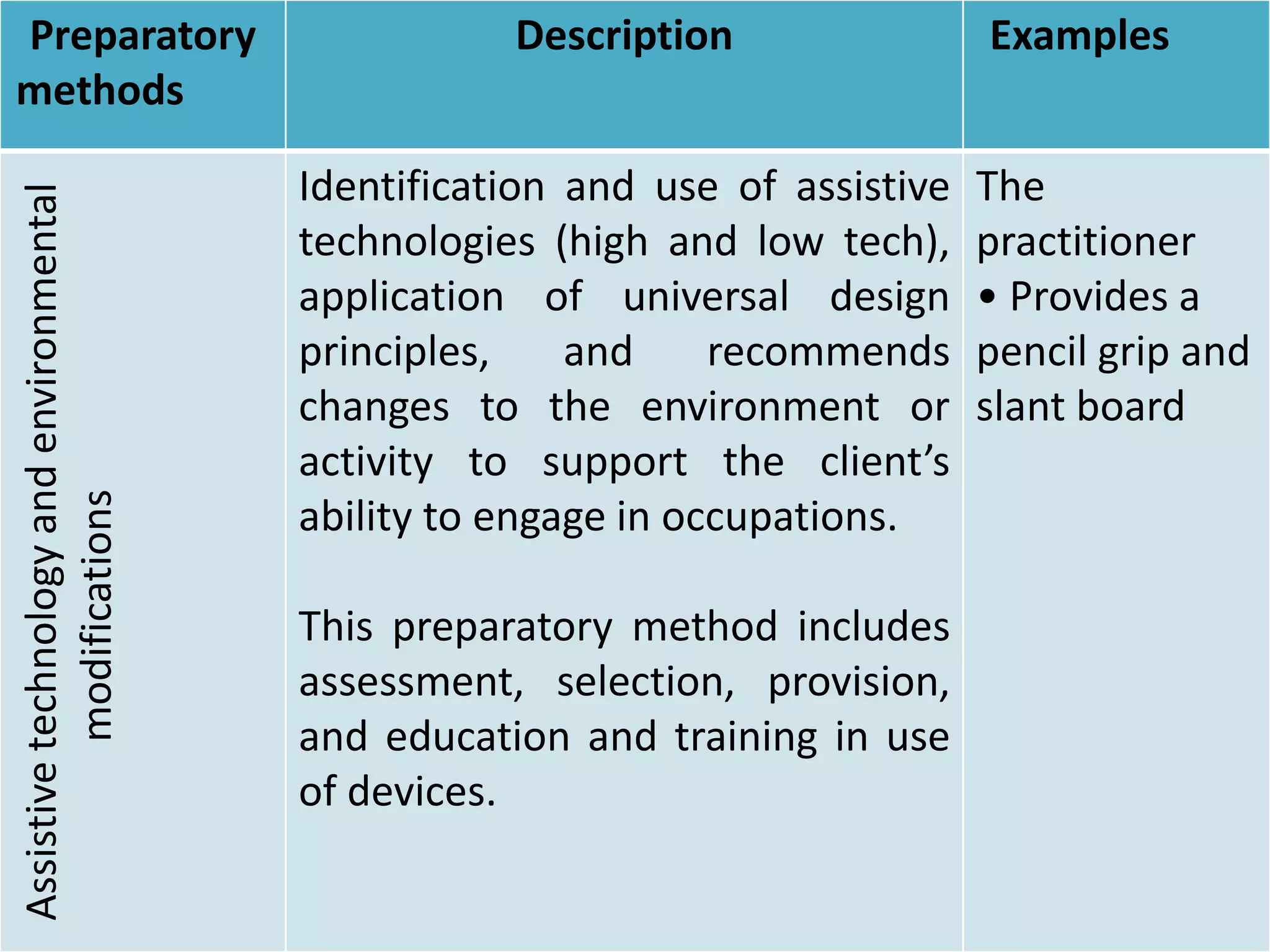
Preparatory
methods
Description ExamplesAssistivetechnologyandenvironmental
modifications
Identification and use of assistive
technologies (high and low tech),
application of universal design
principles, and recommends
changes to the environment or
activity to support the client’s
ability to engage in occupations.
This preparatory method includes
assessment, selection, provision,
and education and training in use
of devices.
The
practitioner
• Provides a
pencil grip and
slant board
Preparatory
methods
Des ExamplesAssistivetechnologyand
environmentalmodifications
The practitioner
• Provides electronic books with text-to-
speech software
• Recommends visual supports (e.g., a
social story) to guide behavior
• Recommends replacing steps with an
appropriately graded ramp
• Recommends universally designed
curriculum materials
Preparator
y methods
Description Examples
Wheeled
mobility
Use of products and technologies
that facilitate a client’s ability to
maneuver through space,
including seating and positioning,
and that improve mobility,
enhance participation in desired
daily occupations, and reduce
risk for complications such as
skin breakdown or limb
contractures.
The practitioner
• Recommends, in
conjunction with the
wheelchair team, a sip-
and-puff switch to allow
the client to maneuver
the power wheelchair
independently and
interface with an
environmental control
unit in the home
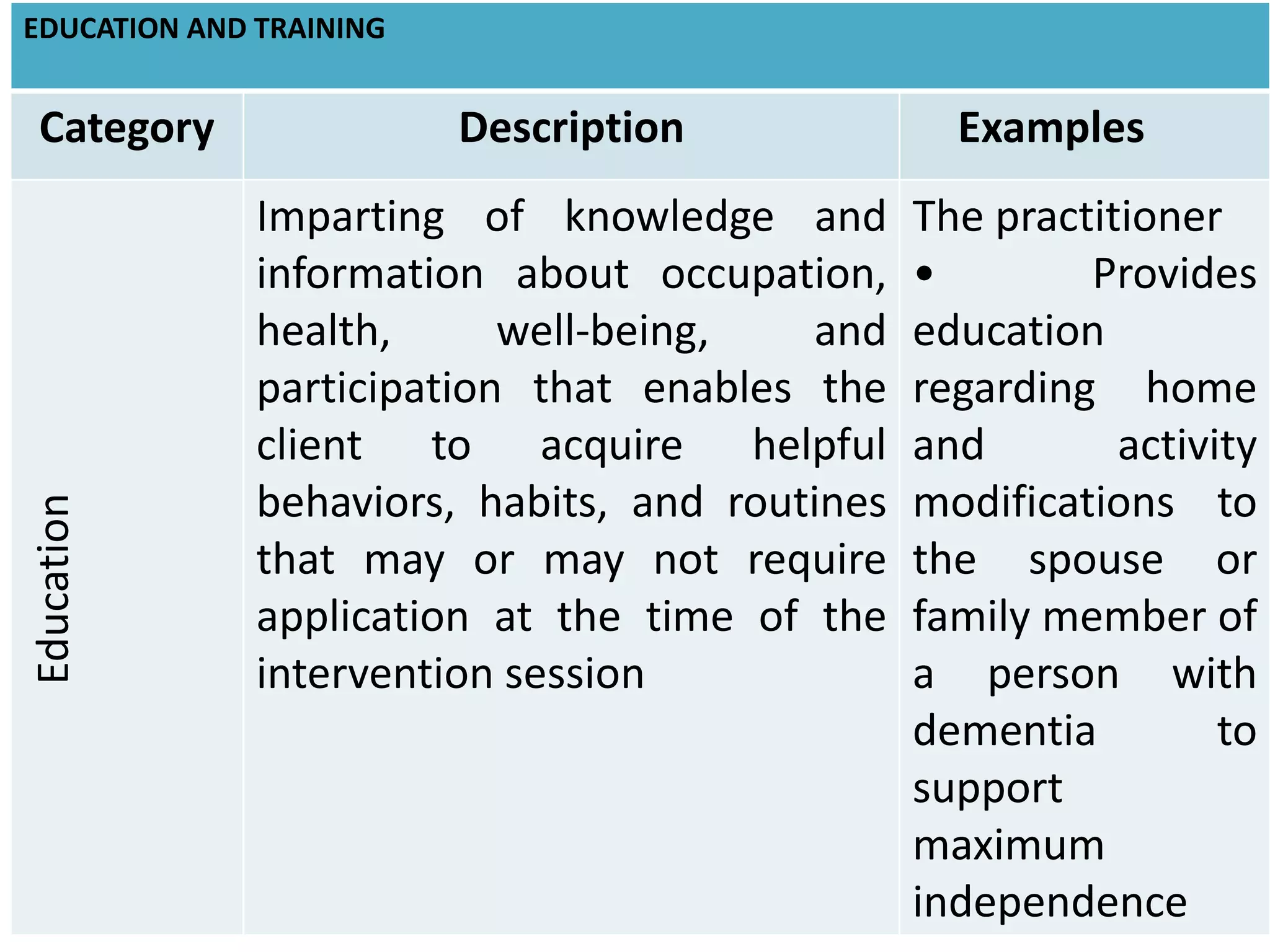
EDUCATION AND TRAINING
Category Description Examples
Education
Imparting of knowledge and
information about occupation,
health, well-being, and
participation that enables the
client to acquire helpful
behaviors, habits, and routines
that may or may not require
application at the time of the
intervention session
The practitioner
• Provides
education
regarding home
and activity
modifications to
the spouse or
family member of
a person with
dementia to
support
maximum
independence
EDUCATION AND TRAINING
Category Des Examples
Education
The practitioner
• Educates town officials about the value of
and strategies for making walking and biking
paths accessible for all community members
• Educates providers of care for people who
have experienced trauma on the use of
sensory strategies
• Provides education to people with mental
health issues and their families on the
psychological and social factors that influence
engagement in occupation
EDUCATION AND TRAINING
Category Description Examples
Training
Facilitation of the acquisition of
concrete skills for meeting specific
goals in a real-life, applied situation.
In this case, skills refers to
measurable components of function
that enable mastery.
Training is differentiated from
education by its goal of enhanced
performance as opposed to enhanced
understanding, although these goals
often go hand in hand (Collins &
The
practitioner
• Instructs
the client in
how to
operate a
universal
control
device to
manage
household
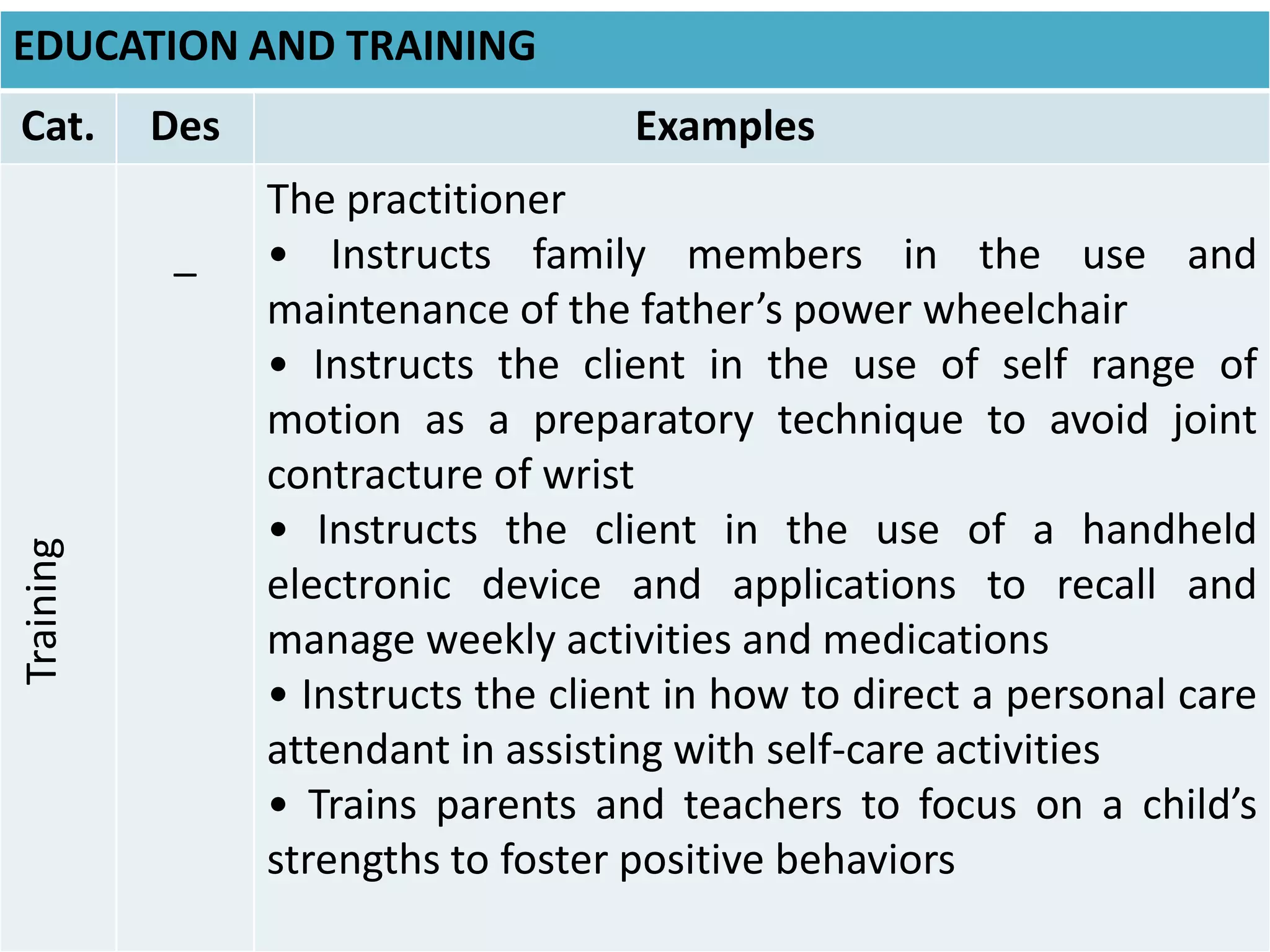
EDUCATION AND TRAINING
Cat. Des Examples
Training
_
The practitioner
• Instructs family members in the use and
maintenance of the father’s power wheelchair
• Instructs the client in the use of self range of
motion as a preparatory technique to avoid joint
contracture of wrist
• Instructs the client in the use of a handheld
electronic device and applications to recall and
manage weekly activities and medications
• Instructs the client in how to direct a personal care
attendant in assisting with self-care activities
• Trains parents and teachers to focus on a child’s
strengths to foster positive behaviors
Category Description Examples
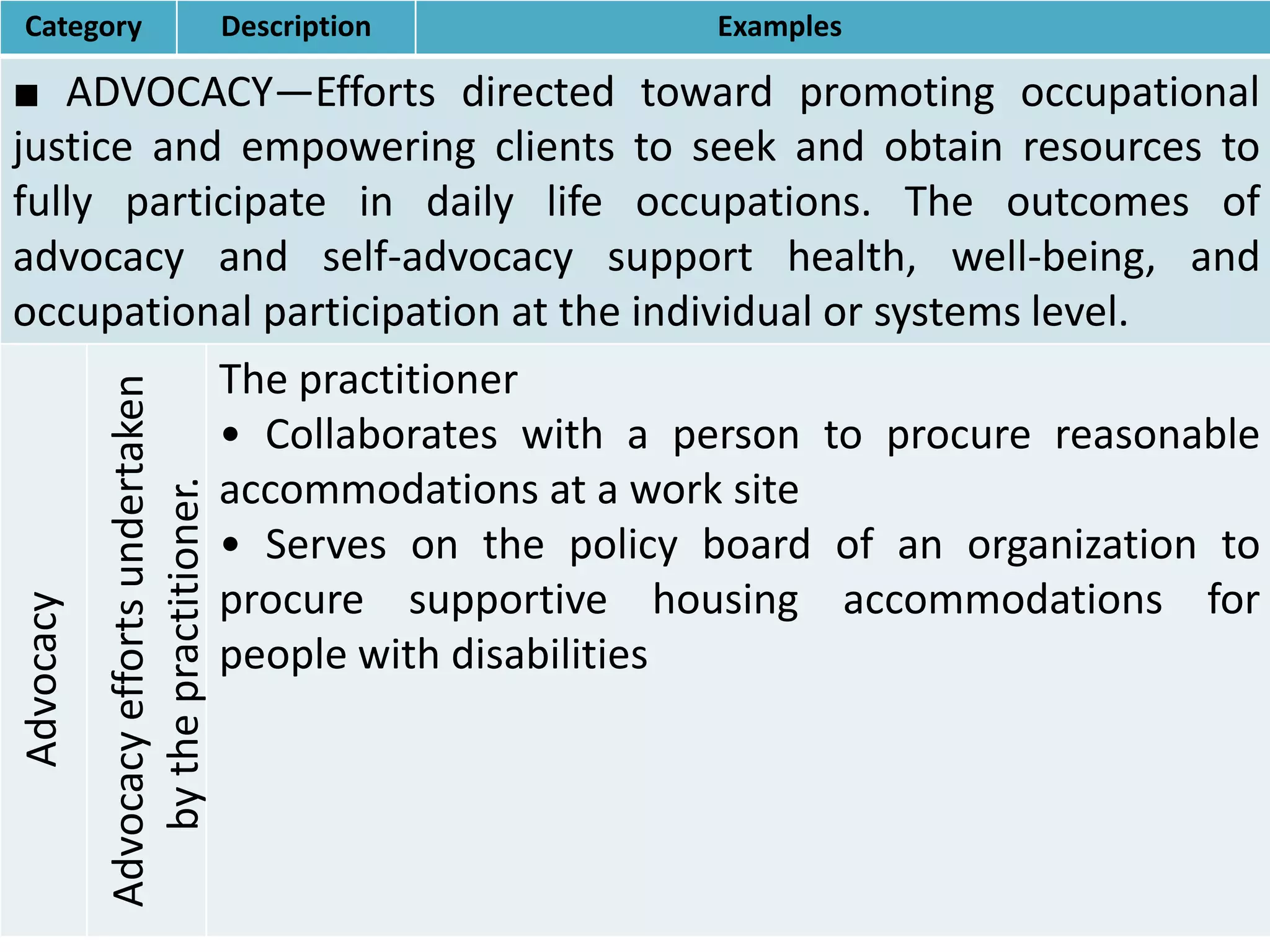
■ ADVOCACY—Efforts directed toward promoting occupational
justice and empowering clients to seek and obtain resources to
fully participate in daily life occupations. The outcomes of
advocacy and self-advocacy support health, well-being, and
occupational participation at the individual or systems level.
Advocacy
Advocacyeffortsundertaken
bythepractitioner.
The practitioner
• Collaborates with a person to procure reasonable
accommodations at a work site
• Serves on the policy board of an organization to
procure supportive housing accommodations for
people with disabilities
Category Description Examples
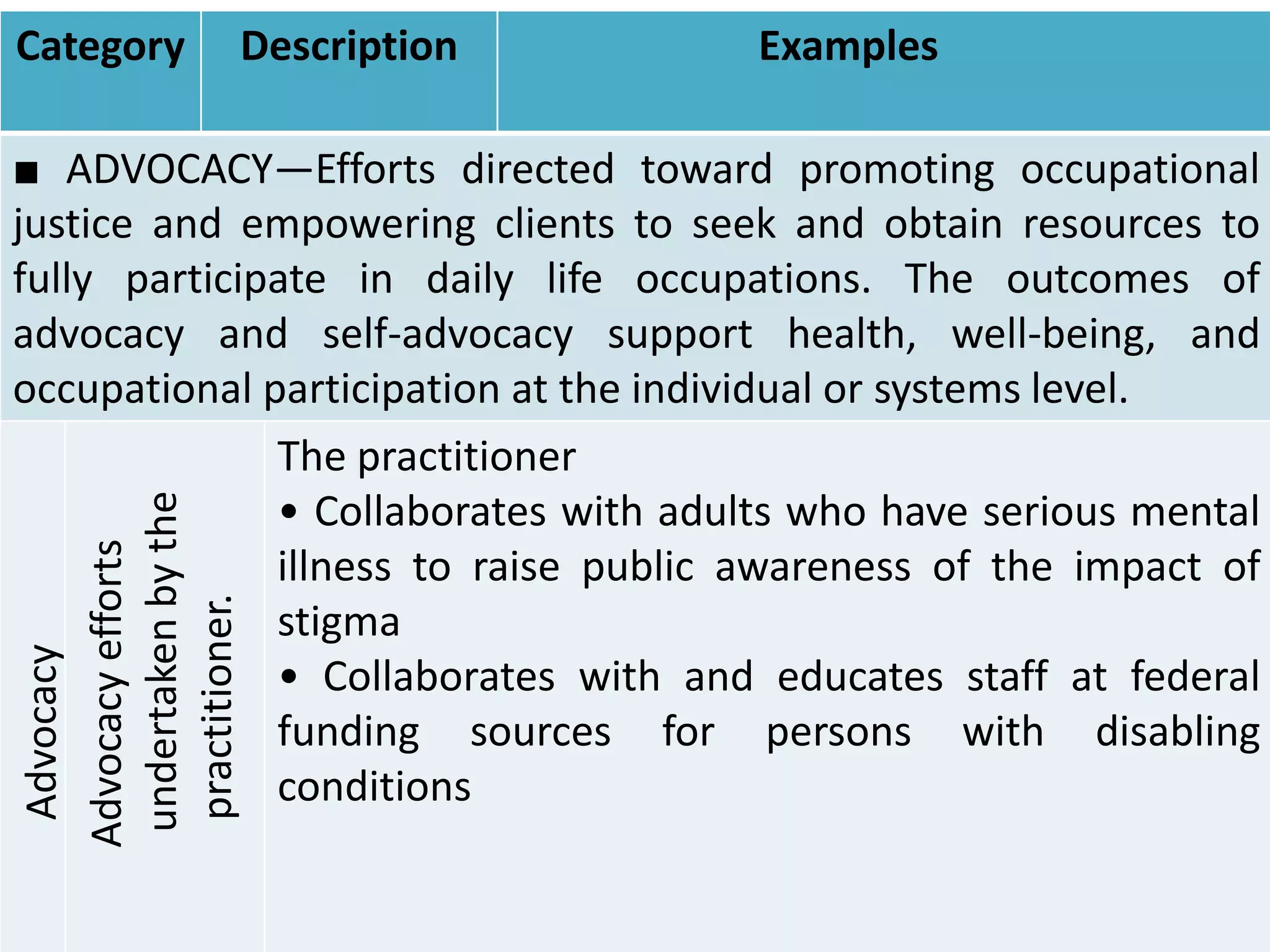
■ ADVOCACY—Efforts directed toward promoting occupational
justice and empowering clients to seek and obtain resources to
fully participate in daily life occupations. The outcomes of
advocacy and self-advocacy support health, well-being, and
occupational participation at the individual or systems level.
Advocacy
Advocacyefforts
undertakenbythe
practitioner.
The practitioner
• Collaborates with adults who have serious mental
illness to raise public awareness of the impact of
stigma
• Collaborates with and educates staff at federal
funding sources for persons with disabling
conditions
Category
Description
ExamplesSelf-advocacy
Advocacyeffortsundertakenbythe
client,whichthepractitionercan
promoteandsupport. • A student with a learning disability
requests and receives reasonable
accommodations such as textbooks on tape.
• A grassroots employee committee requests
and procures ergonomically designed
keyboards for their work computers.
• People with disabilities advocate for the
use of universal design principles with all
new public construction.
• Young adults contact their Internet service
provider to request support for cyber
bullying prevention.

occupational therapy intervention

  • 1.
    Shamima Akter B. Sc(Honours) in Occupational Therapy & M. Sc in Rehabilitation Science Assistant Professor, Department of Occupational Therapy Bangladesh Health Professions Institute (BHPI) Centre for the Rehabilitation of the Paralysed (CRP) Chapain, Savar
  • 2.
    Types of occupationaltherapy interventions • Occupational therapy interventions include the use of occupations and activities, preparatory methods and tasks, education and training, advocacy, and group interventions to facilitate engagement in occupations to promote health and participation. • The examples provided illustrate the types of interventions occupational therapy practitioners provide and are not intended to be all inclusive.
  • 3.
    Category Description Examples OCCUPATIONSAND ACTIVITIES— Occupations and activities selected as interventions for specific clients and designed to meet therapeutic goals and address the underlying needs of the mind, body, and spirit of the client. To use occupations and activities therapeutically, the practitioner considers activity demands and client factors in relation to the client’s therapeutic goals, contexts, and environments. Occupations Client-directed daily life activities that match and support or address identified participation goals. The client • Completes morning dressing and hygiene using adaptive devices • Purchases groceries and prepares a meal • Visits a friend using public transportation independently
  • 4.
    Category Description ExamplesOccupations - • Appliesfor a job in the retail industry • Plays on a playground with children and adults • Participates in a community festival by setting up a booth to sell baked goods • Engages in a pattern of self-care and relaxation activities in preparation for sleep • Engages in a statewide advocacy program to improve services to people with mental illness
  • 5.
    Category Description ExamplesActivities Actionsdesigned and selected to support the development of performance skills and performance patterns to enhance occupational engagement. Activities often are components of occupations and always hold meaning, relevance, and perceived utility for clients at their level of interest and motivation. The client • Selects clothing and manipulates clothing fasteners in advance of dressing • Practices safe ways to get into and out of the bathtub • Prepares a food list and practices using cooking appliances
  • 6.
    Category Des ExamplesActivities The client • Reviewshow to use a map and transportation schedule •Writes answers on an application form • Climbs on and off playground and recreation equipment • Greets people and initiates conversation in a role-play situation Develops a weekly schedule to manage time and organize daily and weekly responsibilities required to live independently • Uses adaptive switches to operate the home environmental control system • Completes a desired expressive activity (e.g., art, craft, dance) that is not otherwise classified
  • 7.
    Category Description Examples PREPARATORYMETHODS AND TASKS—Methods and tasks that prepare the client for occupational performance, used as part of a treatment session in preparation for or concurrently with occupations and activities or provided to a client as a home-based engagement to support daily occupational performance. Preparatory methods Modalities, devices, and techniques to prepare the client for occupational performance. Often preparatory methods are interventions that are “done to” the client without the client’s active participation. The practitioner • Administers physical agent modalities to decrease pain, assist with wound healing or edema control, or prepare muscles for movement • Provides massage • Performs manual lymphatic drainage techniques • Performs wound care techniques, including dressing changes
  • 8.
    Preparatory methods Description Examples Splints Constructionand use of devices to mobilize, immobilize, and support body structures to enhance participation in occupations. The practitioner • Fabricates and issues a splint or orthotic to support a weakened hand and decrease pain • Fabricates and issues a wrist splint to facilitate movement and enhance participation in household activities
  • 9.
    Preparatory methods Description ExamplesAssistivetechnologyandenvironmental modifications Identification anduse of assistive technologies (high and low tech), application of universal design principles, and recommends changes to the environment or activity to support the client’s ability to engage in occupations. This preparatory method includes assessment, selection, provision, and education and training in use of devices. The practitioner • Provides a pencil grip and slant board
  • 10.
    Preparatory methods Des ExamplesAssistivetechnologyand environmentalmodifications The practitioner •Provides electronic books with text-to- speech software • Recommends visual supports (e.g., a social story) to guide behavior • Recommends replacing steps with an appropriately graded ramp • Recommends universally designed curriculum materials
  • 11.
    Preparator y methods Description Examples Wheeled mobility Useof products and technologies that facilitate a client’s ability to maneuver through space, including seating and positioning, and that improve mobility, enhance participation in desired daily occupations, and reduce risk for complications such as skin breakdown or limb contractures. The practitioner • Recommends, in conjunction with the wheelchair team, a sip- and-puff switch to allow the client to maneuver the power wheelchair independently and interface with an environmental control unit in the home
  • 12.
    EDUCATION AND TRAINING CategoryDescription Examples Education Imparting of knowledge and information about occupation, health, well-being, and participation that enables the client to acquire helpful behaviors, habits, and routines that may or may not require application at the time of the intervention session The practitioner • Provides education regarding home and activity modifications to the spouse or family member of a person with dementia to support maximum independence
  • 13.
    EDUCATION AND TRAINING CategoryDes Examples Education The practitioner • Educates town officials about the value of and strategies for making walking and biking paths accessible for all community members • Educates providers of care for people who have experienced trauma on the use of sensory strategies • Provides education to people with mental health issues and their families on the psychological and social factors that influence engagement in occupation
  • 14.
    EDUCATION AND TRAINING CategoryDescription Examples Training Facilitation of the acquisition of concrete skills for meeting specific goals in a real-life, applied situation. In this case, skills refers to measurable components of function that enable mastery. Training is differentiated from education by its goal of enhanced performance as opposed to enhanced understanding, although these goals often go hand in hand (Collins & The practitioner • Instructs the client in how to operate a universal control device to manage household
  • 15.
    EDUCATION AND TRAINING Cat.Des Examples Training _ The practitioner • Instructs family members in the use and maintenance of the father’s power wheelchair • Instructs the client in the use of self range of motion as a preparatory technique to avoid joint contracture of wrist • Instructs the client in the use of a handheld electronic device and applications to recall and manage weekly activities and medications • Instructs the client in how to direct a personal care attendant in assisting with self-care activities • Trains parents and teachers to focus on a child’s strengths to foster positive behaviors
  • 16.
    Category Description Examples ■ADVOCACY—Efforts directed toward promoting occupational justice and empowering clients to seek and obtain resources to fully participate in daily life occupations. The outcomes of advocacy and self-advocacy support health, well-being, and occupational participation at the individual or systems level. Advocacy Advocacyeffortsundertaken bythepractitioner. The practitioner • Collaborates with a person to procure reasonable accommodations at a work site • Serves on the policy board of an organization to procure supportive housing accommodations for people with disabilities
  • 17.
    Category Description Examples ■ADVOCACY—Efforts directed toward promoting occupational justice and empowering clients to seek and obtain resources to fully participate in daily life occupations. The outcomes of advocacy and self-advocacy support health, well-being, and occupational participation at the individual or systems level. Advocacy Advocacyefforts undertakenbythe practitioner. The practitioner • Collaborates with adults who have serious mental illness to raise public awareness of the impact of stigma • Collaborates with and educates staff at federal funding sources for persons with disabling conditions
  • 18.
    Category Description ExamplesSelf-advocacy Advocacyeffortsundertakenbythe client,whichthepractitionercan promoteandsupport. • Astudent with a learning disability requests and receives reasonable accommodations such as textbooks on tape. • A grassroots employee committee requests and procures ergonomically designed keyboards for their work computers. • People with disabilities advocate for the use of universal design principles with all new public construction. • Young adults contact their Internet service provider to request support for cyber bullying prevention.