1
WELCOME
Reshma . A. Victor
Dept. of Agricultural Extension
2
OCCUPATIONAL STRESS AND ITS IMPACT
ON JOB PERFORMANCE
 1964-Hans Selye
 Stress - Latin word-
Stringi
to be drawn tight
STRESS
( Fevre et al., 2003)
3
4
“The only person
without stress is a
dead person”
- Hans Seyle
5
What is stress?
5
6
Stress is a psychological and physical state
that results when the resources of the
individual are not sufficient to cope with
the demands and pressures of the situation
(Ratnawat and and Jha, 2014)
It is the destructive
physical, mental, and
emotional reaction when
there exists a mismatch
between job demand and
competencies.
OCCUPATIONAL STRESS
(Rahim, 2010) 7
8
Every working professional-
regardless of age, experience,
gender and profile has felt the
pressure of work-related stress at
some point in their career
( The economic times,2016)
9
80% of working professionals in
India complain that they suffer
from stress
10
CAUSES OF OCCUPATIONAL STRESS
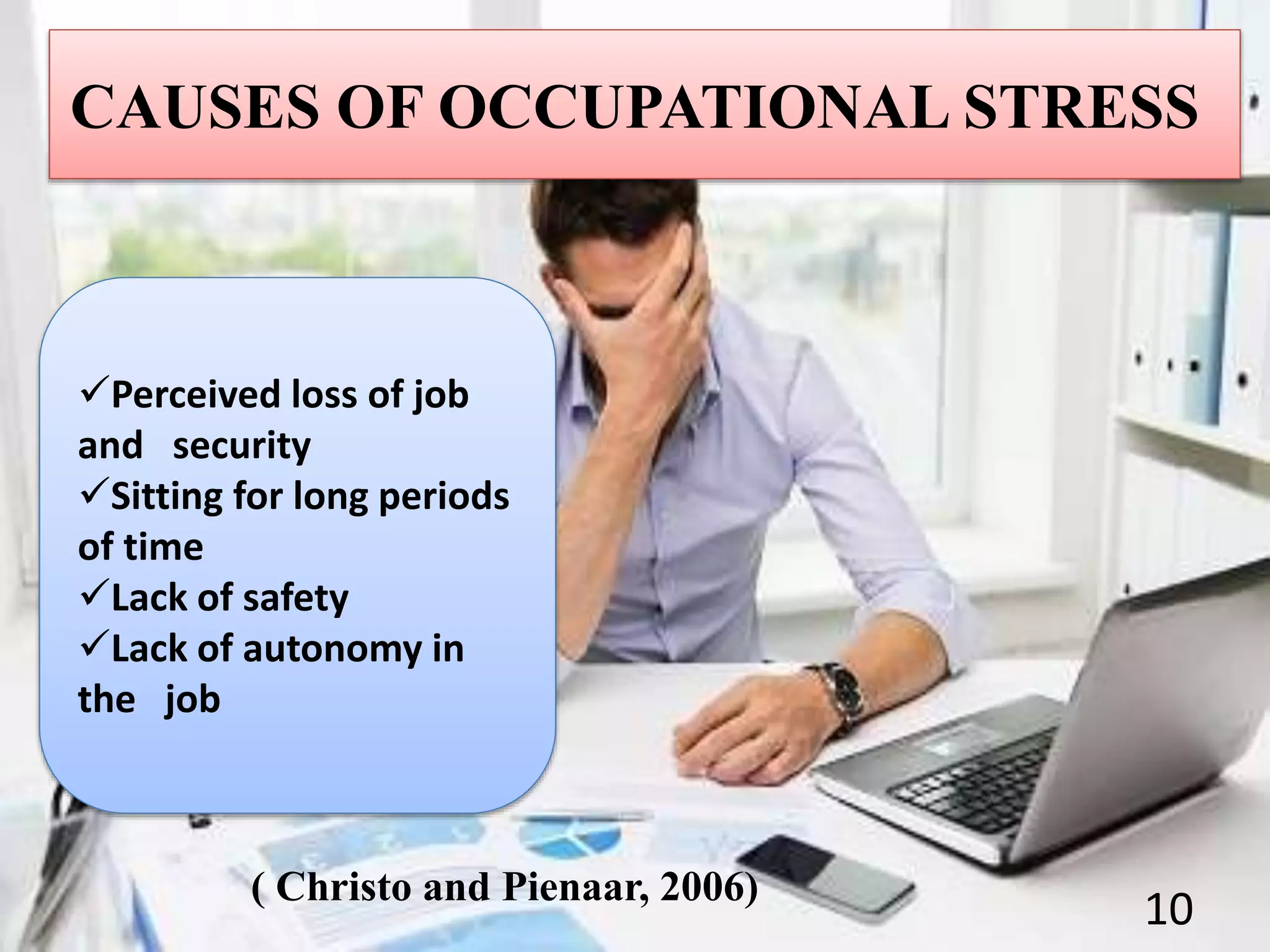
Perceived loss of job
and security
Sitting for long periods
of time
Lack of safety
Lack of autonomy in
the job
( Christo and Pienaar, 2006)
11
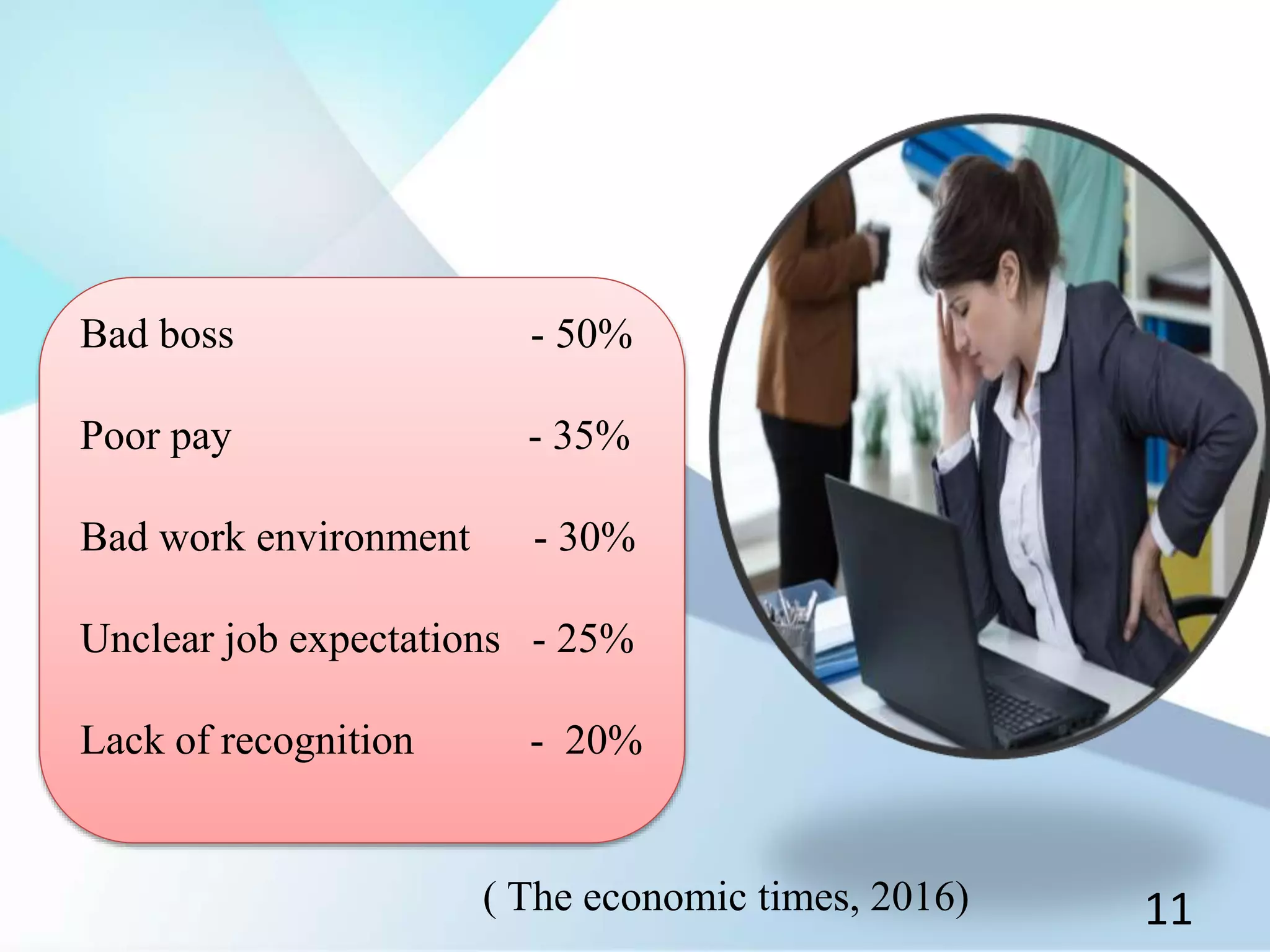
Bad boss - 50%
Poor pay - 35%
Bad work environment - 30%
Unclear job expectations - 25%
Lack of recognition - 20%
( The economic times, 2016)
12
57%
20%
21%
3%
Workload
Role overload
Role ambiguity
Other
(Kwaku, 2012)
What constitute Occupational Stress?....
13
Causes Stress(%)
Shortage of essential resources 56
Shortage of staff 65
Work overload 64
Long working hours 40
Time pressure 37
No personal growth 46
Unfriendly work environment 60
Lack of support 52
Financial problems 48
Unfriendly supervisor 40
Lack of motivation 47
Lack of appreciation 50
Lack of reward 57
(Maphangela, 2015)
Stress
Eustress
Distress
Acute
stress
Chronic
Stress
TYPES OF STRESS
14
Positive stress
Short-term
Motivates
Feels exciting
Improves
Performance
1.Eustress
(Ornelas and Kleiner, 2003) 15
2.Distress
(Ornelas & Kleiner, 2003)
Negative stress
Short or long-term
Causes anxiety
Feels unpleasant
Decreases
performance
Leads - mental and
physical problem
16
3. Acute stress
• Short time
• Due to work
pressure
• Meeting deadlines
• Minor accident
• Increased physical
activity
(Kwaku, 2012) 17
Headaches
Back pain
Stomach problems
Rapid heartbeat
Muscle aches
Body pain
Symptoms
(Kwaku, 2012)
18
4. Chronic Stress
• Due to poverty
• Broken or stressed
families and
marriages
• Chronic illness
• Successive failures in
life
(Kwaku, 2012)
19
20
21
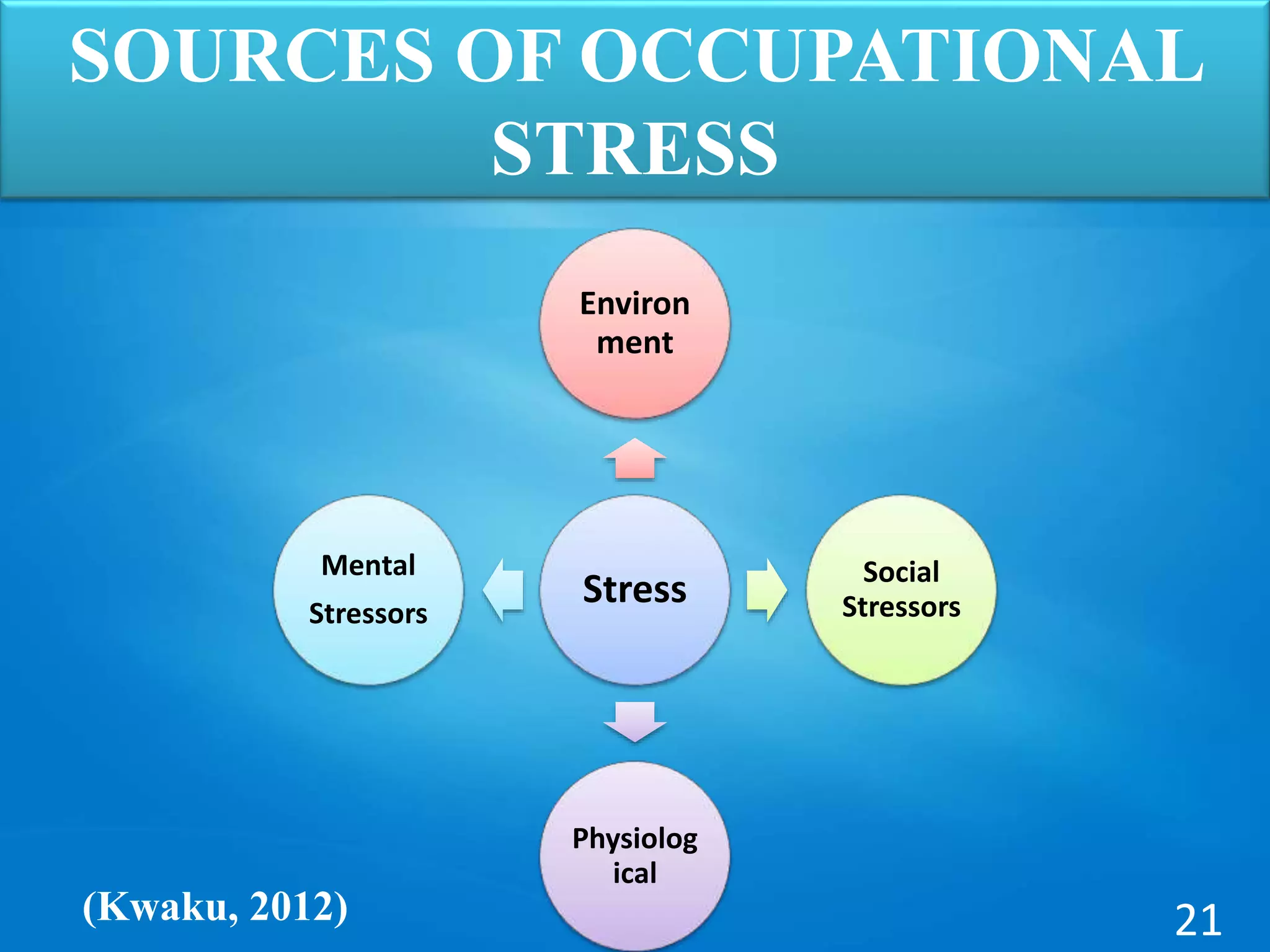
Stress
Environ
ment
Social
Stressors
Physiolog
ical
Mental
Stressors
SOURCES OF OCCUPATIONAL
STRESS
(Kwaku, 2012) 21
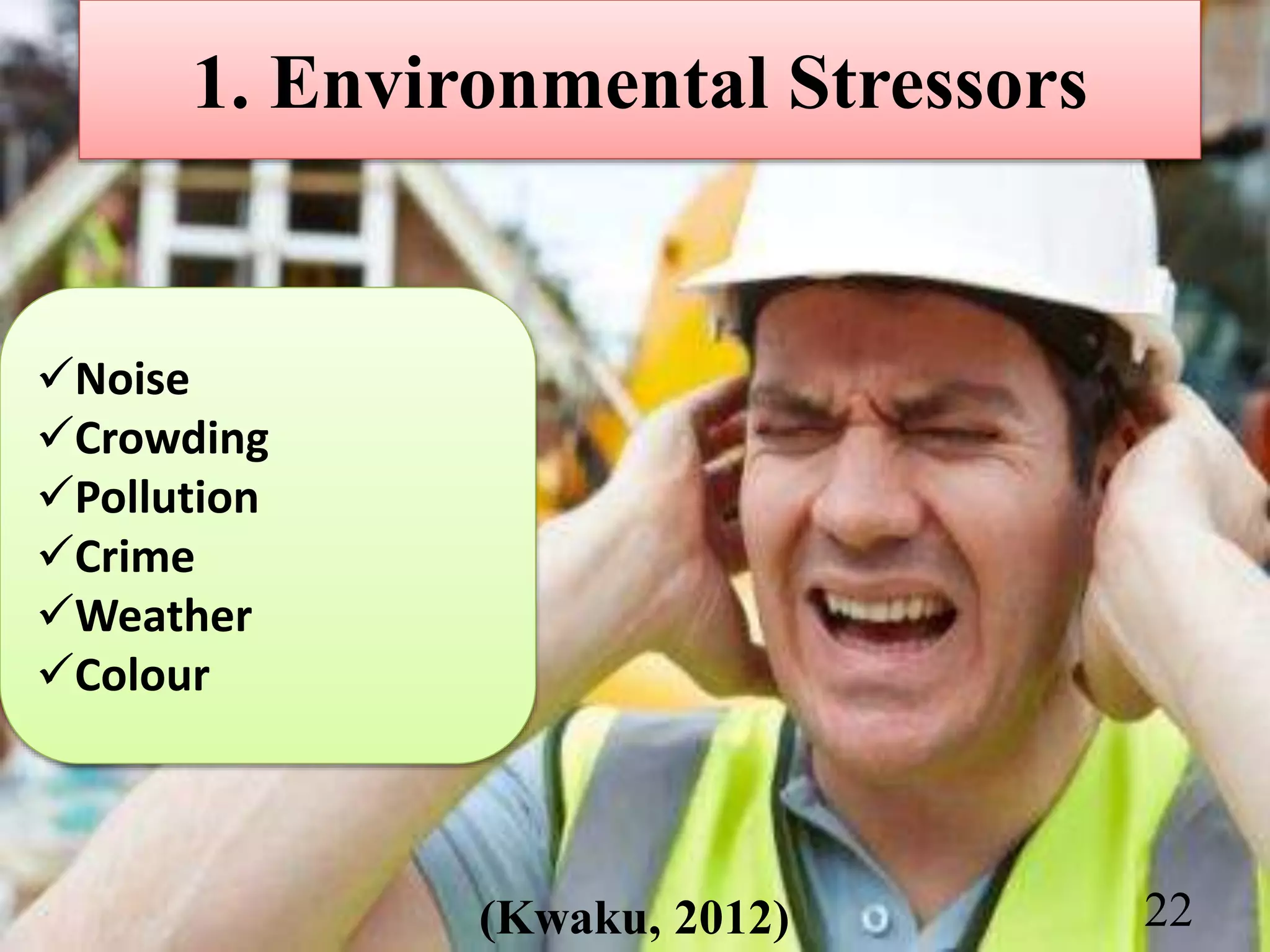
Noise
Crowding
Pollution
Crime
Weather
Colour
1. Environmental Stressors
(Kwaku, 2012) 22
2. Social Stressors
• Deadlines
• Financial problems
• Job interviews
• Presentations
(Kwaku, 2012)
23
Menopause
Illness
Aging
Accidents
Sleep disturbances
Negative thoughts
Low self confidence
3. Physiological Stressors
(Kwaku, 2012) 24
25
Physiological consequences of work stress on
the individual body
0
10
20
30
40
50
60
70
60
9
30
43
48
8
34
63
51
36
percentage
(Gebregzabiher, 2015)
Mental Stress
Subjective
effects
Behavioral
effects
Cognitive
effects
26
4.Mental Stress
( Dissanayaka, 2014)
a) Subjective effects
• Leads to anxiety
• Depression
• Frustration
• Fatigue
• Reduce job
performance
b) Behavioral effects
• Leads to accident
proneness
•Substance abuse
•Impaired speech
•Restlessness
( Dissanayaka, 2014) 27
28
Behavioral Consequences of work stress on
the individual body
91
69
94 91
80 84
68 70
80
(Gebregzabiher, 2015)
p
e
r
c
e
n
ta
g
e
c) Cognitive effects
• Stress affects our thought
process
• Leads to difficulty of
making decisions
• Hypersensitivity
• Mental blocks
( Dissanayaka, 2014)
29
30
Psychological Disorders Due To Work
Stress
Depression
40%
Irritability
25%
Anger
25%
(The Economics Times, 2016)
31
Psychological consequences of work stress on
the individual body
0
20
40
60
80
53 55
68
55
43
55 55
61
53
34
25
38
11
percentage
(Gebregzabiher, 2015)
32
(Lazarus, 1974)
32
33
Signals Of Occupational Stress
Feeling anxious,
irritable or
depressed
27%
Loss of interest in
work
25%
Problems
sleeping, fatigue
20%
Troubles
concentrating
27%
Others
1%
(Kwaku, 2012)
34
Personal Factors Associated With
Occupational Stress
14
8
13 11
55
48
56
0
10
20
30
40
50
60
Marital
difficulties
Breaking of
relationship
Large
family size
Discipline
troubles
with
children
Conflicting
demands at
home and
work
Lack of
support for
domestic
problems at
work
work place
being far
from family
(Gebregzabiher, 2015)
35
Economic Factors Associated With
Occupational Stress
(Gebregzabiher, 2015)
OCCUPATIONAL STRESS AND HEALTH
36
Do you think your work can affect your
health?
Yes
89%
No
11%
(Kwaku, 2012)
37
Effects of Occupational Stress and the
Immune System
 Leukocytes are the
immune system’s foot
soldiers
Kills-bacteria, viruses, and
fungi, and cells that have
become cancerous.
(Jiang & Chess, 2006)
38
39
Psychological stressors can dampen
the response of the immune
system, especially when the stress
is intense or prolonged
(Segerstrom and Miller, 2004)
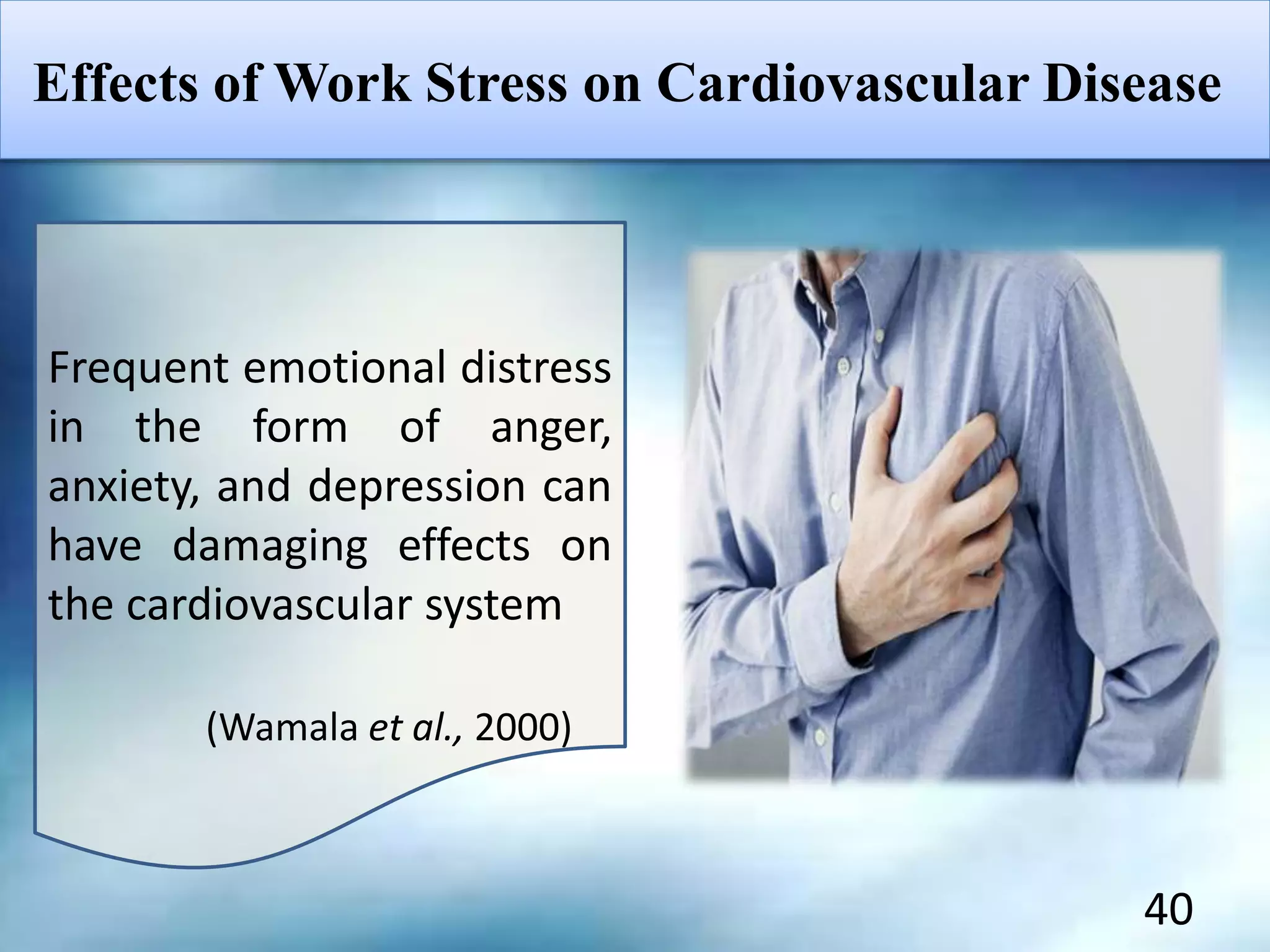
Frequent emotional distress
in the form of anger,
anxiety, and depression can
have damaging effects on
the cardiovascular system
Effects of Work Stress on Cardiovascular Disease
(Wamala et al., 2000)
40
• Stress hormones - epinephrine and non
epinephrine
• Anxiety and anger – release - stress hormones by
the adrenal glands
• Increase heart rate, breathing rate, and blood
pressure
(Bunde and Suls, 2006) 41
Acute anger - trigger heart
attacks & sudden cardiac
death
(Bunde & Suls, 2006)
4242
43
Effects of Work Stress on Headaches
Contractions - muscles of the
scalp, face, neck, and shoulders -
chronic tension headaches.
Dull, steady pain on both sides
of the head.
(Linde et al., 2005)
SINUS
Deep and constant
pain around cheek
bones
TENSION
Dull, constant pain
on both sides of the
head
MIGRAINE
Pain on one side of
the head
44
JOB PERFORMANCE
It is defined as the overall
expected value from
employees’ behaviors carried
out over the course of a set
period of time
45
(Motowidlo et al., 1997)
46
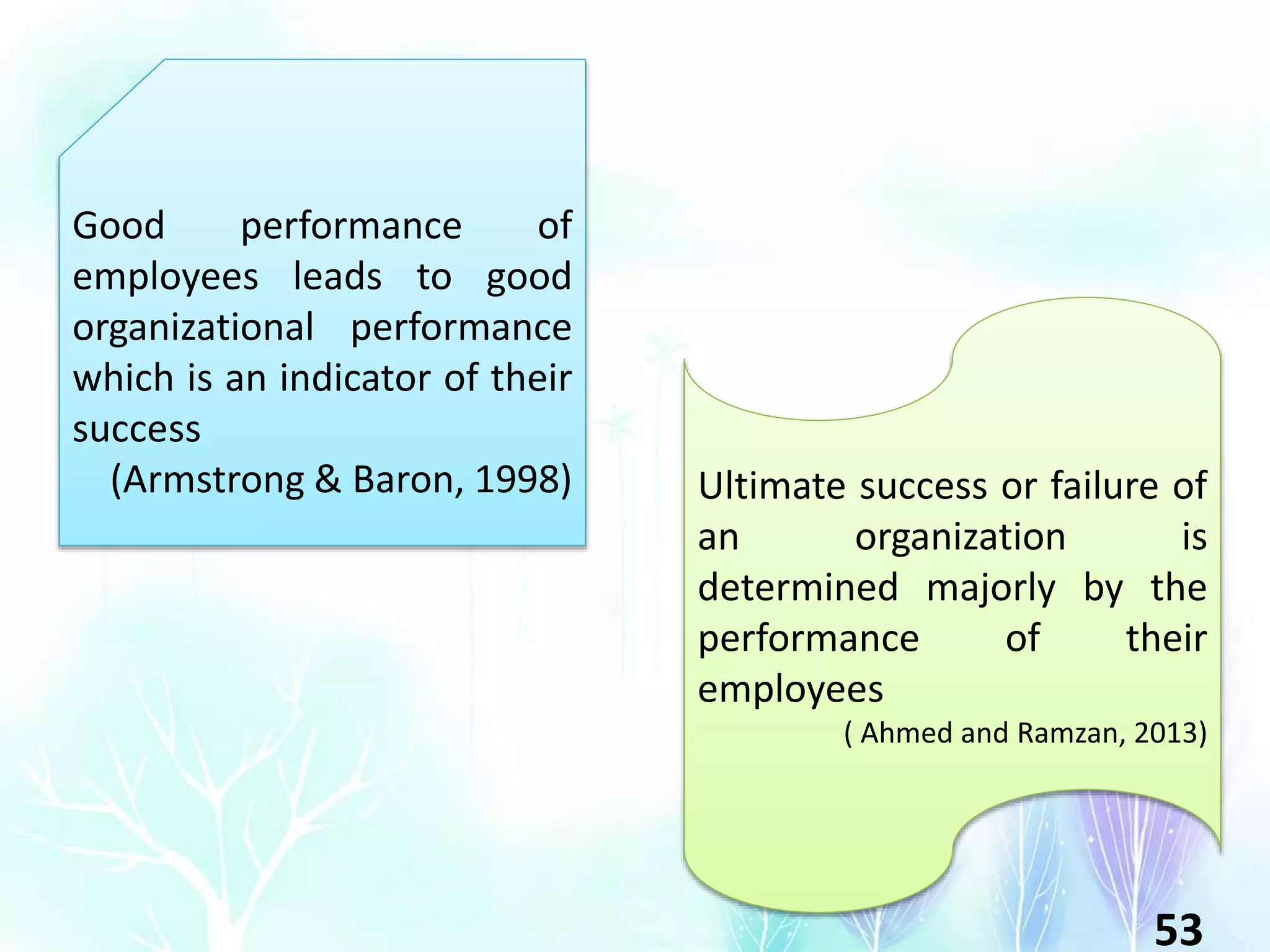
Good performance of
employees leads to good
organizational performance
which is an indicator of their
success
(Armstrong & Baron, 1998) Ultimate success or failure of
an organization is
determined majorly by the
performance of their
employees
( Ahmed and Ramzan, 2013)
53
47(Kwaku, 2012)
48
Level of stress faced by employees of
different organization
 Pestonjee (1992) investigated occupational
stress in academic and non academic staff working
at the university of New England in Australia.
 Aim: To determine the relationship between
occupational stress, non work stress, physical
health, emotional health, and job satisfaction
 Study -1000 staff members of the university
49
• Male experienced higher workload stress than females
• Females reported more stress due to work politics than male
• Younger staff - more stress due to job significance and work politics
than older staff
• Older staff - more stress due to work overload, and university
reorganization than younger staff
• Lower level staffs were more stressed than higher level employees
46
50
JOB STRESS OF WOMEN & MEN
EXTENSION OFFICERS
High
19%
Medium
15%
Low
66%
WOMEN
High
20%
Medium
17%Low
63%
MEN
(Mishra, 2005)
51
High
9%
Mediu
m
74%
Low
17%
Men
JOB PERFORMANCE OF MEN & WOMEN
EXTENSION OFFICERS
(Mishra, 2005)
High
11%
Mediu
m
77%
Low
12%
Women
52
JOB STRESS OF BANKING SECTOR
•Job stress had a negative relation with job
performance
• Causes:
Work overload
Extreme burden of work
Time pressure of completion of tasks
More than 12 hours of work duration
Fear of termination of job contract, etc.
(Rahim, 2010)
53(Lopes and Kachalia, 2016)
Job Stress of Banking Sector
18%
56%
26%
21% 21%
40%
50%
Lack of
support from
organization
Work
overload
Lack of social
support from
colleagues
No
motivation
factor
Role
ambiguity
Operational
risk
Working
overtime
54
IMPACT OF STRESS ON JOB
PERFORMANCE
Occupational stress shows high dissatisfaction among
the employees, burnout, poor work performance and
less effective interpersonal relations at work
(Manshor et al., 2003)
Workers who are stressed are also most likely to be
unhealthy, poorly motivated, less productive and
less effective at work and their organizations are less
likely to be successful in a competitive market.
(Kwaku, 2012)
55
Absenteeism Reduced
productivity
Low morale Poor work
relations
6.8
63.6
24.6
5.1
(Kwaku, 2012)
STEPS TO MANAGING STRESS
Step 1: Identify if you are stressed
Step 2: Identify the stressor
Step 3: Identify the reason for the stressor
Step 4: Select an appropriate stress
management
57
STRESS MANAGEMENT
58
Organizational
approaches.
Individual
approaches
(Dissanayaka, 2014)
Approaches
Individual Approaches.
Walking
Riding bicycles
Attending aerobic
classes
Practicing yoga
Jogging
Swimming
Playing tennis
a) Exercise
59(Dissanayaka, 2014)
Meditation
Prayer
Hypnosis
Biofeedback
b) Relaxation
60(Dissanayaka, 2014)
61
Physical exercise of respondent for managing stress
0
10
20
30
40
50
60
70
8
16
45
11
5 5
13
35
49
69
36
49
28
40
51
4544
15
19
40
68
55
36
20
Always Some times Not at all
(Gebregzabiher, 2015)
c) Opening up
62
Family
Colleague
Friends
(Dissanayaka, 2014)
63
Social support
(Gebregzabiher, 2015)
64
2. Organization approach
 Training programmes
 Effective upward and downward communication
in the organization
 Improvement in personnel policies
 Improvement in the physical work environment
 Management should provide technical support to
employees.
(Dissanayaka, 2014)
STRESS MANAGEMENT
 The management should know the capabilities of the
employees
 Social interaction with the superiors
 The superiors must be friendly to the employees
 The management must give equal remuneration and
incentives to the employees
65(Priya, 2016)
• The management must avoid the frequent rotating
shifts to the employees.
• Conduct seminars and fun activities.
• The superiors should give proper training to the
employees to achieve their target.
66
(Priya, 2016)
66
67
• The management must give proper training to the fresher
employee.
• Arrange medical facilities to the employees, who is
affected by high blood pressure
•The work environment should be in such a way that the
employees should not feel anger.
(Priya, 2016)
67
68
CONCLUSION
Negative correlation between stress and
job performance
Good management and good work
organizations are the best forms of stress
prevention
6969
70

Occupational stress and its impact on job performance