1
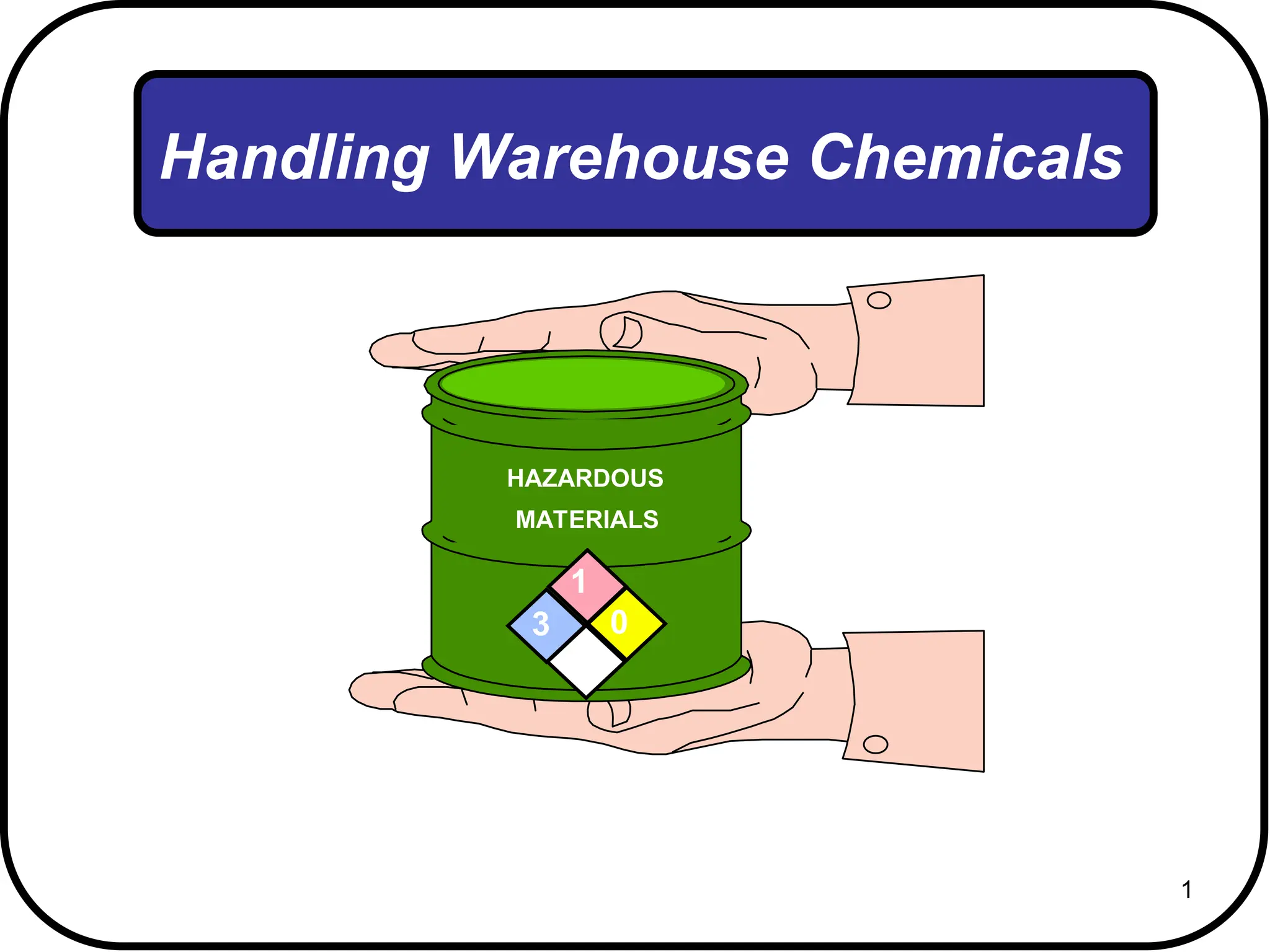
HAZARDOUS
MATERIALS
1
0
3
Handling Warehouse Chemicals
2
COURSE OBJECTIVES
COURSE OBJECTIVES
 Introduce basic rules for safe chemical handling.
Introduce basic rules for safe chemical handling.
 Discuss the health hazards of chemicals.
Discuss the health hazards of chemicals.
 Discuss the physical properties of chemicals.
Discuss the physical properties of chemicals.
 Introduce
Introduce the Hazard Communication Standard (HAZCOM)
the Hazard Communication Standard (HAZCOM)
 Discuss general concepts of toxicology.
Discuss general concepts of toxicology.
 Discuss employee protective measures.
Discuss employee protective measures.
 Discuss the hazard rating systems currently in use.
Discuss the hazard rating systems currently in use.
 Discuss chemical warning labels.
Discuss chemical warning labels.
 Discuss chemical storage requirements.
Discuss chemical storage requirements.
3
CHEMICAL RISKS TO HEALTH
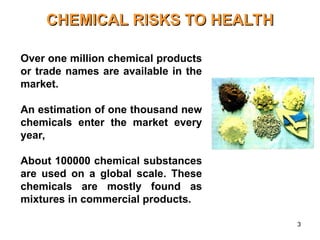
Over one million chemical products
or trade names are available in the
market.
An estimation of one thousand new
chemicals enter the market every
year,
About 100000 chemical substances
are used on a global scale. These
chemicals are mostly found as
mixtures in commercial products.
4
CHEMICAL RISKS TO HEALTH
• Not only the worker handling chemicals is at
risk, we may be exposed to chemical risks in
our homes through misuse or by accidents.
• The environment may be affected.
– Chemicals may pollute the air we breathe, the water
we drink, and the food we eat.
– They may have entered into forests and lakes,
destroying wildlife and changing the ecosystems.
5
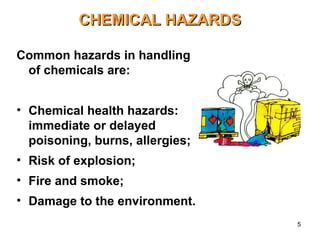
CHEMICAL HAZARDS
CHEMICAL HAZARDS
Common hazards in handling
of chemicals are:
• Chemical health hazards:
immediate or delayed
poisoning, burns, allergies;
• Risk of explosion;
• Fire and smoke;
• Damage to the environment.
6
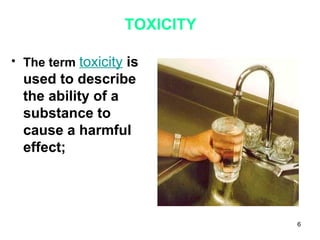
TOXICITY
• The term toxicity is
used to describe
the ability of a
substance to
cause a harmful
effect;
7
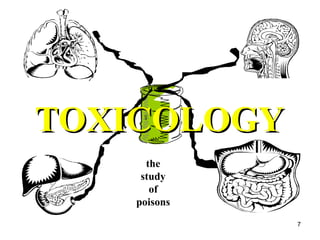
TOXICOLOGY
TOXICOLOGY
the
study
of
poisons
8
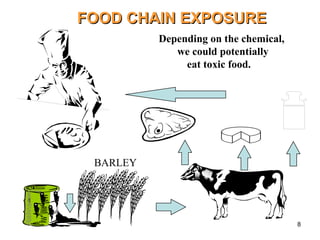
FOOD CHAIN EXPOSURE
FOOD CHAIN EXPOSURE
BARLEY
Depending on the chemical,
we could potentially
eat toxic food.
9
WORKPLACE CHEMICALS
WORKPLACE CHEMICALS
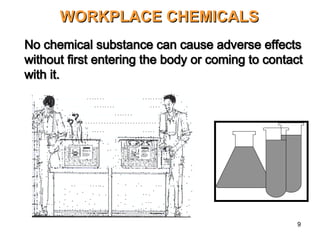
No chemical substance can cause adverse effects
without first entering the body or coming to contact
with it.
with it.
10
WORKPLACE CHEMICALS
WORKPLACE CHEMICALS
ROUTES OF ENTRY
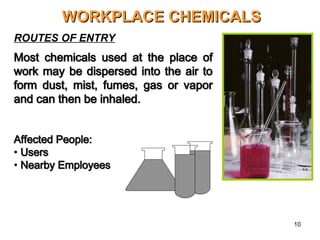
Most chemicals used at the place of
work may be dispersed into the air to
form dust, mist, fumes, gas or vapor
and can then be inhaled.
Affected People:
Affected People:
• Users
Users
• Nearby Employees
Nearby Employees
11
CHEMICAL TOXICOLOGY
CHEMICAL TOXICOLOGY
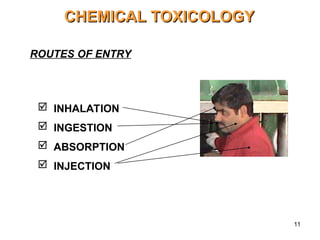
ROUTES OF ENTRY
 INHALATION
 INGESTION
 ABSORPTION
 INJECTION
12
INHALATION
Inhalation
is the most common route
of exposure for most
health hazards. This
includes breathing in
dust, fumes, oil mist, and
vapors from solvents and
various gases.
13
INHALATION
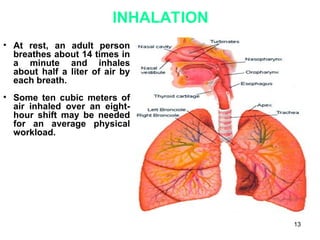
• At rest, an adult person
breathes about 14 times in
a minute and inhales
about half a liter of air by
each breath.
• Some ten cubic meters of
air inhaled over an eight-
hour shift may be needed
for an average physical
workload.
14
INHALATION
INHALATION
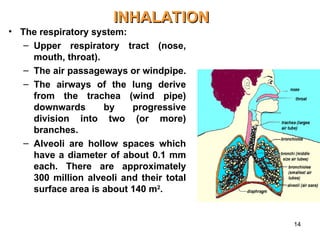
• The respiratory system:
– Upper respiratory tract (nose,
mouth, throat).
– The air passageways or windpipe.
– The airways of the lung derive
from the trachea (wind pipe)
downwards by progressive
division into two (or more)
branches.
– Alveoli are hollow spaces which
have a diameter of about 0.1 mm
each. There are approximately
300 million alveoli and their total
surface area is about 140 m2
.
15
INHALATION
INHALATION
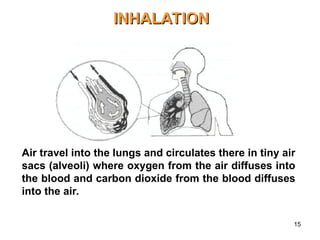
Air travel into the lungs and circulates there in tiny air
sacs (alveoli) where oxygen from the air diffuses into
the blood and carbon dioxide from the blood diffuses
into the air.
16
Gases are used in many operations and may
combine with other substances to produce
toxic gases such as phosgene, ozone, and
carbon monoxide. Workers can be exposed to
these and other gases during work. Potential
exposure to gases occurs through inhalation.
Such exposure may produce eye damage,
headaches, shivering, tiredness, nausea, and
possible kidney and liver damage.
Example: Exposure to Gases
17
Used as fillers in epoxy resins and
other plastics, in wire coatings or
electrical insulation. Uncontrolled
exposures may produce skin and
upper respiratory irritations and, in the
case of asbestos, cancer.
Example: Exposure to Fiberglass and
Asbestos
Asbestos
18
Metal, wood, plastics. Raw materials
used to manufacture products are
usually bought in large quantities, and
can cause injuries or fatalities in
many ways.
Example: Exposure to Solids
19
Some hazards are created by the
work environment.
Environment
Environment
•Lack Of Systems &
Procedures.
•Lack of training
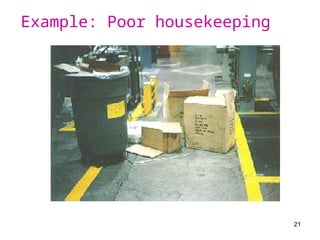
•Poor Housekeeping
20
Look for:
• Condition of all surfaces where people
walk or where things are placed
• Overcrowding and poor ventilation
• Poor lighting, extreme temperatures
and noise.
• Poor housekeeping
Environment:
21
Example: Poor housekeeping
22
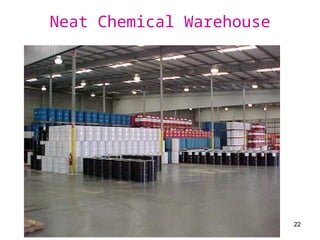
Neat Chemical Warehouse
23
Identifying Chemical
Hazards
•Check all chemicals that come
on site
•Check which (if any) dangerous
goods class they belong to
•Identify the primary hazard
•Identify any important
secondary hazards
24
Chemical Storage
• Chemical Labels.
Label all containers of hazardous
chemicals
• Identity of the hazardous
chemicals, hazard warnings in
words, pictures, symbols, or a
combination thereof, which
provide at least general
information regarding the
hazards of the chemical.
25
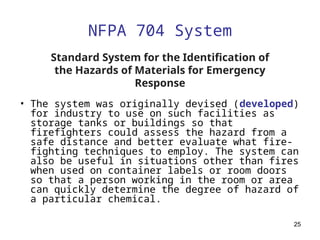
NFPA 704 System
• The system was originally devised (developed)
for industry to use on such facilities as
storage tanks or buildings so that
firefighters could assess the hazard from a
safe distance and better evaluate what fire-
fighting techniques to employ. The system can
also be useful in situations other than fires
when used on container labels or room doors
so that a person working in the room or area
can quickly determine the degree of hazard of
a particular chemical.
Standard System for the Identification of
the Hazards of Materials for Emergency
Response
26
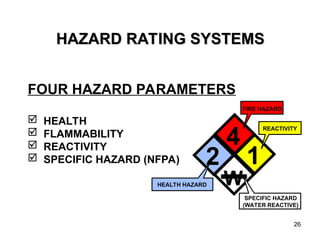
HAZARD RATING SYSTEMS
FOUR HAZARD PARAMETERS
 HEALTH
 FLAMMABILITY
 REACTIVITY
 SPECIFIC HAZARD (NFPA)
4
1
2
W
FIRE HAZARD
REACTIVITY
SPECIFIC HAZARD
(WATER REACTIVE)
HEALTH HAZARD
27
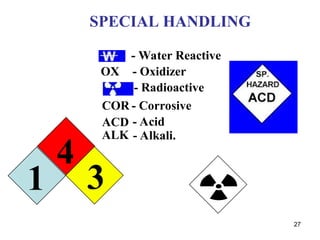
SPECIAL HANDLING
4
1 3
OX
COR
ACD
ALK
- Water Reactive
- Oxidizer
- Radioactive
- Corrosive
- Acid
- Alkali.
28
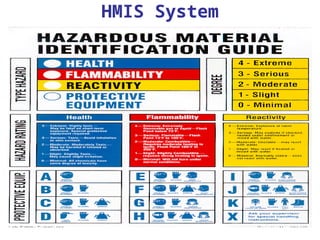
HMIS System
29
Chemical Dating
• Shall be dated on receipt in the
warehouse and on opening. This information
provides a history of the chemicals in
each container and guides future
researches.
• Providing container-opening dates is
especially important for peroxide-forming
chemicals such as ethers, dioxane,
isopropanol, and tetrahydrofuran that
could pose an explosion hazard. Chemicals
shall be removed to the waste disposal
area if they are past their expiration
date.
30
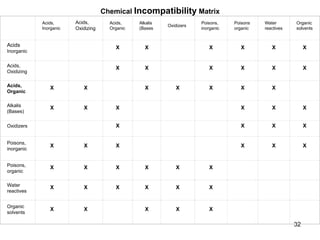
Chemical Compatibility.
Chemicals shall be stored only
with other compatible chemicals
.
Do not store them
alphabetically, except within a
grouping of compatible
chemicals.
31
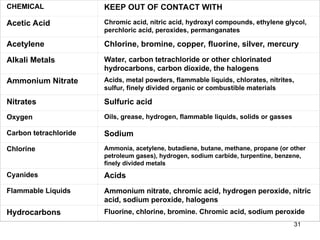
CHEMICAL KEEP OUT OF CONTACT WITH
Acetic Acid Chromic acid, nitric acid, hydroxyl compounds, ethylene glycol,
perchloric acid, peroxides, permanganates
Acetylene Chlorine, bromine, copper, fluorine, silver, mercury
Alkali Metals Water, carbon tetrachloride or other chlorinated
hydrocarbons, carbon dioxide, the halogens
Ammonium Nitrate Acids, metal powders, flammable liquids, chlorates, nitrites,
sulfur, finely divided organic or combustible materials
Nitrates Sulfuric acid
Oxygen Oils, grease, hydrogen, flammable liquids, solids or gasses
Carbon tetrachloride Sodium
Chlorine Ammonia, acetylene, butadiene, butane, methane, propane (or other
petroleum gases), hydrogen, sodium carbide, turpentine, benzene,
finely divided metals
Cyanides Acids
Flammable Liquids Ammonium nitrate, chromic acid, hydrogen peroxide, nitric
acid, sodium peroxide, halogens
Hydrocarbons Fluorine, chlorine, bromine. Chromic acid, sodium peroxide
32
Chemical Incompatibility Matrix
Acids,
Inorganic
Acids,
Oxidizing
Acids,
Organic
Alkalis
(Bases
Oxidizers
Poisons,
inorganic
Poisons
organic
Water
reactives
Organic
solvents
Acids
Inorganic
X X X X X X
Acids,
Oxidizing
X X X X X X
Acids,
Organic
X X X X X X X
Alkalis
(Bases)
X X X X X X
Oxidizers X X X X
Poisons,
inorganic
X X X X X X
Poisons,
organic
X X X X X X
Water
reactives
X X X X X X
Organic
solvents
X X X X X
33
Chemical Groupings
• Highly Toxic (Poisons) and habit-forming
organic chemicals.
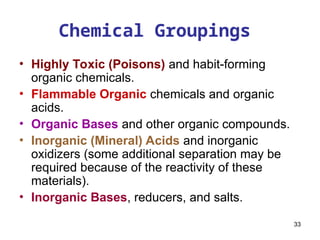
• Flammable Organic chemicals and organic
acids.
• Organic Bases and other organic compounds.
• Inorganic (Mineral) Acids and inorganic
oxidizers (some additional separation may be
required because of the reactivity of these
materials).
• Inorganic Bases, reducers, and salts.
34
Storage Facilities
Highly toxic chemicals (such as
cyanide) shock-sensitive
chemicals (such as solid sodium
acid or picric acid), and
habit-forming chemicals (amyl
nitrite) shall be stored in
locked cabinets to prevent
Possible Threat of This
sensitive Chemicals.
35
Shock-sensitive
Peroxide-forming chemicals and
those that may become shock-
sensitive with long-term
storage shall be stored
separately and shall be labeled
and dated. Peroxide-forming
chemicals shall be stored in a
cool, dark, dry place
36
Flammable Liquids
Shall be stored in
flammable-liquid cabinets if
the quantity contains a
total of 10 gallons or more,
including flammable liquid
wastes.
37
Volatile
Highly Odorous chemicals shall
be stored in a well-ventilated
area; a ventilated cabinet is
preferable. Chemical fume hoods
shall not be used for storage,
as containers block proper air
flow in the hood and take up
work space.
38
Inspections
• Chemicals showing any of the indications
listed below shall be turned over to HSE
for safe disposal:
• Slightly cloudy liquids.
• Darkening or change in color.
• Spotting on solids.
• Caking of anhydrous materials.
• Existence of solids in liquids or
liquids in solids.
• Pressure buildup in containers.
• Evidence of reaction with water.
• Corrosion or damage to the container.
• Missing or damaged (i.e., illegible)
labels
39
Hazard Classes
There are nine main hazard classes.
Of these, four may be of concern.
40
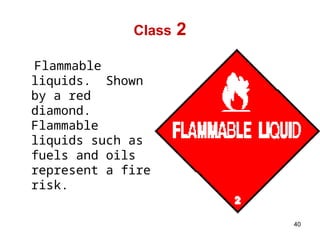
Class 2
Flammable
liquids. Shown
by a red
diamond.
Flammable
liquids such as
fuels and oils
represent a fire
risk.
41
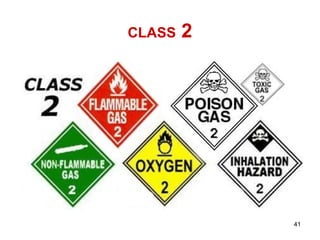
CLASS 2
42
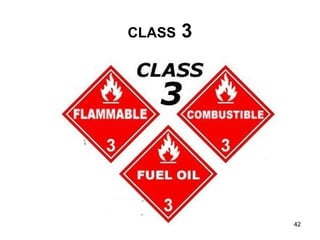
CLASS 3
43
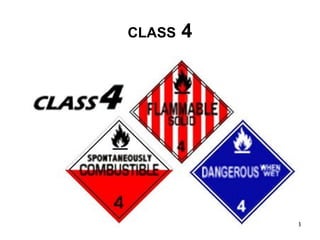
CLASS 4
44
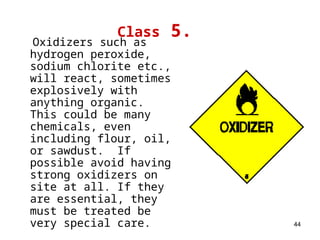
Class 5.
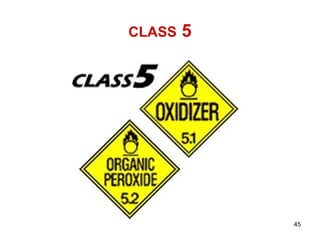
Oxidizers such as
hydrogen peroxide,
sodium chlorite etc.,
will react, sometimes
explosively with
anything organic.
This could be many
chemicals, even
including flour, oil,
or sawdust. If
possible avoid having
strong oxidizers on
site at all. If they
are essential, they
must be treated be
very special care.
45
CLASS 5
46
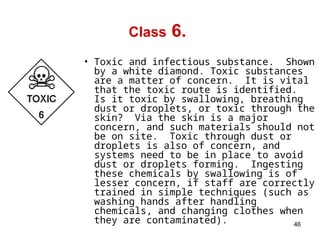
Class 6.
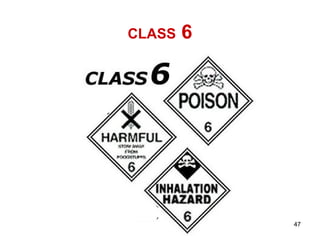
• Toxic and infectious substance. Shown
by a white diamond. Toxic substances
are a matter of concern. It is vital
that the toxic route is identified.
Is it toxic by swallowing, breathing
dust or droplets, or toxic through the
skin? Via the skin is a major
concern, and such materials should not
be on site. Toxic through dust or
droplets is also of concern, and
systems need to be in place to avoid
dust or droplets forming. Ingesting
these chemicals by swallowing is of
lesser concern, if staff are correctly
trained in simple techniques (such as
washing hands after handling
chemicals, and changing clothes when
they are contaminated).
47
CLASS 6
48
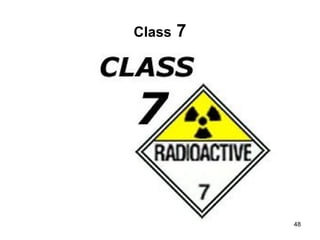
Class 7
49
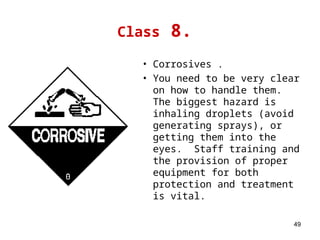
Class 8.
• Corrosives .
• You need to be very clear
on how to handle them.
The biggest hazard is
inhaling droplets (avoid
generating sprays), or
getting them into the
eyes. Staff training and
the provision of proper
equipment for both
protection and treatment
is vital.
50
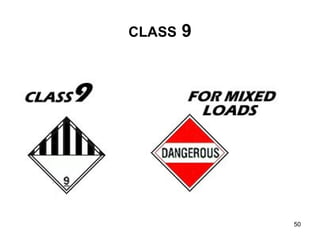
CLASS 9
51
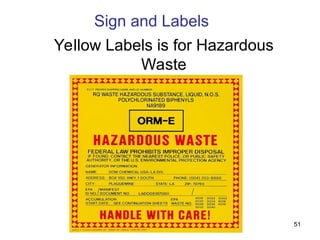
Sign and Labels
Yellow Labels is for Hazardous
Waste
52
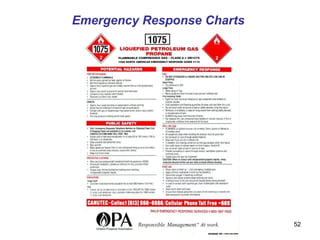
Emergency Response Charts
53
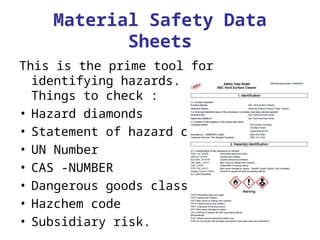
Material Safety Data
Sheets
This is the prime tool for
identifying hazards.
Things to check :
• Hazard diamonds
• Statement of hazard class
• UN Number
• CAS -NUMBER
• Dangerous goods class
• Hazchem code
• Subsidiary risk.
54
Hazard Identification
Checklist
• What chemical substances are produced, used,
handled, stored or shipped in the workplace?
• Are any vapours, gasses, dusts, mists or
fumes present (including chemical by-
products of work processes)?
• Are biological substances (such as bacteria,
viruses, parasites, dusts, molds and fungi)
present in the workplace, the ventilation
systems and other components of the physical
plant?
• Are physical agents (energy sources strong
enough to harm the body, such as electric
currents, heat, light, vibration, noise and
radiation) present?
• Are temperature extremes present?
55
• Do ergonomic hazards exist—such as work
requiring lifting, awkward posture,
repetitive motions, excessive muscular force
or computer use?
• Could any work processes, tools or equipment
cause health hazards (such as back injuries,
soft tissue injuries, whole body vibration,
hearing loss, infections and so forth)?
• Could departures from safe work practices
cause illnesses?
• Can any potential health hazards be detected
with the senses (smell, taste, touch,
hearing and sight)?
• Are there any complaints from workers about
workplace related health problems?
Hazard Identification
Checklist
56
The “Walk Through”
• Physical
• Workplace construction
• Workplace housekeeping
• Lighting
• Noise
• Ventilation - general
• Ventilation - local
• Thermal environment
• Machine guarding
• Machine design
• Electricity/ radiation
• Sanitary facilities
• Eating facilities
• Personal/ Biological
• Infectious diseases
– Bacterial
– Viral
– Fungal
• Direct animal contact
• Posture
• Work movements
– repetition
– force
• Personal protective
equipment
– respiratory
– ears
– eyes
– heads/ feet/ skin
57
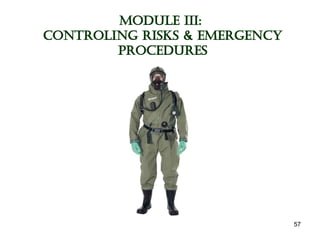
Module III:
CONTROLING Risks & Emergency
Procedures
58
Controlling Risks
•Elimination of the risk
•Isolation of the risk
•Minimizing the risk
•Monitoring the risk.
59
Elimination
Vital for those chemicals you
have found by your evaluation
to be an extreme risk. For
lesser risks, ask yourself “Is
this dangerous item really
essential?” If not, get rid of
it!
60
Isolation
• Put dangerous chemicals into a
secure enclosure. The special
case is oxidizers.
• Keep them well clear of other
chemicals (including oil,
sawdust etc.)
• Keep away from untrained
staff. Good security required.
• Keep off the floor.
61
Minimizing
• Keep exposure to hazardous chemicals
to a minimum.
• Use good ventilation.
• Design your systems to reduce time
exposed to chemicals.
• Thorough training of operators.
• Make sure proper protective clothing
is fully available, and used.
• When possible, use automatic dosing
systems.
62
Monitoring
• This is a legal requirement -
not voluntary.
• Use both environmental and
biological monitoring methods.
• Watch absenteeism. Sometimes
there is a good reason!
• Involve all staff in monitoring
programs. Their input is vital.
63
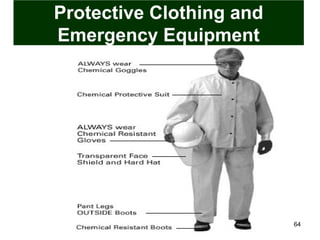
Protective Clothing and Emergency
Equipment
• All must meet approved standards.
• All must be fully available when required.
• One item per operator may be required. Do
not expect staff to share intimate
personal equipment such as respirators,
gloves or boots. Hygiene is then a major
problem.
• Store close to work station. Store in a
suitable box to keep the equipment clean
and in good condition.
• Replace safety clothing and equipment
often.
• Each item must fit the individual. Do not
rely on “one size fits all” approach.
64
Protective Clothing and
Emergency Equipment
65
Respirators
Must be of the proper type.
Filter masks are fine for dusts,
but no good for gases. Use
filters, activated charcoal masks,
or air flow masks as needed to meet
the particular hazard. For
example, Hydrogen Sulphide exposure
needs at least air flow or self
contained breathing apparatus.
66
Gloves
• This is an often misused item.
There are many types, and they are
not all suitable for all end uses.
Consider the following factors.
• How long do they need to be?
• For prolonged use, they should be
lined with cotton.
• Chemical resistant gloves are needed
for specific chemicals.
• Seams in gloves will allow chemicals
to pass through.
• Replace them often.
67
Emergency Eye Wash
• These need to be near each work
station where chemicals are used.
Near means within 5 meters. Place
them in a position so that all staff
can use them. Check them often, and
keep them clean.
• The modern aerated (to allow air to act on something)
wash should be used. Older “jet” wash
systems should be replaced.
• When in use, they need to be washing
for minutes, not seconds. Preferably
15 minutes. While doing so, hold the
victim’s eyes open.
68
Guidelines for Handling
Chemicals
• Substitute less hazardous
chemicals whenever possible
• Minimize chemical exposures
• Avoid underestimating risk
• Provide adequate ventilation
69
Remember
• Avoid skin contact with chemicals.
• Mixtures are more toxic than their
components.
• All substances of unknown toxicity are
toxic.
• Do not work with a volatile or
aerosolizing material without adequate
ventilation from chemical fume hoods
or other protective devices.
• Remember:
Prepare yourself, then protect
yourself.
70
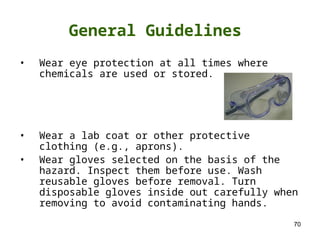
General Guidelines
• Wear eye protection at all times where
chemicals are used or stored.
• Wear a lab coat or other protective
clothing (e.g., aprons).
• Wear gloves selected on the basis of the
hazard. Inspect them before use. Wash
reusable gloves before removal. Turn
disposable gloves inside out carefully when
removing to avoid contaminating hands.
71
• Wash hands immediately after removing gloves,
after handling chemical agents, and before
leaving the warehouse, even though you wore
gloves.
• Aprons or coats and gloves are worn only in the
warehouse. They are not taken outside the
warehouse to lunch rooms or offices nor are
they worn outdoors. Aprons & coats shall be
cleaned frequently.
• Confine long hair and loose clothing.
General Guidelines
72
• Wear sturdy/Safety shoes that cover feet
completely.
• Do not store or prepare food, eat, drink, chew
gum, apply lip balm or cosmetics, or handle
contact lenses in areas where hazardous
chemicals are present.
• Check with your supervisor regarding contact
lens policy in your warehouse. If wearing them is
acceptable, take appropriate precautions such as
informing other warehouse occupants and
having a suction-type removal device in your first
aid kit.
General Guidelines
73
• Food is stored in cabinets or
refrigerators designated for
such use only.
• Label all chemical containers .
• Chemical storage is by hazard
class . Chemicals are not stored
merely by alphabetical order .
General Guidelines
74
• Never smell or taste chemicals.
Again, label containers properly to
avoid confusion about contents.
• Keep work areas clean and uncluttered
(untidy or badly organized).
• Keep personal belongings away from
chemicals.

• Obtain an MSDS for each chemical, and
consult the MSDS before you use a
chemical.
General Guidelines
75
• Know the emergency procedures
for the plant, the warehouse,
and the chemicals being used.
• Vent into local exhaust devices
any apparatus that may discharge
toxic vapors, fumes, mists,
dusts, or gases. Never release
toxic chemicals into cold rooms
or warm rooms that have
recirculating atmospheres.
General Guidelines
76
• Use chemical fume hoods or
other engineering controls to
minimize exposure to airborne
contaminants.
• Properly handle, collect, and
dispose of surplus and waste
chemicals.
General Guidelines
77
Chemical Emergency Procedures
• Warn all persons nearby.
• Turn off any ignition sources
such as burners, motors, and
other spark-producing equipment.
• Leave the room and close the
door if possible.
• Report a life-threatening
hazardous material spill.
78
Small spills
Can be absorbed with paper
towels or other absorbents.
However, these materials can
increase the surface area and
evaporation rate, increasing
the potential fire hazard if
the material is flammable and
airborne concentration reaches
the flammability level.
79
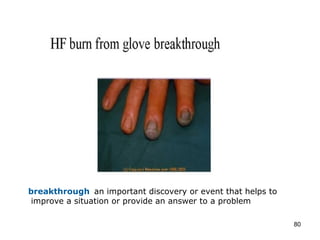
Spill On The Skin.
• Know where the nearest eyewash and safety
shower are located.
• For small spills on the skin, flush immediately
under running water for at least fifteen minutes,
removing any jewelry that might contain residue.
If there is no sign of a burn, wash the area with
soap under warm running water. Exception: only
five minutes of flushing for HF (Hydrofluoric
Acid) burns. Proceed to aggressive antidote gel
application as soon as possible. The antidote is
the best hope of preventing permanent bone or
tissue damage.
80
breakthrough an important discovery or event that helps to
improve a situation or provide an answer to a problem
81
If pain returns after the
fifteen-minute flooding, resume
flooding the area (but not for
HF spills). When providing
assistance to a victim of
chemical contamination, use
appropriate personal protective
equipment.
Procedures for Chemical Spill
on a Person.
82
For a chemical splash in the eyes,
immediately flush the eyes under
running potable water for fifteen
minutes, holding the eyes open and
rotating the eyeballs. This is
preferably done at an eyewash
fountain with tepid (not very
worm) water and properly
controlled flow. Hold the eyelids
open and move the eye up, down,
and sideways to ensure complete
coverage.
Chemical Splash In Eyes
83
If no eyewash fountain is available,
put the victim on his back and
gently pour water into the eyes for
fifteen minutes or until medical
personnel arrive. If Person is
splashed in the eye, flush for five
minutes and then irrigate the eye
with a 1% solution prepared from the
Calcium Gluconate Antidote (a chemical,
especially a drug, which limits the effects of a poison)
Gel.
Procedures for Chemical Spill
on a Person.
84
Immediately remove contaminated
clothing, including shoes and
jewelry, while standing under running
water or the safety shower. When
removing shirts or pullover sweaters,
be careful not to contaminate the
eyes. Cutting off such clothing will
help prevent spreading the
contamination. To prepare for
emergencies, shears (rounded-tip
scissors) should be available in the
first aid kit to allow safe cutting
of contaminated clothing.
Spills On Clothing
85
Consult the MSDS to see if any delayed
effects should be expected, and keep the
MSDS with the victim. Request medical
help to have the victim taken to the
emergency room for medical attention. Be
sure to inform emergency personnel of
the decontamination procedures used
prior to their arrival (for example,
flushing for fifteen minutes with
water). Be certain that emergency room
personnel are told exactly what the
victim was contaminated with so they can
treat the victim accordingly.
Procedures for Chemical Spill
on a Person.
86
Incidental Spills
• Alert persons in the area that a spill
has occurred.
• Evaluate the toxicity, flammability,
and other hazardous properties of the
chemical as well as the size and
location of the spill (for example,
chemical fume hood ) to determine
whether evacuation or additional
assistance is necessary. Large or toxic
spills are beyond the scope of this
procedure.
87
• Contain any volatile material
within a room by keeping doors
closed. Increase exhaust
efficiency , if possible.
• Consult your MSDS & relevant
procedures.
Incidental Spills
88
• Obtain cleaning equipment and
protective gear, if needed.
• Wear protective equipment such as
goggles, apron, laboratory coat,
gloves, shoe covers, or respirator.
Base the selection of the equipment on
the hazard.
• First, cordon off the spill area to
prevent inadvertently spreading the
contamination over a much larger area.
Incidental Spills
89
• Absorb liquid spills using paper
towels, spill pillows, vermiculite
(mineral), or sand. Place the spill
pillow over the spill and draw the free
liquid into the pillow. Sprinkle
vermiculite or sand over the surface of
the free liquid.
• Place the used pillows or absorbent
materials in plastic bags for disposal
along with contaminated disposable
gear, such as gloves.
Incidental Spills
90
• Neutralize spills of corrosives
and absorb, if appropriate.
Sweep up waste and place in
plastic bags for disposal.
• Report to the WHSE department
to pick up the wastes.
• Complete an Incident Report
describing the spill . A copy
may be kept , if required.
Incidental Spills
91
Lets Learn Together !!!

Handling WH Chemicals training and training

  • 1.
  • 2.
    2 COURSE OBJECTIVES COURSE OBJECTIVES Introduce basic rules for safe chemical handling. Introduce basic rules for safe chemical handling.  Discuss the health hazards of chemicals. Discuss the health hazards of chemicals.  Discuss the physical properties of chemicals. Discuss the physical properties of chemicals.  Introduce Introduce the Hazard Communication Standard (HAZCOM) the Hazard Communication Standard (HAZCOM)  Discuss general concepts of toxicology. Discuss general concepts of toxicology.  Discuss employee protective measures. Discuss employee protective measures.  Discuss the hazard rating systems currently in use. Discuss the hazard rating systems currently in use.  Discuss chemical warning labels. Discuss chemical warning labels.  Discuss chemical storage requirements. Discuss chemical storage requirements.
  • 3.
    3 CHEMICAL RISKS TOHEALTH CHEMICAL RISKS TO HEALTH Over one million chemical products or trade names are available in the market. An estimation of one thousand new chemicals enter the market every year, About 100000 chemical substances are used on a global scale. These chemicals are mostly found as mixtures in commercial products.
  • 4.
    4 CHEMICAL RISKS TOHEALTH CHEMICAL RISKS TO HEALTH • Not only the worker handling chemicals is at risk, we may be exposed to chemical risks in our homes through misuse or by accidents. • The environment may be affected. – Chemicals may pollute the air we breathe, the water we drink, and the food we eat. – They may have entered into forests and lakes, destroying wildlife and changing the ecosystems.
  • 5.
    5 CHEMICAL HAZARDS CHEMICAL HAZARDS Commonhazards in handling of chemicals are: • Chemical health hazards: immediate or delayed poisoning, burns, allergies; • Risk of explosion; • Fire and smoke; • Damage to the environment.
  • 6.
    6 TOXICITY • The termtoxicity is used to describe the ability of a substance to cause a harmful effect;
  • 7.
  • 8.
    8 FOOD CHAIN EXPOSURE FOODCHAIN EXPOSURE BARLEY Depending on the chemical, we could potentially eat toxic food.
  • 9.
    9 WORKPLACE CHEMICALS WORKPLACE CHEMICALS Nochemical substance can cause adverse effects No chemical substance can cause adverse effects without first entering the body or coming to contact without first entering the body or coming to contact with it. with it.
  • 10.
    10 WORKPLACE CHEMICALS WORKPLACE CHEMICALS ROUTESOF ENTRY Most chemicals used at the place of Most chemicals used at the place of work may be dispersed into the air to work may be dispersed into the air to form dust, mist, fumes, gas or vapor form dust, mist, fumes, gas or vapor and can then be inhaled. and can then be inhaled. Affected People: Affected People: • Users Users • Nearby Employees Nearby Employees
  • 11.
    11 CHEMICAL TOXICOLOGY CHEMICAL TOXICOLOGY ROUTESOF ENTRY  INHALATION  INGESTION  ABSORPTION  INJECTION
  • 12.
    12 INHALATION Inhalation is the mostcommon route of exposure for most health hazards. This includes breathing in dust, fumes, oil mist, and vapors from solvents and various gases.
  • 13.
    13 INHALATION • At rest,an adult person breathes about 14 times in a minute and inhales about half a liter of air by each breath. • Some ten cubic meters of air inhaled over an eight- hour shift may be needed for an average physical workload.
  • 14.
    14 INHALATION INHALATION • The respiratorysystem: – Upper respiratory tract (nose, mouth, throat). – The air passageways or windpipe. – The airways of the lung derive from the trachea (wind pipe) downwards by progressive division into two (or more) branches. – Alveoli are hollow spaces which have a diameter of about 0.1 mm each. There are approximately 300 million alveoli and their total surface area is about 140 m2 .
  • 15.
    15 INHALATION INHALATION Air travel intothe lungs and circulates there in tiny air sacs (alveoli) where oxygen from the air diffuses into the blood and carbon dioxide from the blood diffuses into the air.
  • 16.
    16 Gases are usedin many operations and may combine with other substances to produce toxic gases such as phosgene, ozone, and carbon monoxide. Workers can be exposed to these and other gases during work. Potential exposure to gases occurs through inhalation. Such exposure may produce eye damage, headaches, shivering, tiredness, nausea, and possible kidney and liver damage. Example: Exposure to Gases Example: Exposure to Gases
  • 17.
    17 Used as fillersin epoxy resins and other plastics, in wire coatings or electrical insulation. Uncontrolled exposures may produce skin and upper respiratory irritations and, in the case of asbestos, cancer. Example: Exposure to Fiberglass and Example: Exposure to Fiberglass and Asbestos Asbestos
  • 18.
    18 Metal, wood, plastics.Raw materials used to manufacture products are usually bought in large quantities, and can cause injuries or fatalities in many ways. Example: Exposure to Solids Example: Exposure to Solids
  • 19.
    19 Some hazards arecreated by the work environment. Environment Environment •Lack Of Systems & Procedures. •Lack of training •Poor Housekeeping
  • 20.
    20 Look for: • Conditionof all surfaces where people walk or where things are placed • Overcrowding and poor ventilation • Poor lighting, extreme temperatures and noise. • Poor housekeeping Environment:
  • 21.
  • 22.
  • 23.
    23 Identifying Chemical Hazards •Check allchemicals that come on site •Check which (if any) dangerous goods class they belong to •Identify the primary hazard •Identify any important secondary hazards
  • 24.
    24 Chemical Storage • ChemicalLabels. Label all containers of hazardous chemicals • Identity of the hazardous chemicals, hazard warnings in words, pictures, symbols, or a combination thereof, which provide at least general information regarding the hazards of the chemical.
  • 25.
    25 NFPA 704 System •The system was originally devised (developed) for industry to use on such facilities as storage tanks or buildings so that firefighters could assess the hazard from a safe distance and better evaluate what fire- fighting techniques to employ. The system can also be useful in situations other than fires when used on container labels or room doors so that a person working in the room or area can quickly determine the degree of hazard of a particular chemical. Standard System for the Identification of the Hazards of Materials for Emergency Response
  • 26.
    26 HAZARD RATING SYSTEMS HAZARDRATING SYSTEMS FOUR HAZARD PARAMETERS  HEALTH  FLAMMABILITY  REACTIVITY  SPECIFIC HAZARD (NFPA) 4 1 2 W FIRE HAZARD REACTIVITY SPECIFIC HAZARD (WATER REACTIVE) HEALTH HAZARD
  • 27.
    27 SPECIAL HANDLING 4 1 3 OX COR ACD ALK -Water Reactive - Oxidizer - Radioactive - Corrosive - Acid - Alkali.
  • 28.
  • 29.
    29 Chemical Dating • Shallbe dated on receipt in the warehouse and on opening. This information provides a history of the chemicals in each container and guides future researches. • Providing container-opening dates is especially important for peroxide-forming chemicals such as ethers, dioxane, isopropanol, and tetrahydrofuran that could pose an explosion hazard. Chemicals shall be removed to the waste disposal area if they are past their expiration date.
  • 30.
    30 Chemical Compatibility. Chemicals shallbe stored only with other compatible chemicals . Do not store them alphabetically, except within a grouping of compatible chemicals.
  • 31.
    31 CHEMICAL KEEP OUTOF CONTACT WITH Acetic Acid Chromic acid, nitric acid, hydroxyl compounds, ethylene glycol, perchloric acid, peroxides, permanganates Acetylene Chlorine, bromine, copper, fluorine, silver, mercury Alkali Metals Water, carbon tetrachloride or other chlorinated hydrocarbons, carbon dioxide, the halogens Ammonium Nitrate Acids, metal powders, flammable liquids, chlorates, nitrites, sulfur, finely divided organic or combustible materials Nitrates Sulfuric acid Oxygen Oils, grease, hydrogen, flammable liquids, solids or gasses Carbon tetrachloride Sodium Chlorine Ammonia, acetylene, butadiene, butane, methane, propane (or other petroleum gases), hydrogen, sodium carbide, turpentine, benzene, finely divided metals Cyanides Acids Flammable Liquids Ammonium nitrate, chromic acid, hydrogen peroxide, nitric acid, sodium peroxide, halogens Hydrocarbons Fluorine, chlorine, bromine. Chromic acid, sodium peroxide
  • 32.
    32 Chemical Incompatibility Matrix Acids, Inorganic Acids, Oxidizing Acids, Organic Alkalis (Bases Oxidizers Poisons, inorganic Poisons organic Water reactives Organic solvents Acids Inorganic XX X X X X Acids, Oxidizing X X X X X X Acids, Organic X X X X X X X Alkalis (Bases) X X X X X X Oxidizers X X X X Poisons, inorganic X X X X X X Poisons, organic X X X X X X Water reactives X X X X X X Organic solvents X X X X X
  • 33.
    33 Chemical Groupings • HighlyToxic (Poisons) and habit-forming organic chemicals. • Flammable Organic chemicals and organic acids. • Organic Bases and other organic compounds. • Inorganic (Mineral) Acids and inorganic oxidizers (some additional separation may be required because of the reactivity of these materials). • Inorganic Bases, reducers, and salts.
  • 34.
    34 Storage Facilities Highly toxicchemicals (such as cyanide) shock-sensitive chemicals (such as solid sodium acid or picric acid), and habit-forming chemicals (amyl nitrite) shall be stored in locked cabinets to prevent Possible Threat of This sensitive Chemicals.
  • 35.
    35 Shock-sensitive Peroxide-forming chemicals and thosethat may become shock- sensitive with long-term storage shall be stored separately and shall be labeled and dated. Peroxide-forming chemicals shall be stored in a cool, dark, dry place
  • 36.
    36 Flammable Liquids Shall bestored in flammable-liquid cabinets if the quantity contains a total of 10 gallons or more, including flammable liquid wastes.
  • 37.
    37 Volatile Highly Odorous chemicalsshall be stored in a well-ventilated area; a ventilated cabinet is preferable. Chemical fume hoods shall not be used for storage, as containers block proper air flow in the hood and take up work space.
  • 38.
    38 Inspections • Chemicals showingany of the indications listed below shall be turned over to HSE for safe disposal: • Slightly cloudy liquids. • Darkening or change in color. • Spotting on solids. • Caking of anhydrous materials. • Existence of solids in liquids or liquids in solids. • Pressure buildup in containers. • Evidence of reaction with water. • Corrosion or damage to the container. • Missing or damaged (i.e., illegible) labels
  • 39.
    39 Hazard Classes There arenine main hazard classes. Of these, four may be of concern.
  • 40.
    40 Class 2 Flammable liquids. Shown bya red diamond. Flammable liquids such as fuels and oils represent a fire risk.
  • 41.
  • 42.
  • 43.
  • 44.
    44 Class 5. Oxidizers suchas hydrogen peroxide, sodium chlorite etc., will react, sometimes explosively with anything organic. This could be many chemicals, even including flour, oil, or sawdust. If possible avoid having strong oxidizers on site at all. If they are essential, they must be treated be very special care.
  • 45.
  • 46.
    46 Class 6. • Toxicand infectious substance. Shown by a white diamond. Toxic substances are a matter of concern. It is vital that the toxic route is identified. Is it toxic by swallowing, breathing dust or droplets, or toxic through the skin? Via the skin is a major concern, and such materials should not be on site. Toxic through dust or droplets is also of concern, and systems need to be in place to avoid dust or droplets forming. Ingesting these chemicals by swallowing is of lesser concern, if staff are correctly trained in simple techniques (such as washing hands after handling chemicals, and changing clothes when they are contaminated).
  • 47.
  • 48.
  • 49.
    49 Class 8. • Corrosives. • You need to be very clear on how to handle them. The biggest hazard is inhaling droplets (avoid generating sprays), or getting them into the eyes. Staff training and the provision of proper equipment for both protection and treatment is vital.
  • 50.
  • 51.
    51 Sign and Labels YellowLabels is for Hazardous Waste
  • 52.
  • 53.
    53 Material Safety Data Sheets Thisis the prime tool for identifying hazards. Things to check : • Hazard diamonds • Statement of hazard class • UN Number • CAS -NUMBER • Dangerous goods class • Hazchem code • Subsidiary risk.
  • 54.
    54 Hazard Identification Checklist • Whatchemical substances are produced, used, handled, stored or shipped in the workplace? • Are any vapours, gasses, dusts, mists or fumes present (including chemical by- products of work processes)? • Are biological substances (such as bacteria, viruses, parasites, dusts, molds and fungi) present in the workplace, the ventilation systems and other components of the physical plant? • Are physical agents (energy sources strong enough to harm the body, such as electric currents, heat, light, vibration, noise and radiation) present? • Are temperature extremes present?
  • 55.
    55 • Do ergonomichazards exist—such as work requiring lifting, awkward posture, repetitive motions, excessive muscular force or computer use? • Could any work processes, tools or equipment cause health hazards (such as back injuries, soft tissue injuries, whole body vibration, hearing loss, infections and so forth)? • Could departures from safe work practices cause illnesses? • Can any potential health hazards be detected with the senses (smell, taste, touch, hearing and sight)? • Are there any complaints from workers about workplace related health problems? Hazard Identification Checklist
  • 56.
    56 The “Walk Through” •Physical • Workplace construction • Workplace housekeeping • Lighting • Noise • Ventilation - general • Ventilation - local • Thermal environment • Machine guarding • Machine design • Electricity/ radiation • Sanitary facilities • Eating facilities • Personal/ Biological • Infectious diseases – Bacterial – Viral – Fungal • Direct animal contact • Posture • Work movements – repetition – force • Personal protective equipment – respiratory – ears – eyes – heads/ feet/ skin
  • 57.
    57 Module III: CONTROLING Risks& Emergency Procedures
  • 58.
    58 Controlling Risks •Elimination ofthe risk •Isolation of the risk •Minimizing the risk •Monitoring the risk.
  • 59.
    59 Elimination Vital for thosechemicals you have found by your evaluation to be an extreme risk. For lesser risks, ask yourself “Is this dangerous item really essential?” If not, get rid of it!
  • 60.
    60 Isolation • Put dangerouschemicals into a secure enclosure. The special case is oxidizers. • Keep them well clear of other chemicals (including oil, sawdust etc.) • Keep away from untrained staff. Good security required. • Keep off the floor.
  • 61.
    61 Minimizing • Keep exposureto hazardous chemicals to a minimum. • Use good ventilation. • Design your systems to reduce time exposed to chemicals. • Thorough training of operators. • Make sure proper protective clothing is fully available, and used. • When possible, use automatic dosing systems.
  • 62.
    62 Monitoring • This isa legal requirement - not voluntary. • Use both environmental and biological monitoring methods. • Watch absenteeism. Sometimes there is a good reason! • Involve all staff in monitoring programs. Their input is vital.
  • 63.
    63 Protective Clothing andEmergency Equipment • All must meet approved standards. • All must be fully available when required. • One item per operator may be required. Do not expect staff to share intimate personal equipment such as respirators, gloves or boots. Hygiene is then a major problem. • Store close to work station. Store in a suitable box to keep the equipment clean and in good condition. • Replace safety clothing and equipment often. • Each item must fit the individual. Do not rely on “one size fits all” approach.
  • 64.
  • 65.
    65 Respirators Must be ofthe proper type. Filter masks are fine for dusts, but no good for gases. Use filters, activated charcoal masks, or air flow masks as needed to meet the particular hazard. For example, Hydrogen Sulphide exposure needs at least air flow or self contained breathing apparatus.
  • 66.
    66 Gloves • This isan often misused item. There are many types, and they are not all suitable for all end uses. Consider the following factors. • How long do they need to be? • For prolonged use, they should be lined with cotton. • Chemical resistant gloves are needed for specific chemicals. • Seams in gloves will allow chemicals to pass through. • Replace them often.
  • 67.
    67 Emergency Eye Wash •These need to be near each work station where chemicals are used. Near means within 5 meters. Place them in a position so that all staff can use them. Check them often, and keep them clean. • The modern aerated (to allow air to act on something) wash should be used. Older “jet” wash systems should be replaced. • When in use, they need to be washing for minutes, not seconds. Preferably 15 minutes. While doing so, hold the victim’s eyes open.
  • 68.
    68 Guidelines for Handling Chemicals •Substitute less hazardous chemicals whenever possible • Minimize chemical exposures • Avoid underestimating risk • Provide adequate ventilation
  • 69.
    69 Remember • Avoid skincontact with chemicals. • Mixtures are more toxic than their components. • All substances of unknown toxicity are toxic. • Do not work with a volatile or aerosolizing material without adequate ventilation from chemical fume hoods or other protective devices. • Remember: Prepare yourself, then protect yourself.
  • 70.
    70 General Guidelines • Weareye protection at all times where chemicals are used or stored. • Wear a lab coat or other protective clothing (e.g., aprons). • Wear gloves selected on the basis of the hazard. Inspect them before use. Wash reusable gloves before removal. Turn disposable gloves inside out carefully when removing to avoid contaminating hands.
  • 71.
    71 • Wash handsimmediately after removing gloves, after handling chemical agents, and before leaving the warehouse, even though you wore gloves. • Aprons or coats and gloves are worn only in the warehouse. They are not taken outside the warehouse to lunch rooms or offices nor are they worn outdoors. Aprons & coats shall be cleaned frequently. • Confine long hair and loose clothing. General Guidelines
  • 72.
    72 • Wear sturdy/Safetyshoes that cover feet completely. • Do not store or prepare food, eat, drink, chew gum, apply lip balm or cosmetics, or handle contact lenses in areas where hazardous chemicals are present. • Check with your supervisor regarding contact lens policy in your warehouse. If wearing them is acceptable, take appropriate precautions such as informing other warehouse occupants and having a suction-type removal device in your first aid kit. General Guidelines
  • 73.
    73 • Food isstored in cabinets or refrigerators designated for such use only. • Label all chemical containers . • Chemical storage is by hazard class . Chemicals are not stored merely by alphabetical order . General Guidelines
  • 74.
    74 • Never smellor taste chemicals. Again, label containers properly to avoid confusion about contents. • Keep work areas clean and uncluttered (untidy or badly organized). • Keep personal belongings away from chemicals. • Obtain an MSDS for each chemical, and consult the MSDS before you use a chemical. General Guidelines
  • 75.
    75 • Know theemergency procedures for the plant, the warehouse, and the chemicals being used. • Vent into local exhaust devices any apparatus that may discharge toxic vapors, fumes, mists, dusts, or gases. Never release toxic chemicals into cold rooms or warm rooms that have recirculating atmospheres. General Guidelines
  • 76.
    76 • Use chemicalfume hoods or other engineering controls to minimize exposure to airborne contaminants. • Properly handle, collect, and dispose of surplus and waste chemicals. General Guidelines
  • 77.
    77 Chemical Emergency Procedures •Warn all persons nearby. • Turn off any ignition sources such as burners, motors, and other spark-producing equipment. • Leave the room and close the door if possible. • Report a life-threatening hazardous material spill.
  • 78.
    78 Small spills Can beabsorbed with paper towels or other absorbents. However, these materials can increase the surface area and evaporation rate, increasing the potential fire hazard if the material is flammable and airborne concentration reaches the flammability level.
  • 79.
    79 Spill On TheSkin. • Know where the nearest eyewash and safety shower are located. • For small spills on the skin, flush immediately under running water for at least fifteen minutes, removing any jewelry that might contain residue. If there is no sign of a burn, wash the area with soap under warm running water. Exception: only five minutes of flushing for HF (Hydrofluoric Acid) burns. Proceed to aggressive antidote gel application as soon as possible. The antidote is the best hope of preventing permanent bone or tissue damage.
  • 80.
    80 breakthrough an importantdiscovery or event that helps to improve a situation or provide an answer to a problem
  • 81.
    81 If pain returnsafter the fifteen-minute flooding, resume flooding the area (but not for HF spills). When providing assistance to a victim of chemical contamination, use appropriate personal protective equipment. Procedures for Chemical Spill on a Person.
  • 82.
    82 For a chemicalsplash in the eyes, immediately flush the eyes under running potable water for fifteen minutes, holding the eyes open and rotating the eyeballs. This is preferably done at an eyewash fountain with tepid (not very worm) water and properly controlled flow. Hold the eyelids open and move the eye up, down, and sideways to ensure complete coverage. Chemical Splash In Eyes
  • 83.
    83 If no eyewashfountain is available, put the victim on his back and gently pour water into the eyes for fifteen minutes or until medical personnel arrive. If Person is splashed in the eye, flush for five minutes and then irrigate the eye with a 1% solution prepared from the Calcium Gluconate Antidote (a chemical, especially a drug, which limits the effects of a poison) Gel. Procedures for Chemical Spill on a Person.
  • 84.
    84 Immediately remove contaminated clothing,including shoes and jewelry, while standing under running water or the safety shower. When removing shirts or pullover sweaters, be careful not to contaminate the eyes. Cutting off such clothing will help prevent spreading the contamination. To prepare for emergencies, shears (rounded-tip scissors) should be available in the first aid kit to allow safe cutting of contaminated clothing. Spills On Clothing
  • 85.
    85 Consult the MSDSto see if any delayed effects should be expected, and keep the MSDS with the victim. Request medical help to have the victim taken to the emergency room for medical attention. Be sure to inform emergency personnel of the decontamination procedures used prior to their arrival (for example, flushing for fifteen minutes with water). Be certain that emergency room personnel are told exactly what the victim was contaminated with so they can treat the victim accordingly. Procedures for Chemical Spill on a Person.
  • 86.
    86 Incidental Spills • Alertpersons in the area that a spill has occurred. • Evaluate the toxicity, flammability, and other hazardous properties of the chemical as well as the size and location of the spill (for example, chemical fume hood ) to determine whether evacuation or additional assistance is necessary. Large or toxic spills are beyond the scope of this procedure.
  • 87.
    87 • Contain anyvolatile material within a room by keeping doors closed. Increase exhaust efficiency , if possible. • Consult your MSDS & relevant procedures. Incidental Spills
  • 88.
    88 • Obtain cleaningequipment and protective gear, if needed. • Wear protective equipment such as goggles, apron, laboratory coat, gloves, shoe covers, or respirator. Base the selection of the equipment on the hazard. • First, cordon off the spill area to prevent inadvertently spreading the contamination over a much larger area. Incidental Spills
  • 89.
    89 • Absorb liquidspills using paper towels, spill pillows, vermiculite (mineral), or sand. Place the spill pillow over the spill and draw the free liquid into the pillow. Sprinkle vermiculite or sand over the surface of the free liquid. • Place the used pillows or absorbent materials in plastic bags for disposal along with contaminated disposable gear, such as gloves. Incidental Spills
  • 90.
    90 • Neutralize spillsof corrosives and absorb, if appropriate. Sweep up waste and place in plastic bags for disposal. • Report to the WHSE department to pick up the wastes. • Complete an Incident Report describing the spill . A copy may be kept , if required. Incidental Spills
  • 91.

Editor's Notes

  • #2 NOTES: _________________________________________________________ _________________________________________________________ _________________________________________________________ _________________________________________________________ _________________________________________________________ _________________________________________________________ _________________________________________________________ _________________________________________________________ _________________________________________________________ _________________________________________________________ _________________________________________________________ _________________________________________________________