Decentralisation of the
educational system as a vehicle
        for innovation

              Stavros Savvas
          Ellinogermaniki Agogi


  2011 Open Classroom Conference – Ellinogermaniki Agogi
21st Century Challenges and
                Education
The Information and Knowledge Society has emerged as a result of
technological advancements of the World Wide Web, the Internet and
mobile communications over the last two decades. These technological
Developments have had; and still have direct impact to every spect of
our personal and social life, thus changing the way we communicate,
collaborate, work and learn. Europe has been a world driving force
when it comes to these technological developments, however, in many
cases European Member States have falled behind in adopting the
necessary societal re-organisational changes needed in education.

This can be a critical issue for the future of European Union and the
future of its Member States within the complex global challenges of the
21st Century.


         2011 Open Classroom Conference – Ellinogermaniki Agogi
ARTICLE I - MEETING BASIC LEARNING NEEDS

  Every person - child, youth and adult - shall be able to benefit from
  educational opportunities designed to meet their basic learning needs.
  These needs comprise both essential learning tools (such as literacy, oral
  expression, numeracy, and problem solving) and the basic learning content (such
  as knowledge, skills, values, and attitudes). The scope of basic learning needs
  and how they should be met varies with individual countries and cultures, and
  inevitably, changes with the passage of time.

                                         World Declaration on Education for All:
                                         Meeting Basic Learning Needs
Άρθρο 16

2. Η παιδεία αποτελεί βασική αποστολή του the State και έχει σκοπόat the moral,
   Education constitutes a basic mission for Κράτους and shall aim την ηθική,
    πνευματική επαγγελματική και φυσική αγωγή των Ελλήνων, την ανάπτυξη
   intellectual, professional and physical training of Greeks, the development of
    της εθνικής και θρησκευτικής συνείδησης και τη διάπλασή τους σε
   national and religious consciousness and at their formation as free and
    ελεύθερους και υπεύθυνους πολίτες.
   responsible citizens.

                                                            Greek Constitution

             2011 Open Classroom Conference – Ellinogermaniki Agogi
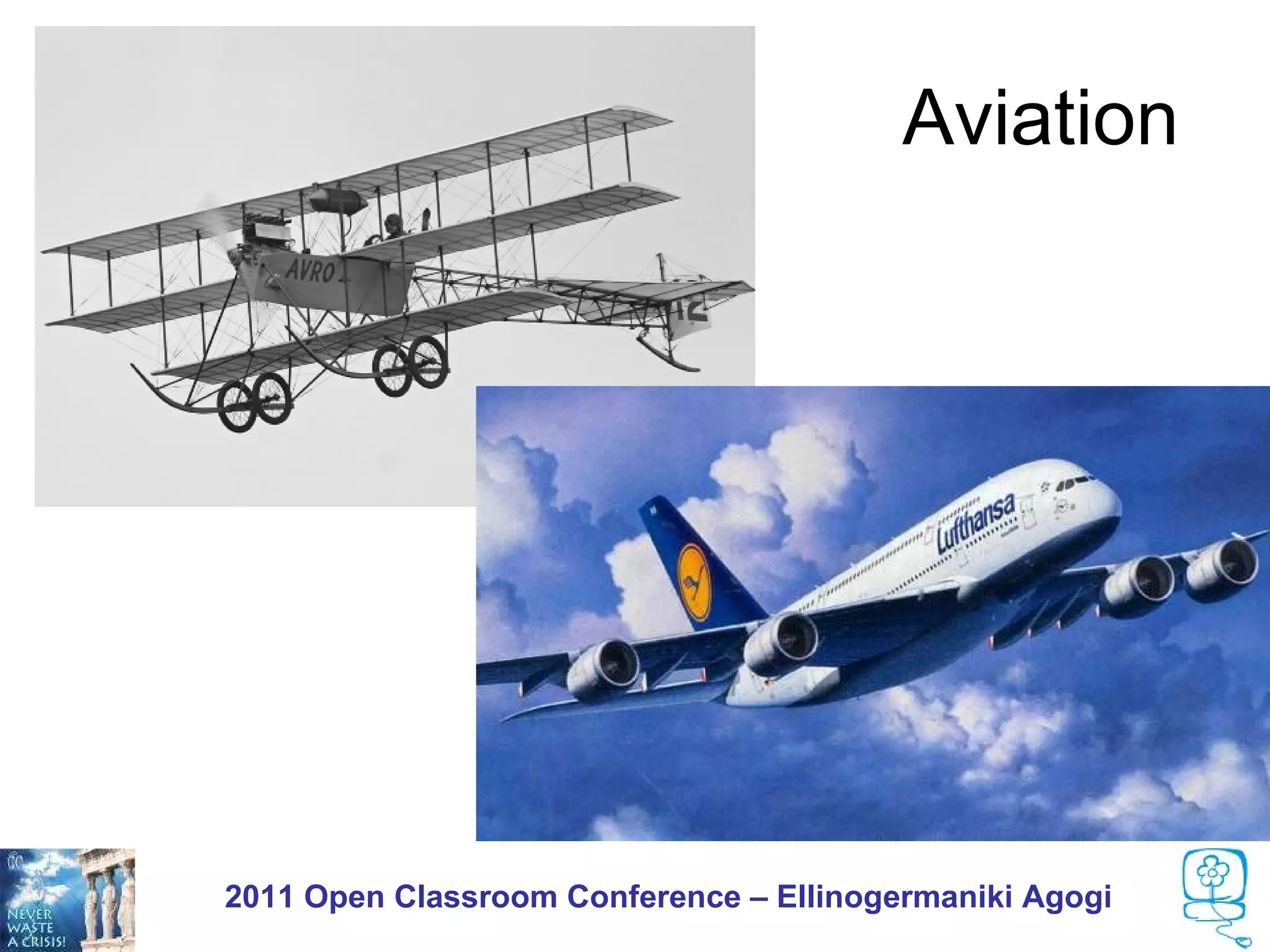
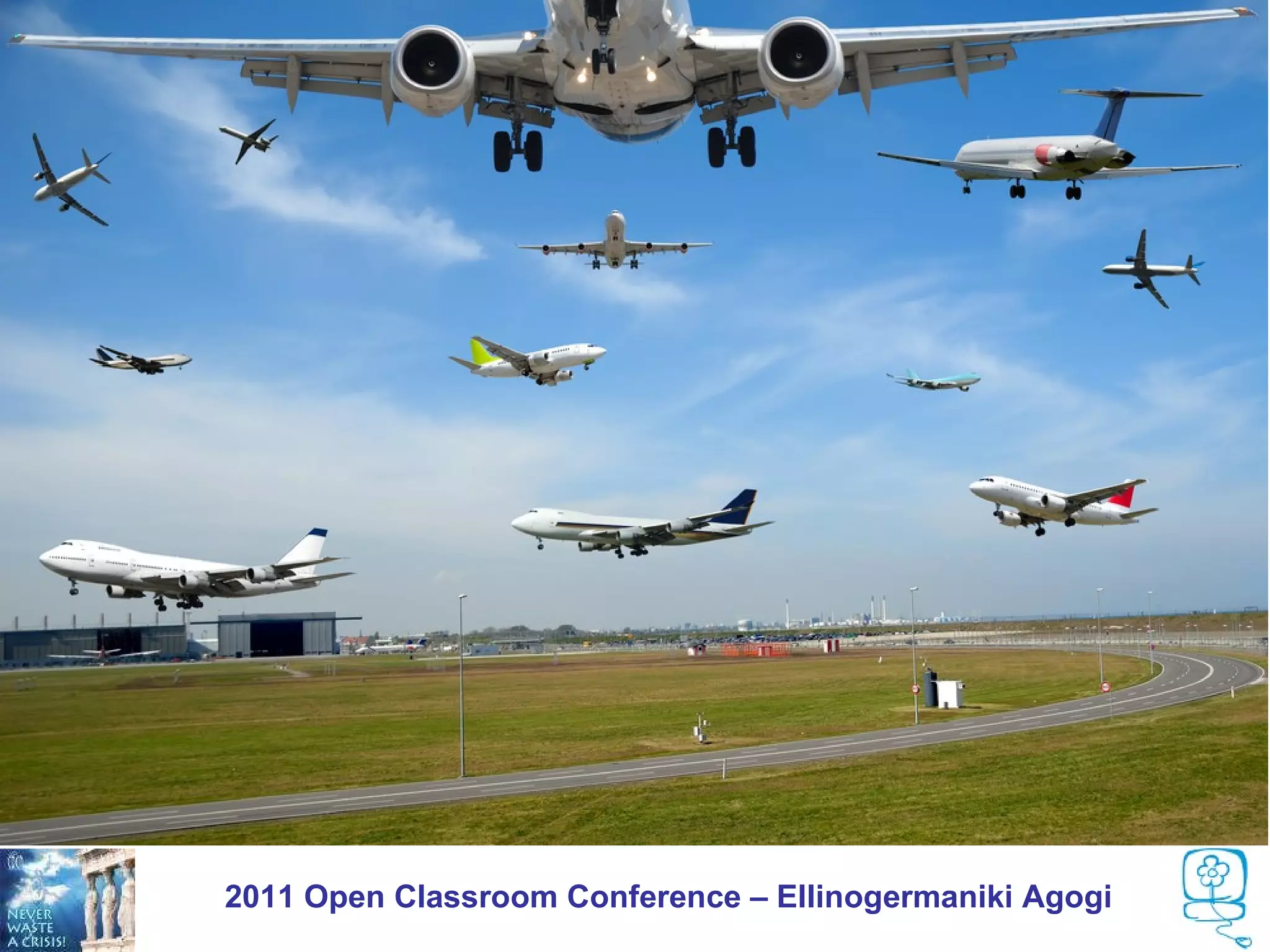
Aviation


2011 Open Classroom Conference – Ellinogermaniki Agogi
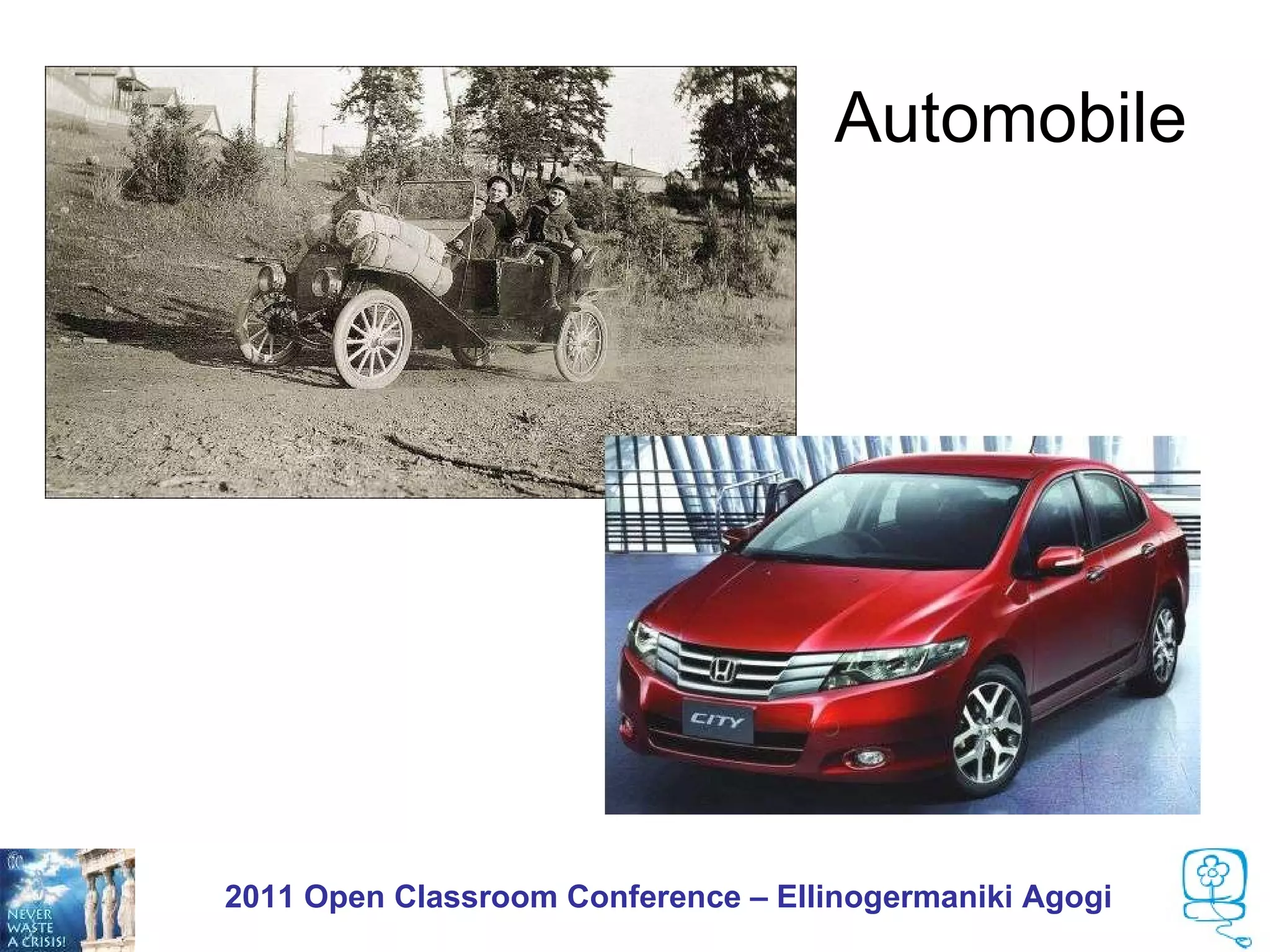
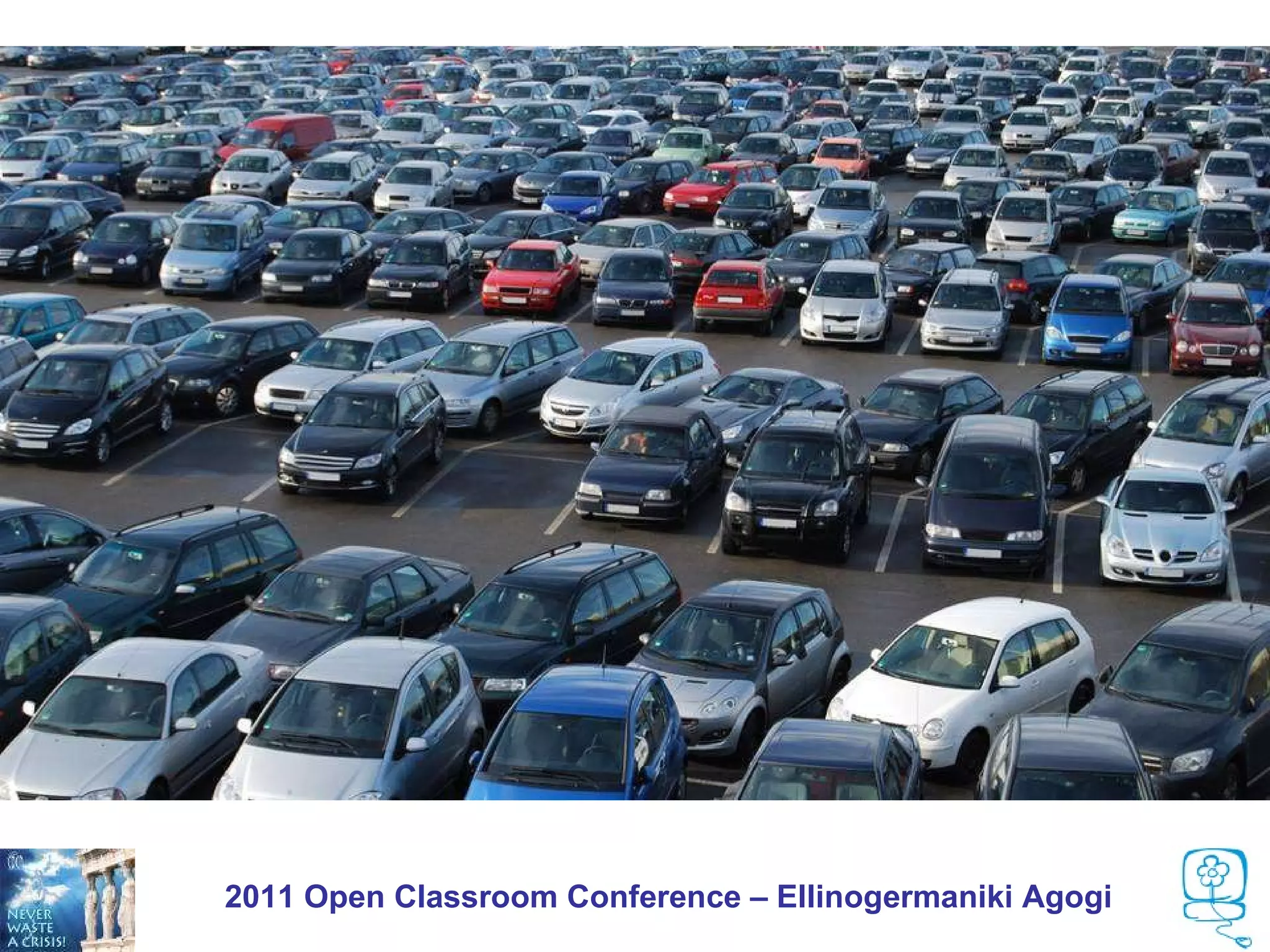
Automobile


2011 Open Classroom Conference – Ellinogermaniki Agogi
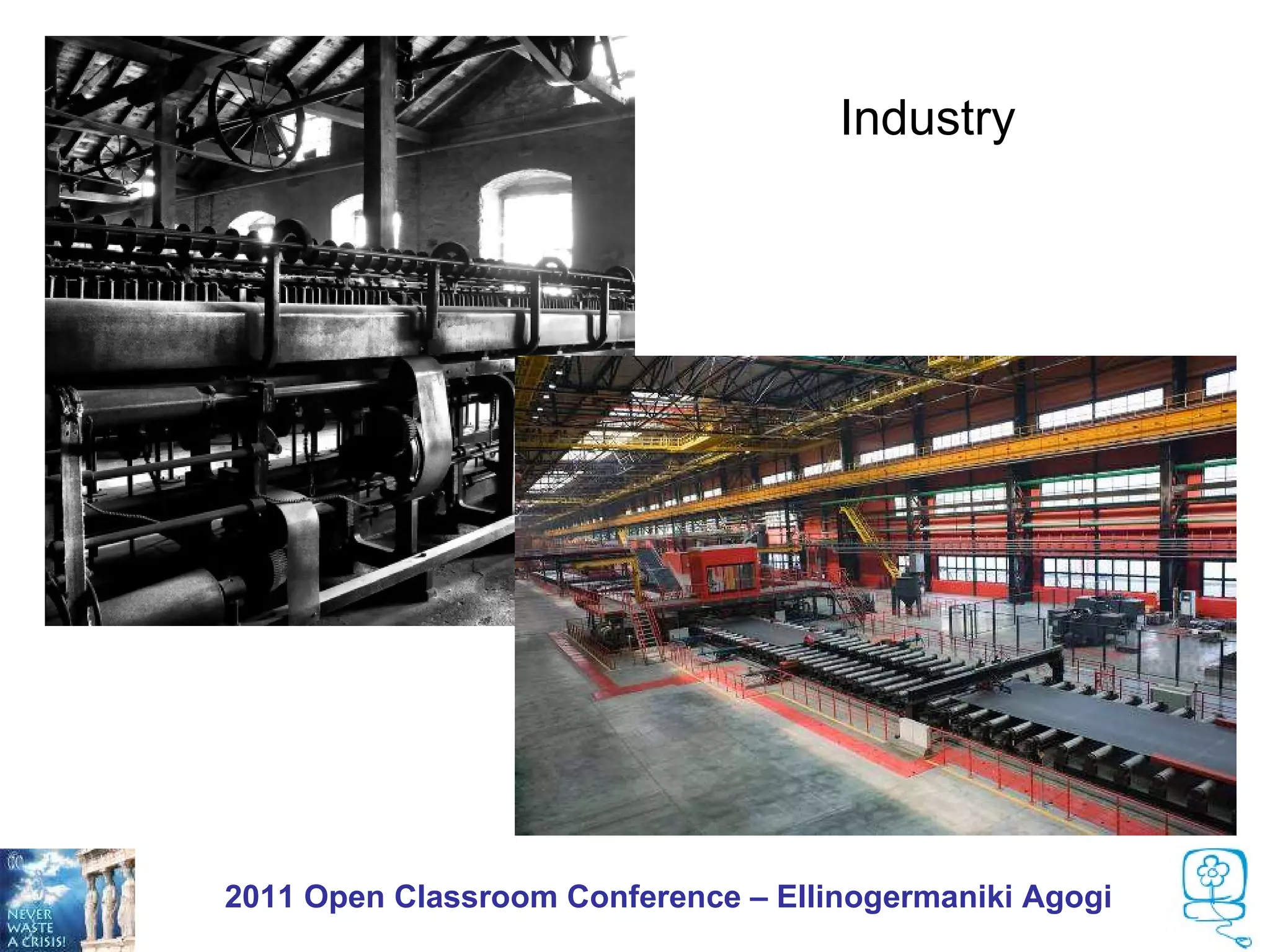
Industry


2011 Open Classroom Conference – Ellinogermaniki Agogi
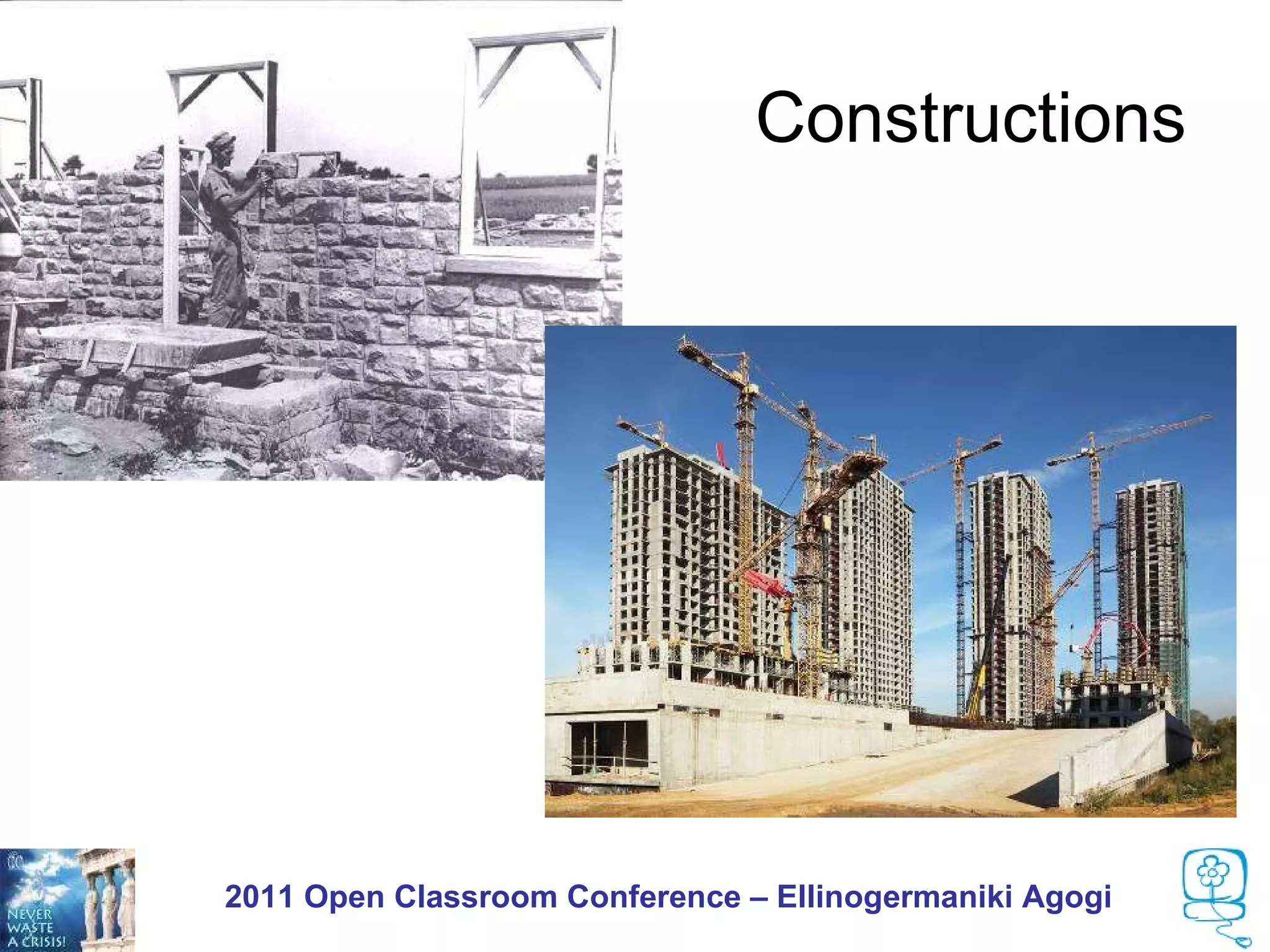
Constructions


2011 Open Classroom Conference – Ellinogermaniki Agogi
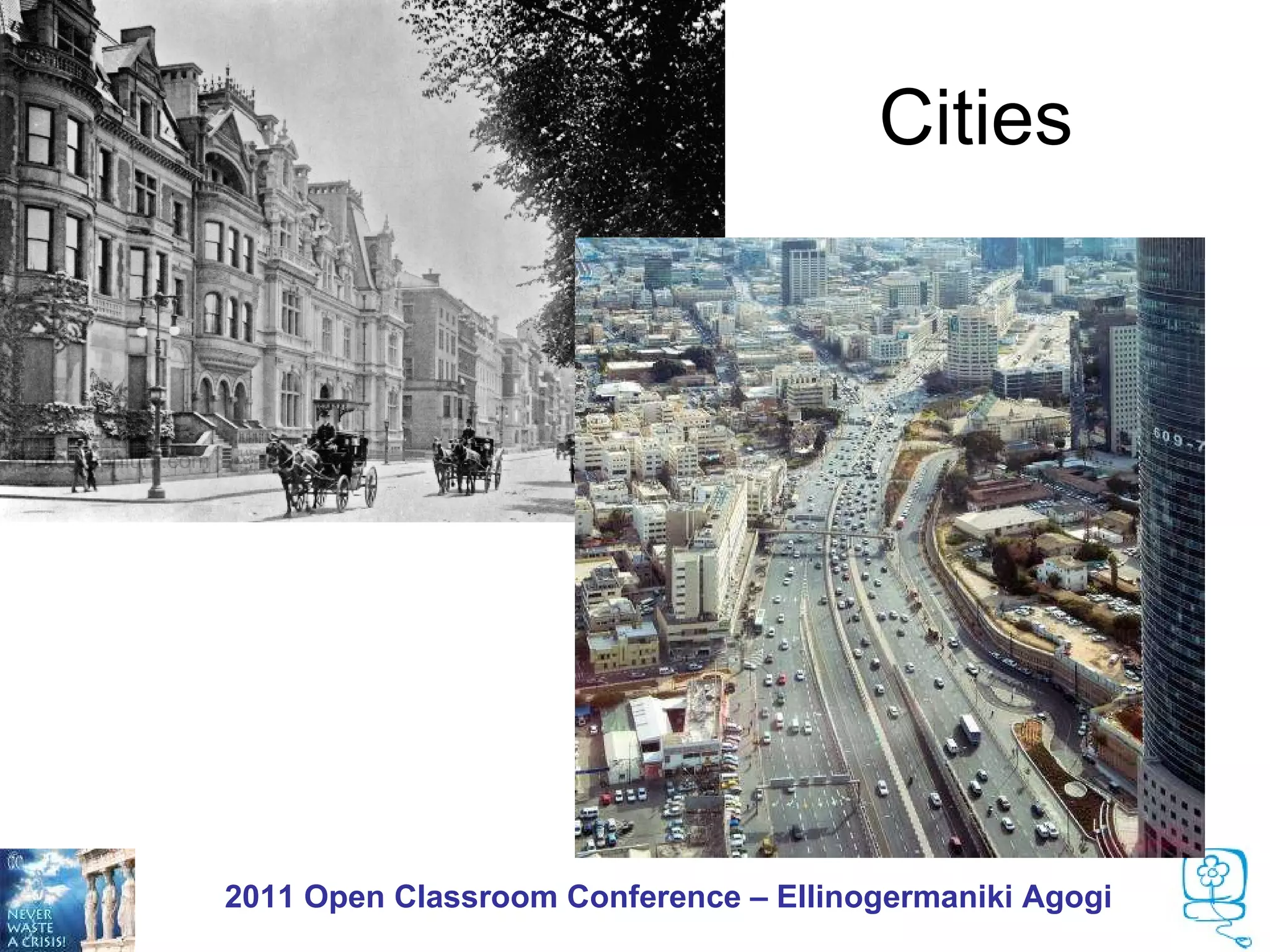
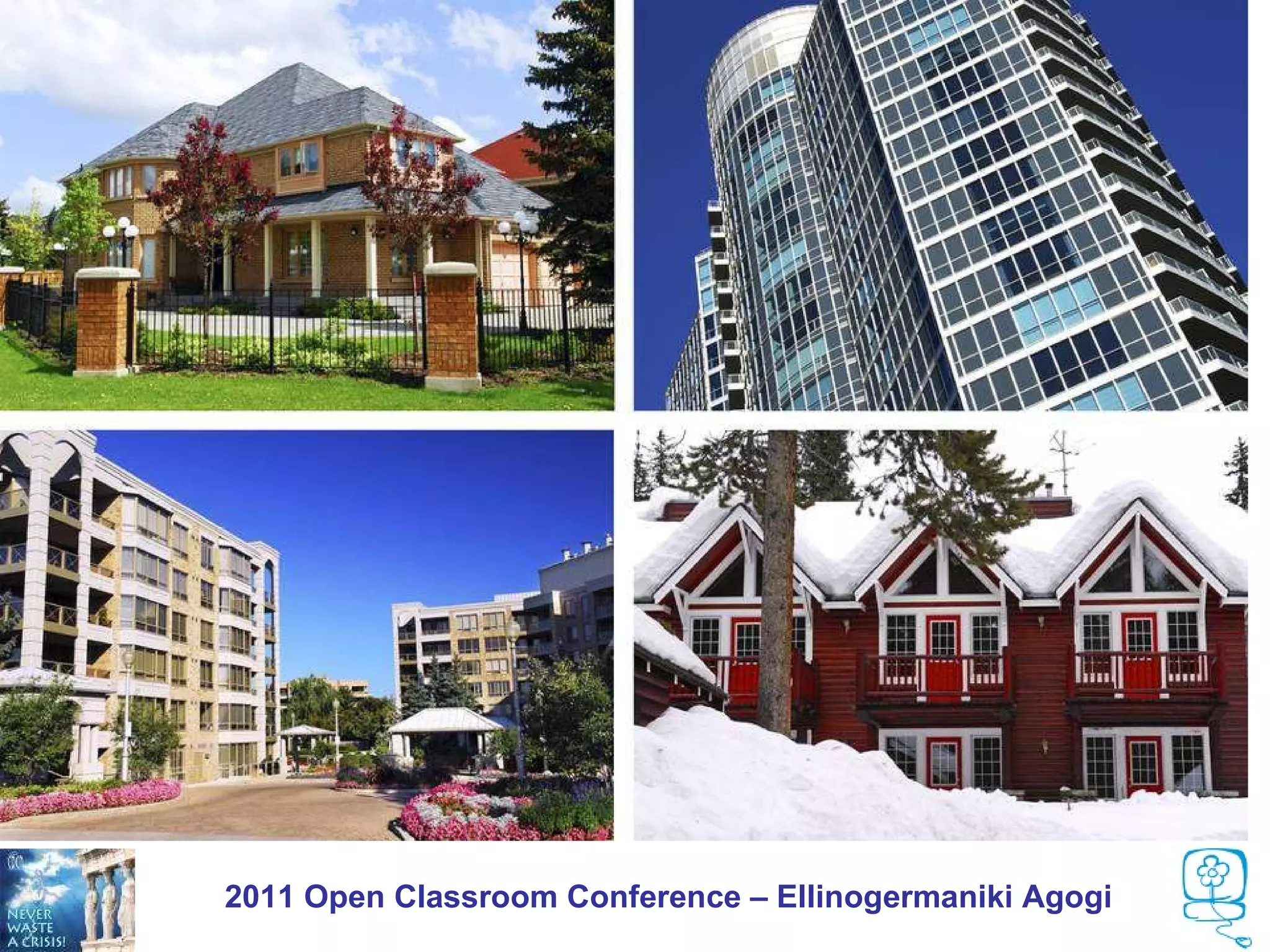
Cities


2011 Open Classroom Conference – Ellinogermaniki Agogi
Schools remain unchanged
When it comes to the field of education, this lack of social innovation
becomes even more troubling, due to the fact that failing to “re-engineer” our
national and European educational systems, effects significantly all other areas of
social and economical development, jurpotising Europe’s position in the global
knowledge-based society.

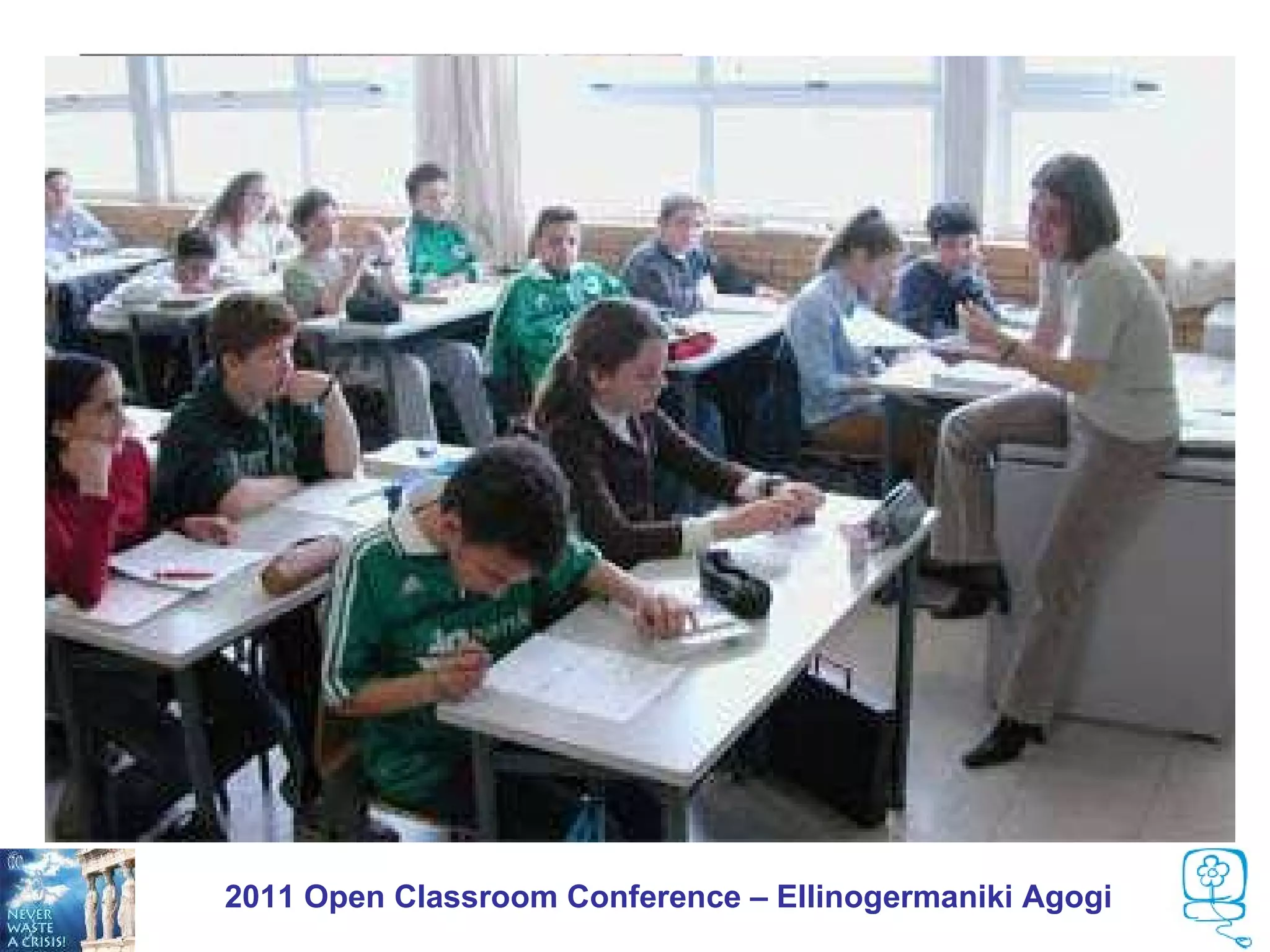
Especially, Schools appear to remain almost unchanged for the most part despite
numerous efforts and investments in technology, teachers’ training and
infrastructure. Yet, the way we organise schooling and provide education remains
basically the same.

To put it in another way: “we still educate our students based on an
agricultural timetable, in an industrial setting, yet telling students and teachers
they live in a digital age”.


           2011 Open Classroom Conference – Ellinogermaniki Agogi
2011 Open Classroom Conference – Ellinogermaniki Agogi
During the past years, several reasons have been identified
separately as possible distractions in aligning schools
operations and results to the ones anticipated by the 21st
Century Societies.

The most highlighted ones being:
Lack of funds, not enough computers in the classroom, little
interest from students and parents, out of date teaching
practices, poorly trained teachers, and even a
fundamentally flawed way to measure performance at
schools.

Many national and European initiatives have been
undertaken to tackle these issues separately. Yet, the
improvement has been marginal, if any at all.

       2011 Open Classroom Conference – Ellinogermaniki Agogi
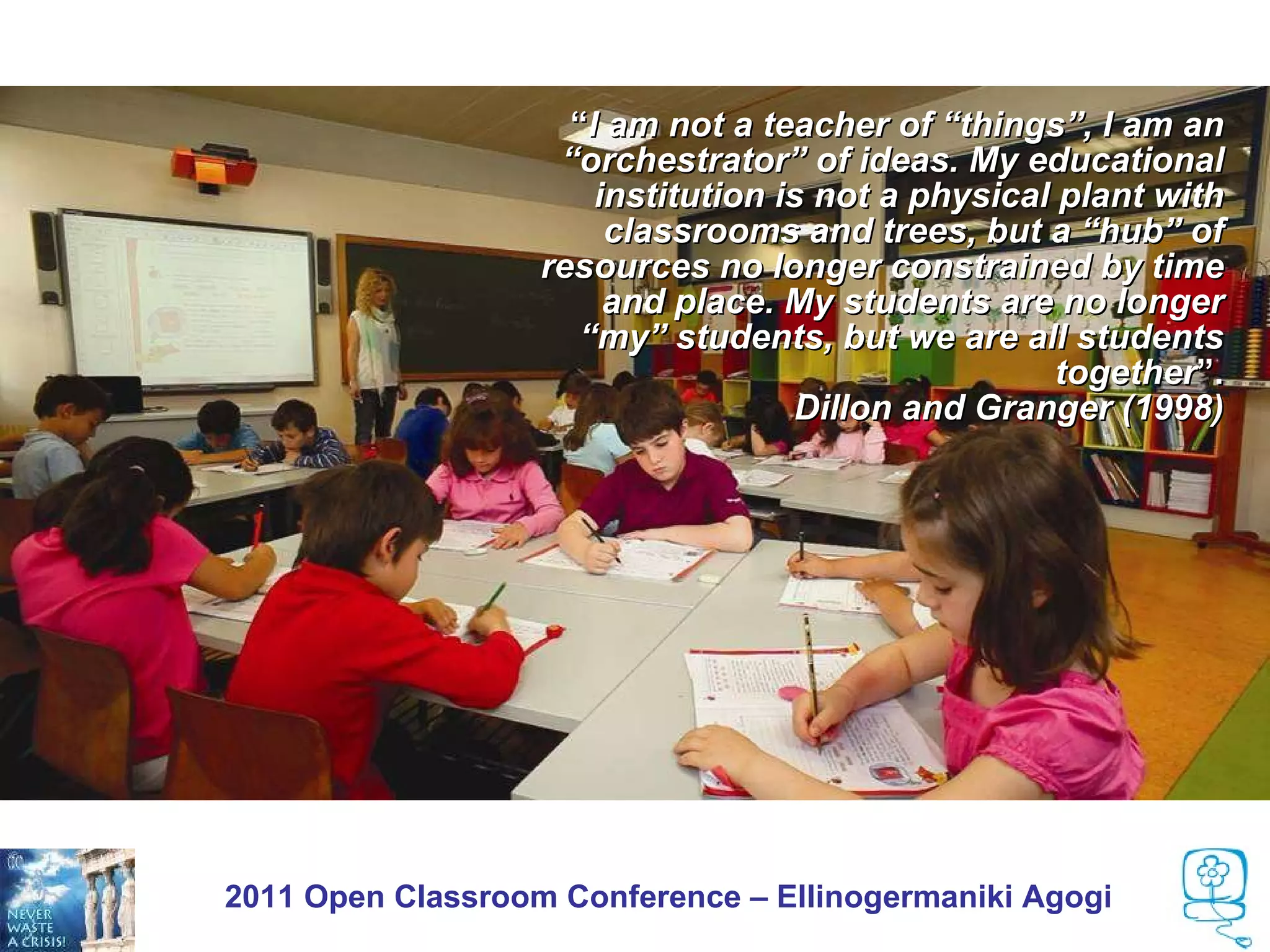
“I am not a teacher of “things”, I am an
                    “orchestrator” of ideas. My educational
                       institution is not a physical plant with
                        classrooms and trees, but a “hub” of
                   resources no longer constrained by time
                        and place. My students are no longer
                      “my” students, but we are all students
                                                     together”.
                                    Dillon and Granger (1998)


2011 Open Classroom Conference – Ellinogermaniki Agogi
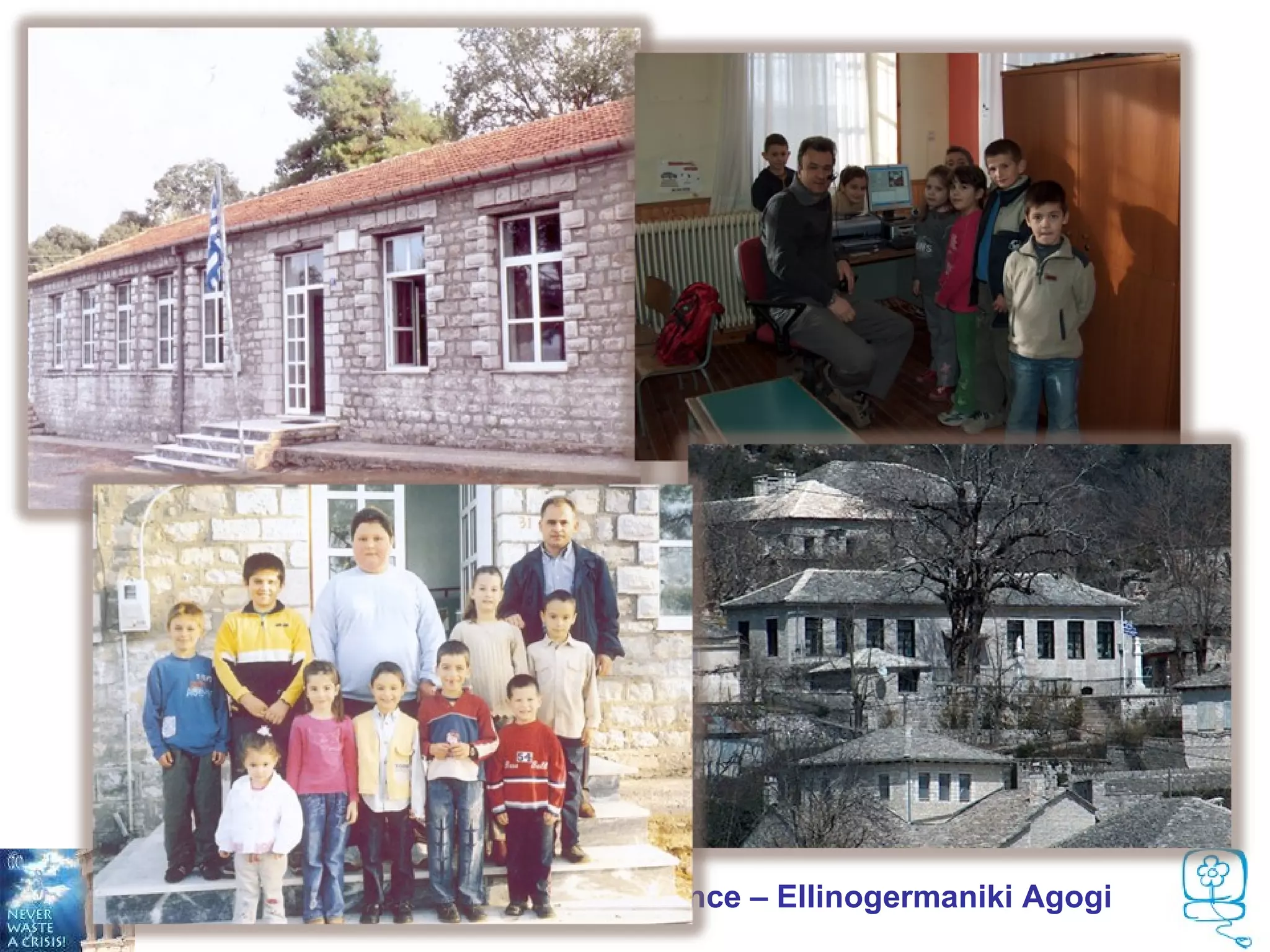
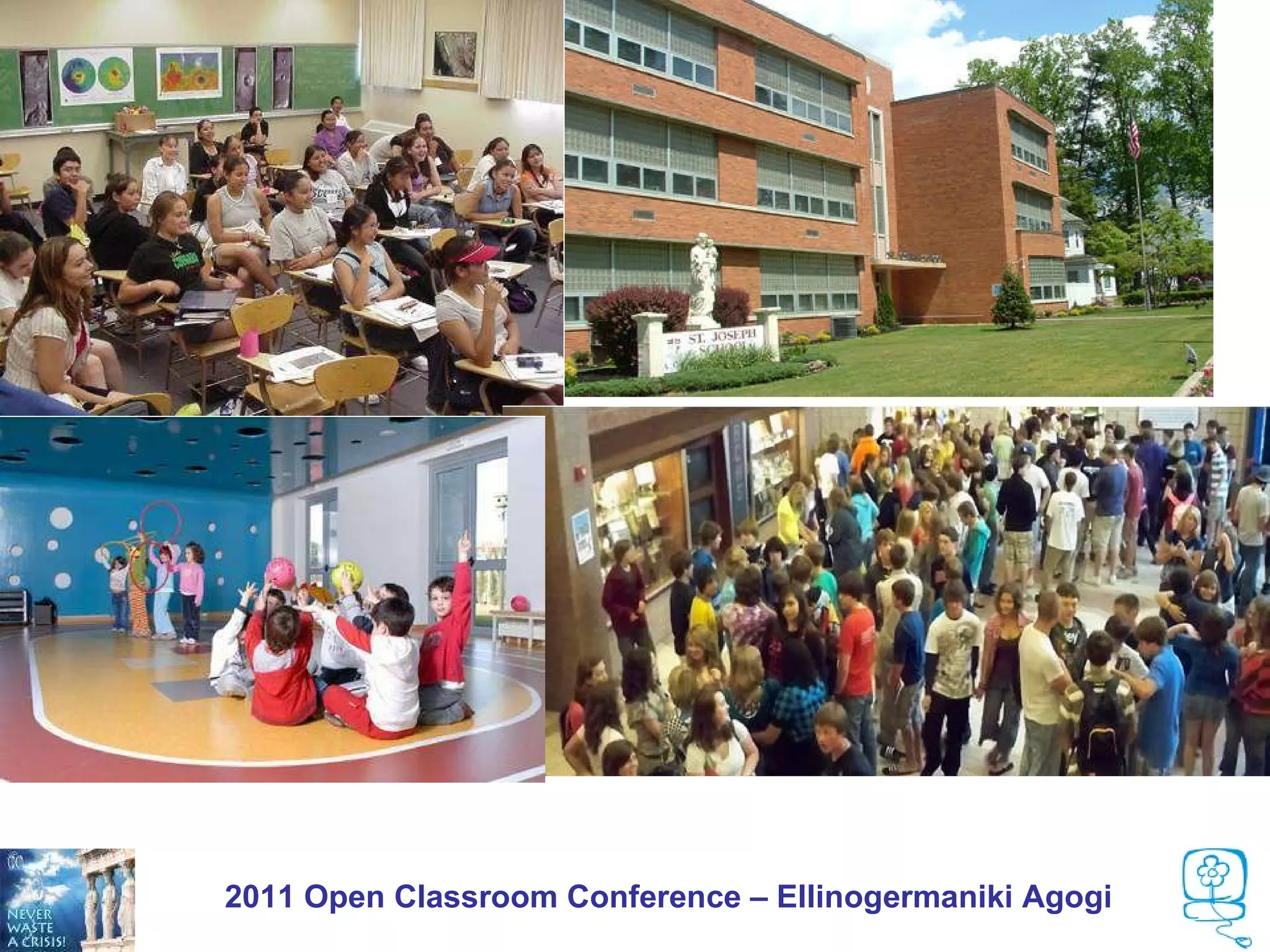
Different Cultures, Different settings,
           Different Needs


 2011 Open Classroom Conference – Ellinogermaniki Agogi
2011 Open Classroom Conference – Ellinogermaniki Agogi
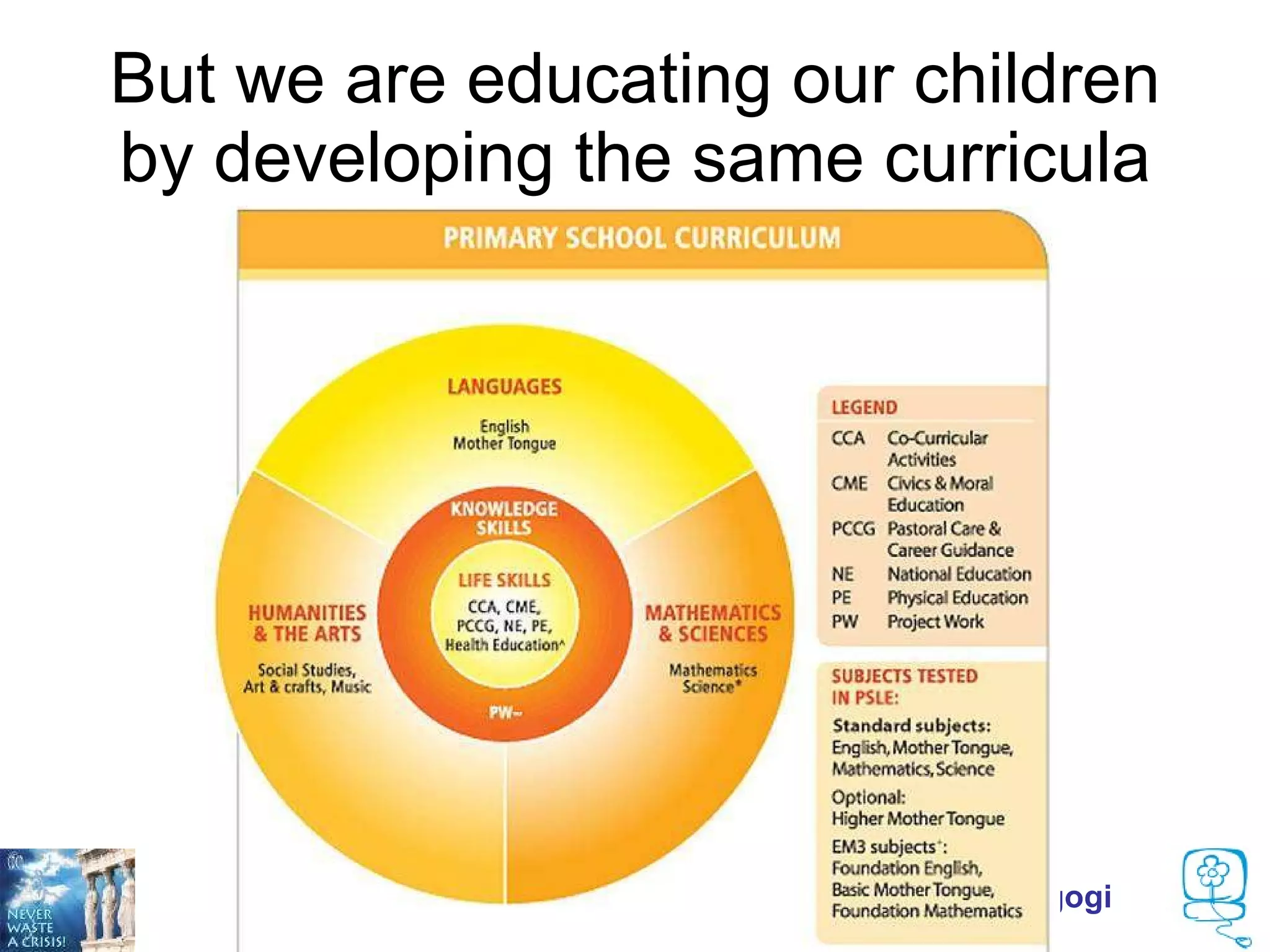
But we are educating our children
by developing the same curricula


   2011 Open Classroom Conference – Ellinogermaniki Agogi
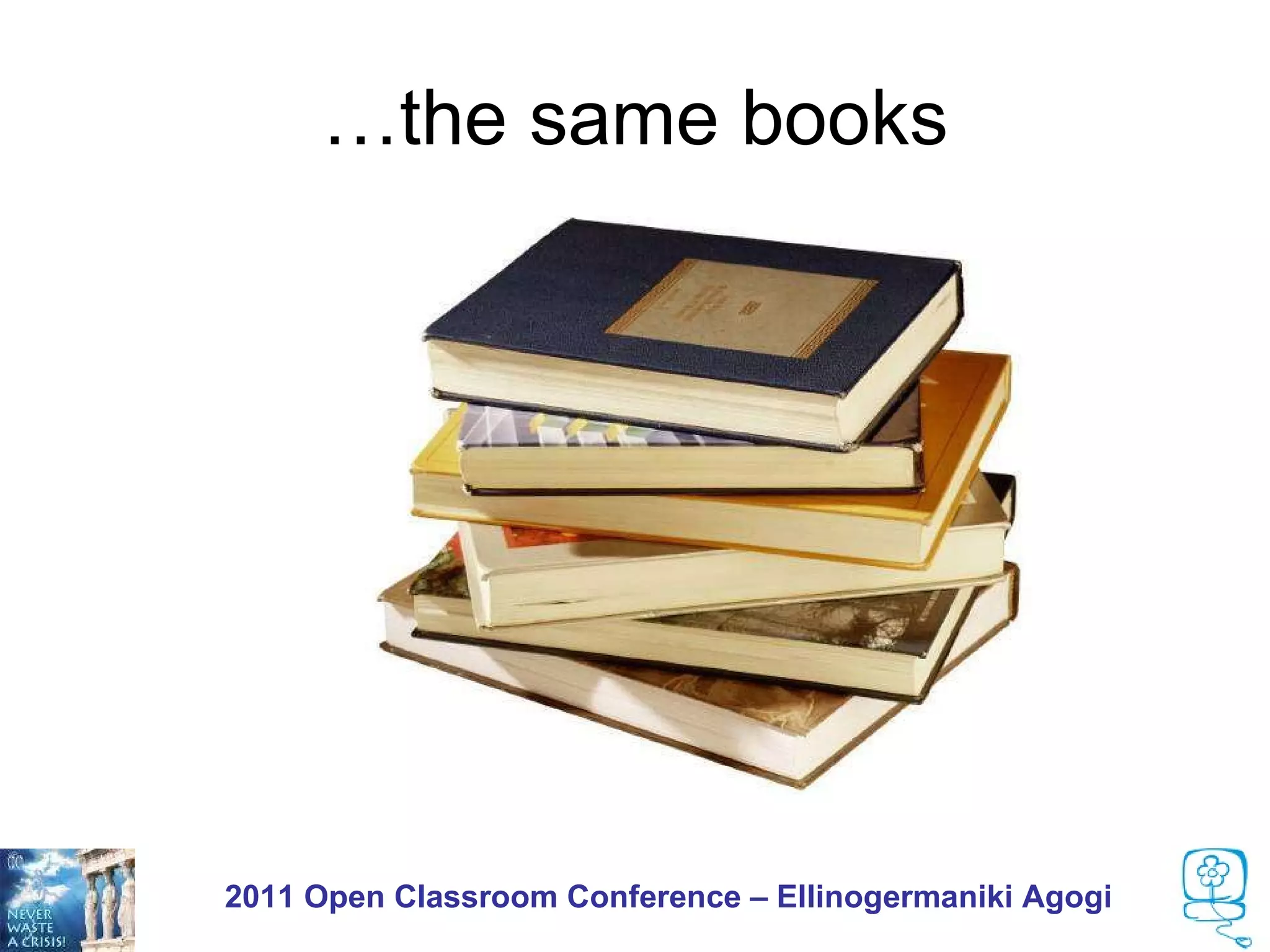
…the same books


2011 Open Classroom Conference – Ellinogermaniki Agogi
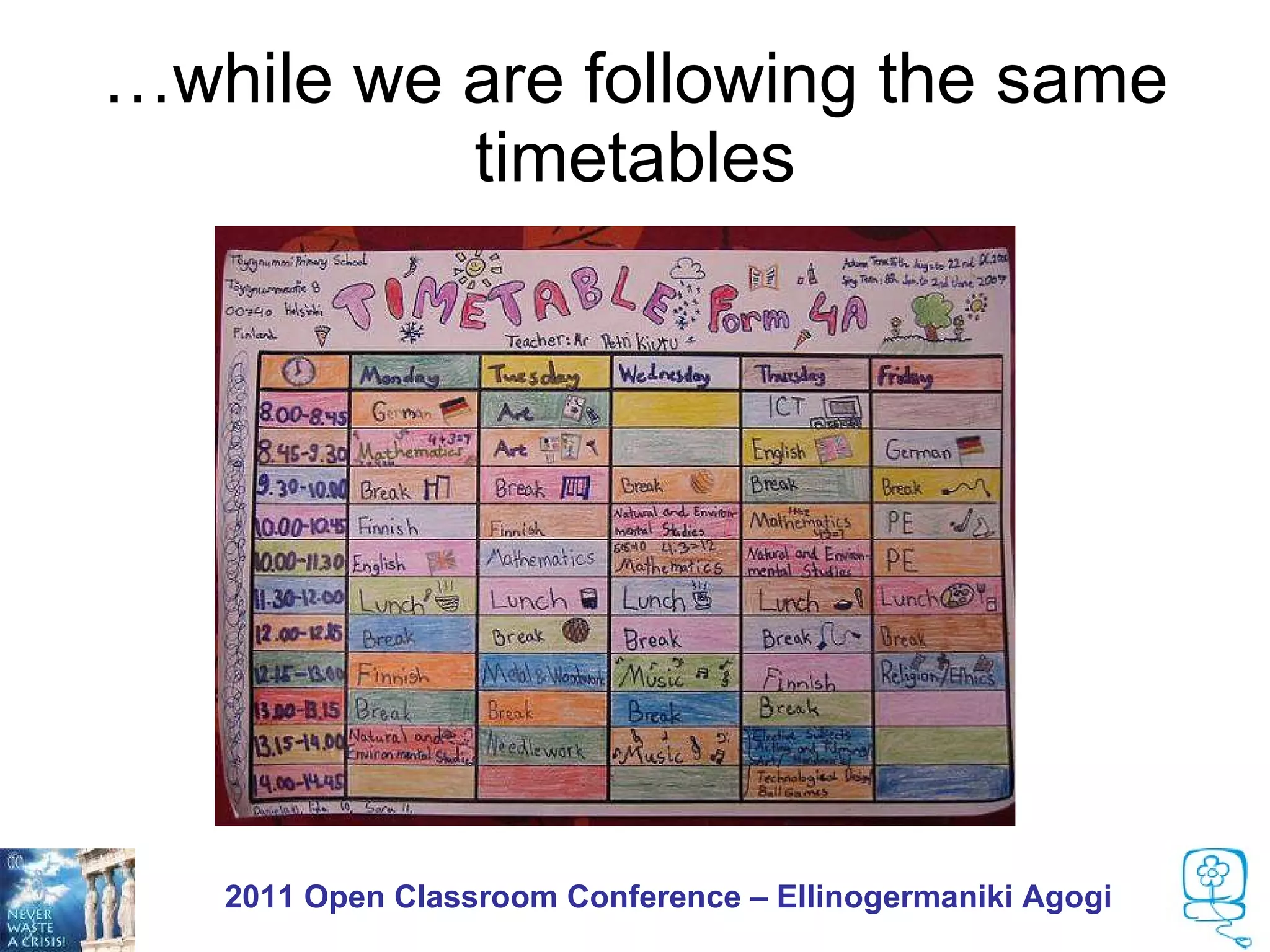
…while we are following the same
          timetables


   2011 Open Classroom Conference – Ellinogermaniki Agogi
Educational Systems have to focus
  on the real educational needs.

Current approaches, although are
promising “education for all”, seem
 to ignore the real situation in the
           local settings.

    2011 Open Classroom Conference – Ellinogermaniki Agogi
2011 Open Classroom Conference – Ellinogermaniki Agogi
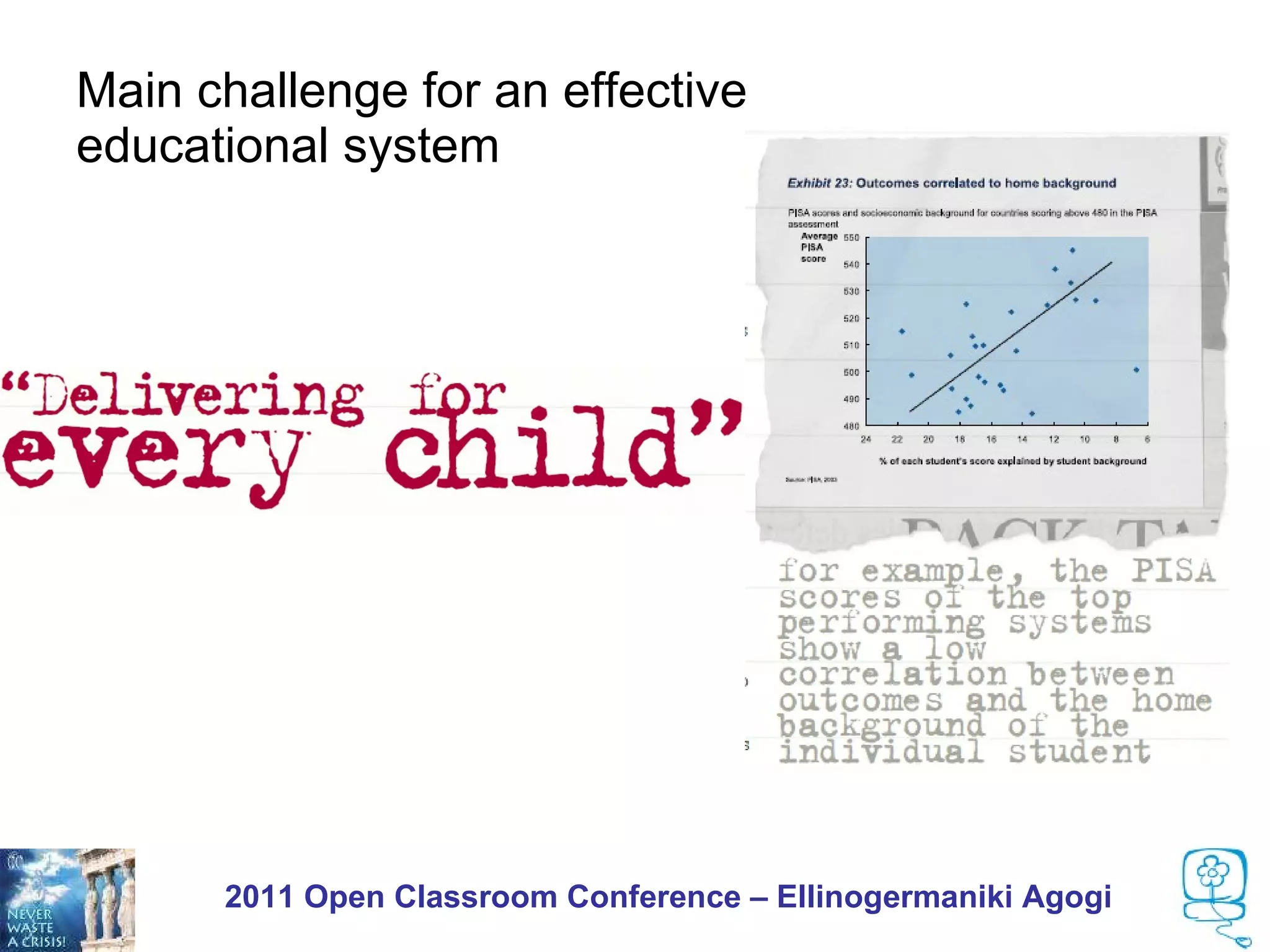
Main challenge for an effective
educational system


      2011 Open Classroom Conference – Ellinogermaniki Agogi
ARTICLE I - MEETING BASIC LEARNING NEEDS

  Every person - child, youth and adult - shall be able to benefit from
  educational opportunities designed to meet their basic learning needs.
  These needs comprise both essential learning tools (such as literacy, oral
  expression, numeracy, and problem solving) and the basic learning content (such
  as knowledge, skills, values, and attitudes). The scope of basic learning needs
  and how they should be met varies with individual countries and cultures, and
  inevitably, changes with the passage of time.

                                         World Declaration on Education for All:
                                         Meeting Basic Learning Needs
Άρθρο 16

2. Η παιδεία αποτελεί βασική αποστολή του the State και έχει σκοπόat the moral,
   Education constitutes a basic mission for Κράτους and shall aim την ηθική,
    πνευματική επαγγελματική και φυσική αγωγή των Ελλήνων, την ανάπτυξη
   intellectual, professional and physical training of Greeks, the development of
    της εθνικής και θρησκευτικής συνείδησης και τη διάπλασή τους σε
   national and religious consciousness and at their formation as free and
    ελεύθερους και υπεύθυνους πολίτες.
   responsible citizens.

                                                            Greek Constitution

             2011 Open Classroom Conference – Ellinogermaniki Agogi
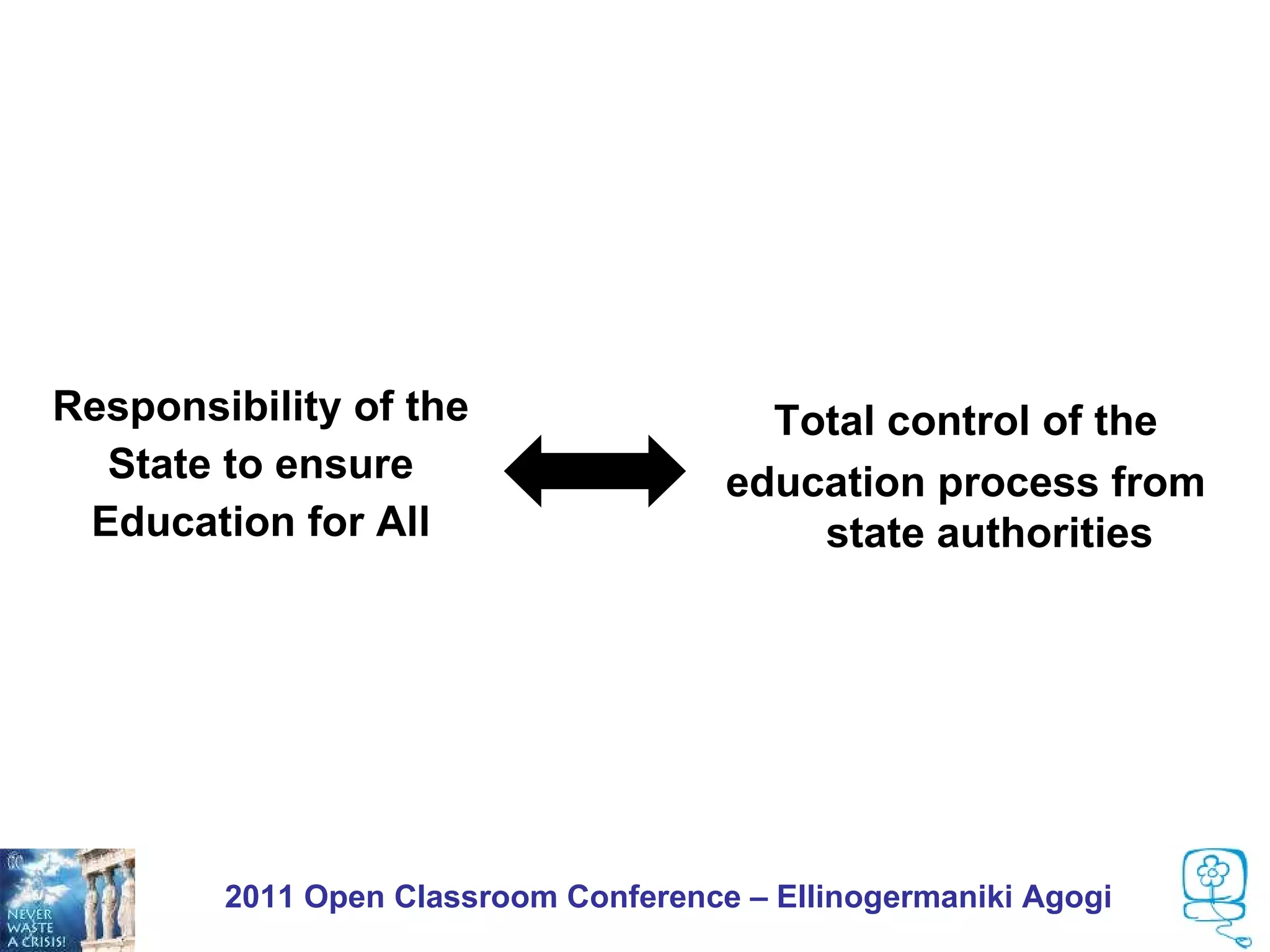
Responsibility of the                   Total control of the
  State to ensure                     education process from
 Education for All                        state authorities


        2011 Open Classroom Conference – Ellinogermaniki Agogi
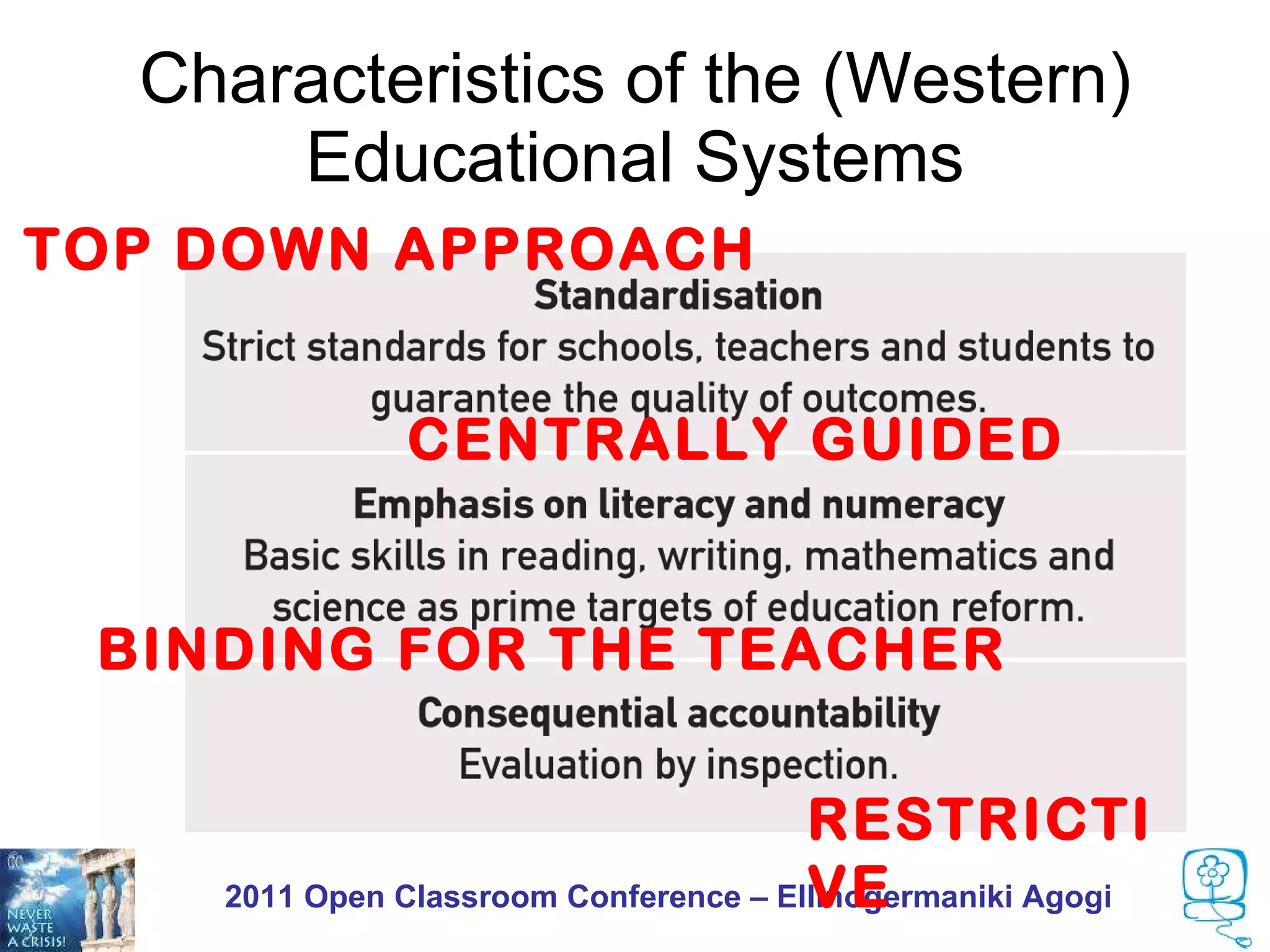
Characteristics of the (Western)
      Educational Systems
TOP DOWN APPROACH


              CENTRALLY GUIDED


 BINDING FOR THE TEACHER


                                       RESTRICTI
                                       VE
    2011 Open Classroom Conference – Ellinogermaniki Agogi
2011 Open Classroom Conference – Ellinogermaniki Agogi
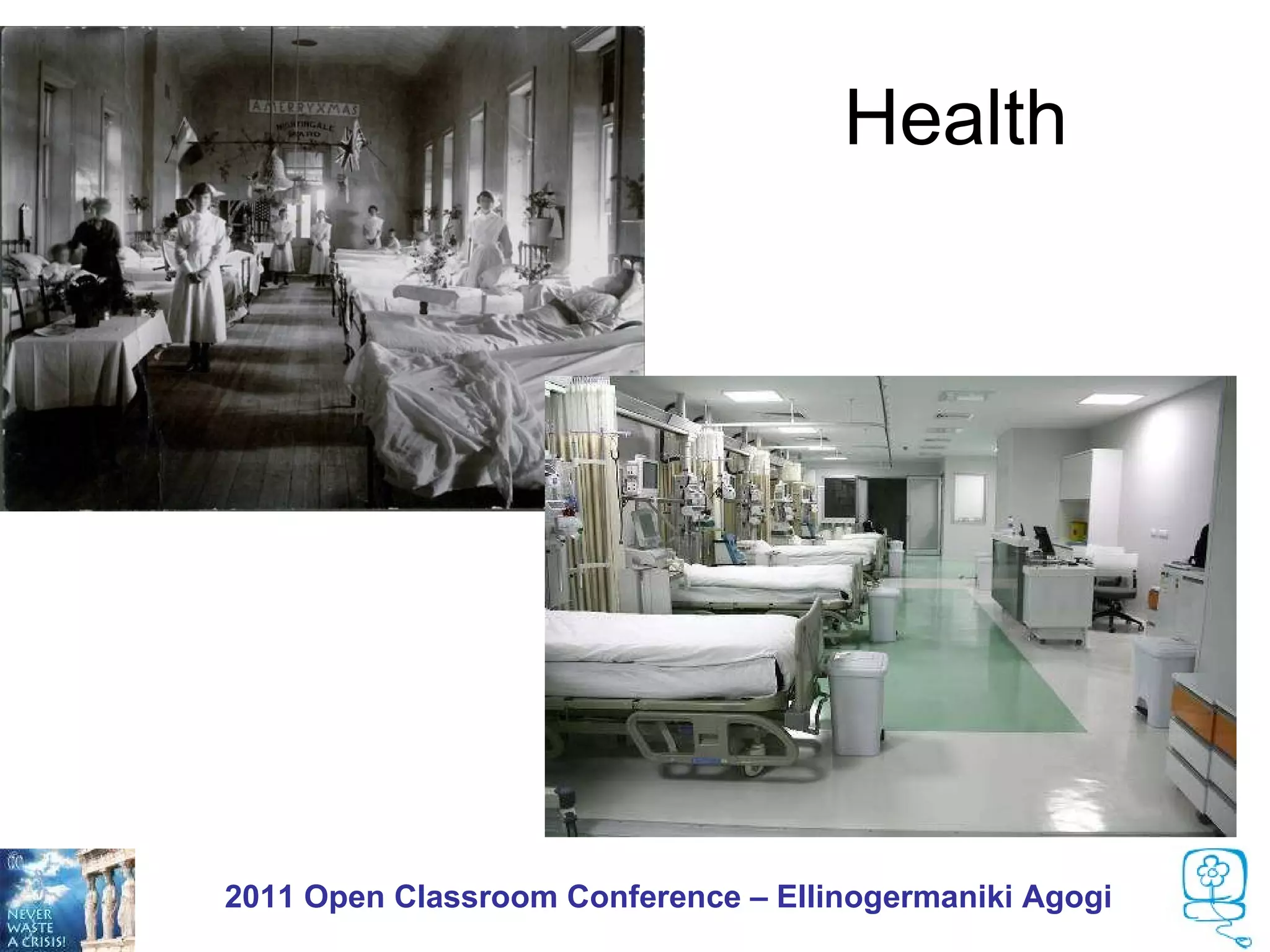
Health


2011 Open Classroom Conference – Ellinogermaniki Agogi
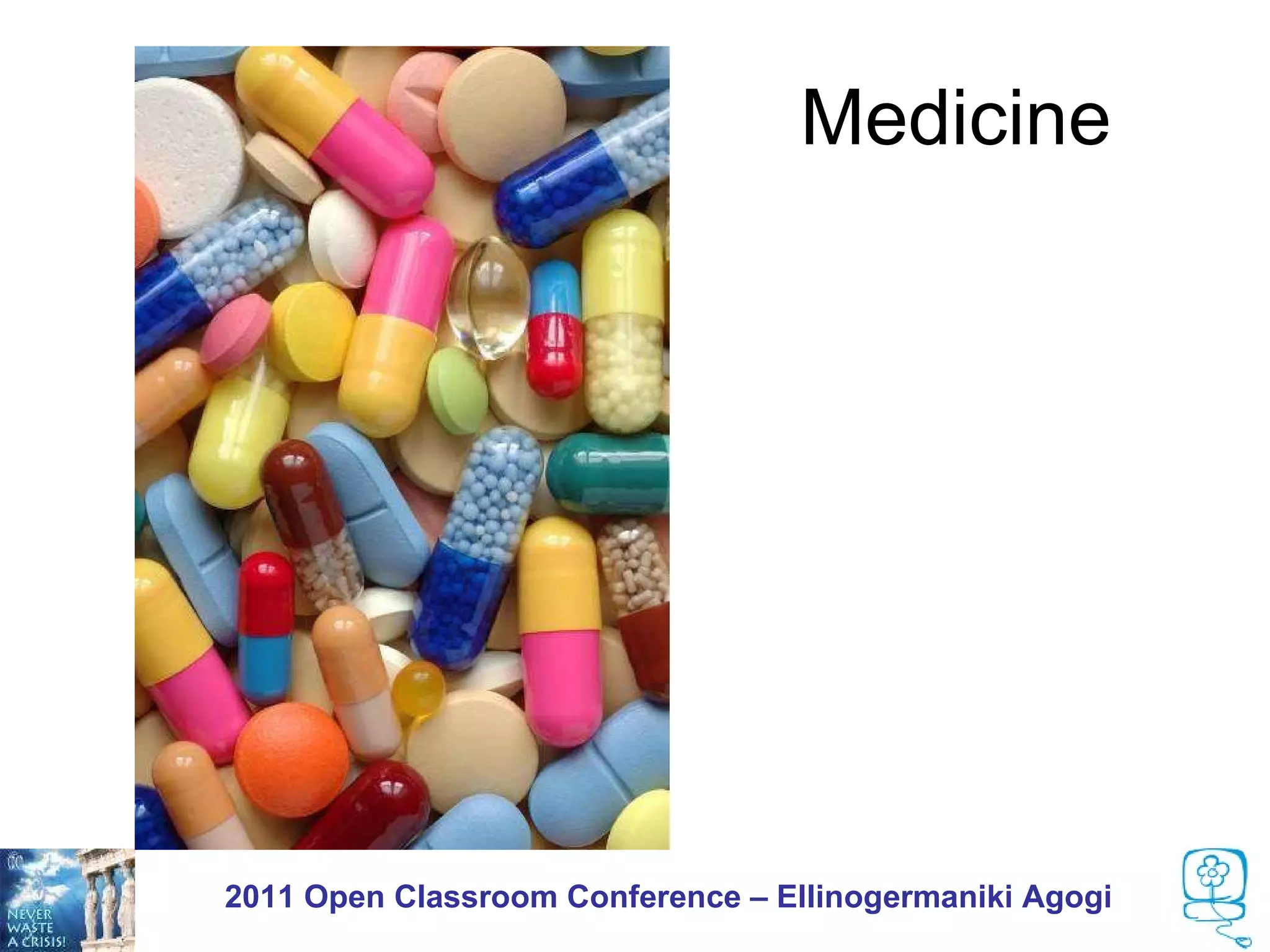
Medicine


2011 Open Classroom Conference – Ellinogermaniki Agogi
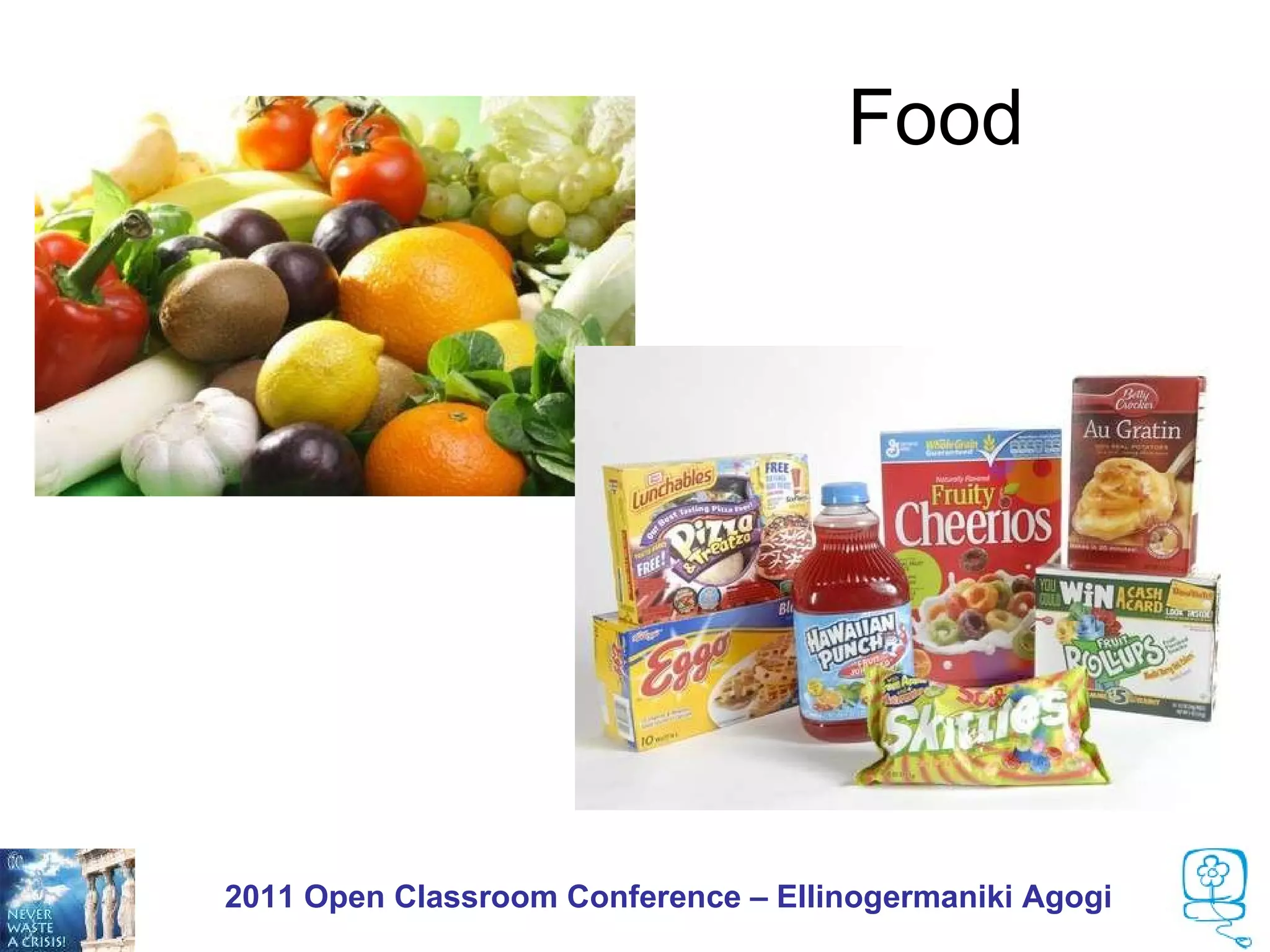
Food


2011 Open Classroom Conference – Ellinogermaniki Agogi
Effective Educational Systems
The success of the effective educational systems
  (e.g. Finland) can be attributed to shift from
  controlling the resources and content of
  education towards a focus on better outcomes,
  while establishing universal high standards.
These systems have also abandoned uniformity
  in favour of embracing diversity and
  individualised learning and moved from a
  bureaucratic approach towards delegating
  responsibilities; from talking about equity to
  delivering equity.

      2011 Open Classroom Conference – Ellinogermaniki Agogi
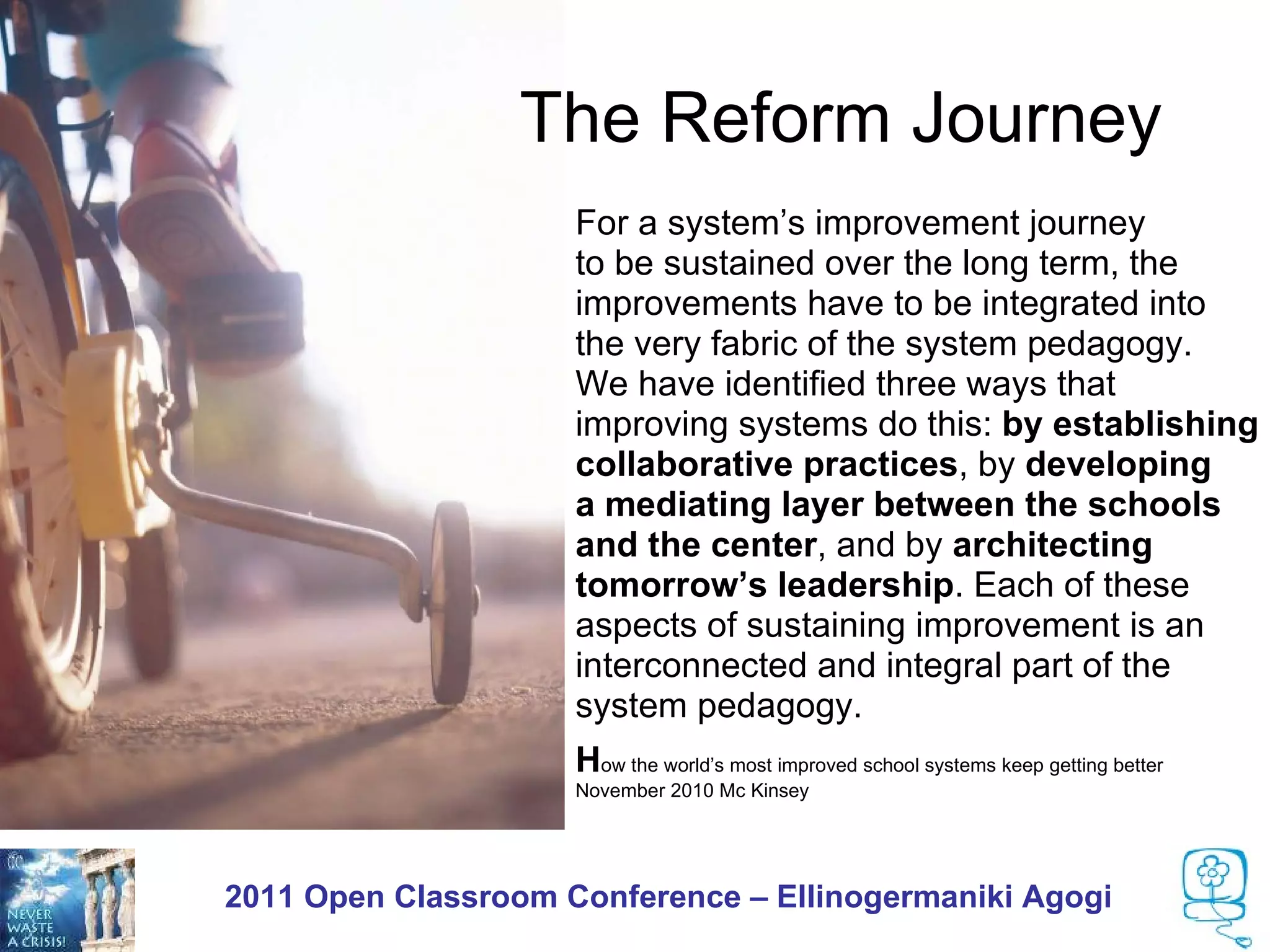
The Reform Journey
                  •   For a system’s improvement journey
                  •   to be sustained over the long term, the
                  •   improvements have to be integrated into
                  •   the very fabric of the system pedagogy.
                  •   We have identified three ways that
                  •   improving systems do this: by establishing
                  •   collaborative practices, by developing
                  •   a mediating layer between the schools
                  •   and the center, and by architecting
                  •   tomorrow’s leadership. Each of these
                  •   aspects of sustaining improvement is an
                  •   interconnected and integral part of the
                  •   system pedagogy.
                  •   How the world’s most improved school systems keep getting better
                  •   November 2010 Mc Kinsey


2011 Open Classroom Conference – Ellinogermaniki Agogi
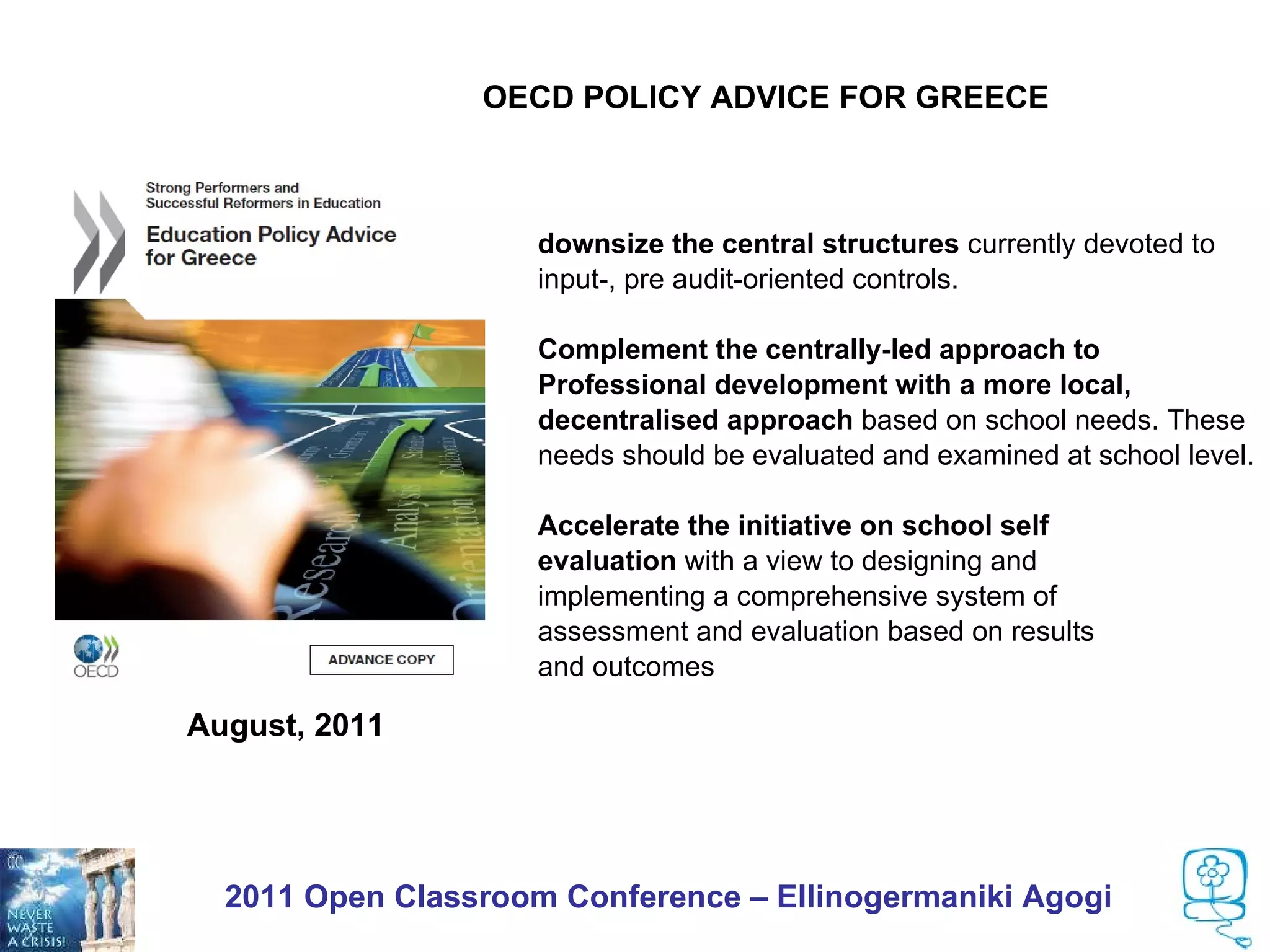
OECD POLICY ADVICE FOR GREECE


                     downsize the central structures currently devoted to
                     input-, pre audit-oriented controls.

                     Complement the centrally-led approach to
                     Professional development with a more local,
                     decentralised approach based on school needs. These
                     needs should be evaluated and examined at school level.

                     Accelerate the initiative on school self
                     evaluation with a view to designing and
                     implementing a comprehensive system of
                     assessment and evaluation based on results
                     and outcomes

August, 2011


  2011 Open Classroom Conference – Ellinogermaniki Agogi
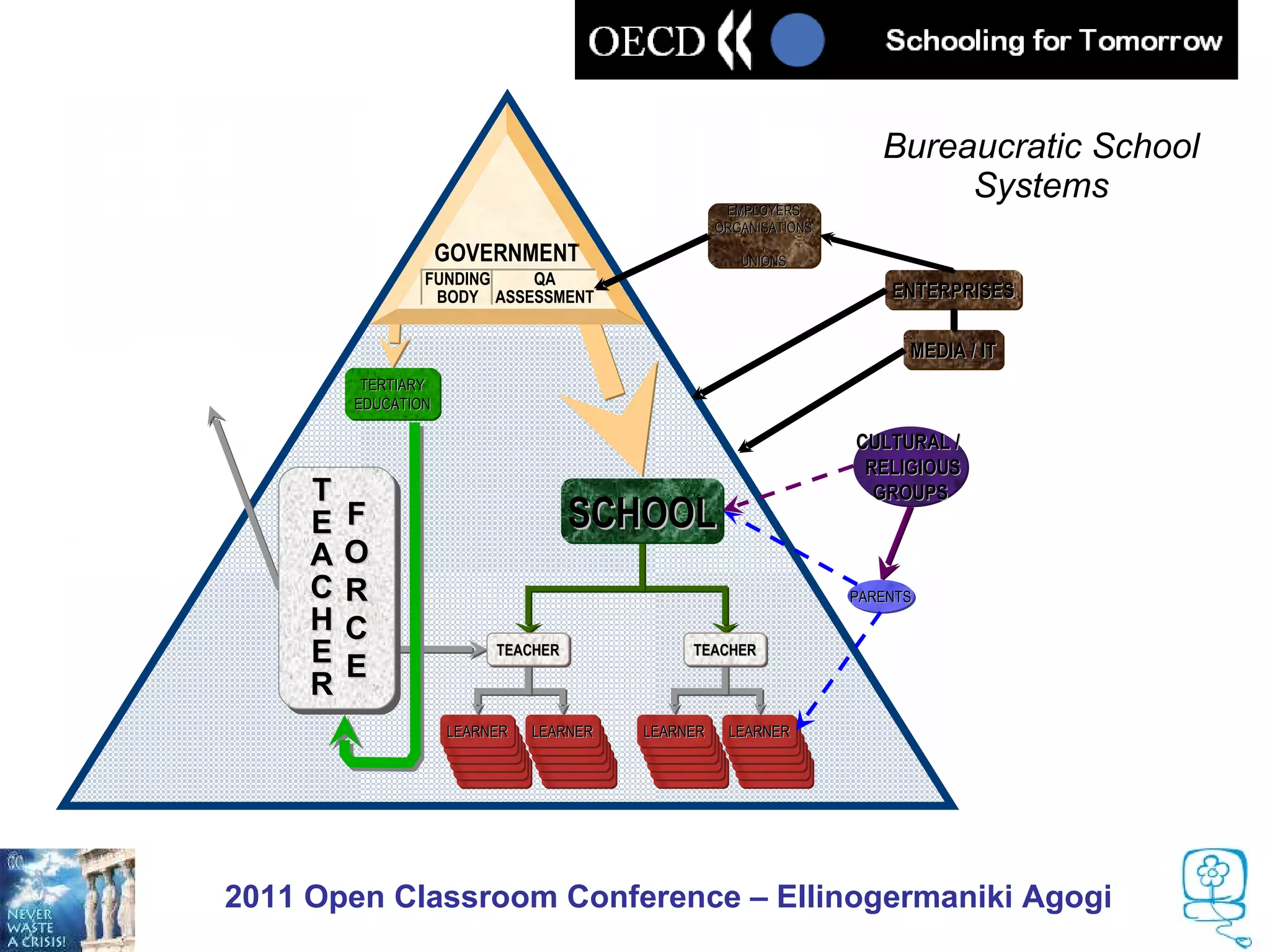
Bureaucratic School
                                                                         Systems
                                                  EMPLOYERS
                                                 ORGANISATIONS
                                                       ,
                     GOVERNMENT                     UNIONS
                 FUNDING   QA
                  BODY ASSESSMENT                                    ENTERPRISES

                                                                       MEDIA / IT
          TERTIARY
         EDUCATION

                                                                 CULTURAL /
                                                                  RELIGIOUS
     T                                                             GROUPS
     E   F                          SCHOOL
     A   O
     C   R                                                       PARENTS
     H   C
     E   E
                          TEACHER             TEACHER

     R
                     LEARNER  LEARNER    LEARNER   LEARNER
                     LEARNER LEARNER     LEARNER LEARNER
                      LEARNER LEARNER     LEARNER LEARNER
                      LEARNER  LEARNER    LEARNER LEARNER
                       LEARNER LEARNER     LEARNER
                       LEARNER LEARNER     LEARNER LEARNER
                                                     LEARNER


2011 Open Classroom Conference – Ellinogermaniki Agogi
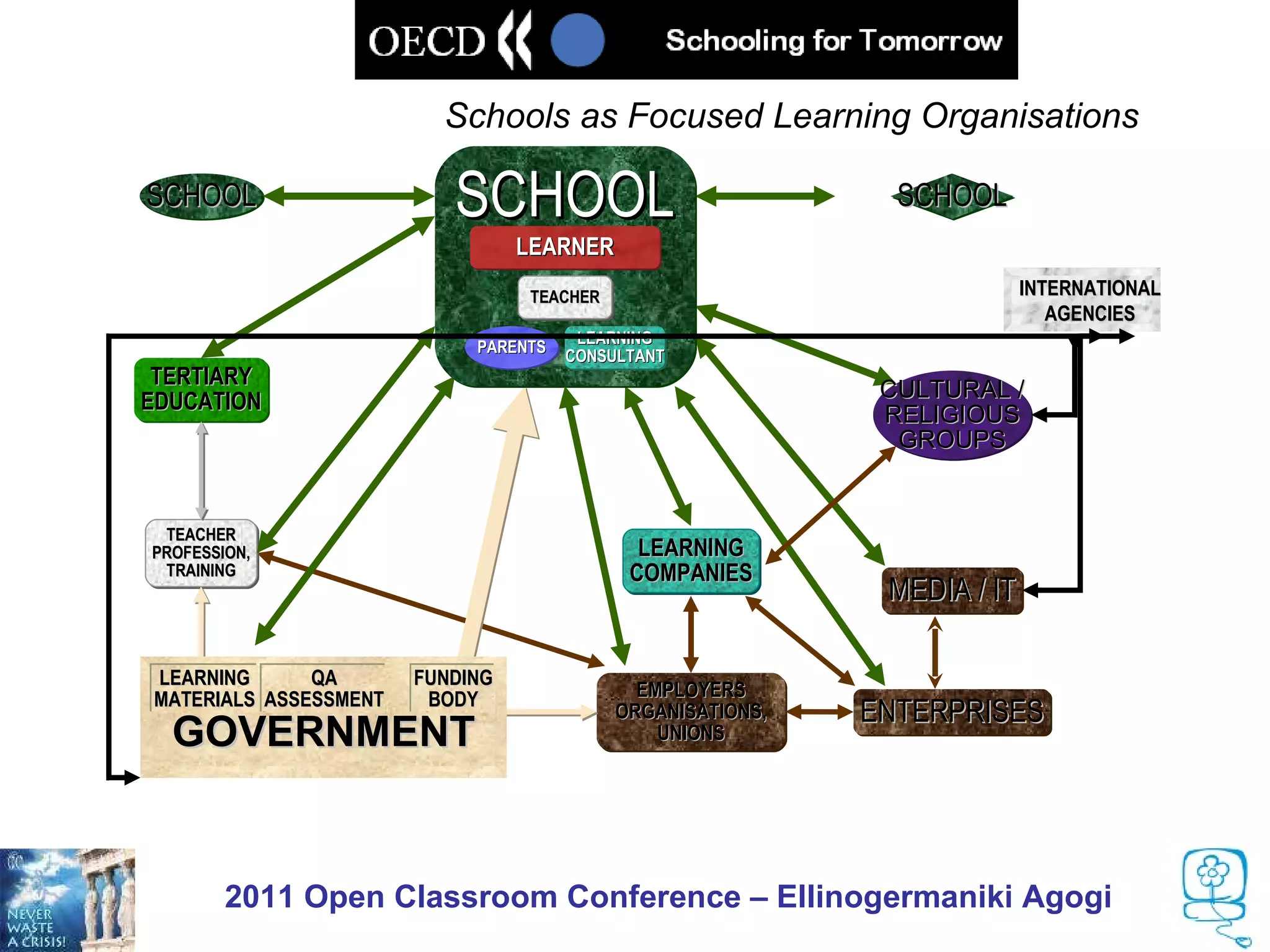
Schools as Focused Learning Organisations

SCHOOL                    SCHOOL                               SCHOOL
                                 LEARNER
                                  TEACHER                                  INTERNATIONAL
                                                                              AGENCIES
                                       LEARNING
                            PARENTS
                                      CONSULTANT
 TERTIARY
EDUCATION                                                     CULTURAL /
                                                              RELIGIOUS
                                                               GROUPS


 TEACHER
PROFESSION,                                   LEARNING
 TRAINING                                    COMPANIES
                                                              MEDIA / IT

LEARNING      QA       FUNDING
MATERIALS ASSESSMENT    BODY                  EMPLOYERS
                                            ORGANISATIONS,   ENTERPRISES
  GOVERNMENT                                    UNIONS


        2011 Open Classroom Conference – Ellinogermaniki Agogi
What is really needed:
                        Flexibility and Diversity
                 School-based curriculum development,
                   steering by information and support
                  The State only defines the framework.

                 More freedom of choice to the teacher
              Flexibility to the teacher to form his/her lesson
                 and apply innovative methods and tools

                       Trust through professionalism
A culture of trust on teachers’ and headmasters’ professionalism in judging
              what is best for students and in reporting of progress


           2011 Open Classroom Conference – Ellinogermaniki Agogi
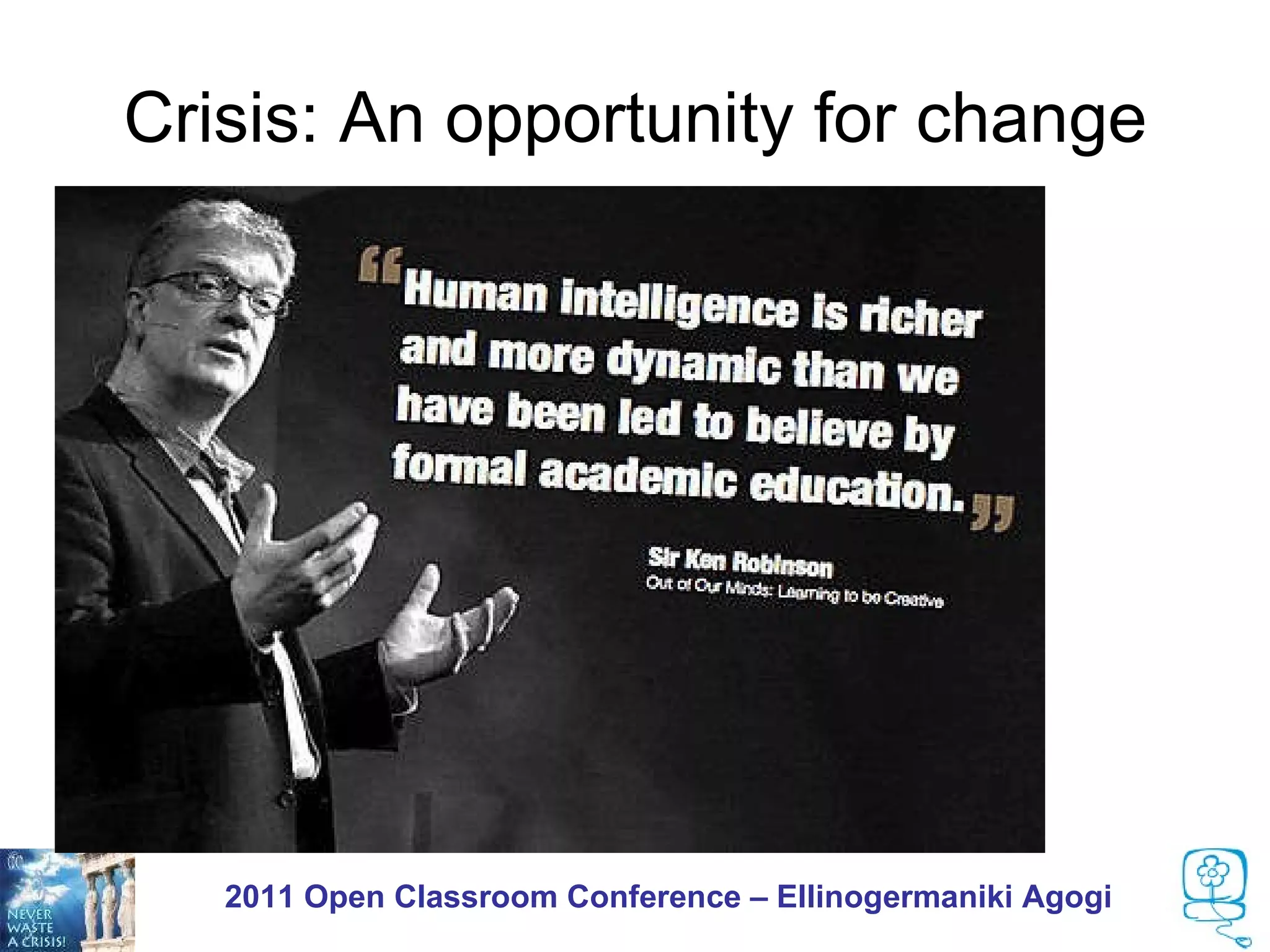
Crisis: An opportunity for change

It is not a matter of money!


                                 It is a matter of
                                    creativity!


       2011 Open Classroom Conference – Ellinogermaniki Agogi

OCC2011 Keynotes: Stavros Savvas

  • 1.
    Decentralisation of the educationalsystem as a vehicle for innovation Stavros Savvas Ellinogermaniki Agogi 2011 Open Classroom Conference – Ellinogermaniki Agogi
  • 2.
    21st Century Challengesand Education The Information and Knowledge Society has emerged as a result of technological advancements of the World Wide Web, the Internet and mobile communications over the last two decades. These technological Developments have had; and still have direct impact to every spect of our personal and social life, thus changing the way we communicate, collaborate, work and learn. Europe has been a world driving force when it comes to these technological developments, however, in many cases European Member States have falled behind in adopting the necessary societal re-organisational changes needed in education. This can be a critical issue for the future of European Union and the future of its Member States within the complex global challenges of the 21st Century. 2011 Open Classroom Conference – Ellinogermaniki Agogi
  • 3.
    ARTICLE I -MEETING BASIC LEARNING NEEDS Every person - child, youth and adult - shall be able to benefit from educational opportunities designed to meet their basic learning needs. These needs comprise both essential learning tools (such as literacy, oral expression, numeracy, and problem solving) and the basic learning content (such as knowledge, skills, values, and attitudes). The scope of basic learning needs and how they should be met varies with individual countries and cultures, and inevitably, changes with the passage of time. World Declaration on Education for All: Meeting Basic Learning Needs Άρθρο 16 2. Η παιδεία αποτελεί βασική αποστολή του the State και έχει σκοπόat the moral, Education constitutes a basic mission for Κράτους and shall aim την ηθική, πνευματική επαγγελματική και φυσική αγωγή των Ελλήνων, την ανάπτυξη intellectual, professional and physical training of Greeks, the development of της εθνικής και θρησκευτικής συνείδησης και τη διάπλασή τους σε national and religious consciousness and at their formation as free and ελεύθερους και υπεύθυνους πολίτες. responsible citizens. Greek Constitution 2011 Open Classroom Conference – Ellinogermaniki Agogi
  • 4.
    Aviation 2011 Open ClassroomConference – Ellinogermaniki Agogi
  • 5.
    Automobile 2011 Open ClassroomConference – Ellinogermaniki Agogi
  • 6.
    Industry 2011 Open ClassroomConference – Ellinogermaniki Agogi
  • 7.
    Constructions 2011 Open ClassroomConference – Ellinogermaniki Agogi
  • 8.
    Cities 2011 Open ClassroomConference – Ellinogermaniki Agogi
  • 9.
    Schools remain unchanged Whenit comes to the field of education, this lack of social innovation becomes even more troubling, due to the fact that failing to “re-engineer” our national and European educational systems, effects significantly all other areas of social and economical development, jurpotising Europe’s position in the global knowledge-based society. Especially, Schools appear to remain almost unchanged for the most part despite numerous efforts and investments in technology, teachers’ training and infrastructure. Yet, the way we organise schooling and provide education remains basically the same. To put it in another way: “we still educate our students based on an agricultural timetable, in an industrial setting, yet telling students and teachers they live in a digital age”. 2011 Open Classroom Conference – Ellinogermaniki Agogi
  • 10.
    2011 Open ClassroomConference – Ellinogermaniki Agogi
  • 11.
    During the pastyears, several reasons have been identified separately as possible distractions in aligning schools operations and results to the ones anticipated by the 21st Century Societies. The most highlighted ones being: Lack of funds, not enough computers in the classroom, little interest from students and parents, out of date teaching practices, poorly trained teachers, and even a fundamentally flawed way to measure performance at schools. Many national and European initiatives have been undertaken to tackle these issues separately. Yet, the improvement has been marginal, if any at all. 2011 Open Classroom Conference – Ellinogermaniki Agogi
  • 12.
    “I am nota teacher of “things”, I am an “orchestrator” of ideas. My educational institution is not a physical plant with classrooms and trees, but a “hub” of resources no longer constrained by time and place. My students are no longer “my” students, but we are all students together”. Dillon and Granger (1998) 2011 Open Classroom Conference – Ellinogermaniki Agogi
  • 13.
    Different Cultures, Differentsettings, Different Needs 2011 Open Classroom Conference – Ellinogermaniki Agogi
  • 14.
    2011 Open ClassroomConference – Ellinogermaniki Agogi
  • 15.
    2011 Open ClassroomConference – Ellinogermaniki Agogi
  • 16.
    2011 Open ClassroomConference – Ellinogermaniki Agogi
  • 17.
    But we areeducating our children by developing the same curricula 2011 Open Classroom Conference – Ellinogermaniki Agogi
  • 18.
    …the same books 2011Open Classroom Conference – Ellinogermaniki Agogi
  • 19.
    …while we arefollowing the same timetables 2011 Open Classroom Conference – Ellinogermaniki Agogi
  • 20.
    Educational Systems haveto focus on the real educational needs. Current approaches, although are promising “education for all”, seem to ignore the real situation in the local settings. 2011 Open Classroom Conference – Ellinogermaniki Agogi
  • 21.
    2011 Open ClassroomConference – Ellinogermaniki Agogi
  • 22.
    2011 Open ClassroomConference – Ellinogermaniki Agogi
  • 23.
    Main challenge foran effective educational system 2011 Open Classroom Conference – Ellinogermaniki Agogi
  • 24.
    ARTICLE I -MEETING BASIC LEARNING NEEDS Every person - child, youth and adult - shall be able to benefit from educational opportunities designed to meet their basic learning needs. These needs comprise both essential learning tools (such as literacy, oral expression, numeracy, and problem solving) and the basic learning content (such as knowledge, skills, values, and attitudes). The scope of basic learning needs and how they should be met varies with individual countries and cultures, and inevitably, changes with the passage of time. World Declaration on Education for All: Meeting Basic Learning Needs Άρθρο 16 2. Η παιδεία αποτελεί βασική αποστολή του the State και έχει σκοπόat the moral, Education constitutes a basic mission for Κράτους and shall aim την ηθική, πνευματική επαγγελματική και φυσική αγωγή των Ελλήνων, την ανάπτυξη intellectual, professional and physical training of Greeks, the development of της εθνικής και θρησκευτικής συνείδησης και τη διάπλασή τους σε national and religious consciousness and at their formation as free and ελεύθερους και υπεύθυνους πολίτες. responsible citizens. Greek Constitution 2011 Open Classroom Conference – Ellinogermaniki Agogi
  • 25.
    Responsibility of the Total control of the State to ensure education process from Education for All state authorities 2011 Open Classroom Conference – Ellinogermaniki Agogi
  • 26.
    Characteristics of the(Western) Educational Systems TOP DOWN APPROACH CENTRALLY GUIDED BINDING FOR THE TEACHER RESTRICTI VE 2011 Open Classroom Conference – Ellinogermaniki Agogi
  • 27.
    2011 Open ClassroomConference – Ellinogermaniki Agogi
  • 28.
    Health 2011 Open ClassroomConference – Ellinogermaniki Agogi
  • 29.
    Medicine 2011 Open ClassroomConference – Ellinogermaniki Agogi
  • 30.
    Food 2011 Open ClassroomConference – Ellinogermaniki Agogi
  • 31.
    2011 Open ClassroomConference – Ellinogermaniki Agogi
  • 32.
    Effective Educational Systems Thesuccess of the effective educational systems (e.g. Finland) can be attributed to shift from controlling the resources and content of education towards a focus on better outcomes, while establishing universal high standards. These systems have also abandoned uniformity in favour of embracing diversity and individualised learning and moved from a bureaucratic approach towards delegating responsibilities; from talking about equity to delivering equity. 2011 Open Classroom Conference – Ellinogermaniki Agogi
  • 33.
    The Reform Journey • For a system’s improvement journey • to be sustained over the long term, the • improvements have to be integrated into • the very fabric of the system pedagogy. • We have identified three ways that • improving systems do this: by establishing • collaborative practices, by developing • a mediating layer between the schools • and the center, and by architecting • tomorrow’s leadership. Each of these • aspects of sustaining improvement is an • interconnected and integral part of the • system pedagogy. • How the world’s most improved school systems keep getting better • November 2010 Mc Kinsey 2011 Open Classroom Conference – Ellinogermaniki Agogi
  • 34.
    OECD POLICY ADVICEFOR GREECE downsize the central structures currently devoted to input-, pre audit-oriented controls. Complement the centrally-led approach to Professional development with a more local, decentralised approach based on school needs. These needs should be evaluated and examined at school level. Accelerate the initiative on school self evaluation with a view to designing and implementing a comprehensive system of assessment and evaluation based on results and outcomes August, 2011 2011 Open Classroom Conference – Ellinogermaniki Agogi
  • 35.
    Bureaucratic School Systems EMPLOYERS ORGANISATIONS , GOVERNMENT UNIONS FUNDING QA BODY ASSESSMENT ENTERPRISES MEDIA / IT TERTIARY EDUCATION CULTURAL / RELIGIOUS T GROUPS E F SCHOOL A O C R PARENTS H C E E TEACHER TEACHER R LEARNER LEARNER LEARNER LEARNER LEARNER LEARNER LEARNER LEARNER LEARNER LEARNER LEARNER LEARNER LEARNER LEARNER LEARNER LEARNER LEARNER LEARNER LEARNER LEARNER LEARNER LEARNER LEARNER LEARNER 2011 Open Classroom Conference – Ellinogermaniki Agogi
  • 36.
    Schools as FocusedLearning Organisations SCHOOL SCHOOL SCHOOL LEARNER TEACHER INTERNATIONAL AGENCIES LEARNING PARENTS CONSULTANT TERTIARY EDUCATION CULTURAL / RELIGIOUS GROUPS TEACHER PROFESSION, LEARNING TRAINING COMPANIES MEDIA / IT LEARNING QA FUNDING MATERIALS ASSESSMENT BODY EMPLOYERS ORGANISATIONS, ENTERPRISES GOVERNMENT UNIONS 2011 Open Classroom Conference – Ellinogermaniki Agogi
  • 37.
    What is reallyneeded: Flexibility and Diversity School-based curriculum development, steering by information and support The State only defines the framework. More freedom of choice to the teacher Flexibility to the teacher to form his/her lesson and apply innovative methods and tools Trust through professionalism A culture of trust on teachers’ and headmasters’ professionalism in judging what is best for students and in reporting of progress 2011 Open Classroom Conference – Ellinogermaniki Agogi
  • 38.
    Crisis: An opportunityfor change It is not a matter of money! It is a matter of creativity! 2011 Open Classroom Conference – Ellinogermaniki Agogi