Unit 2
• Perception-Nature &
Importance of Perception, Sub-
processes of Perception
• Factors influencing Perception
at workplace
• Attribution- Attribution theory
• Impression Management-the
process of Impression
management
• Employee impression
management strategies
• Role of Attitudes
• Values
• Personality
• Emotions in determining work
behavior
Chapter Outline
 Perception Defined
 Factors Influencing Perception
 Perceptual Errors
 Why Do Perception and Judgment
Matter?
 Personality
 Emotions
Chapter 2, Nancy Langton and Stephen P. Robbins,
Fundamentals of Organizational Behaviour, Third
Canadian Edition
2-2
Copyright © 2007 Pearson Education Canada
Perception, Personality, and Emotions
1. What is perception?
2. What causes people to have different
perceptions of the same situation?
3. Can people be mistaken in their perceptions?
4. Does perception really affect outcomes?
5. What is personality and how does it affect
behaviour?
6. Can emotions help or get in the way when
dealing with others? Chapter 2, Nancy Langton and Stephen P. Robbins,
Fundamentals of Organizational Behaviour, Third
Canadian Edition
2-3
Copyright © 2007 Pearson Education Canada
 Describe a situation in which your
perception turned out to be wrong. What
perceptual errors did you make that
might have caused this to happen?
Chapter 2, Nancy Langton and Stephen P. Robbins,
Fundamentals of Organizational Behaviour, Third
Canadian Edition
2-4
Copyright © 2007 Pearson Education Canada
Perception
 What Is Perception?
 The process by which individuals organize
and interpret their impressions in order to give
meaning to their environment.
 Why Is It Important?
 Because people’s behaviour is based on their
perception of what reality is, not on reality
itself.
 The world as it is perceived is the world that is
behaviourally important.
Chapter 2, Nancy Langton and Stephen P. Robbins,
Fundamentals of Organizational Behaviour, Third
Canadian Edition
2-5
Copyright © 2007 Pearson Education Canada
Why We Study Perceptions
 To better understand how people make
attributions about events.
 We don’t see reality. We interpret what
we see and call it reality.
 The attribution process guides our
behaviour, regardless of the truth of the
attribution.
Chapter 2, Nancy Langton and Stephen P. Robbins,
Fundamentals of Organizational Behaviour, Third
Canadian Edition
2-6
Copyright © 2007 Pearson Education Canada
Factors Influencing Perception
 The Perceiver
 The Target
 The Situation
Chapter 2, Nancy Langton and Stephen P. Robbins,
Fundamentals of Organizational Behaviour, Third
Canadian Edition
2-7
Copyright © 2007 Pearson Education Canada
Exhibit 2-1 Factors that
Influence Perception
Chapter 2, Nancy Langton and Stephen P. Robbins,
Fundamentals of Organizational Behaviour, Third
Canadian Edition
2-8
Copyright © 2007 Pearson Education Canada
Perception
The Target
• Novelty
• Motion
• Sounds
• Size
• Background
• Proximity
The Perceiver
• Attitudes
• Motives
• Interests
• Experience
• Expectations
The Situation
• Time
• Work setting
• Social setting
Perceptual Errors
 Attribution Theory
 Selective Perception
 Halo Effect
 Contrast Effects
 Projection
 Stereotyping
Chapter 2, Nancy Langton and Stephen P. Robbins,
Fundamentals of Organizational Behaviour, Third
Canadian Edition
2-9
Copyright © 2007 Pearson Education Canada
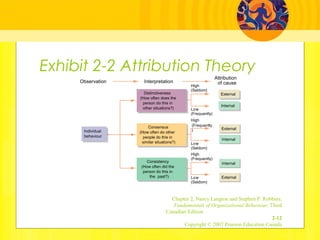
Attribution Theory
 When individuals observe behaviour, they
attempt to determine whether it is
internally or externally caused.
 Distinctiveness
 Does the individual act the same way in other
situations?
 Consensus
 Does the individual act the same as others in
same situation?
 Consistency
 Does the individual act the same way over
time? Chapter 2, Nancy Langton and Stephen P. Robbins,
Fundamentals of Organizational Behaviour, Third
Canadian Edition
2-10
Copyright © 2007 Pearson Education Canada
Attribution Theory
 Fundamental Attribution Error
 The tendency to underestimate external
factors and overestimate internal factors
when making judgments about others’
behaviour.
 Self-Serving Bias
 The tendency to attribute one’s successes
to internal factors while putting the blame
for failures on external factors.
Chapter 2, Nancy Langton and Stephen P. Robbins,
Fundamentals of Organizational Behaviour, Third
Canadian Edition
2-11
Copyright © 2007 Pearson Education Canada
Exhibit 2-2 Attribution Theory
Chapter 2, Nancy Langton and Stephen P. Robbins,
Fundamentals of Organizational Behaviour, Third
Canadian Edition
2-12
Copyright © 2007 Pearson Education Canada
Observation Interpretation
Attribution
of cause
External
High
(Seldom)
Low
(Frequently)
High
Low
(Seldom)
High
(Frequently)
Low
(Seldom)
Internal
rnal
Individual
behaviour
Distinctiveness
(How often does the
person do this in
other situations?)
Consensus
(How often do other
people do this in
similar situations?)
Consistency
(How often did the
person do this in
the past?)
External
Internal
Internal
External
(Frequently
)
Perceptual Errors
 Selective Perception
 People selectively interpret what they see
based on their interests, background,
experience, and attitudes.
 Halo Effect
 Drawing a general impression about an
individual based on a single characteristic.
 Contrast Effects
 A person’s evaluation is affected by
comparisons with other individuals recently
encountered.
Chapter 2, Nancy Langton and Stephen P. Robbins,
Fundamentals of Organizational Behaviour, Third
Canadian Edition
2-13
Copyright © 2007 Pearson Education Canada
Perceptual Errors Projection
 Attributing one’s own characteristics to other
people.
 Stereotyping
 Judging someone on the basis of your perception
of the group to which that person belongs.
Chapter 2, Nancy Langton and Stephen P. Robbins,
Fundamentals of Organizational Behaviour, Third
Canadian Edition
2-14
Copyright © 2007 Pearson Education Canada
Why Do Perceptions and
Judgment Matter?
 Self-Fulfilling Prophecy
 A concept that proposes a person will
behave in ways consistent with how he or
she is perceived by others.
Chapter 2, Nancy Langton and Stephen P. Robbins,
Fundamentals of Organizational Behaviour, Third
Canadian Edition
2-15
Copyright © 2007 Pearson Education Canada
PersonalityThe sum total of ways in which an individual reacts
and interacts with others.
 Personality Determinants
 Heredity
 Environmental Factors
 Situational Conditions
 Personality Traits
 Enduring characteristics that describe an
individual’s behaviour.
 The Myers-Briggs Type Indicator (MBTI)
 The Big Five Model Chapter 2, Nancy Langton and Stephen P. Robbins,
Fundamentals of Organizational Behaviour, Third
Canadian Edition
2-16
Copyright © 2007 Pearson Education Canada
Myers-Briggs Type Indicator
 Personality test to determine how people
usually act or feel in particular situations.
 Classifications:
 Extroverted (E) or Introverted (I)
 Sensing (S) or Intuitive (N)
 Thinking (T) or Feeling (F)
 Perceiving (P) or Judging (J)
 Combined to form types, for example:
 ESTP
 INTJ Chapter 2, Nancy Langton and Stephen P. Robbins,
Fundamentals of Organizational Behaviour, Third
Canadian Edition
2-17
Copyright © 2007 Pearson Education Canada
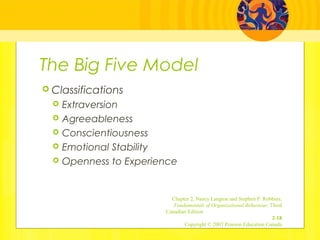
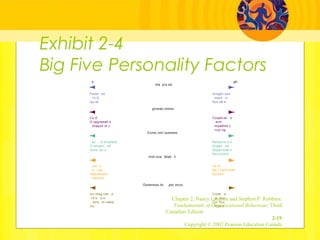
The Big Five Model
 Classifications
 Extraversion
 Agreeableness
 Conscientiousness
 Emotional Stability
 Openness to Experience
Chapter 2, Nancy Langton and Stephen P. Robbins,
Fundamentals of Organizational Behaviour, Third
Canadian Edition
2-18
Copyright © 2007 Pearson Education Canada
Exhibit 2-4
Big Five Personality Factors
Chapter 2, Nancy Langton and Stephen P. Robbins,
Fundamentals of Organizational Behaviour, Third
Canadian Edition
2-19
Copyright © 2007 Pearson Education Canada
Major Personality Attributes
Influencing OB
 Locus of Control
 Machiavellianism
 Self-Esteem
 Self-Monitoring
 Risk-Taking
 Type A Personality
 Type B Personality
 Proactive Personality
Chapter 2, Nancy Langton and Stephen P. Robbins,
Fundamentals of Organizational Behaviour, Third
Canadian Edition
2-20
Copyright © 2007 Pearson Education Canada
Locus of Control
 The degree to which people believe they
are in control of their own fate.
 Internals
 Individuals who believe that they control
what happens to them.
 Externals
 Individuals who believe that what happens to
them is controlled by outside forces such as
luck or chance.
Chapter 2, Nancy Langton and Stephen P. Robbins,
Fundamentals of Organizational Behaviour, Third
Canadian Edition
2-21
Copyright © 2007 Pearson Education Canada
Exhibit 2-5 The Effects of
Locus of Control on
Performance
Chapter 2, Nancy Langton and Stephen P. Robbins,
Fundamentals of Organizational Behaviour, Third
Canadian Edition
2-22
Copyright © 2007 Pearson Education Canada
Condition Performance
Information Processing
The work requires complex information
processing and complex learning
Internals perform better
The work is quite simple and easy to learn Internals perform better than externals
Initiative
The work requires initiative and independent
action
Internals perform better
The work requires compliance and conformity Externals perform better
Motivation
The work requires high motivation and
provides valued rewards in return for greater
effort; it offers incentive pay for greater
productivity
Internals perform better
The work does not require great effort and
contingent rewards are lacking; hourly pay
rates are determined by collective bargaining
Externals perform at least as well as
internals
Source: J. B. Miner,
Industrial-Organizational
Psychology (New York:
McGraw Hill, 1992), p. 151.
Reprinted with permission
of The McGraw-Hill
Companies.
Machiavellianism
 Degree to which an individual is
pragmatic, maintains emotional distance,
and believes that ends can justify means.
Chapter 2, Nancy Langton and Stephen P. Robbins,
Fundamentals of Organizational Behaviour, Third
Canadian Edition
2-23
Copyright © 2007 Pearson Education Canada
Self-Esteem
 Individuals’ degree of liking or disliking of
themselves.
Chapter 2, Nancy Langton and Stephen P. Robbins,
Fundamentals of Organizational Behaviour, Third
Canadian Edition
2-24
Copyright © 2007 Pearson Education Canada
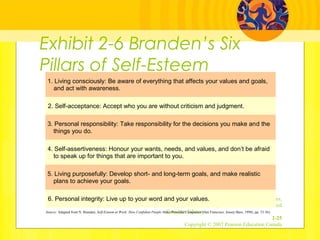
Exhibit 2-6 Branden’s Six
Pillars of Self-Esteem
Chapter 2, Nancy Langton and Stephen P. Robbins,
Fundamentals of Organizational Behaviour, Third
Canadian Edition
2-25
Copyright © 2007 Pearson Education Canada
1. Living consciously: Be aware of everything that affects your values and goals,
and act with awareness.
2. Self-acceptance: Accept who you are without criticism and judgment.
3. Personal responsibility: Take responsibility for the decisions you make and the
things you do.
4. Self-assertiveness: Honour your wants, needs, and values, and don’t be afraid
to speak up for things that are important to you.
5. Living purposefully: Develop short- and long-term goals, and make realistic
plans to achieve your goals.
6. Personal integrity: Live up to your word and your values.
Source: Adapted from N. Branden, Self-Esteem at Work: How Confident People Make Powerful Companies (San Francisco: Jossey-Bass, 1998), pp. 33-36).
Self-Monitoring
 A personality trait that measures an
individual’s ability to adjust behaviour to
external situational factors.
Chapter 2, Nancy Langton and Stephen P. Robbins,
Fundamentals of Organizational Behaviour, Third
Canadian Edition
2-26
Copyright © 2007 Pearson Education Canada
Risk-Taking
 Refers to a person’s willingness to take
chances or risks.
Chapter 2, Nancy Langton and Stephen P. Robbins,
Fundamentals of Organizational Behaviour, Third
Canadian Edition
2-27
Copyright © 2007 Pearson Education Canada
Type A Personality
 Moves, walks, and eats rapidly
 Impatient
 Multitasks
 Dislikes leisure time
 Obsessed with numbers, measures success
in terms of how many or how much of
everything is acquired
Chapter 2, Nancy Langton and Stephen P. Robbins,
Fundamentals of Organizational Behaviour, Third
Canadian Edition
2-28
Copyright © 2007 Pearson Education Canada
Type B Personality
 Never suffers from a sense of time urgency
 Doesn’t need to display or discuss
achievements or accomplishments
 Plays for fun and relaxation, not to win
 Can relax without guilt
Chapter 2, Nancy Langton and Stephen P. Robbins,
Fundamentals of Organizational Behaviour, Third
Canadian Edition
2-29
Copyright © 2007 Pearson Education Canada
Proactive Personality
 A person who identifies opportunities,
shows initiative, takes action, and
perseveres until meaningful change
occurs.
Chapter 2, Nancy Langton and Stephen P. Robbins,
Fundamentals of Organizational Behaviour, Third
Canadian Edition
2-30
Copyright © 2007 Pearson Education Canada
What Are Emotions?
 Two related terms:
 Emotions
 Intense feelings that are directed at someone
or something.
 Moods
 Feelings that tend to be less intense than
emotions and that lack a contextual stimulus.
Chapter 2, Nancy Langton and Stephen P. Robbins,
Fundamentals of Organizational Behaviour, Third
Canadian Edition
2-31
Copyright © 2007 Pearson Education Canada
Choosing Emotions: Emotional
Labour When an employee expresses
organizationally- desired emotions during
interpersonal interactions.
Chapter 2, Nancy Langton and Stephen P. Robbins,
Fundamentals of Organizational Behaviour, Third
Canadian Edition
2-32
Copyright © 2007 Pearson Education Canada
Emotional Intelligence
 Noncognitive skills, capabilities, and
competencies that influence a
person's ability to interact with others.
 Five dimensions
 Self-awareness
 Self-management
 Self-motivation
 Empathy
 Social skills
Chapter 2, Nancy Langton and Stephen P. Robbins,
Fundamentals of Organizational Behaviour, Third
Canadian Edition
2-33
Copyright © 2007 Pearson Education Canada
Negative Workplace
Emotions
 Negative emotions can lead to negative
workplace behaviours:
 Production (leaving early, intentionally
working slowly)
 Property (stealing, sabotage)
 Political (gossiping, blaming co-workers)
 Personal aggression (sexual harassment,
verbal abuse)
Chapter 2, Nancy Langton and Stephen P. Robbins,
Fundamentals of Organizational Behaviour, Third
Canadian Edition
2-34
Copyright © 2007 Pearson Education Canada
Perception Exercise
 In the new OB project team, two members obviously have
different perceptions on just about everything the team
does. Kevin sees the project one way; Kim sees it differently.
They have different perceptions about team goals,
methods, values, and the roles team members should play.
Kevin gives the impression he wants to be in charge and he
argues aggressively to get his way. Kim, who is more
reserved, offers thoughtful ideas in rebuttal, and usually
consults with the other group members for their views and
support. Privately, Kevin bad-mouths Kim to anyone who
will listen. He says that he has been on successful teams
many times and knows the best ways to operate the team.
He says that Kim is a “control freak” and “the only one on
the team holding up progress.”Kim, on the other hand, only
conveys her feelings about Kevin when team members are
present, but she has repeatedly said out loud, “There are
more ways of getting this team started than just yours! Too
bad you have a closed mind!” For the most part, the other
team members perceive Kim and Kevin to have a
“personality conflict,” and they are avoiding getting
involved. The team is ineffective so far, and there’s pressure
Chapter 2, Nancy Langton and Stephen P. Robbins,
Fundamentals of Organizational Behaviour, Third
Canadian Edition
2-35
Copyright © 2007 Pearson Education Canada
In Groups Agree on answers to the following questions, and then report back
on your group’s conclusions. Time: 30 minutes.
 What main factors may account for the different perceptions
held by Kevin and Kim?
 In each perceiver?
 In the targets?
 In the current situation?
 What are some “short cuts” each may be taking in judging the
other? Are these judgements correct?
 To what extent might the current situation be affecting the
different perceptions?
 To what extent might each person’s apparent personality be
the cause for the current conflict? Define their respective
personalities.
 If behaviour such as this happens often, how can perceptions
be changed to that people in conflict like Kevin and Kim can
reach consensus? List some ideas.
 Source: Larry Anderson, Sauder School of Business, UBC
Chapter 2, Nancy Langton and Stephen P. Robbins,
Fundamentals of Organizational Behaviour, Third
Canadian Edition
2-36
Copyright © 2007 Pearson Education Canada

perception

  • 1.
    Unit 2 • Perception-Nature& Importance of Perception, Sub- processes of Perception • Factors influencing Perception at workplace • Attribution- Attribution theory • Impression Management-the process of Impression management • Employee impression management strategies • Role of Attitudes • Values • Personality • Emotions in determining work behavior
  • 2.
    Chapter Outline  PerceptionDefined  Factors Influencing Perception  Perceptual Errors  Why Do Perception and Judgment Matter?  Personality  Emotions Chapter 2, Nancy Langton and Stephen P. Robbins, Fundamentals of Organizational Behaviour, Third Canadian Edition 2-2 Copyright © 2007 Pearson Education Canada
  • 3.
    Perception, Personality, andEmotions 1. What is perception? 2. What causes people to have different perceptions of the same situation? 3. Can people be mistaken in their perceptions? 4. Does perception really affect outcomes? 5. What is personality and how does it affect behaviour? 6. Can emotions help or get in the way when dealing with others? Chapter 2, Nancy Langton and Stephen P. Robbins, Fundamentals of Organizational Behaviour, Third Canadian Edition 2-3 Copyright © 2007 Pearson Education Canada
  • 4.
     Describe asituation in which your perception turned out to be wrong. What perceptual errors did you make that might have caused this to happen? Chapter 2, Nancy Langton and Stephen P. Robbins, Fundamentals of Organizational Behaviour, Third Canadian Edition 2-4 Copyright © 2007 Pearson Education Canada
  • 5.
    Perception  What IsPerception?  The process by which individuals organize and interpret their impressions in order to give meaning to their environment.  Why Is It Important?  Because people’s behaviour is based on their perception of what reality is, not on reality itself.  The world as it is perceived is the world that is behaviourally important. Chapter 2, Nancy Langton and Stephen P. Robbins, Fundamentals of Organizational Behaviour, Third Canadian Edition 2-5 Copyright © 2007 Pearson Education Canada
  • 6.
    Why We StudyPerceptions  To better understand how people make attributions about events.  We don’t see reality. We interpret what we see and call it reality.  The attribution process guides our behaviour, regardless of the truth of the attribution. Chapter 2, Nancy Langton and Stephen P. Robbins, Fundamentals of Organizational Behaviour, Third Canadian Edition 2-6 Copyright © 2007 Pearson Education Canada
  • 7.
    Factors Influencing Perception The Perceiver  The Target  The Situation Chapter 2, Nancy Langton and Stephen P. Robbins, Fundamentals of Organizational Behaviour, Third Canadian Edition 2-7 Copyright © 2007 Pearson Education Canada
  • 8.
    Exhibit 2-1 Factorsthat Influence Perception Chapter 2, Nancy Langton and Stephen P. Robbins, Fundamentals of Organizational Behaviour, Third Canadian Edition 2-8 Copyright © 2007 Pearson Education Canada Perception The Target • Novelty • Motion • Sounds • Size • Background • Proximity The Perceiver • Attitudes • Motives • Interests • Experience • Expectations The Situation • Time • Work setting • Social setting
  • 9.
    Perceptual Errors  AttributionTheory  Selective Perception  Halo Effect  Contrast Effects  Projection  Stereotyping Chapter 2, Nancy Langton and Stephen P. Robbins, Fundamentals of Organizational Behaviour, Third Canadian Edition 2-9 Copyright © 2007 Pearson Education Canada
  • 10.
    Attribution Theory  Whenindividuals observe behaviour, they attempt to determine whether it is internally or externally caused.  Distinctiveness  Does the individual act the same way in other situations?  Consensus  Does the individual act the same as others in same situation?  Consistency  Does the individual act the same way over time? Chapter 2, Nancy Langton and Stephen P. Robbins, Fundamentals of Organizational Behaviour, Third Canadian Edition 2-10 Copyright © 2007 Pearson Education Canada
  • 11.
    Attribution Theory  FundamentalAttribution Error  The tendency to underestimate external factors and overestimate internal factors when making judgments about others’ behaviour.  Self-Serving Bias  The tendency to attribute one’s successes to internal factors while putting the blame for failures on external factors. Chapter 2, Nancy Langton and Stephen P. Robbins, Fundamentals of Organizational Behaviour, Third Canadian Edition 2-11 Copyright © 2007 Pearson Education Canada
  • 12.
    Exhibit 2-2 AttributionTheory Chapter 2, Nancy Langton and Stephen P. Robbins, Fundamentals of Organizational Behaviour, Third Canadian Edition 2-12 Copyright © 2007 Pearson Education Canada Observation Interpretation Attribution of cause External High (Seldom) Low (Frequently) High Low (Seldom) High (Frequently) Low (Seldom) Internal rnal Individual behaviour Distinctiveness (How often does the person do this in other situations?) Consensus (How often do other people do this in similar situations?) Consistency (How often did the person do this in the past?) External Internal Internal External (Frequently )
  • 13.
    Perceptual Errors  SelectivePerception  People selectively interpret what they see based on their interests, background, experience, and attitudes.  Halo Effect  Drawing a general impression about an individual based on a single characteristic.  Contrast Effects  A person’s evaluation is affected by comparisons with other individuals recently encountered. Chapter 2, Nancy Langton and Stephen P. Robbins, Fundamentals of Organizational Behaviour, Third Canadian Edition 2-13 Copyright © 2007 Pearson Education Canada
  • 14.
    Perceptual Errors Projection Attributing one’s own characteristics to other people.  Stereotyping  Judging someone on the basis of your perception of the group to which that person belongs. Chapter 2, Nancy Langton and Stephen P. Robbins, Fundamentals of Organizational Behaviour, Third Canadian Edition 2-14 Copyright © 2007 Pearson Education Canada
  • 15.
    Why Do Perceptionsand Judgment Matter?  Self-Fulfilling Prophecy  A concept that proposes a person will behave in ways consistent with how he or she is perceived by others. Chapter 2, Nancy Langton and Stephen P. Robbins, Fundamentals of Organizational Behaviour, Third Canadian Edition 2-15 Copyright © 2007 Pearson Education Canada
  • 16.
    PersonalityThe sum totalof ways in which an individual reacts and interacts with others.  Personality Determinants  Heredity  Environmental Factors  Situational Conditions  Personality Traits  Enduring characteristics that describe an individual’s behaviour.  The Myers-Briggs Type Indicator (MBTI)  The Big Five Model Chapter 2, Nancy Langton and Stephen P. Robbins, Fundamentals of Organizational Behaviour, Third Canadian Edition 2-16 Copyright © 2007 Pearson Education Canada
  • 17.
    Myers-Briggs Type Indicator Personality test to determine how people usually act or feel in particular situations.  Classifications:  Extroverted (E) or Introverted (I)  Sensing (S) or Intuitive (N)  Thinking (T) or Feeling (F)  Perceiving (P) or Judging (J)  Combined to form types, for example:  ESTP  INTJ Chapter 2, Nancy Langton and Stephen P. Robbins, Fundamentals of Organizational Behaviour, Third Canadian Edition 2-17 Copyright © 2007 Pearson Education Canada
  • 18.
    The Big FiveModel  Classifications  Extraversion  Agreeableness  Conscientiousness  Emotional Stability  Openness to Experience Chapter 2, Nancy Langton and Stephen P. Robbins, Fundamentals of Organizational Behaviour, Third Canadian Edition 2-18 Copyright © 2007 Pearson Education Canada
  • 19.
    Exhibit 2-4 Big FivePersonality Factors Chapter 2, Nancy Langton and Stephen P. Robbins, Fundamentals of Organizational Behaviour, Third Canadian Edition 2-19 Copyright © 2007 Pearson Education Canada
  • 20.
    Major Personality Attributes InfluencingOB  Locus of Control  Machiavellianism  Self-Esteem  Self-Monitoring  Risk-Taking  Type A Personality  Type B Personality  Proactive Personality Chapter 2, Nancy Langton and Stephen P. Robbins, Fundamentals of Organizational Behaviour, Third Canadian Edition 2-20 Copyright © 2007 Pearson Education Canada
  • 21.
    Locus of Control The degree to which people believe they are in control of their own fate.  Internals  Individuals who believe that they control what happens to them.  Externals  Individuals who believe that what happens to them is controlled by outside forces such as luck or chance. Chapter 2, Nancy Langton and Stephen P. Robbins, Fundamentals of Organizational Behaviour, Third Canadian Edition 2-21 Copyright © 2007 Pearson Education Canada
  • 22.
    Exhibit 2-5 TheEffects of Locus of Control on Performance Chapter 2, Nancy Langton and Stephen P. Robbins, Fundamentals of Organizational Behaviour, Third Canadian Edition 2-22 Copyright © 2007 Pearson Education Canada Condition Performance Information Processing The work requires complex information processing and complex learning Internals perform better The work is quite simple and easy to learn Internals perform better than externals Initiative The work requires initiative and independent action Internals perform better The work requires compliance and conformity Externals perform better Motivation The work requires high motivation and provides valued rewards in return for greater effort; it offers incentive pay for greater productivity Internals perform better The work does not require great effort and contingent rewards are lacking; hourly pay rates are determined by collective bargaining Externals perform at least as well as internals Source: J. B. Miner, Industrial-Organizational Psychology (New York: McGraw Hill, 1992), p. 151. Reprinted with permission of The McGraw-Hill Companies.
  • 23.
    Machiavellianism  Degree towhich an individual is pragmatic, maintains emotional distance, and believes that ends can justify means. Chapter 2, Nancy Langton and Stephen P. Robbins, Fundamentals of Organizational Behaviour, Third Canadian Edition 2-23 Copyright © 2007 Pearson Education Canada
  • 24.
    Self-Esteem  Individuals’ degreeof liking or disliking of themselves. Chapter 2, Nancy Langton and Stephen P. Robbins, Fundamentals of Organizational Behaviour, Third Canadian Edition 2-24 Copyright © 2007 Pearson Education Canada
  • 25.
    Exhibit 2-6 Branden’sSix Pillars of Self-Esteem Chapter 2, Nancy Langton and Stephen P. Robbins, Fundamentals of Organizational Behaviour, Third Canadian Edition 2-25 Copyright © 2007 Pearson Education Canada 1. Living consciously: Be aware of everything that affects your values and goals, and act with awareness. 2. Self-acceptance: Accept who you are without criticism and judgment. 3. Personal responsibility: Take responsibility for the decisions you make and the things you do. 4. Self-assertiveness: Honour your wants, needs, and values, and don’t be afraid to speak up for things that are important to you. 5. Living purposefully: Develop short- and long-term goals, and make realistic plans to achieve your goals. 6. Personal integrity: Live up to your word and your values. Source: Adapted from N. Branden, Self-Esteem at Work: How Confident People Make Powerful Companies (San Francisco: Jossey-Bass, 1998), pp. 33-36).
  • 26.
    Self-Monitoring  A personalitytrait that measures an individual’s ability to adjust behaviour to external situational factors. Chapter 2, Nancy Langton and Stephen P. Robbins, Fundamentals of Organizational Behaviour, Third Canadian Edition 2-26 Copyright © 2007 Pearson Education Canada
  • 27.
    Risk-Taking  Refers toa person’s willingness to take chances or risks. Chapter 2, Nancy Langton and Stephen P. Robbins, Fundamentals of Organizational Behaviour, Third Canadian Edition 2-27 Copyright © 2007 Pearson Education Canada
  • 28.
    Type A Personality Moves, walks, and eats rapidly  Impatient  Multitasks  Dislikes leisure time  Obsessed with numbers, measures success in terms of how many or how much of everything is acquired Chapter 2, Nancy Langton and Stephen P. Robbins, Fundamentals of Organizational Behaviour, Third Canadian Edition 2-28 Copyright © 2007 Pearson Education Canada
  • 29.
    Type B Personality Never suffers from a sense of time urgency  Doesn’t need to display or discuss achievements or accomplishments  Plays for fun and relaxation, not to win  Can relax without guilt Chapter 2, Nancy Langton and Stephen P. Robbins, Fundamentals of Organizational Behaviour, Third Canadian Edition 2-29 Copyright © 2007 Pearson Education Canada
  • 30.
    Proactive Personality  Aperson who identifies opportunities, shows initiative, takes action, and perseveres until meaningful change occurs. Chapter 2, Nancy Langton and Stephen P. Robbins, Fundamentals of Organizational Behaviour, Third Canadian Edition 2-30 Copyright © 2007 Pearson Education Canada
  • 31.
    What Are Emotions? Two related terms:  Emotions  Intense feelings that are directed at someone or something.  Moods  Feelings that tend to be less intense than emotions and that lack a contextual stimulus. Chapter 2, Nancy Langton and Stephen P. Robbins, Fundamentals of Organizational Behaviour, Third Canadian Edition 2-31 Copyright © 2007 Pearson Education Canada
  • 32.
    Choosing Emotions: Emotional LabourWhen an employee expresses organizationally- desired emotions during interpersonal interactions. Chapter 2, Nancy Langton and Stephen P. Robbins, Fundamentals of Organizational Behaviour, Third Canadian Edition 2-32 Copyright © 2007 Pearson Education Canada
  • 33.
    Emotional Intelligence  Noncognitiveskills, capabilities, and competencies that influence a person's ability to interact with others.  Five dimensions  Self-awareness  Self-management  Self-motivation  Empathy  Social skills Chapter 2, Nancy Langton and Stephen P. Robbins, Fundamentals of Organizational Behaviour, Third Canadian Edition 2-33 Copyright © 2007 Pearson Education Canada
  • 34.
    Negative Workplace Emotions  Negativeemotions can lead to negative workplace behaviours:  Production (leaving early, intentionally working slowly)  Property (stealing, sabotage)  Political (gossiping, blaming co-workers)  Personal aggression (sexual harassment, verbal abuse) Chapter 2, Nancy Langton and Stephen P. Robbins, Fundamentals of Organizational Behaviour, Third Canadian Edition 2-34 Copyright © 2007 Pearson Education Canada
  • 35.
    Perception Exercise  Inthe new OB project team, two members obviously have different perceptions on just about everything the team does. Kevin sees the project one way; Kim sees it differently. They have different perceptions about team goals, methods, values, and the roles team members should play. Kevin gives the impression he wants to be in charge and he argues aggressively to get his way. Kim, who is more reserved, offers thoughtful ideas in rebuttal, and usually consults with the other group members for their views and support. Privately, Kevin bad-mouths Kim to anyone who will listen. He says that he has been on successful teams many times and knows the best ways to operate the team. He says that Kim is a “control freak” and “the only one on the team holding up progress.”Kim, on the other hand, only conveys her feelings about Kevin when team members are present, but she has repeatedly said out loud, “There are more ways of getting this team started than just yours! Too bad you have a closed mind!” For the most part, the other team members perceive Kim and Kevin to have a “personality conflict,” and they are avoiding getting involved. The team is ineffective so far, and there’s pressure Chapter 2, Nancy Langton and Stephen P. Robbins, Fundamentals of Organizational Behaviour, Third Canadian Edition 2-35 Copyright © 2007 Pearson Education Canada
  • 36.
    In Groups Agreeon answers to the following questions, and then report back on your group’s conclusions. Time: 30 minutes.  What main factors may account for the different perceptions held by Kevin and Kim?  In each perceiver?  In the targets?  In the current situation?  What are some “short cuts” each may be taking in judging the other? Are these judgements correct?  To what extent might the current situation be affecting the different perceptions?  To what extent might each person’s apparent personality be the cause for the current conflict? Define their respective personalities.  If behaviour such as this happens often, how can perceptions be changed to that people in conflict like Kevin and Kim can reach consensus? List some ideas.  Source: Larry Anderson, Sauder School of Business, UBC Chapter 2, Nancy Langton and Stephen P. Robbins, Fundamentals of Organizational Behaviour, Third Canadian Edition 2-36 Copyright © 2007 Pearson Education Canada