Obj. 25 Properties of Polygons
The student is able to (I can):
• Name polygons based on their number of sides
• Classify polygons based on
— concave or convex
— equilateral, equiangular, regular
• Calculate and use the measures of interior and exterior
angles of polygons
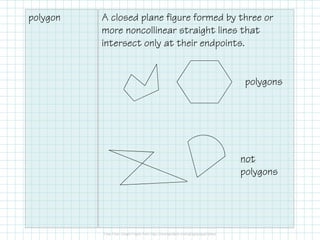
polygon

A closed plane figure formed by three or
more noncollinear straight lines that
intersect only at their endpoints.

polygons

not
polygons
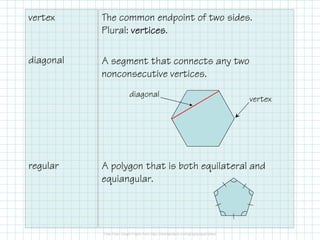
vertex

The common endpoint of two sides.
Plural: vertices
vertices.

diagonal

A segment that connects any two
nonconsecutive vertices.
diagonal

regular

vertex

A polygon that is both equilateral and
equiangular.
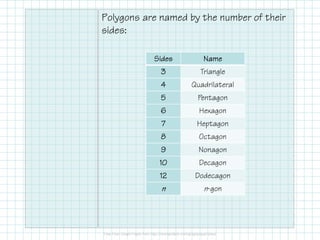
Polygons are named by the number of their
sides:
Sides

Name

3

Triangle

4

Quadrilateral

5

Pentagon

6

Hexagon

7

Heptagon

8

Octagon

9

Nonagon

10

Decagon

12

Dodecagon

n

n-gon
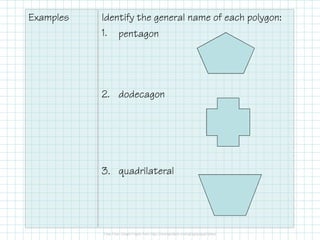
Examples

Identify the general name of each polygon:
1. pentagon

2. dodecagon

3. quadrilateral
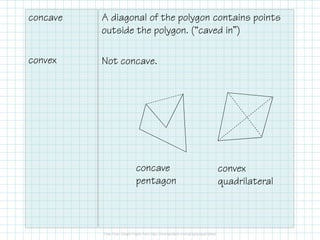
concave

A diagonal of the polygon contains points
outside the polygon. (“caved in”)

convex

Not concave.

concave
pentagon

convex
quadrilateral
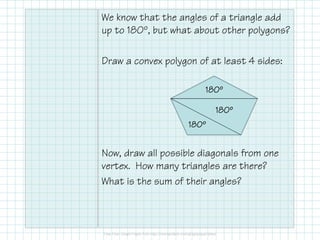
We know that the angles of a triangle add
up to 180º, but what about other polygons?
Draw a convex polygon of at least 4 sides:
180º
180º
180º

Now, draw all possible diagonals from one
vertex. How many triangles are there?
What is the sum of their angles?
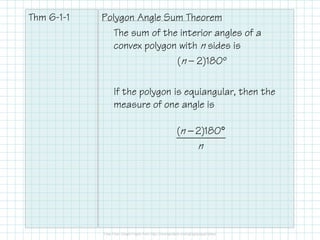
Thm 6-1-1

Polygon Angle Sum Theorem
The sum of the interior angles of a
convex polygon with n sides is
(n — 2)180º
If the polygon is equiangular, then the
measure of one angle is
(n − 2)180°

n
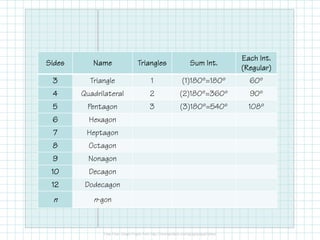
Sides

Name

Triangles

Sum Int.

Each Int.
(Regular)

3

Triangle

1

(1)180º=180º

60º

4

Quadrilateral

2

(2)180º=360º

90º

5

Pentagon

3

(3)180º=540º

108º

6

Hexagon

7

Heptagon

8

Octagon

9

Nonagon

10

Decagon

12

Dodecagon

n

n-gon
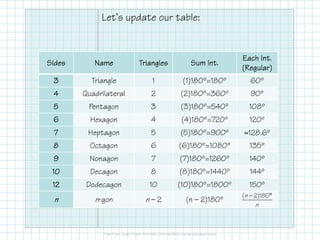
Let’s update our table:

Sides

Name

Triangles

Sum Int.

Each Int.
(Regular)

3

Triangle

1

(1)180º=180º

60º

4

Quadrilateral

2

(2)180º=360º

90º

5

Pentagon

3

(3)180º=540º

108º

6

Hexagon

4

(4)180º=720º

120º

7

Heptagon

5

(5)180º=900º

≈128.6º

8

Octagon

6

(6)180º=1080º

135º

9

Nonagon

7

(7)180º=1260º

140º

10

Decagon

8

(8)180º=1440º

144º

12

Dodecagon

10

(10)180º=1800º

150º

n

n-gon

n—2

(n — 2)180º

(n − 2)180°

n
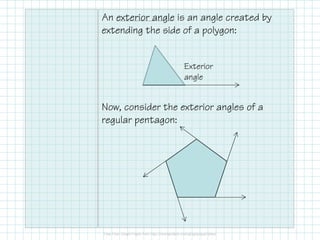
An exterior angle is an angle created by
extending the side of a polygon:
Exterior
angle

Now, consider the exterior angles of a
regular pentagon:
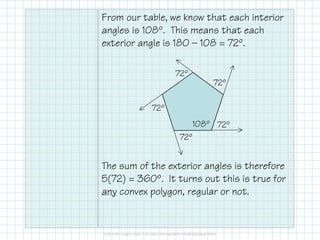
From our table, we know that each interior
angles is 108º. This means that each
exterior angle is 180 — 108 = 72º.
72º
72º
72º
108º 72º
72º

The sum of the exterior angles is therefore
5(72) = 360º. It turns out this is true for
any convex polygon, regular or not.
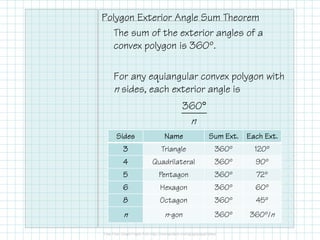
Polygon Exterior Angle Sum Theorem
The sum of the exterior angles of a
convex polygon is 360º.
For any equiangular convex polygon with
n sides, each exterior angle is
360°

n
Sides

Name

Sum Ext.

Each Ext.

3

Triangle

360º

120º

4

Quadrilateral

360º

90º

5

Pentagon

360º

72º

6

Hexagon

360º

60º

8

Octagon

360º

45º

n

n-gon

360º

360º/n

Obj. 25 Properties of Polygons

  • 1.
    Obj. 25 Propertiesof Polygons The student is able to (I can): • Name polygons based on their number of sides • Classify polygons based on — concave or convex — equilateral, equiangular, regular • Calculate and use the measures of interior and exterior angles of polygons
  • 2.
    polygon A closed planefigure formed by three or more noncollinear straight lines that intersect only at their endpoints. polygons not polygons
  • 3.
    vertex The common endpointof two sides. Plural: vertices vertices. diagonal A segment that connects any two nonconsecutive vertices. diagonal regular vertex A polygon that is both equilateral and equiangular.
  • 4.
    Polygons are namedby the number of their sides: Sides Name 3 Triangle 4 Quadrilateral 5 Pentagon 6 Hexagon 7 Heptagon 8 Octagon 9 Nonagon 10 Decagon 12 Dodecagon n n-gon
  • 5.
    Examples Identify the generalname of each polygon: 1. pentagon 2. dodecagon 3. quadrilateral
  • 6.
    concave A diagonal ofthe polygon contains points outside the polygon. (“caved in”) convex Not concave. concave pentagon convex quadrilateral
  • 7.
    We know thatthe angles of a triangle add up to 180º, but what about other polygons? Draw a convex polygon of at least 4 sides: 180º 180º 180º Now, draw all possible diagonals from one vertex. How many triangles are there? What is the sum of their angles?
  • 8.
    Thm 6-1-1 Polygon AngleSum Theorem The sum of the interior angles of a convex polygon with n sides is (n — 2)180º If the polygon is equiangular, then the measure of one angle is (n − 2)180° n
  • 9.
  • 10.
    Let’s update ourtable: Sides Name Triangles Sum Int. Each Int. (Regular) 3 Triangle 1 (1)180º=180º 60º 4 Quadrilateral 2 (2)180º=360º 90º 5 Pentagon 3 (3)180º=540º 108º 6 Hexagon 4 (4)180º=720º 120º 7 Heptagon 5 (5)180º=900º ≈128.6º 8 Octagon 6 (6)180º=1080º 135º 9 Nonagon 7 (7)180º=1260º 140º 10 Decagon 8 (8)180º=1440º 144º 12 Dodecagon 10 (10)180º=1800º 150º n n-gon n—2 (n — 2)180º (n − 2)180° n
  • 11.
    An exterior angleis an angle created by extending the side of a polygon: Exterior angle Now, consider the exterior angles of a regular pentagon:
  • 12.
    From our table,we know that each interior angles is 108º. This means that each exterior angle is 180 — 108 = 72º. 72º 72º 72º 108º 72º 72º The sum of the exterior angles is therefore 5(72) = 360º. It turns out this is true for any convex polygon, regular or not.
  • 13.
    Polygon Exterior AngleSum Theorem The sum of the exterior angles of a convex polygon is 360º. For any equiangular convex polygon with n sides, each exterior angle is 360° n Sides Name Sum Ext. Each Ext. 3 Triangle 360º 120º 4 Quadrilateral 360º 90º 5 Pentagon 360º 72º 6 Hexagon 360º 60º 8 Octagon 360º 45º n n-gon 360º 360º/n