Cataract
Muna Ahmed
Feb 2020
Overview
 Introduction
 Definition
 Types
 Pathophysiology
 Normal lens
 Cataract
 Presentation
 Symptoms
 Signs
 Management
 Surgery
 Complications
Introduction
Definition
 Lens opacity
 Impairs vision
 Can be unilateral or bilateral
 Major cause of blindness worldwide
Cataract in childhood
 Congenital
 Hereditary
 Maternal infection:
 Rubella
 Toxoplasmosis
 CMV
 Varicella zoster
 Syndromic
 Down’s syndrome
 Edward’s syndrome
 Patau syndrome
 Metabolic
 Galactosemia
 Wilson’s Disease
Risk factors in adults
 Old age
 Diabetes
 Eye trauma/disease
 Previous uveitis
 Radiation
 Steroid use
 Alcohol
 Smoking
 Dehydration
 Sunlight
Pathophysiology
Normal Lens
 Biconvex
 Colourless
 Transparent
 Non-vascular (aqueous humour
supplies nutrients and oxygen)
 Attached to zonular fibres
 Refracts light
 Power 18 dioptres
 Focuses light onto the
retina
 Controlled by ciliary
muscle contraction
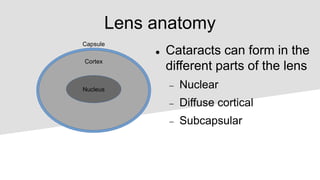
Lens anatomy
 Cataracts can form in the
different parts of the lens
 Nuclear
 Diffuse cortical
 Subcapsular
Capsule
Cortex
Nucleus
Cataract
 Pathophysiology remains unclear
 Protein denaturation by oxidation disturbs structure and
creates opacity
 Loss of osmotic balance with influx of water into the lens
also contributes
 Therefore, light is not refracted uniformly and scatters over
the retina
Partially
opaque
Totally
opaque
Wrinkled
capsule
due to lysis of the
cortex
Nucleus
drops
inferiorly
within the capsule
Immature Mature Hypermature Morgagnian
Classification
Classification by type / location
Presentation
Symptoms
 Painless vision loss
 Reduced visual acuity both near and far vision
 Reduced colour appreciation
 Reduced contrast sensitivity
 Glare
 Change in refraction
 Ghosting
 Polyplopia
 Unilocular diplopia
 Diplopia continues when one eye is covered
Signs
 Early
 Indistinct appearance
when examining
retina
 Dim red reflex
 Late
 Unable to visualise
retina
 Absent red reflex
Rare signs
 Increased IOP
 Large cataract can cause anterior bowing of the iris, causing angle closure
 Hypermature cataract can lose protein through the (intact) anterior capsule, which obstructs the
trabecular meshwork
 Both can lead to IOP and glaucoma
 Uveitis
 Traumatic capsular rupture can release lens protein, causing an inflammatory response
Management
Surgery
 Effective
 Safe
 No proven medical treatment
Indication for surgery
 Cataract is causing significant visual
impairment, compromising lifestyle
 Poor visual acuity when corrected
Principles of surgery
 Corneal section
 Paracentesis
 Capsulorhexis
 Hydrodissection
 Phacoemulsification
 Insert IOL
 Seal wound
 After-care
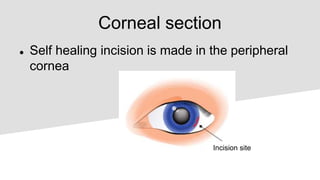
Corneal section
 Self healing incision is made in the peripheral
cornea
Incision site
Paracentesis
 Aqueous will leak out of the incision, making the
anterior chamber shallow
 Viscoelastic is injected into the anterior
chamber, restoring its normal depth
 This is done via a second smaller incision
Capsulorhexis
 An opening is formed in the central part of the anterior
lens capsule
 This gives access to the lens cortex
 By maintaining the peripheral part of the capsule, the
capsule remains attached to the zonules, and an IOL
can be placed in the empty capsule later
Hydrodissection
 A needle is inserted into the soft cortex
 Balanced salt solution (BSS) is injected
between the cortex and the capsule
 BSS is specifically made to match the osmolarity/pH of
aqueous humour
 This strips the cortex away from the capsule
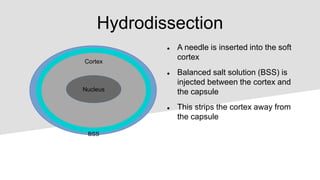
Hydrodissection
Capsule
Cortex
Nucleus
 A needle is inserted into the soft
cortex
 Balanced salt solution (BSS) is
injected between the cortex and
the capsule
 This strips the cortex away from
the capsule
BSS
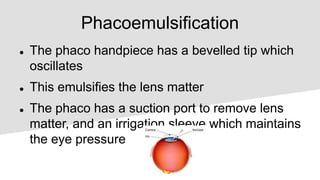
Phacoemulsification
 The phaco handpiece has a bevelled tip which
oscillates
 This emulsifies the lens matter
 The phaco has a suction port to remove lens
matter, and an irrigation sleeve which maintains
the eye pressure
Irrigation/aspiration (I/A)
 This step removes any remaining debris from
the capsule including the epinucleus (soft
continuous cortex surrounding the nucleus)
Insertion of IOL
 The correct IOL is loaded into the cartridge, and
injected into the capsule
 The IOL will unfold. Both haptics should be in
the capsule
Seal wound
 The wound is sealed by ‘stromal hydration’
 This is done by injecting BSS into the corneal
incision which causes the cornea to swell and
self-seal

After-care
 The eye is covered with gauze and a patch is applied over the eye
 Patients are advised not to rub the eye as this can impair healing
 Antibiotic eye drops are prescribed
 Watering, gritty sensation, blurred vision and red eye can be observed
 Patients are advised not to drive or fly until seen in follow-up clinic

Complications
 Corneal section may not self seal if too long
 Capsulorhexis done incorrectly can cause the tear to reach the posterior capsule
 Phacoemulsification may also cause a tear in the posterior capsule
 If the capsule is unstable, the lens can drop into the vitreous. Vitreous can enter the anterior chamber
 Posterior capsule opacification may occur, this can be treated with laser

Cataract

  • 1.
  • 2.
    Overview  Introduction  Definition Types  Pathophysiology  Normal lens  Cataract  Presentation  Symptoms  Signs  Management  Surgery  Complications
  • 3.
  • 4.
    Definition  Lens opacity Impairs vision  Can be unilateral or bilateral  Major cause of blindness worldwide
  • 6.
    Cataract in childhood Congenital  Hereditary  Maternal infection:  Rubella  Toxoplasmosis  CMV  Varicella zoster  Syndromic  Down’s syndrome  Edward’s syndrome  Patau syndrome  Metabolic  Galactosemia  Wilson’s Disease
  • 7.
    Risk factors inadults  Old age  Diabetes  Eye trauma/disease  Previous uveitis  Radiation  Steroid use  Alcohol  Smoking  Dehydration  Sunlight
  • 8.
  • 9.
    Normal Lens  Biconvex Colourless  Transparent  Non-vascular (aqueous humour supplies nutrients and oxygen)  Attached to zonular fibres  Refracts light  Power 18 dioptres  Focuses light onto the retina  Controlled by ciliary muscle contraction
  • 11.
    Lens anatomy  Cataractscan form in the different parts of the lens  Nuclear  Diffuse cortical  Subcapsular Capsule Cortex Nucleus
  • 12.
    Cataract  Pathophysiology remainsunclear  Protein denaturation by oxidation disturbs structure and creates opacity  Loss of osmotic balance with influx of water into the lens also contributes  Therefore, light is not refracted uniformly and scatters over the retina
  • 14.
    Partially opaque Totally opaque Wrinkled capsule due to lysisof the cortex Nucleus drops inferiorly within the capsule Immature Mature Hypermature Morgagnian Classification
  • 15.
  • 16.
  • 17.
    Symptoms  Painless visionloss  Reduced visual acuity both near and far vision  Reduced colour appreciation  Reduced contrast sensitivity  Glare  Change in refraction  Ghosting  Polyplopia  Unilocular diplopia  Diplopia continues when one eye is covered
  • 18.
    Signs  Early  Indistinctappearance when examining retina  Dim red reflex  Late  Unable to visualise retina  Absent red reflex
  • 19.
    Rare signs  IncreasedIOP  Large cataract can cause anterior bowing of the iris, causing angle closure  Hypermature cataract can lose protein through the (intact) anterior capsule, which obstructs the trabecular meshwork  Both can lead to IOP and glaucoma  Uveitis  Traumatic capsular rupture can release lens protein, causing an inflammatory response
  • 20.
  • 21.
    Surgery  Effective  Safe No proven medical treatment
  • 22.
    Indication for surgery Cataract is causing significant visual impairment, compromising lifestyle  Poor visual acuity when corrected
  • 23.
    Principles of surgery Corneal section  Paracentesis  Capsulorhexis  Hydrodissection  Phacoemulsification  Insert IOL  Seal wound  After-care
  • 24.
    Corneal section  Selfhealing incision is made in the peripheral cornea Incision site
  • 25.
    Paracentesis  Aqueous willleak out of the incision, making the anterior chamber shallow  Viscoelastic is injected into the anterior chamber, restoring its normal depth  This is done via a second smaller incision
  • 26.
    Capsulorhexis  An openingis formed in the central part of the anterior lens capsule  This gives access to the lens cortex  By maintaining the peripheral part of the capsule, the capsule remains attached to the zonules, and an IOL can be placed in the empty capsule later
  • 27.
    Hydrodissection  A needleis inserted into the soft cortex  Balanced salt solution (BSS) is injected between the cortex and the capsule  BSS is specifically made to match the osmolarity/pH of aqueous humour  This strips the cortex away from the capsule
  • 28.
    Hydrodissection Capsule Cortex Nucleus  A needleis inserted into the soft cortex  Balanced salt solution (BSS) is injected between the cortex and the capsule  This strips the cortex away from the capsule BSS
  • 29.
    Phacoemulsification  The phacohandpiece has a bevelled tip which oscillates  This emulsifies the lens matter  The phaco has a suction port to remove lens matter, and an irrigation sleeve which maintains the eye pressure
  • 30.
    Irrigation/aspiration (I/A)  Thisstep removes any remaining debris from the capsule including the epinucleus (soft continuous cortex surrounding the nucleus)
  • 31.
    Insertion of IOL The correct IOL is loaded into the cartridge, and injected into the capsule  The IOL will unfold. Both haptics should be in the capsule
  • 32.
    Seal wound  Thewound is sealed by ‘stromal hydration’  This is done by injecting BSS into the corneal incision which causes the cornea to swell and self-seal 
  • 33.
    After-care  The eyeis covered with gauze and a patch is applied over the eye  Patients are advised not to rub the eye as this can impair healing  Antibiotic eye drops are prescribed  Watering, gritty sensation, blurred vision and red eye can be observed  Patients are advised not to drive or fly until seen in follow-up clinic 
  • 34.
    Complications  Corneal sectionmay not self seal if too long  Capsulorhexis done incorrectly can cause the tear to reach the posterior capsule  Phacoemulsification may also cause a tear in the posterior capsule  If the capsule is unstable, the lens can drop into the vitreous. Vitreous can enter the anterior chamber  Posterior capsule opacification may occur, this can be treated with laser