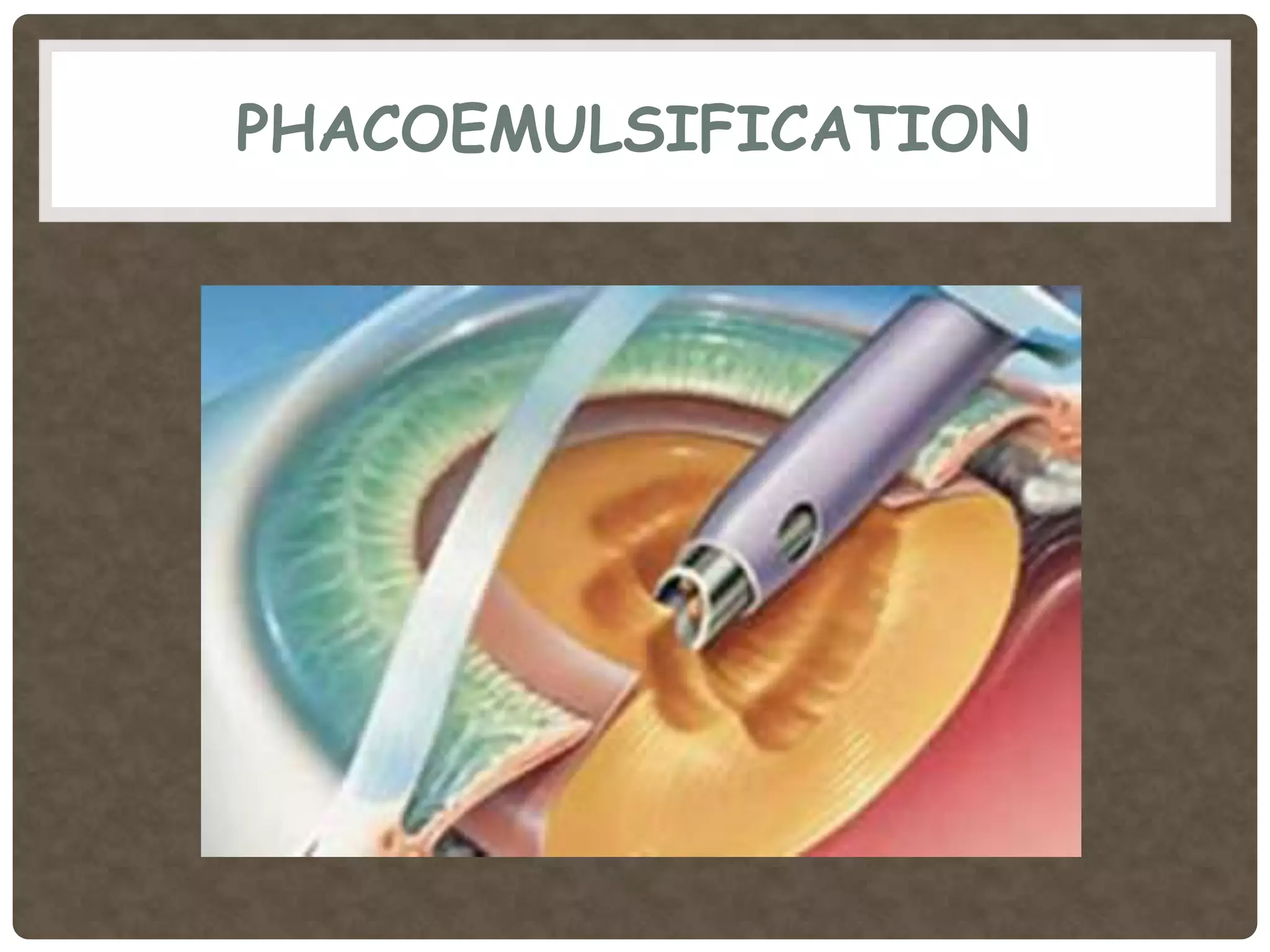
PHACOEMULSIFICATION
INTRODUCTION

It was introduced by Charles Kelman in 1967.
Small Incision which in turn reduces
    • Healing time
    • No of sutures
    • Postoperative astigmatism
    • Hemorrhagic complications
Conservation of posterior chamber, avoiding retinal detachment, maintaining
 vitreous.
Complete aspiration of cortex.
Easy implantation of IOL.
PRINCIPLES OF
           PHACOEMULSIFICATION


¤Hardness of the nucleus.
¤Red reflex of the fundus.
¤Corneal transparency.
¤Trophism of iris.
¤Chamber depth.
¤Pathologies.
ANESTHESIA


 General Anesthesia
 Local Anesthesia
 Topical Anesthesia
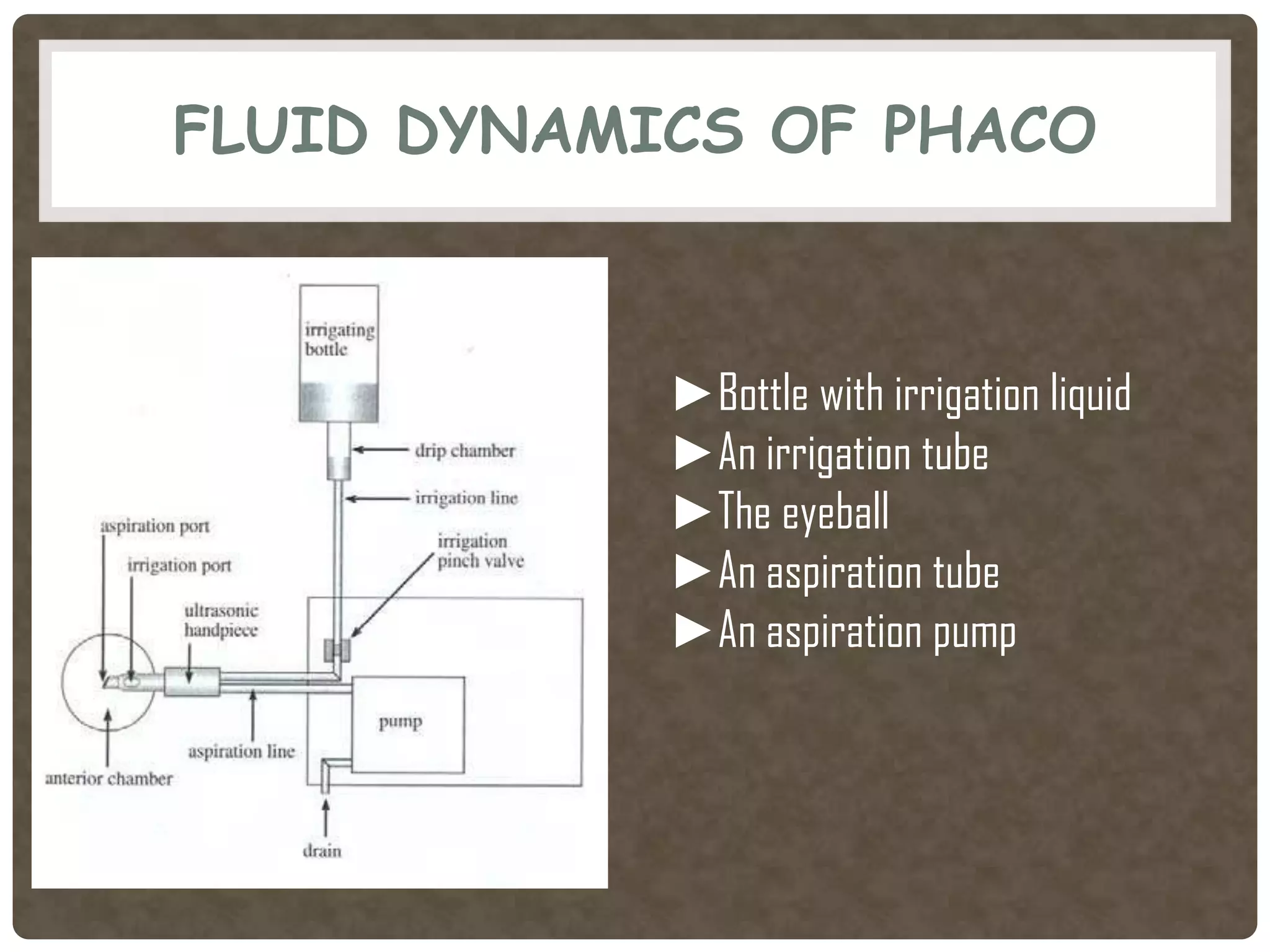
FLUID DYNAMICS OF PHACO


            ►Bottle with irrigation liquid
            ►An irrigation tube
            ►The eyeball
            ►An aspiration tube
            ►An aspiration pump
IRRIGATION/ASPIRATION

 Irrigation depends on the height of the bottle and thus gravitational
  force.
 Aspiration depends on the type of the pump

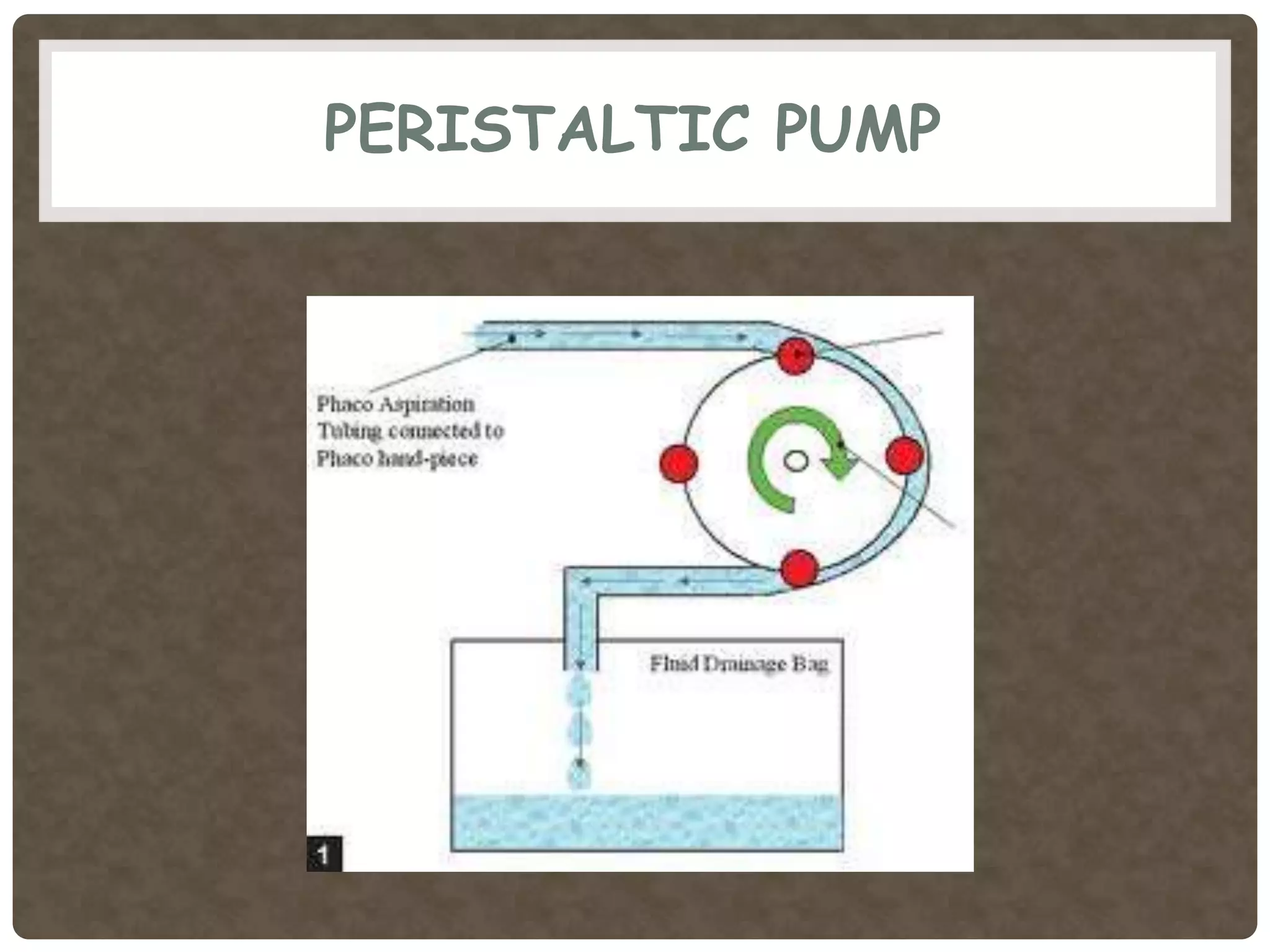
 Peristaltic.
 Venturi
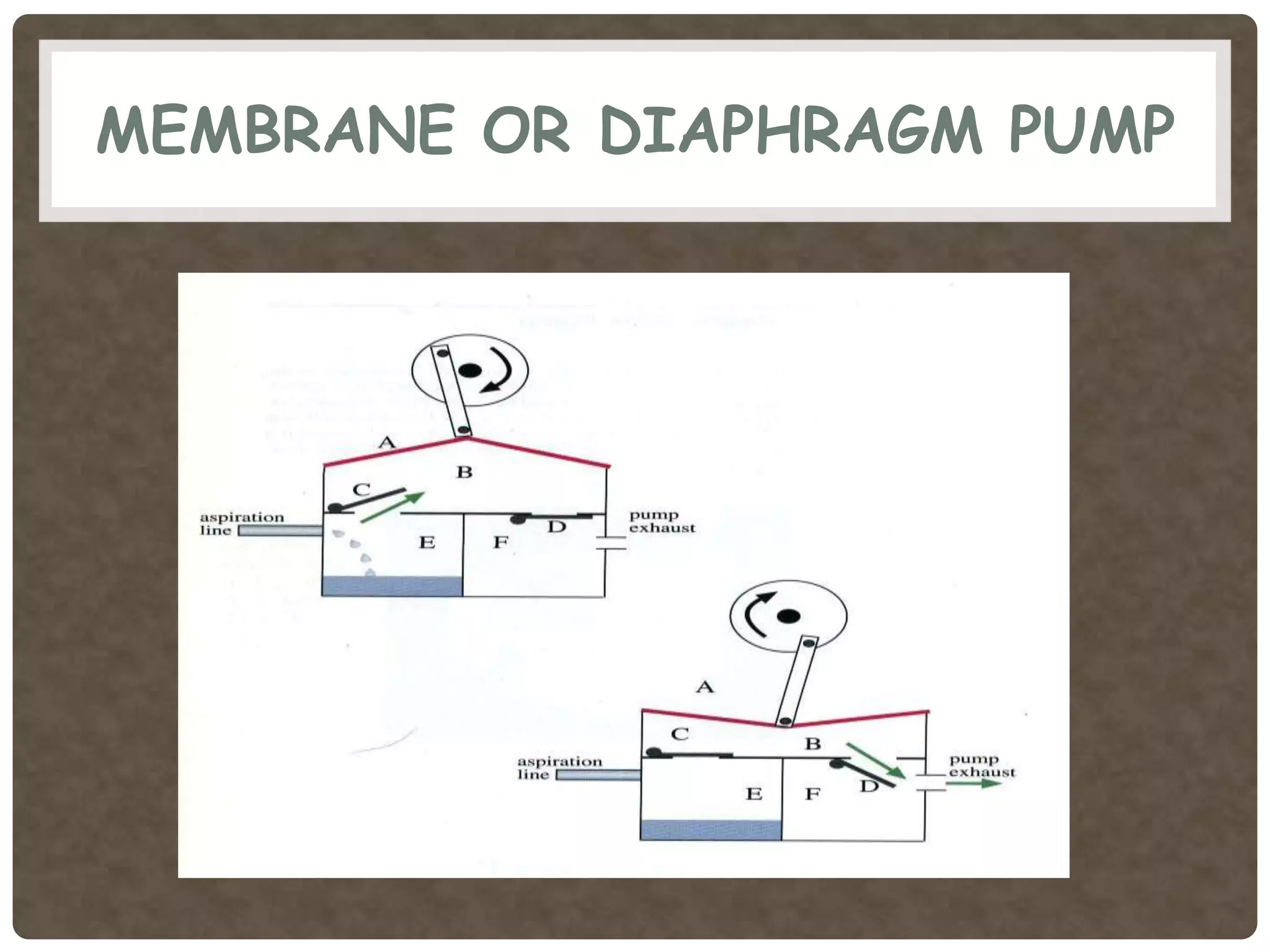
 Diaphragm.
PERISTALTIC PUMP
VENTURI PUMP
MEMBRANE OR DIAPHRAGM PUMP
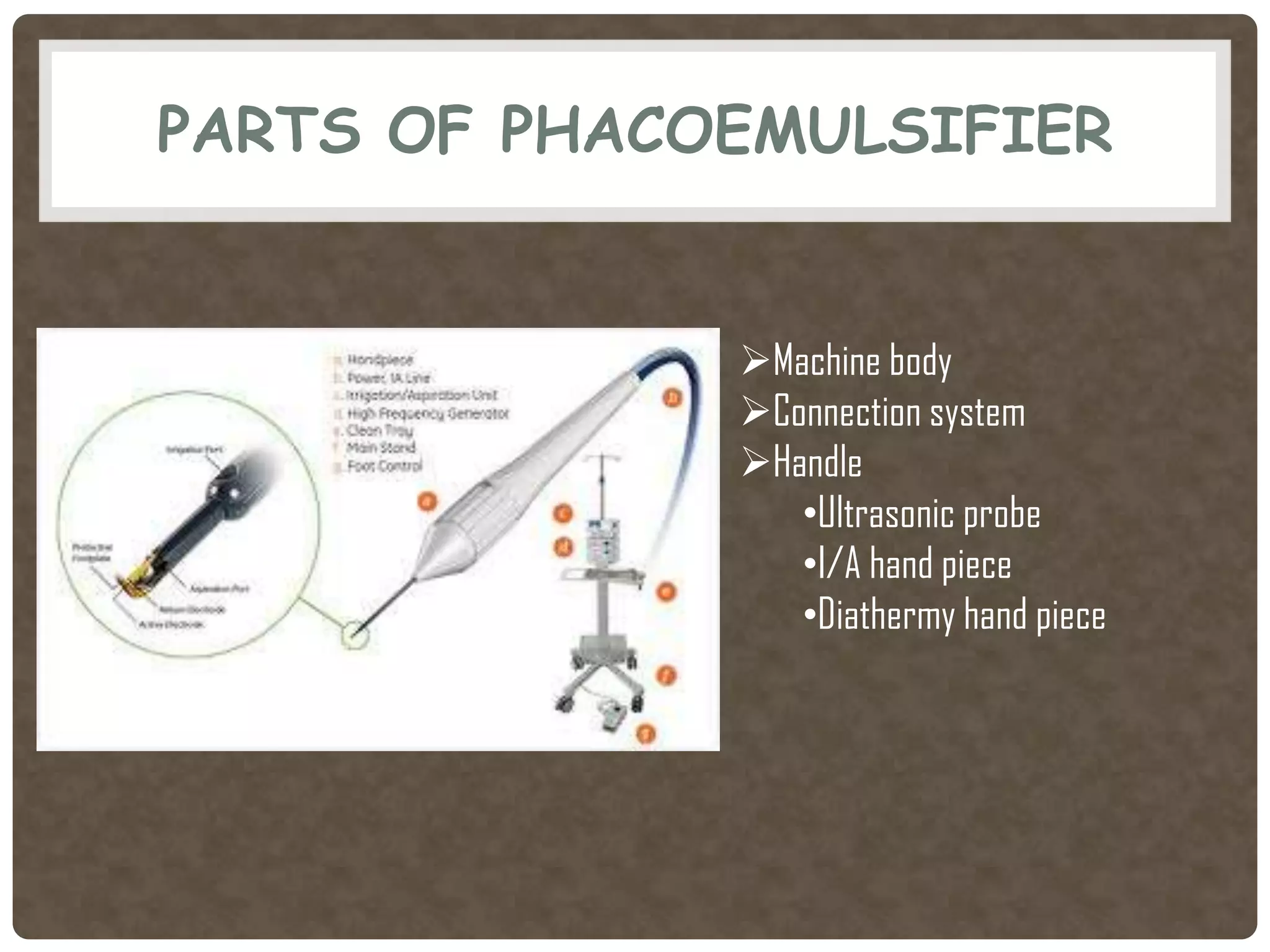
PARTS OF PHACOEMULSIFIER


              Machine body
              Connection system
              Handle
                 •Ultrasonic probe
                 •I/A hand piece
                 •Diathermy hand piece
STEPS FOR PHACOEMULSIFICATION

Incision

                Limbal
                  Easy to perform,
                  Need sutures.
                Scleral(3.5-7mm)
                Corneal (2.8-4mm)
                 (4.5-6.5)
CAPSULOTOMY

It is the process of making the incisions around the anterior capsule of
the lens.
 Can opener.
 Christmas tree.
 Postage stamp.
 Envelope.
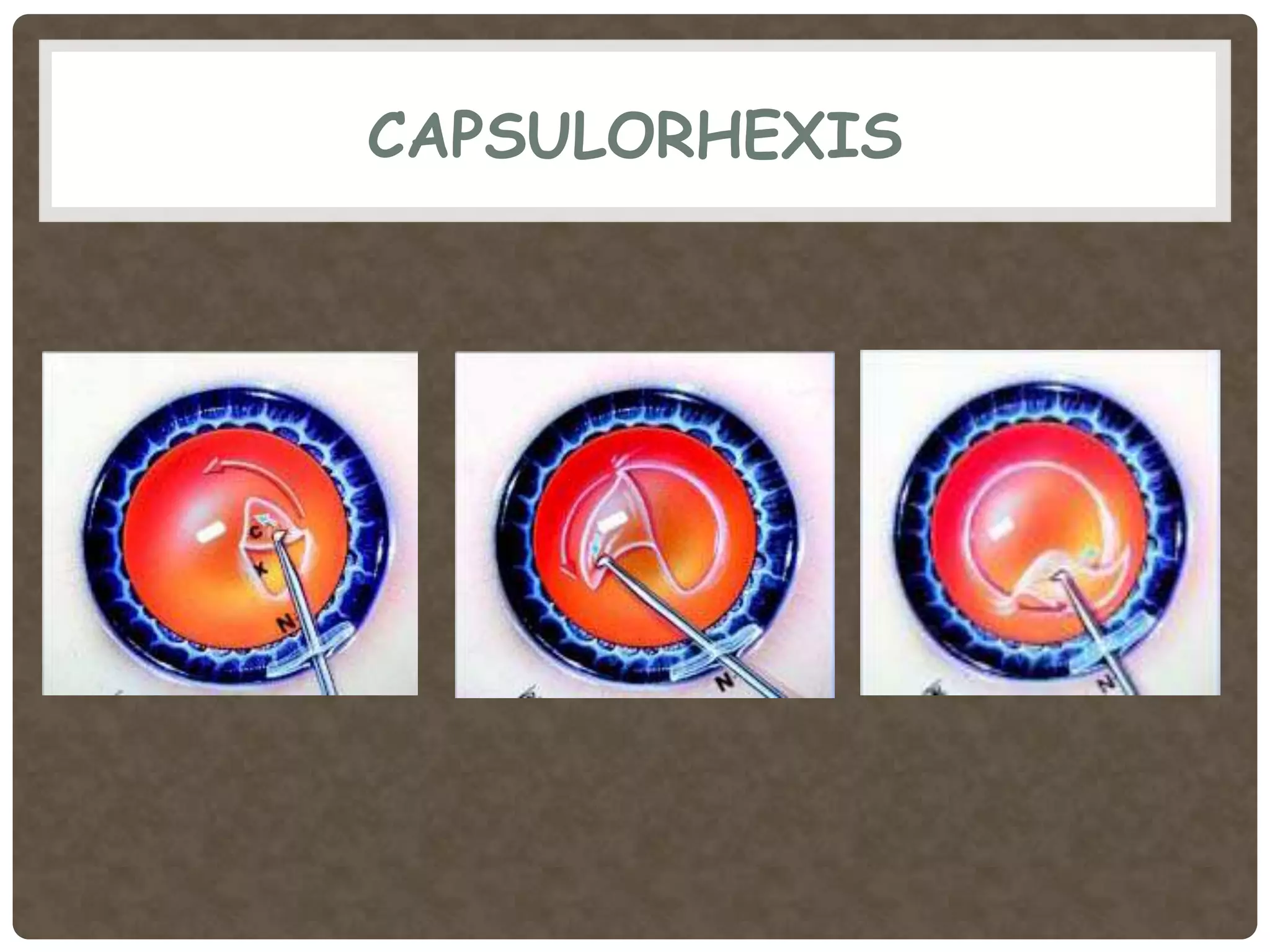
 Capsulorhexis.
CAPSULORHEXIS
HYDRODELINEATION


It is used to separate
 epinucleus and nucleus.
HYDRODISSECTION


It is used to separate
 capsulse and cortex ,
  Cortex and epi nucleus.
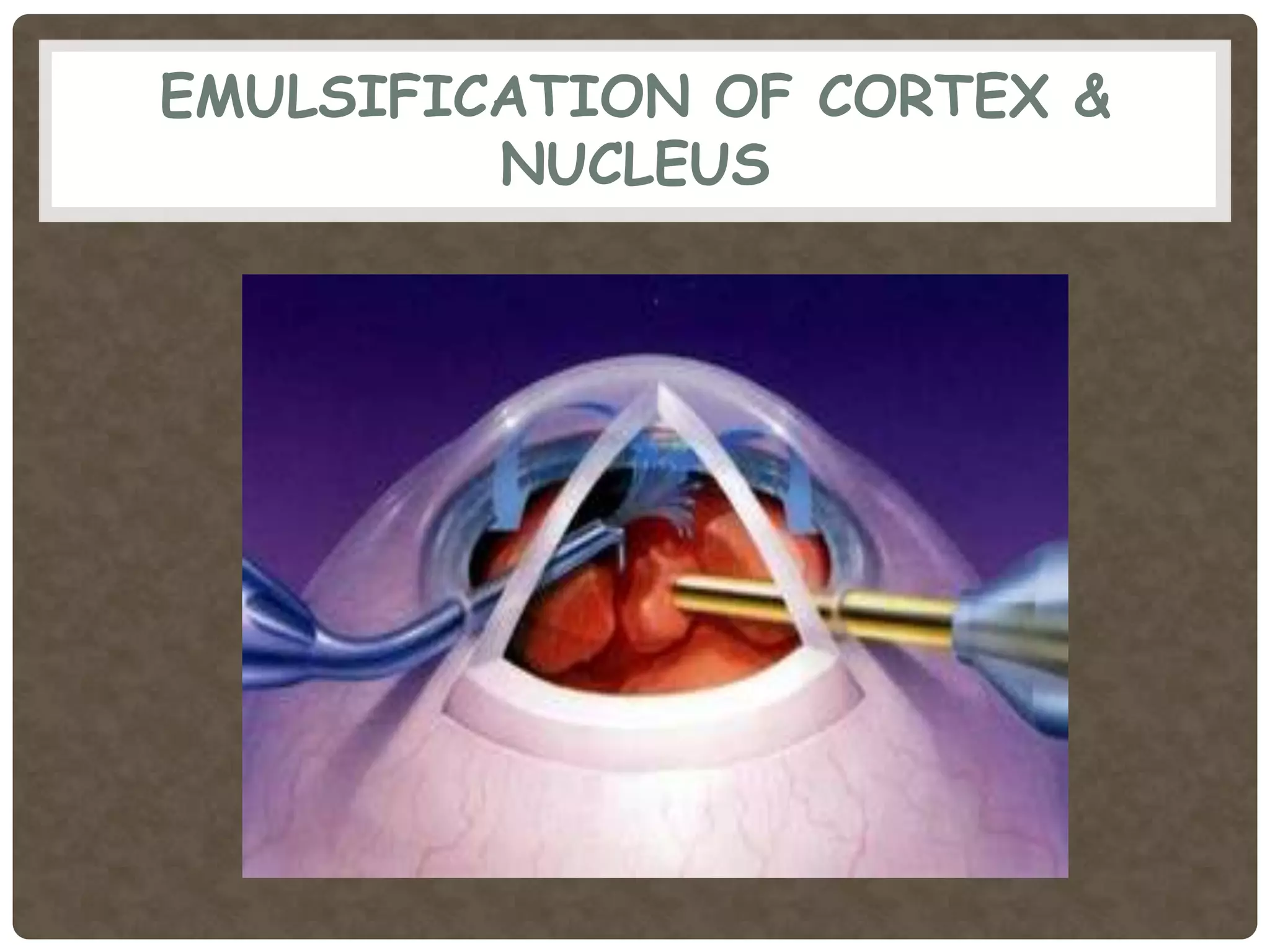
EMULSIFICATION OF CORTEX &
         NUCLEUS
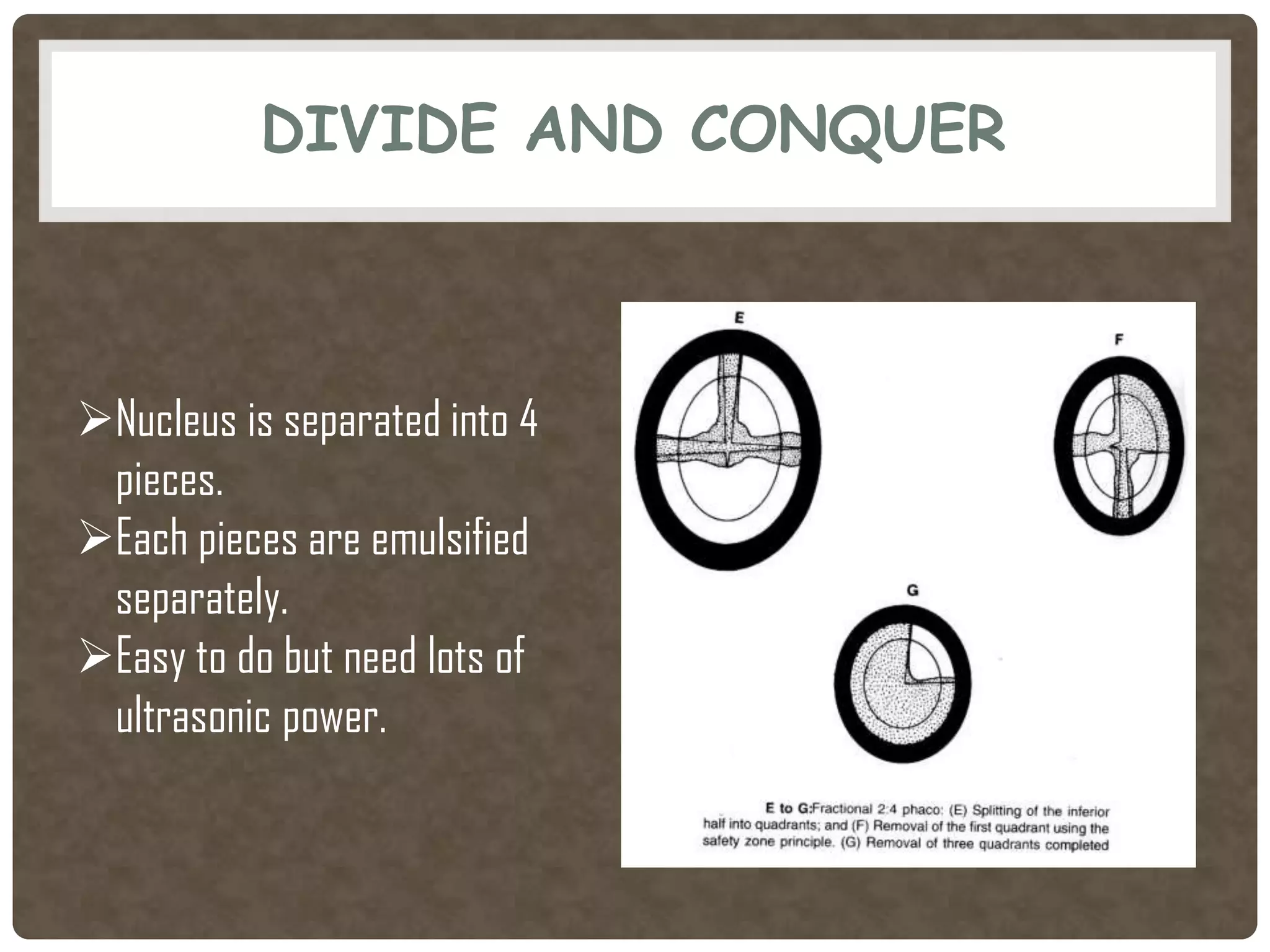
DIVIDE AND CONQUER


Nucleus is separated into 4
 pieces.
Each pieces are emulsified
 separately.
Easy to do but need lots of
 ultrasonic power.
STOP AND CHOP


Formation of groove.
Nucleus is break into two halves.
Easy to do.
Less ultrasonic power.
Need two hands.
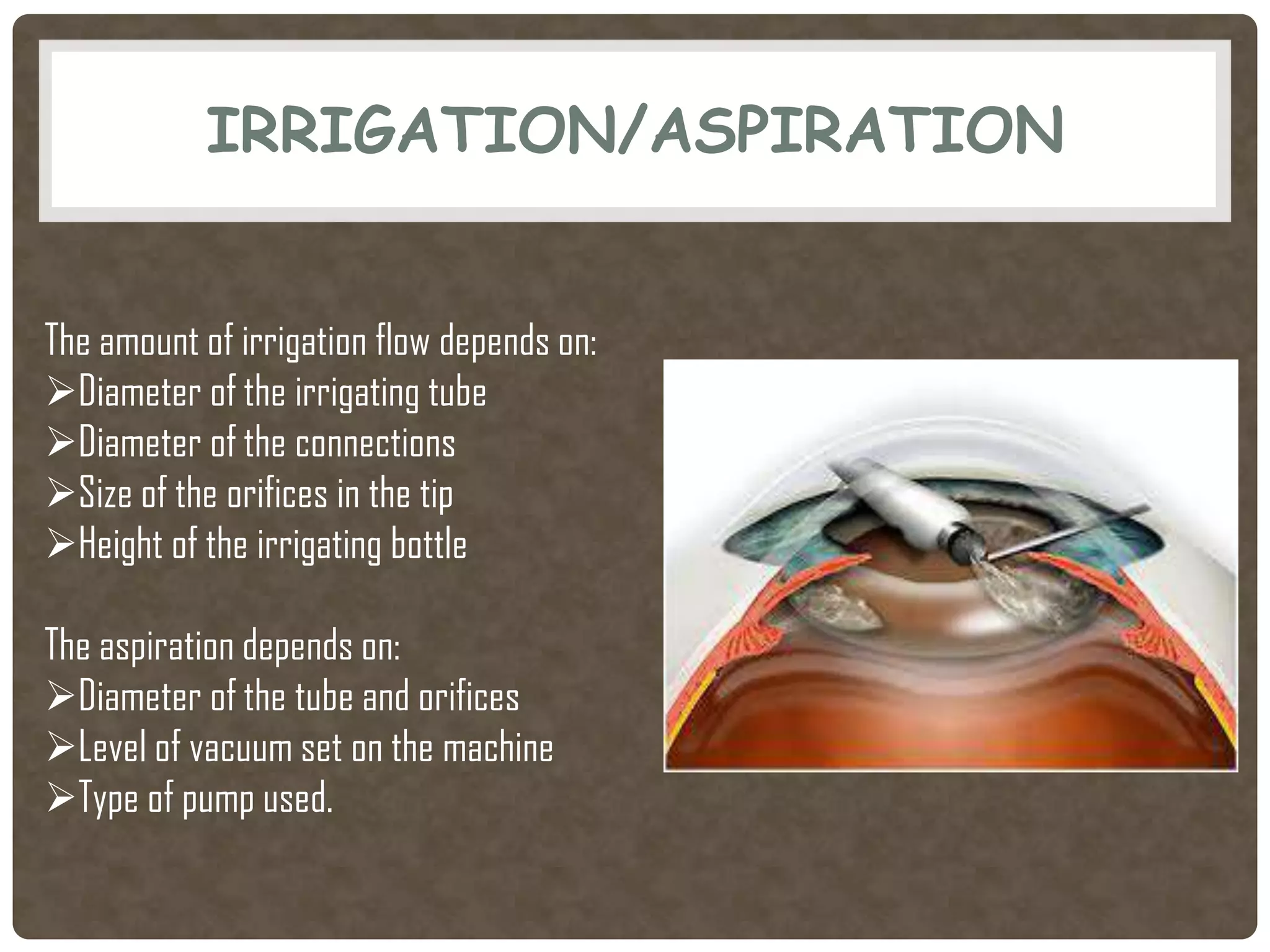
IRRIGATION/ASPIRATION


The amount of irrigation flow depends on:
Diameter of the irrigating tube
Diameter of the connections
Size of the orifices in the tip
Height of the irrigating bottle

The aspiration depends on:
Diameter of the tube and orifices
Level of vacuum set on the machine
Type of pump used.
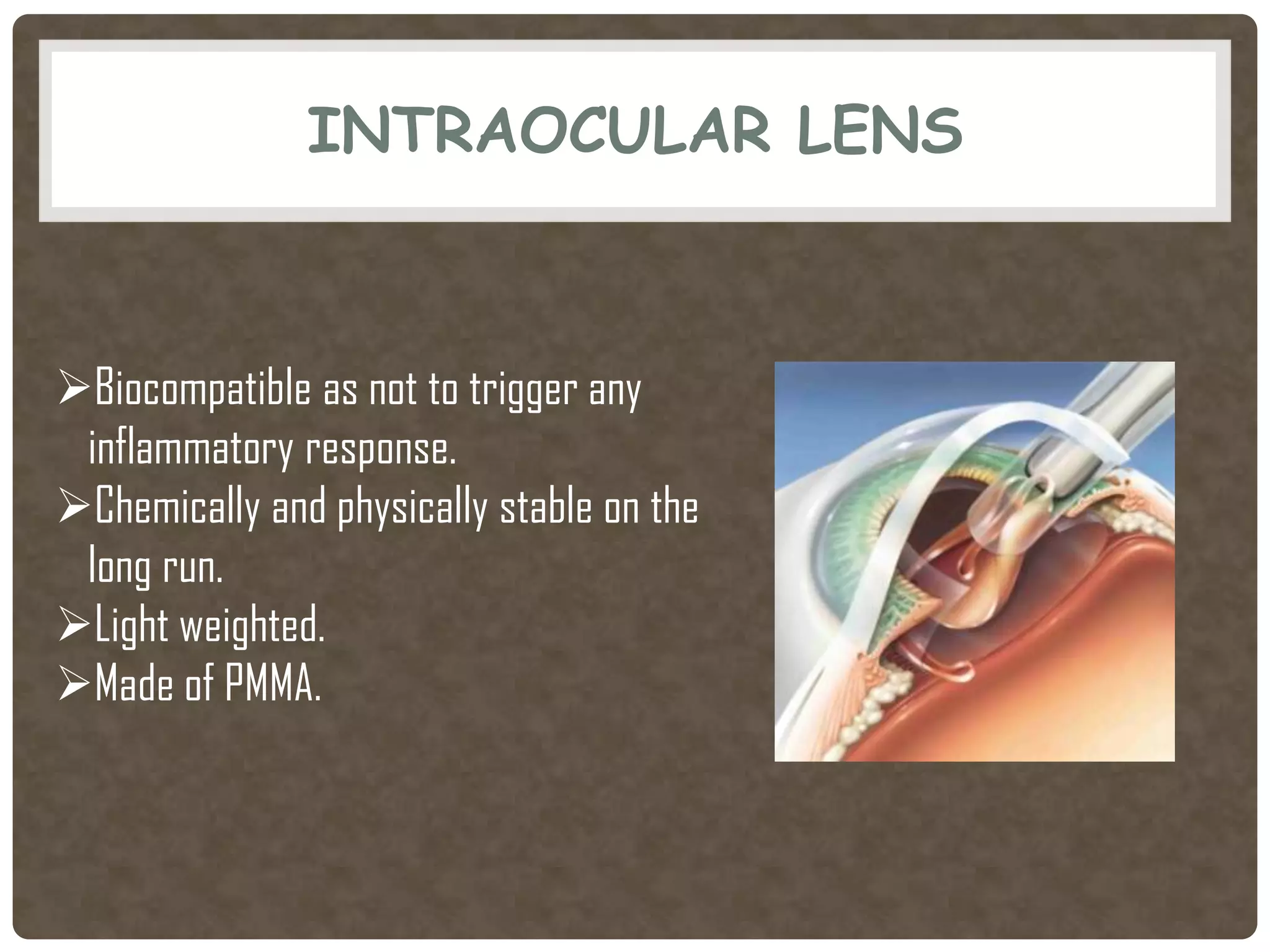
INTRAOCULAR LENS


Biocompatible as not to trigger any
 inflammatory response.
Chemically and physically stable on the
 long run.
Light weighted.
Made of PMMA.

Phacoemulsification