Healthy Body
  Weight
   William VanWasshenova
           CMU 653
          5/11/2012
How do you know if your body
 weight is in a healthy range?
• A common tool used to determine body fatness
  of a person is called a Body Mass Index (BMI)
   A BMI calculator uses a person’s height and
    weight to determine whether the person is in
    the proper weight range
BMI
• A BMI test categorizes the person in 1 of 4
  categories
  • Underweight
  • Healthy weight
  • Overweight
  • Obese
Reliability of BMI

• The BMI is not a perfect tool for all situations, it
  is simply used as an indicator of potential health
  issues
• People who have a large percentage of muscle
  mass may be incorrectly perceived to be
  overweight based on their BMI results
Where can you find a
   BMI Calculator?
• For Kids or Teens:
  • http://apps.nccd.cdc.gov/dnpabmi/
• For Adults:
  • http://www.cdc.gov/healthyweight/assessing/
    bmi/adult_bmi/english_bmi_calculator/bmi_c
    alculator.html
How do you lose weight or
     gain weight?

• Eat appropriate foods
• Exercise
• Monitor your weight on a regular basis
Eating Appropriate Food
• Food contains calories which is energy the body needs to
  function
• Your body needs a certain amount of calories to maintain your
  current body weight
• If you consume more calories than your body needs, your
  body stores it as fat (causing weight gain)
• If you consume less calories than your body needs, your body
  will borrow energy from fat cells previously stored (causing
  weight loss)
• A calorie calculator can help determine the number of calories
  you need to consume per day
Eating Appropriate Food
• Keep in mind that calorie calculators can only estimate.
• Many websites that have calculators, also have many
  advertisements for weight loss products. Beware of personal
  agendas that these sites may have.
• Remember that everyone is different. The number of calories
  recommended for weight loss or weight gain on websites may
  not be appropriate for everyone.
• The Mayo Clinic provides an online calculator free of diet
  advertisements at the following address:
  • http://www.mayoclinic.com/health/calorie-calculator/NU00598
Eating Appropriate Food

• Many people are unaware of the caloric value of the foods
  they consume.
• Use the following link to find a tool that estimates the amount
  of calories in your favorite foods
  • https://www.choosemyplate.gov/SuperTracker/foodapedia.aspx
Eating Appropriate Food

• In addition to eating the appropriate amount of calories, it is
  also important to eat a balanced diet full of fruits, vegetables,
  carbohydrates, protein, and dairy products to have a healthy
  body weight.
  • To better understand the five food groups in your diet, follow the
    link below:
      • http://www.choosemyplate.gov/food-groups/
Exercise
• Exercise is a useful component of weight management
  because it helps to burn calories
• The amount a person exercises effects how many calories
  their body uses

• Click below to view the number of calories your favorite
  exercise will burn
  • http://www.cdc.gov/healthyweight/physical_activity/index.html
Exercise
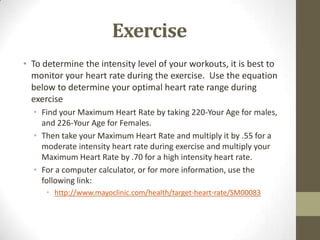
• To determine the intensity level of your workouts, it is best to
  monitor your heart rate during the exercise. Use the equation
  below to determine your optimal heart rate range during
  exercise
  • Find your Maximum Heart Rate by taking 220-Your Age for males,
    and 226-Your Age for Females.
  • Then take your Maximum Heart Rate and multiply it by .55 for a
    moderate intensity heart rate during exercise and multiply your
    Maximum Heart Rate by .70 for a high intensity heart rate.
  • For a computer calculator, or for more information, use the
    following link:
      • http://www.mayoclinic.com/health/target-heart-rate/SM00083
Monitoring Your Weight

• If you currently have a healthy weight, you need to try to
  maintain that weight
• By consuming the amount of calories needed to maintain your
  current weight, you are in “caloric balance”
What does metabolism have to do
           with it?

• Everyone’s metabolism is different
• Individuals that have a high muscle percentage have higher
  metabolism
• Metabolism can also be affected by genetics and stress
Summary
•   Know your BMI
•   Be conscious of the foods you eat
•   Be active!
•   Monitor your weight
•   There are many websites that can assist with you better
    understanding weight management. Always be sure to get
    information from a trusted source.
Sources
“Assessing Your Weight.” Centers for Disease Control and Prevention. 17 Aug. 2011. Web. 10
          May 2012. http://www.cdc.gov/healthyweight/assessing/Index.html

“Balancing Calories.” Centers for Disease Control and Prevention. 31 Oct. 2011. Web. 10 May
          2012. http://www.cdc.gov/healthyweight/calories/index.html

“Body Mass Index.” Centers for Disease Control and Prevention. 13 Sept. 2011. Web. 10 May
         2012. http://www.cdc.gov/healthyweight/assessing/bmi/Index.html

“Calorie Calculator.” Mayo Clinic. Mayo Foundation for Medical Education and Research, 17
           Apr 2010. Web 10 May 2012. http://www.mayoclinic.com/health/calorie-
calculator/NU00598/

“Food-A-Pedia.” United States Dairy Association. Web 10 May 2012.
          https://www.choosemyplate.gov/SuperTracker/foodapedia.aspx

“Food Groups.” United States Dairy Associaiton. Web 10 May 2012.
          http://www.choosemyplate.gov/food-groups/

“Physical Activity for a Healthy Weight.” Centers for Disease Control and Prevention. 13 Sept.
           2011. Web 10 May 2012.
           http://www.cdc.gov/healthyweight/physical_activity/index.html

Healthy body weight

  • 1.
    Healthy Body Weight William VanWasshenova CMU 653 5/11/2012
  • 2.
    How do youknow if your body weight is in a healthy range? • A common tool used to determine body fatness of a person is called a Body Mass Index (BMI)  A BMI calculator uses a person’s height and weight to determine whether the person is in the proper weight range
  • 3.
    BMI • A BMItest categorizes the person in 1 of 4 categories • Underweight • Healthy weight • Overweight • Obese
  • 4.
    Reliability of BMI •The BMI is not a perfect tool for all situations, it is simply used as an indicator of potential health issues • People who have a large percentage of muscle mass may be incorrectly perceived to be overweight based on their BMI results
  • 5.
    Where can youfind a BMI Calculator? • For Kids or Teens: • http://apps.nccd.cdc.gov/dnpabmi/ • For Adults: • http://www.cdc.gov/healthyweight/assessing/ bmi/adult_bmi/english_bmi_calculator/bmi_c alculator.html
  • 6.
    How do youlose weight or gain weight? • Eat appropriate foods • Exercise • Monitor your weight on a regular basis
  • 7.
    Eating Appropriate Food •Food contains calories which is energy the body needs to function • Your body needs a certain amount of calories to maintain your current body weight • If you consume more calories than your body needs, your body stores it as fat (causing weight gain) • If you consume less calories than your body needs, your body will borrow energy from fat cells previously stored (causing weight loss) • A calorie calculator can help determine the number of calories you need to consume per day
  • 8.
    Eating Appropriate Food •Keep in mind that calorie calculators can only estimate. • Many websites that have calculators, also have many advertisements for weight loss products. Beware of personal agendas that these sites may have. • Remember that everyone is different. The number of calories recommended for weight loss or weight gain on websites may not be appropriate for everyone. • The Mayo Clinic provides an online calculator free of diet advertisements at the following address: • http://www.mayoclinic.com/health/calorie-calculator/NU00598
  • 9.
    Eating Appropriate Food •Many people are unaware of the caloric value of the foods they consume. • Use the following link to find a tool that estimates the amount of calories in your favorite foods • https://www.choosemyplate.gov/SuperTracker/foodapedia.aspx
  • 10.
    Eating Appropriate Food •In addition to eating the appropriate amount of calories, it is also important to eat a balanced diet full of fruits, vegetables, carbohydrates, protein, and dairy products to have a healthy body weight. • To better understand the five food groups in your diet, follow the link below: • http://www.choosemyplate.gov/food-groups/
  • 11.
    Exercise • Exercise isa useful component of weight management because it helps to burn calories • The amount a person exercises effects how many calories their body uses • Click below to view the number of calories your favorite exercise will burn • http://www.cdc.gov/healthyweight/physical_activity/index.html
  • 12.
    Exercise • To determinethe intensity level of your workouts, it is best to monitor your heart rate during the exercise. Use the equation below to determine your optimal heart rate range during exercise • Find your Maximum Heart Rate by taking 220-Your Age for males, and 226-Your Age for Females. • Then take your Maximum Heart Rate and multiply it by .55 for a moderate intensity heart rate during exercise and multiply your Maximum Heart Rate by .70 for a high intensity heart rate. • For a computer calculator, or for more information, use the following link: • http://www.mayoclinic.com/health/target-heart-rate/SM00083
  • 13.
    Monitoring Your Weight •If you currently have a healthy weight, you need to try to maintain that weight • By consuming the amount of calories needed to maintain your current weight, you are in “caloric balance”
  • 14.
    What does metabolismhave to do with it? • Everyone’s metabolism is different • Individuals that have a high muscle percentage have higher metabolism • Metabolism can also be affected by genetics and stress
  • 15.
    Summary • Know your BMI • Be conscious of the foods you eat • Be active! • Monitor your weight • There are many websites that can assist with you better understanding weight management. Always be sure to get information from a trusted source.
  • 16.
    Sources “Assessing Your Weight.”Centers for Disease Control and Prevention. 17 Aug. 2011. Web. 10 May 2012. http://www.cdc.gov/healthyweight/assessing/Index.html “Balancing Calories.” Centers for Disease Control and Prevention. 31 Oct. 2011. Web. 10 May 2012. http://www.cdc.gov/healthyweight/calories/index.html “Body Mass Index.” Centers for Disease Control and Prevention. 13 Sept. 2011. Web. 10 May 2012. http://www.cdc.gov/healthyweight/assessing/bmi/Index.html “Calorie Calculator.” Mayo Clinic. Mayo Foundation for Medical Education and Research, 17 Apr 2010. Web 10 May 2012. http://www.mayoclinic.com/health/calorie- calculator/NU00598/ “Food-A-Pedia.” United States Dairy Association. Web 10 May 2012. https://www.choosemyplate.gov/SuperTracker/foodapedia.aspx “Food Groups.” United States Dairy Associaiton. Web 10 May 2012. http://www.choosemyplate.gov/food-groups/ “Physical Activity for a Healthy Weight.” Centers for Disease Control and Prevention. 13 Sept. 2011. Web 10 May 2012. http://www.cdc.gov/healthyweight/physical_activity/index.html