Nutrients
Substances that
 Provide Energy
 Helps with body processes
 Helps with growth & repair of cells
Six Categories:
 Fats
 Proteins
 Carbohydrates
 Minerals
 Vitamins
 Water
Carbohydrates
Main source of energy
1g carbs = 4 calories
Simple Carbohyrates:
sugars that provide quick
energy
Complex
carbohydrates: starches
& fibers
Fiber
 Part of grains & plant foods
that cannot be digested
 Helps move food through
digestive system
 Reduces cholesterol & risk
of heart disease
Protein
Nutrient needed:
 For Growth
 To build, repair, and
maintain body tissues
 To regulate body
processes
 To supply energy
1 g protein = 4 calories
Amino acids: building
blocks that make up
proteins
9 of the amino acids are
considered essential
(body cannot produce)
11 are considered
nonessential (body can
produce
Complete protein =
contains all essential
amino acids
Incomplete protein = is
low in 1 or more essential
amino acids
Fats
Saturated
 Found mainly in animal
 Solid @ room temp.
 Causes liver to produce
cholesterol
 Trans Fat: snack foods &
margarine
 Unsaturated: liquid @ room
temp.
 Monounsaturated: olive &
canola oils
 Polyunsaturated: sunflower,
corn, canola oils, seafood
Nutrient that
source of stored energy
Helps body store & use
vitamins
Maintain body heat
Build brain cells &
nerve tissue
1 g fat = 9 calories
Vitamins
Nutrient that:
 Helps the body use
carbohydrates, fats, &
proteins
Fat Soluble Vitamins:
dissolves in fat & can be
stored in the body
 Vitamins A, D, E, K
 released as the body
needs them
 Taking large doses can be
toxic
Water Soluble Vitamins
 Dissolves in water & is not
stored in the body in
significant amounts
 must be replenished
regularly
 Excess excreted from body
 B1 (thiamin), B2, B6, B12,
C, niacin, folic acid,
riboflavin
Minerals Water
Nutrient that
 Regulates chemical
reactions in the body
 Builds tissues
 Macro minerals
 Calcium
 Phosphorus
 Potassium
 Sodium
 Micro minerals
 Copper
 Iron
 zinc
Nutrient that
 Involved in all body processes
 Makes up the basic part of
blood
 Helps with waste removal
 Regulates body temperature
 Cushions spinal cord & joints
 Sources
 Drinking water
 Moist food (fruits & veggies)
 Dehydration: when water
content of body is very low
 Diuretic: product that
increases urine output
Vitamins and Their Functions
Vitamin A- aids in immune function, bone and teeth formation, promotes
growth and repair of body tissues
Vitamin D- improves absorption of calcium and phosphorus, maintains nervous
system
Vitamin E- major antioxidant, nourishes cells, prevents blood clots
Vitamin K- prevents internal bleeding
 Vitamin B- promote growth and muscle tone, aids in digesting carbs, maintain
nervous system and vision, maintain red and white blood cells, aids in
metabolizing proteins, promote healthy skin
Vitamin C- antioxidant, maintains oral health, helps heal wounds, helps prevent
infection, prevents scurvy
Folic Acid- promotes growth and reproduction of cells, aids in formation of red
blood cells and bone marrow, prevents neural tube birth defects
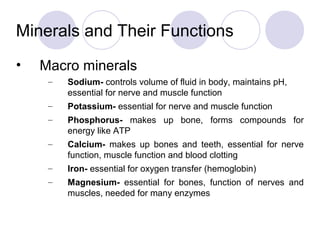
Minerals and Their Functions
• Macro minerals
– Sodium- controls volume of fluid in body, maintains pH,
essential for nerve and muscle function
– Potassium- essential for nerve and muscle function
– Phosphorus- makes up bone, forms compounds for
energy like ATP
– Calcium- makes up bones and teeth, essential for nerve
function, muscle function and blood clotting
– Iron- essential for oxygen transfer (hemoglobin)
– Magnesium- essential for bones, function of nerves and
muscles, needed for many enzymes
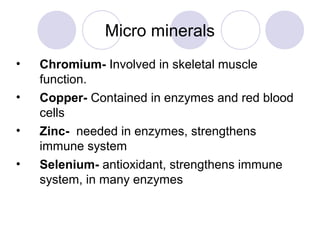
Micro minerals
• Chromium- Involved in skeletal muscle
function.
• Copper- Contained in enzymes and red blood
cells
• Zinc- needed in enzymes, strengthens
immune system
• Selenium- antioxidant, strengthens immune
system, in many enzymes
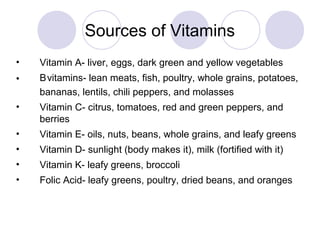
Sources of Vitamins
• Vitamin A- liver, eggs, dark green and yellow vegetables
• Bvitamins- lean meats, fish, poultry, whole grains, potatoes,
bananas, lentils, chili peppers, and molasses
• Vitamin C- citrus, tomatoes, red and green peppers, and
berries
• Vitamin E- oils, nuts, beans, whole grains, and leafy greens
• Vitamin D- sunlight (body makes it), milk (fortified with it)
• Vitamin K- leafy greens, broccoli
• Folic Acid- leafy greens, poultry, dried beans, and oranges
Sources of Vitamins
• Vitamin A- liver, eggs, dark green and yellow vegetables
• Bvitamins- lean meats, fish, poultry, whole grains, potatoes,
bananas, lentils, chili peppers, and molasses
• Vitamin C- citrus, tomatoes, red and green peppers, and
berries
• Vitamin E- oils, nuts, beans, whole grains, and leafy greens
• Vitamin D- sunlight (body makes it), milk (fortified with it)
• Vitamin K- leafy greens, broccoli
• Folic Acid- leafy greens, poultry, dried beans, and oranges
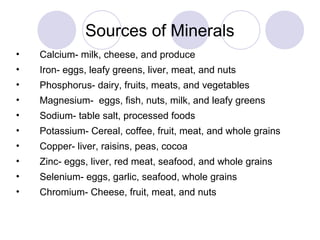
Sources of Minerals
• Calcium- milk, cheese, and produce
• Iron- eggs, leafy greens, liver, meat, and nuts
• Phosphorus- dairy, fruits, meats, and vegetables
• Magnesium- eggs, fish, nuts, milk, and leafy greens
• Sodium- table salt, processed foods
• Potassium- Cereal, coffee, fruit, meat, and whole grains
• Copper- liver, raisins, peas, cocoa
• Zinc- eggs, liver, red meat, seafood, and whole grains
• Selenium- eggs, garlic, seafood, whole grains
• Chromium- Cheese, fruit, meat, and nuts
Sources
• http://www.cdc.gov/nccdphp/dnpa/nutrition/nutrition_for_everyone/basics/vitamins.htm
• http://www.healthline.com/hlbook/nut-vitamins

Nutrients copy

  • 1.
    Nutrients Substances that  ProvideEnergy  Helps with body processes  Helps with growth & repair of cells Six Categories:  Fats  Proteins  Carbohydrates  Minerals  Vitamins  Water
  • 2.
    Carbohydrates Main source ofenergy 1g carbs = 4 calories Simple Carbohyrates: sugars that provide quick energy Complex carbohydrates: starches & fibers Fiber  Part of grains & plant foods that cannot be digested  Helps move food through digestive system  Reduces cholesterol & risk of heart disease
  • 3.
    Protein Nutrient needed:  ForGrowth  To build, repair, and maintain body tissues  To regulate body processes  To supply energy 1 g protein = 4 calories Amino acids: building blocks that make up proteins 9 of the amino acids are considered essential (body cannot produce) 11 are considered nonessential (body can produce Complete protein = contains all essential amino acids Incomplete protein = is low in 1 or more essential amino acids
  • 4.
    Fats Saturated  Found mainlyin animal  Solid @ room temp.  Causes liver to produce cholesterol  Trans Fat: snack foods & margarine  Unsaturated: liquid @ room temp.  Monounsaturated: olive & canola oils  Polyunsaturated: sunflower, corn, canola oils, seafood Nutrient that source of stored energy Helps body store & use vitamins Maintain body heat Build brain cells & nerve tissue 1 g fat = 9 calories
  • 5.
    Vitamins Nutrient that:  Helpsthe body use carbohydrates, fats, & proteins Fat Soluble Vitamins: dissolves in fat & can be stored in the body  Vitamins A, D, E, K  released as the body needs them  Taking large doses can be toxic Water Soluble Vitamins  Dissolves in water & is not stored in the body in significant amounts  must be replenished regularly  Excess excreted from body  B1 (thiamin), B2, B6, B12, C, niacin, folic acid, riboflavin
  • 6.
    Minerals Water Nutrient that Regulates chemical reactions in the body  Builds tissues  Macro minerals  Calcium  Phosphorus  Potassium  Sodium  Micro minerals  Copper  Iron  zinc Nutrient that  Involved in all body processes  Makes up the basic part of blood  Helps with waste removal  Regulates body temperature  Cushions spinal cord & joints  Sources  Drinking water  Moist food (fruits & veggies)  Dehydration: when water content of body is very low  Diuretic: product that increases urine output
  • 7.
    Vitamins and TheirFunctions Vitamin A- aids in immune function, bone and teeth formation, promotes growth and repair of body tissues Vitamin D- improves absorption of calcium and phosphorus, maintains nervous system Vitamin E- major antioxidant, nourishes cells, prevents blood clots Vitamin K- prevents internal bleeding  Vitamin B- promote growth and muscle tone, aids in digesting carbs, maintain nervous system and vision, maintain red and white blood cells, aids in metabolizing proteins, promote healthy skin Vitamin C- antioxidant, maintains oral health, helps heal wounds, helps prevent infection, prevents scurvy Folic Acid- promotes growth and reproduction of cells, aids in formation of red blood cells and bone marrow, prevents neural tube birth defects
  • 8.
    Minerals and TheirFunctions • Macro minerals – Sodium- controls volume of fluid in body, maintains pH, essential for nerve and muscle function – Potassium- essential for nerve and muscle function – Phosphorus- makes up bone, forms compounds for energy like ATP – Calcium- makes up bones and teeth, essential for nerve function, muscle function and blood clotting – Iron- essential for oxygen transfer (hemoglobin) – Magnesium- essential for bones, function of nerves and muscles, needed for many enzymes
  • 9.
    Micro minerals • Chromium-Involved in skeletal muscle function. • Copper- Contained in enzymes and red blood cells • Zinc- needed in enzymes, strengthens immune system • Selenium- antioxidant, strengthens immune system, in many enzymes
  • 10.
    Sources of Vitamins •Vitamin A- liver, eggs, dark green and yellow vegetables • Bvitamins- lean meats, fish, poultry, whole grains, potatoes, bananas, lentils, chili peppers, and molasses • Vitamin C- citrus, tomatoes, red and green peppers, and berries • Vitamin E- oils, nuts, beans, whole grains, and leafy greens • Vitamin D- sunlight (body makes it), milk (fortified with it) • Vitamin K- leafy greens, broccoli • Folic Acid- leafy greens, poultry, dried beans, and oranges
  • 11.
    Sources of Vitamins •Vitamin A- liver, eggs, dark green and yellow vegetables • Bvitamins- lean meats, fish, poultry, whole grains, potatoes, bananas, lentils, chili peppers, and molasses • Vitamin C- citrus, tomatoes, red and green peppers, and berries • Vitamin E- oils, nuts, beans, whole grains, and leafy greens • Vitamin D- sunlight (body makes it), milk (fortified with it) • Vitamin K- leafy greens, broccoli • Folic Acid- leafy greens, poultry, dried beans, and oranges
  • 12.
    Sources of Minerals •Calcium- milk, cheese, and produce • Iron- eggs, leafy greens, liver, meat, and nuts • Phosphorus- dairy, fruits, meats, and vegetables • Magnesium- eggs, fish, nuts, milk, and leafy greens • Sodium- table salt, processed foods • Potassium- Cereal, coffee, fruit, meat, and whole grains • Copper- liver, raisins, peas, cocoa • Zinc- eggs, liver, red meat, seafood, and whole grains • Selenium- eggs, garlic, seafood, whole grains • Chromium- Cheese, fruit, meat, and nuts
  • 13.

Editor's Notes

  • #2 Nutrition is the study of what people eat & of eating habits & how these affect health status.
  • #3 Both simple and complex carbs become glucose after digestion Complex carbs such as fruits and veggies often contain vitamins and minerals. Diabetes is a condition of having little or no insulin produced by the pancreas.
  • #4 Important components of muscles, connective tissue, skin, organs, blood, some hormones, antibodies and enzymes Average adult requirement for protein is considered to be 0.8 grams per kg body weight. **Have students determine their protein requirement.** Amino acids are the building blocks of protein, and are provided to the body by the breakdown of dietary protein during digestion. Essential amino acids can only be provided by the diet (FOOD). Nonessential amino acids can be produced by the body Many plant proteins are incomplete, but a vegetarian diet can provide the body with all needed amino acids.
  • #5 No more than 10% of daily calories should come from saturated fat; and less than 30% from all fats Polyunsaturated fatty acids are essential b/c they are required in the diet & used in the body for cell structure & producing some hormones.
  • #6 There are 13 essential vitamins that have been determined because of their special function & the ways they work with other nutrients… The human body cannot manufacture vitamins, they must be obtained from the foods we eat or from dietary supplements. Fat-soluble vitamins require fat to be dissolved (which is why fat is an important part of the diet). Fat-soluble vitamins are stored in the fatty tissues, principally the liver. Taking a greater amount of vitamins A & D can cause serious toxic effects over a period of time. Water-soluble vitamins are dissolved in water. When more is consumed than needed, the excess is eliminated in the urine. This does not enhance performance. Consuming an excess amount of vitamins from supplements can be toxic because vitamins in the form of supplements tend to stay in the body longer than those obtained from food.
  • #7 Minerals such as calcium and phosphorus are important to build bones and teeth. Others are important components of hormones. Certain minerals, called electrolytes (sodium, potassium, calcium, chloride) are needed for muscle contraction, heart rhythm and the conduction of nerve impulses. Copper and iron are important for RBC production & function. Zinc helps with digestion & wound healing Kidneys play an important role in regulating body’s water balance To maintain proper hydration, 6-8 glasses/day Signs of dehydration: dizziness, fatigue, weakness, dry mouth, flushed skin, headache, blurred vision, difficulty swallowing, dry, hot skin; rapid pulse, frequent need to urinate Examples of diuretics, soda, tea, coffee, energy drinks, anything with caffeine, alcohol