“Research Problem & Types of
Variables”
by
Dr. Mohmed Amin Mir
PG Department of Commerce
Islamia College of Science & Commerce
Srinagar, Jammu & Kashmir – 190002.
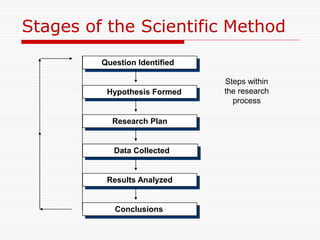
Stages of the Scientific Method
Question Identified
Hypothesis Formed
Research Plan
Data Collected
Results Analyzed
Conclusions
Steps within
the research
process
Types of Research Questions
 Conceptualize that a research study can ask
three types of questions:
1. Descriptive question
2. Relationship question
3. Difference question
 This general classification scheme helps not
only with the design of the study, but also in
choosing the type of data analysis procedure
1. Descriptive Question
Seeks to describe phenomena or characteristics
of a particular group of subjects being studied
 Answers the question “what is”
• Asking questions of the research participants
• Testing or measuring their performance
 Survey research
Example
 What are the attitudes of rural parents toward the
inclusion of Co-education in the school
curriculum? (Welshimer & Harris, 1994)
2. Relationship Question
 Investigates the degree to which two or more
variables are associated with each other
 Does not establish “cause-and-effect”
 Only identifies extent of relationship between
variables
 Example
 Is there an association between self-esteem and
eating behaviors among collegiate female
swimmers? (Fey, 1998)
3. Difference Question
Seeks to make comparisons between or within
groups of interest
 Often associated with experimental research
 Comparison of one group to another on the basis
of existing characteristics
Example
 Does participation in Special Olympics affect the
self-esteem of adults with mental retardation?
(Major, 1998)
Criteria for Selecting a Problem
 Interest
 Most important
 Significance
 Theoretical value
 Practical value
 Timeliness
 External review
 Manageability
 Expertise, time, resources
 Free from personal bias
Problem Distillation
 The process of refining the question or idea
into a problem and making it sufficiently
specific so that it is amenable to investigation
 This process should lead to the development of
a “statement of the problem” that is clear,
concise, and definitive
Research Problem
 Well begun is half-done & good start for some
act is mandatory for its successful completion
 Refers to the topic of research
 A situation that induces the researcher to feel
doubtful and perplexed
 A problem (theoretical or practical) of which a
researcher wants to find a best solution
Research Problem
 Existing Problems of which a researcher wants
to find an answer
 Situation that is not posing any severe problem
presently but can be improved
 Area in which more clarity is required
 Area of interest to a researcher
Pre-Conditions of Research Problem
1. There must be an individual, group or organization to
which the problems can be attributes
2. Thee must be minimum of two courses of action, which a
researcher can pursue
3. There must be atleast two feasible outcomes of the
action
4. There must be a problem whose solution should not
exist
Components of Research Problem
1. Research Problem must be attributed to an individual,
group or institution
2. Pre-determined objectives (purpose)
3. Alternative means to conduct research
4. Doubt/apprehension in researcher’s mind
5. Environment
A well Defined Research Problem
1. Discriminating relevant data from irrelevant data
2. Preventing the research study go out of the track
3. Exploring data, techniques & other aspects of
research in an efficient manner
4. Using research problem as a guiding principle
through out the research
Research Problem
I. Identifying a Research Problem
II. Defining a Research Problem
III.Formulating a Research Problem
I. Identifying a Research Problem
Two Types of Criteria:
A. Internal Criteria
i. Researcher’s Interest
ii. Researcher’s Competence
iii. Researcher’s Resources (time, financial resources etc.)
B. External Criteria (Problems)
i. Importance and Urgency of the problem
ii. Novelty of the problem
iii. Researchability of the problem [Example: Does God Exist?]
II. Defining a Research Problem
A Difficult task
1. Preparing Statement of the Problem in a simple way
2. Understanding the nature of the problem (origin &
nature)
3. Surveying the available literature
4. Developing ideas through Discussion
5. Rephrasing the Research problem [Operational terms,
Standard Formulation, Working Hypothesis]
II. Formulating a Research Problem
 Workable Size
 Scope
 Boundaries of Investigation
3-Step Process:
1. Stating the research problem (Question/ Statement)
2. Identifying the variables (Expressed & measures qualitatively or
quantitatively)
3. Evaluating the research problem
 Originality
 Importance
 Feasibility (Chances of conducting a research)
II. Formulating a Research Problem
Example
Why productivity in China is better than in India?
• What exactly productivity means?
• Which industries are being referred in the
problem?
• What is the time period referred?
Types of Research Problem
1. Simple Problems
Whose components & their relationships are clear &
transparent
2. Complex Problems
Several subsystems interact with each other & are difficult
to understand
3. Well Defined Problems
Researcher exactly knows the problem.
For Example: How new packaging affected sales of the
product?
Types of Research Problem
4. Ill Defined Problems
Researcher is not sure of the exact problem
5. Tamed Problems & Wicked Problems
Which cannot be defined clearly & difficult to derive
accurate solutions
Statement of the Problem
 A very specific statement which clearly
identifies the problem being studied;
 Will usually identify the key variables as well as
give some information about the scope of the
study
 May be in either question or declarative form
 May include inherent sub-problems, if
appropriate
 Formulation of problem statement
takes place after an initial review of related
literature and the distillation process
Problem Statements
 “The problem of this study was to ……”
 “This study was concerned with ….…”
 “This study is designed to …….”
 “The purpose of this investigation is to……”
Sample Problem Statements - Examples
1. The problem was to investigate the effects of
exercise on blood lipids among college-age females…
2. This study was designed to determine the
relationship between stability performance and
physical growth characteristics of preschool
children…
3. The present study was designed to identify those
characteristics which differentiate between students
who binge cold drink and those that do not…
4. The problem of the study was to determine is there
is a relationship between self-efficacy and self-
reported drug usage among middle-aged adult
males…
Delimitations
 Delimitations define the scope of the study.
That is, they set the boundaries of the study
 Normally under control of the researcher
 Examples include
 number and kinds of subjects
 treatment conditions
 tests, measures, instruments used
 type of equipment
 location, environmental setting
 type of training (time and duration)
Limitations
 Limitations are very similar to delimitations,
but they tend to focus on potential weaknesses
of the study
 Examples include
1. Sampling Problems (representativeness of
subjects)
2. Uncontrolled Factors And Extraneous Variables
3. Faulty Research Design And Techniques
4. Reliability And Validity Of Measuring
Instruments
5. Compromises To Internal/External Validity
Limitations contd….
 Possible shortcomings of the study . . . usually
cannot be controlled by the researcher
 the researcher will, of course, try to eliminate
extremely serious weaknesses before the study
is commenced
 May be a result of assumptions not being met
 No study is perfect; the researcher recognizes
the weaknesses
Assumptions
 Assumptions are basic, fundamental conditions
that must exist in order for the research to
proceed
 Basic premises required in the study... the
researcher does everything possible to increase
the credibility of the assumptions, but does not
have absolute control
 Assumptions could be made about:
1. The motivation of the subjects,
2. Whether subjects responded truthfully,
3. The validity of the measuring instrument, and
4. Whether subjects followed directions correctly
Concept of Variables
 A variable is a characteristic, trait, or attribute
of a person or thing that can be classified or
measured
 Attitude
 Gender
 Heart rate
 Hair color
 Variable - the condition or characteristic which
in a given study may have more than one
value
Various Types of Variables
 Quantitative Variables – measured numerically
 Discrete
 Continuous
 Qualitative Variables – categorical in nature
Various Types of Variables
1. Exogenous (Independent) Variable
 A variable that is presumed to influence another
variable; the variable under study or the one that
the researcher manipulates
 Two types
 Active – variable is actually manipulated
 Attribute – cannot be manipulated because it is
preexisting trait; sometimes called a “categorical”
variable (e.g., race, gender)
Example:
In an inventory control model, demand is an
exogenous variable
Impact of Remuneration on Employee Retention in
an organization
Various Types of Variables
2. Endogenous (Dependent) Variable
 The variable that is expected to change as a
result of the manipulation of the independent
variable; that which is measured in a study
 Example:
 In the model of income determination, consumption
expenditure is endogenous
 Effectiveness of watching Youtube on the
performance of students in UG Studies
3. Controllable Variables
 For Example: The manager of an organization
plans to purchase a stock of goods. The ordered
quantity of goods is under the control of
manager and is known as controllable variable
4. Uncontrollable Variables
 For Example: Demand of a product by consumer
is an uncontrollable variable for a production
origanisation.
Various Types of Variables
Extraneous Variable
A variable that could contribute some type of
error in a research study
Also referred to as . . .
• Confounding variable
• Intervening variable
• Modifying variable
Error-producing variable that the researcher
should attempt to eliminate or control
May affect the relationship between the
independent variable and the dependent
variable, if not adequately controlled
Controlling Extraneous Variables
 Excluding the variable
 Random selection of research participants
 Matching cases according to some criterion

RESEARCH PROBLEM & TYPES OF VARIABLES.pptx

  • 1.
    “Research Problem &Types of Variables” by Dr. Mohmed Amin Mir PG Department of Commerce Islamia College of Science & Commerce Srinagar, Jammu & Kashmir – 190002.
  • 2.
    Stages of theScientific Method Question Identified Hypothesis Formed Research Plan Data Collected Results Analyzed Conclusions Steps within the research process
  • 3.
    Types of ResearchQuestions  Conceptualize that a research study can ask three types of questions: 1. Descriptive question 2. Relationship question 3. Difference question  This general classification scheme helps not only with the design of the study, but also in choosing the type of data analysis procedure
  • 4.
    1. Descriptive Question Seeksto describe phenomena or characteristics of a particular group of subjects being studied  Answers the question “what is” • Asking questions of the research participants • Testing or measuring their performance  Survey research Example  What are the attitudes of rural parents toward the inclusion of Co-education in the school curriculum? (Welshimer & Harris, 1994)
  • 5.
    2. Relationship Question Investigates the degree to which two or more variables are associated with each other  Does not establish “cause-and-effect”  Only identifies extent of relationship between variables  Example  Is there an association between self-esteem and eating behaviors among collegiate female swimmers? (Fey, 1998)
  • 6.
    3. Difference Question Seeksto make comparisons between or within groups of interest  Often associated with experimental research  Comparison of one group to another on the basis of existing characteristics Example  Does participation in Special Olympics affect the self-esteem of adults with mental retardation? (Major, 1998)
  • 7.
    Criteria for Selectinga Problem  Interest  Most important  Significance  Theoretical value  Practical value  Timeliness  External review  Manageability  Expertise, time, resources  Free from personal bias
  • 8.
    Problem Distillation  Theprocess of refining the question or idea into a problem and making it sufficiently specific so that it is amenable to investigation  This process should lead to the development of a “statement of the problem” that is clear, concise, and definitive
  • 9.
    Research Problem  Wellbegun is half-done & good start for some act is mandatory for its successful completion  Refers to the topic of research  A situation that induces the researcher to feel doubtful and perplexed  A problem (theoretical or practical) of which a researcher wants to find a best solution
  • 10.
    Research Problem  ExistingProblems of which a researcher wants to find an answer  Situation that is not posing any severe problem presently but can be improved  Area in which more clarity is required  Area of interest to a researcher
  • 11.
    Pre-Conditions of ResearchProblem 1. There must be an individual, group or organization to which the problems can be attributes 2. Thee must be minimum of two courses of action, which a researcher can pursue 3. There must be atleast two feasible outcomes of the action 4. There must be a problem whose solution should not exist
  • 12.
    Components of ResearchProblem 1. Research Problem must be attributed to an individual, group or institution 2. Pre-determined objectives (purpose) 3. Alternative means to conduct research 4. Doubt/apprehension in researcher’s mind 5. Environment
  • 13.
    A well DefinedResearch Problem 1. Discriminating relevant data from irrelevant data 2. Preventing the research study go out of the track 3. Exploring data, techniques & other aspects of research in an efficient manner 4. Using research problem as a guiding principle through out the research
  • 14.
    Research Problem I. Identifyinga Research Problem II. Defining a Research Problem III.Formulating a Research Problem
  • 15.
    I. Identifying aResearch Problem Two Types of Criteria: A. Internal Criteria i. Researcher’s Interest ii. Researcher’s Competence iii. Researcher’s Resources (time, financial resources etc.) B. External Criteria (Problems) i. Importance and Urgency of the problem ii. Novelty of the problem iii. Researchability of the problem [Example: Does God Exist?]
  • 16.
    II. Defining aResearch Problem A Difficult task 1. Preparing Statement of the Problem in a simple way 2. Understanding the nature of the problem (origin & nature) 3. Surveying the available literature 4. Developing ideas through Discussion 5. Rephrasing the Research problem [Operational terms, Standard Formulation, Working Hypothesis]
  • 17.
    II. Formulating aResearch Problem  Workable Size  Scope  Boundaries of Investigation 3-Step Process: 1. Stating the research problem (Question/ Statement) 2. Identifying the variables (Expressed & measures qualitatively or quantitatively) 3. Evaluating the research problem  Originality  Importance  Feasibility (Chances of conducting a research)
  • 18.
    II. Formulating aResearch Problem Example Why productivity in China is better than in India? • What exactly productivity means? • Which industries are being referred in the problem? • What is the time period referred?
  • 19.
    Types of ResearchProblem 1. Simple Problems Whose components & their relationships are clear & transparent 2. Complex Problems Several subsystems interact with each other & are difficult to understand 3. Well Defined Problems Researcher exactly knows the problem. For Example: How new packaging affected sales of the product?
  • 20.
    Types of ResearchProblem 4. Ill Defined Problems Researcher is not sure of the exact problem 5. Tamed Problems & Wicked Problems Which cannot be defined clearly & difficult to derive accurate solutions
  • 21.
    Statement of theProblem  A very specific statement which clearly identifies the problem being studied;  Will usually identify the key variables as well as give some information about the scope of the study  May be in either question or declarative form  May include inherent sub-problems, if appropriate  Formulation of problem statement takes place after an initial review of related literature and the distillation process
  • 22.
    Problem Statements  “Theproblem of this study was to ……”  “This study was concerned with ….…”  “This study is designed to …….”  “The purpose of this investigation is to……”
  • 23.
    Sample Problem Statements- Examples 1. The problem was to investigate the effects of exercise on blood lipids among college-age females… 2. This study was designed to determine the relationship between stability performance and physical growth characteristics of preschool children… 3. The present study was designed to identify those characteristics which differentiate between students who binge cold drink and those that do not… 4. The problem of the study was to determine is there is a relationship between self-efficacy and self- reported drug usage among middle-aged adult males…
  • 24.
    Delimitations  Delimitations definethe scope of the study. That is, they set the boundaries of the study  Normally under control of the researcher  Examples include  number and kinds of subjects  treatment conditions  tests, measures, instruments used  type of equipment  location, environmental setting  type of training (time and duration)
  • 25.
    Limitations  Limitations arevery similar to delimitations, but they tend to focus on potential weaknesses of the study  Examples include 1. Sampling Problems (representativeness of subjects) 2. Uncontrolled Factors And Extraneous Variables 3. Faulty Research Design And Techniques 4. Reliability And Validity Of Measuring Instruments 5. Compromises To Internal/External Validity
  • 26.
    Limitations contd….  Possibleshortcomings of the study . . . usually cannot be controlled by the researcher  the researcher will, of course, try to eliminate extremely serious weaknesses before the study is commenced  May be a result of assumptions not being met  No study is perfect; the researcher recognizes the weaknesses
  • 27.
    Assumptions  Assumptions arebasic, fundamental conditions that must exist in order for the research to proceed  Basic premises required in the study... the researcher does everything possible to increase the credibility of the assumptions, but does not have absolute control  Assumptions could be made about: 1. The motivation of the subjects, 2. Whether subjects responded truthfully, 3. The validity of the measuring instrument, and 4. Whether subjects followed directions correctly
  • 28.
    Concept of Variables A variable is a characteristic, trait, or attribute of a person or thing that can be classified or measured  Attitude  Gender  Heart rate  Hair color  Variable - the condition or characteristic which in a given study may have more than one value
  • 29.
    Various Types ofVariables  Quantitative Variables – measured numerically  Discrete  Continuous  Qualitative Variables – categorical in nature
  • 30.
    Various Types ofVariables 1. Exogenous (Independent) Variable  A variable that is presumed to influence another variable; the variable under study or the one that the researcher manipulates  Two types  Active – variable is actually manipulated  Attribute – cannot be manipulated because it is preexisting trait; sometimes called a “categorical” variable (e.g., race, gender) Example: In an inventory control model, demand is an exogenous variable Impact of Remuneration on Employee Retention in an organization
  • 31.
    Various Types ofVariables 2. Endogenous (Dependent) Variable  The variable that is expected to change as a result of the manipulation of the independent variable; that which is measured in a study  Example:  In the model of income determination, consumption expenditure is endogenous  Effectiveness of watching Youtube on the performance of students in UG Studies
  • 32.
    3. Controllable Variables For Example: The manager of an organization plans to purchase a stock of goods. The ordered quantity of goods is under the control of manager and is known as controllable variable 4. Uncontrollable Variables  For Example: Demand of a product by consumer is an uncontrollable variable for a production origanisation. Various Types of Variables
  • 33.
    Extraneous Variable A variablethat could contribute some type of error in a research study Also referred to as . . . • Confounding variable • Intervening variable • Modifying variable Error-producing variable that the researcher should attempt to eliminate or control May affect the relationship between the independent variable and the dependent variable, if not adequately controlled
  • 34.
    Controlling Extraneous Variables Excluding the variable  Random selection of research participants  Matching cases according to some criterion