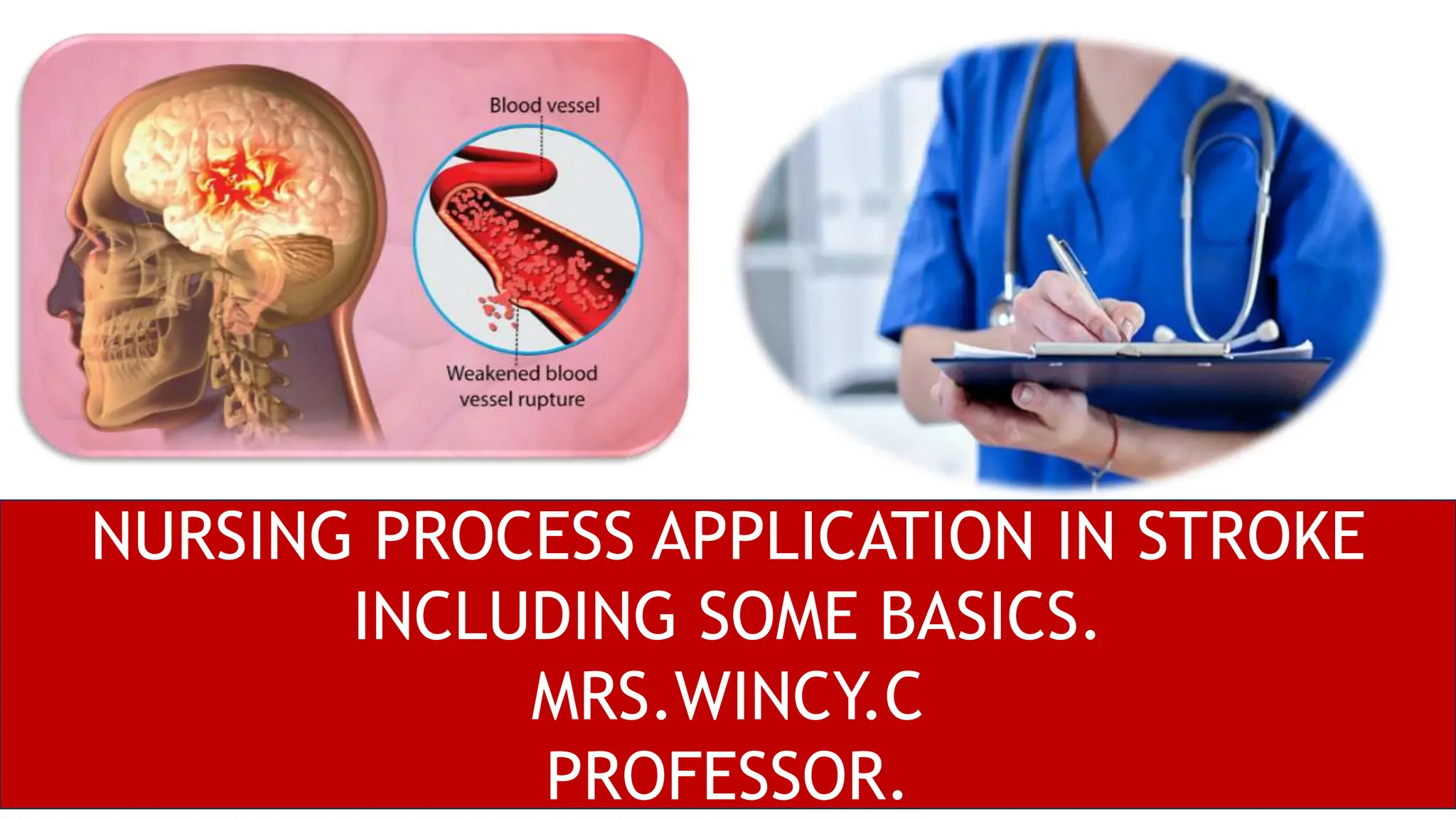
NURSING PROCESS APPLICATION IN STROKE
INCLUDING SOME BASICS.
MRS.WINCY.C
PROFESSOR.
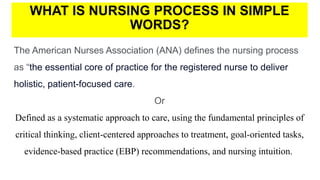
The American Nurses Association (ANA) defines the nursing process
as “the essential core of practice for the registered nurse to deliver
holistic, patient-focused care.
Or
Defined as a systematic approach to care, using the fundamental principles of
critical thinking, client-centered approaches to treatment, goal-oriented tasks,
evidence-based practice (EBP) recommendations, and nursing intuition.
WHAT IS NURSING PROCESS IN SIMPLE
WORDS?
WHAT IS NURSING PROCESS IN SIMPLE
WORDS?
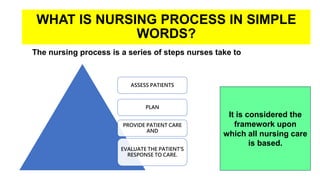
ASSESS PATIENTS
PLAN
PROVIDE PATIENT CARE
AND
EVALUATE THE PATIENT’S
RESPONSE TO CARE.
The nursing process is a series of steps nurses take to
It is considered the
framework upon
which all nursing care
is based.
WHEN WAS THE NURSING PROCESS
DEVELOPED?
Lydia
Hall.
Ms.
Hall
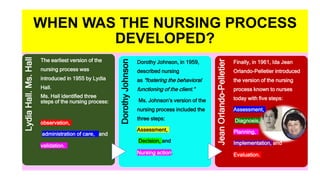
The earliest version of the
nursing process was
introduced in 1955 by Lydia
Hall.
Ms. Hall identified three
steps of the nursing process:
observation,
administration of care, and
validation.
Dorothy
Johnson
Dorothy Johnson, in 1959,
described nursing
as "fostering the behavioral
functioning of the client.”
Ms. Johnson’s version of the
nursing process included the
three steps:
Assessment,
Decision, and
Nursing action.
Jean
Orlando-Pelletier
Finally, in 1961, Ida Jean
Orlando-Pelletier introduced
the version of the nursing
process known to nurses
today with five steps:
Assessment,
Diagnosis,
Planning,
Implementation, and
Evaluation.
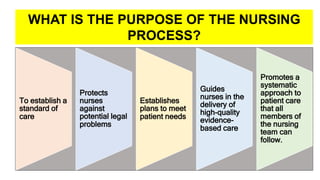
To establish a
standard of
care
Protects
nurses
against
potential legal
problems
Establishes
plans to meet
patient needs
Guides
nurses in the
delivery of
high-quality
evidence-
based care
Promotes a
systematic
approach to
patient care
that all
members of
the nursing
team can
follow.
WHAT IS THE PURPOSE OF THE NURSING
PROCESS?
WHAT ARE THE IMPORTANT
STEPS/COMPONENTS OF
NURSING PROCESS
DEVELOPED?
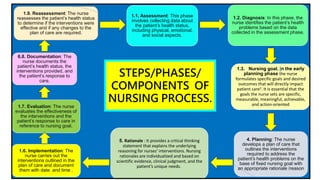
1.1. Assessment: This phase
involves collecting data about
the patient’s health status,
including physical, emotional,
and social aspects.
1.2. Diagnosis: In this phase, the
nurse identifies the patient’s health
problems based on the data
collected in the assessment phase.
1.3. Nursing goal. In the early
planning phase the nurse
formulates specific goals and desired
outcomes that will directly impact
patient care2. It is essential that the
goals the nurse sets are specific,
measurable, meaningful, achievable,
and action-oriented
4. Planning: The nurse
develops a plan of care that
outlines the interventions
required to address the
patient’s health problems on the
base of fixed nursing goal with
an appropriate rationale /reason
5. Rationale : It provides a critical thinking
statement that explains the underlying
reasoning for nurses’ interventions. Nursing
rationales are individualized and based on
scientific evidence, clinical judgment, and the
patient’s unique needs.
1.6. Implementation: The
nurse carries out the
interventions outlined in the
plan of care and document
them with date and time .
1.7. Evaluation: The nurse
evaluates the effectiveness of
the interventions and the
patient’s response to care in
reference to nursing goal.
6.8. Documentation: The
nurse documents the
patient’s health status, the
interventions provided, and
the patient’s response to
care.
1.9. Reassessment: The nurse
reassesses the patient’s health status
to determine if the interventions were
effective and if any changes to the
plan of care are required.
STEPS/PHASES/
COMPONENTS OF
NURSING PROCESS.
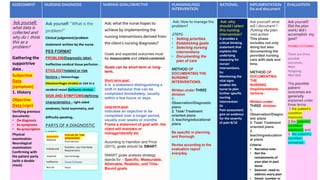
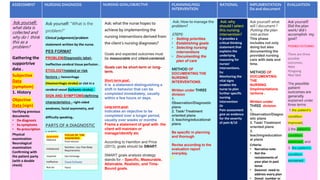
ASSESSMENT NURSING DIAGNOSIS NURSING GOAL/OBJECTIVE PLANNING/NSG
INTERVENTION
RATIONAL IMPLIMENTATION
Do and document
EVALUATION
Ask yourself:
what data is
collected and
why do I think
this as a
problem?
Gathering the
supportrive
data .
Subjective
Data
(symptom)
1. History
Objective
Data (sign)
Verifying previous
documents
• Dx-diagnosis
• Sx-symptoms
• Rx-prescription
Physical
examination
Neurological
examination
Confirming with
the patient party
(with a double
check)
Ask yourself: “What is the
problem?”
Clinical judgement/problem
statement written by the nurse.
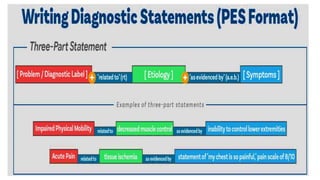
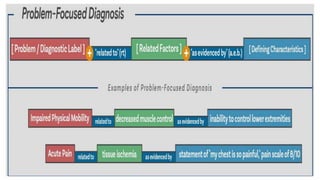
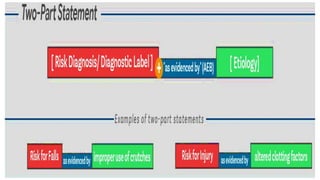
PES FORMAT
PROBLEM/Diagnostic label-
Ineffective cerebral tissue perfusion .
ETIOLOGY/related or risk
factors – hemorrhage
(Heamorrhagic stroke) or clot in a
cerebral vessel (Ischemic stroke) .
SIGN AND SYMPTOMS/defining
characteristics - right-sided
weakness, facial asymmetry, and
difficulty speaking.
PARTS OF A DIAGNOSTIC
LABEL
usually has two parts:
Ask: what the nurse hopes to
achieve by implementing the
nursing interventions derived from
the client’s nursing diagnoses?
Goals and expected outcomes must
be measurable and client-centered.
Goals can be short-term or long-
term.
Short-term goal:
It is a statement distinguishing a
shift in behavior that can be
completed immediately, usually
within a few hours or days.
Long-term goal:
Indicates an objective to be
completed over a longer period,
usually over weeks or months
Frame a statement of goal with the
client will maintain or
manage/identify etc
According to Hamilton and Price
(2013), goals should be SMART.
SMART goals analysis strategy
stands for – Specific, Measurable,
Attainable, Realistic, and Time-
Bound goals.
Ask: How to manage the
problem?
STEPS:
• Setting priorities
• Establishing goals
• Selecting nursing
interventions
• Documenting the
plan of care
METHOD OF
DOCUMENTING THE
NURSING
INTERVENTIONS.
Written under THREE
division
1.
Observation/Diagnostic
plans
2. Task/ Treatment
oriented plans
3. teaching/educational
plans
Be specific in planning
and thorough
Revise according to the
evaluation report
everyday.
Ask: why
should I select
this nursing
intervention?
It provides a
critical thinking
statement that
explains the
underlying
reasoning for
nurses’
interventions.
Ex:
Monitoring the
vital signs
enables the
nurse to plan
further specific
nursing
intervention
Or
Pain assessment
give an evidence
for the severity
of pain 8/10
Ask yourself: what
will I document ?
Putting the plan
into action
This phase
includes not only
doing but also
documenting the
provided nursing
care with date and
time.
METHOD OF
DOCUMENTING
THE
NURSING
Iimplimentations
/actions .
Written under
THREE division
1.
Observation/Diagno
stic plans
2. Task/ Treatment
oriented plans
3.
teaching/education
al plans
Criteria:
• Narrative note
• Not the
restatements of
your plan in past
tense
• Doesnot need to
address every plan
• Donot number or
Ask yourself:
Did the plan
work/ did I
accomplish my
goal?
POSSIBLE OUTCOMES :
There are three
possible
outcomes,
•Met
•Ongoing
•Not Met
The possible
patient
outcomes are
generally
explained under
three terms:
1.the patient’s
condition
improved,
2.the patient’s
condition
stabilized, and
3. the patient’s
condition
worsened.
QUALIFIER
Deficient
FOCUS OF THE
DIAGNOSIS.
Fluid volume
Imbalanced
Nutrition: Less Than Body
Requirements
Impaired Gas Exchange
Ineffective Tissue Perfusion
Risk for Injury
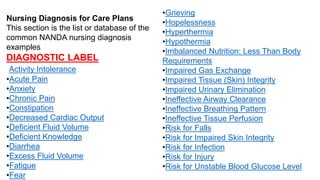
Nursing Diagnosis for Care Plans
This section is the list or database of the
common NANDA nursing diagnosis
examples
DIAGNOSTIC LABEL
Activity Intolerance
•Acute Pain
•Anxiety
•Chronic Pain
•Constipation
•Decreased Cardiac Output
•Deficient Fluid Volume
•Deficient Knowledge
•Diarrhea
•Excess Fluid Volume
•Fatigue
•Fear
•Grieving
•Hopelessness
•Hyperthermia
•Hypothermia
•Imbalanced Nutrition: Less Than Body
Requirements
•Impaired Gas Exchange
•Impaired Tissue (Skin) Integrity
•Impaired Urinary Elimination
•Ineffective Airway Clearance
•Ineffective Breathing Pattern
•Ineffective Tissue Perfusion
•Risk for Falls
•Risk for Impaired Skin Integrity
•Risk for Infection
•Risk for Injury
•Risk for Unstable Blood Glucose Level
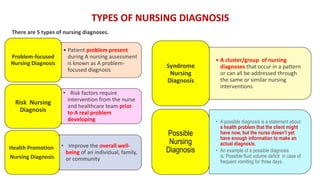
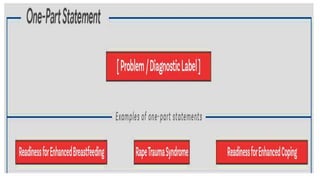
• Patient problem present
during A nursing assessment
is known as A problem-
focused diagnosis
Problem-focused
Nursing Diagnosis
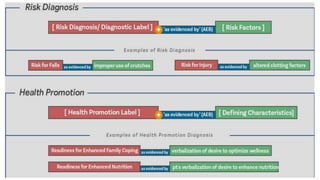
• Risk factors require
intervention from the nurse
and healthcare team prior
to A real problem
developing
Risk Nursing
Diagnosis
• Improve the overall well-
being of an individual, family,
or community
Health Promotion
Nursing Diagnosis
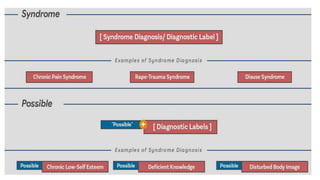
• A cluster/group of nursing
diagnoses that occur in a pattern
or can all be addressed through
the same or similar nursing
interventions
Syndrome
Nursing
Diagnosis
• A possible diagnosis is a statement about
a health problem that the client might
have now, but the nurse doesn’t yet
have enough information to make an
actual diagnosis.
• An example of a possible diagnosis
is: Possible fluid volume deficit in case of
frequent vomiting for three days .
Possible
Nursing
Diagnosis
TYPES OF NURSING DIAGNOSIS
There are 5 types of nursing diagnoses.
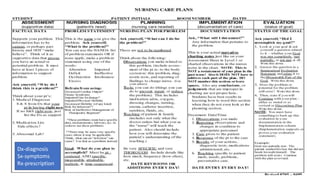
ASSESSMENT NURSING DIAGNOSIS NURSING GOAL/OBJECTIVE PLANNING/NSG
INTERVENTION
RATIONAL IMPLIMENTATION
Do and document
EVALUATION
Ask yourself:
what data is
collected and
why do I think
this as a
problem?
Gathering the
supportrive
data .
Subjective
Data
(symptom)
1. History
Objective
Data (sign)
Verifying previous
documents
• Dx-diagnosis
• Sx-symptoms
• Rx-prescription
Physical
examination
Neurological
examination
Confirming with
the patient party
(with a double
check)
Ask yourself: “What is the
problem?”
Clinical judgement/problem
statement written by the nurse.
PES FORMAT
PROBLEM/Diagnostic label-
Ineffective cerebral tissue perfusion .
ETIOLOGY/related or risk
factors – hemorrhage
(Heamorrhagic stroke) or clot in a
cerebral vessel (Ischemic stroke) .
SIGN AND SYMPTOMS/defining
characteristics - right-sided
weakness, facial asymmetry, and
difficulty speaking.
PARTS OF A DIAGNOSTIC
LABEL
usually has two parts:
Ask: what the nurse hopes to
achieve by implementing the
nursing interventions derived from
the client’s nursing diagnoses?
Goals and expected outcomes must
be measurable and client-centered.
Goals can be short-term or long-
term.
Short-term goal:
It is a statement distinguishing a
shift in behavior that can be
completed immediately, usually
within a few hours or days.
Long-term goal:
Indicates an objective to be
completed over a longer period,
usually over weeks or months
Frame a statement of goal with the
client will maintain or
manage/identify etc
According to Hamilton and Price
(2013), goals should be SMART.
SMART goals analysis strategy
stands for – Specific, Measurable,
Attainable, Realistic, and Time-
Bound goals.
Ask: How to manage the
problem?
STEPS:
• Setting priorities
• Establishing goals
• Selecting nursing
interventions
• Documenting the
plan of care
METHOD OF
DOCUMENTING THE
NURSING
INTERVENTIONS.
Written under THREE
division
1.
Observation/Diagnostic
plans
2. Task/ Treatment
oriented plans
3. teaching/educational
plans
Be specific in planning
and thorough
Revise according to the
evaluation report
everyday.
Ask: why
should I select
this nursing
intervention?
It provides a
critical thinking
statement that
explains the
underlying
reasoning for
nurses’
interventions.
Ex:
Monitoring the
vital signs
enables the
nurse to plan
further specific
nursing
intervention
Or
Pain assessment
give an evidence
for the severity
of pain 8/10
Ask yourself: what
will I document ?
Putting the plan
into action
This phase
includes not only
doing but also
documenting the
provided nursing
care with date and
time.
METHOD OF
DOCUMENTING
THE
NURSING
Iimplimentations
/actions .
Written under
THREE division
1.
Observation/Diagno
stic plans
2. Task/ Treatment
oriented plans
3.
teaching/education
al plans
Criteria:
• Narrative note
• Not the
restatements of
your plan in past
tense
• Doesnot need to
address every plan
• Donot number or
Ask yourself:
Did the plan
work/ did I
accomplish my
goal?
POSSIBLE OUTCOMES :
There are three
possible
outcomes,
•Met
•Ongoing
•Not Met
The possible
patient
outcomes are
generally
explained under
three terms:
1.the patient’s
condition
improved,
2.the patient’s
condition
stabilized, and
3. the patient’s
condition
worsened.
QUALIFIER
Deficient
FOCUS OF THE
DIAGNOSIS.
Fluid volume
Imbalanced
Nutrition: Less Than Body
Requirements
Impaired Gas Exchange
Ineffective Tissue Perfusion
Risk for Injury
Dx-diagnosis
Sx-symptoms
Rx-prescription
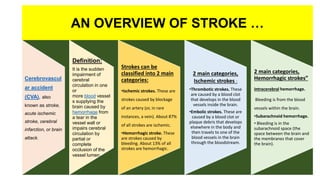
Cerebrovascul
ar accident
(CVA), also
known as stroke,
acute ischemic
stroke, cerebral
infarction, or brain
attack.
Definition:
It is the sudden
impairment of
cerebral
circulation in one
or
more blood vessel
s supplying the
brain caused by
hemorrhage from
a tear in the
vessel wall or
impairs cerebral
circulation by
partial or
complete
occlusion of the
vessel lumen .
Strokes can be
classified into 2 main
categories:
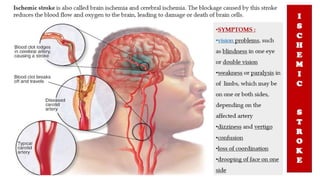
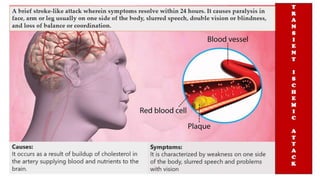
•Ischemic strokes. These are
strokes caused by blockage
of an artery (or, in rare
instances, a vein). About 87%
of all strokes are ischemic.
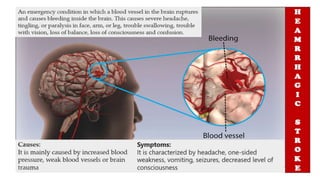
•Hemorrhagic stroke. These
are strokes caused by
bleeding. About 13% of all
strokes are hemorrhagic.
2 main categories,
Ischemic strokes :
•Thrombotic strokes. These
are caused by a blood clot
that develops in the blood
vessels inside the brain.
•Embolic strokes. These are
caused by a blood clot or
plaque debris that develops
elsewhere in the body and
then travels to one of the
blood vessels in the brain
through the bloodstream.
2 main categories,
Hemorrhagic strokes”
Intracerebral hemorrhage.
Bleeding is from the blood
vessels within the brain.
•Subarachnoid hemorrhage.
• Bleeding is in the
subarachnoid space (the
space between the brain and
the membranes that cover
the brain).
AN OVERVIEW OF STROKE …
T
Y
P
E
S
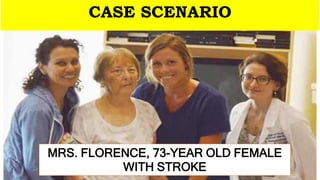
MRS. FLORENCE, 73-YEAR OLD FEMALE
WITH STROKE
CASE SCENARIO
CASE SCENARIO
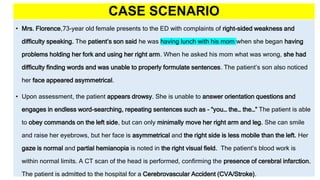
• Mrs. Florence,73-year old female presents to the ED with complaints of right-sided weakness and
difficulty speaking. The patient’s son said he was having lunch with his mom when she began having
problems holding her fork and using her right arm. When he asked his mom what was wrong, she had
difficulty finding words and was unable to properly formulate sentences. The patient’s son also noticed
her face appeared asymmetrical.
• Upon assessment, the patient appears drowsy. She is unable to answer orientation questions and
engages in endless word-searching, repeating sentences such as – “you… the… the…” The patient is able
to obey commands on the left side, but can only minimally move her right arm and leg. She can smile
and raise her eyebrows, but her face is asymmetrical and the right side is less mobile than the left. Her
gaze is normal and partial hemianopia is noted in the right visual field. The patient’s blood work is
within normal limits. A CT scan of the head is performed, confirming the presence of cerebral infarction.
The patient is admitted to the hospital for a Cerebrovascular Accident (CVA/Stroke).
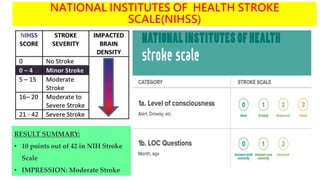
NATIONAL INSTITUTES OF HEALTH STROKE
SCALE(NIHSS)
RESULT SUMMARY:
• 10 points out of 42 in NIH Stroke
Scale
• IMPRESSION: Moderate Stroke
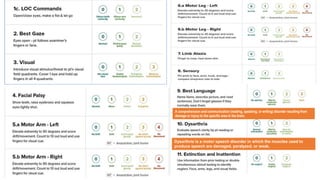
Dysarthria is a motor speech disorder in which the muscles used to
produce speech are damaged, paralyzed, or weak.
A comprehension and communication (reading, speaking, or writing) disorder resulting from
damage or injury to the specific area in the brain.
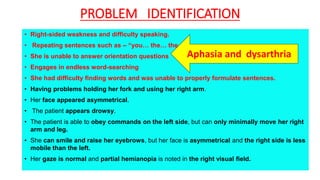
PROBLEM IDENTIFICATION
• Right-sided weakness and difficulty speaking.
• Repeating sentences such as – “you… the… the…”
• She is unable to answer orientation questions
• Engages in endless word-searching
• She had difficulty finding words and was unable to properly formulate sentences.
• Having problems holding her fork and using her right arm.
• Her face appeared asymmetrical.
• The patient appears drowsy.
• The patient is able to obey commands on the left side, but can only minimally move her right
arm and leg.
• She can smile and raise her eyebrows, but her face is asymmetrical and the right side is less
mobile than the left.
• Her gaze is normal and partial hemianopia is noted in the right visual field.
Aphasia and dysarthria
APPLICATION OF
NURSING PROCESS
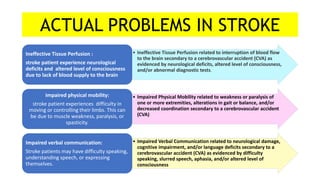
• Ineffective Tissue Perfusion related to interruption of blood flow
to the brain secondary to a cerebrovascular accident (CVA) as
evidenced by neurological deficits, altered level of consciousness,
and/or abnormal diagnostic tests.
Ineffective Tissue Perfusion :
stroke patient experience neurological
deficits and altered level of consciousness
due to lack of blood supply to the brain
• Impaired Physical Mobility related to weakness or paralysis of
one or more extremities, alterations in gait or balance, and/or
decreased coordination secondary to a cerebrovascular accident
(CVA)
Impaired physical mobility:
stroke patient experiences difficulty in
moving or controlling their limbs. This can
be due to muscle weakness, paralysis, or
spasticity.
• Impaired Verbal Communication related to neurological damage,
cognitive impairment, and/or language deficits secondary to a
cerebrovascular accident (CVA) as evidenced by difficulty
speaking, slurred speech, aphasia, and/or altered level of
consciousness
Impaired verbal communication:
Stroke patients may have difficulty speaking,
understanding speech, or expressing
themselves.
ACTUAL PROBLEMS IN STROKE
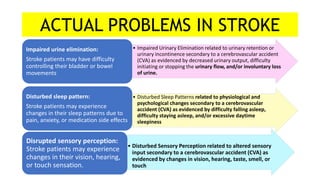
Actual problems in stroke
• Impaired Urinary Elimination related to urinary retention or
urinary incontinence secondary to a cerebrovascular accident
(CVA) as evidenced by decreased urinary output, difficulty
initiating or stopping the urinary flow, and/or involuntary loss
of urine.
Impaired urine elimination:
Stroke patients may have difficulty
controlling their bladder or bowel
movements
• Disturbed Sleep Patterns related to physiological and
psychological changes secondary to a cerebrovascular
accident (CVA) as evidenced by difficulty falling asleep,
difficulty staying asleep, and/or excessive daytime
sleepiness
Disturbed sleep pattern:
Stroke patients may experience
changes in their sleep patterns due to
pain, anxiety, or medication side effects
• Disturbed Sensory Perception related to altered sensory
input secondary to a cerebrovascular accident (CVA) as
evidenced by changes in vision, hearing, taste, smell, or
touch
Disrupted sensory perception:
Stroke patients may experience
changes in their vision, hearing,
or touch sensation.
ACTUAL PROBLEMS IN STROKE
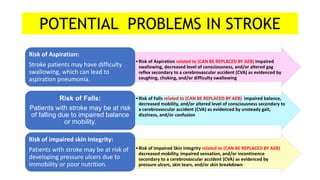
•Risk of Aspiration related to (CAN BE REPLACED BY AEB) impaired
swallowing, decreased level of consciousness, and/or altered gag
reflex secondary to a cerebrovascular accident (CVA) as evidenced by
coughing, choking, and/or difficulty swallowing
Risk of Aspiration:
Stroke patients may have difficulty
swallowing, which can lead to
aspiration pneumonia.
•Risk of Falls related to (CAN BE REPLACED BY AEB) impaired balance,
decreased mobility, and/or altered level of consciousness secondary to
a cerebrovascular accident (CVA) as evidenced by unsteady gait,
dizziness, and/or confusion
Risk of Falls:
Patients with stroke may be at risk
of falling due to impaired balance
or mobility.
•Risk of Impaired Skin Integrity related to (CAN BE REPLACED BY AEB)
decreased mobility, impaired sensation, and/or incontinence
secondary to a cerebrovascular accident (CVA) as evidenced by
pressure ulcers, skin tears, and/or skin breakdown
Risk of impaired skin Integrity:
Patients with stroke may be at risk of
developing pressure ulcers due to
immobility or poor nutrition.
POTENTIAL PROBLEMS IN STROKE
ASSESSMENT NURSING
DIAGNOSIS
NURSING
GOAL/OBJECTIVE
PLANNING/NSG
INTERVENTION
RATIONAL IMPLIMENTATION EVALUATION
Subjective Data:
The son of Mrs.
Florence says that,
“my mom has right-
sided weakness,
drowsiness and
difficulty speaking from
2pm ”.
Objective Data:
The patient has right-sided
weakness, alterd level of
consciousness(
drowsiness),facial
asymmetry, and difficulty
speaking.
CT scan confirms the
presence of a cerebral
infarction.
Total NIHSS score is 10/42
LOC (DROWSY) (1) and LOC
ON COMMAND(OBEYS ONE
COMMAND (1)
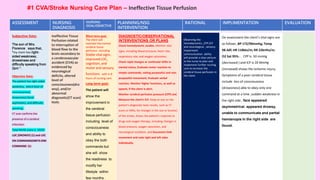
Ineffective Tissue
Perfusion related
to interruption of
blood flow to the
brain secondary to
a cerebrovascular
accident (CVA) as
evidenced by
neurological
deficits, altered
level of
consciousness(dro
wsy), and/or
abnormal
diagnostic(CT scan)
tests.
Short-term goal:
The client will
maintain the normal
cerebral tissue
perfusion including
Stable vital signs .
improved LOC,
cognition, and
motor and sensory
functions .with in 8
hours of nursing care
Long-term goal:
The patient will
show the
improvement in
the cerebral
tissue perfusion
including level of
consciousness
and ability to
obey the both
commands but
she will show
the readiness to
modify her
lifestyle within
few months .
DIAGNOSTIC/OBSERVATIONAL
INTERVENTIONS OR PLANS
Check hemodynamic studies. Monitor vital
signs, including blood pressure, heart rate,
respiratory rate, and oxygen saturation,
Check rapid changes or continued shifts in
mental status, Evaluate motor reaction to
simple commands, noting purposeful and non-
purposeful movement, Evaluate verbal
reaction, Monitor higher functions, as well as
speech, if the client is alert.
Monitor cerebral perfusion pressure (CPP) and
Measure the client’s ICP. Keep an eye on the
patient’s diagnostic tests results, such as CT
scans or MRIs, for changes in the size or location
of the stroke, Assess the patient’s response to
drugs and oxygen therapy, including changes in
blood pressure, oxygen saturation, and
neurological condition. and Document limb
movement and note right and left sides
individually.
Observing the
hemodynamics ,CPP,ICP
and neurological , sensory
impairment
communication ability
will provide a clear picture
to the nurse to plan and
implement further nursing
care to increase the
cerebral tissue perfusion in
the client.
On assessment the client’s vital signs are
as follows ;BP 172/90mmhg; Temp
98.3df; HR 118bts/m; RR 22brths/m;
O2 Sat 95%... CPP is 50 mmHg
(decreased ) and ICP is 20 MmHg
(increased) shows the ischemic injury,
Symptoms of a poor cerebral tissue
include loss of consciousness
(drowsiness) able to obey only one
command at a time ,sudden weakness in
the right side , face appeared
asymmetrical. appeared drowsy,
unable to communicate and partial
hemianopia in the right side are
found.
#1 CVA/Stroke Nursing Care Plan – Ineffective Tissue Perfusion
ASSESSMENT NURSING
DIAGNOSIS
NURSING
GOAL/OBJECTIVE
PLANNING/NSG
INTERVENTION
RATIONAL IMPLIMENTATION EVALUATION
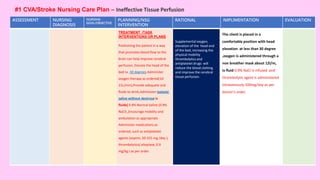
TREATMENT /TASK
INTERVENTIONS OR PLANS
Positioning the patient in a way
that promotes blood flow to the
brain can help improve cerebral
perfusion, Elevate the head of the
bed to 30 degrees.Administer
oxygen therapy as ordered(10-
15L/min),Provide adequate oral
fluids to drink,Administer isotonic
saline without dextrose iv
fluids( 0.9% Normal Saline (0.9%
NaCl) ,Encourage mobility and
ambulation as appropriate
Administer medications as
ordered, such as antiplatelet
agents (aspirin, 50-325 mg /day ),
thrombolytics( alteplase, 0.9
mg/kg ) as per order.
Supplemental oxygen,
elevation of the head end
of the bed, increasing the
physical mobility
thrombolytics and
antiplatelet drugs will
reduce the blood clotting
and improve the cerebral
tissue perfusion.
The client is placed in a
comfortable position with head
elevation at less than 30 degree
,oxygen is administered through a
non breather mask about 12l/m,
iv fluid 0.9% NaCl is infused and
thrombolytic agent is administered
intravenously 100mg/day as per
doctor’s order.
#1 CVA/Stroke Nursing Care Plan – Ineffective Tissue Perfusion
ASSESSMENT NURSING
DIAGNOSIS
NURSING
GOAL/OBJECTIV
E
PLANNING/NSG
INTERVENTION
RATIONAL IMPLIMENTAT
ION
EVALUATION
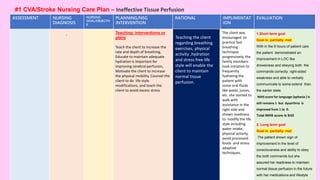
. Teaching interventions or
plans
Teach the client to increase the
rate and depth of breathing,
Educate to maintain adequate
hydration is important for
improving cerebral perfusion,
Motivate the client to increase
the physical mobility. Counsel the
client to do life style
modifications, and teach the
client to avoid excess stress
Teaching the client
regarding breathing
exercises, physical
activity ,hydration
and stress free life
style will enable the
client to maintain
normal tissue
perfusion.
The client was
encouraged to
practice fast
breathing
technique
progressively, the
family members
took initiation to
frequently
hydrating the
patient with
some oral fluids
like water, juices,
etc. she started to
walk with
assistance in the
right side and
shown readiness
to modify the life
style including
water intake,
physical activity,
avoid processed
foods and stress
adaptive
techniques.
1.Short term goal
Goal is partially met
With in the 8 hours of patient care
the patient demonstrated an
improvement in LOC like
drowsiness and obeying both the
commands correctly. right-sided
weakness and able to verbally
communicate to some extend than
the earlier state.
NIHS score for language (aphasia ) is
still remains 1 but dysarthria is
improved from 1 to 0.
Total NIHS score is 9/42
2. Long term goal
Goal is partially met
The patient shown sign of
improvement in the level of
consciousness and ability to obey
the both commands but she
assured her readiness to maintain
normal tissue perfusion in the future
with her medications and lifestyle
#1 CVA/Stroke Nursing Care Plan – Ineffective Tissue Perfusion
ASSESSMENT NURSING
DIAGNOSIS
NURSING
GOAL/OBJECTIVE
PLANNING/NSG
INTERVENTION
RATIONAL IMPLIMENTATION EVALUATION
Subjective Data:
The son of Mrs.
Florence says that,
“my mom has right-
sided weakness and
difficulty speaking
from 2pm ”.
Objective Data:
The patient has right-
sided weakness, facial
asymmetry, and
difficulty speaking.
CT scan confirms the
presence of a cerebral
infarction.
Total NIHSS score is
10/42
Mild to moderate
dysarthria(1) and mild
to moderate
aphasia(1)
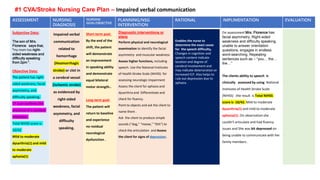
Impaired verbal
communication
related to
hemorrhage
(Heamorrhagic
stroke) or clot in
a cerebral vessel
(Ischemic stroke)
as evidenced by
right-sided
weakness, facial
asymmetry, and
difficulty
speaking.
Short-term goal:
By the end of the
shift, the patient
will demonstrate
an improvement
in speaking ability
and demonstrate
equal bilateral
motor strength..
Long-term goal:
The patient will
return to baseline
and experience
no residual
neurological
dysfunction .
Diagnostic interventions or
plans
Perform physical and neurological
examination to identify the facial
asymmetry and muscular weakness
Assess higher functions, including
speech. Use the National Institutes
of Health Stroke Scale (NIHSS) for
assessing neurologic impairment
Assess the client for aphasia and
dysarthria and Differentiate and
check for fluency.
Point to objects and ask the client to
name them .
Ask the client to produce simple
sounds (“dog,” “meow,” “Shh”) to
check the articulation and Assess
the client for signs of depression.
Enables the nurse to
determine the exact cause
for the speech difficulty,
Changes in cognition and
speech content indicate
location and degree of
cerebral involvement and
may indicate deterioration or
increased ICP. Also helps to
rule out depression due to
aphasia .
On assessment Mrs. Florence has
facial asymmetry, Right-sided
weakness and difficulty speaking,
unable to answer orientation
questions, engages in endless
word-searching, Repeating
sentences such as – “you… the…
the…”
The clients ability to speech is
clinically assessed by using National
Institutes of Health Stroke Scale
(NIHSS) .the result is Total NIHSS
score is 10/42. Mild to moderate
dysarthria(1) and mild to moderate
aphasia(1). On observation she
couldn't articulate and had fluency
issues and She was bit depressed on
being unable to communicate with her
family members .
#1 CVA/Stroke Nursing Care Plan – Impaired verbal communication
ASSESSMENT NURSING
DIAGNOSIS
NURSING
GOAL/OBJECTIVE
PLANNING/NSG INTERVENTION RATIONAL IMPLIMENTATION EVALUATION
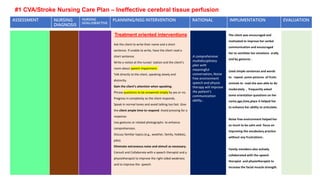
Treatment oriented interventions
Ask the client to write their name and a short
sentence. If unable to write, have the client read a
short sentence.
Write a notice at the nurses’ station and the client’s
room about speech impairment.
Talk directly to the client, speaking slowly and
distinctly.
Gain the client’s attention when speaking.
Phrase questions to be answered simply by yes or no.
Progress in complexity as the client responds.
Speak in normal tones and avoid talking too fast. Give
the client ample time to respond. Avoid pressing for a
response.
Use gestures or related photographs to enhance
comprehension.
Discuss familiar topics (e.g., weather, family, hobbies,
jobs).
Eliminate extraneous noise and stimuli as necessary.
Consult and Collaborate with a speech therapist and a
physiotherapist to improve the right sided weakness
and to improve the speech.
A comprehensive
multidisciplinary
plan with
meaningful
conversation, Noise
free environment
speech and physio
therapy will improve
the patient’s
communication
ability..
The client was encouraged and
motivated to improve her verbal
communication and encouraged
her to ventilate her emotions orally
and by gestures .
Used simple sentences and words
to repeat ,some pictures of fruits
animals to read she was able to do
moderately , frequently asked
some orientation questions on her
name,age,time,place it helped her
to enhance her ability to articulate.
Noise free environment helped her
so much to be calm and focus on
improving the vocabulary practice
without any frustrations .
Family members also actively
collaborated with the speech
therapist and physiotherapist to
increase the facial muscle strength.
#1 CVA/Stroke Nursing Care Plan – Ineffective cerebral tissue perfusion
ASSESSMEN
T
NURSING
DIAGNOSIS
NURSING
GOAL/OBJECTIVE
PLANNING/NSG INTERVENTION RATIONAL IMPLIMENTATION EVALUATION
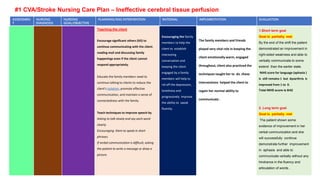
Teaching the client
Encourage significant others (SO) to
continue communicating with the client:
reading mail and discussing family
happenings even if the client cannot
respond appropriately.
Educate the family members need to
continue talking to clients to reduce the
client’s isolation, promote effective
communication, and maintain a sense of
connectedness with the family.
Teach techniques to improve speech by
Asking to talk slowly and say each word
clearly.
Encouraging them to speak in short
phrases.
If verbal communication is difficult, asking
the patient to write a message or draw a
picture.
Encouraging the family
members to help the
client to establish
interesting
conversation and
keeping the client
engaged by a family
members will help to
rid off the depression,
loneliness and
progressively improve
the ability to speak
fluently.
The family members and friends
played very vital role in keeping the
client emotionally warm, engaged
throughout, client also practiced the
techniques taught her to do .these
interventions helped the client to
regain her normal ability to
communicate .
1.Short term goal
Goal is partially met
By the end of the shift the patient
demonstrated an improvement in
right-sided weakness and able to
verbally communicate to some
extend than the earlier state.
NIHS score for language (aphasia )
is still remains 1 but dysarthria is
improved from 1 to 0.
Total NIHS score is 9/42
2. Long term goal
Goal is partially met
The patient shown some
evidence of improvement in her
verbal communication and she
will successfully continue
demonstrate further improvement
in aphasia and able to
communicate verbally without any
hindrance in the fluency and
articulation of words .
#1 CVA/Stroke Nursing Care Plan – Ineffective cerebral tissue perfusion
NURSING PROCESS APPLICATION IN STROKE.pptx

NURSING PROCESS APPLICATION IN STROKE.pptx

  • 1.
    NURSING PROCESS APPLICATIONIN STROKE INCLUDING SOME BASICS. MRS.WINCY.C PROFESSOR.
  • 2.
    The American NursesAssociation (ANA) defines the nursing process as “the essential core of practice for the registered nurse to deliver holistic, patient-focused care. Or Defined as a systematic approach to care, using the fundamental principles of critical thinking, client-centered approaches to treatment, goal-oriented tasks, evidence-based practice (EBP) recommendations, and nursing intuition. WHAT IS NURSING PROCESS IN SIMPLE WORDS?
  • 3.
    WHAT IS NURSINGPROCESS IN SIMPLE WORDS? ASSESS PATIENTS PLAN PROVIDE PATIENT CARE AND EVALUATE THE PATIENT’S RESPONSE TO CARE. The nursing process is a series of steps nurses take to It is considered the framework upon which all nursing care is based.
  • 4.
    WHEN WAS THENURSING PROCESS DEVELOPED? Lydia Hall. Ms. Hall The earliest version of the nursing process was introduced in 1955 by Lydia Hall. Ms. Hall identified three steps of the nursing process: observation, administration of care, and validation. Dorothy Johnson Dorothy Johnson, in 1959, described nursing as "fostering the behavioral functioning of the client.” Ms. Johnson’s version of the nursing process included the three steps: Assessment, Decision, and Nursing action. Jean Orlando-Pelletier Finally, in 1961, Ida Jean Orlando-Pelletier introduced the version of the nursing process known to nurses today with five steps: Assessment, Diagnosis, Planning, Implementation, and Evaluation.
  • 5.
    To establish a standardof care Protects nurses against potential legal problems Establishes plans to meet patient needs Guides nurses in the delivery of high-quality evidence- based care Promotes a systematic approach to patient care that all members of the nursing team can follow. WHAT IS THE PURPOSE OF THE NURSING PROCESS?
  • 6.
    WHAT ARE THEIMPORTANT STEPS/COMPONENTS OF NURSING PROCESS DEVELOPED?
  • 7.
    1.1. Assessment: Thisphase involves collecting data about the patient’s health status, including physical, emotional, and social aspects. 1.2. Diagnosis: In this phase, the nurse identifies the patient’s health problems based on the data collected in the assessment phase. 1.3. Nursing goal. In the early planning phase the nurse formulates specific goals and desired outcomes that will directly impact patient care2. It is essential that the goals the nurse sets are specific, measurable, meaningful, achievable, and action-oriented 4. Planning: The nurse develops a plan of care that outlines the interventions required to address the patient’s health problems on the base of fixed nursing goal with an appropriate rationale /reason 5. Rationale : It provides a critical thinking statement that explains the underlying reasoning for nurses’ interventions. Nursing rationales are individualized and based on scientific evidence, clinical judgment, and the patient’s unique needs. 1.6. Implementation: The nurse carries out the interventions outlined in the plan of care and document them with date and time . 1.7. Evaluation: The nurse evaluates the effectiveness of the interventions and the patient’s response to care in reference to nursing goal. 6.8. Documentation: The nurse documents the patient’s health status, the interventions provided, and the patient’s response to care. 1.9. Reassessment: The nurse reassesses the patient’s health status to determine if the interventions were effective and if any changes to the plan of care are required. STEPS/PHASES/ COMPONENTS OF NURSING PROCESS.
  • 8.
    ASSESSMENT NURSING DIAGNOSISNURSING GOAL/OBJECTIVE PLANNING/NSG INTERVENTION RATIONAL IMPLIMENTATION Do and document EVALUATION Ask yourself: what data is collected and why do I think this as a problem? Gathering the supportrive data . Subjective Data (symptom) 1. History Objective Data (sign) Verifying previous documents • Dx-diagnosis • Sx-symptoms • Rx-prescription Physical examination Neurological examination Confirming with the patient party (with a double check) Ask yourself: “What is the problem?” Clinical judgement/problem statement written by the nurse. PES FORMAT PROBLEM/Diagnostic label- Ineffective cerebral tissue perfusion . ETIOLOGY/related or risk factors – hemorrhage (Heamorrhagic stroke) or clot in a cerebral vessel (Ischemic stroke) . SIGN AND SYMPTOMS/defining characteristics - right-sided weakness, facial asymmetry, and difficulty speaking. PARTS OF A DIAGNOSTIC LABEL usually has two parts: Ask: what the nurse hopes to achieve by implementing the nursing interventions derived from the client’s nursing diagnoses? Goals and expected outcomes must be measurable and client-centered. Goals can be short-term or long- term. Short-term goal: It is a statement distinguishing a shift in behavior that can be completed immediately, usually within a few hours or days. Long-term goal: Indicates an objective to be completed over a longer period, usually over weeks or months Frame a statement of goal with the client will maintain or manage/identify etc According to Hamilton and Price (2013), goals should be SMART. SMART goals analysis strategy stands for – Specific, Measurable, Attainable, Realistic, and Time- Bound goals. Ask: How to manage the problem? STEPS: • Setting priorities • Establishing goals • Selecting nursing interventions • Documenting the plan of care METHOD OF DOCUMENTING THE NURSING INTERVENTIONS. Written under THREE division 1. Observation/Diagnostic plans 2. Task/ Treatment oriented plans 3. teaching/educational plans Be specific in planning and thorough Revise according to the evaluation report everyday. Ask: why should I select this nursing intervention? It provides a critical thinking statement that explains the underlying reasoning for nurses’ interventions. Ex: Monitoring the vital signs enables the nurse to plan further specific nursing intervention Or Pain assessment give an evidence for the severity of pain 8/10 Ask yourself: what will I document ? Putting the plan into action This phase includes not only doing but also documenting the provided nursing care with date and time. METHOD OF DOCUMENTING THE NURSING Iimplimentations /actions . Written under THREE division 1. Observation/Diagno stic plans 2. Task/ Treatment oriented plans 3. teaching/education al plans Criteria: • Narrative note • Not the restatements of your plan in past tense • Doesnot need to address every plan • Donot number or Ask yourself: Did the plan work/ did I accomplish my goal? POSSIBLE OUTCOMES : There are three possible outcomes, •Met •Ongoing •Not Met The possible patient outcomes are generally explained under three terms: 1.the patient’s condition improved, 2.the patient’s condition stabilized, and 3. the patient’s condition worsened. QUALIFIER Deficient FOCUS OF THE DIAGNOSIS. Fluid volume Imbalanced Nutrition: Less Than Body Requirements Impaired Gas Exchange Ineffective Tissue Perfusion Risk for Injury
  • 9.
    Nursing Diagnosis forCare Plans This section is the list or database of the common NANDA nursing diagnosis examples DIAGNOSTIC LABEL Activity Intolerance •Acute Pain •Anxiety •Chronic Pain •Constipation •Decreased Cardiac Output •Deficient Fluid Volume •Deficient Knowledge •Diarrhea •Excess Fluid Volume •Fatigue •Fear •Grieving •Hopelessness •Hyperthermia •Hypothermia •Imbalanced Nutrition: Less Than Body Requirements •Impaired Gas Exchange •Impaired Tissue (Skin) Integrity •Impaired Urinary Elimination •Ineffective Airway Clearance •Ineffective Breathing Pattern •Ineffective Tissue Perfusion •Risk for Falls •Risk for Impaired Skin Integrity •Risk for Infection •Risk for Injury •Risk for Unstable Blood Glucose Level
  • 10.
    • Patient problempresent during A nursing assessment is known as A problem- focused diagnosis Problem-focused Nursing Diagnosis • Risk factors require intervention from the nurse and healthcare team prior to A real problem developing Risk Nursing Diagnosis • Improve the overall well- being of an individual, family, or community Health Promotion Nursing Diagnosis • A cluster/group of nursing diagnoses that occur in a pattern or can all be addressed through the same or similar nursing interventions Syndrome Nursing Diagnosis • A possible diagnosis is a statement about a health problem that the client might have now, but the nurse doesn’t yet have enough information to make an actual diagnosis. • An example of a possible diagnosis is: Possible fluid volume deficit in case of frequent vomiting for three days . Possible Nursing Diagnosis TYPES OF NURSING DIAGNOSIS There are 5 types of nursing diagnoses.
  • 17.
    ASSESSMENT NURSING DIAGNOSISNURSING GOAL/OBJECTIVE PLANNING/NSG INTERVENTION RATIONAL IMPLIMENTATION Do and document EVALUATION Ask yourself: what data is collected and why do I think this as a problem? Gathering the supportrive data . Subjective Data (symptom) 1. History Objective Data (sign) Verifying previous documents • Dx-diagnosis • Sx-symptoms • Rx-prescription Physical examination Neurological examination Confirming with the patient party (with a double check) Ask yourself: “What is the problem?” Clinical judgement/problem statement written by the nurse. PES FORMAT PROBLEM/Diagnostic label- Ineffective cerebral tissue perfusion . ETIOLOGY/related or risk factors – hemorrhage (Heamorrhagic stroke) or clot in a cerebral vessel (Ischemic stroke) . SIGN AND SYMPTOMS/defining characteristics - right-sided weakness, facial asymmetry, and difficulty speaking. PARTS OF A DIAGNOSTIC LABEL usually has two parts: Ask: what the nurse hopes to achieve by implementing the nursing interventions derived from the client’s nursing diagnoses? Goals and expected outcomes must be measurable and client-centered. Goals can be short-term or long- term. Short-term goal: It is a statement distinguishing a shift in behavior that can be completed immediately, usually within a few hours or days. Long-term goal: Indicates an objective to be completed over a longer period, usually over weeks or months Frame a statement of goal with the client will maintain or manage/identify etc According to Hamilton and Price (2013), goals should be SMART. SMART goals analysis strategy stands for – Specific, Measurable, Attainable, Realistic, and Time- Bound goals. Ask: How to manage the problem? STEPS: • Setting priorities • Establishing goals • Selecting nursing interventions • Documenting the plan of care METHOD OF DOCUMENTING THE NURSING INTERVENTIONS. Written under THREE division 1. Observation/Diagnostic plans 2. Task/ Treatment oriented plans 3. teaching/educational plans Be specific in planning and thorough Revise according to the evaluation report everyday. Ask: why should I select this nursing intervention? It provides a critical thinking statement that explains the underlying reasoning for nurses’ interventions. Ex: Monitoring the vital signs enables the nurse to plan further specific nursing intervention Or Pain assessment give an evidence for the severity of pain 8/10 Ask yourself: what will I document ? Putting the plan into action This phase includes not only doing but also documenting the provided nursing care with date and time. METHOD OF DOCUMENTING THE NURSING Iimplimentations /actions . Written under THREE division 1. Observation/Diagno stic plans 2. Task/ Treatment oriented plans 3. teaching/education al plans Criteria: • Narrative note • Not the restatements of your plan in past tense • Doesnot need to address every plan • Donot number or Ask yourself: Did the plan work/ did I accomplish my goal? POSSIBLE OUTCOMES : There are three possible outcomes, •Met •Ongoing •Not Met The possible patient outcomes are generally explained under three terms: 1.the patient’s condition improved, 2.the patient’s condition stabilized, and 3. the patient’s condition worsened. QUALIFIER Deficient FOCUS OF THE DIAGNOSIS. Fluid volume Imbalanced Nutrition: Less Than Body Requirements Impaired Gas Exchange Ineffective Tissue Perfusion Risk for Injury
  • 18.
  • 19.
    Cerebrovascul ar accident (CVA), also knownas stroke, acute ischemic stroke, cerebral infarction, or brain attack. Definition: It is the sudden impairment of cerebral circulation in one or more blood vessel s supplying the brain caused by hemorrhage from a tear in the vessel wall or impairs cerebral circulation by partial or complete occlusion of the vessel lumen . Strokes can be classified into 2 main categories: •Ischemic strokes. These are strokes caused by blockage of an artery (or, in rare instances, a vein). About 87% of all strokes are ischemic. •Hemorrhagic stroke. These are strokes caused by bleeding. About 13% of all strokes are hemorrhagic. 2 main categories, Ischemic strokes : •Thrombotic strokes. These are caused by a blood clot that develops in the blood vessels inside the brain. •Embolic strokes. These are caused by a blood clot or plaque debris that develops elsewhere in the body and then travels to one of the blood vessels in the brain through the bloodstream. 2 main categories, Hemorrhagic strokes” Intracerebral hemorrhage. Bleeding is from the blood vessels within the brain. •Subarachnoid hemorrhage. • Bleeding is in the subarachnoid space (the space between the brain and the membranes that cover the brain). AN OVERVIEW OF STROKE …
  • 20.
  • 24.
    MRS. FLORENCE, 73-YEAROLD FEMALE WITH STROKE CASE SCENARIO
  • 25.
    CASE SCENARIO • Mrs.Florence,73-year old female presents to the ED with complaints of right-sided weakness and difficulty speaking. The patient’s son said he was having lunch with his mom when she began having problems holding her fork and using her right arm. When he asked his mom what was wrong, she had difficulty finding words and was unable to properly formulate sentences. The patient’s son also noticed her face appeared asymmetrical. • Upon assessment, the patient appears drowsy. She is unable to answer orientation questions and engages in endless word-searching, repeating sentences such as – “you… the… the…” The patient is able to obey commands on the left side, but can only minimally move her right arm and leg. She can smile and raise her eyebrows, but her face is asymmetrical and the right side is less mobile than the left. Her gaze is normal and partial hemianopia is noted in the right visual field. The patient’s blood work is within normal limits. A CT scan of the head is performed, confirming the presence of cerebral infarction. The patient is admitted to the hospital for a Cerebrovascular Accident (CVA/Stroke).
  • 26.
    NATIONAL INSTITUTES OFHEALTH STROKE SCALE(NIHSS) RESULT SUMMARY: • 10 points out of 42 in NIH Stroke Scale • IMPRESSION: Moderate Stroke
  • 27.
    Dysarthria is amotor speech disorder in which the muscles used to produce speech are damaged, paralyzed, or weak. A comprehension and communication (reading, speaking, or writing) disorder resulting from damage or injury to the specific area in the brain.
  • 28.
    PROBLEM IDENTIFICATION • Right-sidedweakness and difficulty speaking. • Repeating sentences such as – “you… the… the…” • She is unable to answer orientation questions • Engages in endless word-searching • She had difficulty finding words and was unable to properly formulate sentences. • Having problems holding her fork and using her right arm. • Her face appeared asymmetrical. • The patient appears drowsy. • The patient is able to obey commands on the left side, but can only minimally move her right arm and leg. • She can smile and raise her eyebrows, but her face is asymmetrical and the right side is less mobile than the left. • Her gaze is normal and partial hemianopia is noted in the right visual field. Aphasia and dysarthria
  • 29.
  • 30.
    • Ineffective TissuePerfusion related to interruption of blood flow to the brain secondary to a cerebrovascular accident (CVA) as evidenced by neurological deficits, altered level of consciousness, and/or abnormal diagnostic tests. Ineffective Tissue Perfusion : stroke patient experience neurological deficits and altered level of consciousness due to lack of blood supply to the brain • Impaired Physical Mobility related to weakness or paralysis of one or more extremities, alterations in gait or balance, and/or decreased coordination secondary to a cerebrovascular accident (CVA) Impaired physical mobility: stroke patient experiences difficulty in moving or controlling their limbs. This can be due to muscle weakness, paralysis, or spasticity. • Impaired Verbal Communication related to neurological damage, cognitive impairment, and/or language deficits secondary to a cerebrovascular accident (CVA) as evidenced by difficulty speaking, slurred speech, aphasia, and/or altered level of consciousness Impaired verbal communication: Stroke patients may have difficulty speaking, understanding speech, or expressing themselves. ACTUAL PROBLEMS IN STROKE
  • 31.
    Actual problems instroke • Impaired Urinary Elimination related to urinary retention or urinary incontinence secondary to a cerebrovascular accident (CVA) as evidenced by decreased urinary output, difficulty initiating or stopping the urinary flow, and/or involuntary loss of urine. Impaired urine elimination: Stroke patients may have difficulty controlling their bladder or bowel movements • Disturbed Sleep Patterns related to physiological and psychological changes secondary to a cerebrovascular accident (CVA) as evidenced by difficulty falling asleep, difficulty staying asleep, and/or excessive daytime sleepiness Disturbed sleep pattern: Stroke patients may experience changes in their sleep patterns due to pain, anxiety, or medication side effects • Disturbed Sensory Perception related to altered sensory input secondary to a cerebrovascular accident (CVA) as evidenced by changes in vision, hearing, taste, smell, or touch Disrupted sensory perception: Stroke patients may experience changes in their vision, hearing, or touch sensation. ACTUAL PROBLEMS IN STROKE
  • 32.
    •Risk of Aspirationrelated to (CAN BE REPLACED BY AEB) impaired swallowing, decreased level of consciousness, and/or altered gag reflex secondary to a cerebrovascular accident (CVA) as evidenced by coughing, choking, and/or difficulty swallowing Risk of Aspiration: Stroke patients may have difficulty swallowing, which can lead to aspiration pneumonia. •Risk of Falls related to (CAN BE REPLACED BY AEB) impaired balance, decreased mobility, and/or altered level of consciousness secondary to a cerebrovascular accident (CVA) as evidenced by unsteady gait, dizziness, and/or confusion Risk of Falls: Patients with stroke may be at risk of falling due to impaired balance or mobility. •Risk of Impaired Skin Integrity related to (CAN BE REPLACED BY AEB) decreased mobility, impaired sensation, and/or incontinence secondary to a cerebrovascular accident (CVA) as evidenced by pressure ulcers, skin tears, and/or skin breakdown Risk of impaired skin Integrity: Patients with stroke may be at risk of developing pressure ulcers due to immobility or poor nutrition. POTENTIAL PROBLEMS IN STROKE
  • 33.
    ASSESSMENT NURSING DIAGNOSIS NURSING GOAL/OBJECTIVE PLANNING/NSG INTERVENTION RATIONAL IMPLIMENTATIONEVALUATION Subjective Data: The son of Mrs. Florence says that, “my mom has right- sided weakness, drowsiness and difficulty speaking from 2pm ”. Objective Data: The patient has right-sided weakness, alterd level of consciousness( drowsiness),facial asymmetry, and difficulty speaking. CT scan confirms the presence of a cerebral infarction. Total NIHSS score is 10/42 LOC (DROWSY) (1) and LOC ON COMMAND(OBEYS ONE COMMAND (1) Ineffective Tissue Perfusion related to interruption of blood flow to the brain secondary to a cerebrovascular accident (CVA) as evidenced by neurological deficits, altered level of consciousness(dro wsy), and/or abnormal diagnostic(CT scan) tests. Short-term goal: The client will maintain the normal cerebral tissue perfusion including Stable vital signs . improved LOC, cognition, and motor and sensory functions .with in 8 hours of nursing care Long-term goal: The patient will show the improvement in the cerebral tissue perfusion including level of consciousness and ability to obey the both commands but she will show the readiness to modify her lifestyle within few months . DIAGNOSTIC/OBSERVATIONAL INTERVENTIONS OR PLANS Check hemodynamic studies. Monitor vital signs, including blood pressure, heart rate, respiratory rate, and oxygen saturation, Check rapid changes or continued shifts in mental status, Evaluate motor reaction to simple commands, noting purposeful and non- purposeful movement, Evaluate verbal reaction, Monitor higher functions, as well as speech, if the client is alert. Monitor cerebral perfusion pressure (CPP) and Measure the client’s ICP. Keep an eye on the patient’s diagnostic tests results, such as CT scans or MRIs, for changes in the size or location of the stroke, Assess the patient’s response to drugs and oxygen therapy, including changes in blood pressure, oxygen saturation, and neurological condition. and Document limb movement and note right and left sides individually. Observing the hemodynamics ,CPP,ICP and neurological , sensory impairment communication ability will provide a clear picture to the nurse to plan and implement further nursing care to increase the cerebral tissue perfusion in the client. On assessment the client’s vital signs are as follows ;BP 172/90mmhg; Temp 98.3df; HR 118bts/m; RR 22brths/m; O2 Sat 95%... CPP is 50 mmHg (decreased ) and ICP is 20 MmHg (increased) shows the ischemic injury, Symptoms of a poor cerebral tissue include loss of consciousness (drowsiness) able to obey only one command at a time ,sudden weakness in the right side , face appeared asymmetrical. appeared drowsy, unable to communicate and partial hemianopia in the right side are found. #1 CVA/Stroke Nursing Care Plan – Ineffective Tissue Perfusion
  • 34.
    ASSESSMENT NURSING DIAGNOSIS NURSING GOAL/OBJECTIVE PLANNING/NSG INTERVENTION RATIONAL IMPLIMENTATIONEVALUATION TREATMENT /TASK INTERVENTIONS OR PLANS Positioning the patient in a way that promotes blood flow to the brain can help improve cerebral perfusion, Elevate the head of the bed to 30 degrees.Administer oxygen therapy as ordered(10- 15L/min),Provide adequate oral fluids to drink,Administer isotonic saline without dextrose iv fluids( 0.9% Normal Saline (0.9% NaCl) ,Encourage mobility and ambulation as appropriate Administer medications as ordered, such as antiplatelet agents (aspirin, 50-325 mg /day ), thrombolytics( alteplase, 0.9 mg/kg ) as per order. Supplemental oxygen, elevation of the head end of the bed, increasing the physical mobility thrombolytics and antiplatelet drugs will reduce the blood clotting and improve the cerebral tissue perfusion. The client is placed in a comfortable position with head elevation at less than 30 degree ,oxygen is administered through a non breather mask about 12l/m, iv fluid 0.9% NaCl is infused and thrombolytic agent is administered intravenously 100mg/day as per doctor’s order. #1 CVA/Stroke Nursing Care Plan – Ineffective Tissue Perfusion
  • 35.
    ASSESSMENT NURSING DIAGNOSIS NURSING GOAL/OBJECTIV E PLANNING/NSG INTERVENTION RATIONAL IMPLIMENTAT ION EVALUATION .Teaching interventions or plans Teach the client to increase the rate and depth of breathing, Educate to maintain adequate hydration is important for improving cerebral perfusion, Motivate the client to increase the physical mobility. Counsel the client to do life style modifications, and teach the client to avoid excess stress Teaching the client regarding breathing exercises, physical activity ,hydration and stress free life style will enable the client to maintain normal tissue perfusion. The client was encouraged to practice fast breathing technique progressively, the family members took initiation to frequently hydrating the patient with some oral fluids like water, juices, etc. she started to walk with assistance in the right side and shown readiness to modify the life style including water intake, physical activity, avoid processed foods and stress adaptive techniques. 1.Short term goal Goal is partially met With in the 8 hours of patient care the patient demonstrated an improvement in LOC like drowsiness and obeying both the commands correctly. right-sided weakness and able to verbally communicate to some extend than the earlier state. NIHS score for language (aphasia ) is still remains 1 but dysarthria is improved from 1 to 0. Total NIHS score is 9/42 2. Long term goal Goal is partially met The patient shown sign of improvement in the level of consciousness and ability to obey the both commands but she assured her readiness to maintain normal tissue perfusion in the future with her medications and lifestyle #1 CVA/Stroke Nursing Care Plan – Ineffective Tissue Perfusion
  • 36.
    ASSESSMENT NURSING DIAGNOSIS NURSING GOAL/OBJECTIVE PLANNING/NSG INTERVENTION RATIONAL IMPLIMENTATIONEVALUATION Subjective Data: The son of Mrs. Florence says that, “my mom has right- sided weakness and difficulty speaking from 2pm ”. Objective Data: The patient has right- sided weakness, facial asymmetry, and difficulty speaking. CT scan confirms the presence of a cerebral infarction. Total NIHSS score is 10/42 Mild to moderate dysarthria(1) and mild to moderate aphasia(1) Impaired verbal communication related to hemorrhage (Heamorrhagic stroke) or clot in a cerebral vessel (Ischemic stroke) as evidenced by right-sided weakness, facial asymmetry, and difficulty speaking. Short-term goal: By the end of the shift, the patient will demonstrate an improvement in speaking ability and demonstrate equal bilateral motor strength.. Long-term goal: The patient will return to baseline and experience no residual neurological dysfunction . Diagnostic interventions or plans Perform physical and neurological examination to identify the facial asymmetry and muscular weakness Assess higher functions, including speech. Use the National Institutes of Health Stroke Scale (NIHSS) for assessing neurologic impairment Assess the client for aphasia and dysarthria and Differentiate and check for fluency. Point to objects and ask the client to name them . Ask the client to produce simple sounds (“dog,” “meow,” “Shh”) to check the articulation and Assess the client for signs of depression. Enables the nurse to determine the exact cause for the speech difficulty, Changes in cognition and speech content indicate location and degree of cerebral involvement and may indicate deterioration or increased ICP. Also helps to rule out depression due to aphasia . On assessment Mrs. Florence has facial asymmetry, Right-sided weakness and difficulty speaking, unable to answer orientation questions, engages in endless word-searching, Repeating sentences such as – “you… the… the…” The clients ability to speech is clinically assessed by using National Institutes of Health Stroke Scale (NIHSS) .the result is Total NIHSS score is 10/42. Mild to moderate dysarthria(1) and mild to moderate aphasia(1). On observation she couldn't articulate and had fluency issues and She was bit depressed on being unable to communicate with her family members . #1 CVA/Stroke Nursing Care Plan – Impaired verbal communication
  • 37.
    ASSESSMENT NURSING DIAGNOSIS NURSING GOAL/OBJECTIVE PLANNING/NSG INTERVENTIONRATIONAL IMPLIMENTATION EVALUATION Treatment oriented interventions Ask the client to write their name and a short sentence. If unable to write, have the client read a short sentence. Write a notice at the nurses’ station and the client’s room about speech impairment. Talk directly to the client, speaking slowly and distinctly. Gain the client’s attention when speaking. Phrase questions to be answered simply by yes or no. Progress in complexity as the client responds. Speak in normal tones and avoid talking too fast. Give the client ample time to respond. Avoid pressing for a response. Use gestures or related photographs to enhance comprehension. Discuss familiar topics (e.g., weather, family, hobbies, jobs). Eliminate extraneous noise and stimuli as necessary. Consult and Collaborate with a speech therapist and a physiotherapist to improve the right sided weakness and to improve the speech. A comprehensive multidisciplinary plan with meaningful conversation, Noise free environment speech and physio therapy will improve the patient’s communication ability.. The client was encouraged and motivated to improve her verbal communication and encouraged her to ventilate her emotions orally and by gestures . Used simple sentences and words to repeat ,some pictures of fruits animals to read she was able to do moderately , frequently asked some orientation questions on her name,age,time,place it helped her to enhance her ability to articulate. Noise free environment helped her so much to be calm and focus on improving the vocabulary practice without any frustrations . Family members also actively collaborated with the speech therapist and physiotherapist to increase the facial muscle strength. #1 CVA/Stroke Nursing Care Plan – Ineffective cerebral tissue perfusion
  • 38.
    ASSESSMEN T NURSING DIAGNOSIS NURSING GOAL/OBJECTIVE PLANNING/NSG INTERVENTION RATIONALIMPLIMENTATION EVALUATION Teaching the client Encourage significant others (SO) to continue communicating with the client: reading mail and discussing family happenings even if the client cannot respond appropriately. Educate the family members need to continue talking to clients to reduce the client’s isolation, promote effective communication, and maintain a sense of connectedness with the family. Teach techniques to improve speech by Asking to talk slowly and say each word clearly. Encouraging them to speak in short phrases. If verbal communication is difficult, asking the patient to write a message or draw a picture. Encouraging the family members to help the client to establish interesting conversation and keeping the client engaged by a family members will help to rid off the depression, loneliness and progressively improve the ability to speak fluently. The family members and friends played very vital role in keeping the client emotionally warm, engaged throughout, client also practiced the techniques taught her to do .these interventions helped the client to regain her normal ability to communicate . 1.Short term goal Goal is partially met By the end of the shift the patient demonstrated an improvement in right-sided weakness and able to verbally communicate to some extend than the earlier state. NIHS score for language (aphasia ) is still remains 1 but dysarthria is improved from 1 to 0. Total NIHS score is 9/42 2. Long term goal Goal is partially met The patient shown some evidence of improvement in her verbal communication and she will successfully continue demonstrate further improvement in aphasia and able to communicate verbally without any hindrance in the fluency and articulation of words . #1 CVA/Stroke Nursing Care Plan – Ineffective cerebral tissue perfusion