z
NURSING
PROCESS
DIVYESH R. KANGAD
NURSING TUTOR
GNS - JUNAGADH
NURSING
FOUNDATION
z
Nursing process
 Nursing process is a systematic method of providing care to clients.
 The nursing process is a systematic method of planning and providing
individualized nursing care.
 A process is a series of steps or acts that lead to accomplishment of some goal or
purpose. Nursing process: is a systemic method for providing care to 4 clients.
The purpose is to provide individualized , holistic, effective client care 5 efficiently.
Although the steps of nursing process build on each other, each step 6 overlaps
with the previous and subsequent steps.
D.
R.
KANGAD
z
Nursing process
 Purposes of nursing process
 To identify a client's health status and actual or potential health care problems or
needs.
 To establish plans to meet the identified needs.
 To deliver specific nursing interventions to meet those needs.
D.
R.
KANGAD
z
Benefit Of Nursing Process
 Provides an orderly & systematic method for planning & providing care
 Enhances nursing efficiency by standardizing nursing practice
 Facilitates documentation of care Provides a unity of language for the nursing
profession
 Nursing Process is economical
 Stresses the independent function of nurses
 Increases care quality through the use of deliberate actions 8. Provide continuity of
care and prevent duplication
D.
R.
KANGAD
z
Purposes of nursing process
1. Providing professional, quality nursing care.
2. Directs nursing activities for health promotion, health
protection, and disease prevention and is used by
nurses in every practice setting and specialty.
3. Provides the basis for critical thinking in nursing.
D.
R.
KANGAD
z
Phases of the nursing process
1. Assessment (of patient's needs).
2. Diagnosis (of human response needs that nurses can deal with).
3. Planning (of patient's care).
4. Implementation (of care).
5. Evaluation (of the implemented care).
D.
R.
KANGAD
z
Assessment
 Assessment Is the first step in the nursing process and includes systemic collection,
verification, organization, interpretation (analysis), and documentation of data.
 The completeness and correctness of the information obtained during assessment are
directly related to the accuracy of the steps that follow.
 Assessment involves 6 several steps:
1. Data collection from a variety of sources.
2. Data validation.
3. Organizing the data.
4. Data interpretation (Data analysis).
5. Making initial inferences or impressions.
6. Recording or reporting data.
D.
R.
KANGAD
z
Purpose of assessment
 Organize a database regarding a client physical, psychological, and emotional health.
 Identified of health promoting behaviors and actual or potential health problems.
 The nurse can ascertains of the clients about:
a. Functional abilities,
b. Absence or the presence of dysfunction,
c. Normal activities of daily living, and
d. Lifestyle pattern.
 Identifying the client strengths gives the nurse information about the abilities, behavior,
and skills the client can use during the treatment and recovery process.
 Provides an opportunity to form a therapeutic interpersonal relationship with clients.
 The client can discuss health care concerns and goals with the nurse.
D.
R.
KANGAD
z
Type of assessment
 The information needed for assessment is usually determined by health
care setting and needs of the clients. Three types of assessment includes:
1. Comprehensive assessment:
A. Provide baseline of client data including a complete health history and
current needs assessment.
B. Usually completed upon admission to health care agency.
C. Changes in the clients health status can be measured against this
database.
D. Includes of clients physical and psychological health, perception of
health, presence of health risk factors, and coping patterns.
z
Type of assessment
2. Focused assessment:
A. Is limited to potential health care risks, a particular need, or health care concern.
B. There are not as a detailed as comprehensive assessment.
C. Often used when short stays are anticipated (e.g., outpatient surgery and emergency
departments).
D. Used in specialty areas such as mental health settings and delivery.
E. Used in screening for specific problems or risk factors.
3. Ongoing assessment:
A. Follow up , or monitoring of specific problems.
B. Broadens the database and allow the nurse to confirm the validity of data obtained during the
initial assessment.
C. Systematic monitoring allows the nurse to determine the clients response to nursing
interventions and to identify any other problems.
z
Sources of Data collection by assessment methods
1. Primary sources: the client should be considered the primary
source of data. As much information as possible should be gathered
from the client, using both interview techniques and physical
examination skills.
2. Secondary sources: data source from other than the client are
considered secondary sources (family members, other health care
providers, and medical records).
z
Types of Data collection by assessment methods
A. Subjective data (also called symptoms):
Subjective data are data from the client’s point of view (provided verbally by the
patient) and include feelings, perceptions, and concerns. Interview is the primarily method
of collecting subjective information. Steps of collecting subjective data:
1. Begin with the patient’s main concern (chief complain ).
2. Reason of seeking health care. The question, “What happened that made you decide to
come to the hospital (clinic, office)?”
3. Use the letters of the “WHAT’S UP?” questioning format to remember questions to ask
the patient,
4. Obtain a patient history by asking the patient and family questions about patient’s past
and present health problems, including specific questions about each body system,
family health problems, and risk factors for health problems. The patient’s medical
record may also be consulted for 1 background history information.
z
Guide to symptom assessment
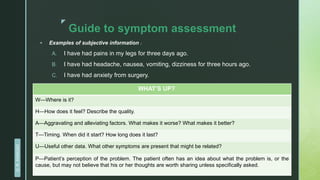
 Examples of subjective information :
A. I have had pains in my legs for three days ago.
B. I have had headache, nausea, vomiting, dizziness for three hours ago.
C. I have had anxiety from surgery.
WHAT’S UP?
W—Where is it?
H—How does it feel? Describe the quality.
A—Aggravating and alleviating factors. What makes it worse? What makes it better?
T—Timing. When did it start? How long does it last?
U—Useful other data. What other symptoms are present that might be related?
P—Patient’s perception of the problem. The patient often has an idea about what the problem is, or the
cause, but may not believe that his or her thoughts are worth sharing unless specifically asked.
D.
R.
KANGAD
z
Types of Data collection by assessment methods
 B. Objective data (also called signs): are observable and measurable data that
are obtained through both physical examination and the result of laboratory and
diagnostic tests. The primary method of collecting objective information is the
physical examination, which provides information about the function of body
systems. Inspection, palpation, percussion, and auscultation techniques are used
to collect objective data.
Examples of objective information include:
1. Temperature (37.3°C), Pulse rate (100 b/m), Respiration (18 T/m), Blood pressure
(130/76 mm/hg).
2. Positive bowel sounds.
3. Flushed face.
z
Validating the data
 Objective information may add to or validate subjective information. Validation is a
critical step in data collection to avoid omissions, prevent misunderstandings, and
avoid incorrect inferences and conclusions.
z
Organizing the data:
Data that are collected must be organized to be useful to the health care professional
collecting the data as well as others involved with the client’s care.
Data should be organize through:
A. Data clustering (admission assessment format): is the process to putting the data together in
order to identify areas of the client problems and strengths.
B. Assessment model: is a framework providing a systematic way to organize data such as:
C. Hierarchy of needs: proposes that an individual basic needs (physiological) must be meet before
higher level can be meet.
D. Body system model: organizes data according to tissue and organ function in the various body
systems.
E. Functional health pattern: cluster information about client habitual pattern and any change to
determine if the clients current response is functional or dysfunctional.
F. Theory of self care: based on the client ability to meet self care needs and identifying existing self
care deficits.
z
Interpretation and Documentation of Data
Interpreting the data:
 when data are placed in clusters the nurse can:
A. Distinguish between relevant and irrelevant data.
B. Determine whether and where there are gaps in the data.
C. Identify patterns of cause and effect.
Documenting the data:
 Assessment data must be recorded and reported. The nurse must make a judgment about which
data are to be reported immediately and which data need only to be recorded at that time. Data that
reflect a significant deviation from the normal (for example, rapid heart rate with irregular rhythm,
severe difficulty in breathing, or high levels of anxiety) would need to be reported as well as
recorded. Examples of data that need only to be recorded at the time include a report that prescribed
medication has relieved a headache and a determination that an abdominal dressing is dry and
intact.
 NOTE: Assessment does not end with the initial interview and physical 31 examination. Assessment
is dynamic and continues with each nurse-client 32 interaction.
D.
R.
KANGAD
z
Nursing Diagnosis phase
 Involves further analysis and synthesis of the data that have been collected.
According to the North American Nursing Diagnosis Association (NANDA) a
nursing diagnosis: Is a clinical judgment about individual, family, or
community responses to actual or potential health problems / life processes.
 The nursing diagnoses provide the basis for client care delivered through the
remaining steps. Clients receive both medical and nursing diagnoses.
 A medical diagnosis : Is a clinical judgment by the physician that identifies or
determines a specific disease, condition, or pathological state.
z
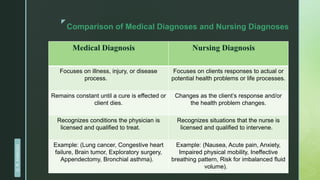
Comparison of Medical Diagnoses and Nursing Diagnoses
Medical Diagnosis Nursing Diagnosis
Focuses on illness, injury, or disease
process.
Focuses on clients responses to actual or
potential health problems or life processes.
Remains constant until a cure is effected or
client dies.
Changes as the client’s response and/or
the health problem changes.
Recognizes conditions the physician is
licensed and qualified to treat.
Recognizes situations that the nurse is
licensed and qualified to intervene.
Example: (Lung cancer, Congestive heart
failure, Brain tumor, Exploratory surgery,
Appendectomy, Bronchial asthma).
Example: (Nausea, Acute pain, Anxiety,
Impaired physical mobility, Ineffective
breathing pattern, Risk for imbalanced fluid
volume).
D.
R.
KANGAD
z
Types of Nursing Diagnoses
1. Actual nursing diagnosis (Actual problems):
A. Indicates that a problem exists.
B. Composed of (diagnostic label, related factors, and signs and
symptoms).
C. Example (Impaired Skin Integrity related to prolonged
pressure on bony prominence as manifested by stage II
pressure ulcer over coccyx, 3 cm in diameter).
z
Types of Nursing Diagnoses
2. Risk nursing diagnosis (Potential problems)
A. Indicates that a problem does not yet exist, but special risk factors are present.
B. A risk diagnosis is composed of the diagnostic label preceded by the phrase “risk for” with the specific
risk factors listed.
C. An example of a risk diagnosis is: (Risk for Impaired Skin Integrity related to inability to turn self
from side to side in bed).
D. A possible (Potential) nursing diagnosis indicates a situation in which a problem could arise unless
preventive action is taken.
E. A possible diagnosis is composed of the diagnostic label and related factors.
F. An example of a possible diagnosis is: (Possible Self-Esteem Disturbance related to recent
retirement and relocation). The nurse may not yet have enough data to confirm this diagnosis or a
more specific one. However, this diagnosis will alert other nurses to collect data that will either confirm
this or another diagnosis, verify a risk diagnosis, or rule out the existence of a problem.
z
Types of Nursing Diagnoses
3. Wellness nursing diagnosis (Wellness conditions):
A. Indicates the client’s expression of a desire to attain a higher level of wellness
in some area of function.
B. Composed of the diagnostic label preceded by the phrase “potential for
enhanced.”
C. For example a client who is neither overweight nor underweight tells the nurse
that she knows she could improve her diet in some ways. She expresses a
desire to know more about how to improve her diet. The nurse would make a
wellness diagnosis of Potential for Enhanced Nutrition.
D.
R.
KANGAD
z
Types of Nursing Diagnoses
3. Collaborative problems:
 Are defined as physiologic complications monitored by nurses to assess changes in
client status. Usually collaborative problems involve alterations in organ and/or
system function or structure (e.g., myocardial infarction, duodenal ulcer).
Collaborative problems begin with the label potential complication followed by the
situation. for example, respiratory are the specific collaborative problems of
potential complication : hypoxemia
z
Planning phase
 Outcome Identification and planning:
 Includes the formulation of guidelines that establish the proposed course of nursing
action in the resolution of nursing diagnoses and the development of the client’s
plan of care.
The planning of nursing care occurs in three phases:
A. Initial planning: Developed by the nurse who performs the admission
assessment and gathers the comprehensive admission assessment data.
B. Ongoing planning: Updating of the client’s plan of care.
C. Discharge planning: Critical anticipation and planning for the client’s needs after
discharge.
z
Planning
The planning phase involves several tasks:
A. Establishing priorities of nursing diagnoses.
B. Setting goals and developing expected outcomes (outcome identification).
C. Planning nursing interventions (with collaboration and consultation as needed).
D. Record the entire nursing care plan in the client record.
There are a number of frameworks used to prioritize nursing diagnoses;
however, those diagnoses involving life-threatening situations are given the highest
priority.
D.
R.
KANGAD
z
Goal
 A goal : is an aim, intent, or end. Goals are broad statements that describe the
intended or desired change in the client’s behavior. Expected outcomes: are
specific objectives related to the goals and are used to evaluate the nursing
interventions. They must be measurable, have a time limit, and be realistic. A
nursing intervention: is the activity that the nurse will perform for and with the
client to enable accomplishment of the goals.
z
Implementation phase
Involves the execution of the nursing care plan derived during planning phase.
It consists of performing nursing activities that have been planned to meet the goals
set with the client. The implementation phase of the nursing process requires cognitive
(intellectual), psychomotor (technical), and interpersonal skills. The nurse must
continue to assess the client’s condition before, during, and after the nursing
intervention.
Nursing implementation activities include:
A. Ongoing assessment.
B. Establishment of priorities.
C. Allocation of resources.
D. Initiation of nursing interventions.
E. Documentation of interventions and client response.
D.
R.
KANGAD
z
Evaluation phase
 Involves determining whether the goals have been met, partially met, or not met.
1. If the goal has been met, the nurse must then decide whether nursing activities will stop
or continue in order for status to be maintained.
2. If the goal has been partially met or not been met, the nurse must reassess the situation
and change the plan of care accordingly. New problems may be identified at this stage,
and thus the process will start all over again.
There are a number of possible reasons that goals are not met or are only partially
met, including:
a) The initial assessment data were incomplete.
b) The goals and expected outcomes were not realistic.
c) The time frame was too optimistic.
d) The goals and/or the nursing interventions planned were not appropriate 36 for the client.
z
THANK YOU…………….
D.
R.
KANGAD

Nursing process.pptx

  • 1.
    z NURSING PROCESS DIVYESH R. KANGAD NURSINGTUTOR GNS - JUNAGADH NURSING FOUNDATION
  • 2.
    z Nursing process  Nursingprocess is a systematic method of providing care to clients.  The nursing process is a systematic method of planning and providing individualized nursing care.  A process is a series of steps or acts that lead to accomplishment of some goal or purpose. Nursing process: is a systemic method for providing care to 4 clients. The purpose is to provide individualized , holistic, effective client care 5 efficiently. Although the steps of nursing process build on each other, each step 6 overlaps with the previous and subsequent steps. D. R. KANGAD
  • 3.
    z Nursing process  Purposesof nursing process  To identify a client's health status and actual or potential health care problems or needs.  To establish plans to meet the identified needs.  To deliver specific nursing interventions to meet those needs. D. R. KANGAD
  • 4.
    z Benefit Of NursingProcess  Provides an orderly & systematic method for planning & providing care  Enhances nursing efficiency by standardizing nursing practice  Facilitates documentation of care Provides a unity of language for the nursing profession  Nursing Process is economical  Stresses the independent function of nurses  Increases care quality through the use of deliberate actions 8. Provide continuity of care and prevent duplication D. R. KANGAD
  • 5.
    z Purposes of nursingprocess 1. Providing professional, quality nursing care. 2. Directs nursing activities for health promotion, health protection, and disease prevention and is used by nurses in every practice setting and specialty. 3. Provides the basis for critical thinking in nursing. D. R. KANGAD
  • 6.
    z Phases of thenursing process 1. Assessment (of patient's needs). 2. Diagnosis (of human response needs that nurses can deal with). 3. Planning (of patient's care). 4. Implementation (of care). 5. Evaluation (of the implemented care). D. R. KANGAD
  • 7.
    z Assessment  Assessment Isthe first step in the nursing process and includes systemic collection, verification, organization, interpretation (analysis), and documentation of data.  The completeness and correctness of the information obtained during assessment are directly related to the accuracy of the steps that follow.  Assessment involves 6 several steps: 1. Data collection from a variety of sources. 2. Data validation. 3. Organizing the data. 4. Data interpretation (Data analysis). 5. Making initial inferences or impressions. 6. Recording or reporting data. D. R. KANGAD
  • 8.
    z Purpose of assessment Organize a database regarding a client physical, psychological, and emotional health.  Identified of health promoting behaviors and actual or potential health problems.  The nurse can ascertains of the clients about: a. Functional abilities, b. Absence or the presence of dysfunction, c. Normal activities of daily living, and d. Lifestyle pattern.  Identifying the client strengths gives the nurse information about the abilities, behavior, and skills the client can use during the treatment and recovery process.  Provides an opportunity to form a therapeutic interpersonal relationship with clients.  The client can discuss health care concerns and goals with the nurse. D. R. KANGAD
  • 9.
    z Type of assessment The information needed for assessment is usually determined by health care setting and needs of the clients. Three types of assessment includes: 1. Comprehensive assessment: A. Provide baseline of client data including a complete health history and current needs assessment. B. Usually completed upon admission to health care agency. C. Changes in the clients health status can be measured against this database. D. Includes of clients physical and psychological health, perception of health, presence of health risk factors, and coping patterns.
  • 10.
    z Type of assessment 2.Focused assessment: A. Is limited to potential health care risks, a particular need, or health care concern. B. There are not as a detailed as comprehensive assessment. C. Often used when short stays are anticipated (e.g., outpatient surgery and emergency departments). D. Used in specialty areas such as mental health settings and delivery. E. Used in screening for specific problems or risk factors. 3. Ongoing assessment: A. Follow up , or monitoring of specific problems. B. Broadens the database and allow the nurse to confirm the validity of data obtained during the initial assessment. C. Systematic monitoring allows the nurse to determine the clients response to nursing interventions and to identify any other problems.
  • 11.
    z Sources of Datacollection by assessment methods 1. Primary sources: the client should be considered the primary source of data. As much information as possible should be gathered from the client, using both interview techniques and physical examination skills. 2. Secondary sources: data source from other than the client are considered secondary sources (family members, other health care providers, and medical records).
  • 12.
    z Types of Datacollection by assessment methods A. Subjective data (also called symptoms): Subjective data are data from the client’s point of view (provided verbally by the patient) and include feelings, perceptions, and concerns. Interview is the primarily method of collecting subjective information. Steps of collecting subjective data: 1. Begin with the patient’s main concern (chief complain ). 2. Reason of seeking health care. The question, “What happened that made you decide to come to the hospital (clinic, office)?” 3. Use the letters of the “WHAT’S UP?” questioning format to remember questions to ask the patient, 4. Obtain a patient history by asking the patient and family questions about patient’s past and present health problems, including specific questions about each body system, family health problems, and risk factors for health problems. The patient’s medical record may also be consulted for 1 background history information.
  • 13.
    z Guide to symptomassessment  Examples of subjective information : A. I have had pains in my legs for three days ago. B. I have had headache, nausea, vomiting, dizziness for three hours ago. C. I have had anxiety from surgery. WHAT’S UP? W—Where is it? H—How does it feel? Describe the quality. A—Aggravating and alleviating factors. What makes it worse? What makes it better? T—Timing. When did it start? How long does it last? U—Useful other data. What other symptoms are present that might be related? P—Patient’s perception of the problem. The patient often has an idea about what the problem is, or the cause, but may not believe that his or her thoughts are worth sharing unless specifically asked. D. R. KANGAD
  • 14.
    z Types of Datacollection by assessment methods  B. Objective data (also called signs): are observable and measurable data that are obtained through both physical examination and the result of laboratory and diagnostic tests. The primary method of collecting objective information is the physical examination, which provides information about the function of body systems. Inspection, palpation, percussion, and auscultation techniques are used to collect objective data. Examples of objective information include: 1. Temperature (37.3°C), Pulse rate (100 b/m), Respiration (18 T/m), Blood pressure (130/76 mm/hg). 2. Positive bowel sounds. 3. Flushed face.
  • 15.
    z Validating the data Objective information may add to or validate subjective information. Validation is a critical step in data collection to avoid omissions, prevent misunderstandings, and avoid incorrect inferences and conclusions.
  • 16.
    z Organizing the data: Datathat are collected must be organized to be useful to the health care professional collecting the data as well as others involved with the client’s care. Data should be organize through: A. Data clustering (admission assessment format): is the process to putting the data together in order to identify areas of the client problems and strengths. B. Assessment model: is a framework providing a systematic way to organize data such as: C. Hierarchy of needs: proposes that an individual basic needs (physiological) must be meet before higher level can be meet. D. Body system model: organizes data according to tissue and organ function in the various body systems. E. Functional health pattern: cluster information about client habitual pattern and any change to determine if the clients current response is functional or dysfunctional. F. Theory of self care: based on the client ability to meet self care needs and identifying existing self care deficits.
  • 17.
    z Interpretation and Documentationof Data Interpreting the data:  when data are placed in clusters the nurse can: A. Distinguish between relevant and irrelevant data. B. Determine whether and where there are gaps in the data. C. Identify patterns of cause and effect. Documenting the data:  Assessment data must be recorded and reported. The nurse must make a judgment about which data are to be reported immediately and which data need only to be recorded at that time. Data that reflect a significant deviation from the normal (for example, rapid heart rate with irregular rhythm, severe difficulty in breathing, or high levels of anxiety) would need to be reported as well as recorded. Examples of data that need only to be recorded at the time include a report that prescribed medication has relieved a headache and a determination that an abdominal dressing is dry and intact.  NOTE: Assessment does not end with the initial interview and physical 31 examination. Assessment is dynamic and continues with each nurse-client 32 interaction. D. R. KANGAD
  • 18.
    z Nursing Diagnosis phase Involves further analysis and synthesis of the data that have been collected. According to the North American Nursing Diagnosis Association (NANDA) a nursing diagnosis: Is a clinical judgment about individual, family, or community responses to actual or potential health problems / life processes.  The nursing diagnoses provide the basis for client care delivered through the remaining steps. Clients receive both medical and nursing diagnoses.  A medical diagnosis : Is a clinical judgment by the physician that identifies or determines a specific disease, condition, or pathological state.
  • 19.
    z Comparison of MedicalDiagnoses and Nursing Diagnoses Medical Diagnosis Nursing Diagnosis Focuses on illness, injury, or disease process. Focuses on clients responses to actual or potential health problems or life processes. Remains constant until a cure is effected or client dies. Changes as the client’s response and/or the health problem changes. Recognizes conditions the physician is licensed and qualified to treat. Recognizes situations that the nurse is licensed and qualified to intervene. Example: (Lung cancer, Congestive heart failure, Brain tumor, Exploratory surgery, Appendectomy, Bronchial asthma). Example: (Nausea, Acute pain, Anxiety, Impaired physical mobility, Ineffective breathing pattern, Risk for imbalanced fluid volume). D. R. KANGAD
  • 20.
    z Types of NursingDiagnoses 1. Actual nursing diagnosis (Actual problems): A. Indicates that a problem exists. B. Composed of (diagnostic label, related factors, and signs and symptoms). C. Example (Impaired Skin Integrity related to prolonged pressure on bony prominence as manifested by stage II pressure ulcer over coccyx, 3 cm in diameter).
  • 21.
    z Types of NursingDiagnoses 2. Risk nursing diagnosis (Potential problems) A. Indicates that a problem does not yet exist, but special risk factors are present. B. A risk diagnosis is composed of the diagnostic label preceded by the phrase “risk for” with the specific risk factors listed. C. An example of a risk diagnosis is: (Risk for Impaired Skin Integrity related to inability to turn self from side to side in bed). D. A possible (Potential) nursing diagnosis indicates a situation in which a problem could arise unless preventive action is taken. E. A possible diagnosis is composed of the diagnostic label and related factors. F. An example of a possible diagnosis is: (Possible Self-Esteem Disturbance related to recent retirement and relocation). The nurse may not yet have enough data to confirm this diagnosis or a more specific one. However, this diagnosis will alert other nurses to collect data that will either confirm this or another diagnosis, verify a risk diagnosis, or rule out the existence of a problem.
  • 22.
    z Types of NursingDiagnoses 3. Wellness nursing diagnosis (Wellness conditions): A. Indicates the client’s expression of a desire to attain a higher level of wellness in some area of function. B. Composed of the diagnostic label preceded by the phrase “potential for enhanced.” C. For example a client who is neither overweight nor underweight tells the nurse that she knows she could improve her diet in some ways. She expresses a desire to know more about how to improve her diet. The nurse would make a wellness diagnosis of Potential for Enhanced Nutrition. D. R. KANGAD
  • 23.
    z Types of NursingDiagnoses 3. Collaborative problems:  Are defined as physiologic complications monitored by nurses to assess changes in client status. Usually collaborative problems involve alterations in organ and/or system function or structure (e.g., myocardial infarction, duodenal ulcer). Collaborative problems begin with the label potential complication followed by the situation. for example, respiratory are the specific collaborative problems of potential complication : hypoxemia
  • 24.
    z Planning phase  OutcomeIdentification and planning:  Includes the formulation of guidelines that establish the proposed course of nursing action in the resolution of nursing diagnoses and the development of the client’s plan of care. The planning of nursing care occurs in three phases: A. Initial planning: Developed by the nurse who performs the admission assessment and gathers the comprehensive admission assessment data. B. Ongoing planning: Updating of the client’s plan of care. C. Discharge planning: Critical anticipation and planning for the client’s needs after discharge.
  • 25.
    z Planning The planning phaseinvolves several tasks: A. Establishing priorities of nursing diagnoses. B. Setting goals and developing expected outcomes (outcome identification). C. Planning nursing interventions (with collaboration and consultation as needed). D. Record the entire nursing care plan in the client record. There are a number of frameworks used to prioritize nursing diagnoses; however, those diagnoses involving life-threatening situations are given the highest priority. D. R. KANGAD
  • 26.
    z Goal  A goal: is an aim, intent, or end. Goals are broad statements that describe the intended or desired change in the client’s behavior. Expected outcomes: are specific objectives related to the goals and are used to evaluate the nursing interventions. They must be measurable, have a time limit, and be realistic. A nursing intervention: is the activity that the nurse will perform for and with the client to enable accomplishment of the goals.
  • 27.
    z Implementation phase Involves theexecution of the nursing care plan derived during planning phase. It consists of performing nursing activities that have been planned to meet the goals set with the client. The implementation phase of the nursing process requires cognitive (intellectual), psychomotor (technical), and interpersonal skills. The nurse must continue to assess the client’s condition before, during, and after the nursing intervention. Nursing implementation activities include: A. Ongoing assessment. B. Establishment of priorities. C. Allocation of resources. D. Initiation of nursing interventions. E. Documentation of interventions and client response. D. R. KANGAD
  • 28.
    z Evaluation phase  Involvesdetermining whether the goals have been met, partially met, or not met. 1. If the goal has been met, the nurse must then decide whether nursing activities will stop or continue in order for status to be maintained. 2. If the goal has been partially met or not been met, the nurse must reassess the situation and change the plan of care accordingly. New problems may be identified at this stage, and thus the process will start all over again. There are a number of possible reasons that goals are not met or are only partially met, including: a) The initial assessment data were incomplete. b) The goals and expected outcomes were not realistic. c) The time frame was too optimistic. d) The goals and/or the nursing interventions planned were not appropriate 36 for the client.
  • 29.