THE NURSING
PROCESS
UNDERSTANDING
SAPHAN C. AGABA
BScN, MSc.HPE
UGANDA CHRISTIAN UNIVERSITY
Ⓒ2022
DEFINITION.
•Nursing process is a critical
thinking process that professional
nurses use to apply the best
available evidence to caregiving
and promoting human functions
and responses to health and
illness (American Nurses
Association, 2010)
DEFINITION Cont’d.
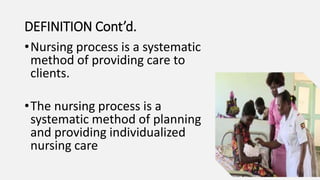
•Nursing process is a systematic
method of providing care to
clients.
•The nursing process is a
systematic method of planning
and providing individualized
nursing care
The nursing process the nurse
helps to;
Identify a client’s health status and actual or
potential health care problems or needs.
Establish plans to meet the identified needs.
Deliver specific nursing interventions to meet
those needs
Components/Steps of the
Nursing Process
ADPIE
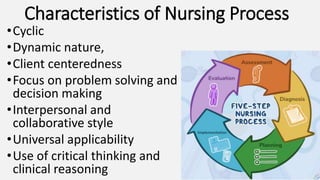
Characteristics of Nursing Process
•Cyclic
•Dynamic nature,
•Client centeredness
•Focus on problem solving and
decision making
•Interpersonal and
collaborative style
•Universal applicability
•Use of critical thinking and
clinical reasoning
Assessment is the
systematic and
continuous collection,
organization,
validation, and
documentation of data
(information)
Types of assessment
•The four different types of assessments are;
1. Initial nursing assessment
2. Problem-focused assessment
3. Emergency assessment
4. Time-lapsed reassessment/partial continuous
Several months after initial assessment. To compare the client’s
current health status with the data previously obtained
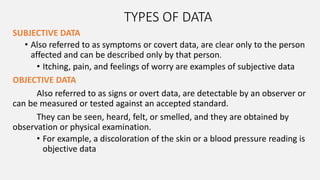
TYPES OF DATA
SUBJECTIVE DATA
• Also referred to as symptoms or covert data, are clear only to the person
affected and can be described only by that person.
• Itching, pain, and feelings of worry are examples of subjective data
OBJECTIVE DATA
Also referred to as signs or overt data, are detectable by an observer or
can be measured or tested against an accepted standard.
They can be seen, heard, felt, or smelled, and they are obtained by
observation or physical examination.
• For example, a discoloration of the skin or a blood pressure reading is
objective data
Organization of data
•The nurse uses a format that organizes
the assessment data systematically.
•This is often referred to as nursing
health history or nursing assessment
form
Validation of data
•The information gathered during the
assessment is “double-checked” or
verified to confirm that it is accurate
and complete
Documentation of data
•To complete the assessment phase, the
nurse records client data.
•Accurate documentation is essential and
should include all data collected about
the client’s health status
Diagnosis is the second
phase of the nursing
process.
In this phase, nurses use
critical thinking skills to
interpret assessment data
to identify client
problems.
North American Nursing Diagnosis
Association (NANDA) defines the
diagnoses
NURSING DIAGNOSIS
•The official NANDA definition of a nursing
diagnosis is:
“a clinical judgment concerning a human
response to health conditions/life
processes, or a vulnerability for that
response, by an individual, family, group,
or community”
TYPES of the Nursing Diagnosis
•ACTUAL NDx – a client problem that is present at the
time of the nursing assessment.
•RISK/POTENTIAL NDx – a clinical judgement that a
problem does not exist, but the presence of risk factors
indicates that a problem may develop if adequate care is
not given
•HEALTH PROMOTION NDX – relates to clients’
preparedness to improve their health condition
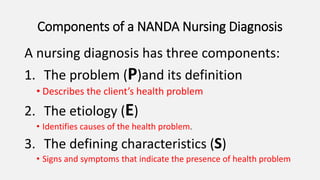
Components of a NANDA Nursing Diagnosis
A nursing diagnosis has three components:
1. The problem (P)and its definition
• Describes the client’s health problem
2. The etiology (E)
• Identifies causes of the health problem.
3. The defining characteristics (S)
• Signs and symptoms that indicate the presence of health problem
Formulating Diagnostic Statements
The Nursing diagnosis = P+E+S
PROBLEM [P] Etiology [E] Evidence (defining
characteristics)
ACUTE ABDOMINAL PAIN
Acute inflammation of the
appendix,
• Guarding
• Patient assuming a bent
position to relieve the
pain
• Patient verbalizing a
9/10 pain scale
• Flushed patient face
• Patient sighing
NURSING DIAGNOSIS VS MEDICAL DIAGNOSIS
NURSING DIAGNOSIS MEDICAL DIAGNOSIS
A nursing diagnosis is a statement of
nursing judgment that made by nurse,
by their education, experience, and
expertise, are licensed to treat.
A medical diagnosis is made by a
physician.
Nursing diagnoses may change as
the client’s responses change.
A client’s medical diagnosis
remains the same for as long as the
disease is present
Nursing diagnoses describe the human
response to an illness or a health
problem.
Medical diagnoses refer to disease
processes
PLANNING involves
decision making and
problem solving.
• It is the process of
formulating client
goals and designing
the nursing
interventions
required to prevent,
reduce, or eliminate
the client’s health
problems
CARE
THE PLANNING PROCESS
•Setting priorities
•Establishing client goals/desired outcomes
•Selecting nursing interventions and
activities
•Writing individualized nursing interventions
on care plans
SETTING PRIORITIES
• Decide which nursing diagnosis requires attention first, which wil
come next or last.
• The Maslow’s hierarchy of needs helps you to set priorities
THE MASLOW’S
HIERARCHY OF
NEEDS
GOAL & DESIRED OUTCOMES
• After establishing priorities, the nurse set goals
for each nursing diagnosis.
Goals may be;
Short term
Long term
NURSING INTERVENTIONS
A nursing intervention is any treatment, that a
nurse performs to improve patient’s health
•Independent intervention:
• Nurse can, Nurse will, Nurse is silenced to Do
•Dependent Interventions:
• Nurse does under orders or supervision of a physician
•Collaborative interventions:
• Nurse can do in collaboration with others professions
IMPLEMENTATION
•Implementation consists of doing and
documenting the activities
•The process of implementation includes;
•• Implementing the nursing interventions
•• Documenting nursing activities
EVALUATION
• Evaluation is a planned, ongoing, purposeful activity in
which the nurse determines
• (a)the client’s progress toward achievement of
goals/outcomes and
• (b)the effectiveness of the nursing care plan
• The evaluation includes;
• Comparing the data with desired outcomes
• Continuing, modifying, or terminating the nursing care
plan
THANK
YOU

THE Nursing process. 1.3.pptx

  • 1.
    THE NURSING PROCESS UNDERSTANDING SAPHAN C.AGABA BScN, MSc.HPE UGANDA CHRISTIAN UNIVERSITY Ⓒ2022
  • 2.
    DEFINITION. •Nursing process isa critical thinking process that professional nurses use to apply the best available evidence to caregiving and promoting human functions and responses to health and illness (American Nurses Association, 2010)
  • 3.
    DEFINITION Cont’d. •Nursing processis a systematic method of providing care to clients. •The nursing process is a systematic method of planning and providing individualized nursing care
  • 4.
    The nursing processthe nurse helps to; Identify a client’s health status and actual or potential health care problems or needs. Establish plans to meet the identified needs. Deliver specific nursing interventions to meet those needs
  • 5.
  • 7.
    Characteristics of NursingProcess •Cyclic •Dynamic nature, •Client centeredness •Focus on problem solving and decision making •Interpersonal and collaborative style •Universal applicability •Use of critical thinking and clinical reasoning
  • 8.
    Assessment is the systematicand continuous collection, organization, validation, and documentation of data (information)
  • 9.
    Types of assessment •Thefour different types of assessments are; 1. Initial nursing assessment 2. Problem-focused assessment 3. Emergency assessment 4. Time-lapsed reassessment/partial continuous Several months after initial assessment. To compare the client’s current health status with the data previously obtained
  • 10.
    TYPES OF DATA SUBJECTIVEDATA • Also referred to as symptoms or covert data, are clear only to the person affected and can be described only by that person. • Itching, pain, and feelings of worry are examples of subjective data OBJECTIVE DATA Also referred to as signs or overt data, are detectable by an observer or can be measured or tested against an accepted standard. They can be seen, heard, felt, or smelled, and they are obtained by observation or physical examination. • For example, a discoloration of the skin or a blood pressure reading is objective data
  • 11.
    Organization of data •Thenurse uses a format that organizes the assessment data systematically. •This is often referred to as nursing health history or nursing assessment form
  • 12.
    Validation of data •Theinformation gathered during the assessment is “double-checked” or verified to confirm that it is accurate and complete
  • 13.
    Documentation of data •Tocomplete the assessment phase, the nurse records client data. •Accurate documentation is essential and should include all data collected about the client’s health status
  • 14.
    Diagnosis is thesecond phase of the nursing process. In this phase, nurses use critical thinking skills to interpret assessment data to identify client problems. North American Nursing Diagnosis Association (NANDA) defines the diagnoses
  • 15.
    NURSING DIAGNOSIS •The officialNANDA definition of a nursing diagnosis is: “a clinical judgment concerning a human response to health conditions/life processes, or a vulnerability for that response, by an individual, family, group, or community”
  • 16.
    TYPES of theNursing Diagnosis •ACTUAL NDx – a client problem that is present at the time of the nursing assessment. •RISK/POTENTIAL NDx – a clinical judgement that a problem does not exist, but the presence of risk factors indicates that a problem may develop if adequate care is not given •HEALTH PROMOTION NDX – relates to clients’ preparedness to improve their health condition
  • 17.
    Components of aNANDA Nursing Diagnosis A nursing diagnosis has three components: 1. The problem (P)and its definition • Describes the client’s health problem 2. The etiology (E) • Identifies causes of the health problem. 3. The defining characteristics (S) • Signs and symptoms that indicate the presence of health problem
  • 18.
    Formulating Diagnostic Statements TheNursing diagnosis = P+E+S PROBLEM [P] Etiology [E] Evidence (defining characteristics) ACUTE ABDOMINAL PAIN Acute inflammation of the appendix, • Guarding • Patient assuming a bent position to relieve the pain • Patient verbalizing a 9/10 pain scale • Flushed patient face • Patient sighing
  • 19.
    NURSING DIAGNOSIS VSMEDICAL DIAGNOSIS NURSING DIAGNOSIS MEDICAL DIAGNOSIS A nursing diagnosis is a statement of nursing judgment that made by nurse, by their education, experience, and expertise, are licensed to treat. A medical diagnosis is made by a physician. Nursing diagnoses may change as the client’s responses change. A client’s medical diagnosis remains the same for as long as the disease is present Nursing diagnoses describe the human response to an illness or a health problem. Medical diagnoses refer to disease processes
  • 20.
    PLANNING involves decision makingand problem solving. • It is the process of formulating client goals and designing the nursing interventions required to prevent, reduce, or eliminate the client’s health problems CARE
  • 21.
    THE PLANNING PROCESS •Settingpriorities •Establishing client goals/desired outcomes •Selecting nursing interventions and activities •Writing individualized nursing interventions on care plans
  • 22.
    SETTING PRIORITIES • Decidewhich nursing diagnosis requires attention first, which wil come next or last. • The Maslow’s hierarchy of needs helps you to set priorities
  • 23.
  • 24.
    GOAL & DESIREDOUTCOMES • After establishing priorities, the nurse set goals for each nursing diagnosis. Goals may be; Short term Long term
  • 25.
    NURSING INTERVENTIONS A nursingintervention is any treatment, that a nurse performs to improve patient’s health •Independent intervention: • Nurse can, Nurse will, Nurse is silenced to Do •Dependent Interventions: • Nurse does under orders or supervision of a physician •Collaborative interventions: • Nurse can do in collaboration with others professions
  • 27.
    IMPLEMENTATION •Implementation consists ofdoing and documenting the activities •The process of implementation includes; •• Implementing the nursing interventions •• Documenting nursing activities
  • 28.
    EVALUATION • Evaluation isa planned, ongoing, purposeful activity in which the nurse determines • (a)the client’s progress toward achievement of goals/outcomes and • (b)the effectiveness of the nursing care plan • The evaluation includes; • Comparing the data with desired outcomes • Continuing, modifying, or terminating the nursing care plan
  • 29.