LOGO
LOGO
NURSING
MANAGEMENT
DURINGTHE
POSTPARTUM PERIOD
Riski Oktafia, M.Kep., Ns., Sp.Kep.Mat
PSIK-FKIK-UMY-BLOK MATERNITAS-2021
Contents
Assessment
Nursing Diagnosa
Nursing Care Plan
Discussion
Postpartum period
• The postpartum period is a time of major
adjustments and adaptations not just for the
mother, but for all members of the family.
• It is during this time that parenting starts and
a relationship with the newborn begins.
• A positive, loving relationship between
parents and their newborn promotes the
emotional well-being of all.
Nursing management during the postpartum
• Nursing management during the postpartum period
focuses on assessing the woman’s ability to adapt to
the physiologic and psychological changes occurring
• Nurses need to be aware of these behaviors so they
can perform appropriate interventions. Steps to
address physiologic needs such as comfort, self-care,
nutrition, and contraception are described.
• Ways to help the woman and her family adapt to the
birth of the newborn
Cont...
• Once the infant is born, each system in the mother’s body
takes several weeks to return to its nonpregnant state.
• The physiologic changes in women during the postpartum
period are dramatic.
• Nurses should be aware of these changes and should be
able to make observations and assessments to validate
normal occurrences and detect any deviations.
• In addition to physical assessment and care of the woman
in the postpartum period, strong social support is vital to
help her integrate the baby into the family.
Goal of postpartum care
• Assist and support the woman’s recovery,
assess and identify deviations from the norm
& educate the mother about her own self care
and infant care
• During the fourth stage of labor the woman is
closely observed for hemorrhage and
hypovolemic shock
• After the initial dangers of hemorrhage and
shock have passed the primary postpartum
danger is infection
Postpartum assessment
Postpartum assessment typically is performed
as follows:
• During the first hour: every 15 minutes
• During the second hour: every 30 minutes
• During the first 24 hours: every 4 hours
• After 24 hours: every 8 hours
Postpartum assessment
• During each assessment, keep in mind risk factors
that may lead to complications, such as infection or
hemorrhage, during the recovery period
• Early identification is critical to ensure prompt
intervention.
• As with any assessment, always review the
woman’s medical record for information about her
pregnancy, labor, and birth.
• Note any preexisting conditions, any complications
that occurred during pregnancy, labor, birth, and
immediately afterward, and any treatments
provided.
Postpartum assessment
• Vital signs
• Pain level,
• A systematic head-to-toe review of body
systems → BUBBLEHEED
breasts, uterus, bladder, bowels, lochia,
episiotomy/ perineum, Homan sign/
extremities, emotional status, education and
diastasis reacti
Assessment
• Assessment of a postpartum woman includes:
Health History
Physical examination
Analysis of laboratory findings
Health History
• The technical aspects of a woman’s
pregnancy, labor, and birth can be learned
from her pregnancy, labor, and birth charts.
• Most of this information is best obtained from
a woman herself
Health Hystory → Family Profile
• Information for a family profile includes:
type of housing
and community
setting
socioeconomic
occupation
support persons
education level
other children
age
Pregnancy History
Information for a pregnancy history includes:
• gravida status
• expected date of birth
• whether the pregnancy was planned
• any problems or complications such as
spotting or pregnancy-induced
hypertension that occurred
Labor and Birth History
It is important to gather information:
• the length of labor
• position of the fetus
• type of birth
• any analgesia or anesthesia used
• problems during labor such as fetal distress
Infant Data
• The sex and weight of the infant
• any difficulty at birth such as the need for
resuscitation
• plans to breastfeed or formula feed
• any congenital anomalies present
Postpartum Course
• Ask about a woman’s general health;
• A her activity level since the birth;
• A description of lochia;
• The presence of perineal, abdominal, or
breast pain;
• Difficulty with elimination;
• Success with infant feeding;
• Response of her support person to parenting.
Laboratory Data
• Women routinely have their hemoglobin and
hematocrit levels measured 12 to 24 hours after birth
→ If the hemoglobin finding is lower than 10 g/100
mL, supplementary iron is usually prescribed.
• Take note of the laboratory reports on a postpartum
woman, and make certain that any abnormal finding,
such as low hemoglobin, is brought to the attention of
the woman’s physician or nurse-midwife.
• If a woman required catheterization during labor or
had a urinary tract infection during pregnancy, a
urinalysis or urine culture may be ordered in the
postpartum period.
RETROGRESSIVE CHANGES OF THE
PUERPERIUM
Temperature Pulse Respiration
Blood
pressure
After pain
Vital Signs
Physical
Assessment
Physical Assessment
BUBBLEHEED Assessment
➢Breasts
➢Uterus
➢Bladder
➢Bowel
➢Lochia
➢Episiotomy/ Perineum
➢Homan’s Sign/ extremities
➢Emotional Status
➢Education
➢Diastasis Recti
Physical Assessment → head to toe
HAIR
• Palpate the woman’s hair to determine its
firmness and strength; whenever a diet is full
• of nutrients, hair is firm and crisp, whereas if a
woman’s intake during pregnancy
wasdeficient in nutrients,
Physical Assessment → head to toe
Face
• Assess the woman’s face for evidence of
edema such as puffy eyelids or a prominent
fold of tissue inferior to the lower eyelid.
Physical Assessment → head to toe
Eyes
• Inspect the color and texture of the inner
conjunctiva.
• If a woman is dehydrated, the area appears
dry.
• The conjunctiva of a woman who is anemic
from poor pregnancy nutrition or excessive
blood loss is pale.
Breasts
➢ Palpate both breasts for engorgement/filling. Minimize palpation
for bottle feeding mother to avoid stimulation.
➢ Check nipples for pressure sores, cracks, or fissures. Evaluate
whether nipples are everted, flat, or inverted.
➢ All mothers should wear a supportive bra 24 hours a day for the
first few days postpartum.
➢ Engorgement-- usually occurs 2-3 days post-partum.
Teach mother to:
• apply warm packs or K-pad 15-20 minutes pre-nursing
• try a warm shower before nursing
• ice bags and/or binders for non-nursing mothers
Uterus
• The fundus is palpated for the following:
➢ Height-- Record finger widths above or below the umbilicus.
❖ Fundus descends 1 fingerbreadth each day
➢ Position-- Fundus should be midline near the umbilicus
→ A full bladder may push the fundus to the R or L of the umbilicus
and cause the pt’s flow to be heavier.
➢ Tone → Fundus should remain firm
FUNDAL ASSESSMENT
Uterine involution
The uterus decreases in size at a
predictable rate during the postpartal
period.
After 10 days, it recedes
under the pubic bone and is no longer
palpable.
After pains
• In some women, contraction of the uterus after birth causes
intermittent cramping similar to that accompanying a
menstrual period.
• They tend to be noticed most by multiparas rather than
primiparas and by women who have given birth to large
babies or had an over distended uterus for any other reason.
• In these situations, the uterus must contract more forcefully
to regain its prepregnancy size and has difficulty maintaining
a steady contracted state.
• These sensations are noticed most intensely with breast-
feeding, when the infant's sucking causes a release of
oxytocin from the posterior pituitary, increasing the strength
of the contractions.
Nursing Interventions in case of After pain
• Lying in a prone position with a small pillow
under the abdomen will help decrease the
discomfort.
• Encourage the mother to empty her bladder
before she breastfeeds. An empty bladder will
allow the uterus to contract more efficiently
and decreases the discomfor
Diastasis Recti
• What to assess?
– Diastisis Recti
• Abdominal wall separates during pregnancy
– Have pt. do mini sit up and will palpate and visually inspect
abdomen
» Diastisis recti can be seen as a little hill in the center of the
abdomen and with palpation will feel separated
» Measured in fingerbreadths of separation
• What to teach?
– Importance of pp exercise—one link
– Responds to exercise within 2-3 months
• Chin lifts
– Separation of diastisis recti becomes less apparent
with time
C-SECTION
• C-SECTION: If the patient had a C-Section,
inspect the dressing or incision at this time
noting site, redness, discharge, and
approximation of the incision if uncovered.
Don't forget to check for bowel sounds.
Bladder
Assess the following
➢ Accompany mother and record first 2 voidings.
(More if voiding less than 150cc each time)
➢ Palpate for distention above the symphysis pubis
➢ 6-8 hours post-delivery → eliminasi
➢ How often and how much.. Is bladder distended?
(A) Assessing
bladder filling by palpation.
(B) Assessing bladder filling by
percussion.
Bowel
• Assess for presence of Bowel Sounds
• palpate abdomen for distension
• Spontaneous bowel movements may not occur for 2
to 3 days after giving birth because of a decrease in
muscle tone in the intestines during labor.
• Normal patterns of bowel elimination usually return
within 8 to 14 days after birth
• If no bowel movement by the second day, she may
need a stool softener or a laxative.
• Encourage increase in fluid and juices along with
increasing intake of fruits and vegetables.
Ambulation helps too.
Lochia
Type of Lochia Color Postpartal Day Composition
Lochia rubra Blood, Red 1–3 fragments of decidua, and
mucus
Lochia serosa Pink 4–10 Blood, mucus, and invading
leukocytes
Lochia alba White 11–14 (may last 6
weeks)
Largely mucus; leukocyte
count high
➢check the lochia for color, amount, odor, and the number of
pads used
➢If the lochia has a foul odor, then be suspicious of an
infection
Lochia- how to esstimate amounts
The amount of lochia is described:
• Scant: a 1- to 2-inch lochia stain on the
perineal pad or approximately a 10-mL
loss
• Light or small: an approximately 4-inch
stain or a 10- to 25-mL loss
• Moderate: a 4- to 6-inch stain with an
estimated loss of 25 to 50 mL
• Large or heavy: a pad is saturated
within 1 hour after changing it
Episiotomy and perineum
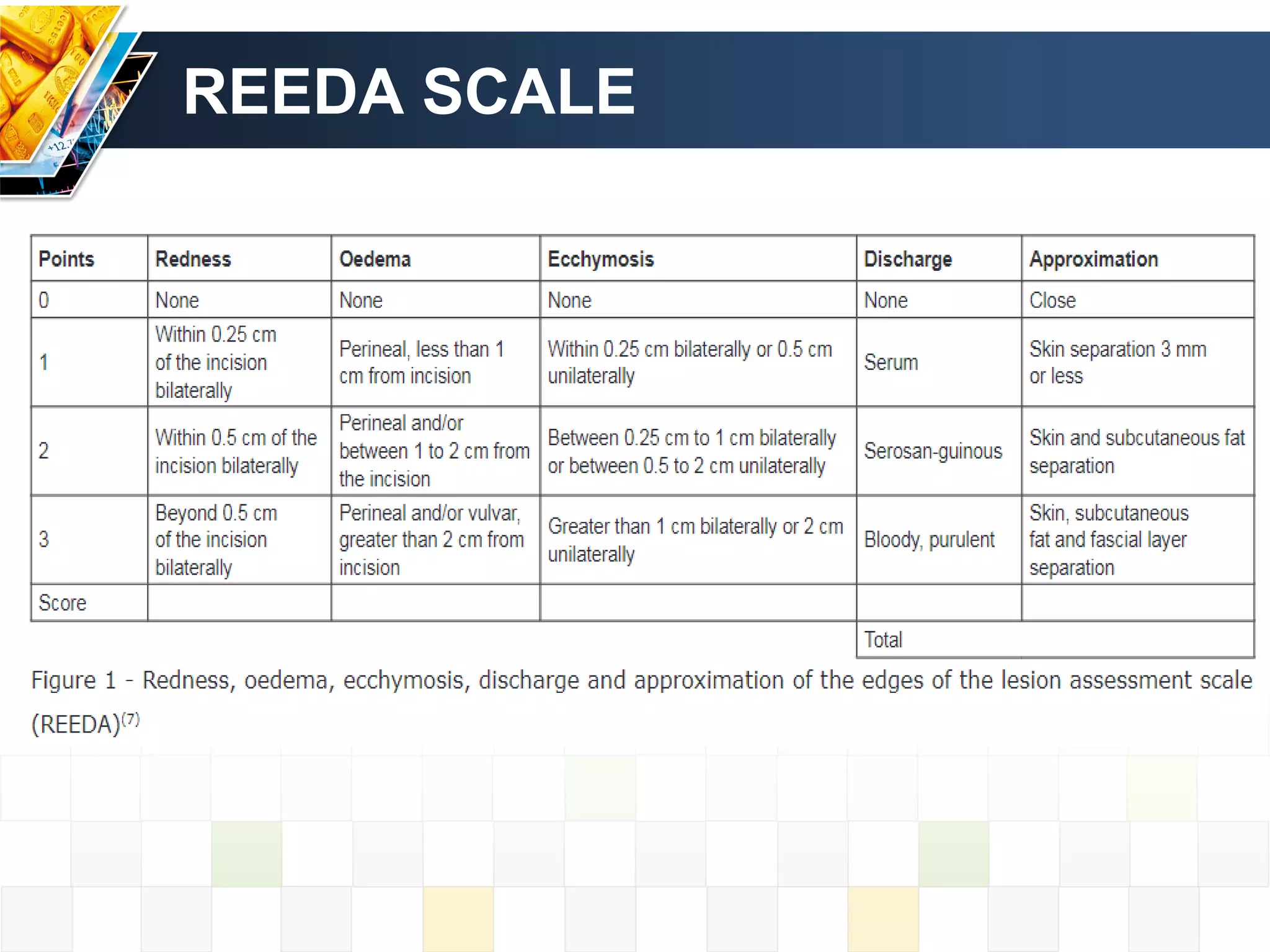
➢Assess using REEDA every shift
R=redness
E-edema
E=ecchymosis
D=discharge
A=approximation
➢Assess for presence of
hemorrhoids
REEDA SCALE
Homan’s Sign/ extremities
• Assess daily for redness, nodular or warm
areas
• Assess Homan’s Sign shift
• Extremities → edema & varices
Edema
Emotional Status
Taking in
Taking Hold
Letting Go
EDUCATION/TEACHING:
• Talk with your mom during the assessment,
and teach her the things about her care as you
go along.
• EXAMPLE: Peri care when checking the
perineum
• Rationale for sitz bath and peri light
• Use of local analgesics
• Hemorrhoid treatment,
• Rationale for ambulation especially if a C-
section, etc.
Physichologic Assessment
• “Postpartum blues” are a normal accompaniment to
childbirth. You can assure a woman that such feelings are
normal and offer supportive care until the emotion passes.
• Postpartum Depression (PPD) refers to mental obstacles of
delivery women after 6 week, including depression, sorrow,
irritability, or even illusion and delusion.
• The severe one even damaged children and committed
suicide.
• More than half of delivery women had instable emotions
after delivery.
• EPDS (Edinburgh Postnatal Depression Scale)
• Reva Rubin →emotional status ( Taking in, Taking Hold,
Latting Go)
Danger signs in the Post Partum Period
• Return of vaginal bleeding esp. > 1 pad/hour or large
clots
• Fever >38C with or without chills after 1st 24 hours
• Increased vaginal discharge, especially if foul-
smelling
• Swollen, red area on leg (thrombophlebitis)
• Swollen, red, tender area on breast (mastitis)
• Dysuria, increased frequency and pressure with
urination (UTI)
• Persistent perineal or pelvic pain (chorioamnionitis)
Postpartum Nursing Care
• Maintain physiologic integrity—assess vitals signs,
fundal height and firmness, lochia color and amt, etc. using
BUBBLEHED assessment technique.
• Nurture the Mother—essential nursing role is to help
her transition to motherhood smoothly
• Comfort & Rest—
– Perineal care—careful hygiene, use of sitz bath, use of
anesthetic spray and witch hazel pads, use of donut pillow
prn
Comfort measures (cont’d)
• Hemorrhoids—use of topical cream prn, sitz bath, donut ring
prn, avoid straining with BM, avoid sitting up for long periods.
• Afterpains—encourage massage of uterus, use of relaxation
and breathing techniques, anticipatory analgesic management
based on assessed pt. status. Know side effects of analgesics and
teach as needed.
• Rest—organize care to allow for rest periods. Encourage mom
to sleep when baby sleeps and limit visitors. Don’t lift anything
heavier than baby.
Other Education topics
• Perineal care
• Bowel and bladder function
• Nutrition—no fad diets, prenatal vitamins daily esp. if
breastfeeding, 6-8 glasses of water/day
• Early ambulation
• Bathing—showers only, start with breasts, no soap, then
shower as usual cleansing perineum last with clean
washcloth. Use peri-shower if available
• Exercise—see earlier link
• Breast care (will be discussed later)
Anticipatory Guidance
• Postpartum follow-up visits—4-6 wks for vaginal
delivery, 1 wks for C/S
• Infant development and care
• Physical recovery
• Sexuality and contraception
• Role changes
Postnatal Discharge Planning
• Rest when infant is sleeping
• Hygiene: A woman may take either tub baths or showers.
cleanse her perineum from front to back. Any perineal stitches
will be absorbed within 10 days.
• Avoid heaving lifting or heavy house work for 4 weeks, Limit
exercise and activities
• Sexual intercourse is avoided for 4- 6 weeks, a lubricant should
be used
• Use of a contraceptive
• Follow up with MD in about 4-6 weeks
• Exercise Beginning the second week, if her lochial discharge is
normal, she may start to increase this activity.
Pengabdian masyarakat
• Gerakan tanggap sehat reproduksi (taseksi)
pada masa postpartum melalui kader
posyandu di wilayah sambikerep kasihan
bantul diy
• Gerakan Peduli Sehat Reproduksi Wanita
(Gelis P-San) Di Masa Pandemi Covid-19
Sebagai Upaya Peningkatan Kesehatan Pada
Wanita Di Padukuhan Ngentak Bangunjiwo
Kasihan Bantul Yogyakarta
Research
• Bonding Attachment
• Faktor Determinan Parenting Self Effikasi Pada
Ibu Postpartum
• Anxiety Postpartum
• Sexsual Postpartum
• Fatigue Postpartum
Nursing Diagnosis
• Postpartum discomfort
• Risk Hypovolemia
• Risk for infection
• Risk for haemorhage
• Breasftfeeding
• Constipation
• Elimination
• Readiness to increase to become parents
Nursing Interventions
• Promoting Comfort
• Assisting With Elimination
• Promoting Activity, Rest, and Exercise
• Preventing Stress Incontinence
• Assisting With Self-Care Measures
• Promoting Nutrition
• Counseling About Sexuality
• Contraception
• Breastfeeding counseling
Nursing Care Plan
DIAGNOSIS
KEPERAWATAN
SLKI SIKI
EBN
Ketidaknyama
nan Pasca
Partum b.d
Trauma
perineum dan
kondisi pasca
persalinan d.d
Nyeri pasca
persalinan
Status Kenyamanan Pasca
Partum
Setelah dilakukan tindakan
keperawatan 1x24 jam
Status Kenyamanan Pasca
Partum meningkat dengan
kriteria hasil :
- Keluhan tidak nyaman
menurun
- Meringis/ merintih
menurun
- Luka episiotomi/laseerasi
membaik
- Payudara bengkak
menurun
- Frekuensi nadi membaik
Manajemen Nyeri
Observasi
- Observasi karakteristik nyeri
Terapeutik
- Berikan teknik non farmakologis untuk
mengurangi nyeri (relaksasi, aromaterapi
dan kompres dingin)
Edukasi
- Jelaskan strategi mengurangi nyeri
- Ajarkan teknik non farmakologis
mengurangi nyeri
Kolaborasi
- Kolaborasi analgetik, jika perlu
Perawatan Pasca Persalinan
Observasi
- Monitor TTV ibu
- Monitor karakteristik Lochea
- Periksa adanya laserasi perineum
- Monitor nyeri
Terapeutik
- Dukung ibu melakukan mobilisasi
Edukasi
- Ajarkan cara perawatan perineum
(selalu menjaga area genital tetap
bersih, mencuci dengan air dingin,
mengganti pembalut dan celana tiap 4
jam)
Kolaborasi
Puteri, Risa
Ersivitasari and Wahyuni,
Endah Sri and Fatmawati,
Siti (2020)
Teknik Relaksasi Nafas Dalam
dan Aromaterapi Lavender
Untuk Mengurangi Nyeri
Perineum Pada Ibu Post
Partum
Dalam jurnal tersebut
dijelaskan bahwa Hasil
penelitian menunjukkan
bahwa setelah memberikan
asuhan keperawatan dengan
memberikan teknik relaksasi
nafas dalam dan aromaterapi
didapatkan bahwa nyeri yang
dirasakan oleh dua ibu
primipara menurun dari skala
nyeri 2 menjadi 0.
Berdasarkan hasil penelitian
ini diharapkan dapat
memberikan pemahaman
bagi ibu primipara. Ibu
tentang tindakan non
farmakologis dalam
mengatasi nyeri merupakan
teknik relaksasi nafas dalam
yang efektif mengatasi
ketidaknyamanan pasca
melahirkan.
Nursing Care Plan
M
Menyusui Tidak
Efektif
Status Menyusui
Setelah dilakukan tindakan
keperawatan selama 2x24 jam
Status Menyusui meningkat
dengan kriteria hasil :
- Perlekatan bayi pada
payudara ibu meningkat
- Kemampuan ibu
memposisikan bayi
dengan benar meningkat
- Miksi bayi lebih dari 8x
sehari
- Pancaran ASI meningkat
Edukasi Menyusui
Observasi
- Identifikasi keinginan dan tujuan menyusui
Terapeutik
- Jadwalkan pendidikan keseahtan
- Berikan kesempatan untuk bertanya
- Dukung ibu meningkatkan keperacyaan diri
Edukasi
- Berikan konseling menyusui
- Jelaskan manfaat menyusui bagi ibu
- Ajarkan 4 posisi menyusui dan perlekatan dengan
benar
- Anjurkan perawatan payudara postpartum
(memerah ASI, pijat payudara dan pijat oksitosin
Pendampingan Proses Menyusui
Observasi
- Monitor kemampuan ibu menyusui
- Monitor kemampuan bayi menyusu
Terapeutik
- Dampingi ibu selama proses menyusui
berlangsung
- Dampingi ibu memposisikan bayi secara benar
untuk menyusui
- Diskusikan masalah selama menyusui
Edukasi
- Ajarkan ibu tanda-tanda bayi siap menyusu
- Ajarkan ibu mengolesi asi pada puting sebelum
dan sesudah menyusui
- Ajarkan ibu cara mengarahkan putih ke mulut
bayi
- Ajarkan ibu cara memposisikan bayi
- Ajarkan perlekatan dnegan benar
Evi Rinata, Tutik Rusdyati, Putri
Anjar Sari (2016)
Teknik Menyusui Posisi, Perlekatan
Dan Keefektifan Menghisap - Studi
Pada Ibu Menyusui Di Rsud
Sidoarjo.
Dalam jurnal tersebut dijelaskan
bahwa Masalah payudara ada
hubungan signifikan dengan
perlekatan (P=0,000). Usia gestasi
ada hubungan dengan perlekatan
(P=0,001) dan keefektifan
menghisap (P=0,000). Simpulan
pada penelitian ini yaitu tidak ada
hubungan antara usia ibu, dengan
teknik menyusui. Ada hubungan
antara paritas, pendidikan, status
pekerjaan, masalah payudara, usia
gestasi dengan teknik menyusui.
Diharapkan petugas kesehatan
meningkatkan pemberian
informasi, bimbingan,
pendampingan, dan dukungan
secara optimal kepada setiap ibu
menyusui, sehingga dapat
mencapai keberhasilan menyusui.
Readiness
to increase
to become
parents
Setelah dilakukan asuhan
keperawatan selama 1 x 24 jam
diharapkan Peran menjadi orang
tua membaik dengan kriteria
hasil :
- Keinginan meningkatkan
peran menjadi orang tua
meningkat dari yang
menginginkan dibimbing
oleh orang tua saja menjadi
ingin mendapatkan
informasi dari bidan atau
tenaga kesehatan untuk
menjadi seorang ibu.
Edukasi orang tua : Fase Bayi :
- Identifikasi pengetahuan orang
tua dan kesiapan orang tua
belajar tentang perawatan bayi
- Motivasi orang tua untuk
sering membaca buku atau
internet terkait bayi dan
menjadi orang tua yang baik.
- Jelaskan kebutuhan nutrisi
bayi
- Jelaskan keamanan dan
pencegahan cedera pada bayi
- Anjurkan menyentuh,
memeluk, mengajak bayi
berbicara , dan bermain
dengan bayi.
Ratnawati, A., &
Afiyanti, Y. (2014).
Efektivitas Edukasi
Postpartum
terhadap
Pencapaian Peran
Orangtua pada
Primipara. Jurnal
Teknologi
Kesehatan, 10(2),
63-67.
Dalam jurnal ini
mengatkan bahwa
edukasi post
partum pada ibu
sangat bermanfaat
untuk
mengembangkan
kemampuan
menjadi ibu.
IRK → Breasfeeding
• Para ibu hendaklah menyusukan anak-anaknya selama dua tahun penuh, yaitu
bagi yang ingin menyempurnakan penyusuan. Dan kewajiban ayah memberi
makan dan pakaian kepada para ibu dengan cara ma´ruf. Seseorang tidak dibebani
melainkan menurut kadar kesanggupannya. Janganlah seorang ibu menderita
kesengsaraan karena anaknya dan seorang ayah karena anaknya, dan warispun
berkewajiban demikian. Apabila keduanya ingin menyapih (sebelum dua tahun)
dengan kerelaan keduanya dan permusyawaratan, maka tidak ada dosa atas
keduanya. Dan jika kamu ingin anakmu disusukan oleh orang lain, maka tidak ada
dosa bagimu apabila kamu memberikan pembayaran menurut yang patut.
Bertakwalah kamu kepada Allah dan ketahuilah bahwa Allah Maha Melihat apa
yang kamu kerjakan. (Q.S.al-Baqarah :233)
References
• American Academy of Pediatrics and American College of Obstetricians and Gynecologists.
(2007). Guidelines for perinatal care (6th ed.). Washington, DC: Author.
• https://nursekey.com/12-postpartum-assessment-and-nursing-care/
• Cooper, M., Grywalski, M., Lamp, J., Newhouse, L., & Studlien, R. (2007). Enhancing cultural
competence: A model for nurses. Nursing for Women’s Health, 11(2), 148-159.
• Cunningham, F., Leveno, K., Bloom, S., Hauth, J., Gilstrap, L., & Wenstrom, K. (2015).
• Pilliteri, A .(2017). Maternal and child health nursing: Care of the childbearing and childbering
family 6th ed. Philadephia: Lippincott
• Reeder, Martin, Koniak – Grifin. (2003). Keperawatan Maternitas: Kesehatan wanita, bayi dan
keluarga volume 1 edisi 18. Buku terjemahan ( Afiyanti Yati, Rachmawati Imami Nur,
Djuwitaningsih Sri, Penterjemah). Jakarta: EGC buku asli di terbitkan pada tahun 1997
• Ricci, Susan Scott. (2013). Essentials of Maternity, Newborn and Women’s Health Nursing. 2nd
. China: Lippincott William & Wilkins
• Attilakos, G., & Overton, T. G. (2012). Antenatal care. In D. K. Edmonds (Ed.), Dewhurst’s
textbook of obstetrics & gynaecology (6th ed., pp. 42–52). Oxford, United Kingdom:
Wiley.http://thepoint.lww.com/Flagg8e
LOGO
LOGO
Riski Oktafia, M.Kep.Ns., Sp.Kep.Mat
085762211774
alhamduliah

NURSING MANAGEMENT DURINGTHE POSTPARTUM PERIOD 2021.pdf

  • 1.
    LOGO LOGO NURSING MANAGEMENT DURINGTHE POSTPARTUM PERIOD Riski Oktafia,M.Kep., Ns., Sp.Kep.Mat PSIK-FKIK-UMY-BLOK MATERNITAS-2021
  • 2.
  • 3.
    Postpartum period • Thepostpartum period is a time of major adjustments and adaptations not just for the mother, but for all members of the family. • It is during this time that parenting starts and a relationship with the newborn begins. • A positive, loving relationship between parents and their newborn promotes the emotional well-being of all.
  • 4.
    Nursing management duringthe postpartum • Nursing management during the postpartum period focuses on assessing the woman’s ability to adapt to the physiologic and psychological changes occurring • Nurses need to be aware of these behaviors so they can perform appropriate interventions. Steps to address physiologic needs such as comfort, self-care, nutrition, and contraception are described. • Ways to help the woman and her family adapt to the birth of the newborn
  • 5.
    Cont... • Once theinfant is born, each system in the mother’s body takes several weeks to return to its nonpregnant state. • The physiologic changes in women during the postpartum period are dramatic. • Nurses should be aware of these changes and should be able to make observations and assessments to validate normal occurrences and detect any deviations. • In addition to physical assessment and care of the woman in the postpartum period, strong social support is vital to help her integrate the baby into the family.
  • 6.
    Goal of postpartumcare • Assist and support the woman’s recovery, assess and identify deviations from the norm & educate the mother about her own self care and infant care • During the fourth stage of labor the woman is closely observed for hemorrhage and hypovolemic shock • After the initial dangers of hemorrhage and shock have passed the primary postpartum danger is infection
  • 7.
    Postpartum assessment Postpartum assessmenttypically is performed as follows: • During the first hour: every 15 minutes • During the second hour: every 30 minutes • During the first 24 hours: every 4 hours • After 24 hours: every 8 hours
  • 8.
    Postpartum assessment • Duringeach assessment, keep in mind risk factors that may lead to complications, such as infection or hemorrhage, during the recovery period • Early identification is critical to ensure prompt intervention. • As with any assessment, always review the woman’s medical record for information about her pregnancy, labor, and birth. • Note any preexisting conditions, any complications that occurred during pregnancy, labor, birth, and immediately afterward, and any treatments provided.
  • 9.
    Postpartum assessment • Vitalsigns • Pain level, • A systematic head-to-toe review of body systems → BUBBLEHEED breasts, uterus, bladder, bowels, lochia, episiotomy/ perineum, Homan sign/ extremities, emotional status, education and diastasis reacti
  • 10.
    Assessment • Assessment ofa postpartum woman includes: Health History Physical examination Analysis of laboratory findings
  • 11.
    Health History • Thetechnical aspects of a woman’s pregnancy, labor, and birth can be learned from her pregnancy, labor, and birth charts. • Most of this information is best obtained from a woman herself
  • 12.
    Health Hystory →Family Profile • Information for a family profile includes: type of housing and community setting socioeconomic occupation support persons education level other children age
  • 13.
    Pregnancy History Information fora pregnancy history includes: • gravida status • expected date of birth • whether the pregnancy was planned • any problems or complications such as spotting or pregnancy-induced hypertension that occurred
  • 14.
    Labor and BirthHistory It is important to gather information: • the length of labor • position of the fetus • type of birth • any analgesia or anesthesia used • problems during labor such as fetal distress
  • 15.
    Infant Data • Thesex and weight of the infant • any difficulty at birth such as the need for resuscitation • plans to breastfeed or formula feed • any congenital anomalies present
  • 16.
    Postpartum Course • Askabout a woman’s general health; • A her activity level since the birth; • A description of lochia; • The presence of perineal, abdominal, or breast pain; • Difficulty with elimination; • Success with infant feeding; • Response of her support person to parenting.
  • 17.
    Laboratory Data • Womenroutinely have their hemoglobin and hematocrit levels measured 12 to 24 hours after birth → If the hemoglobin finding is lower than 10 g/100 mL, supplementary iron is usually prescribed. • Take note of the laboratory reports on a postpartum woman, and make certain that any abnormal finding, such as low hemoglobin, is brought to the attention of the woman’s physician or nurse-midwife. • If a woman required catheterization during labor or had a urinary tract infection during pregnancy, a urinalysis or urine culture may be ordered in the postpartum period.
  • 18.
    RETROGRESSIVE CHANGES OFTHE PUERPERIUM Temperature Pulse Respiration Blood pressure After pain Vital Signs
  • 19.
  • 20.
    Physical Assessment BUBBLEHEED Assessment ➢Breasts ➢Uterus ➢Bladder ➢Bowel ➢Lochia ➢Episiotomy/Perineum ➢Homan’s Sign/ extremities ➢Emotional Status ➢Education ➢Diastasis Recti
  • 21.
    Physical Assessment →head to toe HAIR • Palpate the woman’s hair to determine its firmness and strength; whenever a diet is full • of nutrients, hair is firm and crisp, whereas if a woman’s intake during pregnancy wasdeficient in nutrients,
  • 22.
    Physical Assessment →head to toe Face • Assess the woman’s face for evidence of edema such as puffy eyelids or a prominent fold of tissue inferior to the lower eyelid.
  • 23.
    Physical Assessment →head to toe Eyes • Inspect the color and texture of the inner conjunctiva. • If a woman is dehydrated, the area appears dry. • The conjunctiva of a woman who is anemic from poor pregnancy nutrition or excessive blood loss is pale.
  • 24.
    Breasts ➢ Palpate bothbreasts for engorgement/filling. Minimize palpation for bottle feeding mother to avoid stimulation. ➢ Check nipples for pressure sores, cracks, or fissures. Evaluate whether nipples are everted, flat, or inverted. ➢ All mothers should wear a supportive bra 24 hours a day for the first few days postpartum. ➢ Engorgement-- usually occurs 2-3 days post-partum. Teach mother to: • apply warm packs or K-pad 15-20 minutes pre-nursing • try a warm shower before nursing • ice bags and/or binders for non-nursing mothers
  • 25.
    Uterus • The fundusis palpated for the following: ➢ Height-- Record finger widths above or below the umbilicus. ❖ Fundus descends 1 fingerbreadth each day ➢ Position-- Fundus should be midline near the umbilicus → A full bladder may push the fundus to the R or L of the umbilicus and cause the pt’s flow to be heavier. ➢ Tone → Fundus should remain firm
  • 26.
  • 27.
    Uterine involution The uterusdecreases in size at a predictable rate during the postpartal period. After 10 days, it recedes under the pubic bone and is no longer palpable.
  • 28.
    After pains • Insome women, contraction of the uterus after birth causes intermittent cramping similar to that accompanying a menstrual period. • They tend to be noticed most by multiparas rather than primiparas and by women who have given birth to large babies or had an over distended uterus for any other reason. • In these situations, the uterus must contract more forcefully to regain its prepregnancy size and has difficulty maintaining a steady contracted state. • These sensations are noticed most intensely with breast- feeding, when the infant's sucking causes a release of oxytocin from the posterior pituitary, increasing the strength of the contractions.
  • 29.
    Nursing Interventions incase of After pain • Lying in a prone position with a small pillow under the abdomen will help decrease the discomfort. • Encourage the mother to empty her bladder before she breastfeeds. An empty bladder will allow the uterus to contract more efficiently and decreases the discomfor
  • 30.
    Diastasis Recti • Whatto assess? – Diastisis Recti • Abdominal wall separates during pregnancy – Have pt. do mini sit up and will palpate and visually inspect abdomen » Diastisis recti can be seen as a little hill in the center of the abdomen and with palpation will feel separated » Measured in fingerbreadths of separation • What to teach? – Importance of pp exercise—one link – Responds to exercise within 2-3 months • Chin lifts – Separation of diastisis recti becomes less apparent with time
  • 31.
    C-SECTION • C-SECTION: Ifthe patient had a C-Section, inspect the dressing or incision at this time noting site, redness, discharge, and approximation of the incision if uncovered. Don't forget to check for bowel sounds.
  • 32.
    Bladder Assess the following ➢Accompany mother and record first 2 voidings. (More if voiding less than 150cc each time) ➢ Palpate for distention above the symphysis pubis ➢ 6-8 hours post-delivery → eliminasi ➢ How often and how much.. Is bladder distended? (A) Assessing bladder filling by palpation. (B) Assessing bladder filling by percussion.
  • 33.
    Bowel • Assess forpresence of Bowel Sounds • palpate abdomen for distension • Spontaneous bowel movements may not occur for 2 to 3 days after giving birth because of a decrease in muscle tone in the intestines during labor. • Normal patterns of bowel elimination usually return within 8 to 14 days after birth • If no bowel movement by the second day, she may need a stool softener or a laxative. • Encourage increase in fluid and juices along with increasing intake of fruits and vegetables. Ambulation helps too.
  • 34.
    Lochia Type of LochiaColor Postpartal Day Composition Lochia rubra Blood, Red 1–3 fragments of decidua, and mucus Lochia serosa Pink 4–10 Blood, mucus, and invading leukocytes Lochia alba White 11–14 (may last 6 weeks) Largely mucus; leukocyte count high ➢check the lochia for color, amount, odor, and the number of pads used ➢If the lochia has a foul odor, then be suspicious of an infection
  • 35.
    Lochia- how toesstimate amounts The amount of lochia is described: • Scant: a 1- to 2-inch lochia stain on the perineal pad or approximately a 10-mL loss • Light or small: an approximately 4-inch stain or a 10- to 25-mL loss • Moderate: a 4- to 6-inch stain with an estimated loss of 25 to 50 mL • Large or heavy: a pad is saturated within 1 hour after changing it
  • 36.
    Episiotomy and perineum ➢Assessusing REEDA every shift R=redness E-edema E=ecchymosis D=discharge A=approximation ➢Assess for presence of hemorrhoids
  • 37.
  • 38.
    Homan’s Sign/ extremities •Assess daily for redness, nodular or warm areas • Assess Homan’s Sign shift • Extremities → edema & varices
  • 39.
  • 40.
  • 41.
    EDUCATION/TEACHING: • Talk withyour mom during the assessment, and teach her the things about her care as you go along. • EXAMPLE: Peri care when checking the perineum • Rationale for sitz bath and peri light • Use of local analgesics • Hemorrhoid treatment, • Rationale for ambulation especially if a C- section, etc.
  • 42.
    Physichologic Assessment • “Postpartumblues” are a normal accompaniment to childbirth. You can assure a woman that such feelings are normal and offer supportive care until the emotion passes. • Postpartum Depression (PPD) refers to mental obstacles of delivery women after 6 week, including depression, sorrow, irritability, or even illusion and delusion. • The severe one even damaged children and committed suicide. • More than half of delivery women had instable emotions after delivery. • EPDS (Edinburgh Postnatal Depression Scale) • Reva Rubin →emotional status ( Taking in, Taking Hold, Latting Go)
  • 43.
    Danger signs inthe Post Partum Period • Return of vaginal bleeding esp. > 1 pad/hour or large clots • Fever >38C with or without chills after 1st 24 hours • Increased vaginal discharge, especially if foul- smelling • Swollen, red area on leg (thrombophlebitis) • Swollen, red, tender area on breast (mastitis) • Dysuria, increased frequency and pressure with urination (UTI) • Persistent perineal or pelvic pain (chorioamnionitis)
  • 44.
    Postpartum Nursing Care •Maintain physiologic integrity—assess vitals signs, fundal height and firmness, lochia color and amt, etc. using BUBBLEHED assessment technique. • Nurture the Mother—essential nursing role is to help her transition to motherhood smoothly • Comfort & Rest— – Perineal care—careful hygiene, use of sitz bath, use of anesthetic spray and witch hazel pads, use of donut pillow prn
  • 45.
    Comfort measures (cont’d) •Hemorrhoids—use of topical cream prn, sitz bath, donut ring prn, avoid straining with BM, avoid sitting up for long periods. • Afterpains—encourage massage of uterus, use of relaxation and breathing techniques, anticipatory analgesic management based on assessed pt. status. Know side effects of analgesics and teach as needed. • Rest—organize care to allow for rest periods. Encourage mom to sleep when baby sleeps and limit visitors. Don’t lift anything heavier than baby.
  • 46.
    Other Education topics •Perineal care • Bowel and bladder function • Nutrition—no fad diets, prenatal vitamins daily esp. if breastfeeding, 6-8 glasses of water/day • Early ambulation • Bathing—showers only, start with breasts, no soap, then shower as usual cleansing perineum last with clean washcloth. Use peri-shower if available • Exercise—see earlier link • Breast care (will be discussed later)
  • 47.
    Anticipatory Guidance • Postpartumfollow-up visits—4-6 wks for vaginal delivery, 1 wks for C/S • Infant development and care • Physical recovery • Sexuality and contraception • Role changes
  • 48.
    Postnatal Discharge Planning •Rest when infant is sleeping • Hygiene: A woman may take either tub baths or showers. cleanse her perineum from front to back. Any perineal stitches will be absorbed within 10 days. • Avoid heaving lifting or heavy house work for 4 weeks, Limit exercise and activities • Sexual intercourse is avoided for 4- 6 weeks, a lubricant should be used • Use of a contraceptive • Follow up with MD in about 4-6 weeks • Exercise Beginning the second week, if her lochial discharge is normal, she may start to increase this activity.
  • 49.
    Pengabdian masyarakat • Gerakantanggap sehat reproduksi (taseksi) pada masa postpartum melalui kader posyandu di wilayah sambikerep kasihan bantul diy • Gerakan Peduli Sehat Reproduksi Wanita (Gelis P-San) Di Masa Pandemi Covid-19 Sebagai Upaya Peningkatan Kesehatan Pada Wanita Di Padukuhan Ngentak Bangunjiwo Kasihan Bantul Yogyakarta
  • 50.
    Research • Bonding Attachment •Faktor Determinan Parenting Self Effikasi Pada Ibu Postpartum • Anxiety Postpartum • Sexsual Postpartum • Fatigue Postpartum
  • 51.
    Nursing Diagnosis • Postpartumdiscomfort • Risk Hypovolemia • Risk for infection • Risk for haemorhage • Breasftfeeding • Constipation • Elimination • Readiness to increase to become parents
  • 52.
    Nursing Interventions • PromotingComfort • Assisting With Elimination • Promoting Activity, Rest, and Exercise • Preventing Stress Incontinence • Assisting With Self-Care Measures • Promoting Nutrition • Counseling About Sexuality • Contraception • Breastfeeding counseling
  • 53.
    Nursing Care Plan DIAGNOSIS KEPERAWATAN SLKISIKI EBN Ketidaknyama nan Pasca Partum b.d Trauma perineum dan kondisi pasca persalinan d.d Nyeri pasca persalinan Status Kenyamanan Pasca Partum Setelah dilakukan tindakan keperawatan 1x24 jam Status Kenyamanan Pasca Partum meningkat dengan kriteria hasil : - Keluhan tidak nyaman menurun - Meringis/ merintih menurun - Luka episiotomi/laseerasi membaik - Payudara bengkak menurun - Frekuensi nadi membaik Manajemen Nyeri Observasi - Observasi karakteristik nyeri Terapeutik - Berikan teknik non farmakologis untuk mengurangi nyeri (relaksasi, aromaterapi dan kompres dingin) Edukasi - Jelaskan strategi mengurangi nyeri - Ajarkan teknik non farmakologis mengurangi nyeri Kolaborasi - Kolaborasi analgetik, jika perlu Perawatan Pasca Persalinan Observasi - Monitor TTV ibu - Monitor karakteristik Lochea - Periksa adanya laserasi perineum - Monitor nyeri Terapeutik - Dukung ibu melakukan mobilisasi Edukasi - Ajarkan cara perawatan perineum (selalu menjaga area genital tetap bersih, mencuci dengan air dingin, mengganti pembalut dan celana tiap 4 jam) Kolaborasi Puteri, Risa Ersivitasari and Wahyuni, Endah Sri and Fatmawati, Siti (2020) Teknik Relaksasi Nafas Dalam dan Aromaterapi Lavender Untuk Mengurangi Nyeri Perineum Pada Ibu Post Partum Dalam jurnal tersebut dijelaskan bahwa Hasil penelitian menunjukkan bahwa setelah memberikan asuhan keperawatan dengan memberikan teknik relaksasi nafas dalam dan aromaterapi didapatkan bahwa nyeri yang dirasakan oleh dua ibu primipara menurun dari skala nyeri 2 menjadi 0. Berdasarkan hasil penelitian ini diharapkan dapat memberikan pemahaman bagi ibu primipara. Ibu tentang tindakan non farmakologis dalam mengatasi nyeri merupakan teknik relaksasi nafas dalam yang efektif mengatasi ketidaknyamanan pasca melahirkan.
  • 54.
    Nursing Care Plan M MenyusuiTidak Efektif Status Menyusui Setelah dilakukan tindakan keperawatan selama 2x24 jam Status Menyusui meningkat dengan kriteria hasil : - Perlekatan bayi pada payudara ibu meningkat - Kemampuan ibu memposisikan bayi dengan benar meningkat - Miksi bayi lebih dari 8x sehari - Pancaran ASI meningkat Edukasi Menyusui Observasi - Identifikasi keinginan dan tujuan menyusui Terapeutik - Jadwalkan pendidikan keseahtan - Berikan kesempatan untuk bertanya - Dukung ibu meningkatkan keperacyaan diri Edukasi - Berikan konseling menyusui - Jelaskan manfaat menyusui bagi ibu - Ajarkan 4 posisi menyusui dan perlekatan dengan benar - Anjurkan perawatan payudara postpartum (memerah ASI, pijat payudara dan pijat oksitosin Pendampingan Proses Menyusui Observasi - Monitor kemampuan ibu menyusui - Monitor kemampuan bayi menyusu Terapeutik - Dampingi ibu selama proses menyusui berlangsung - Dampingi ibu memposisikan bayi secara benar untuk menyusui - Diskusikan masalah selama menyusui Edukasi - Ajarkan ibu tanda-tanda bayi siap menyusu - Ajarkan ibu mengolesi asi pada puting sebelum dan sesudah menyusui - Ajarkan ibu cara mengarahkan putih ke mulut bayi - Ajarkan ibu cara memposisikan bayi - Ajarkan perlekatan dnegan benar Evi Rinata, Tutik Rusdyati, Putri Anjar Sari (2016) Teknik Menyusui Posisi, Perlekatan Dan Keefektifan Menghisap - Studi Pada Ibu Menyusui Di Rsud Sidoarjo. Dalam jurnal tersebut dijelaskan bahwa Masalah payudara ada hubungan signifikan dengan perlekatan (P=0,000). Usia gestasi ada hubungan dengan perlekatan (P=0,001) dan keefektifan menghisap (P=0,000). Simpulan pada penelitian ini yaitu tidak ada hubungan antara usia ibu, dengan teknik menyusui. Ada hubungan antara paritas, pendidikan, status pekerjaan, masalah payudara, usia gestasi dengan teknik menyusui. Diharapkan petugas kesehatan meningkatkan pemberian informasi, bimbingan, pendampingan, dan dukungan secara optimal kepada setiap ibu menyusui, sehingga dapat mencapai keberhasilan menyusui.
  • 55.
    Readiness to increase to become parents Setelahdilakukan asuhan keperawatan selama 1 x 24 jam diharapkan Peran menjadi orang tua membaik dengan kriteria hasil : - Keinginan meningkatkan peran menjadi orang tua meningkat dari yang menginginkan dibimbing oleh orang tua saja menjadi ingin mendapatkan informasi dari bidan atau tenaga kesehatan untuk menjadi seorang ibu. Edukasi orang tua : Fase Bayi : - Identifikasi pengetahuan orang tua dan kesiapan orang tua belajar tentang perawatan bayi - Motivasi orang tua untuk sering membaca buku atau internet terkait bayi dan menjadi orang tua yang baik. - Jelaskan kebutuhan nutrisi bayi - Jelaskan keamanan dan pencegahan cedera pada bayi - Anjurkan menyentuh, memeluk, mengajak bayi berbicara , dan bermain dengan bayi. Ratnawati, A., & Afiyanti, Y. (2014). Efektivitas Edukasi Postpartum terhadap Pencapaian Peran Orangtua pada Primipara. Jurnal Teknologi Kesehatan, 10(2), 63-67. Dalam jurnal ini mengatkan bahwa edukasi post partum pada ibu sangat bermanfaat untuk mengembangkan kemampuan menjadi ibu.
  • 56.
    IRK → Breasfeeding •Para ibu hendaklah menyusukan anak-anaknya selama dua tahun penuh, yaitu bagi yang ingin menyempurnakan penyusuan. Dan kewajiban ayah memberi makan dan pakaian kepada para ibu dengan cara ma´ruf. Seseorang tidak dibebani melainkan menurut kadar kesanggupannya. Janganlah seorang ibu menderita kesengsaraan karena anaknya dan seorang ayah karena anaknya, dan warispun berkewajiban demikian. Apabila keduanya ingin menyapih (sebelum dua tahun) dengan kerelaan keduanya dan permusyawaratan, maka tidak ada dosa atas keduanya. Dan jika kamu ingin anakmu disusukan oleh orang lain, maka tidak ada dosa bagimu apabila kamu memberikan pembayaran menurut yang patut. Bertakwalah kamu kepada Allah dan ketahuilah bahwa Allah Maha Melihat apa yang kamu kerjakan. (Q.S.al-Baqarah :233)
  • 57.
    References • American Academyof Pediatrics and American College of Obstetricians and Gynecologists. (2007). Guidelines for perinatal care (6th ed.). Washington, DC: Author. • https://nursekey.com/12-postpartum-assessment-and-nursing-care/ • Cooper, M., Grywalski, M., Lamp, J., Newhouse, L., & Studlien, R. (2007). Enhancing cultural competence: A model for nurses. Nursing for Women’s Health, 11(2), 148-159. • Cunningham, F., Leveno, K., Bloom, S., Hauth, J., Gilstrap, L., & Wenstrom, K. (2015). • Pilliteri, A .(2017). Maternal and child health nursing: Care of the childbearing and childbering family 6th ed. Philadephia: Lippincott • Reeder, Martin, Koniak – Grifin. (2003). Keperawatan Maternitas: Kesehatan wanita, bayi dan keluarga volume 1 edisi 18. Buku terjemahan ( Afiyanti Yati, Rachmawati Imami Nur, Djuwitaningsih Sri, Penterjemah). Jakarta: EGC buku asli di terbitkan pada tahun 1997 • Ricci, Susan Scott. (2013). Essentials of Maternity, Newborn and Women’s Health Nursing. 2nd . China: Lippincott William & Wilkins • Attilakos, G., & Overton, T. G. (2012). Antenatal care. In D. K. Edmonds (Ed.), Dewhurst’s textbook of obstetrics & gynaecology (6th ed., pp. 42–52). Oxford, United Kingdom: Wiley.http://thepoint.lww.com/Flagg8e
  • 58.
    LOGO LOGO Riski Oktafia, M.Kep.Ns.,Sp.Kep.Mat 085762211774 alhamduliah