



CARING
MOTHER
DURING
POSTNATAL
PERIOD
RAJOSI KHANRA
Postnatal period begins
immediately after birth of baby
and the placenta is delivered and
lasts up to 6 weeks.
Most of complications, such as
postpartum hemorrhage, sepsis,
uterine prolapse, amniotic fluid
embolism and eclampsia which
may lead to maternal mortality,
occur during this period.
As per WHO's documentation on
‘recommendations on maternal and
newborn care for a positive postnatal
experience’ published in 2022, up to
30% of maternal deaths occur in
postnatal period. The 4th stage of
labor is the 1st hour of postnatal
period and is very crucial for mother
and infant.
Postnatal care is special care
offered to a woman and her
infant during the postnatal
period. It includes routine and
specific clinical examination
and observation of the mother
and baby, routine infant
screening to detect any
abnormalities.
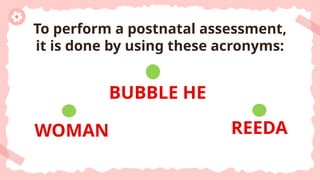
WOMAN
BUBBLE HE
REEDA
To perform a postnatal assessment,
it is done by using these acronyms:
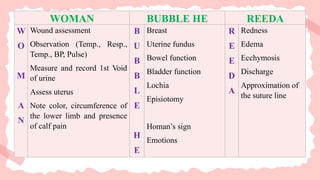
WOMAN BUBBLE HE REEDA
W
O
M
A
N
Wound assessment
Observation (Temp., Resp.,
Temp., BP, Pulse)
Measure and record 1st Void
of urine
Assess uterus
Note color, circumference of
the lower limb and presence
of calf pain
B
U
B
B
L
E
H
E
Breast
Uterine fundus
Bowel function
Bladder function
Lochia
Episiotomy
Homan’s sign
Emotions
R
E
E
D
A
Redness
Edema
Ecchymosis
Discharge
Approximation of
the suture line
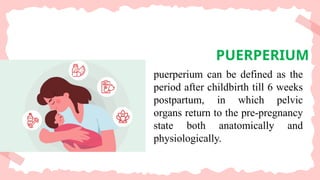
PUERPERIUM
puerperium can be defined as the
period after childbirth till 6 weeks
postpartum, in which pelvic
organs return to the pre-pregnancy
state both anatomically and
physiologically.
PUERPERA
INVOLUTION
SUBINVOLUTION
A woman who is going through
puerperium is termed a puerpera.
It is a term given to a process in which
reproductive organs return to a non-pregnant
state.
When involution is retarded known as
subinvolution.
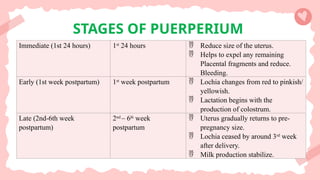
STAGES OF PUERPERIUM
Immediate (1st 24 hours) 1st
24 hours  Reduce size of the uterus.
 Helps to expel any remaining
Placental fragments and reduce.
Bleeding.
Early (1st week postpartum) 1st
week postpartum  Lochia changes from red to pinkish/
yellowish.
 Lactation begins with the
production of colostrum.
Late (2nd-6th week
postpartum)
2nd
– 6th
week
postpartum
 Uterus gradually returns to pre-
pregnancy size.
 Lochia ceased by around 3rd
week
after delivery.
 Milk production stabilize.
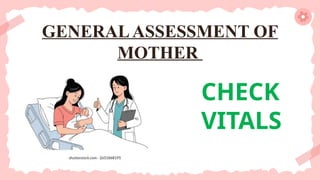
GENERALASSESSMENT OF
MOTHER
CHECK
VITALS
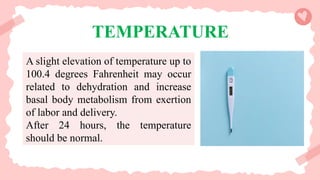
TEMPERATURE
A slight elevation of temperature up to
100.4 degrees Fahrenheit may occur
related to dehydration and increase
basal body metabolism from exertion
of labor and delivery.
After 24 hours, the temperature
should be normal.
PULSE
For a few hours after normal delivery, pulse rate is likely to
be raised, which settle down to normal during second day.
Pulse rate often rises after pain or excitement.
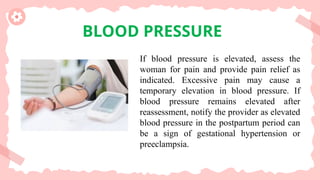
BLOOD PRESSURE
If blood pressure is elevated, assess the
woman for pain and provide pain relief as
indicated. Excessive pain may cause a
temporary elevation in blood pressure. If
blood pressure remains elevated after
reassessment, notify the provider as elevated
blood pressure in the postpartum period can
be a sign of gestational hypertension or
preeclampsia.
• If a decrease in blood pressure (hypotension) is noted,
immediately assess the amount of lochia and watch for signs
of shock such as rapid pulse (tachycardia), confusion,
clammy skin, rapid breathing (tachypnea), decreased pulse
pressure (30 mm Hg or less), weak peripheral pulses,
anxiety, or lightheadedness.
• If hypotension is reassessed, notify the provider to come to
the bedside and call for additional assistance.
UTERUS
 Immediately after expulsion of the placenta, the uterine fundus is palpable
at the level of the maternal umbilicus.
 The uterus shrinks by approximately 1.25-1.5 cm daily so that by 2 weeks,
it descends completely into the true pelvis and cannot be palpated
abdominally. Fundus of uterus reaches symphysis pubis by 10-12 days
following delivery.
 size of uterus changes by:
> Immediately after delivery: 1000 gm
> At 1 week: 500 gm
> At 3 weeks: 100 gm
> At 6 weeks: 60 gm
The size of uterus changes by:
• Immediately after delivery: 1000 gm
• At 1 week: 500 gm
• At 3 weeks: 100 gm
• At 6 weeks: 60 gm
The lower uterine segment also contracts and returns to
normal shape + size of the isthmus.
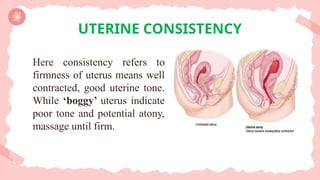
Here consistency refers to
firmness of uterus means well
contracted, good uterine tone.
While ‘boggy’ uterus indicate
poor tone and potential atony,
massage until firm.
UTERINE CONSISTENCY
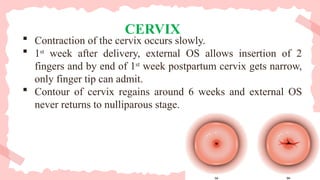
CERVIX
 Contraction of the cervix occurs slowly.
 1st
week after delivery, external OS allows insertion of 2
fingers and by end of 1st
week postpartum cervix gets narrow,
only finger tip can admit.
 Contour of cervix regains around 6 weeks and external OS
never returns to nulliparous stage.
VAGINA
Vagina is smooth, stretchable for a few days after delivery and
involuted by 4-8 weeks. The vagina never gets its tone to a virgin
state.
• Changes in the vagina after a cesarean may differ from those that
follow a vaginal delivery. People who’ve undergone a cesarean
delivery will also experience some vaginal dryness, which is due to
the hormonal effects of the postpartum period. Although mother
may have an abdominal scar, the vaginal recovery process is
quicker, as the area has sustained less damage.
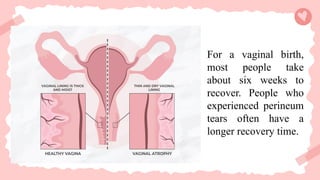
For a vaginal birth,
most people take
about six weeks to
recover. People who
experienced perineum
tears often have a
longer recovery time.
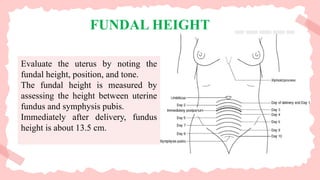
Evaluate the uterus by noting the
fundal height, position, and tone.
The fundal height is measured by
assessing the height between uterine
fundus and symphysis pubis.
Immediately after delivery, fundus
height is about 13.5 cm.
FUNDAL HEIGHT
BLADDER
Bladder distention, incomplete emptying, urine retention, and/or the
inability to void may occur during the first few days postpartum.
Within 12 hours of birth, changes in hormone levels (decreased
estrogen and oxytocin) occur resulting in diuresis. Measure and record
urine output in the first 24 hours post birth. Typically 200-300 ml or
more in the first void. But little or no urine output may indicate urinary
retention.
Provide catheterization if the bladder is distended or woman is unable
to void spontaneously.
BOWEL
During the postpartum period, there is a decrease in gastrointestinal
muscle tone and motility. Normal bowel function should return by the
end of the second postpartum week. In addition to these changes,
decreased activity, hydration, diet, perineal pain, and narcotic
medications increase the risk of constipation. Note the date of her last
bowel movement. This will be helpful information for continued
postpartum care. Auscultate the woman’s bowel sounds in all four
quadrants. The postpartum woman should be able to pass flatus. Notify
the provider if bowel sounds are absent
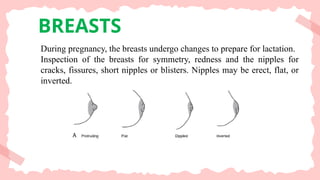
BREASTS
During pregnancy, the breasts undergo changes to prepare for lactation.
Inspection of the breasts for symmetry, redness and the nipples for
cracks, fissures, short nipples or blisters. Nipples may be erect, flat, or
inverted.
Palpation of the breasts for engorgement:
• Breasts should palpate soft and nontender in the first 24
hours.
• Postpartum day 2, the breasts are slightly firm and
nontender as primary engorgement begins.
• Postpartum day 3, the breasts are firm and tender. If
breastfeeding, the breasts may be warm to touch.
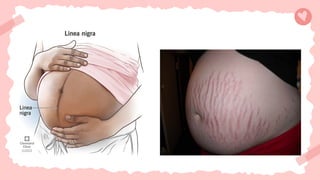
Position mother by keeping pillow under her head
and inspect the shape of abdomen, Linea nigra,
striae gravidarum.
ABDOMEN
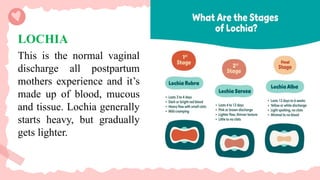
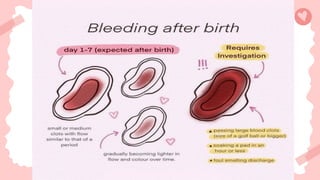
LOCHIA
This is the normal vaginal
discharge all postpartum
mothers experience and it’s
made up of blood, mucous
and tissue. Lochia generally
starts heavy, but gradually
gets lighter.
MENSTURATION AND OVULATION
The onset of the first menstrual period following delivery is very
variable and depends on lactation.
• The mean time for onset of first menstruation is 7-9 weeks.
• If the woman does not breastfeed her baby, menstruation
returns by 6th week following delivery in about 40% and by
12th week in 80% of cases.
• In non lactating mothers, ovulation may occur as early as 4
weeks and in lactating mothers about 10 weeks after delivery.
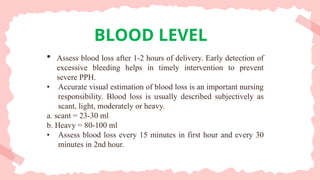
 Assess blood loss after 1-2 hours of delivery. Early detection of
excessive bleeding helps in timely intervention to prevent
severe PPH.
• Accurate visual estimation of blood loss is an important nursing
responsibility. Blood loss is usually described subjectively as
scant, light, moderately or heavy.
a. scant = 23-30 ml
b. Heavy = 80-100 ml
• Assess blood loss every 15 minutes in first hour and every 30
minutes in 2nd hour.
BLOOD LEVEL
GI CHANGES
Immediate afterbirth, intestinal paresis leads to
constipation. Increased thirst is seen in immediate
postpartum period due to perspiration, diuresis, fluid loss
in labor, lochia.
On average there is 2 liters fluid loss within first week of
childbirth. This amount corresponds to fluid retention
during pregnancy, blood and fluid loss during labor.
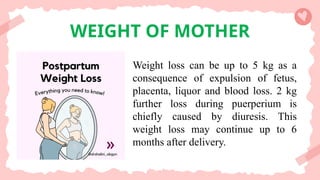
WEIGHT OF MOTHER
Weight loss can be up to 5 kg as a
consequence of expulsion of fetus,
placenta, liquor and blood loss. 2 kg
further loss during puerperium is
chiefly caused by diuresis. This
weight loss may continue up to 6
months after delivery.
CARE OF MOTHERS DURING
POSTNATAL
Immediate attention:
The patient should be closely observed. Emotional
support is essential when she suffers from postpartum
blues/stress due to the newborn's prematurity, illness,
congenital malformation or death.
EARLY AMBULATION OF MOTHER
She must be encouraged to move out of bed as early
ambulation has many benefits such as:
• Less bladder and bowel complication
• Helps in involution
• Reduces risk of embolism and thrombosis
PAIN MANAGEMENT
It is infrequent, spasmodic pain felt in lower abdomen after delivery for
a variable period of 2-4 days. The treatment includes messaging uterus
with expulsion of clot, followed by administration of analgesics and
antispasmodics.
Never forget to examine perineum when analgesic is given to relieve
pain.
• Cold packs should be covered in sterile towel.
• Sitz bath thrice a day.
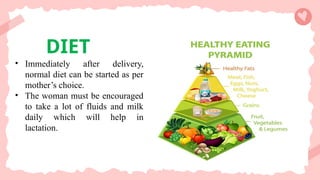
DIET
• Immediately after delivery,
normal diet can be started as per
mother’s choice.
• The woman must be encouraged
to take a lot of fluids and milk
daily which will help in
lactation.
Lactating mothers need high calories, adequate protein, fat,
plenty of fluids. According to the CDC, whether you are a
mother breastfeeding or pumping, you should consume
approximately 2,300 to 2,500 calories per day compared to
1,800 to 2,000 calories for a non-lactating woman. Fresh
seasonal fruits and vegetables are required to meet vitamin
needs.
Iron and calcium supplements are needed for a lactating
mother for at least 3 months.
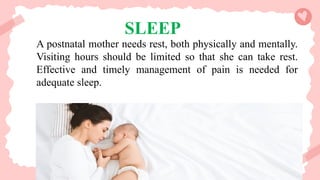
SLEEP
A postnatal mother needs rest, both physically and mentally.
Visiting hours should be limited so that she can take rest.
Effective and timely management of pain is needed for
adequate sleep.
CARE OF BOWEL
Constipation can also be seen in postnatal mothers.
A diet containing sufficient roughage and fluids is
enough to move the bowel.
If necessary, a mild laxative such as Isabgol 2
teaspoons may be given at bedtime.
CARE OF BLADDER
• Mother should be encouraged for passing of
urine as soon as convenient for her.
• If the patient still fails to pass urine,
catheterization should be done.
• Continuous drainage is kept until bladder tone is
regained.
• Also, adequate drainage of urine prevents
infection or cystitis.
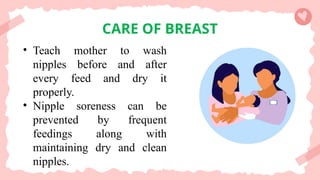
CARE OF BREAST
• Teach mother to wash
nipples before and after
every feed and dry it
properly.
• Nipple soreness can be
prevented by frequent
feedings along with
maintaining dry and clean
nipples.
CARE OF VULVA AND
EPISIOTOMY WOUND
Vulva + Buttocks are washed with water down over the
anus, and a sterile pad is applied. Nurse should use
sterilized gloves during dressing.
Cold sitz bath relieve pain by reducing edema and
inflammation.
when perineal pain is persistent, a vaginal and rectal
examination is done to detect any hematoma, infection.
ASEPSIS AND ANTISEPTICS
• Asepsis must be maintained, especially during 1st Week
of puerperium.
• Liberal use of local antiseptics.
• Use clean linen + clothing are positive steps.
• Clean surroundings and a limited no. of visitors could
be of help in reducing nosocomial infection
CORRECTION OF ANEMIA
supplementary iron therapy should be given daily
for 4-6 weeks.
She should take one IFA tab daily for 3 months.
If she were anemic, recheck her blood Hb level and
if it is less than 11 g/dl, then advise her to take 2
tablets daily for 3 months.
LACTATION SIMULATION
Although lactation starts after the delivery but preparation for effective
breastfeeding starts in pregnancy only.
• From first day of delivery put neonate on breast at 2-3 hours interval
from day one.
• Provide plenty of fluid to the mother.
• Help mother in manual expression of milk to avoid breast
engorgement.
• Drugs to improve milk production:
- Metoclopromide 10 mg thrice daily for increase prolactin level
- Sulpiride also been effective by increasing prolactin level .
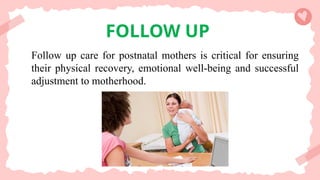
FOLLOW UP
Follow up care for postnatal mothers is critical for ensuring
their physical recovery, emotional well-being and successful
adjustment to motherhood.
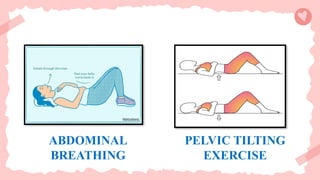
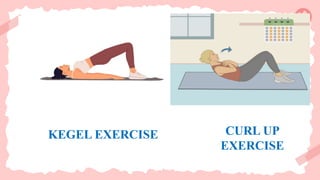
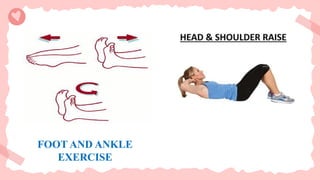
A series of physical exercises that are planned,
structured and repetitive, performed by postnatal
mothers to bring about optimal functioning of all
systems and prevent post labour complications such
as back pain, pelvic pain and general weakness.
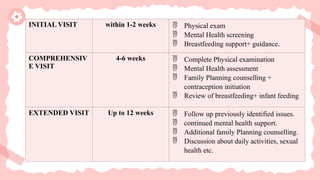
INITIAL VISIT within 1-2 weeks  Physical exam
 Mental Health screening
 Breastfeeding support+ guidance.
COMPREHENSIV
E VISIT
4-6 weeks  Complete Physical examination
 Mental Health assessment
 Family Planning counselling +
contraception initiation
 Review of breastfeeding+ infant feeding
EXTENDED VISIT Up to 12 weeks  Follow up previously identified issues.
 continued mental health support.
 Additional family Planning counselling.
 Discussion about daily activities, sexual
health etc.
ABDOMINAL
BREATHING
PELVIC TILTING
EXERCISE
KEGEL EXERCISE CURL UP
EXERCISE
FOOT AND ANKLE
EXERCISE
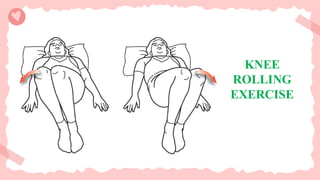
KNEE
ROLLING
EXERCISE
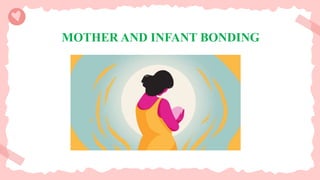
MOTHER AND INFANT BONDING
POSTNATAL
COUNSELLING
Postnatal care includes assessment and
counselling provided to the mother before
discharge after giving birth.
Major elements of Postnatal care include:
• Counselling and health education on
recognition of danger signs and
appropriate care seeking.
• Counselling and health education on
routine care practices such as exclusive
breastfeeding and good thermal care
practices.
• Assessment and case management +
referral for identified complications or
risk conditions.
DANGER SIGNS
Counsel mother to go directly to FRU without waiting if she notices the following
danger signs.
• Excessive bleeding i.e. soaking more than 2-3 pads in 20-30 min. after delivery
• Fever
• Convulsion
• Difficulty in breathing
• Easy fatigue
• Inability to pass urine
• Foul smell of lochia
• Severe abdominal pain
• Leakage of urine
CONTRACEPTION
• Advise couple to obstain from intercourse for 6 weeks postpartum or till
perineal heal.
• If mother wish to have more children then educate them to take 3-4 years
gap between pregnancies. The couple must be educated on different
contraceptive methods available to them.
 lactation amenorrhea
 IUCD
 OCP
 ECP
• If desired number of children have been achieved then
 Female sterilization (tubectomy)
 Non scalpel vasectomy / male sterilization can be done.
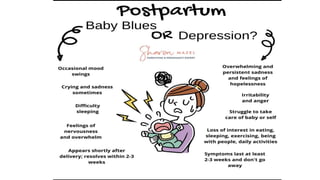
Education on
postnatal blues and postpartum depression
Newborn’s birth can lead to many emotional changes.
Many new mothers go through a period of mild
depression after delivery.
It is important to differentiate between postpartum blues
and postnatal depression.
• Physical Healing: Allows your body to recover from childbirth, promoting wound
healing, and restoring strength and energy levels.
• Emotional Well-being: Provides support and resources to navigate the emotional
challenges of new parenthood, reducing the risk of postpartum depression and
anxiety.
• Mental Clarity: Helps you adjust to the demands of motherhood, promoting mental
clarity and reducing feelings of overwhelm.
• Bonding with Baby: Creates opportunities for skin-to-skin contact, breastfeeding
support, and emotional connection, fostering a strong bond between mother and
child.
• Confident Motherhood: Empowers you with knowledge and self-care strategies,
enabling you to navigate the challenges of motherhood with confidence and
resilience.
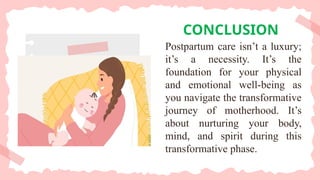
CONCLUSION
Postpartum care isn’t a luxury;
it’s a necessity. It’s the
foundation for your physical
and emotional well-being as
you navigate the transformative
journey of motherhood. It’s
about nurturing your body,
mind, and spirit during this
transformative phase.
CARE DURING POSTNATAL PERIOD / POSTNATAL CARE

CARE DURING POSTNATAL PERIOD / POSTNATAL CARE

  • 1.
  • 3.
    Postnatal period begins immediatelyafter birth of baby and the placenta is delivered and lasts up to 6 weeks. Most of complications, such as postpartum hemorrhage, sepsis, uterine prolapse, amniotic fluid embolism and eclampsia which may lead to maternal mortality, occur during this period.
  • 4.
    As per WHO'sdocumentation on ‘recommendations on maternal and newborn care for a positive postnatal experience’ published in 2022, up to 30% of maternal deaths occur in postnatal period. The 4th stage of labor is the 1st hour of postnatal period and is very crucial for mother and infant.
  • 5.
    Postnatal care isspecial care offered to a woman and her infant during the postnatal period. It includes routine and specific clinical examination and observation of the mother and baby, routine infant screening to detect any abnormalities.
  • 6.
    WOMAN BUBBLE HE REEDA To performa postnatal assessment, it is done by using these acronyms:
  • 7.
    WOMAN BUBBLE HEREEDA W O M A N Wound assessment Observation (Temp., Resp., Temp., BP, Pulse) Measure and record 1st Void of urine Assess uterus Note color, circumference of the lower limb and presence of calf pain B U B B L E H E Breast Uterine fundus Bowel function Bladder function Lochia Episiotomy Homan’s sign Emotions R E E D A Redness Edema Ecchymosis Discharge Approximation of the suture line
  • 8.
    PUERPERIUM puerperium can bedefined as the period after childbirth till 6 weeks postpartum, in which pelvic organs return to the pre-pregnancy state both anatomically and physiologically.
  • 9.
    PUERPERA INVOLUTION SUBINVOLUTION A woman whois going through puerperium is termed a puerpera. It is a term given to a process in which reproductive organs return to a non-pregnant state. When involution is retarded known as subinvolution.
  • 10.
    STAGES OF PUERPERIUM Immediate(1st 24 hours) 1st 24 hours  Reduce size of the uterus.  Helps to expel any remaining Placental fragments and reduce. Bleeding. Early (1st week postpartum) 1st week postpartum  Lochia changes from red to pinkish/ yellowish.  Lactation begins with the production of colostrum. Late (2nd-6th week postpartum) 2nd – 6th week postpartum  Uterus gradually returns to pre- pregnancy size.  Lochia ceased by around 3rd week after delivery.  Milk production stabilize.
  • 11.
  • 12.
    TEMPERATURE A slight elevationof temperature up to 100.4 degrees Fahrenheit may occur related to dehydration and increase basal body metabolism from exertion of labor and delivery. After 24 hours, the temperature should be normal.
  • 13.
    PULSE For a fewhours after normal delivery, pulse rate is likely to be raised, which settle down to normal during second day. Pulse rate often rises after pain or excitement.
  • 14.
    BLOOD PRESSURE If bloodpressure is elevated, assess the woman for pain and provide pain relief as indicated. Excessive pain may cause a temporary elevation in blood pressure. If blood pressure remains elevated after reassessment, notify the provider as elevated blood pressure in the postpartum period can be a sign of gestational hypertension or preeclampsia.
  • 15.
    • If adecrease in blood pressure (hypotension) is noted, immediately assess the amount of lochia and watch for signs of shock such as rapid pulse (tachycardia), confusion, clammy skin, rapid breathing (tachypnea), decreased pulse pressure (30 mm Hg or less), weak peripheral pulses, anxiety, or lightheadedness. • If hypotension is reassessed, notify the provider to come to the bedside and call for additional assistance.
  • 16.
    UTERUS  Immediately afterexpulsion of the placenta, the uterine fundus is palpable at the level of the maternal umbilicus.  The uterus shrinks by approximately 1.25-1.5 cm daily so that by 2 weeks, it descends completely into the true pelvis and cannot be palpated abdominally. Fundus of uterus reaches symphysis pubis by 10-12 days following delivery.  size of uterus changes by: > Immediately after delivery: 1000 gm > At 1 week: 500 gm > At 3 weeks: 100 gm > At 6 weeks: 60 gm
  • 17.
    The size ofuterus changes by: • Immediately after delivery: 1000 gm • At 1 week: 500 gm • At 3 weeks: 100 gm • At 6 weeks: 60 gm The lower uterine segment also contracts and returns to normal shape + size of the isthmus.
  • 18.
    Here consistency refersto firmness of uterus means well contracted, good uterine tone. While ‘boggy’ uterus indicate poor tone and potential atony, massage until firm. UTERINE CONSISTENCY
  • 19.
    CERVIX  Contraction ofthe cervix occurs slowly.  1st week after delivery, external OS allows insertion of 2 fingers and by end of 1st week postpartum cervix gets narrow, only finger tip can admit.  Contour of cervix regains around 6 weeks and external OS never returns to nulliparous stage.
  • 20.
    VAGINA Vagina is smooth,stretchable for a few days after delivery and involuted by 4-8 weeks. The vagina never gets its tone to a virgin state. • Changes in the vagina after a cesarean may differ from those that follow a vaginal delivery. People who’ve undergone a cesarean delivery will also experience some vaginal dryness, which is due to the hormonal effects of the postpartum period. Although mother may have an abdominal scar, the vaginal recovery process is quicker, as the area has sustained less damage.
  • 21.
    For a vaginalbirth, most people take about six weeks to recover. People who experienced perineum tears often have a longer recovery time.
  • 22.
    Evaluate the uterusby noting the fundal height, position, and tone. The fundal height is measured by assessing the height between uterine fundus and symphysis pubis. Immediately after delivery, fundus height is about 13.5 cm. FUNDAL HEIGHT
  • 23.
    BLADDER Bladder distention, incompleteemptying, urine retention, and/or the inability to void may occur during the first few days postpartum. Within 12 hours of birth, changes in hormone levels (decreased estrogen and oxytocin) occur resulting in diuresis. Measure and record urine output in the first 24 hours post birth. Typically 200-300 ml or more in the first void. But little or no urine output may indicate urinary retention. Provide catheterization if the bladder is distended or woman is unable to void spontaneously.
  • 24.
    BOWEL During the postpartumperiod, there is a decrease in gastrointestinal muscle tone and motility. Normal bowel function should return by the end of the second postpartum week. In addition to these changes, decreased activity, hydration, diet, perineal pain, and narcotic medications increase the risk of constipation. Note the date of her last bowel movement. This will be helpful information for continued postpartum care. Auscultate the woman’s bowel sounds in all four quadrants. The postpartum woman should be able to pass flatus. Notify the provider if bowel sounds are absent
  • 25.
    BREASTS During pregnancy, thebreasts undergo changes to prepare for lactation. Inspection of the breasts for symmetry, redness and the nipples for cracks, fissures, short nipples or blisters. Nipples may be erect, flat, or inverted.
  • 26.
    Palpation of thebreasts for engorgement: • Breasts should palpate soft and nontender in the first 24 hours. • Postpartum day 2, the breasts are slightly firm and nontender as primary engorgement begins. • Postpartum day 3, the breasts are firm and tender. If breastfeeding, the breasts may be warm to touch.
  • 27.
    Position mother bykeeping pillow under her head and inspect the shape of abdomen, Linea nigra, striae gravidarum. ABDOMEN
  • 29.
    LOCHIA This is thenormal vaginal discharge all postpartum mothers experience and it’s made up of blood, mucous and tissue. Lochia generally starts heavy, but gradually gets lighter.
  • 30.
    MENSTURATION AND OVULATION Theonset of the first menstrual period following delivery is very variable and depends on lactation. • The mean time for onset of first menstruation is 7-9 weeks. • If the woman does not breastfeed her baby, menstruation returns by 6th week following delivery in about 40% and by 12th week in 80% of cases. • In non lactating mothers, ovulation may occur as early as 4 weeks and in lactating mothers about 10 weeks after delivery.
  • 31.
     Assess bloodloss after 1-2 hours of delivery. Early detection of excessive bleeding helps in timely intervention to prevent severe PPH. • Accurate visual estimation of blood loss is an important nursing responsibility. Blood loss is usually described subjectively as scant, light, moderately or heavy. a. scant = 23-30 ml b. Heavy = 80-100 ml • Assess blood loss every 15 minutes in first hour and every 30 minutes in 2nd hour. BLOOD LEVEL
  • 33.
    GI CHANGES Immediate afterbirth,intestinal paresis leads to constipation. Increased thirst is seen in immediate postpartum period due to perspiration, diuresis, fluid loss in labor, lochia. On average there is 2 liters fluid loss within first week of childbirth. This amount corresponds to fluid retention during pregnancy, blood and fluid loss during labor.
  • 34.
    WEIGHT OF MOTHER Weightloss can be up to 5 kg as a consequence of expulsion of fetus, placenta, liquor and blood loss. 2 kg further loss during puerperium is chiefly caused by diuresis. This weight loss may continue up to 6 months after delivery.
  • 35.
    CARE OF MOTHERSDURING POSTNATAL Immediate attention: The patient should be closely observed. Emotional support is essential when she suffers from postpartum blues/stress due to the newborn's prematurity, illness, congenital malformation or death.
  • 36.
    EARLY AMBULATION OFMOTHER She must be encouraged to move out of bed as early ambulation has many benefits such as: • Less bladder and bowel complication • Helps in involution • Reduces risk of embolism and thrombosis
  • 37.
    PAIN MANAGEMENT It isinfrequent, spasmodic pain felt in lower abdomen after delivery for a variable period of 2-4 days. The treatment includes messaging uterus with expulsion of clot, followed by administration of analgesics and antispasmodics. Never forget to examine perineum when analgesic is given to relieve pain. • Cold packs should be covered in sterile towel. • Sitz bath thrice a day.
  • 38.
    DIET • Immediately afterdelivery, normal diet can be started as per mother’s choice. • The woman must be encouraged to take a lot of fluids and milk daily which will help in lactation.
  • 39.
    Lactating mothers needhigh calories, adequate protein, fat, plenty of fluids. According to the CDC, whether you are a mother breastfeeding or pumping, you should consume approximately 2,300 to 2,500 calories per day compared to 1,800 to 2,000 calories for a non-lactating woman. Fresh seasonal fruits and vegetables are required to meet vitamin needs. Iron and calcium supplements are needed for a lactating mother for at least 3 months.
  • 41.
    SLEEP A postnatal motherneeds rest, both physically and mentally. Visiting hours should be limited so that she can take rest. Effective and timely management of pain is needed for adequate sleep.
  • 42.
    CARE OF BOWEL Constipationcan also be seen in postnatal mothers. A diet containing sufficient roughage and fluids is enough to move the bowel. If necessary, a mild laxative such as Isabgol 2 teaspoons may be given at bedtime.
  • 43.
    CARE OF BLADDER •Mother should be encouraged for passing of urine as soon as convenient for her. • If the patient still fails to pass urine, catheterization should be done. • Continuous drainage is kept until bladder tone is regained. • Also, adequate drainage of urine prevents infection or cystitis.
  • 44.
    CARE OF BREAST •Teach mother to wash nipples before and after every feed and dry it properly. • Nipple soreness can be prevented by frequent feedings along with maintaining dry and clean nipples.
  • 45.
    CARE OF VULVAAND EPISIOTOMY WOUND Vulva + Buttocks are washed with water down over the anus, and a sterile pad is applied. Nurse should use sterilized gloves during dressing. Cold sitz bath relieve pain by reducing edema and inflammation. when perineal pain is persistent, a vaginal and rectal examination is done to detect any hematoma, infection.
  • 46.
    ASEPSIS AND ANTISEPTICS •Asepsis must be maintained, especially during 1st Week of puerperium. • Liberal use of local antiseptics. • Use clean linen + clothing are positive steps. • Clean surroundings and a limited no. of visitors could be of help in reducing nosocomial infection
  • 47.
    CORRECTION OF ANEMIA supplementaryiron therapy should be given daily for 4-6 weeks. She should take one IFA tab daily for 3 months. If she were anemic, recheck her blood Hb level and if it is less than 11 g/dl, then advise her to take 2 tablets daily for 3 months.
  • 48.
    LACTATION SIMULATION Although lactationstarts after the delivery but preparation for effective breastfeeding starts in pregnancy only. • From first day of delivery put neonate on breast at 2-3 hours interval from day one. • Provide plenty of fluid to the mother. • Help mother in manual expression of milk to avoid breast engorgement. • Drugs to improve milk production: - Metoclopromide 10 mg thrice daily for increase prolactin level - Sulpiride also been effective by increasing prolactin level .
  • 49.
    FOLLOW UP Follow upcare for postnatal mothers is critical for ensuring their physical recovery, emotional well-being and successful adjustment to motherhood.
  • 50.
    A series ofphysical exercises that are planned, structured and repetitive, performed by postnatal mothers to bring about optimal functioning of all systems and prevent post labour complications such as back pain, pelvic pain and general weakness.
  • 51.
    INITIAL VISIT within1-2 weeks  Physical exam  Mental Health screening  Breastfeeding support+ guidance. COMPREHENSIV E VISIT 4-6 weeks  Complete Physical examination  Mental Health assessment  Family Planning counselling + contraception initiation  Review of breastfeeding+ infant feeding EXTENDED VISIT Up to 12 weeks  Follow up previously identified issues.  continued mental health support.  Additional family Planning counselling.  Discussion about daily activities, sexual health etc.
  • 52.
  • 53.
  • 54.
  • 55.
  • 56.
  • 57.
    POSTNATAL COUNSELLING Postnatal care includesassessment and counselling provided to the mother before discharge after giving birth. Major elements of Postnatal care include: • Counselling and health education on recognition of danger signs and appropriate care seeking. • Counselling and health education on routine care practices such as exclusive breastfeeding and good thermal care practices. • Assessment and case management + referral for identified complications or risk conditions.
  • 59.
    DANGER SIGNS Counsel motherto go directly to FRU without waiting if she notices the following danger signs. • Excessive bleeding i.e. soaking more than 2-3 pads in 20-30 min. after delivery • Fever • Convulsion • Difficulty in breathing • Easy fatigue • Inability to pass urine • Foul smell of lochia • Severe abdominal pain • Leakage of urine
  • 60.
    CONTRACEPTION • Advise coupleto obstain from intercourse for 6 weeks postpartum or till perineal heal. • If mother wish to have more children then educate them to take 3-4 years gap between pregnancies. The couple must be educated on different contraceptive methods available to them.  lactation amenorrhea  IUCD  OCP  ECP • If desired number of children have been achieved then  Female sterilization (tubectomy)  Non scalpel vasectomy / male sterilization can be done.
  • 61.
    Education on postnatal bluesand postpartum depression Newborn’s birth can lead to many emotional changes. Many new mothers go through a period of mild depression after delivery. It is important to differentiate between postpartum blues and postnatal depression.
  • 63.
    • Physical Healing:Allows your body to recover from childbirth, promoting wound healing, and restoring strength and energy levels. • Emotional Well-being: Provides support and resources to navigate the emotional challenges of new parenthood, reducing the risk of postpartum depression and anxiety. • Mental Clarity: Helps you adjust to the demands of motherhood, promoting mental clarity and reducing feelings of overwhelm. • Bonding with Baby: Creates opportunities for skin-to-skin contact, breastfeeding support, and emotional connection, fostering a strong bond between mother and child. • Confident Motherhood: Empowers you with knowledge and self-care strategies, enabling you to navigate the challenges of motherhood with confidence and resilience.
  • 64.
    CONCLUSION Postpartum care isn’ta luxury; it’s a necessity. It’s the foundation for your physical and emotional well-being as you navigate the transformative journey of motherhood. It’s about nurturing your body, mind, and spirit during this transformative phase.