Over 5,36000
women die
annually from
complications
during
pregnancy,
child birth or
the postpartum
period.
Nearly all of
this death
occur in
developing
countries
where fertility
rates are
higher
POSTNATAL CARE
DEFINITION
According to World health organization postnatal care is defined
as a care given to the mother and her newborn baby immediately
after the birth of the placenta and for the first six weeks of life.
To assess the health status of the mother. Medical disorders
like diabetes, hypertension should be reassessed.
To detect and treat at the earliest any gynecological
condition arising out of obstetric legacy.
To note the progress of the baby including the
immunization schedule for the infant.
To impart family planning guidance.
AIMS AND OBJECTIVES
PROCEDURE
Examination of
the mother
Advice
given to
the mother
Examination
of the baby
and advice
EXAMINATION OF MOTHER
Routine examination
Pelvic examination
Laboratory investigations depending on clinical needs
BUBBLE- is a acronym used to denote the components of the
postpartum maternal nursing assessment.
POST NATAL ASSESSMENT
BREAST UTERUS BLADDER
BUBBLE HE
HOMAN’S SIGN
EMOTIONAL STATUS
BOWEL LOCHIA EPISIOTOMY
BREAST EVALUATION
Size Shape Firmness Redness Symmetry
POSTNATAL CARE
UTERUS
UTERUS
Size, Weight , location and firmness
Immediately after delivery , the uterus begins the process of involution or
reduction in size.
At the end of 6th week weighs 50-100g.
A bulky uterus may indicate the presence of blood clots or retained
placental beats.
Normally uterus should be contracted ,hard and not painful if touched.
The height of uterus should be measured.
After the 1st postpartum day ,the fundus involute 1-2 cm. Per day.
BLADDER
In the immediate postpartum period, the bladder is congested , edematous
and hypotonic from the effect of labour .
After delivery , the client should urinate within 4 hours , at least 300 ml ,
with completely emptying the bladder .
Ask mother when last voided
BUBBLEHE Assessment
• Breasts — Soft, filling, firm, Nipples
• Uterus — consistency, position, height
• Bladder — voiding pattern
• Bowels — bowel sounds, hemorrhoids,
• Lochia — type, amt, clots, odor
• Episiotomy— laceration, bruising, swelling
• Homan sign — present or not
• Emotional status — bonding, blues
BOWELS
The patient
should be
encouraged
to drink
should be 6
to 8 glasses
of water
daily.
Eat a high
fiber diet
(whole
grains ,
legumes ,
vegetable
and fruits ).
Sitz bath.
Enema may
be given.
Stool
softener.
.
POSTNATAL CARE
Color
• Depending upon the
variation of the color of
the discharge it is
names as:
• Lochia Rubra
• Lochia serosa
• Lochia Alba (10-15
days ) pale white
POSTNATAL CARE
Sitz bath
with warm
water may
be given.
The
perineum
should be
cleaned
after each
voiding.
Change
pad
frequently.
Perform
perineal
exercises
such as
kegel
exercise.
Care of the
vulval
hematoma
includes
applying ice
packs .
EPISIOTOMY
REEDA
REEDA
HOMAN’S SIGN
Should be perform leg
exercise, to teach the
client to flex and
extends the both leg
and feet alternatively.
Keeping the leg
uncrossed while
seated.
Padding pressure
points during
lithotomy position .
EMOTIONAL STATUS
The immediate postpartum period is an emotional roller coaster.
Mother is exhausted and need sleep and rest to restore their bodies to
health.
In this “taking in phase” mother wish to meet their own rest and nutritional
needs before focusing their energy on newborns.
ENQUIRY TO THE MOTHER
Any excessive PN
bleeding
Puerperal pyrexia
Puerperal sepsis
Involution of the
uterus
Breast
complications:
• Breast
engorgement
Mastitis
• Cracked nipple
Breast abscess
EXAMINATION OF THE BABY
Head to toe
examination
Newborn
reflexes
ENQUIRY ABOUT BABY
Exclusive
breastfeeding
Keep baby
warm
Dry and wrap Immunization
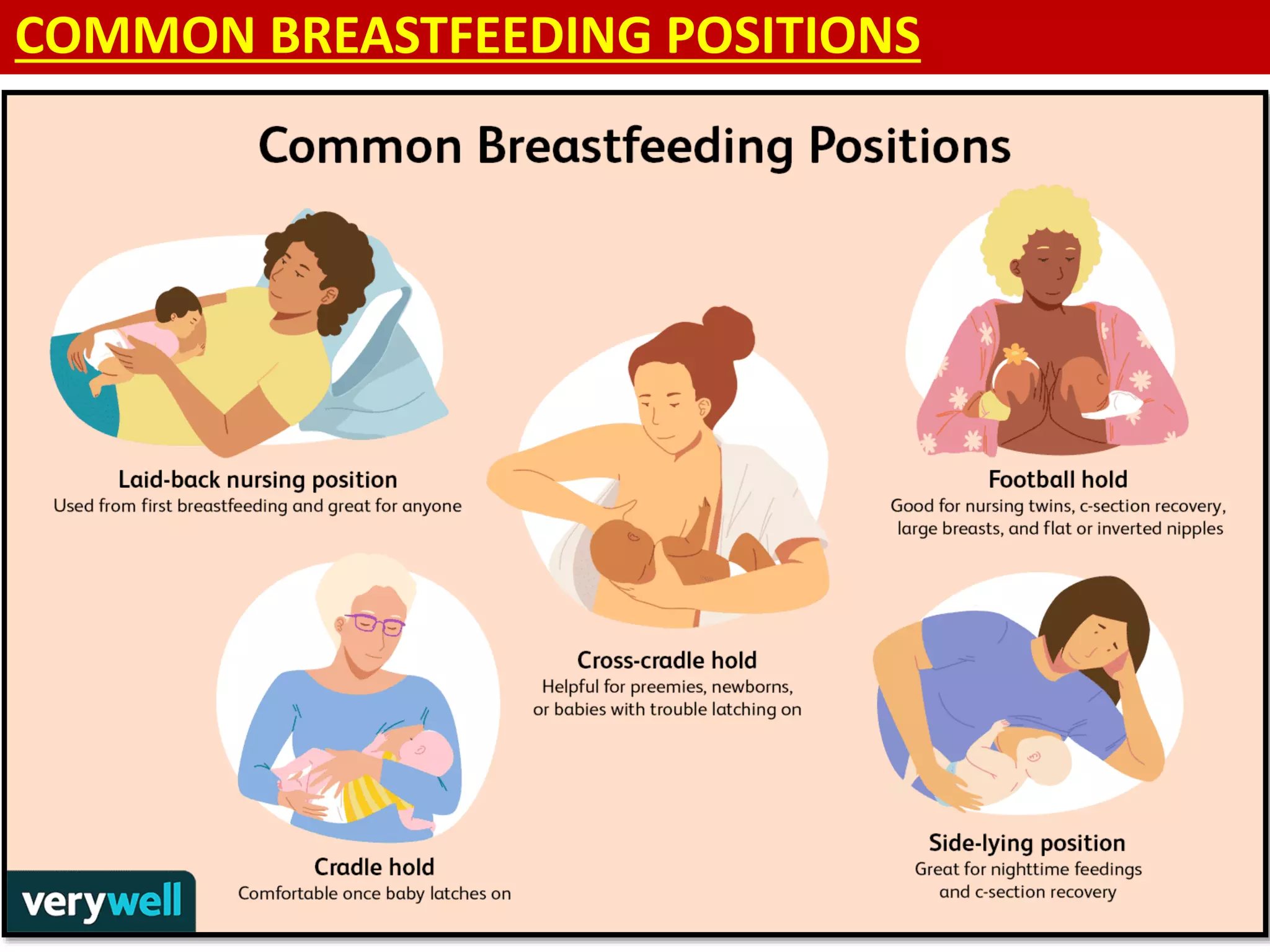
COMMON BREASTFEEDING POSITIONS
POSTNATAL DIET
CARE IN POSTPARTUM BLUES
POST NATAL EXERCISES
A series of physical
exercises that are
performed by the postnatal
mother to bring about
optimal functioning of all
systems and prevent
complications
• It increases
• Muscle tone
• Venous return from the
legs & lower abdomen
• Drainage of the Lochia
• Voiding of urine
BENEFITS OF EXERCISES
TYPES OF EXERCISES
Abdominal
exercises
Circulatory
exercises
Pelvic floor
exercise
ABDOMINAL EXERCISES
HEAD LIFTING
HEAD & SHOULDER RAISE
LEG EXERISES - LEG RAISE
PELVIC FITTING
KNEE & LEG ROLLING
HIP HITCHING
CIRCULATORY EXERCISES
FLOOR & LEG RAISE
PELVIC FLOOR EXERCISE
Sit, stand or half lie with legs slightly apart close and draw up
around the anal passage as through preventing a bowel action
ADVICES AT TIME OF DISCHARGE
Measures to improve her general health
Perineal care
Breast care
Care of breast durig breast engorgement
Postnatal exercises
Gradual return to day to day activities
Return for 6th week post partum check up
SELF
Breastfeeding
If being bottle feed; Care and preparation of bottles and nipples or container
Hold the baby during feeding
Baby bathing and dressing including care of genital area
Cord care
Prevention and treatment of diaper rash
Checking babies temperature
Recognizing baby’s needs
Check up and immunization for the baby
BABY
POSTNATAL HEALTH TALK (1).pptx

POSTNATAL HEALTH TALK (1).pptx

  • 1.
    Over 5,36000 women die annuallyfrom complications during pregnancy, child birth or the postpartum period. Nearly all of this death occur in developing countries where fertility rates are higher
  • 2.
  • 3.
    DEFINITION According to Worldhealth organization postnatal care is defined as a care given to the mother and her newborn baby immediately after the birth of the placenta and for the first six weeks of life.
  • 4.
    To assess thehealth status of the mother. Medical disorders like diabetes, hypertension should be reassessed. To detect and treat at the earliest any gynecological condition arising out of obstetric legacy. To note the progress of the baby including the immunization schedule for the infant. To impart family planning guidance. AIMS AND OBJECTIVES
  • 5.
    PROCEDURE Examination of the mother Advice givento the mother Examination of the baby and advice
  • 6.
    EXAMINATION OF MOTHER Routineexamination Pelvic examination Laboratory investigations depending on clinical needs
  • 7.
    BUBBLE- is aacronym used to denote the components of the postpartum maternal nursing assessment. POST NATAL ASSESSMENT
  • 8.
    BREAST UTERUS BLADDER BUBBLEHE HOMAN’S SIGN EMOTIONAL STATUS BOWEL LOCHIA EPISIOTOMY
  • 9.
    BREAST EVALUATION Size ShapeFirmness Redness Symmetry
  • 10.
  • 11.
  • 12.
    UTERUS Size, Weight ,location and firmness Immediately after delivery , the uterus begins the process of involution or reduction in size. At the end of 6th week weighs 50-100g. A bulky uterus may indicate the presence of blood clots or retained placental beats. Normally uterus should be contracted ,hard and not painful if touched. The height of uterus should be measured. After the 1st postpartum day ,the fundus involute 1-2 cm. Per day.
  • 13.
    BLADDER In the immediatepostpartum period, the bladder is congested , edematous and hypotonic from the effect of labour . After delivery , the client should urinate within 4 hours , at least 300 ml , with completely emptying the bladder . Ask mother when last voided
  • 14.
    BUBBLEHE Assessment • Breasts— Soft, filling, firm, Nipples • Uterus — consistency, position, height • Bladder — voiding pattern • Bowels — bowel sounds, hemorrhoids, • Lochia — type, amt, clots, odor • Episiotomy— laceration, bruising, swelling • Homan sign — present or not • Emotional status — bonding, blues
  • 15.
    BOWELS The patient should be encouraged todrink should be 6 to 8 glasses of water daily. Eat a high fiber diet (whole grains , legumes , vegetable and fruits ). Sitz bath. Enema may be given. Stool softener.
  • 16.
    . POSTNATAL CARE Color • Dependingupon the variation of the color of the discharge it is names as: • Lochia Rubra • Lochia serosa • Lochia Alba (10-15 days ) pale white
  • 17.
  • 18.
    Sitz bath with warm watermay be given. The perineum should be cleaned after each voiding. Change pad frequently. Perform perineal exercises such as kegel exercise. Care of the vulval hematoma includes applying ice packs . EPISIOTOMY
  • 19.
  • 20.
  • 21.
    HOMAN’S SIGN Should beperform leg exercise, to teach the client to flex and extends the both leg and feet alternatively. Keeping the leg uncrossed while seated. Padding pressure points during lithotomy position .
  • 22.
    EMOTIONAL STATUS The immediatepostpartum period is an emotional roller coaster. Mother is exhausted and need sleep and rest to restore their bodies to health. In this “taking in phase” mother wish to meet their own rest and nutritional needs before focusing their energy on newborns.
  • 23.
    ENQUIRY TO THEMOTHER Any excessive PN bleeding Puerperal pyrexia Puerperal sepsis Involution of the uterus Breast complications: • Breast engorgement Mastitis • Cracked nipple Breast abscess
  • 24.
    EXAMINATION OF THEBABY Head to toe examination Newborn reflexes
  • 25.
    ENQUIRY ABOUT BABY Exclusive breastfeeding Keepbaby warm Dry and wrap Immunization
  • 26.
  • 27.
  • 28.
  • 29.
    POST NATAL EXERCISES Aseries of physical exercises that are performed by the postnatal mother to bring about optimal functioning of all systems and prevent complications
  • 30.
    • It increases •Muscle tone • Venous return from the legs & lower abdomen • Drainage of the Lochia • Voiding of urine BENEFITS OF EXERCISES
  • 31.
  • 32.
  • 33.
  • 34.
  • 35.
    LEG EXERISES -LEG RAISE
  • 36.
  • 37.
    KNEE & LEGROLLING
  • 38.
  • 39.
  • 40.
  • 41.
    PELVIC FLOOR EXERCISE Sit,stand or half lie with legs slightly apart close and draw up around the anal passage as through preventing a bowel action
  • 42.
    ADVICES AT TIMEOF DISCHARGE
  • 43.
    Measures to improveher general health Perineal care Breast care Care of breast durig breast engorgement Postnatal exercises Gradual return to day to day activities Return for 6th week post partum check up SELF
  • 44.
    Breastfeeding If being bottlefeed; Care and preparation of bottles and nipples or container Hold the baby during feeding Baby bathing and dressing including care of genital area Cord care Prevention and treatment of diaper rash Checking babies temperature Recognizing baby’s needs Check up and immunization for the baby BABY