2.0 THE     FIRST          TEN           NUMBERS             OF        EACH

   NUMERATION SYSTEM

   2.1 EGYPTIAN NUMERATION SYSTEM

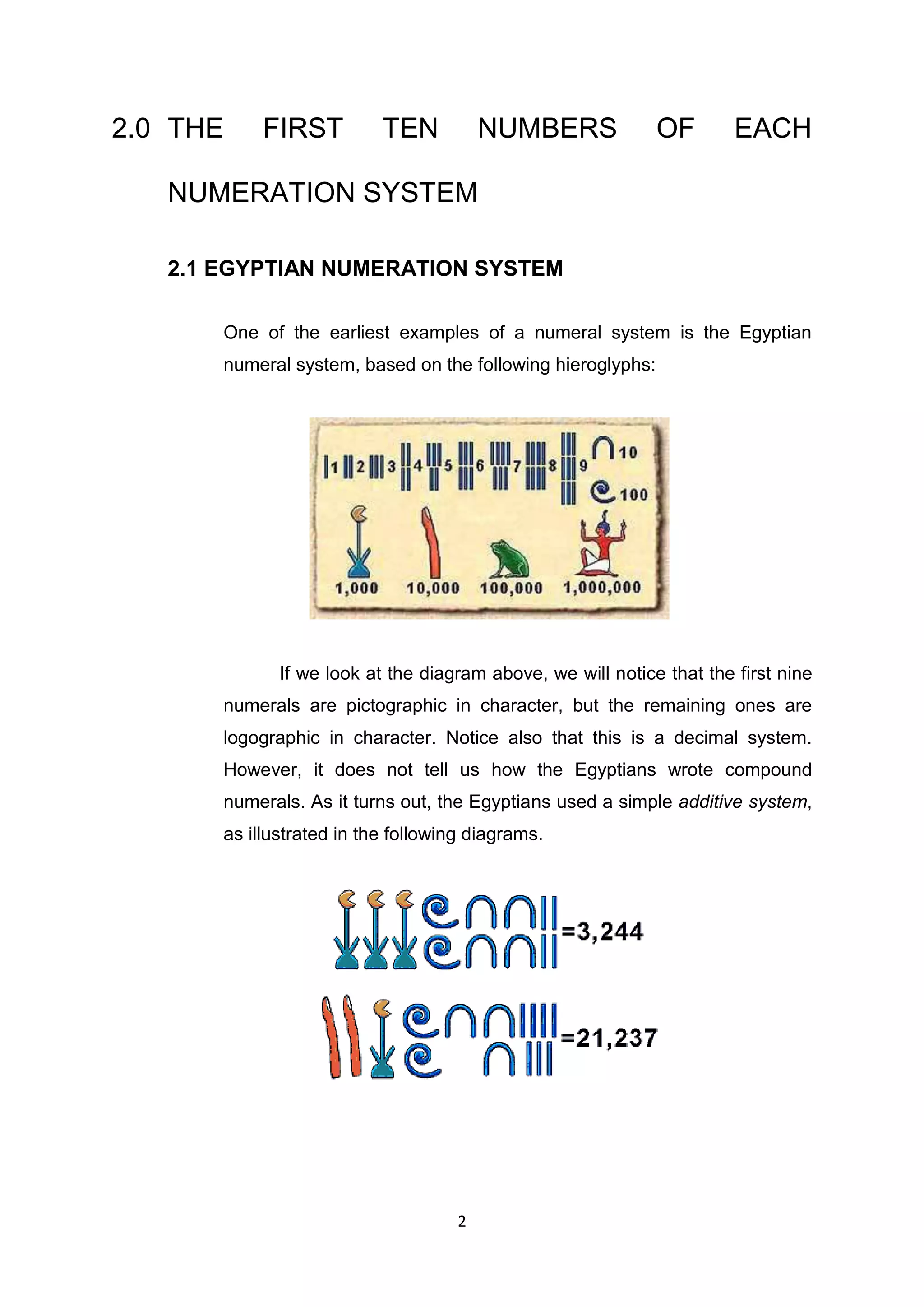
       One of the earliest examples of a numeral system is the Egyptian
       numeral system, based on the following hieroglyphs:


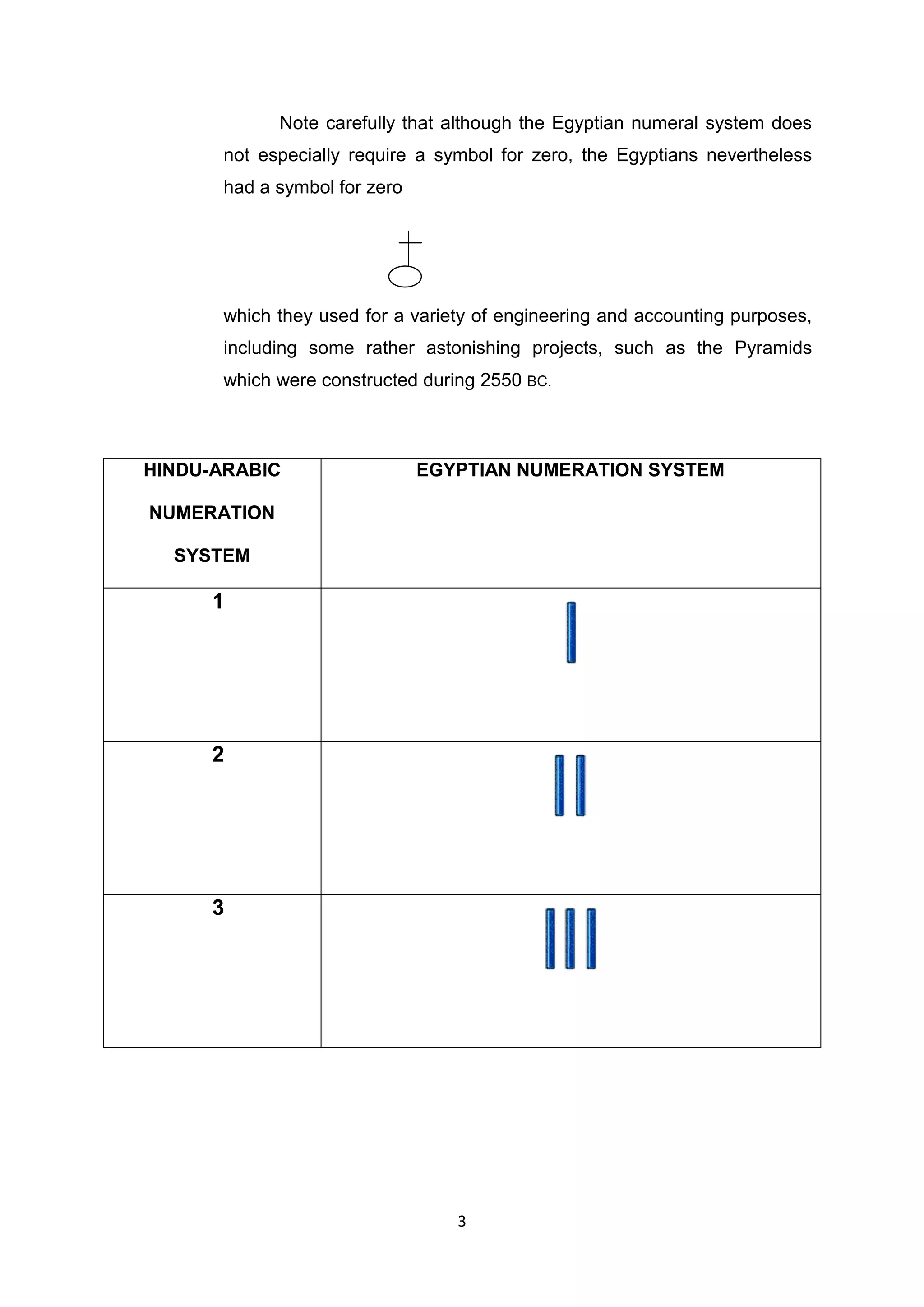
              If we look at the diagram above, we will notice that the first nine
       numerals are pictographic in character, but the remaining ones are
       logographic in character. Notice also that this is a decimal system.
       However, it does not tell us how the Egyptians wrote compound
       numerals. As it turns out, the Egyptians used a simple additive system,
       as illustrated in the following diagrams.


                                     2
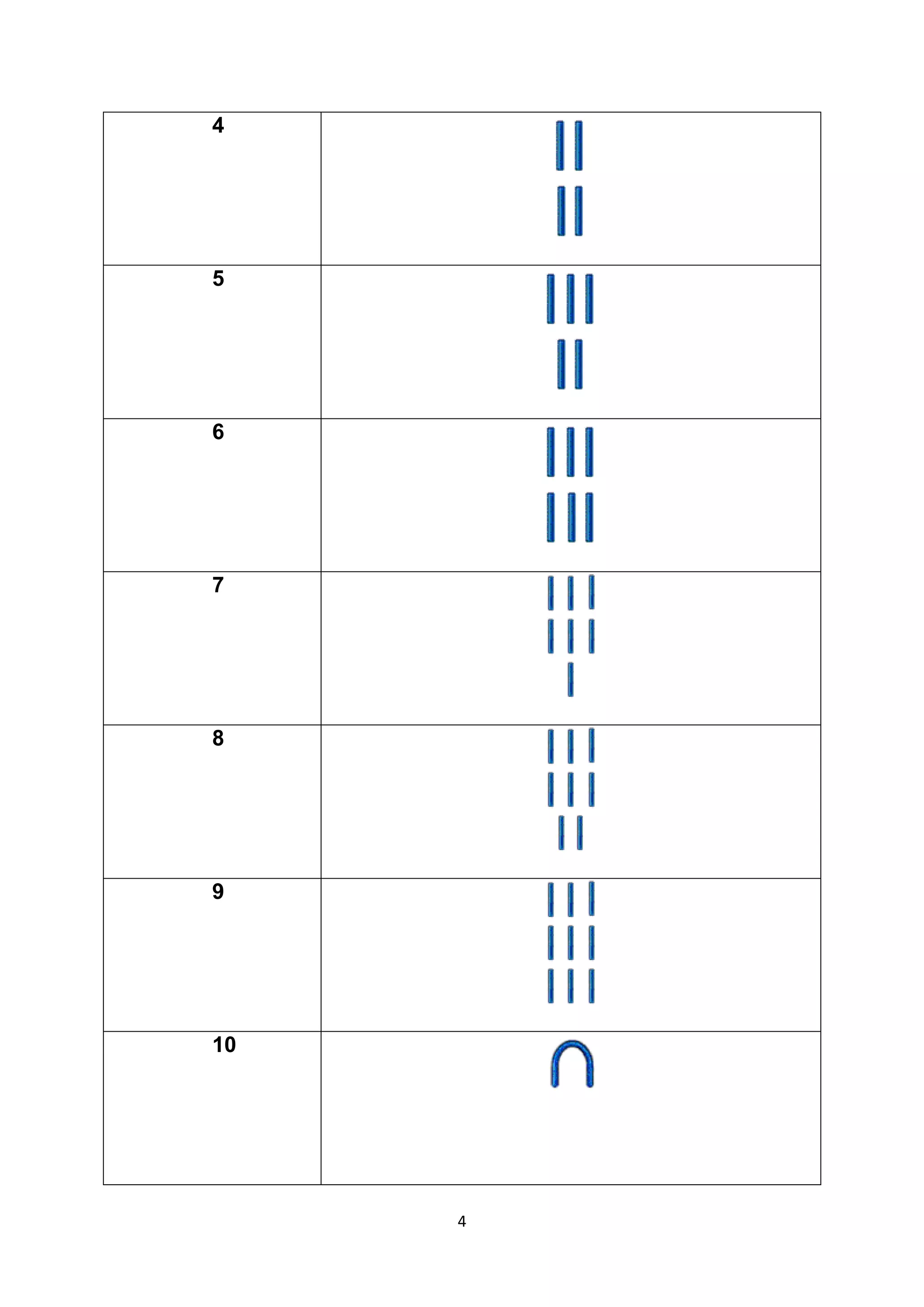
Note carefully that although the Egyptian numeral system does
      not especially require a symbol for zero, the Egyptians nevertheless
      had a symbol for zero


      which they used for a variety of engineering and accounting purposes,
      including some rather astonishing projects, such as the Pyramids
      which were constructed during 2550 BC.


HINDU-ARABIC                  EGYPTIAN NUMERATION SYSTEM

NUMERATION

  SYSTEM

      1


      2


      3


                                 3
4


5


6


7


8


9


10


     4
2.2   BABYLONIAN NUMERATION SYSTEM


      The Babylonians lived in Mesopotamia, which is between the Tigris
      and Euphrates rivers. They began a numbering system about 5,000
      years ago. It is one of the oldest numbering systems.

             The first mathematics can be traced to the ancient country of
      Babylon, during the third millennium B.C. Tables were the Babylonians
      most outstanding accomplishment which helped them in calculating
      problems. The Babylonian numeration system was developed between
      3000                  and                  2000                BCE.
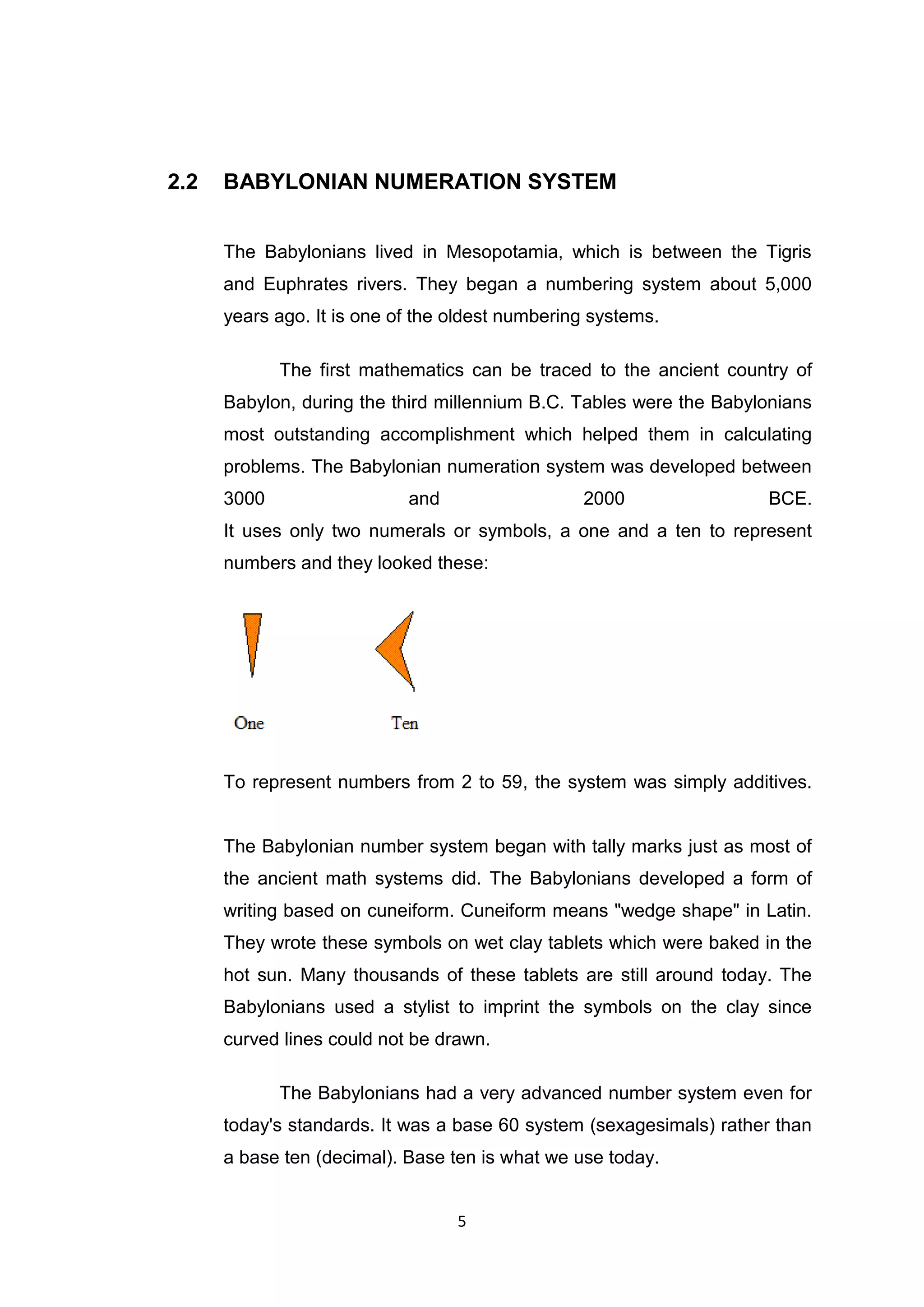
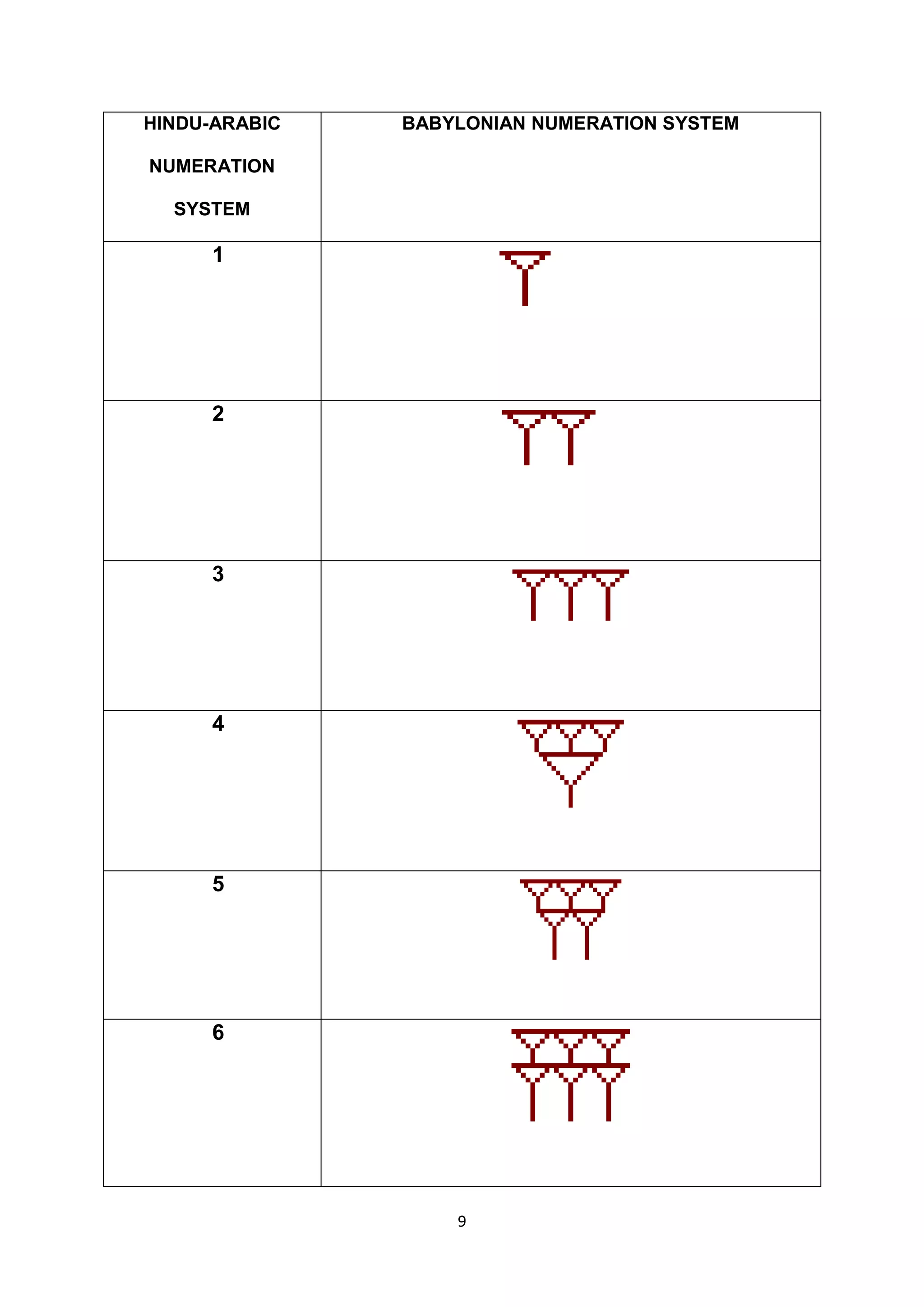
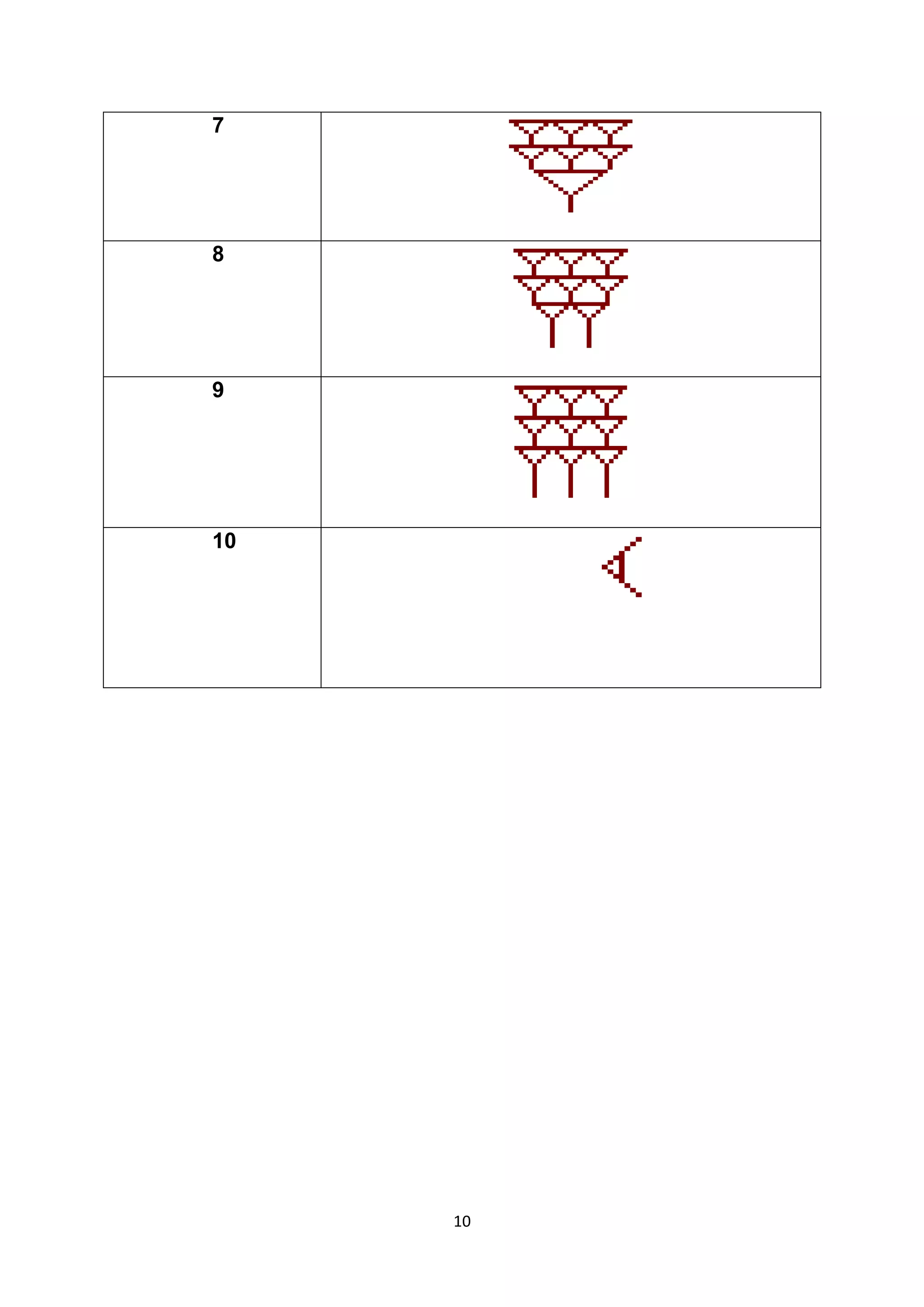
      It uses only two numerals or symbols, a one and a ten to represent
      numbers and they looked these:


      To represent numbers from 2 to 59, the system was simply additives.


      The Babylonian number system began with tally marks just as most of
      the ancient math systems did. The Babylonians developed a form of
      writing based on cuneiform. Cuneiform means "wedge shape" in Latin.
      They wrote these symbols on wet clay tablets which were baked in the
      hot sun. Many thousands of these tablets are still around today. The
      Babylonians used a stylist to imprint the symbols on the clay since
      curved lines could not be drawn.

             The Babylonians had a very advanced number system even for
      today's standards. It was a base 60 system (sexagesimals) rather than
      a base ten (decimal). Base ten is what we use today.


                                  5
The Babylonians divided the day into twenty-four hours, each
hour into sixty minutes, and each minute to sixty seconds. This form of
counting has survived for four thousand years.


Example#1:


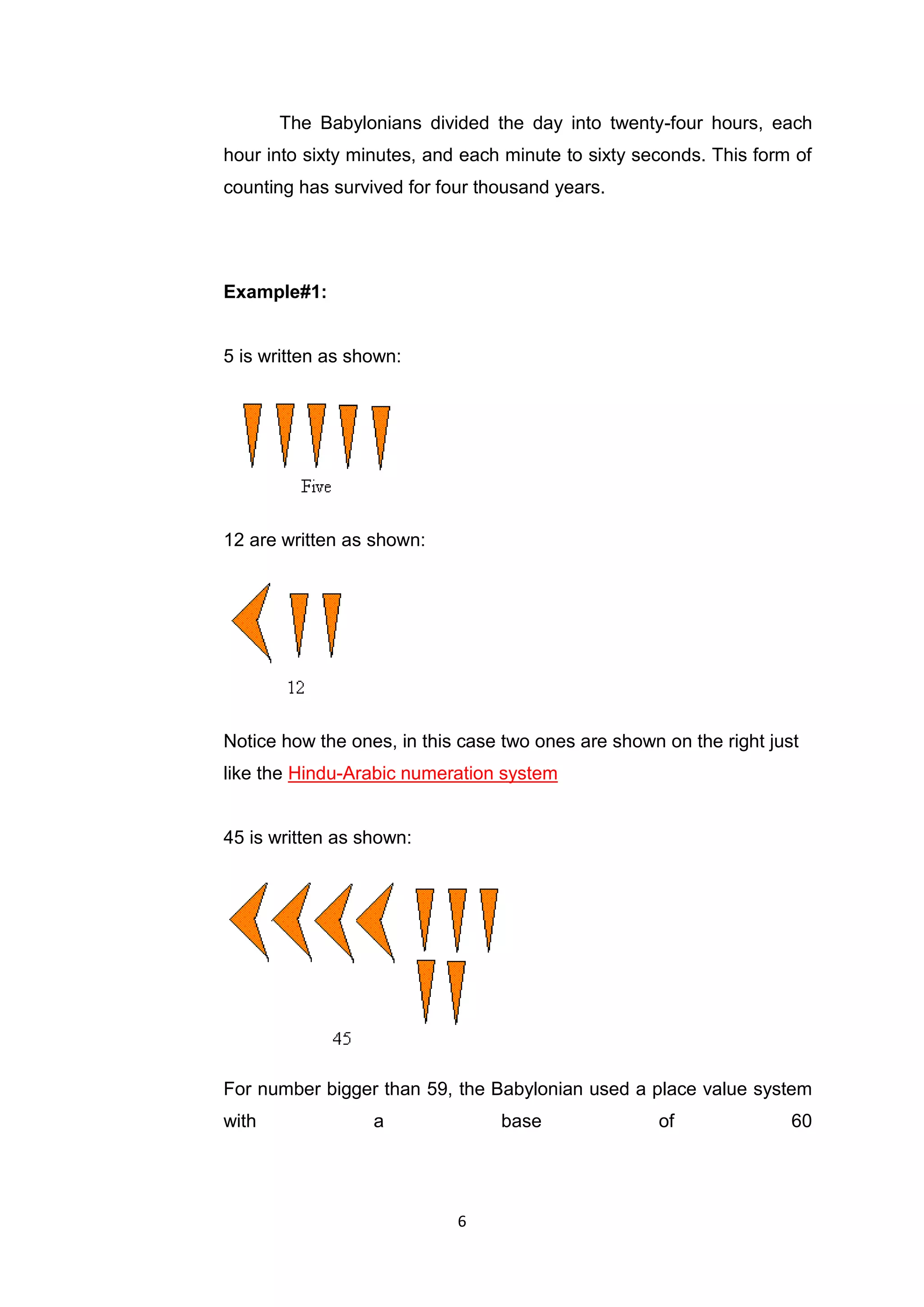
5 is written as shown:


12 are written as shown:


Notice how the ones, in this case two ones are shown on the right just
like the Hindu-Arabic numeration system


45 is written as shown:


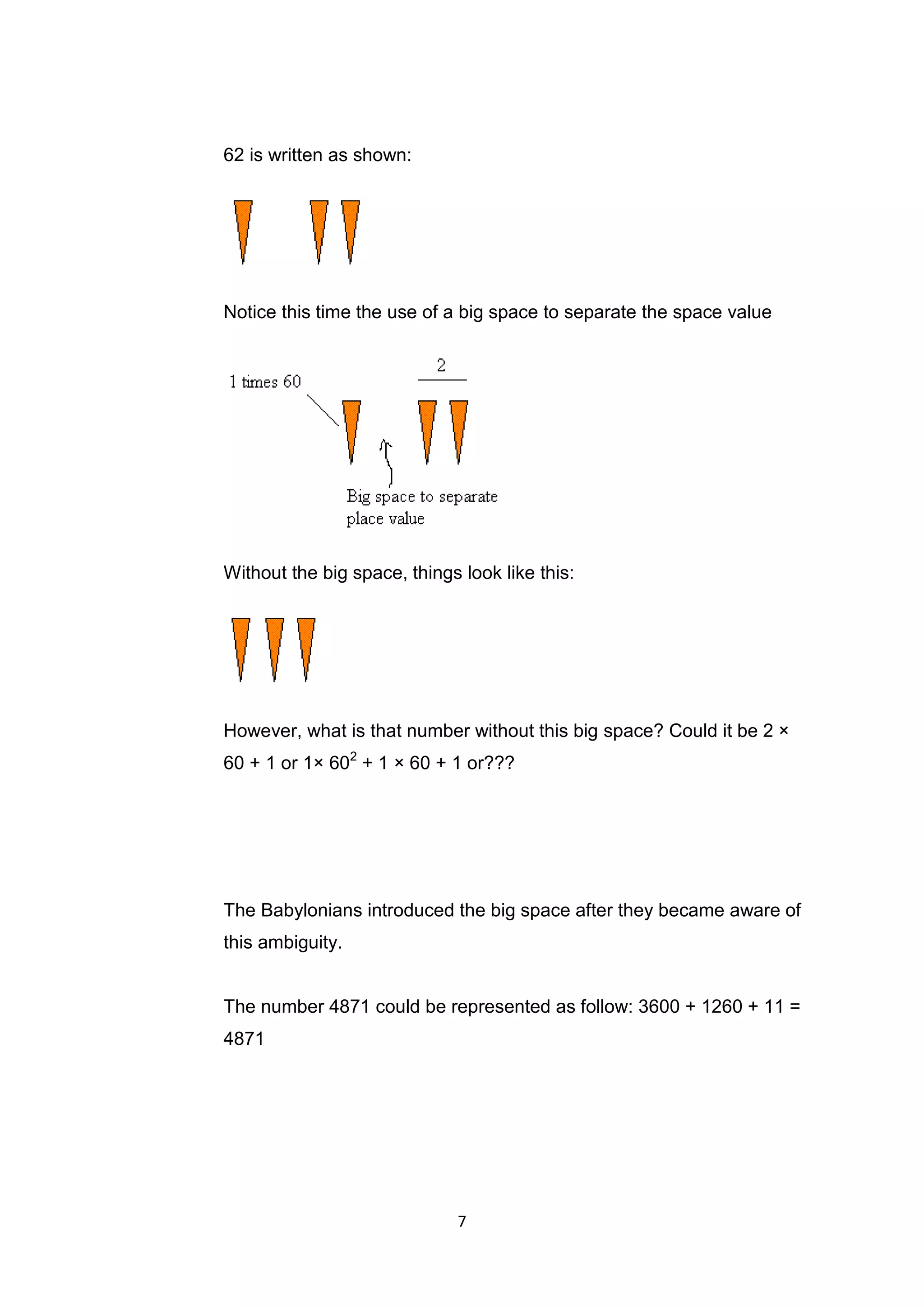
For number bigger than 59, the Babylonian used a place value system
with              a              base               of               60


                            6
62 is written as shown:


Notice this time the use of a big space to separate the space value


Without the big space, things look like this:


However, what is that number without this big space? Could it be 2 ×
60 + 1 or 1× 602 + 1 × 60 + 1 or???


The Babylonians introduced the big space after they became aware of
this ambiguity.


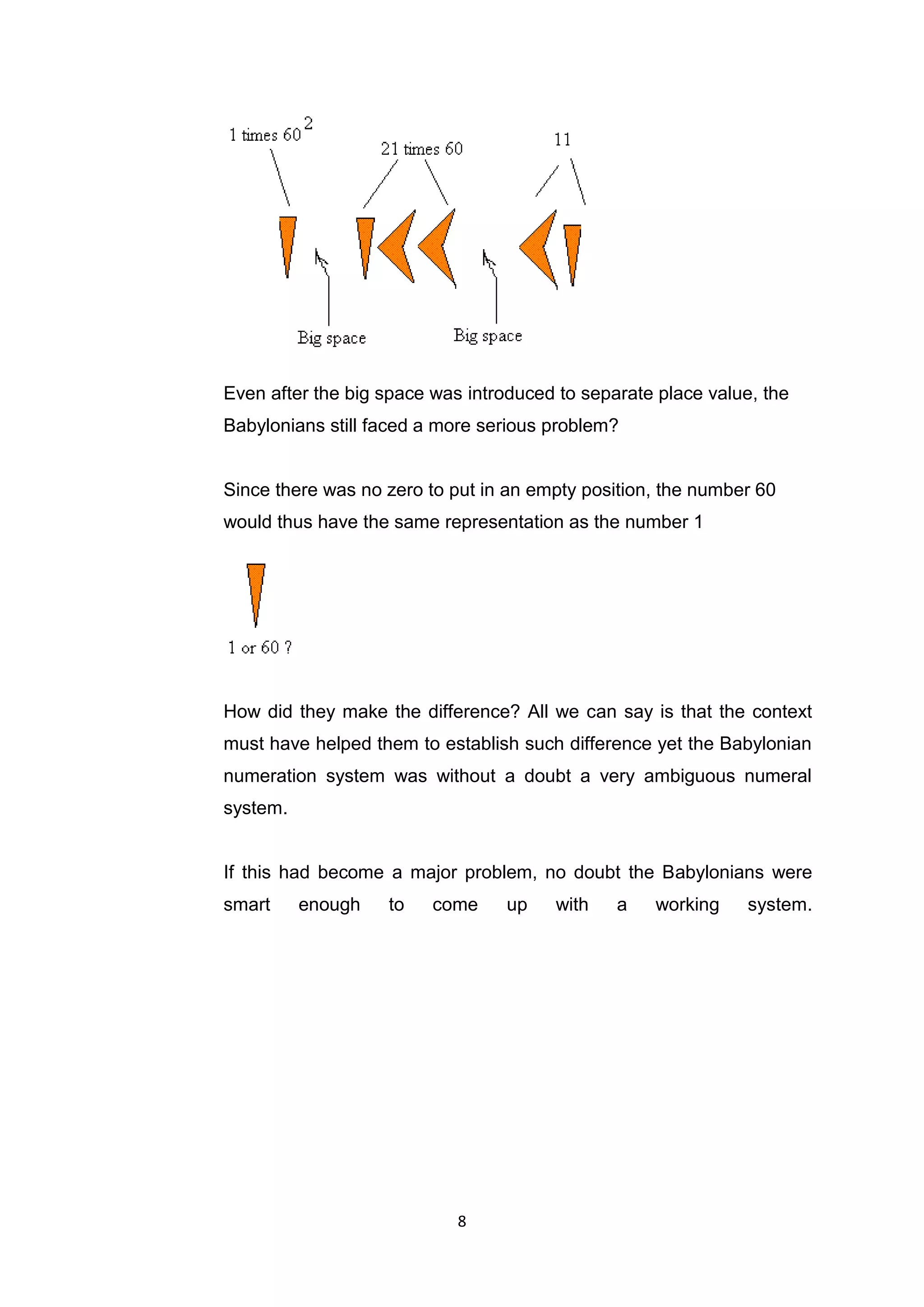
The number 4871 could be represented as follow: 3600 + 1260 + 11 =
4871


                              7
Even after the big space was introduced to separate place value, the
Babylonians still faced a more serious problem?


Since there was no zero to put in an empty position, the number 60
would thus have the same representation as the number 1


How did they make the difference? All we can say is that the context
must have helped them to establish such difference yet the Babylonian
numeration system was without a doubt a very ambiguous numeral
system.


If this had become a major problem, no doubt the Babylonians were
smart     enough   to    come     up   with    a   working     system.


                            8
HINDU-ARABIC   BABYLONIAN NUMERATION SYSTEM

NUMERATION

  SYSTEM

      1


      2


      3


      4


      5


      6


                   9
7


8


9


10


     10
2.3   ROMAN NUMERATION SYSTEM

      Before Rome, the most developed civilization on the Italic Peninsula
      was the Etruscan civilization, who copied their numerals from the early
      Greek (Attic) system. These numerals were adopted and adapted by
      the Romans, who formulated the Roman numeral system, still in wide
      use today for a variety of purposes. There are other Roman numerals
      that most of us never learn, but can be found in Latin dictionaries – for
      example:


                          5000 I>>
                          10000 ==I>>
                          50000 I>>>
                          100000 ===I>>>
                          500000 I>>>>
                          1000000 ====I>>>>


            As every grade school child knows, the Roman numeral system
      is based on the following seven atomic numerals:


                            IVXLCDM
                       1 5 10 50 100 500 1000


            The Roman numeral system is not a simple additive system, but
      is rather an additive-subtractive system. In fact, the subtractive aspect
      is frequently a source of worry when reading large numerals – for
      example:


                                           MCMXCIX


            By saying that the Roman system is (partly) subtractive, we
      mean that some combinations of symbols require us to apply
      subtraction in order to interpret them. For example, IV stands for “one
      before five”, which is four [i.e., 5 minus 1]. Similarly, the numeral XC
                                  11
stands for “ten before one-hundred”, which is ninety [i.e., 100 minus
      10]. On the other hand, the string IC is officially ill-formed, although it
      could be understood to mean “one before one-hundred”, which would
      then be ninety-nine. So how do we interpret a Roman numeral such as
      „MCMXCIX‟?


      M is not before a larger numeral, so it reads: + 1000 1000
      C is before a larger numeral, so it reads: - 100
      M is after a negative prefix, so it reads: + 1000 900
      X is before a larger numeral, so it reads: - 10
      C is after a negative prefix, so it reads: + 100 90
      I is before a larger numeral, so it reads: - 1
      X is after a negative prefix, so it reads: + 10 9
      Thus, „MCMXCIX‟ represents the number 1999.


HINDU-ARABIC                    ROMAN NUMERATION SYSTEM

NUMERATION

  SYSTEM

      1                                            I

      2                                           II

      3                                           III

      4                                           IV

      5                                           V

      6                                           VI

      7                                          VII

      8                                          VIII

      9                                           IX


                                    12
10                                          X


2.4    MAYAN NUMERATION SYSTEM


The Mayan number system dates back to the fourth century and was
approximately 1,000 years more advanced than the Europeans of that time.
This system is unique to our current decimal system, which has a base 10, in
that the Mayan's used a base 20.

       This system is believed to have been used because, since the Mayan's
lived in such a warm climate and there was rarely a need to wear shoes, 20
was the total number of fingers and toes, thus making the system workable.
Therefore two important markers in this system are 20, which relates to the
fingers and toes, and five, which relates to the number of digits on one hand
or foot. The Mayan numeration system evolved around A.D. 300. It uses 3
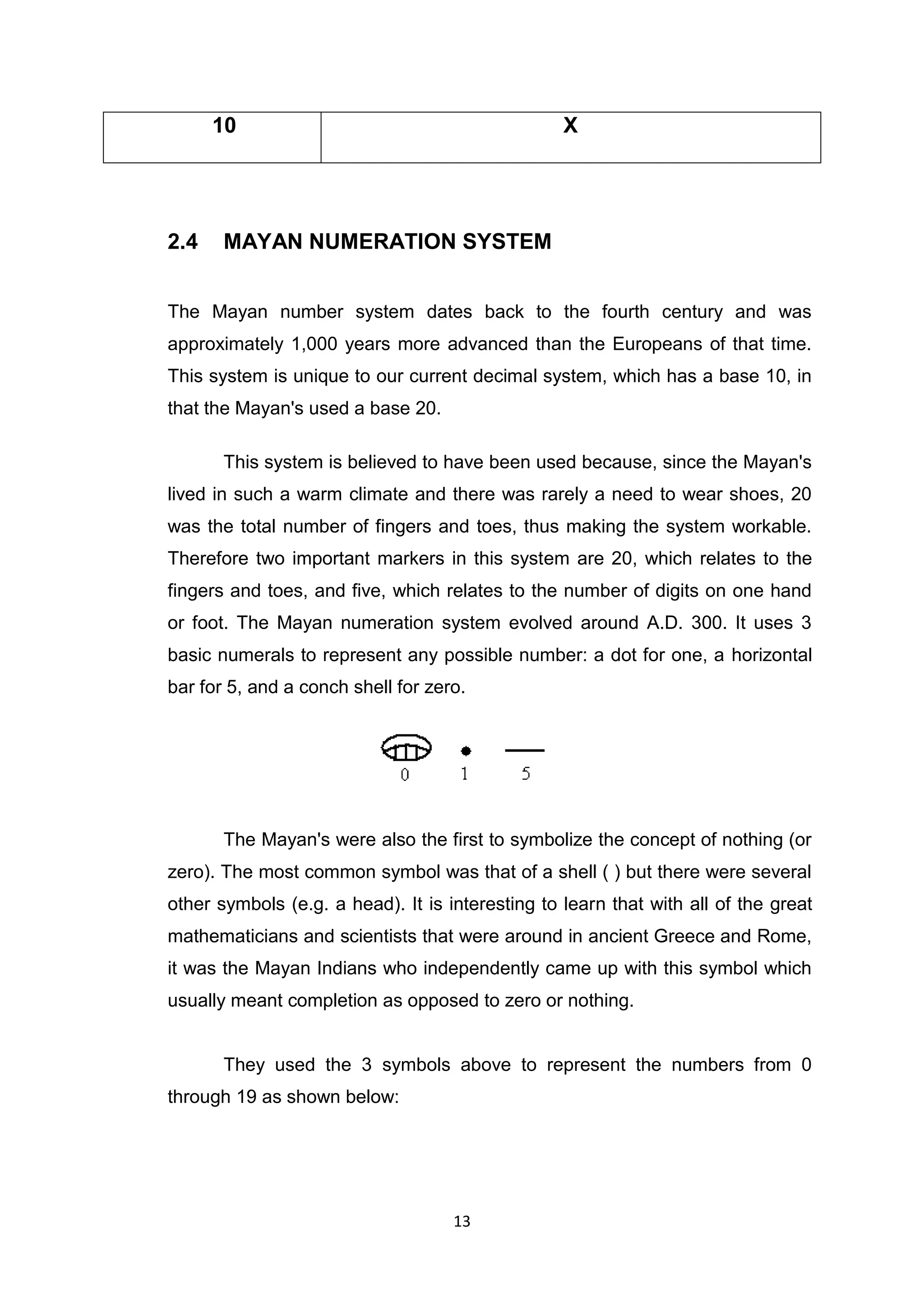
basic numerals to represent any possible number: a dot for one, a horizontal
bar for 5, and a conch shell for zero.


       The Mayan's were also the first to symbolize the concept of nothing (or
zero). The most common symbol was that of a shell ( ) but there were several
other symbols (e.g. a head). It is interesting to learn that with all of the great
mathematicians and scientists that were around in ancient Greece and Rome,
it was the Mayan Indians who independently came up with this symbol which
usually meant completion as opposed to zero or nothing.


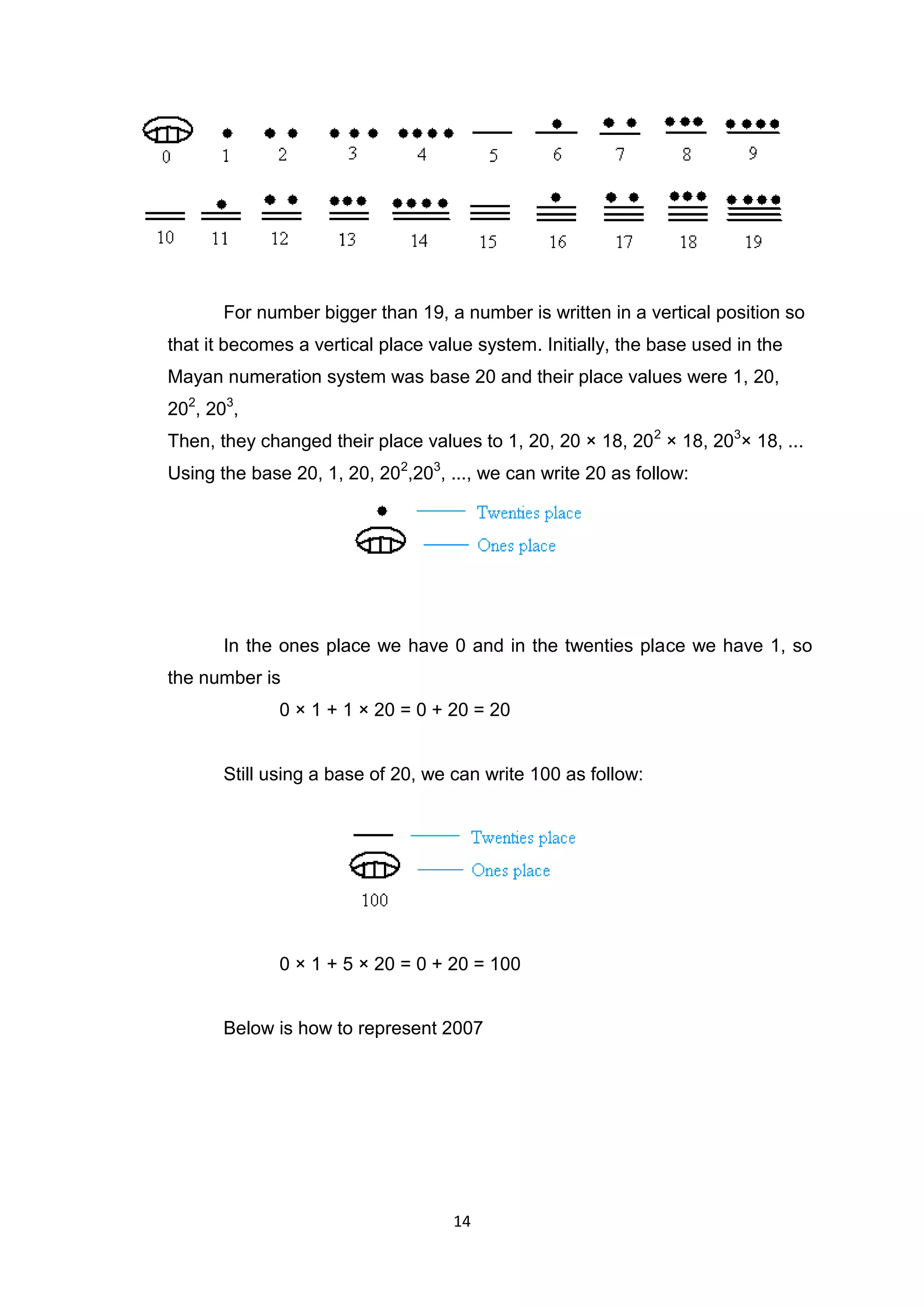
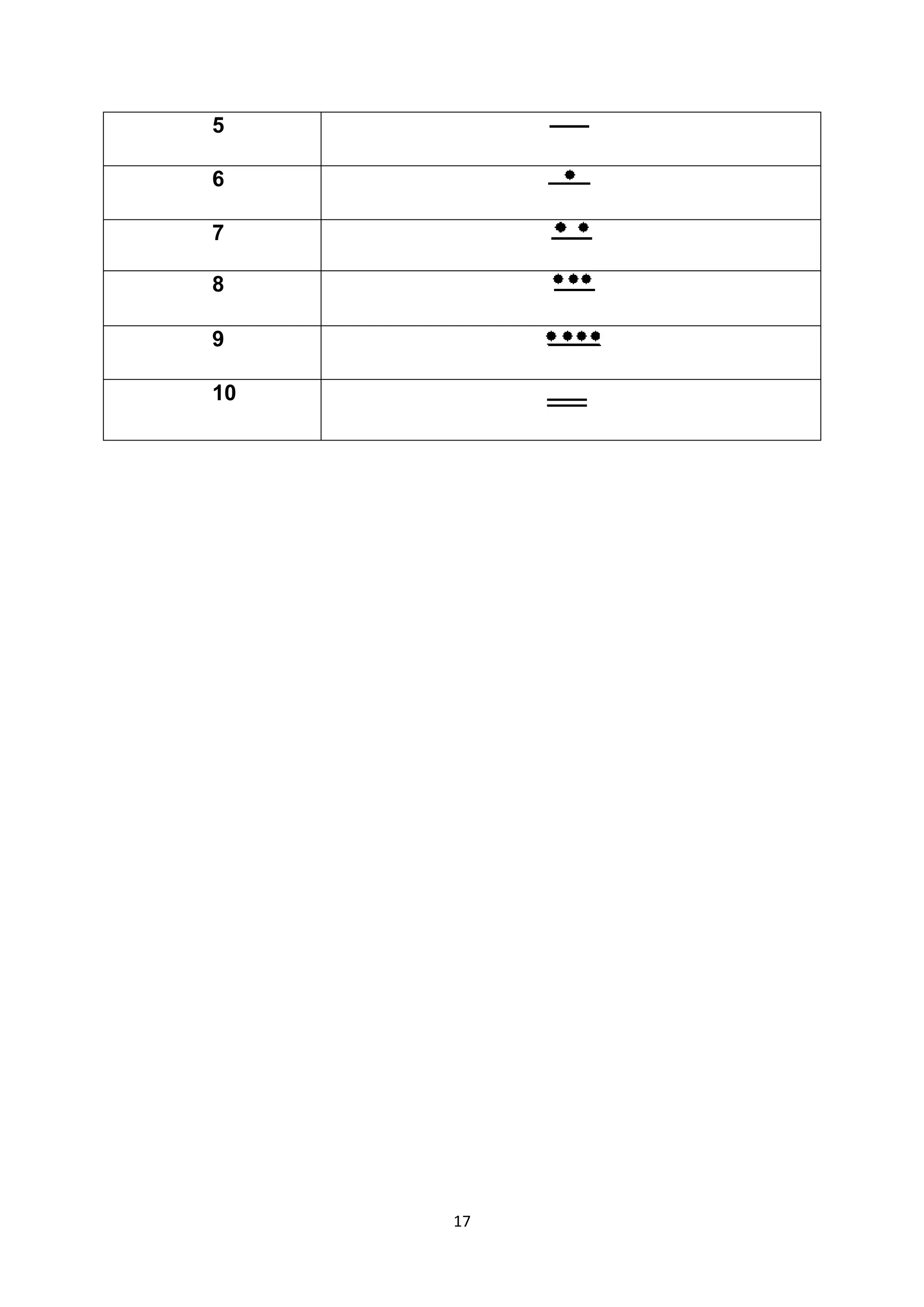
       They used the 3 symbols above to represent the numbers from 0
through 19 as shown below:


                                    13
For number bigger than 19, a number is written in a vertical position so
that it becomes a vertical place value system. Initially, the base used in the
Mayan numeration system was base 20 and their place values were 1, 20,
202, 203,
Then, they changed their place values to 1, 20, 20 × 18, 20 2 × 18, 203× 18, ...
Using the base 20, 1, 20, 202,203, ..., we can write 20 as follow:


       In the ones place we have 0 and in the twenties place we have 1, so
the number is
              0 × 1 + 1 × 20 = 0 + 20 = 20


       Still using a base of 20, we can write 100 as follow:


              0 × 1 + 5 × 20 = 0 + 20 = 100


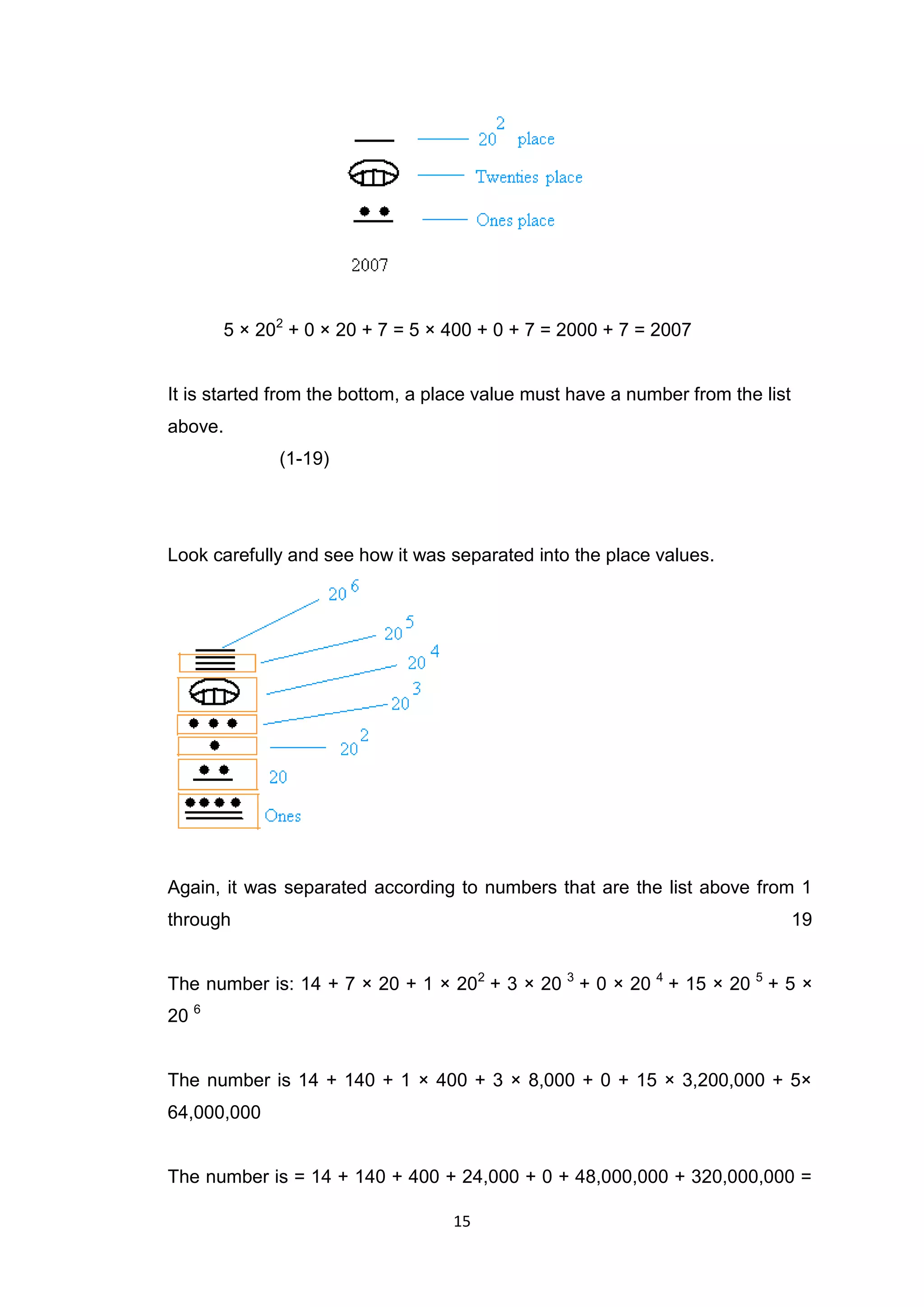
       Below is how to represent 2007


                                    14
5 × 202 + 0 × 20 + 7 = 5 × 400 + 0 + 7 = 2000 + 7 = 2007


It is started from the bottom, a place value must have a number from the list
above.
             (1-19)


Look carefully and see how it was separated into the place values.


Again, it was separated according to numbers that are the list above from 1
through                                                                         19


The number is: 14 + 7 × 20 + 1 × 202 + 3 × 20 3 + 0 × 20 4 + 15 × 20 5 + 5 ×
20 6


The number is 14 + 140 + 1 × 400 + 3 × 8,000 + 0 + 15 × 3,200,000 + 5×
64,000,000


The number is = 14 + 140 + 400 + 24,000 + 0 + 48,000,000 + 320,000,000 =

                                   15
368024554
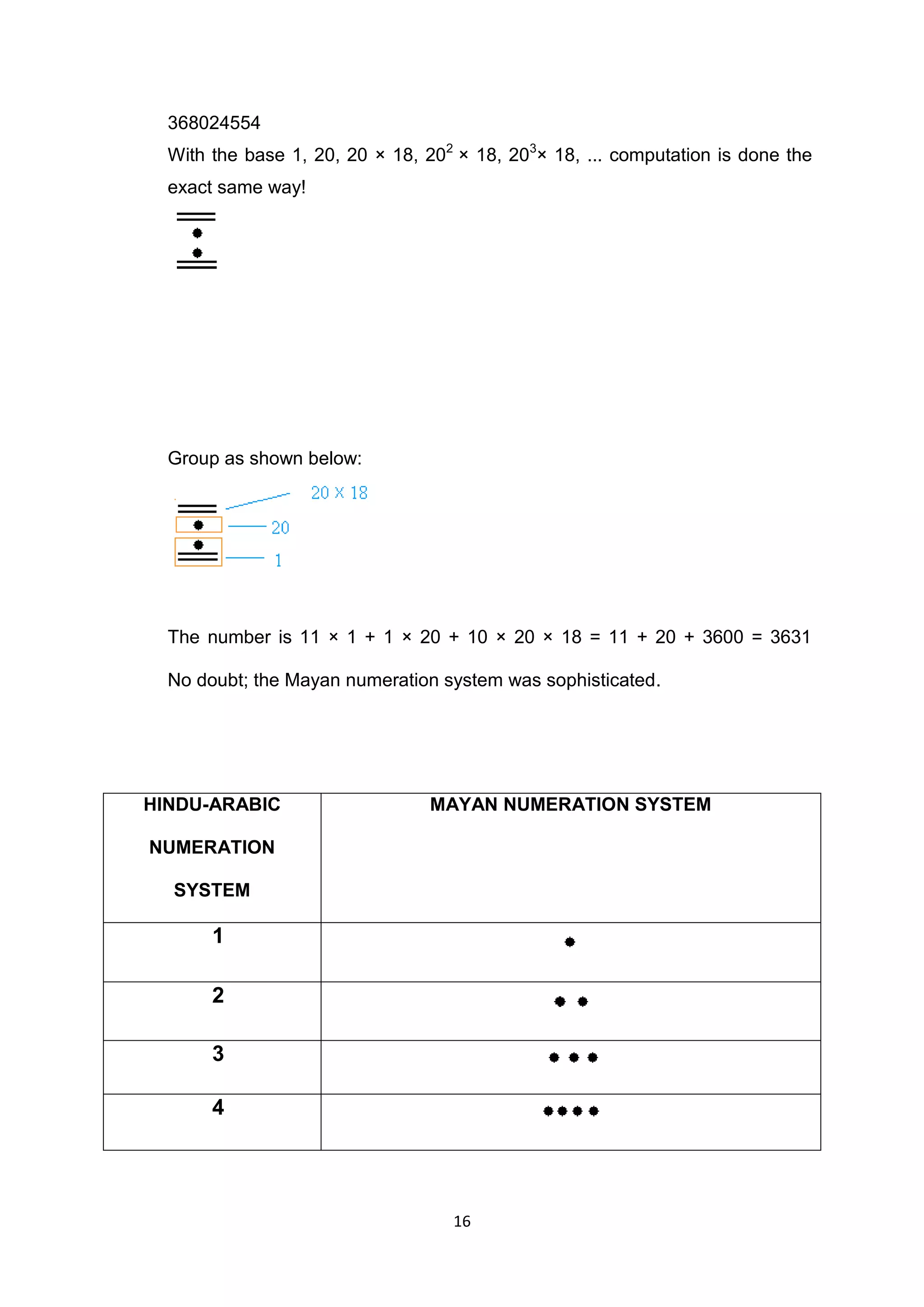
  With the base 1, 20, 20 × 18, 202 × 18, 203× 18, ... computation is done the
  exact same way!


  Group as shown below:


  The number is 11 × 1 + 1 × 20 + 10 × 20 × 18 = 11 + 20 + 3600 = 3631

  No doubt; the Mayan numeration system was sophisticated.


HINDU-ARABIC                    MAYAN NUMERATION SYSTEM

NUMERATION

  SYSTEM

       1

       2

       3

       4


                                   16
5

6

7

8

9

10


     17
2.5   WORD PROBLEM AND ITS SOLUTION


      Question:


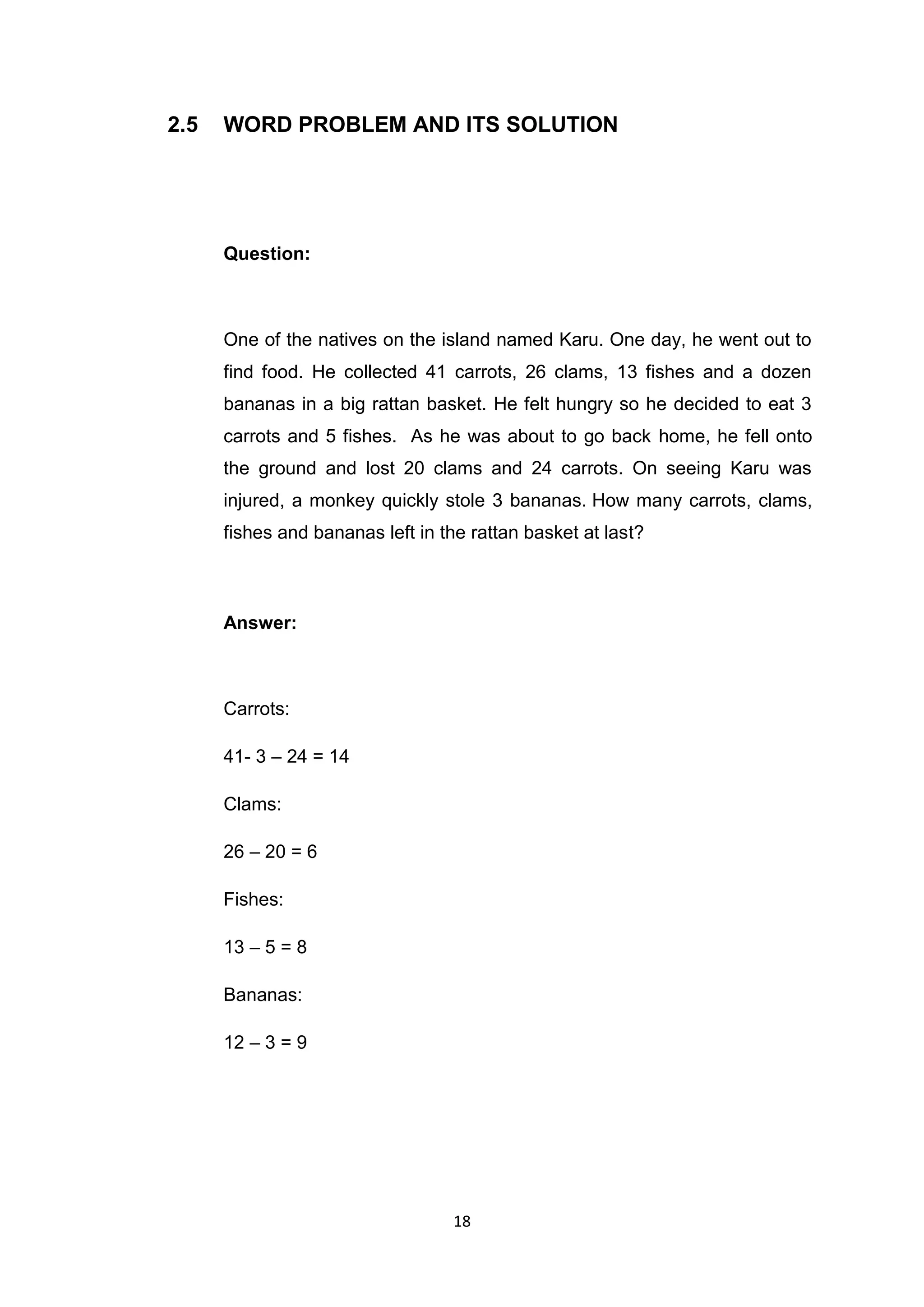
      One of the natives on the island named Karu. One day, he went out to
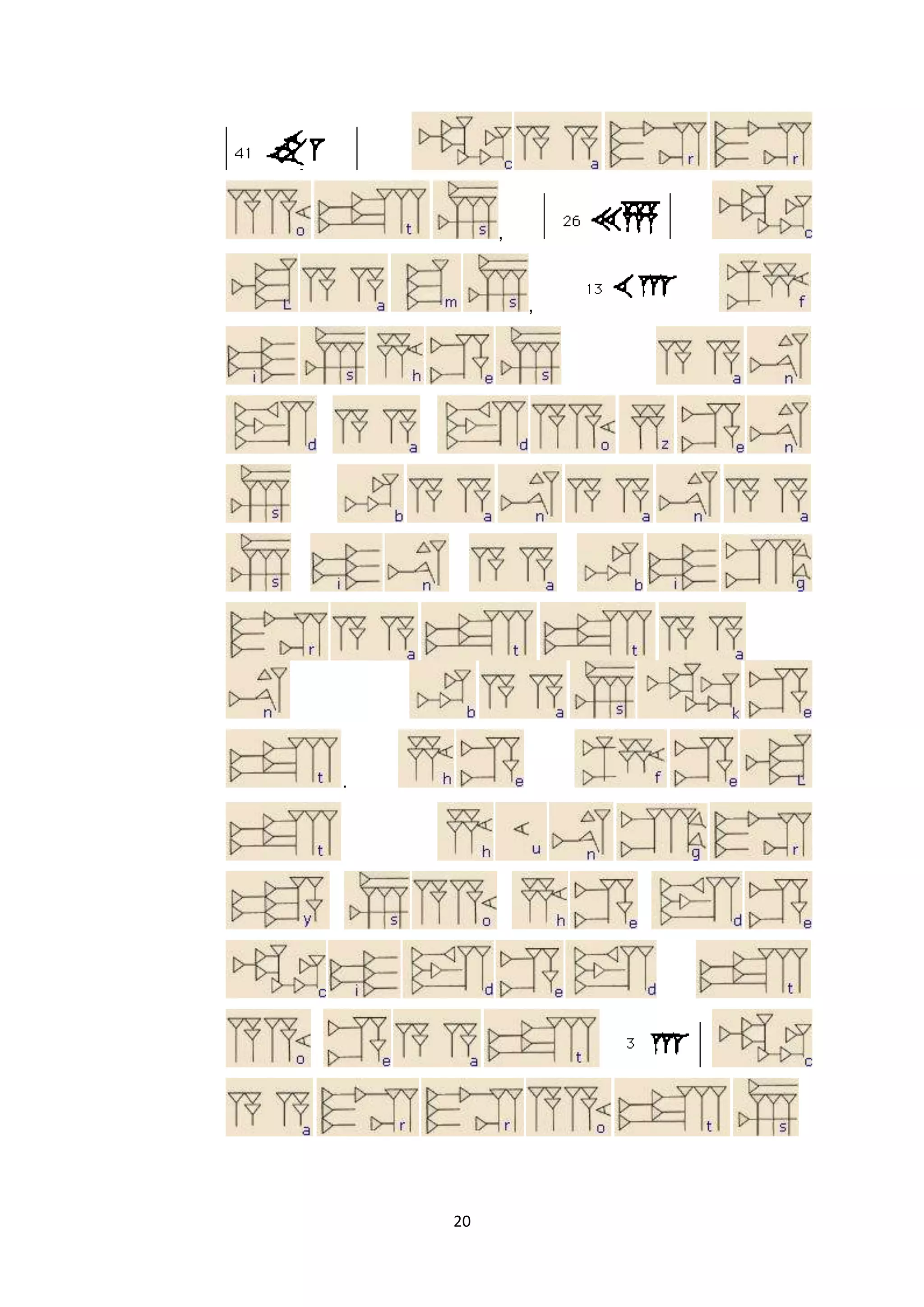
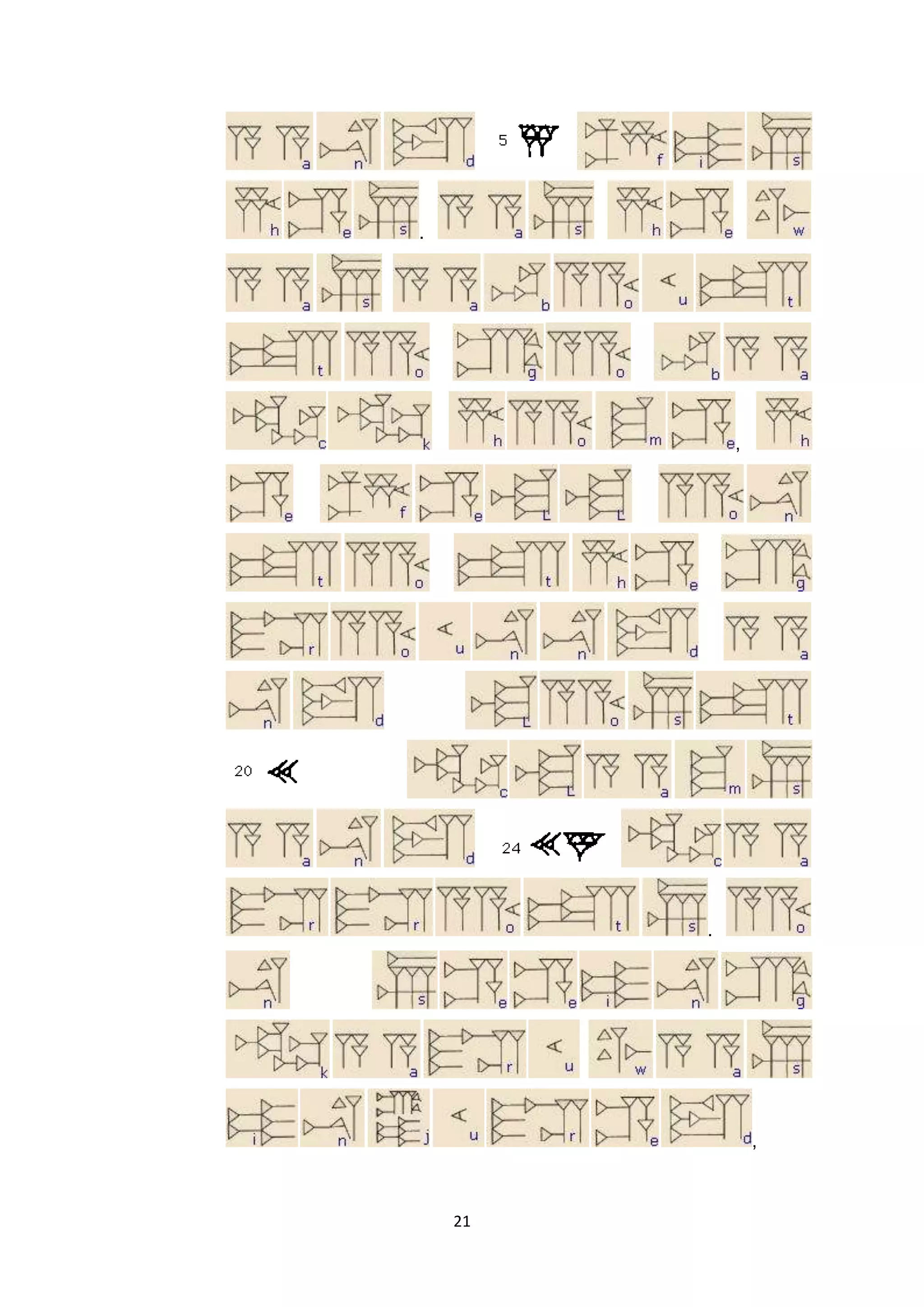
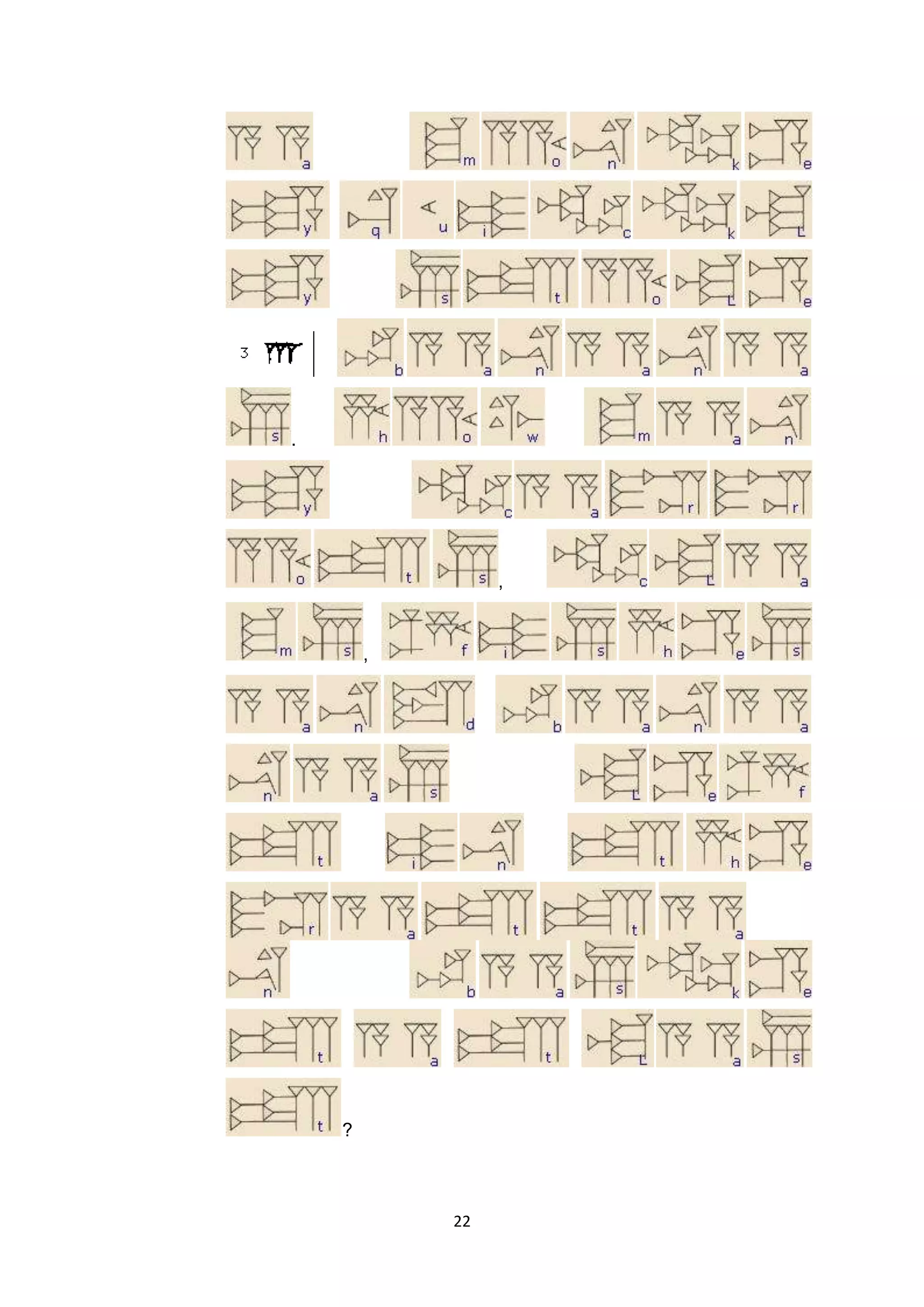
      find food. He collected 41 carrots, 26 clams, 13 fishes and a dozen
      bananas in a big rattan basket. He felt hungry so he decided to eat 3
      carrots and 5 fishes. As he was about to go back home, he fell onto
      the ground and lost 20 clams and 24 carrots. On seeing Karu was
      injured, a monkey quickly stole 3 bananas. How many carrots, clams,
      fishes and bananas left in the rattan basket at last?


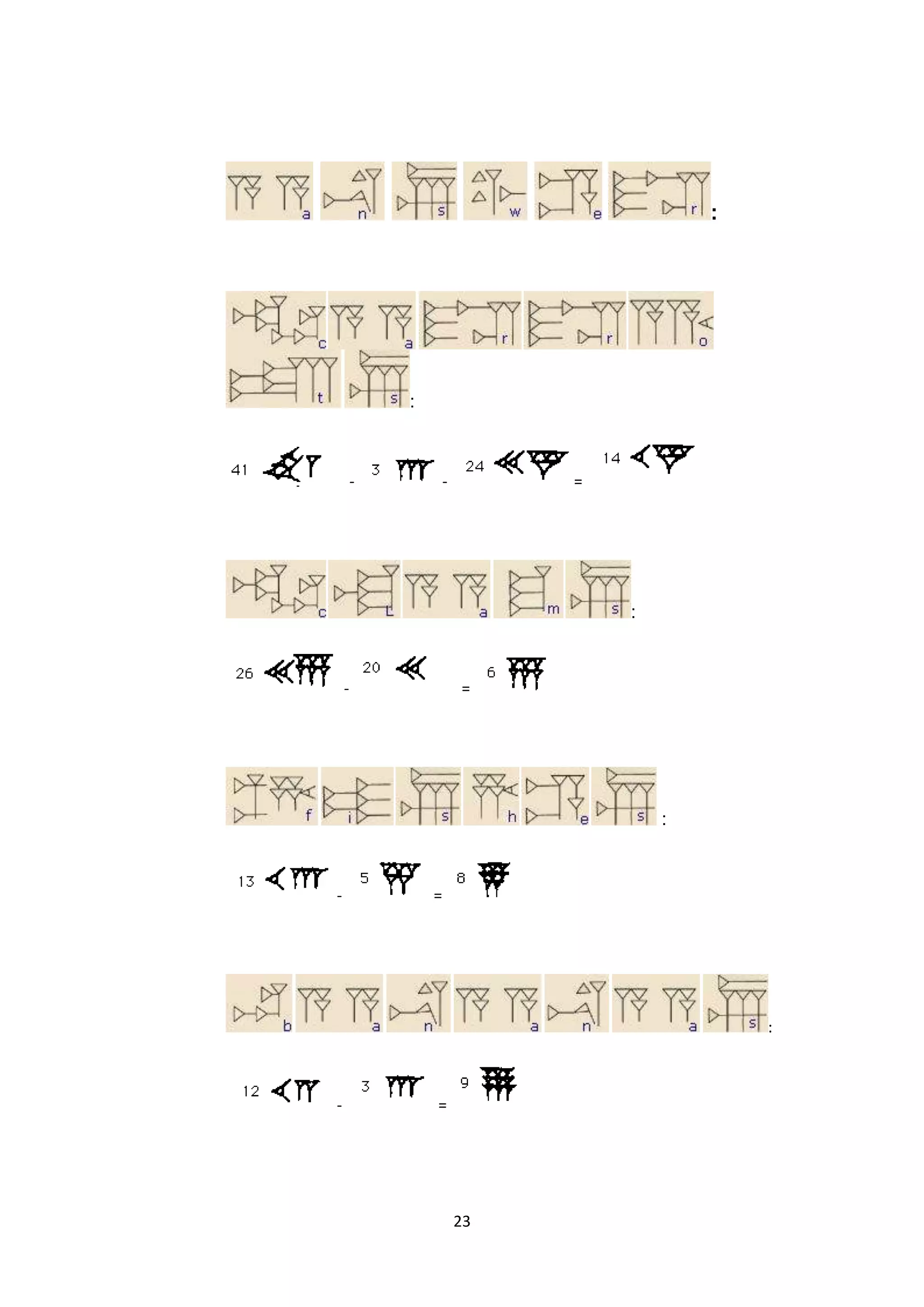
      Answer:


      Carrots:

      41- 3 – 24 = 14

      Clams:

      26 – 20 = 6

      Fishes:

      13 – 5 = 8

      Bananas:

      12 – 3 = 9


                                  18
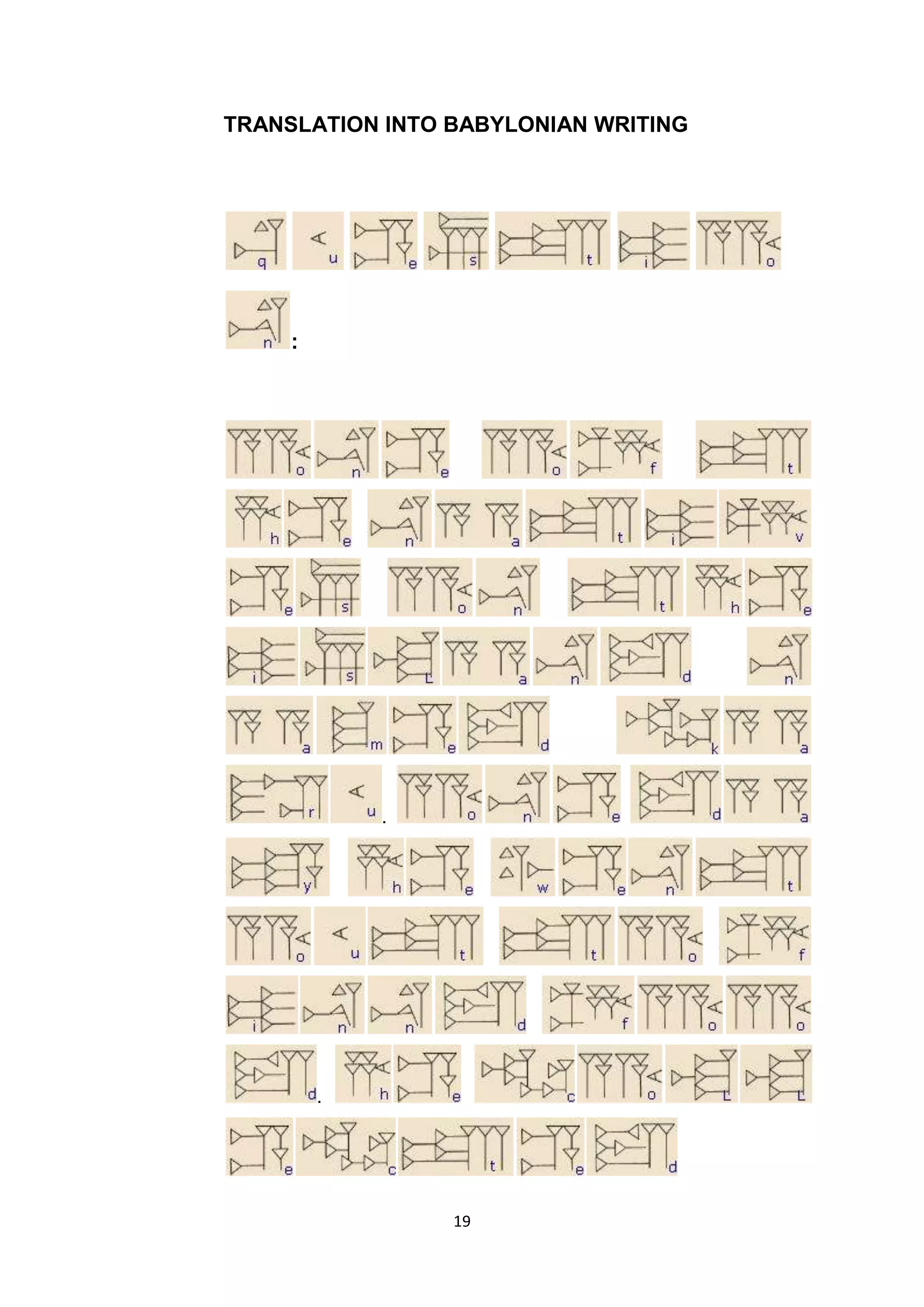
TRANSLATION INTO BABYLONIAN WRITING


     :


             .


         .


                 19
,


             ,


.


    20
.


             ,


         .


                 ,


    21
.


                 ,


        ,


    ?


            22
:


            :


        -           -        =


                                 :


    -                   =


                                     :


-               =


                                             :


-               =


                        23

NUMERATION SYSTEM

  • 1.
    2.0 THE FIRST TEN NUMBERS OF EACH NUMERATION SYSTEM 2.1 EGYPTIAN NUMERATION SYSTEM One of the earliest examples of a numeral system is the Egyptian numeral system, based on the following hieroglyphs: If we look at the diagram above, we will notice that the first nine numerals are pictographic in character, but the remaining ones are logographic in character. Notice also that this is a decimal system. However, it does not tell us how the Egyptians wrote compound numerals. As it turns out, the Egyptians used a simple additive system, as illustrated in the following diagrams. 2
  • 2.
    Note carefully thatalthough the Egyptian numeral system does not especially require a symbol for zero, the Egyptians nevertheless had a symbol for zero which they used for a variety of engineering and accounting purposes, including some rather astonishing projects, such as the Pyramids which were constructed during 2550 BC. HINDU-ARABIC EGYPTIAN NUMERATION SYSTEM NUMERATION SYSTEM 1 2 3 3
  • 3.
  • 4.
    2.2 BABYLONIAN NUMERATION SYSTEM The Babylonians lived in Mesopotamia, which is between the Tigris and Euphrates rivers. They began a numbering system about 5,000 years ago. It is one of the oldest numbering systems. The first mathematics can be traced to the ancient country of Babylon, during the third millennium B.C. Tables were the Babylonians most outstanding accomplishment which helped them in calculating problems. The Babylonian numeration system was developed between 3000 and 2000 BCE. It uses only two numerals or symbols, a one and a ten to represent numbers and they looked these: To represent numbers from 2 to 59, the system was simply additives. The Babylonian number system began with tally marks just as most of the ancient math systems did. The Babylonians developed a form of writing based on cuneiform. Cuneiform means "wedge shape" in Latin. They wrote these symbols on wet clay tablets which were baked in the hot sun. Many thousands of these tablets are still around today. The Babylonians used a stylist to imprint the symbols on the clay since curved lines could not be drawn. The Babylonians had a very advanced number system even for today's standards. It was a base 60 system (sexagesimals) rather than a base ten (decimal). Base ten is what we use today. 5
  • 5.
    The Babylonians dividedthe day into twenty-four hours, each hour into sixty minutes, and each minute to sixty seconds. This form of counting has survived for four thousand years. Example#1: 5 is written as shown: 12 are written as shown: Notice how the ones, in this case two ones are shown on the right just like the Hindu-Arabic numeration system 45 is written as shown: For number bigger than 59, the Babylonian used a place value system with a base of 60 6
  • 6.
    62 is writtenas shown: Notice this time the use of a big space to separate the space value Without the big space, things look like this: However, what is that number without this big space? Could it be 2 × 60 + 1 or 1× 602 + 1 × 60 + 1 or??? The Babylonians introduced the big space after they became aware of this ambiguity. The number 4871 could be represented as follow: 3600 + 1260 + 11 = 4871 7
  • 7.
    Even after thebig space was introduced to separate place value, the Babylonians still faced a more serious problem? Since there was no zero to put in an empty position, the number 60 would thus have the same representation as the number 1 How did they make the difference? All we can say is that the context must have helped them to establish such difference yet the Babylonian numeration system was without a doubt a very ambiguous numeral system. If this had become a major problem, no doubt the Babylonians were smart enough to come up with a working system. 8
  • 8.
    HINDU-ARABIC BABYLONIAN NUMERATION SYSTEM NUMERATION SYSTEM 1 2 3 4 5 6 9
  • 9.
  • 10.
    2.3 ROMAN NUMERATION SYSTEM Before Rome, the most developed civilization on the Italic Peninsula was the Etruscan civilization, who copied their numerals from the early Greek (Attic) system. These numerals were adopted and adapted by the Romans, who formulated the Roman numeral system, still in wide use today for a variety of purposes. There are other Roman numerals that most of us never learn, but can be found in Latin dictionaries – for example: 5000 I>> 10000 ==I>> 50000 I>>> 100000 ===I>>> 500000 I>>>> 1000000 ====I>>>> As every grade school child knows, the Roman numeral system is based on the following seven atomic numerals: IVXLCDM 1 5 10 50 100 500 1000 The Roman numeral system is not a simple additive system, but is rather an additive-subtractive system. In fact, the subtractive aspect is frequently a source of worry when reading large numerals – for example: MCMXCIX By saying that the Roman system is (partly) subtractive, we mean that some combinations of symbols require us to apply subtraction in order to interpret them. For example, IV stands for “one before five”, which is four [i.e., 5 minus 1]. Similarly, the numeral XC 11
  • 11.
    stands for “tenbefore one-hundred”, which is ninety [i.e., 100 minus 10]. On the other hand, the string IC is officially ill-formed, although it could be understood to mean “one before one-hundred”, which would then be ninety-nine. So how do we interpret a Roman numeral such as „MCMXCIX‟? M is not before a larger numeral, so it reads: + 1000 1000 C is before a larger numeral, so it reads: - 100 M is after a negative prefix, so it reads: + 1000 900 X is before a larger numeral, so it reads: - 10 C is after a negative prefix, so it reads: + 100 90 I is before a larger numeral, so it reads: - 1 X is after a negative prefix, so it reads: + 10 9 Thus, „MCMXCIX‟ represents the number 1999. HINDU-ARABIC ROMAN NUMERATION SYSTEM NUMERATION SYSTEM 1 I 2 II 3 III 4 IV 5 V 6 VI 7 VII 8 VIII 9 IX 12
  • 12.
    10 X 2.4 MAYAN NUMERATION SYSTEM The Mayan number system dates back to the fourth century and was approximately 1,000 years more advanced than the Europeans of that time. This system is unique to our current decimal system, which has a base 10, in that the Mayan's used a base 20. This system is believed to have been used because, since the Mayan's lived in such a warm climate and there was rarely a need to wear shoes, 20 was the total number of fingers and toes, thus making the system workable. Therefore two important markers in this system are 20, which relates to the fingers and toes, and five, which relates to the number of digits on one hand or foot. The Mayan numeration system evolved around A.D. 300. It uses 3 basic numerals to represent any possible number: a dot for one, a horizontal bar for 5, and a conch shell for zero. The Mayan's were also the first to symbolize the concept of nothing (or zero). The most common symbol was that of a shell ( ) but there were several other symbols (e.g. a head). It is interesting to learn that with all of the great mathematicians and scientists that were around in ancient Greece and Rome, it was the Mayan Indians who independently came up with this symbol which usually meant completion as opposed to zero or nothing. They used the 3 symbols above to represent the numbers from 0 through 19 as shown below: 13
  • 13.
    For number biggerthan 19, a number is written in a vertical position so that it becomes a vertical place value system. Initially, the base used in the Mayan numeration system was base 20 and their place values were 1, 20, 202, 203, Then, they changed their place values to 1, 20, 20 × 18, 20 2 × 18, 203× 18, ... Using the base 20, 1, 20, 202,203, ..., we can write 20 as follow: In the ones place we have 0 and in the twenties place we have 1, so the number is 0 × 1 + 1 × 20 = 0 + 20 = 20 Still using a base of 20, we can write 100 as follow: 0 × 1 + 5 × 20 = 0 + 20 = 100 Below is how to represent 2007 14
  • 14.
    5 × 202+ 0 × 20 + 7 = 5 × 400 + 0 + 7 = 2000 + 7 = 2007 It is started from the bottom, a place value must have a number from the list above. (1-19) Look carefully and see how it was separated into the place values. Again, it was separated according to numbers that are the list above from 1 through 19 The number is: 14 + 7 × 20 + 1 × 202 + 3 × 20 3 + 0 × 20 4 + 15 × 20 5 + 5 × 20 6 The number is 14 + 140 + 1 × 400 + 3 × 8,000 + 0 + 15 × 3,200,000 + 5× 64,000,000 The number is = 14 + 140 + 400 + 24,000 + 0 + 48,000,000 + 320,000,000 = 15
  • 15.
    368024554 Withthe base 1, 20, 20 × 18, 202 × 18, 203× 18, ... computation is done the exact same way! Group as shown below: The number is 11 × 1 + 1 × 20 + 10 × 20 × 18 = 11 + 20 + 3600 = 3631 No doubt; the Mayan numeration system was sophisticated. HINDU-ARABIC MAYAN NUMERATION SYSTEM NUMERATION SYSTEM 1 2 3 4 16
  • 16.
  • 17.
    2.5 WORD PROBLEM AND ITS SOLUTION Question: One of the natives on the island named Karu. One day, he went out to find food. He collected 41 carrots, 26 clams, 13 fishes and a dozen bananas in a big rattan basket. He felt hungry so he decided to eat 3 carrots and 5 fishes. As he was about to go back home, he fell onto the ground and lost 20 clams and 24 carrots. On seeing Karu was injured, a monkey quickly stole 3 bananas. How many carrots, clams, fishes and bananas left in the rattan basket at last? Answer: Carrots: 41- 3 – 24 = 14 Clams: 26 – 20 = 6 Fishes: 13 – 5 = 8 Bananas: 12 – 3 = 9 18
  • 18.
  • 19.
    , , . 20
  • 20.
    . , . , 21
  • 21.
    . , , ? 22
  • 22.
    : : - - = : - = : - = : - = 23