History of Numbers
Some ancient numbers
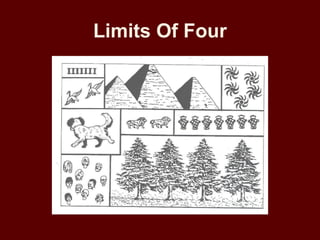
Limits Of Four
Some solutions to “limit of
           four”
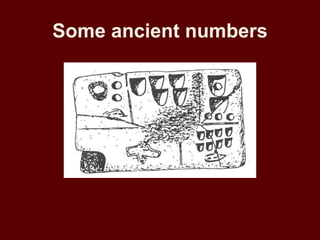
• To surpass this limit of four is to count
  and due to this reason counting developed
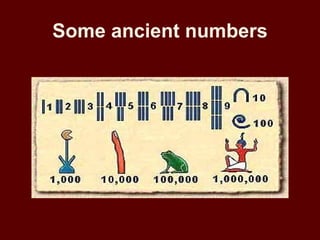
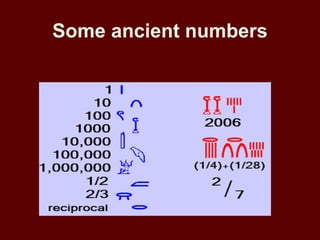
Egyptian 3 Century BC
         rd
Cretan 1200-1700BC
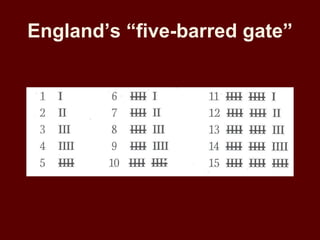
England’s “five-barred gate”
Additive Numeral Systems

• Some societies have an additive
  numeral system: a principle of addition,
  where each character has a value
  independent of its position in its
  representation

• Examples are the Greek and Roman
  numeral systems
The Greek Numeral System
Arithmetic with Greek Numeral System
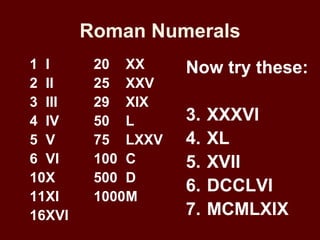
Roman Numerals
1 I      20 XX     Now try these:
2 II     25 XXV
3 III    29 XIX
4 IV     50 L      3.   XXXVI
5 V      75 LXXV   4.   XL
6 VI     100 C     5.   XVII
10X      500 D
                   6.   DCCLVI
11XI     1000M
16XVI              7.   MCMLXIX
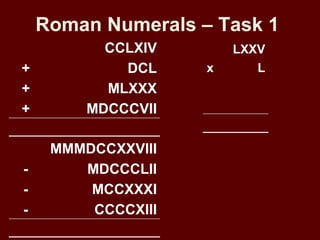
Roman Numerals – Task 1
           CCLXIV       LXXV
+            DCL    x      L
+          MLXXX
+        MDCCCVII

     MMMDCCXXVIII
-       MDCCCLII
-        MCCXXXI
-        CCCCXIII
Roman Numerals – Task 1

       CCLXIV         264
+        DCL    +     650
+      MLXXX    +    1080
+    MDCCCVII   +    1807
    MMMDCCCI         3801
Roman Numerals – Task 1

    MMMDCCXXVIII          3728
-      MDCCCLII       -   1852
-       MCCXXXI       -   1231
-       CCCCXIII      -    413
         CCXXXII           232
Roman Numerals – Task 1
       LXXV                   75
x         L           x       50


    MMMDCCL               3750
Drawbacks of positional numeral
           system
• Hard to represent larger
  numbers
• Hard to do arithmetic with
  larger numbers, trying do 23456
  x 987654
• The search was on for portable
  representation of numbers

• To make progress, humans had to
  solve a tricky problem:

• What is the smallest set of symbols in
  which the largest numbers can in
  theory be represented?
Positional Notation

…     Hundreds   Tens     Units

         5        7        3
South American Maths


The Maya


The Incas
Mayan Maths


twenties   units    2 x 20 +   7 =   47

twenties   units
                   18 x 20 +   5 = 365
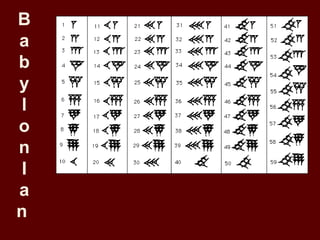
Babylonian Maths
      The Babylonians
B
a
b
y
 l
o
n
 I
a
n
Zero and the Indian Sub-
     Continent Numeral System
• You know the origin of the positional number, and
  its drawbacks.
• One of its limits is how do you represent tens,
  hundreds, etc.
• A number system to be as effective as ours, it must
  possess a zero.
• In the beginning, the concept of zero was
  synonymous with empty space.
• Some societies came up with solutions to represent
  “nothing”.
• The Babylonians left blanks in places where zeroes
  should be.
• The concept of “empty” and “nothing” started
  becoming synonymous.
• It was a long time before zero was discovered.
Cultures that Conceived
            “Zero”
• Zero was conceived by these societies:
• Mesopotamia civilization 200 BC – 100
  BC
• Maya civilization 300 – 1000 AD
• Indian sub-continent 400 BC – 400 AD
Zero and the Indian Sub-
   Continent Numeral System
• We have to thank our ancestors of the
  Indian subcontinent for our modern
  number system.
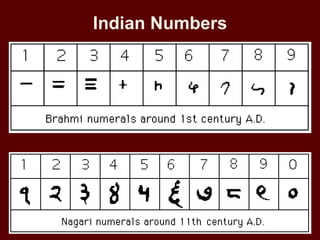
• Similarity between the Indian numeral
  system and our modern one
Indian Numbers
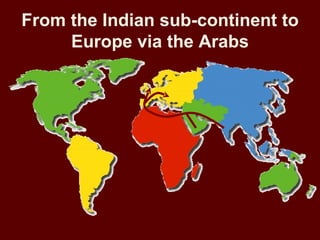
From the Indian sub-continent to
     Europe via the Arabs
Irrationals and Imaginaries
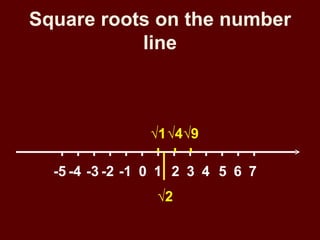
Square roots on the number
           line


                √1√4√9

  -5 -4 -3 -2 -1 0 1 2 3 4 5 6 7
                 √2
Square roots of negatives
Where should we put √-1 ?


                    √-1=i
                   √1√4√9

     -5 -4 -3 -2 -1 0 1 2 3 4 5 6 7
                    √2
Imaginary numbers

       √-4 = √(-1 x 4)
           = √-1 x √4
           = 2i

        √-1=i
Imaginary numbers


       Imaginary
                   4i


         nums
                   3i
                   2i
                   i
                   √1√4√9

-5 -4 -3 -2 -1 0 1 2 3 4 5 6 7   Real
                                 nums
                   √2
Take Home Messages
• The number system we have today have come
  through a long route, and mostly from some far away
  lands, outside of Europe.
• They came about because human beings wanted to
  solve problems and created numbers to solve these
  problems.
• Numbers belong to human culture, and not nature,
  and therefore have their own long history.
3 great ideas made our modern
          number system
Our modern number system was a result of a
conjunction of 3 great ideas:
• the idea of attaching to each basic figure
  graphical signs which were removed from all
  intuitive associations, and did not visually
  evoke the units they represented
• the principle of position
• the idea of a fully operational zero, filling the
  empty spaces of missing units and at the
  same time having the meaning of a null
  number

History numbers

  • 1.
  • 2.
  • 3.
  • 4.
  • 5.
  • 6.
  • 7.
    Some solutions to“limit of four” • To surpass this limit of four is to count and due to this reason counting developed
  • 8.
  • 9.
  • 10.
  • 11.
    Additive Numeral Systems •Some societies have an additive numeral system: a principle of addition, where each character has a value independent of its position in its representation • Examples are the Greek and Roman numeral systems
  • 12.
  • 13.
    Arithmetic with GreekNumeral System
  • 14.
    Roman Numerals 1 I 20 XX Now try these: 2 II 25 XXV 3 III 29 XIX 4 IV 50 L 3. XXXVI 5 V 75 LXXV 4. XL 6 VI 100 C 5. XVII 10X 500 D 6. DCCLVI 11XI 1000M 16XVI 7. MCMLXIX
  • 15.
    Roman Numerals –Task 1 CCLXIV LXXV + DCL x L + MLXXX + MDCCCVII MMMDCCXXVIII - MDCCCLII - MCCXXXI - CCCCXIII
  • 16.
    Roman Numerals –Task 1 CCLXIV 264 + DCL + 650 + MLXXX + 1080 + MDCCCVII + 1807 MMMDCCCI 3801
  • 17.
    Roman Numerals –Task 1 MMMDCCXXVIII 3728 - MDCCCLII - 1852 - MCCXXXI - 1231 - CCCCXIII - 413 CCXXXII 232
  • 18.
    Roman Numerals –Task 1 LXXV 75 x L x 50 MMMDCCL 3750
  • 19.
    Drawbacks of positionalnumeral system • Hard to represent larger numbers • Hard to do arithmetic with larger numbers, trying do 23456 x 987654
  • 20.
    • The searchwas on for portable representation of numbers • To make progress, humans had to solve a tricky problem: • What is the smallest set of symbols in which the largest numbers can in theory be represented?
  • 21.
    Positional Notation … Hundreds Tens Units 5 7 3
  • 22.
  • 23.
    Mayan Maths twenties units 2 x 20 + 7 = 47 twenties units 18 x 20 + 5 = 365
  • 24.
    Babylonian Maths The Babylonians
  • 25.
  • 26.
    Zero and theIndian Sub- Continent Numeral System • You know the origin of the positional number, and its drawbacks. • One of its limits is how do you represent tens, hundreds, etc. • A number system to be as effective as ours, it must possess a zero. • In the beginning, the concept of zero was synonymous with empty space. • Some societies came up with solutions to represent “nothing”. • The Babylonians left blanks in places where zeroes should be. • The concept of “empty” and “nothing” started becoming synonymous. • It was a long time before zero was discovered.
  • 27.
    Cultures that Conceived “Zero” • Zero was conceived by these societies: • Mesopotamia civilization 200 BC – 100 BC • Maya civilization 300 – 1000 AD • Indian sub-continent 400 BC – 400 AD
  • 28.
    Zero and theIndian Sub- Continent Numeral System • We have to thank our ancestors of the Indian subcontinent for our modern number system. • Similarity between the Indian numeral system and our modern one
  • 29.
  • 30.
    From the Indiansub-continent to Europe via the Arabs
  • 31.
  • 32.
    Square roots onthe number line √1√4√9 -5 -4 -3 -2 -1 0 1 2 3 4 5 6 7 √2
  • 33.
    Square roots ofnegatives Where should we put √-1 ? √-1=i √1√4√9 -5 -4 -3 -2 -1 0 1 2 3 4 5 6 7 √2
  • 34.
    Imaginary numbers √-4 = √(-1 x 4) = √-1 x √4 = 2i √-1=i
  • 35.
    Imaginary numbers Imaginary 4i nums 3i 2i i √1√4√9 -5 -4 -3 -2 -1 0 1 2 3 4 5 6 7 Real nums √2
  • 36.
    Take Home Messages •The number system we have today have come through a long route, and mostly from some far away lands, outside of Europe. • They came about because human beings wanted to solve problems and created numbers to solve these problems. • Numbers belong to human culture, and not nature, and therefore have their own long history.
  • 37.
    3 great ideasmade our modern number system Our modern number system was a result of a conjunction of 3 great ideas: • the idea of attaching to each basic figure graphical signs which were removed from all intuitive associations, and did not visually evoke the units they represented • the principle of position • the idea of a fully operational zero, filling the empty spaces of missing units and at the same time having the meaning of a null number

Editor's Notes

  • #2 Introduce ourselves here
  • #7 Take a look at this picture, and try to estimate the quantity of each set of objects in a singe visual glance, without counting . Take a look again. More difficult to see the objects more than four. Everyone can see the sets of one, two, and of three objects in the figure, and most people can see the set of four. But that’s about the limit of our natural ability to numerate. Beyond 4, quantities are vague, and our eyes alone cannot tell us how many things there are.
  • #8 Different societies came up with ways to deal with this “limit of four”.
  • #12 Some societies additive numeral system: a principle of addition , where each character has a value independent of its position in its representation
  • #20 Hard to represent larger numbers Hard to do arithmetic with larger numbers, trying do 23456 x 987654
  • #21 The search was on for portable representation of numbers To make progress, humans had to solve a tricky problem: What is the smallest set of symbols in which the largest numbers can in theory be represented?
  • #27 You know the origin of the positional number, and its drawbacks. One of its limits is how do you represent tens, hundreds, etc. A number system to be as effective as ours, it must possess a zero. In the beginning, the concept of zero was synonymous with empty space. Some societies came up with solutions to represent “nothing”. The Babylonians left blanks in places where zeroes should be. The concept of “empty” and “nothing” started becoming synonymous. It was a long time before zero was discovered.
  • #28 We have to thank the Indians for our modern number system. Similarity between the Indian numeral system and our modern one:
  • #37 The number system we have today have come through a long route, and mostly from some far away lands, outside of Europe. They came about because human beings wanted to solve problems and created numbers to solve these problems.