Numeration SystemsBy: Lindsay FredericksOctober 5th, 2010EDU 290T&TH 8:00am
Three Basic Numeration SystemsThe Egyptian Numeration SystemThe Babylonian numeration SystemThe Roman Numeration System
The Egyptian Numeration System
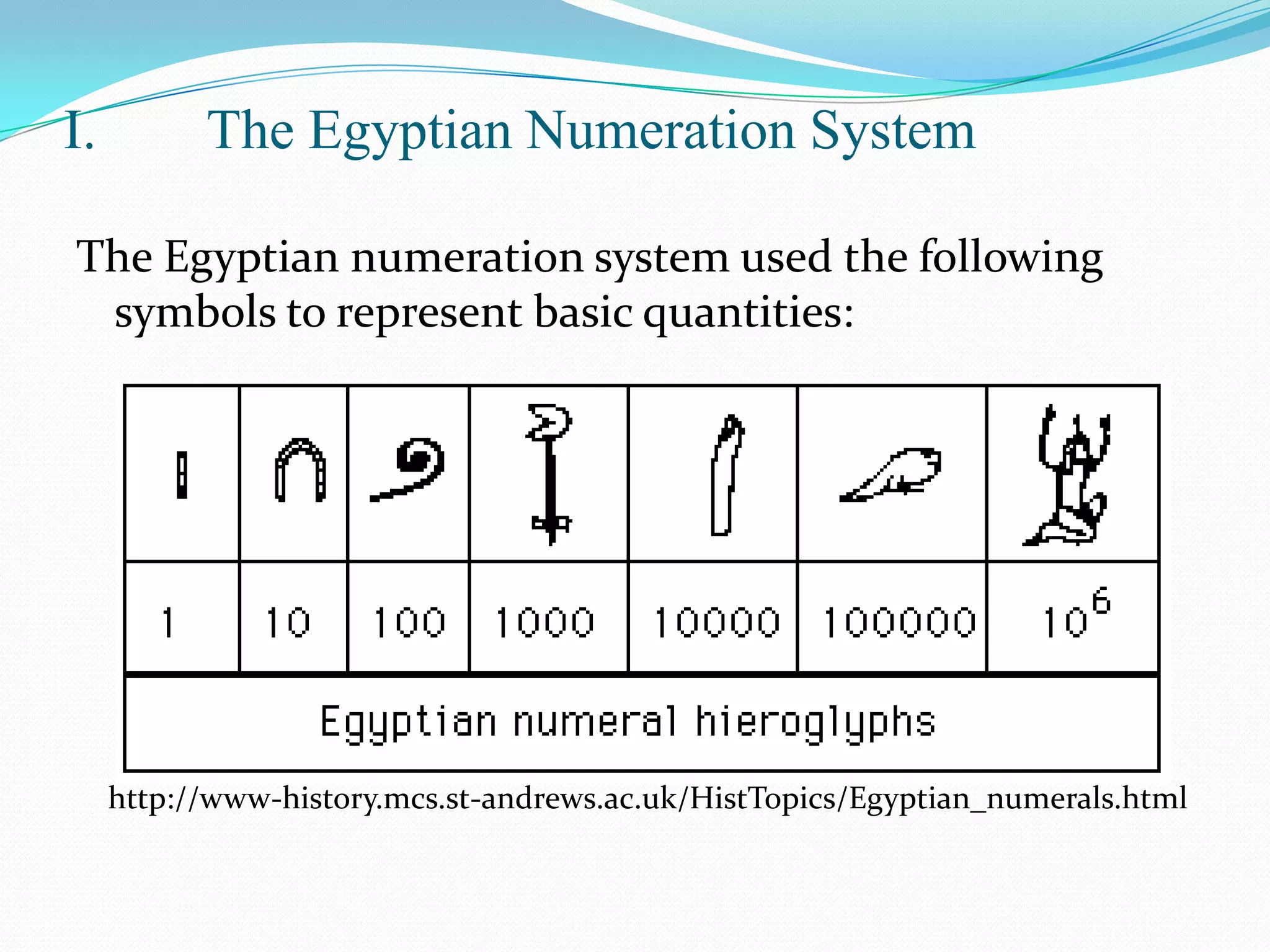
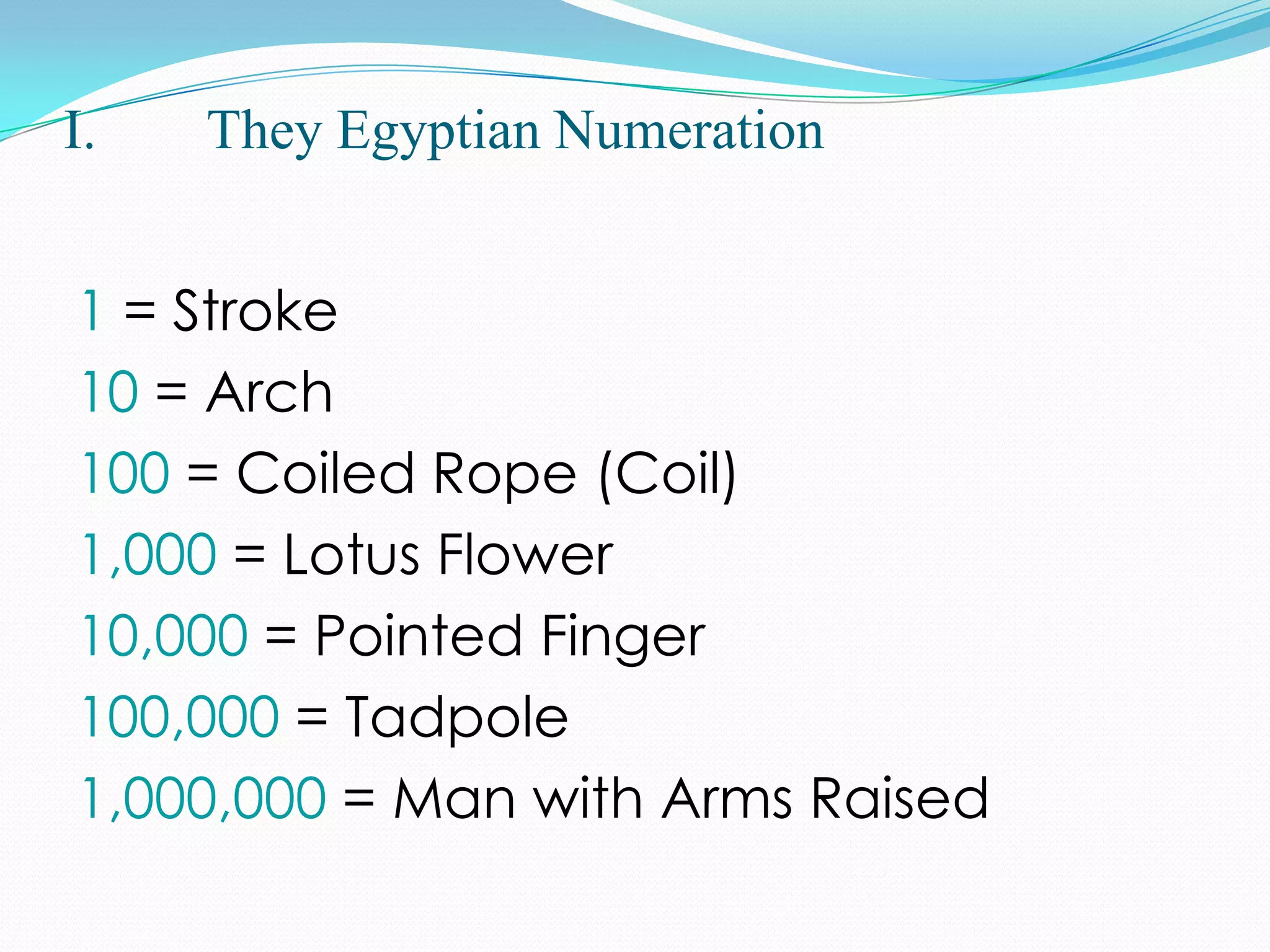
The Egyptian Numeration SystemThe Egyptian numeration system used the following symbols to represent basic quantities:http://www-history.mcs.st-andrews.ac.uk/HistTopics/Egyptian_numerals.html
They Egyptian Numeration1 = Stroke10 = Arch100= Coiled Rope (Coil)1,000= Lotus Flower10,000 = Pointed Finger100,000 = Tadpole1,000,000 = Man with Arms Raised
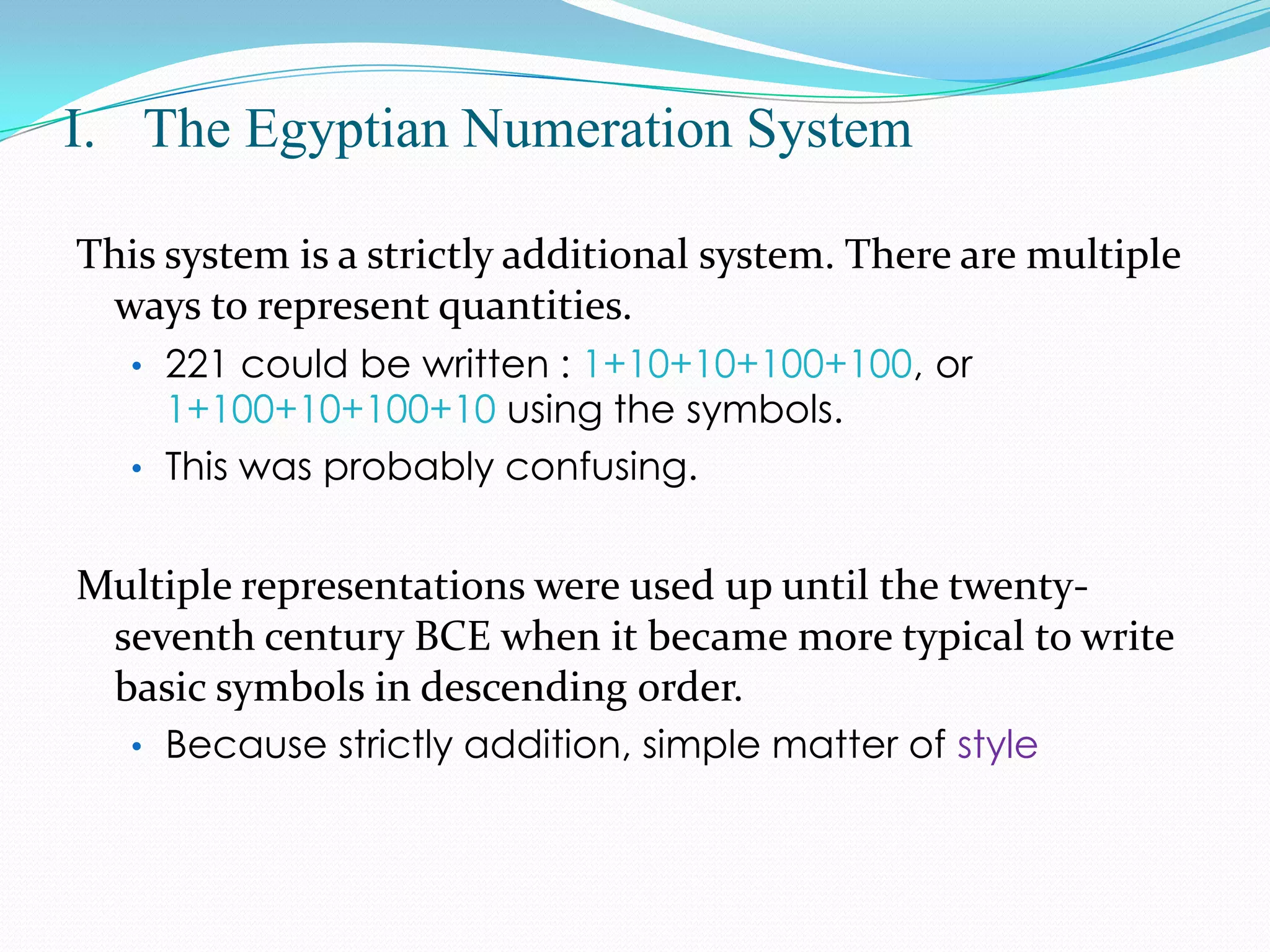
The Egyptian Numeration SystemThis system is a strictly additional system. There are multiple ways to represent quantities. 221 could be written : 1+10+10+100+100, or 1+100+10+100+10using the symbols.
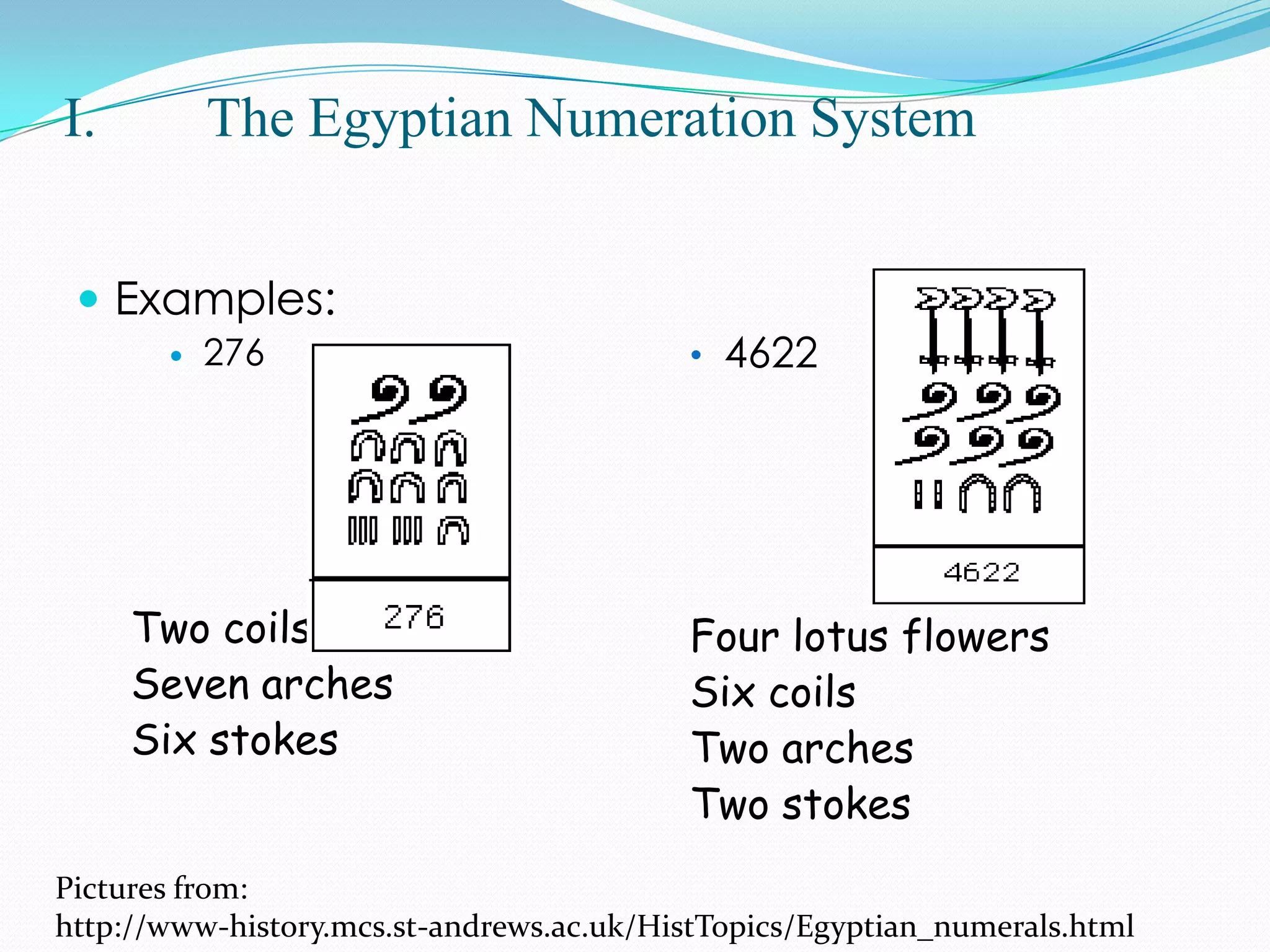
This was probably confusing.Multiple representations were used up until the twenty-seventh century BCE when it became more typical to write basic symbols in descending order.Because strictly addition, simple matter of styleThe Egyptian Numeration SystemExamples: 276Two coilsSeven archesSix stokes4622																						Four lotus flowersSix coils	Two archesTwo stokesPictures from:http://www-history.mcs.st-andrews.ac.uk/HistTopics/Egyptian_numerals.html
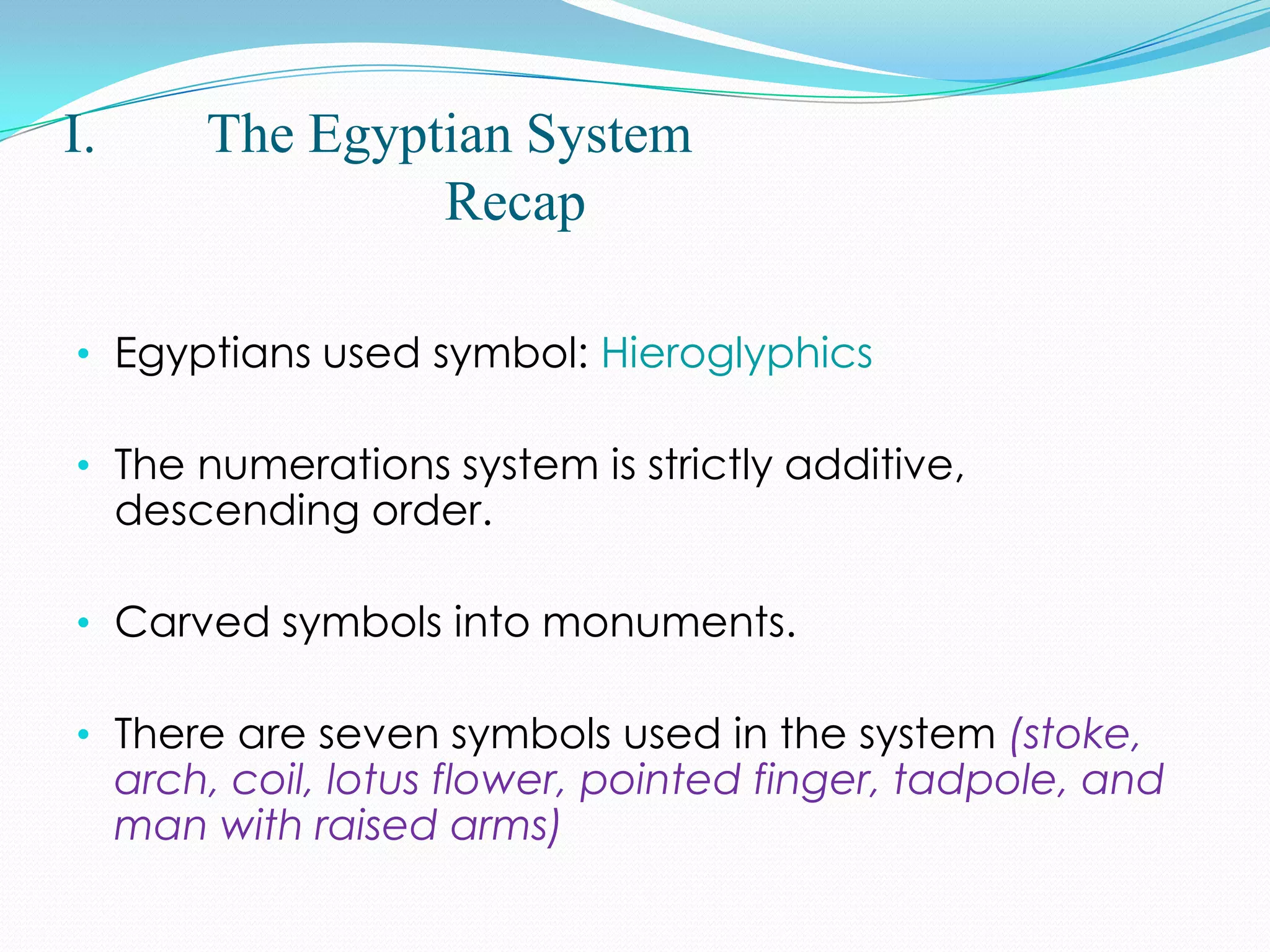
The Egyptian System		RecapEgyptians used symbol: Hieroglyphics
The numerations system is strictly additive, descending order.
Carved symbols into monuments.
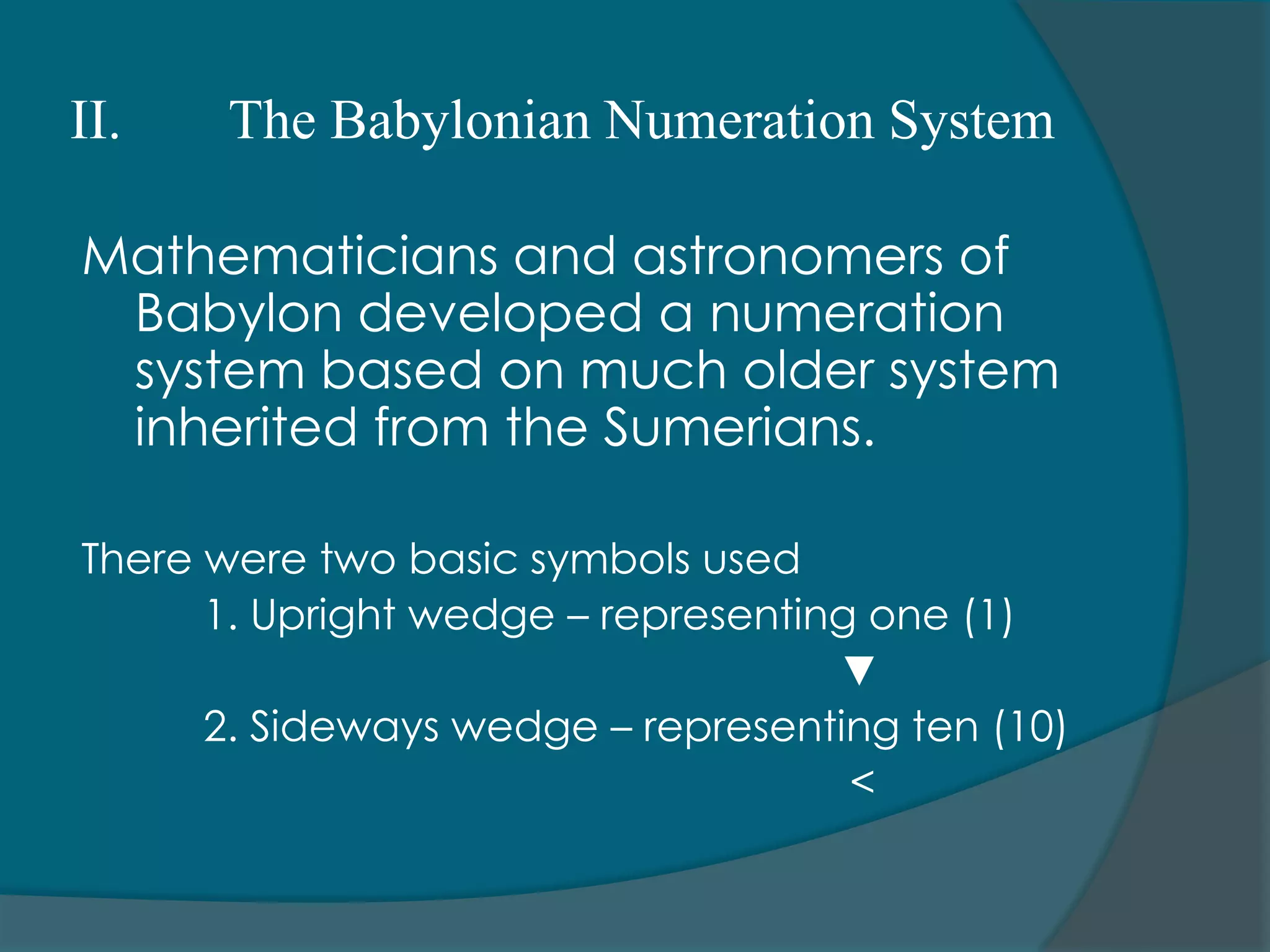
There are seven symbols used in the system (stoke, arch, coil, lotus flower, pointed finger, tadpole, and man with raised arms)II.The Babylonian Numeration SystemMathematicians and astronomers of Babylon developed a numeration system based on much older system inherited from the Sumerians.There were two basic symbols used			1. Upright wedge – representing one (1)							▼		2. Sideways wedge – representing ten (10)							 <
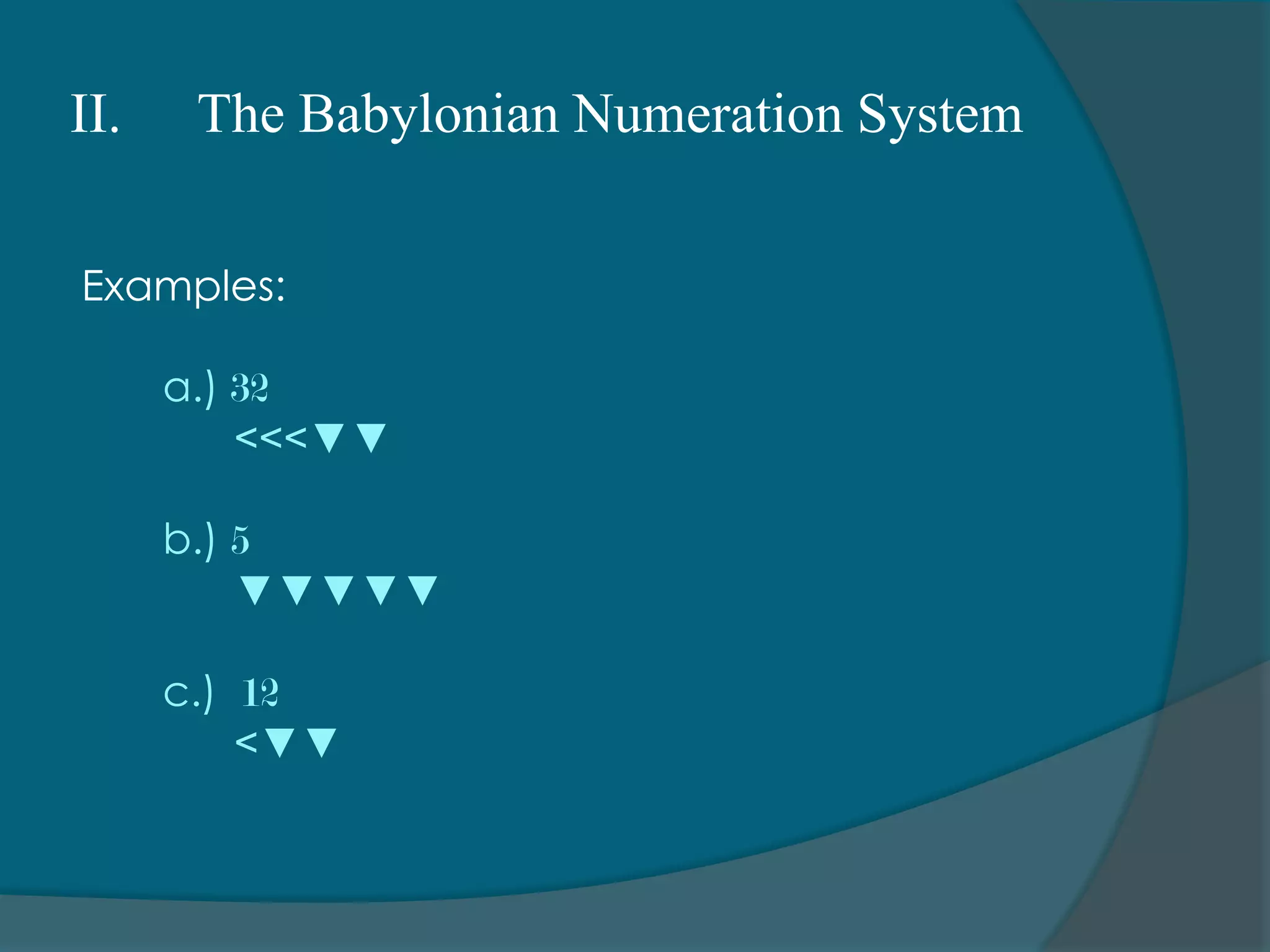
II. 	The Babylonian Numeration SystemExamples:a.) 32	<<<▼▼b.) 5	▼▼▼▼▼c.)  12	<▼▼
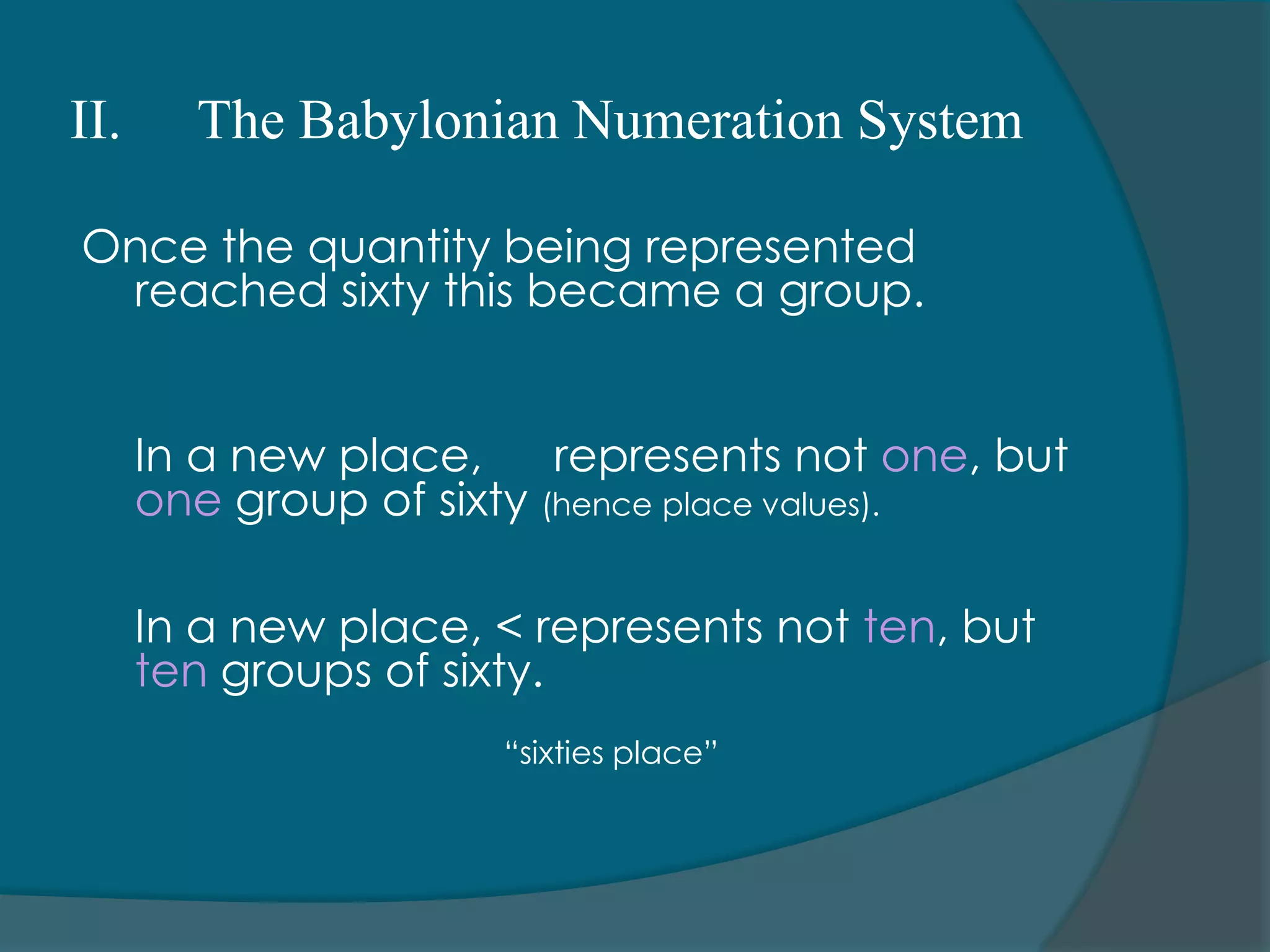
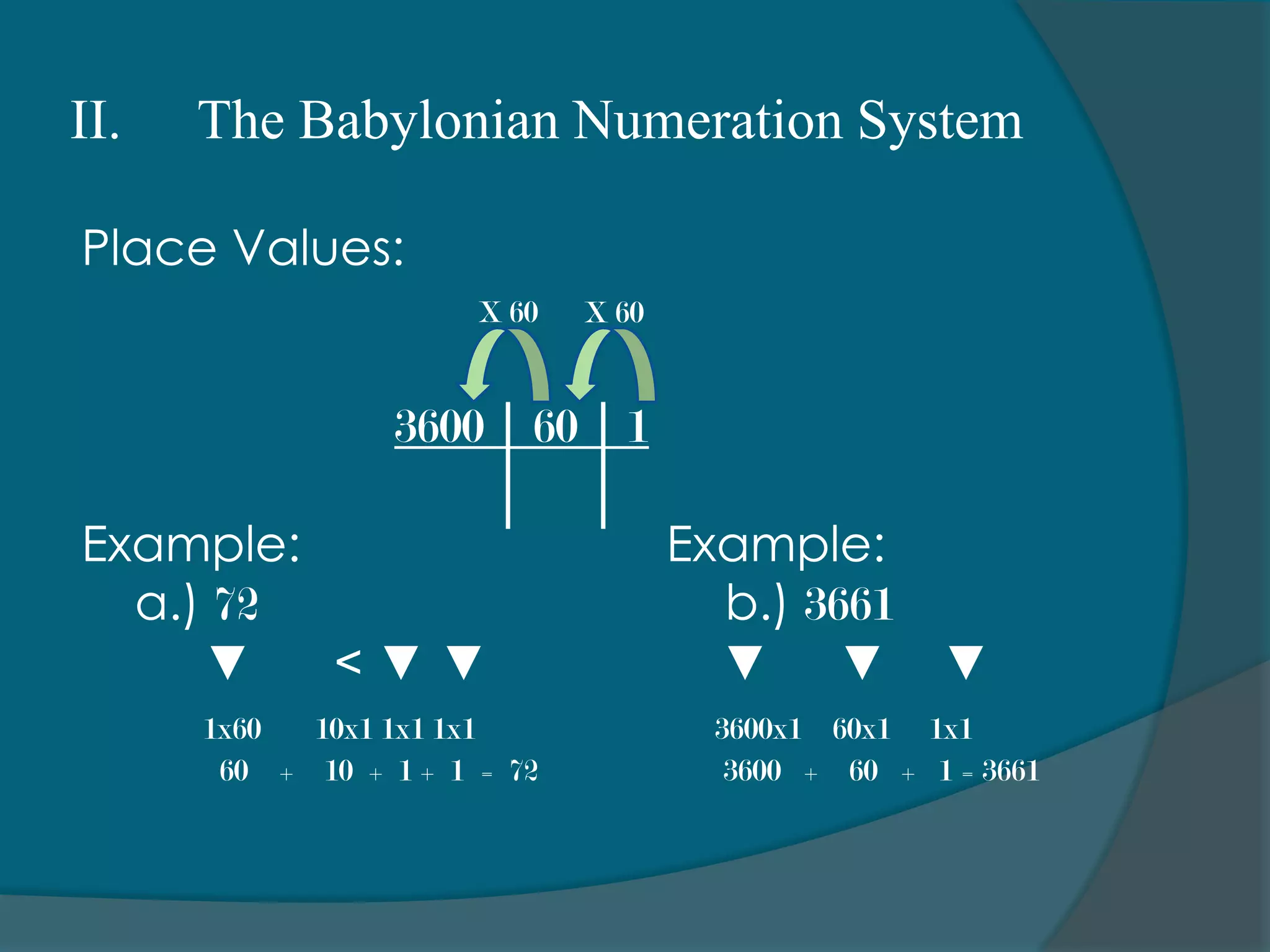
II. 	The Babylonian Numeration SystemOnce the quantity being represented reached sixty this became a group. 	In a new place, ▼ represents not one, but one group of sixty (hence place values).In a new place, < represents not ten, but ten groups of sixty.“sixties place”
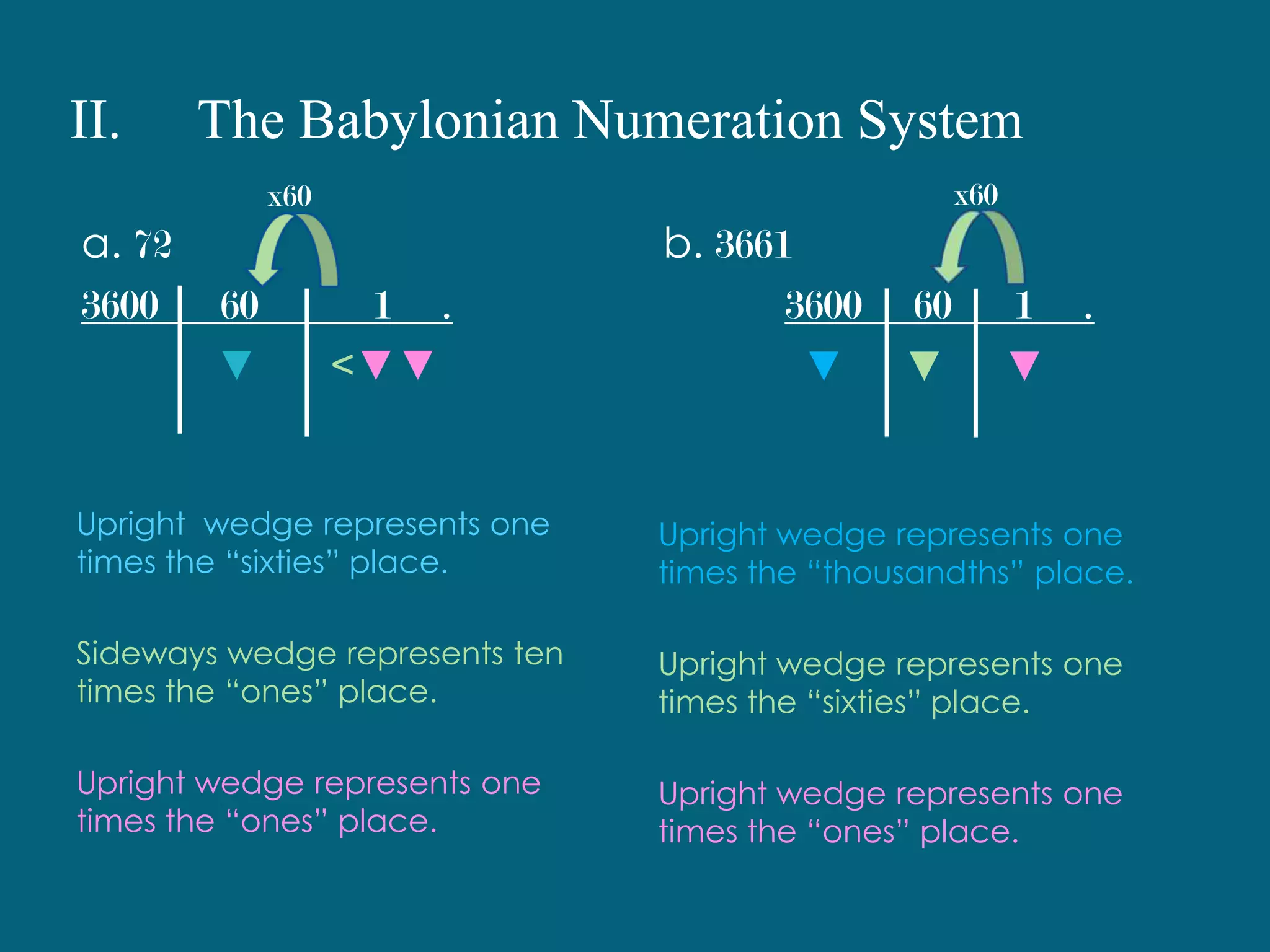
II. 	The Babylonian Numeration Systemx60x60a. 723600      60           1     .  ▼<▼▼b. 36613600     60      1     .▼▼▼Upright wedge represents one times the “sixties” place.Sideways wedge represents ten times the “ones” place.Upright wedge represents one times the “ones” place.Upright wedge represents one times the “thousandths” place. Upright wedge represents one times the “sixties” place.Upright wedge represents one times the “ones” place.
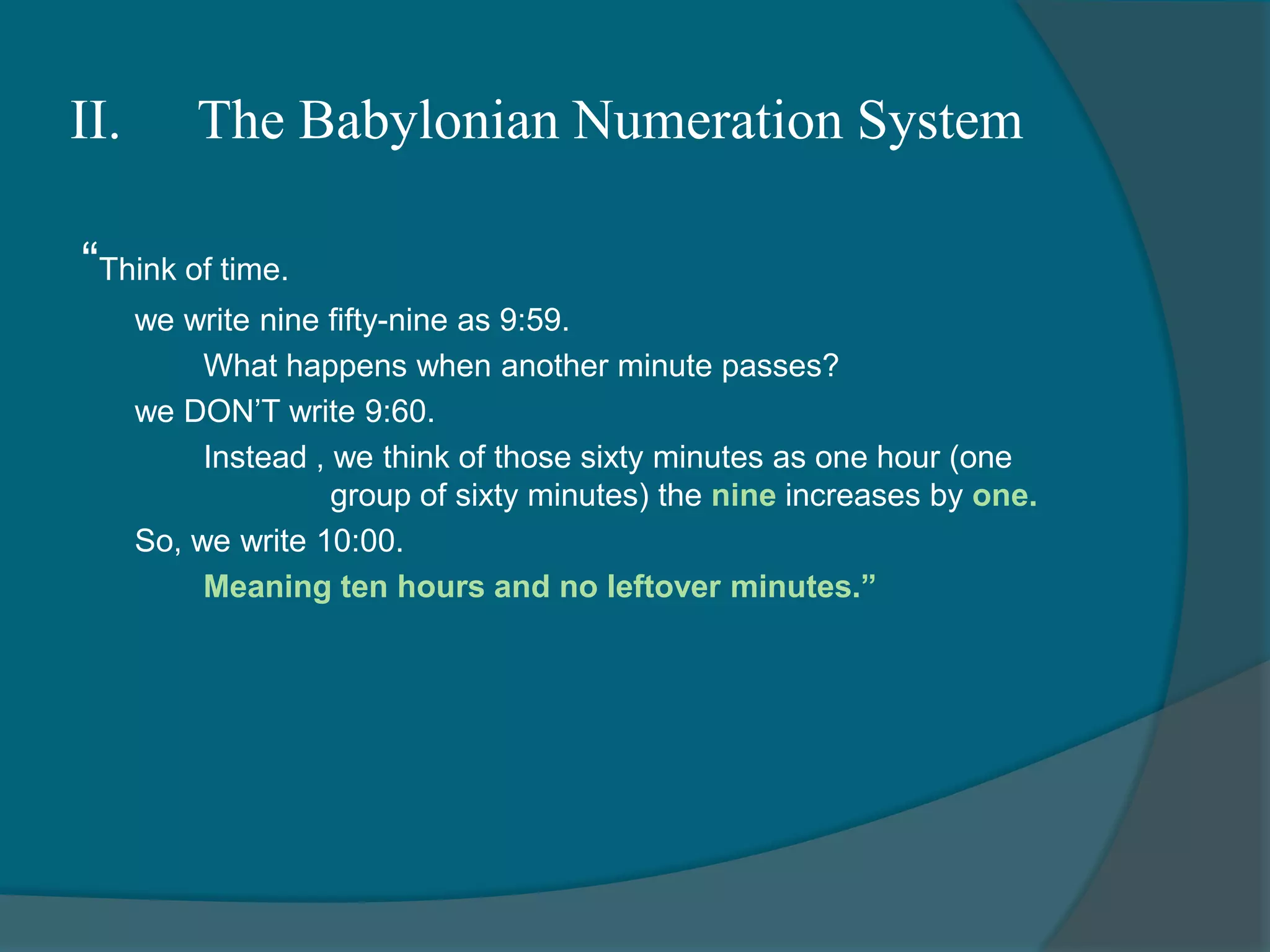
II. 	The Babylonian Numeration System“Think of time.		we write nine fifty-nine as 9:59.		What happens when another minute passes?	we DON’T write 9:60.		Instead , we think of those sixty minutes as one hour (one 		group of sixty minutes) the nine increases by one.So, we write 10:00.		Meaning ten hours and no leftover minutes.”
II. 	The Babylonian Numeration SystemPlace Values:3600    60    1      Example:			      Example:	a.) 72 b.) 3661		▼      < ▼ ▼                 ▼     ▼    ▼1x60       10x1 1x1 1x1                               3600x1    60x1     1x1	           60    +    10  +  1 +  1  =  72                        3600   +    60   +   1 = 3661X 60X 60
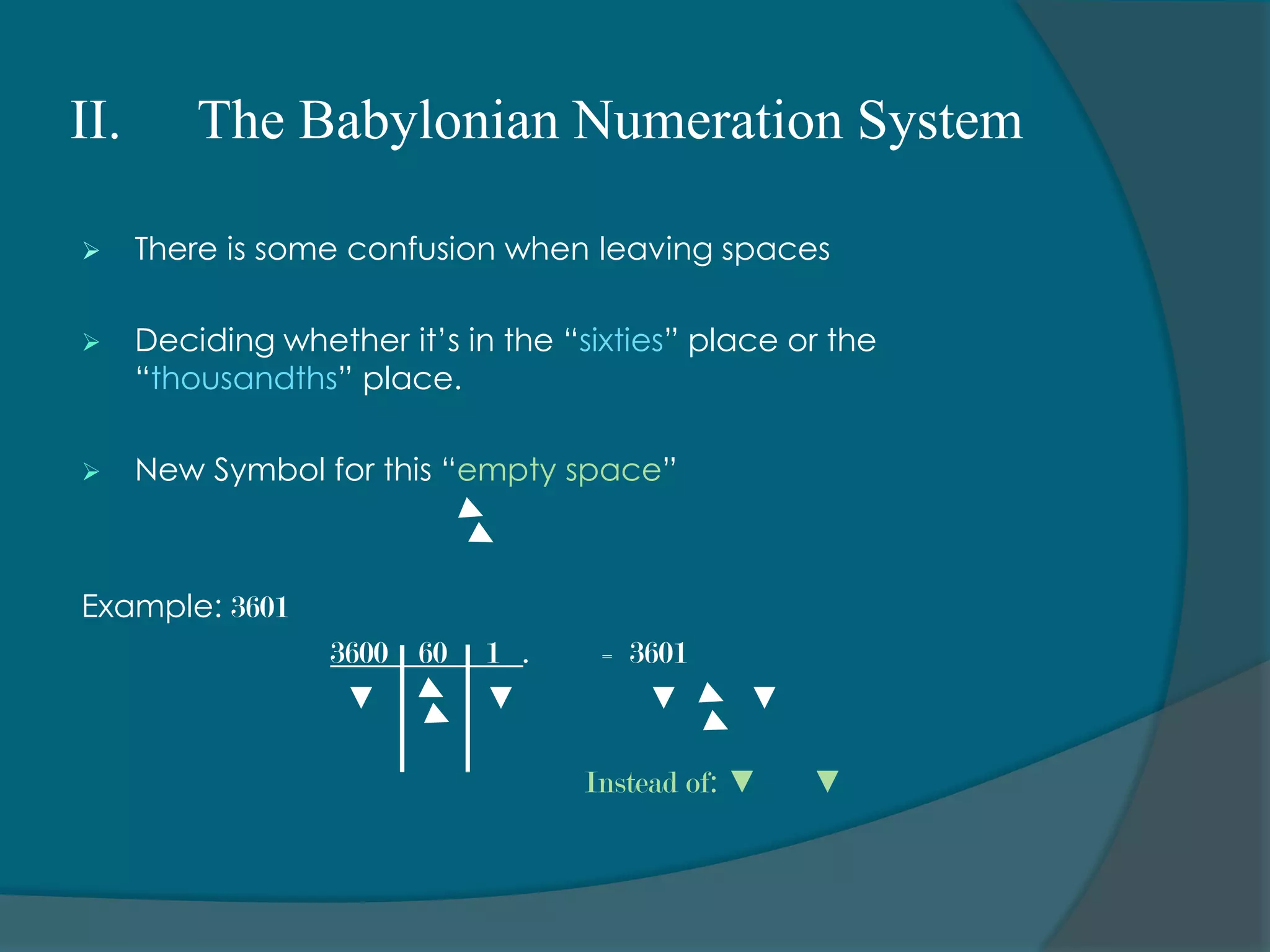
II. 	The Babylonian Numeration SystemThere is some confusion when leaving spaces
Deciding whether it’s in the “sixties” place or the “thousandths” place.
New Symbol for this “empty space”Example: 36013600    60     1   .         =  3601        ▼              ▼                 ▼         ▼Instead of: ▼       ▼►►►►►►
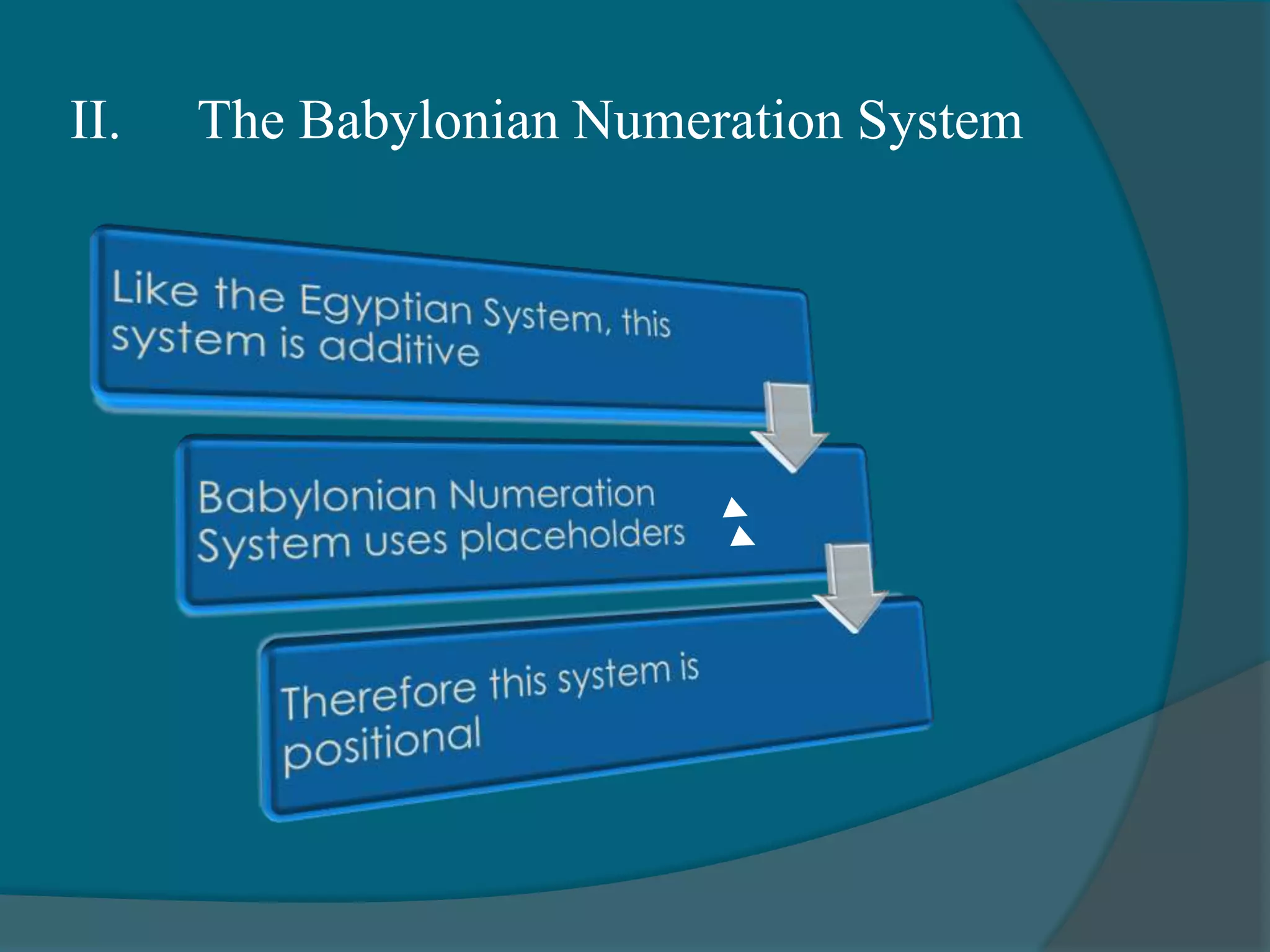
II. 	The Babylonian Numeration System►►
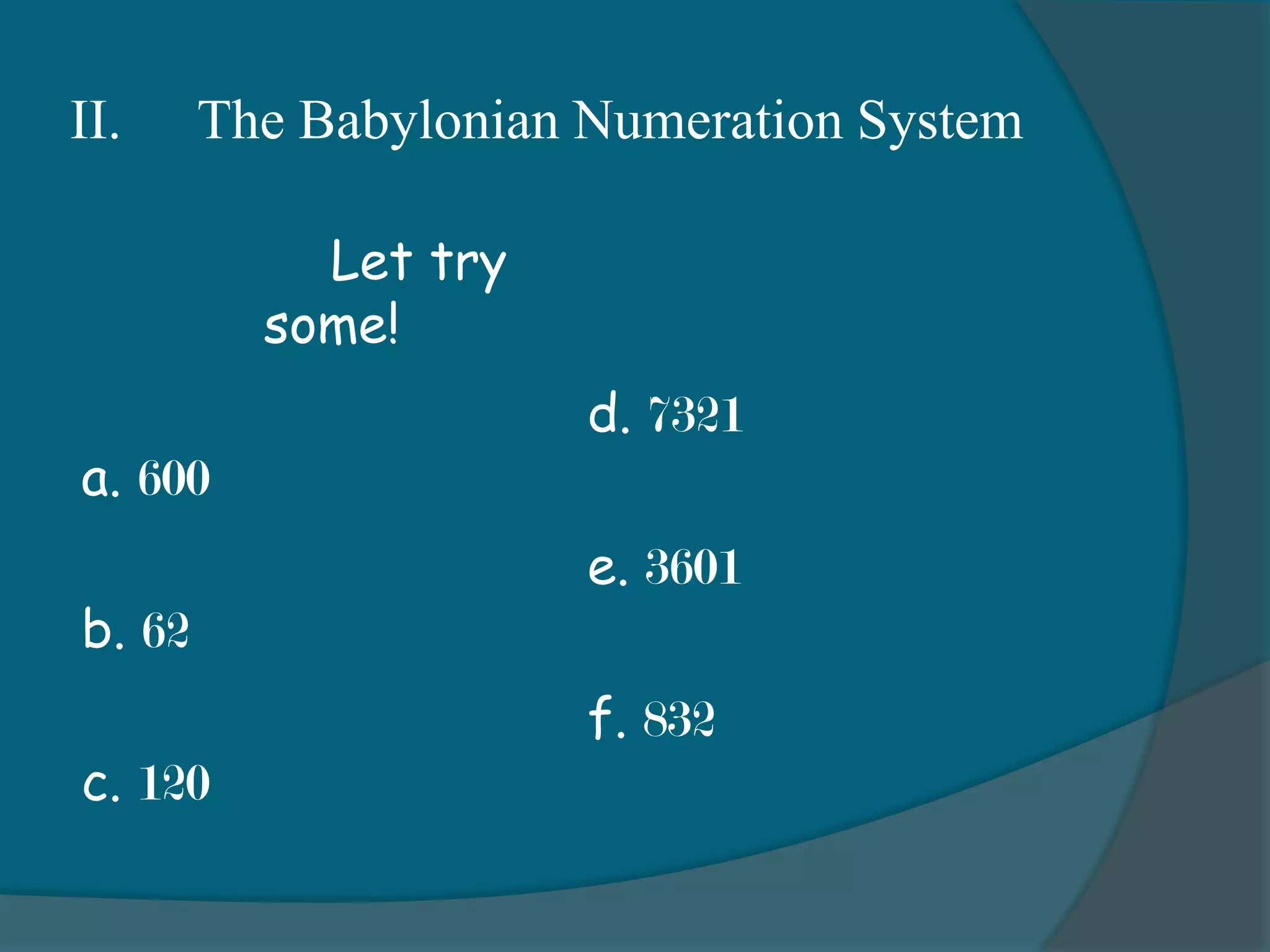
II. 	The Babylonian Numeration System           Let try some!a. 600b. 62c. 120d. 7321e. 3601f. 832
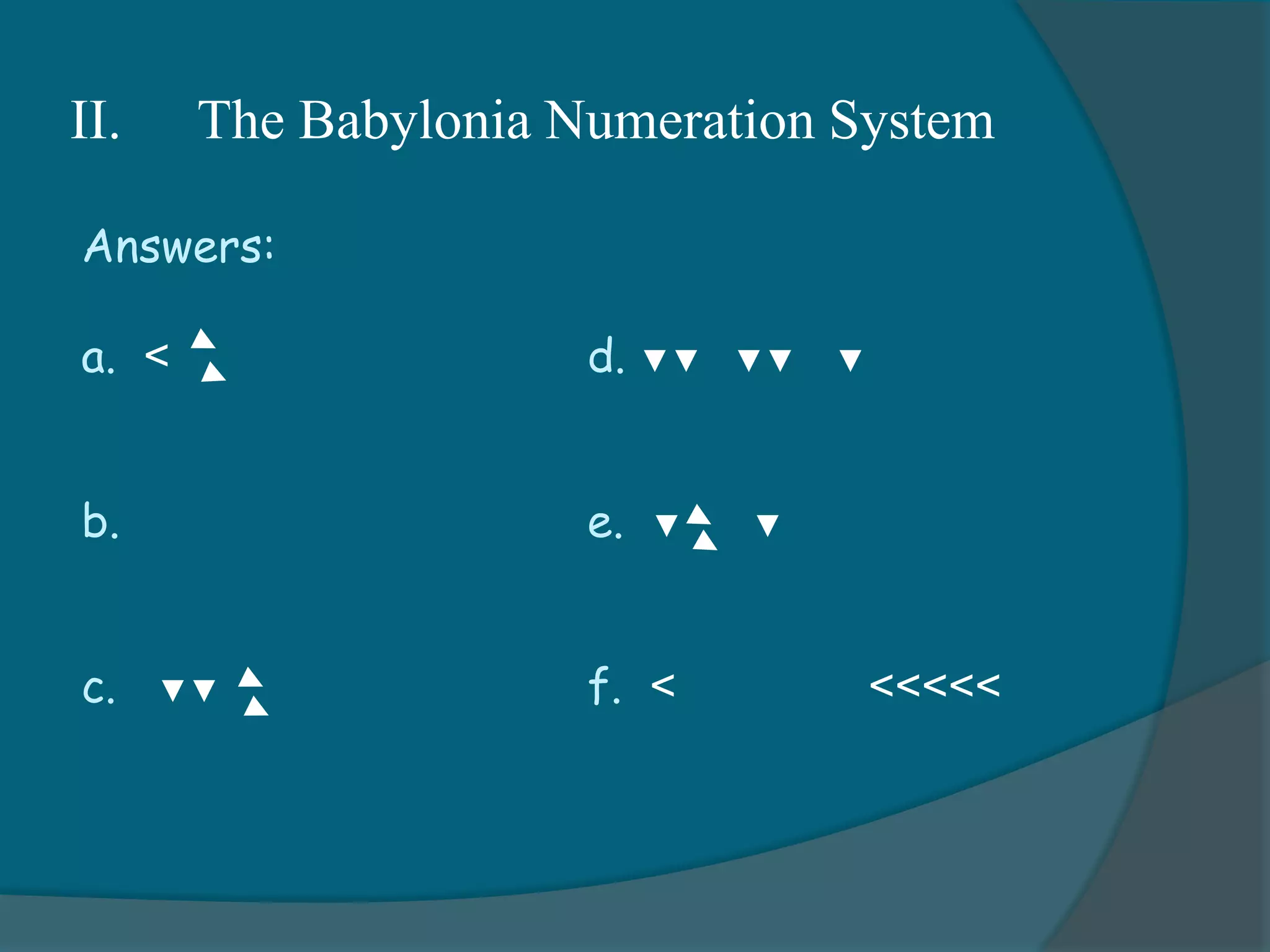
II. 	The Babylonia Numeration SystemAnswers:a.  <b. ▼    ▼▼c. ▼▼    d. ▼▼    ▼▼     ▼e. ▼         ▼ f.  < ▼▼▼      <<<<<▼▼►►►►►►
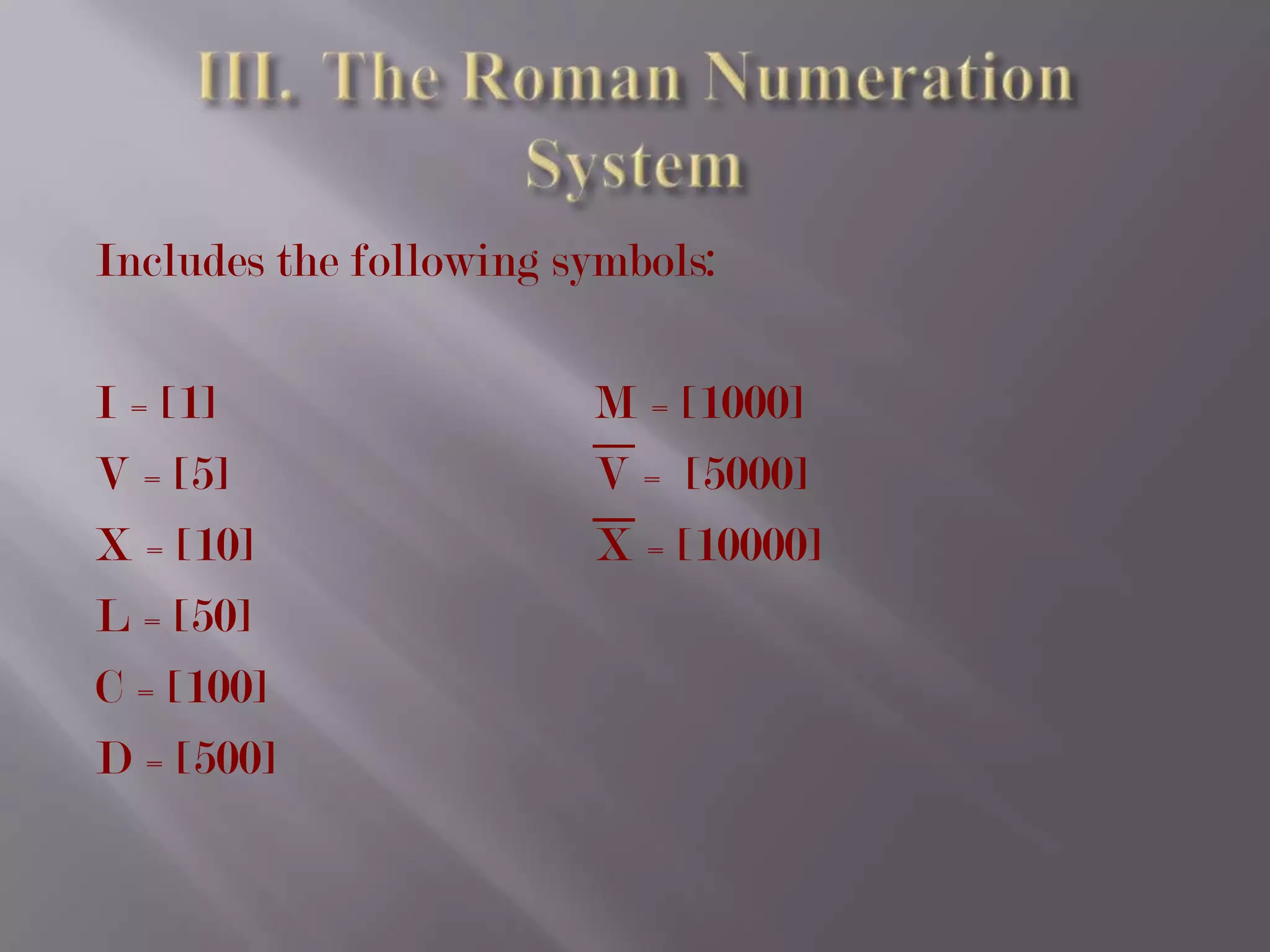
III.	The Roman Numeration SystemIncludes the following symbols:I = [1]                               M = [1000]V = [5]                              V =  [5000]X = [10]                            X = [10000]L = [50]C = [100]D = [500]
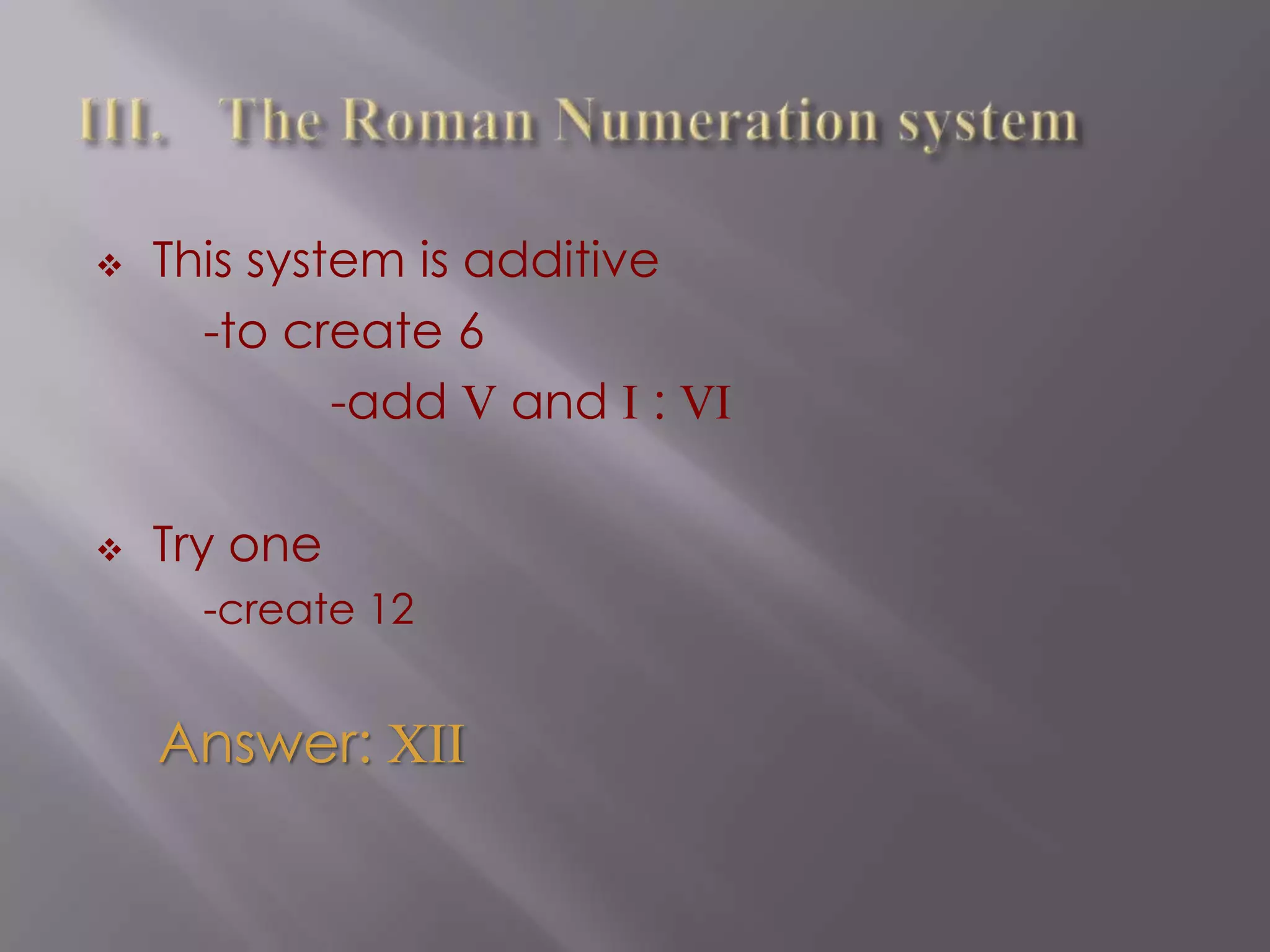
III.	 The Roman Numeration systemThis system is additive-to create 6	-add V and I : VITry one-create 12Answer: XII

Numeration systems

  • 1.
    Numeration SystemsBy: LindsayFredericksOctober 5th, 2010EDU 290T&TH 8:00am
  • 2.
    Three Basic NumerationSystemsThe Egyptian Numeration SystemThe Babylonian numeration SystemThe Roman Numeration System
  • 3.
  • 4.
    The Egyptian NumerationSystemThe Egyptian numeration system used the following symbols to represent basic quantities:http://www-history.mcs.st-andrews.ac.uk/HistTopics/Egyptian_numerals.html
  • 5.
    They Egyptian Numeration1= Stroke10 = Arch100= Coiled Rope (Coil)1,000= Lotus Flower10,000 = Pointed Finger100,000 = Tadpole1,000,000 = Man with Arms Raised
  • 6.
    The Egyptian NumerationSystemThis system is a strictly additional system. There are multiple ways to represent quantities. 221 could be written : 1+10+10+100+100, or 1+100+10+100+10using the symbols.
  • 7.
    This was probablyconfusing.Multiple representations were used up until the twenty-seventh century BCE when it became more typical to write basic symbols in descending order.Because strictly addition, simple matter of styleThe Egyptian Numeration SystemExamples: 276Two coilsSeven archesSix stokes4622 Four lotus flowersSix coils Two archesTwo stokesPictures from:http://www-history.mcs.st-andrews.ac.uk/HistTopics/Egyptian_numerals.html
  • 8.
    The Egyptian System RecapEgyptiansused symbol: Hieroglyphics
  • 9.
    The numerations systemis strictly additive, descending order.
  • 10.
  • 11.
    There are sevensymbols used in the system (stoke, arch, coil, lotus flower, pointed finger, tadpole, and man with raised arms)II.The Babylonian Numeration SystemMathematicians and astronomers of Babylon developed a numeration system based on much older system inherited from the Sumerians.There were two basic symbols used 1. Upright wedge – representing one (1) ▼ 2. Sideways wedge – representing ten (10) <
  • 12.
    II. The BabylonianNumeration SystemExamples:a.) 32 <<<▼▼b.) 5 ▼▼▼▼▼c.) 12 <▼▼
  • 13.
    II. The BabylonianNumeration SystemOnce the quantity being represented reached sixty this became a group. In a new place, ▼ represents not one, but one group of sixty (hence place values).In a new place, < represents not ten, but ten groups of sixty.“sixties place”
  • 14.
    II. The BabylonianNumeration Systemx60x60a. 723600 60 1 . ▼<▼▼b. 36613600 60 1 .▼▼▼Upright wedge represents one times the “sixties” place.Sideways wedge represents ten times the “ones” place.Upright wedge represents one times the “ones” place.Upright wedge represents one times the “thousandths” place. Upright wedge represents one times the “sixties” place.Upright wedge represents one times the “ones” place.
  • 15.
    II. The BabylonianNumeration System“Think of time. we write nine fifty-nine as 9:59. What happens when another minute passes? we DON’T write 9:60. Instead , we think of those sixty minutes as one hour (one group of sixty minutes) the nine increases by one.So, we write 10:00. Meaning ten hours and no leftover minutes.”
  • 16.
    II. The BabylonianNumeration SystemPlace Values:3600 60 1 Example: Example: a.) 72 b.) 3661 ▼ < ▼ ▼ ▼ ▼ ▼1x60 10x1 1x1 1x1 3600x1 60x1 1x1 60 + 10 + 1 + 1 = 72 3600 + 60 + 1 = 3661X 60X 60
  • 17.
    II. The BabylonianNumeration SystemThere is some confusion when leaving spaces
  • 18.
    Deciding whether it’sin the “sixties” place or the “thousandths” place.
  • 19.
    New Symbol forthis “empty space”Example: 36013600 60 1 . = 3601 ▼ ▼ ▼ ▼Instead of: ▼ ▼►►►►►►
  • 20.
    II. The BabylonianNumeration System►►
  • 21.
    II. The BabylonianNumeration System Let try some!a. 600b. 62c. 120d. 7321e. 3601f. 832
  • 22.
    II. The BabyloniaNumeration SystemAnswers:a. <b. ▼ ▼▼c. ▼▼ d. ▼▼ ▼▼ ▼e. ▼ ▼ f. < ▼▼▼ <<<<<▼▼►►►►►►
  • 23.
    III. The Roman NumerationSystemIncludes the following symbols:I = [1] M = [1000]V = [5] V = [5000]X = [10] X = [10000]L = [50]C = [100]D = [500]
  • 24.
    III. The RomanNumeration systemThis system is additive-to create 6 -add V and I : VITry one-create 12Answer: XII
  • 25.
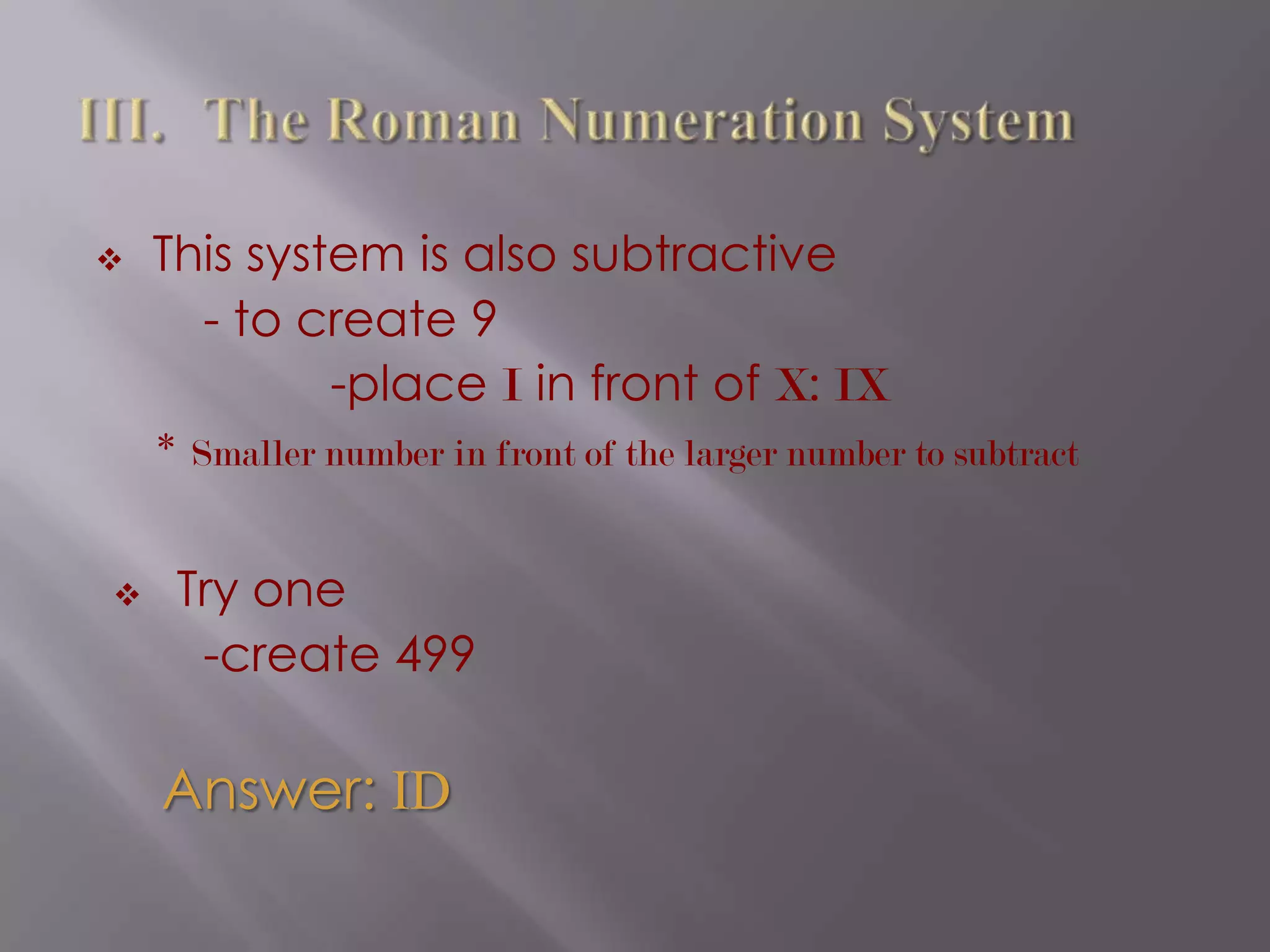
    III. The Roman NumerationSystemThis system is also subtractive - to create 9-place I in front of X: IX* Smaller number in front of the larger number to subtractTry one-create 499Answer: ID
  • 26.
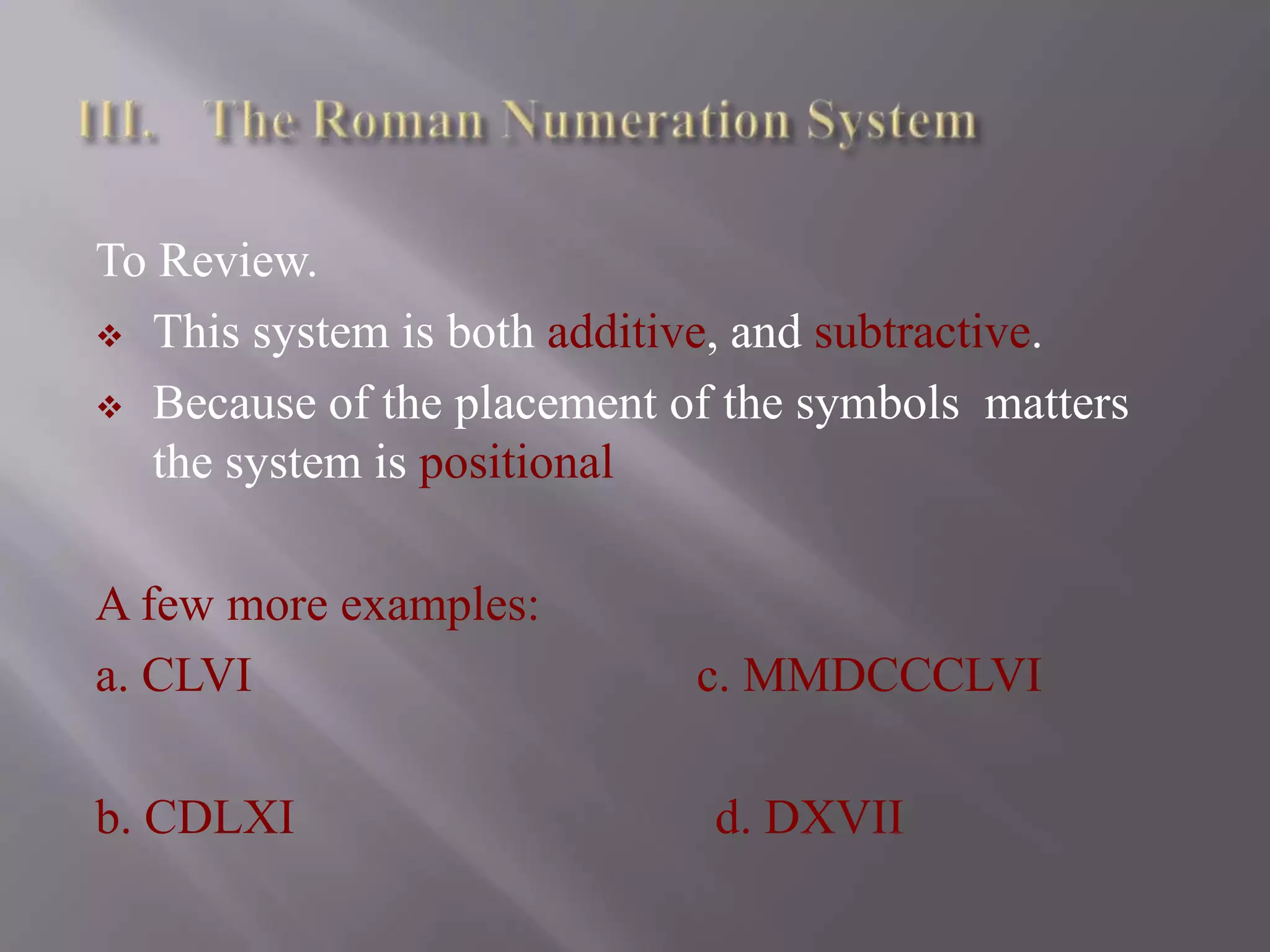
    III. The Roman NumerationSystemTo Review. This system is both additive, and subtractive.
  • 27.
    Because of theplacement of the symbols matters the system is positionalA few more examples:a. CLVI c. MMDCCCLVIb. CDLXI d. DXVII
  • 28.
    III. The Roman NumerationSystemAnswers:CLVI = 156c = 100+ L =50+ V =5+ I =1CDLXI = 461C= 100 - D= 500 + L= 50 + X= 10 + I = 1MMDCCCLVI = 2,856(M=1000)+(M=1000)+(D=500)+(C=100)+(C=100) +(C=100)+(L=50)+(V=5)+(I=1)DXVII = 517(D = 500) + (X = 10) + (V = 5) + (I = 1) + (I = 1)
  • 29.
    The ENDReferences: Dr.Christine PhelpsFall 2010MTH 151Central Michigan University Course # 22129396Pictures on slide seven fromhttp://www-history.mcs.st-andrews.ac.uk/HistTopics/Egyptian_numerals.html Pictures on slide four from http://www-history.mcs.st-andrews.ac.uk/HistTopics/Egyptian_numerals.html