Historical
development of
notations and number
system
Bhumika sehra
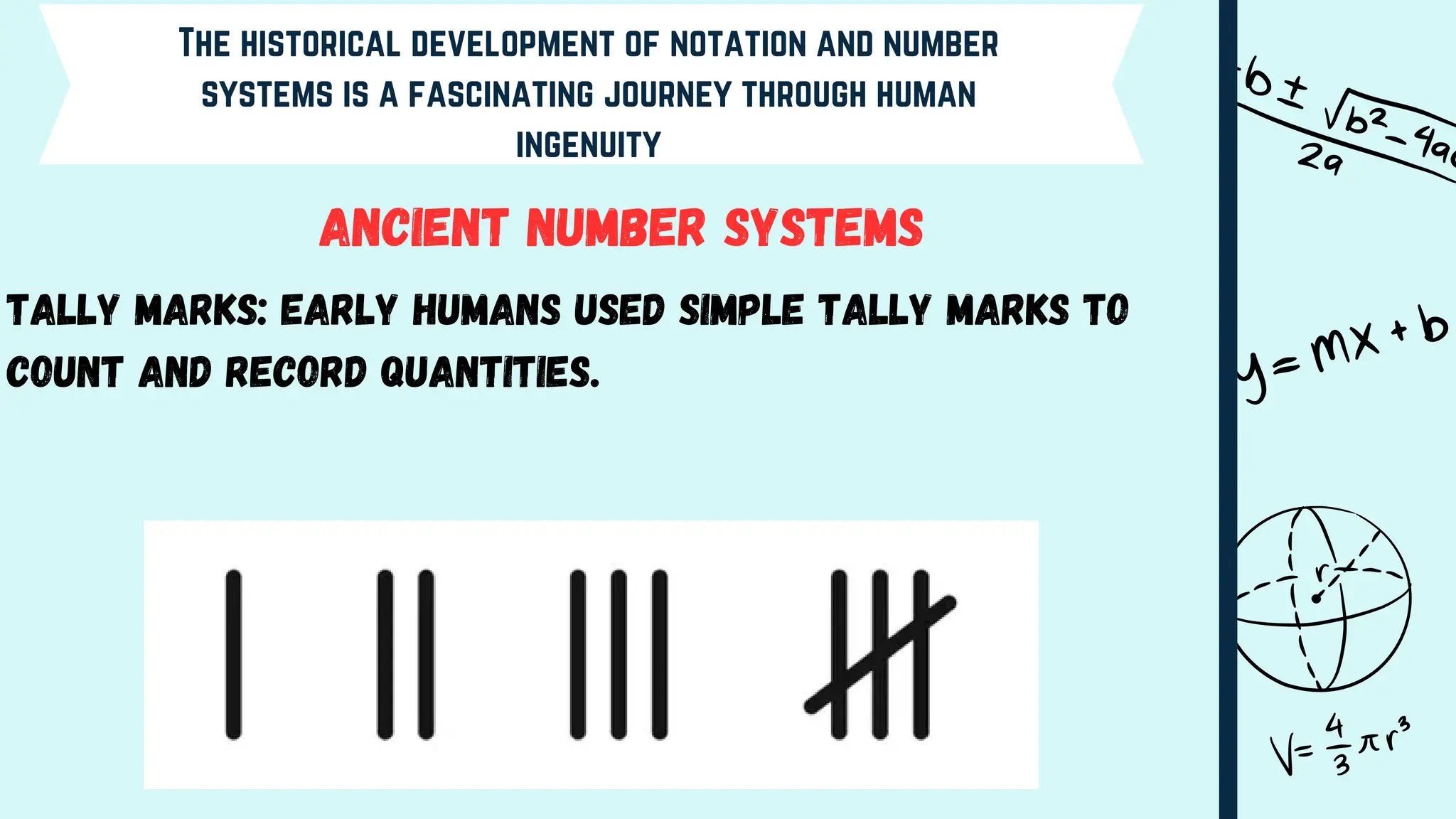
tally Marks: Early humans used simple tally marks to
count and record quantities.
The historical development of notation and number
systems is a fascinating journey through human
ingenuity
Ancient Number Systems
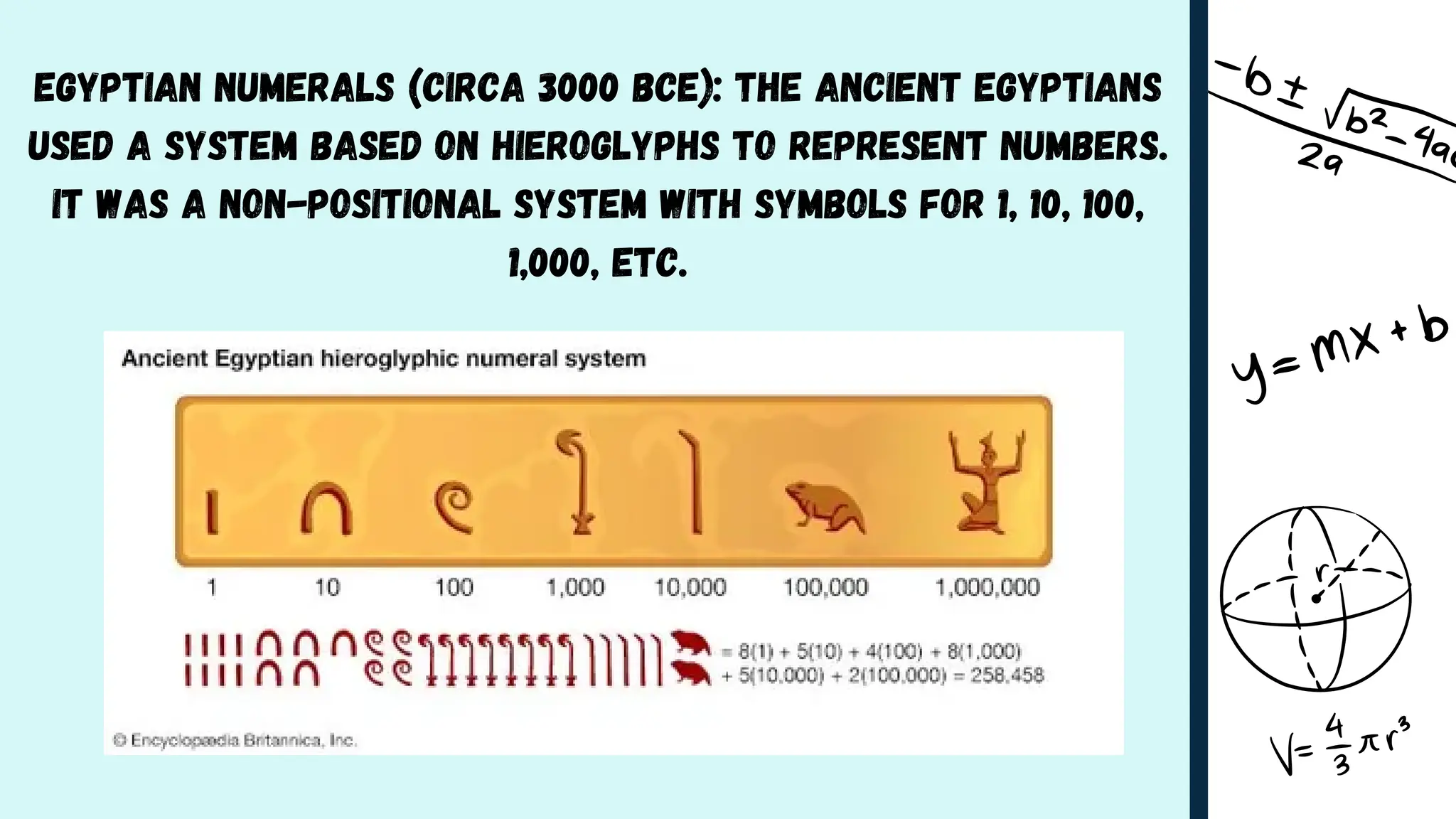
Egyptian Numerals (circa 3000 BCE): The ancient Egyptians
used a system based on hieroglyphs to represent numbers.
It was a non-positional system with symbols for 1, 10, 100,
1,000, etc.
Babylonian Numerals (circa 1800 BCE)
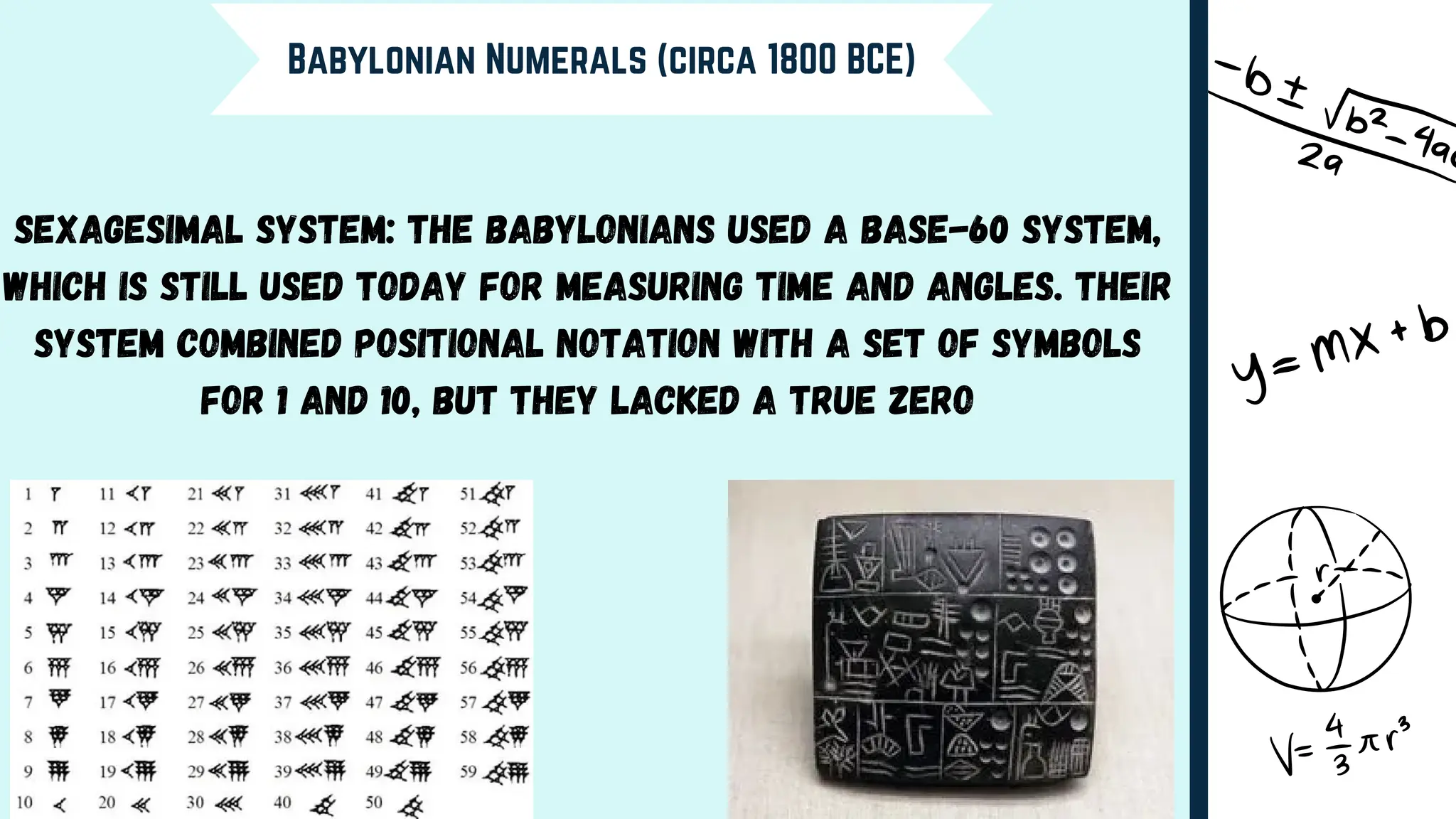
Sexagesimal System: The Babylonians used a base-60 system,
which is still used today for measuring time and angles. Their
system combined positional notation with a set of symbols
for 1 and 10, but they lacked a true zero
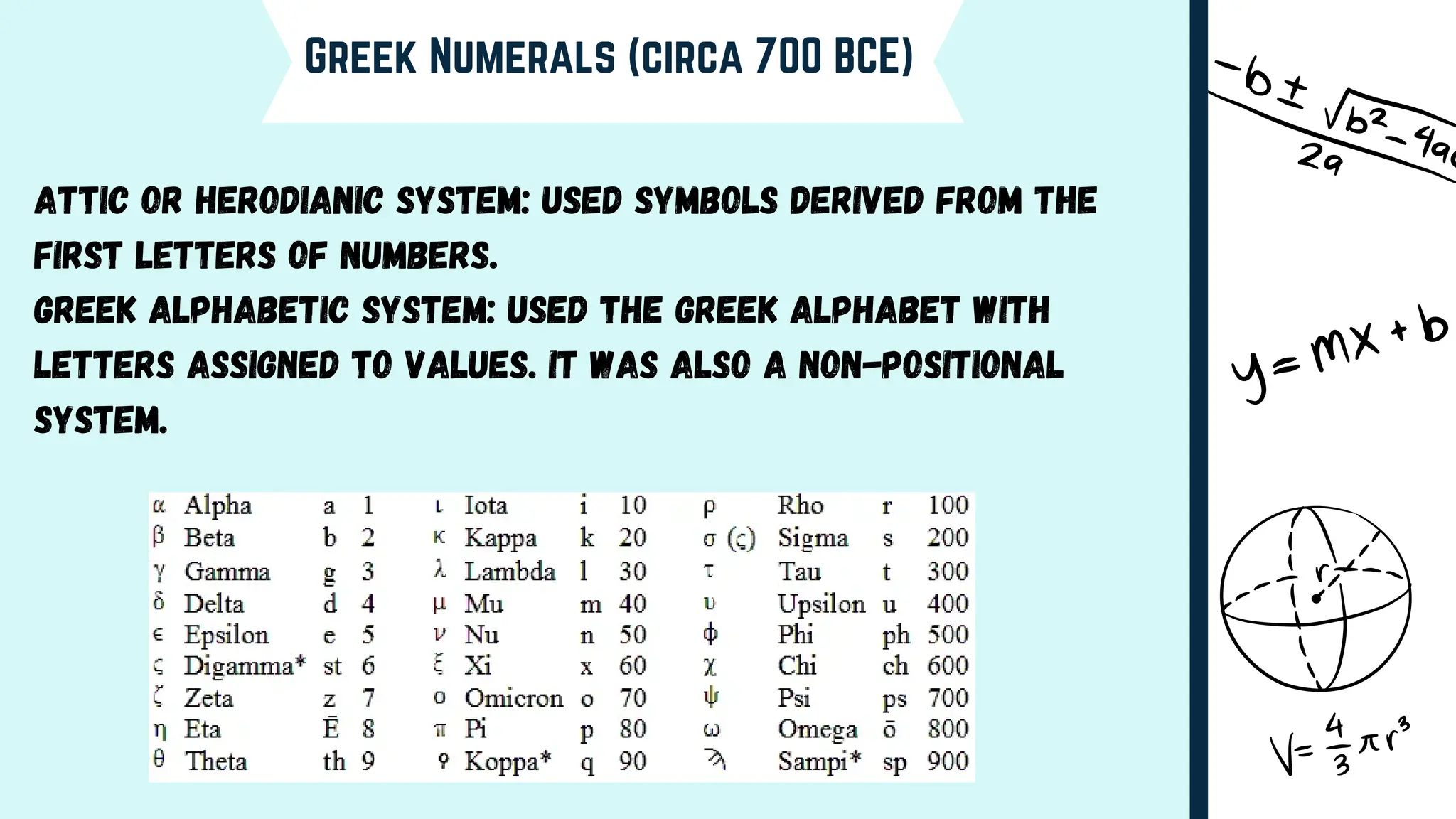
Greek Numerals (circa 700 BCE)
Attic or Herodianic System: Used symbols derived from the
first letters of numbers.
Greek Alphabetic System: Used the Greek alphabet with
letters assigned to values. It was also a non-positional
system.
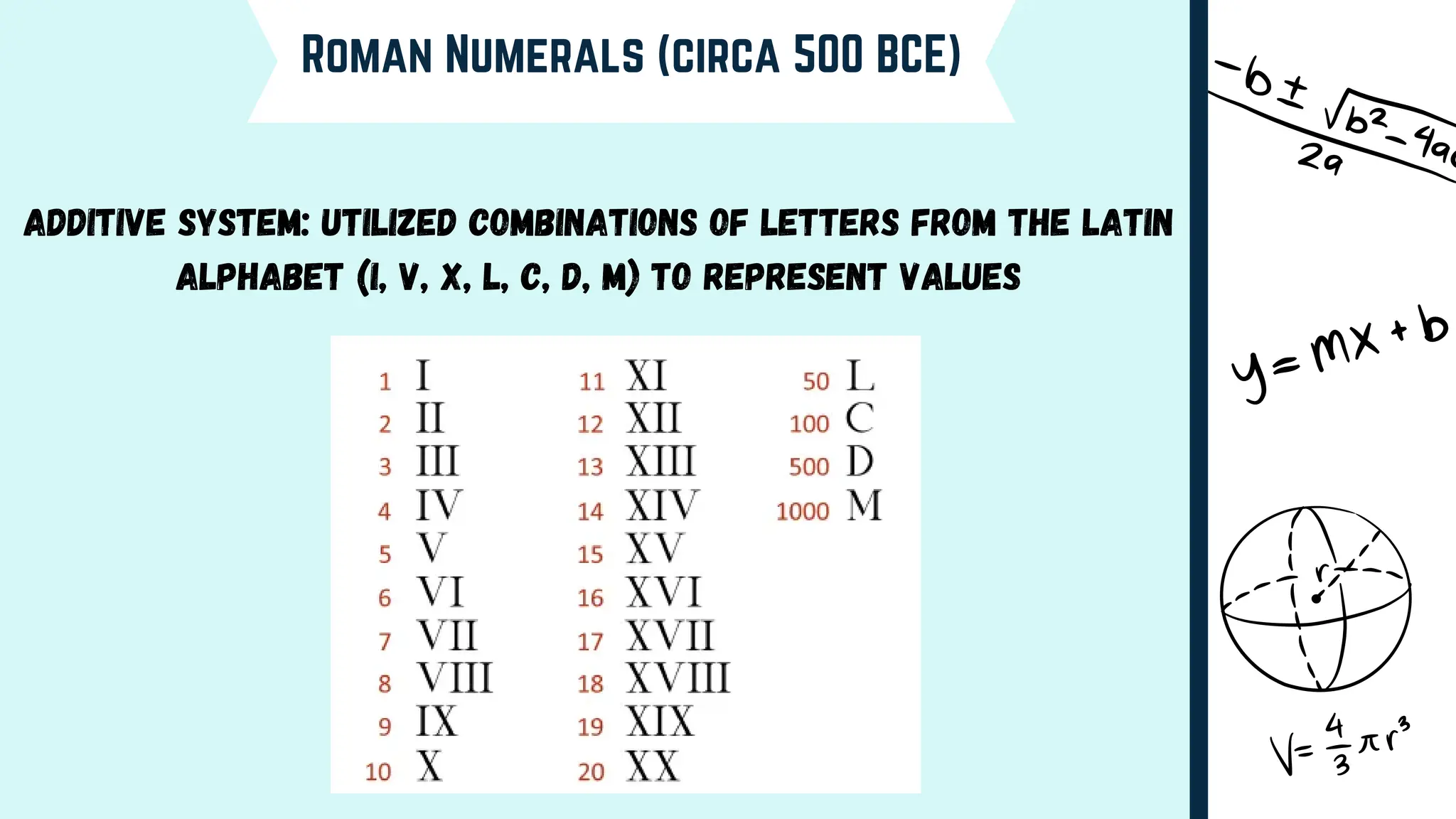
Roman Numerals (circa 500 BCE)
Additive System: Utilized combinations of letters from the Latin
alphabet (I, V, X, L, C, D, M) to represent values
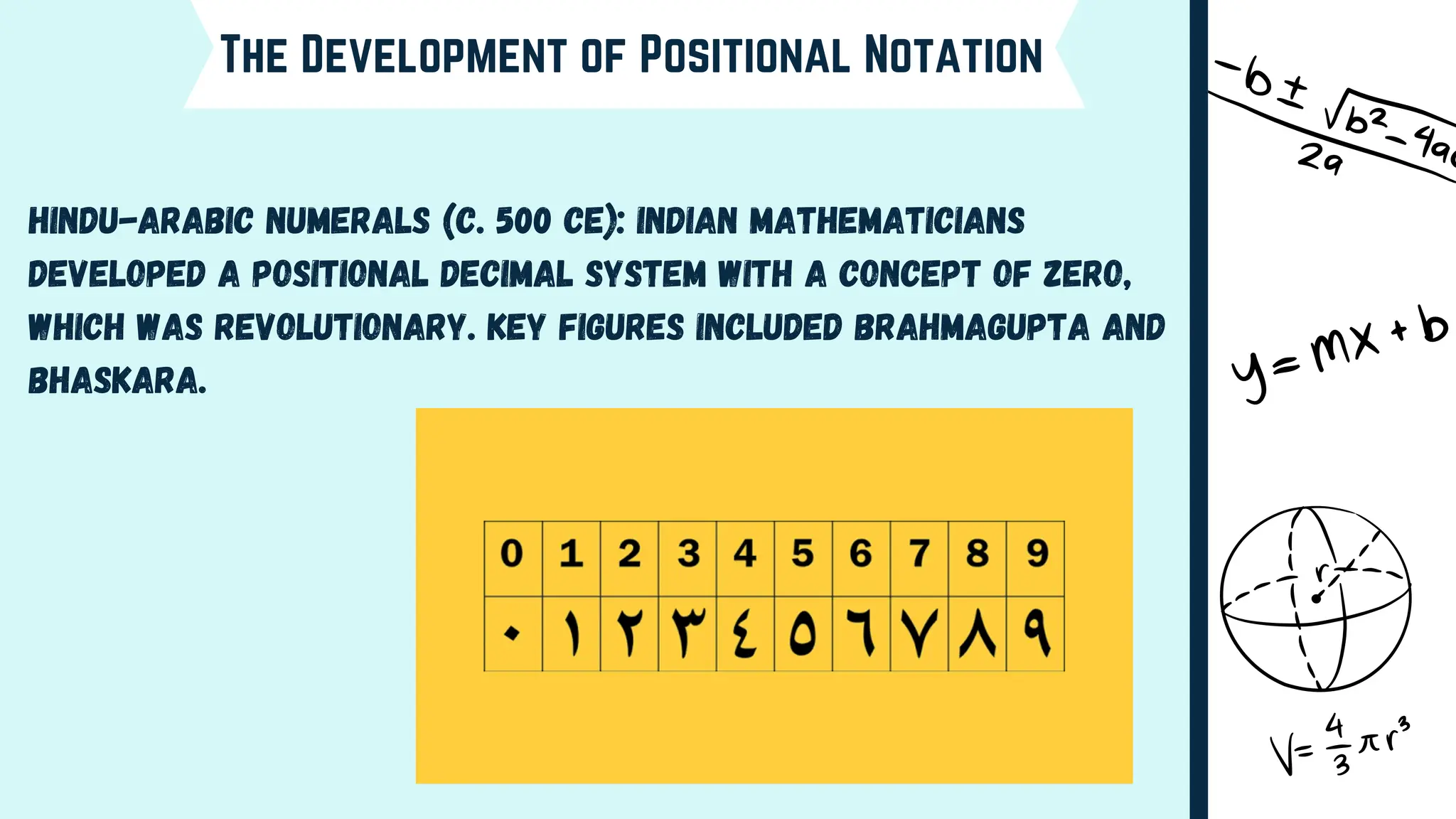
The Development of Positional Notation
Hindu-Arabic Numerals (c. 500 CE): Indian mathematicians
developed a positional decimal system with a concept of zero,
which was revolutionary. Key figures included Brahmagupta and
Bhaskara.
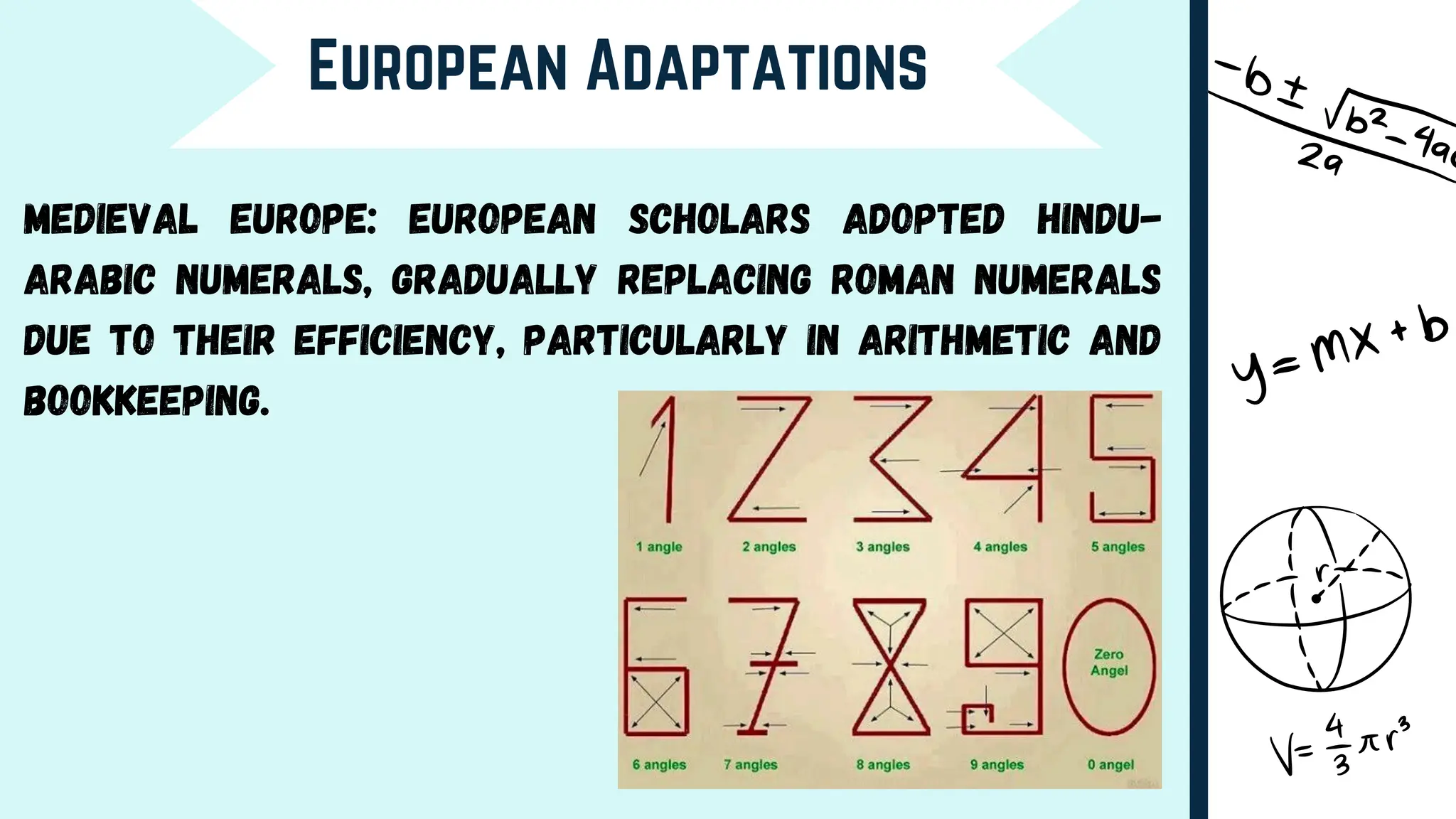
European Adaptations
Medieval Europe: European scholars adopted Hindu-
Arabic numerals, gradually replacing Roman numerals
due to their efficiency, particularly in arithmetic and
bookkeeping.
Modern Developments:
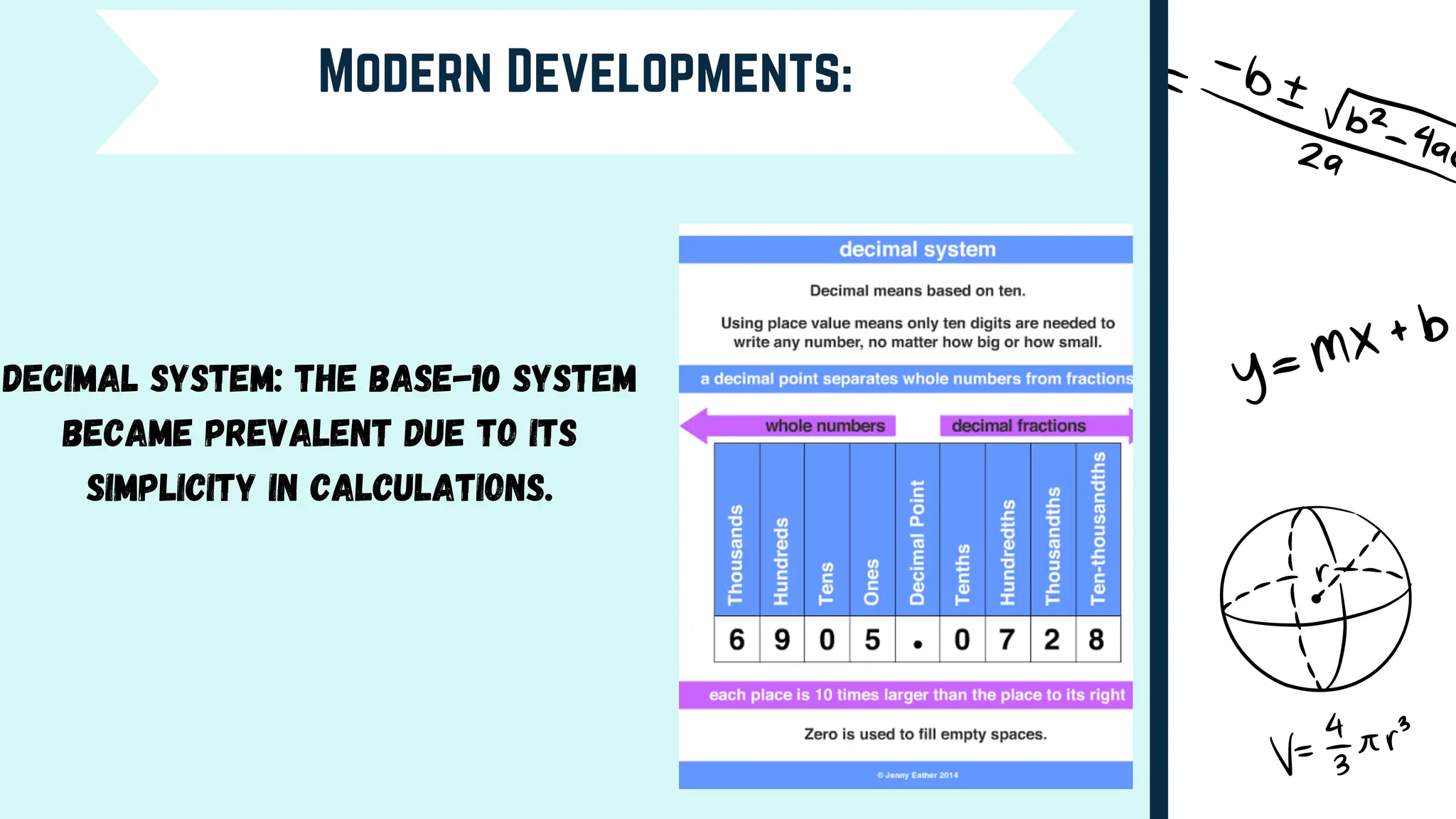
Decimal System: The base-10 system
became prevalent due to its
simplicity in calculations.
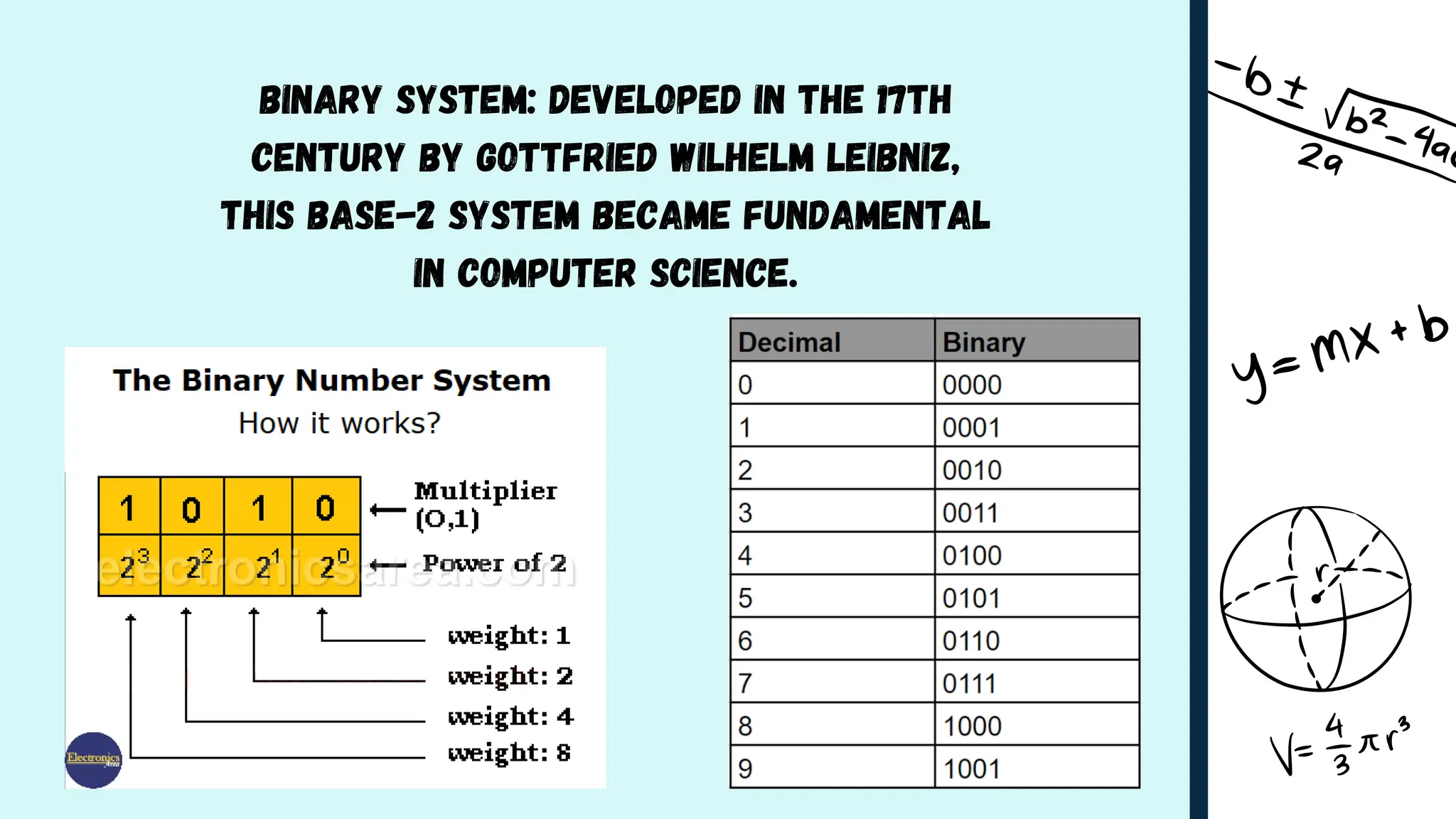
Binary System: Developed in the 17th
century by Gottfried Wilhelm Leibniz,
this base-2 system became fundamental
in computer science.
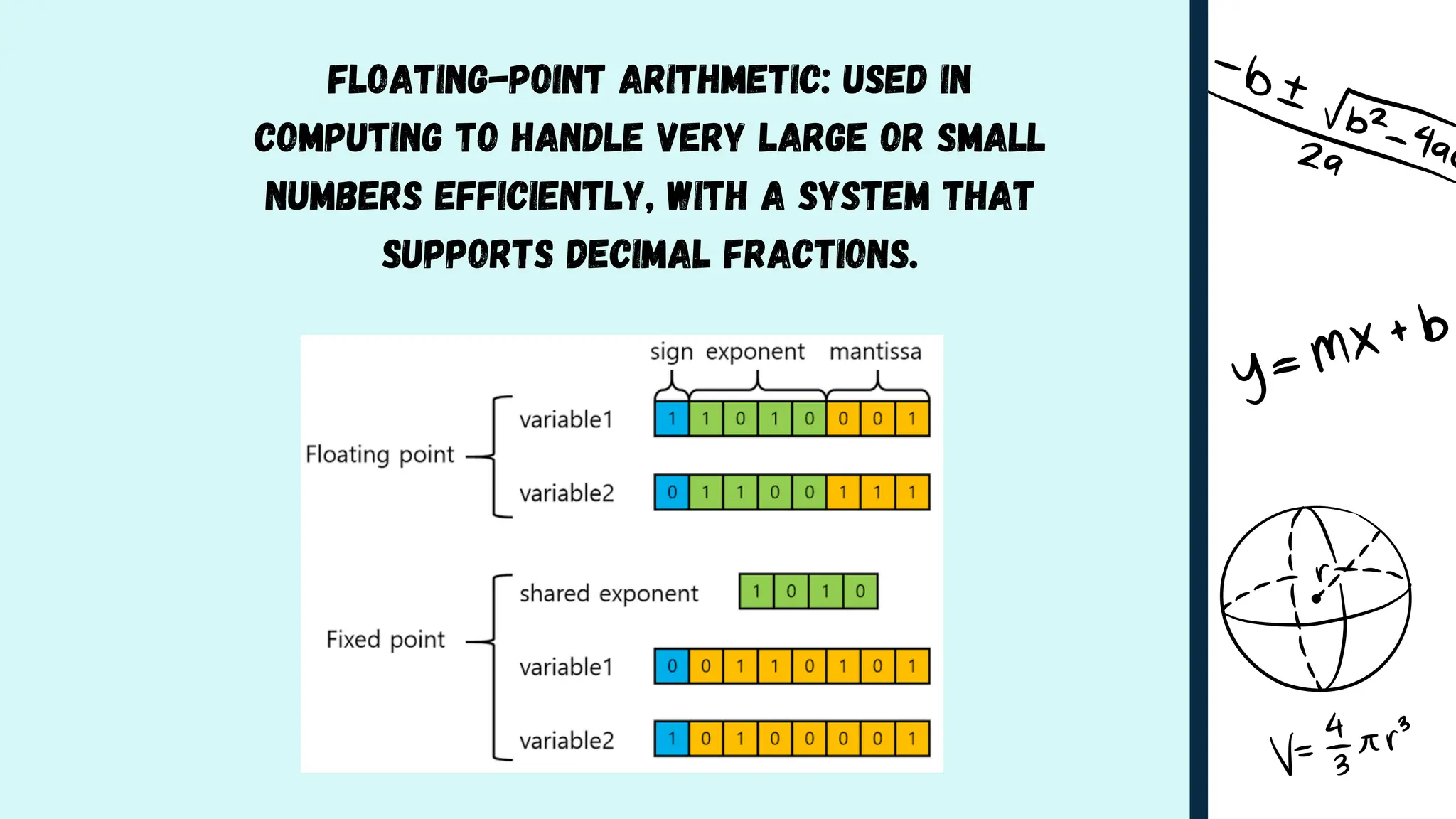
Floating-Point Arithmetic: Used in
computing to handle very large or small
numbers efficiently, with a system that
supports decimal fractions.
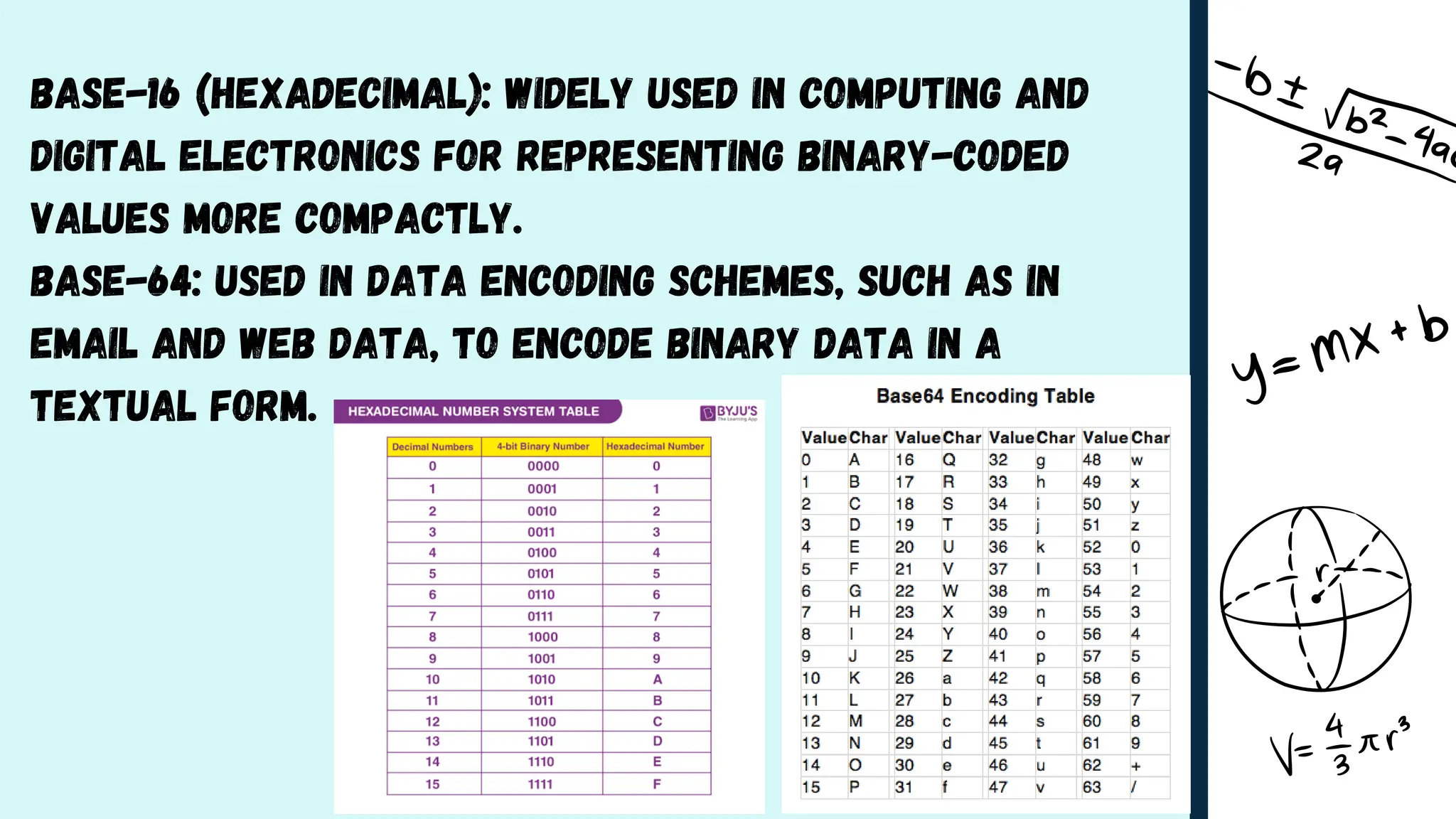
Base-16 (Hexadecimal): Widely used in computing and
digital electronics for representing binary-coded
values more compactly.
Base-64: Used in data encoding schemes, such as in
email and web data, to encode binary data in a
textual form.
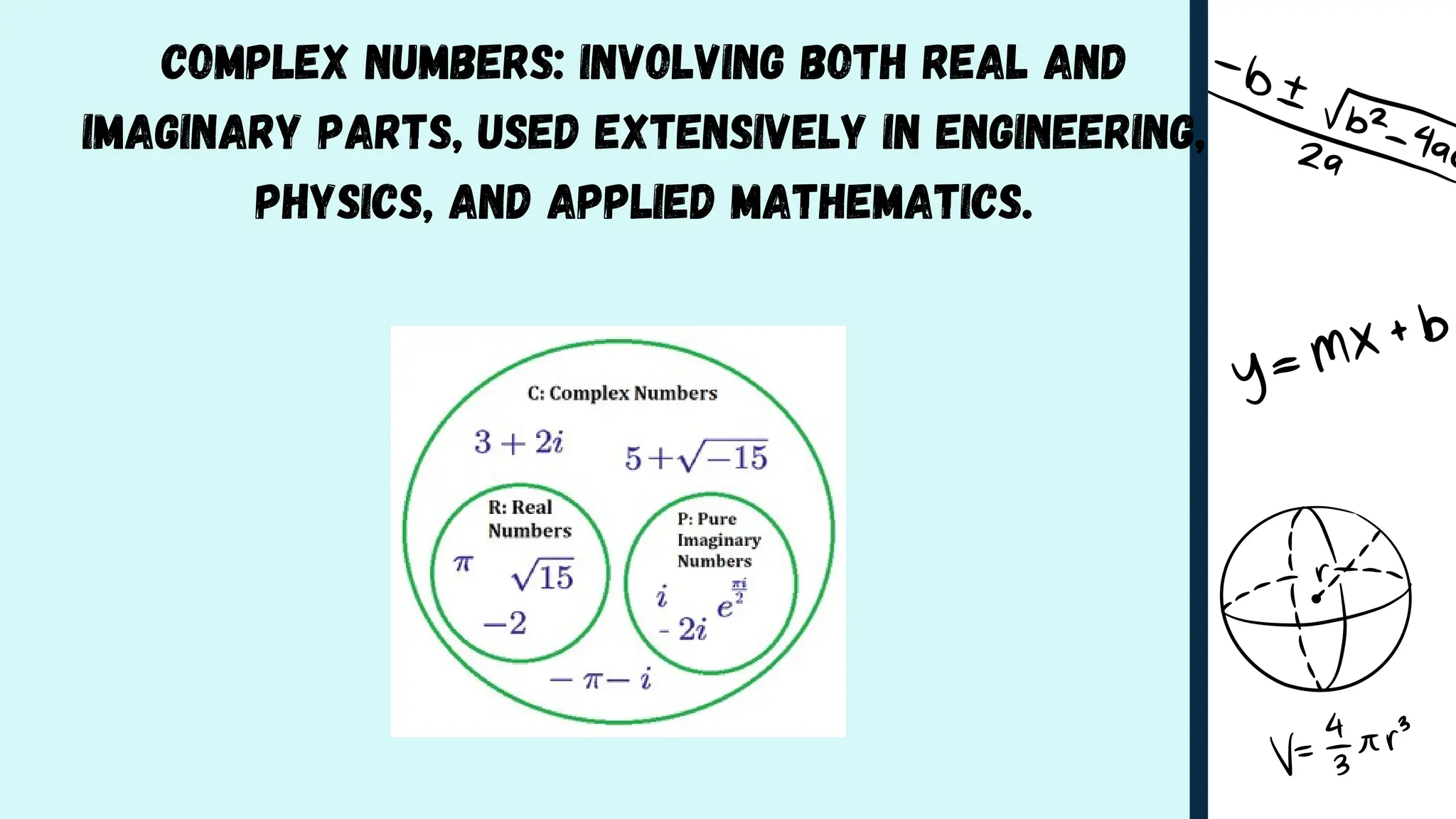
Complex Numbers: Involving both real and
imaginary parts, used extensively in engineering,
physics, and applied mathematics.
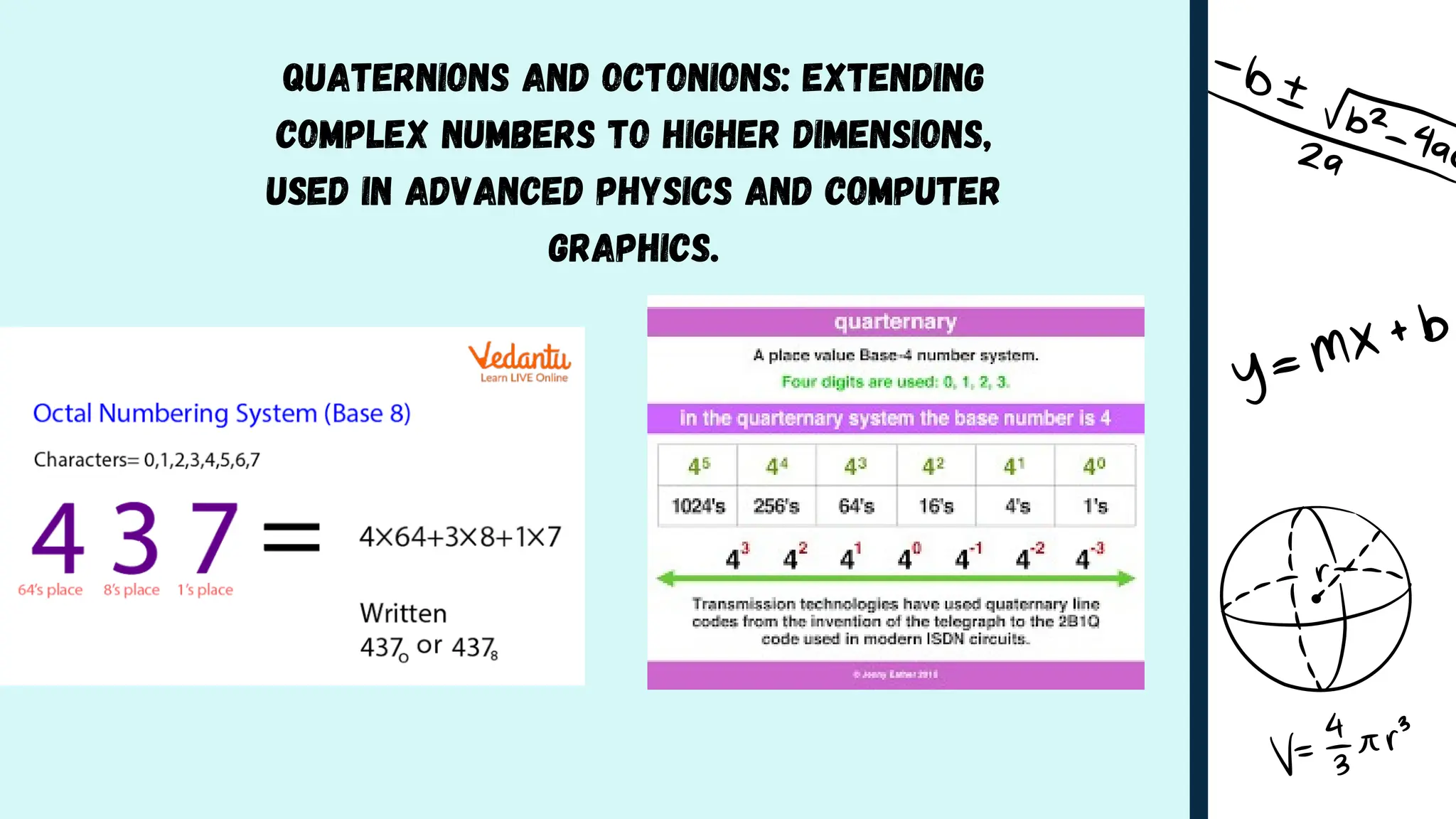
Quaternions and Octonions: Extending
complex numbers to higher dimensions,
used in advanced physics and computer
graphics.
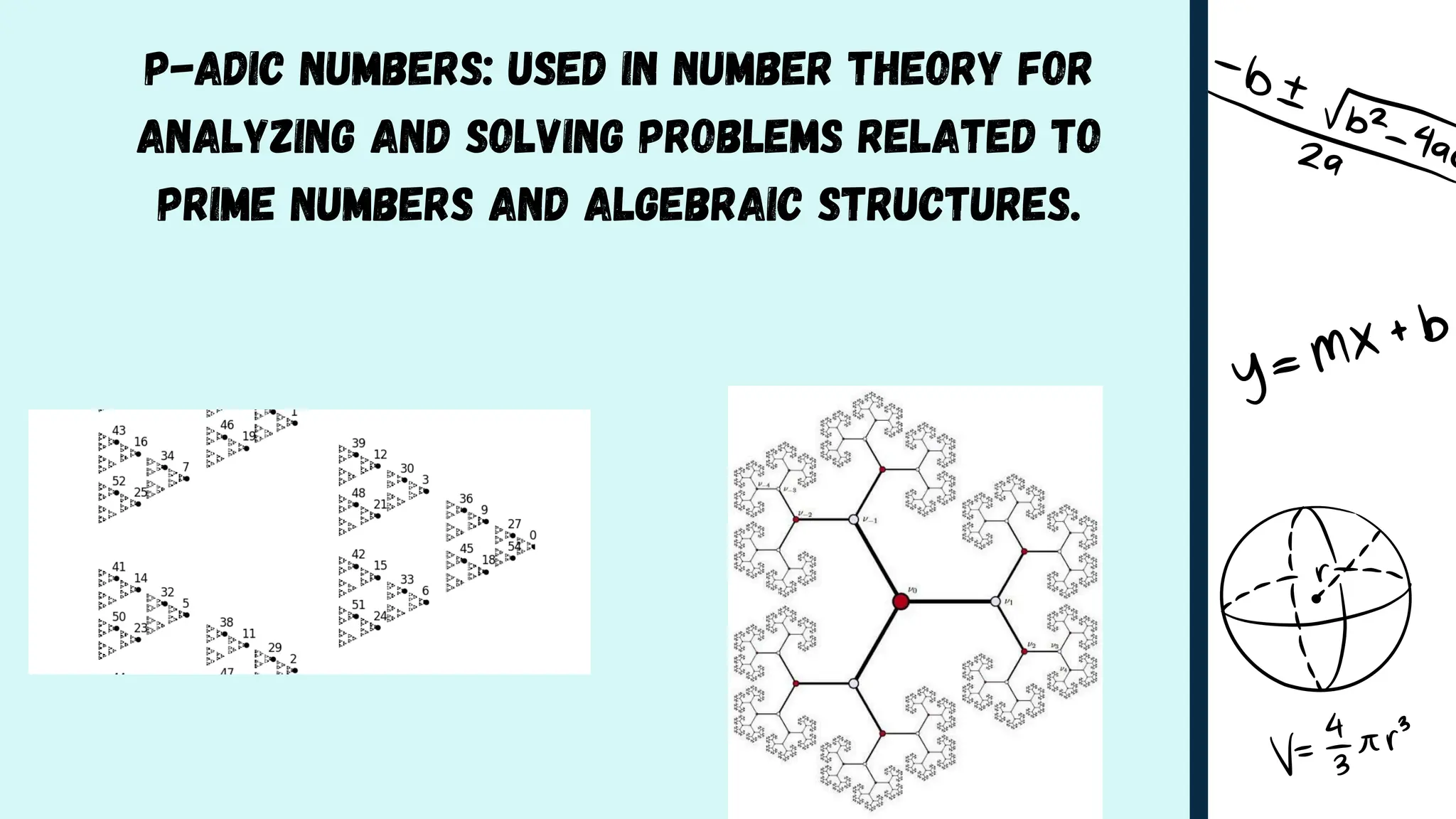
p-adic Numbers: Used in number theory for
analyzing and solving problems related to
prime numbers and algebraic structures.
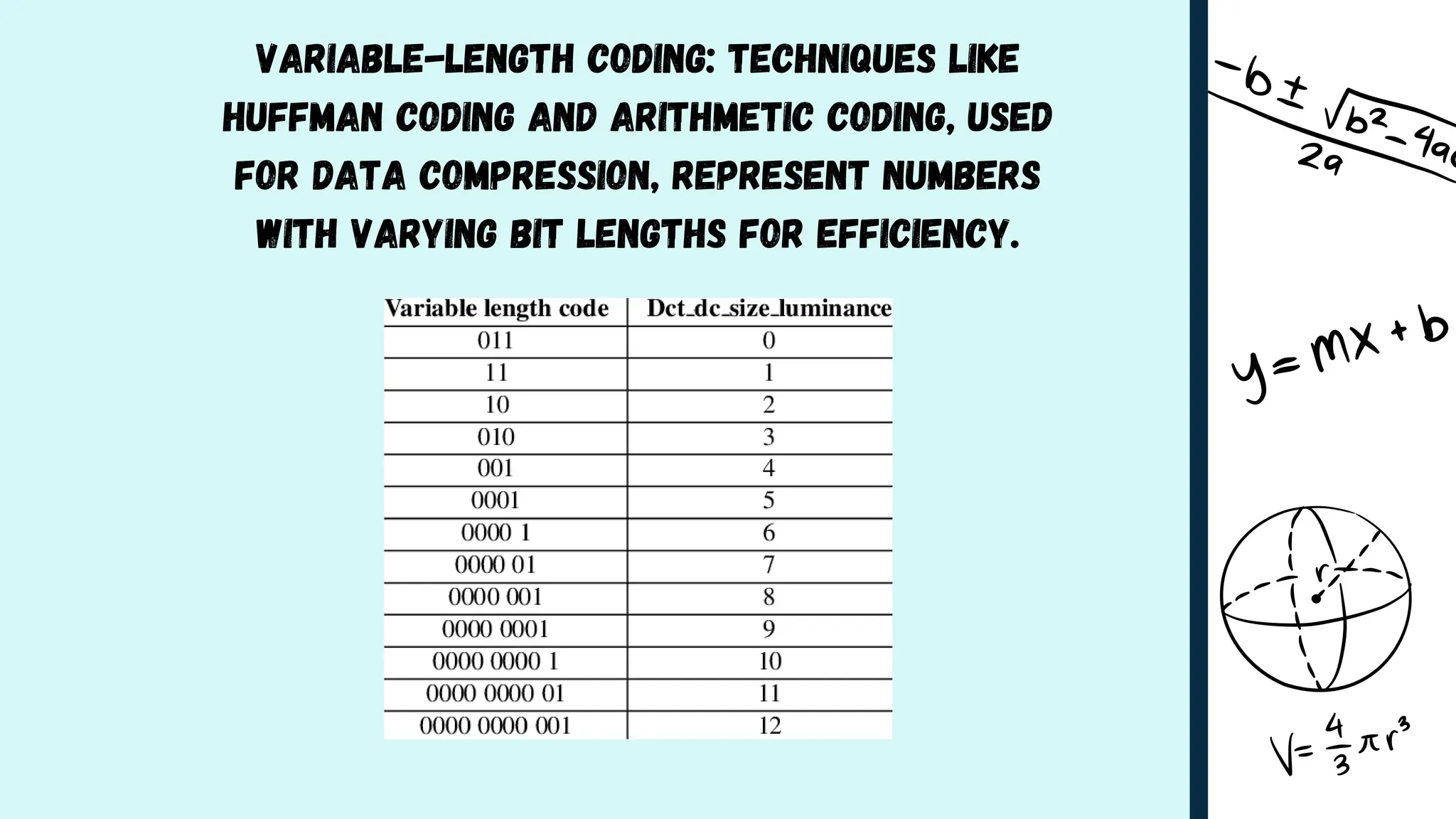
Variable-Length Coding: Techniques like
Huffman coding and arithmetic coding, used
for data compression, represent numbers
with varying bit lengths for efficiency.
historical development of notations and number system.pdf.pdf

historical development of notations and number system.pdf.pdf

  • 1.
    Historical development of notations andnumber system Bhumika sehra
  • 2.
    tally Marks: Earlyhumans used simple tally marks to count and record quantities. The historical development of notation and number systems is a fascinating journey through human ingenuity Ancient Number Systems
  • 3.
    Egyptian Numerals (circa3000 BCE): The ancient Egyptians used a system based on hieroglyphs to represent numbers. It was a non-positional system with symbols for 1, 10, 100, 1,000, etc.
  • 4.
    Babylonian Numerals (circa1800 BCE) Sexagesimal System: The Babylonians used a base-60 system, which is still used today for measuring time and angles. Their system combined positional notation with a set of symbols for 1 and 10, but they lacked a true zero
  • 5.
    Greek Numerals (circa700 BCE) Attic or Herodianic System: Used symbols derived from the first letters of numbers. Greek Alphabetic System: Used the Greek alphabet with letters assigned to values. It was also a non-positional system.
  • 6.
    Roman Numerals (circa500 BCE) Additive System: Utilized combinations of letters from the Latin alphabet (I, V, X, L, C, D, M) to represent values
  • 7.
    The Development ofPositional Notation Hindu-Arabic Numerals (c. 500 CE): Indian mathematicians developed a positional decimal system with a concept of zero, which was revolutionary. Key figures included Brahmagupta and Bhaskara.
  • 8.
    European Adaptations Medieval Europe:European scholars adopted Hindu- Arabic numerals, gradually replacing Roman numerals due to their efficiency, particularly in arithmetic and bookkeeping.
  • 9.
    Modern Developments: Decimal System:The base-10 system became prevalent due to its simplicity in calculations.
  • 10.
    Binary System: Developedin the 17th century by Gottfried Wilhelm Leibniz, this base-2 system became fundamental in computer science.
  • 12.
    Floating-Point Arithmetic: Usedin computing to handle very large or small numbers efficiently, with a system that supports decimal fractions.
  • 13.
    Base-16 (Hexadecimal): Widelyused in computing and digital electronics for representing binary-coded values more compactly. Base-64: Used in data encoding schemes, such as in email and web data, to encode binary data in a textual form.
  • 14.
    Complex Numbers: Involvingboth real and imaginary parts, used extensively in engineering, physics, and applied mathematics.
  • 15.
    Quaternions and Octonions:Extending complex numbers to higher dimensions, used in advanced physics and computer graphics.
  • 16.
    p-adic Numbers: Usedin number theory for analyzing and solving problems related to prime numbers and algebraic structures.
  • 17.
    Variable-Length Coding: Techniqueslike Huffman coding and arithmetic coding, used for data compression, represent numbers with varying bit lengths for efficiency.