Knowing our numbers helps us in counting
 objects in large numbers & representing them
 through numerals.
Numbers helps in communicating through
 suitable number names & to count concrete
 objects.
They help us to say which collection of bigger
 & arrange them in order.
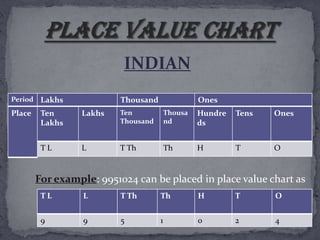
INDIAN
Period    Lakhs            Thousand                Ones
Place     Ten     Lakhs    Ten            Thousa   Hundre   Tens   Ones
          Lakhs            Thousand       nd       ds


          TL      L        T Th           Th       H        T      O


         For example: 9951024 can be placed in place value chart as
          TL       L       T Th       Th           H        T      O


          9        9       5          1            0        2      4
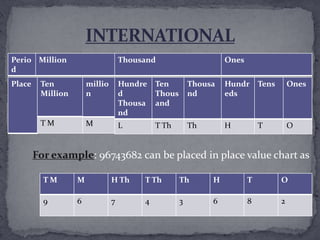
Perio Million                       Thousand                      Ones
d
Place    Ten           millio       Hundre   Ten         Thousa   Hundr      Tens       Ones
         Million       n            d        Thous       nd       eds
                                    Thousa   and
                                    nd
         TM            M            L        T Th        Th       H          T          O


        For example: 96743682 can be placed in place value chart as

          TM       M            H Th     T Th        Th       H          T          O

          9        6            7        4           3        6          8          2
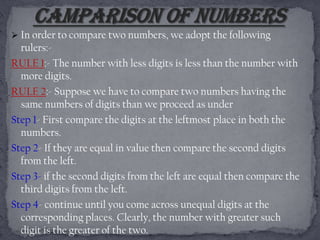
 In order to compare two numbers, we adopt the following
  rulers:-
RULE 1:- The number with less digits is less than the number with
  more digits.
RULE 2:- Suppose we have to compare two numbers having the
  same numbers of digits than we proceed as under
Step 1- First compare the digits at the leftmost place in both the
  numbers.
Step 2- If they are equal in value then compare the second digits
  from the left.
Step 3- if the second digits from the left are equal then compare the
  third digits from the left.
Step 4- continue until you come across unequal digits at the
  corresponding places. Clearly, the number with greater such
  digit is the greater of the two.
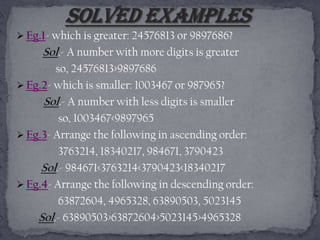
 Eg.1- which is greater: 24576813 or 9897686?
     Sol.- A number with more digits is greater
        so, 24576813>9897686
 Eg.2- which is smaller: 1003467 or 987965?
     Sol.- A number with less digits is smaller
         so, 1003467<9897965
 Eg.3- Arrange the following in ascending order:
         3763214, 18340217, 984671, 3790423
     Sol.- 984671<3763214<3790423<18340217
 Eg.4- Arrange the following in descending order:
         63872604, 4965328, 63890503, 5023145
    Sol.- 63890503>63872604>5023145>4965328
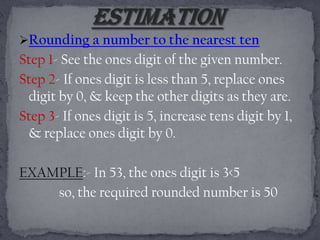
Rounding a number to the nearest ten
Step 1- See the ones digit of the given number.
Step 2- If ones digit is less than 5, replace ones
 digit by 0, & keep the other digits as they are.
Step 3- If ones digit is 5, increase tens digit by 1,
 & replace ones digit by 0.

EXAMPLE:- In 53, the ones digit is 3<5
    so, the required rounded number is 50
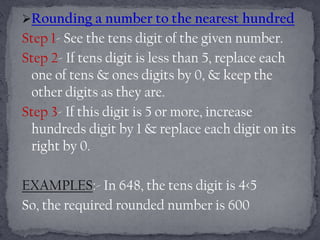
Rounding a number to the nearest hundred
Step 1- See the tens digit of the given number.
Step 2- If tens digit is less than 5, replace each
 one of tens & ones digits by 0, & keep the
 other digits as they are.
Step 3- If this digit is 5 or more, increase
 hundreds digit by 1 & replace each digit on its
 right by 0.

EXAMPLES:- In 648, the tens digit is 4<5
So, the required rounded number is 600
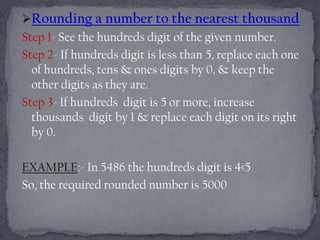
Rounding a number to the nearest thousand
Step 1- See the hundreds digit of the given number.
Step 2- If hundreds digit is less than 5, replace each one
  of hundreds, tens & ones digits by 0, & keep the
  other digits as they are.
Step 3- If hundreds digit is 5 or more, increase
  thousands digit by 1 & replace each digit on its right
  by 0.

EXAMPLE:- In 5486 the hundreds digit is 4<5
So, the required rounded number is 5000
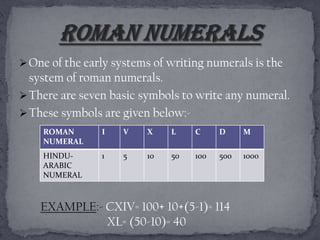
 One of the early systems of writing numerals is the
  system of roman numerals.
 There are seven basic symbols to write any numeral.
 These symbols are given below:-
    ROMAN       I   V    X    L    C     D     M
    NUMERAL
    HINDU-      1   5    10   50   100   500   1000
    ARABIC
    NUMERAL


    EXAMPLE:- CXIV= 100+ 10+(5-1)= 114
              XL= (50-10)= 40

Knowing our numbers

  • 2.
    Knowing our numbershelps us in counting objects in large numbers & representing them through numerals. Numbers helps in communicating through suitable number names & to count concrete objects. They help us to say which collection of bigger & arrange them in order.
  • 3.
    INDIAN Period Lakhs Thousand Ones Place Ten Lakhs Ten Thousa Hundre Tens Ones Lakhs Thousand nd ds TL L T Th Th H T O For example: 9951024 can be placed in place value chart as TL L T Th Th H T O 9 9 5 1 0 2 4
  • 4.
    Perio Million Thousand Ones d Place Ten millio Hundre Ten Thousa Hundr Tens Ones Million n d Thous nd eds Thousa and nd TM M L T Th Th H T O For example: 96743682 can be placed in place value chart as TM M H Th T Th Th H T O 9 6 7 4 3 6 8 2
  • 5.
     In orderto compare two numbers, we adopt the following rulers:- RULE 1:- The number with less digits is less than the number with more digits. RULE 2:- Suppose we have to compare two numbers having the same numbers of digits than we proceed as under Step 1- First compare the digits at the leftmost place in both the numbers. Step 2- If they are equal in value then compare the second digits from the left. Step 3- if the second digits from the left are equal then compare the third digits from the left. Step 4- continue until you come across unequal digits at the corresponding places. Clearly, the number with greater such digit is the greater of the two.
  • 6.
     Eg.1- whichis greater: 24576813 or 9897686? Sol.- A number with more digits is greater so, 24576813>9897686  Eg.2- which is smaller: 1003467 or 987965? Sol.- A number with less digits is smaller so, 1003467<9897965  Eg.3- Arrange the following in ascending order: 3763214, 18340217, 984671, 3790423 Sol.- 984671<3763214<3790423<18340217  Eg.4- Arrange the following in descending order: 63872604, 4965328, 63890503, 5023145 Sol.- 63890503>63872604>5023145>4965328
  • 7.
    Rounding a numberto the nearest ten Step 1- See the ones digit of the given number. Step 2- If ones digit is less than 5, replace ones digit by 0, & keep the other digits as they are. Step 3- If ones digit is 5, increase tens digit by 1, & replace ones digit by 0. EXAMPLE:- In 53, the ones digit is 3<5 so, the required rounded number is 50
  • 8.
    Rounding a numberto the nearest hundred Step 1- See the tens digit of the given number. Step 2- If tens digit is less than 5, replace each one of tens & ones digits by 0, & keep the other digits as they are. Step 3- If this digit is 5 or more, increase hundreds digit by 1 & replace each digit on its right by 0. EXAMPLES:- In 648, the tens digit is 4<5 So, the required rounded number is 600
  • 9.
    Rounding a numberto the nearest thousand Step 1- See the hundreds digit of the given number. Step 2- If hundreds digit is less than 5, replace each one of hundreds, tens & ones digits by 0, & keep the other digits as they are. Step 3- If hundreds digit is 5 or more, increase thousands digit by 1 & replace each digit on its right by 0. EXAMPLE:- In 5486 the hundreds digit is 4<5 So, the required rounded number is 5000
  • 10.
     One ofthe early systems of writing numerals is the system of roman numerals.  There are seven basic symbols to write any numeral.  These symbols are given below:- ROMAN I V X L C D M NUMERAL HINDU- 1 5 10 50 100 500 1000 ARABIC NUMERAL EXAMPLE:- CXIV= 100+ 10+(5-1)= 114 XL= (50-10)= 40