WHAT IS VEDIC MATHSVedic mathematics is the name given to the ancient system of mathematics which was rediscovered from the Vedas.It’s a unique technique of calculations based on simple principles and rules, with which any mathematical problem - be it arithmetic, algebra, geometry or trigonometry can be solved mentally.
WHY VEDIC MATHSIt helps a person to solve problems 10-15 times faster.
It reduces burden (Need to learn tables up to nine only)
It provides one line answer.
It is a magical tool to reduce scratch work and finger   counting.
It increases concentration.
 Time saved can be used to answer more questions.
Improves concentration.
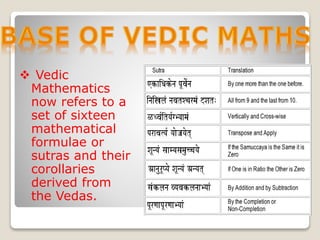
Logical thinking process gets enhanced.BASE OF VEDIC MATHSVedic Mathematics now refers to a set of sixteen mathematical formulae or sutras and their corollaries derived from the Vedas. EKADHIKINA PURVENAThe Sutra (formula) Ekādhikena Pūrvena means:“By one more than the previous one”.  This Sutra is used  to the    ‘Squaring of numbers ending in 5’.
SQUARING OF NUMBERS ENDING WITH 5Conventional Method65 X 65  6 5X 6 5 3 2 53 9 0 X 4 2 2 5Vedic Method65 X 65 = 4225( 'multiply the previous digit 6 by one more than itself 7. Than write 25 )
NIKHILAM NAVATASHCARAMAMDASHATHThis formula can be very effectively applied in multiplication of numbers, which are nearer to bases like 10, 100, 1000 i.e., to the powers of 10 (eg: 96 x 98 or 102 x 104).The Sutra (formula) NIKHILAM NAVATAS’CHARAMAM DASATAH  means :“all from 9 and the last from 10”
I : .CASE1.WHEN BOTH THE NUMBERS ARE LOWER THAN THE BASEVedic Method 	 97		3 X 94		69 1 1 8                 Conventional Method97 X 94  9 7X 9 4 3 8 88 7 3 X  9 1 1 8
Case ( ii) : When both the numbers are higher than the baseConventional Method103 X 105   103X 105 5 1 5            0 0 0 X 1 0 3 X X1 0, 8 1 5Vedic MethodFor Example103 X 105 	 103	3 X 10⁵	51 0, 8 1 5
Case III: When one number is more and the other is less than the base.Conventional Method103 X 98   103X   98  8 2 49 2 7 X1 0, 0 9 4Vedic Method 	 103	 3 X   98 	-21 0, 0 9 4
ĀNURŨPYENAThe Sutra (formula) ĀNURŨPYENA means :'proportionality ' or 'similarly ' This Sutra is highly useful to find products of two numbers when both of them are near the Common bases like 50, 60, 200 etc (multiples of powers of 10).ANUPURYENAConventional Method46 X 43   4 6X 4 3 1 3 81 8 4 X 1 9 7 8Vedic Method 	 	46	-4 X 	43	-71 9 7 8
ĀNURŨPYENAConventional Method58 X 48   5 8X 4 8 4 6 42 4  2 X 2  8  8 4Vedic Method 	 	58	 8 X 	48	-22 8 8 4
URDHVA TIRYAGBHYAMThe Sutra (formula) 	URDHVA TIRYAGBHYAM	means :“Vertically and cross wise” This the general formula applicable to all cases of multiplication and also in the division of a large number by another large number. Two digit multiplication byURDHVA TIRYAGBHYAMThe Sutra (formula) 	URDHVA TIRYAGBHYAM	means :“Vertically and cross wise” Step 1: 5×2=10, write down 0 and carry 1
Step 2: 7×2 + 5×3 = 14+15=29, add to it previous carry over value 1, so we have 30, now write down 0 and carry 3
Step 3: 7×3=21, add previous carry over value of 3 to get 24, write it down.
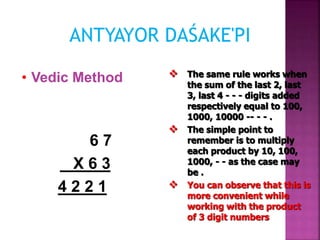
So we have 2400 as the answer.Two digit multiplication byURDHVA TIRYAGBHYAMVedic Method   4 6X 4 3 1 9 7 8
Three digit multiplication byURDHVA TIRYAGBHYAMVedic Method   103X 105 1 0, 8 1 5
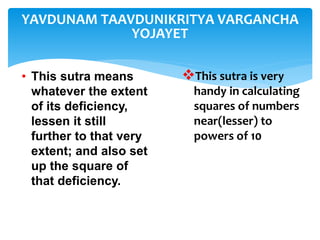
YAVDUNAM TAAVDUNIKRITYA VARGANCHA YOJAYETThis sutra means whatever the extent of its deficiency, lessen it still further to that very extent; and also set up the square of that deficiency. This sutra is very handy in calculating squares of numbers near(lesser) to powers of 10YAVDUNAM TAAVDUNIKRITYA VARGANCHA YOJAYET The nearest power of 10 to 98 is 100. Therefore, let us take 100 as our base.
 Since 98 is 2 less than 100, we call 2 as the deficiency.
 Decrease the given number further by an amount equal to the deficiency. i.e., perform ( 98 -2 ) = 96. This is the left side of our answer!!.
 On the right hand side put the square of the deficiency, that is square of 2 = 04.
 Append the results from step 4 and 5 to get the result. Hence the answer is 9604.98 2	=    9604Note   :	While calculating step 5, the number of digits in the squared number (04)  	should be equal to number of zeroes in the base(100).
YAVDUNAM TAAVDUNIKRITYA VARGANCHA YOJAYET The nearest power of 10 to 103 is 100. Therefore, let us take 100 as our base.
 Since 103 is 3 more than 100 (base), we call 3 as the surplus.
 Increase the given number further by an amount equal to the surplus. i.e., perform ( 103 + 3 ) = 106. This is the left side of our answer!!.
 On the right hand side put the square of the surplus, that is square of 3 = 09.

Vedic maths

  • 2.
    WHAT IS VEDICMATHSVedic mathematics is the name given to the ancient system of mathematics which was rediscovered from the Vedas.It’s a unique technique of calculations based on simple principles and rules, with which any mathematical problem - be it arithmetic, algebra, geometry or trigonometry can be solved mentally.
  • 3.
    WHY VEDIC MATHSIthelps a person to solve problems 10-15 times faster.
  • 4.
    It reduces burden(Need to learn tables up to nine only)
  • 5.
    It provides oneline answer.
  • 6.
    It is amagical tool to reduce scratch work and finger counting.
  • 7.
  • 8.
    Time savedcan be used to answer more questions.
  • 9.
  • 10.
    Logical thinking processgets enhanced.BASE OF VEDIC MATHSVedic Mathematics now refers to a set of sixteen mathematical formulae or sutras and their corollaries derived from the Vedas. EKADHIKINA PURVENAThe Sutra (formula) Ekādhikena Pūrvena means:“By one more than the previous one”. This Sutra is used to the ‘Squaring of numbers ending in 5’.
  • 11.
    SQUARING OF NUMBERSENDING WITH 5Conventional Method65 X 65 6 5X 6 5 3 2 53 9 0 X 4 2 2 5Vedic Method65 X 65 = 4225( 'multiply the previous digit 6 by one more than itself 7. Than write 25 )
  • 12.
    NIKHILAM NAVATASHCARAMAMDASHATHThis formulacan be very effectively applied in multiplication of numbers, which are nearer to bases like 10, 100, 1000 i.e., to the powers of 10 (eg: 96 x 98 or 102 x 104).The Sutra (formula) NIKHILAM NAVATAS’CHARAMAM DASATAH means :“all from 9 and the last from 10”
  • 13.
    I : .CASE1.WHENBOTH THE NUMBERS ARE LOWER THAN THE BASEVedic Method 97 3 X 94 69 1 1 8 Conventional Method97 X 94 9 7X 9 4 3 8 88 7 3 X 9 1 1 8
  • 14.
    Case ( ii): When both the numbers are higher than the baseConventional Method103 X 105 103X 105 5 1 5 0 0 0 X 1 0 3 X X1 0, 8 1 5Vedic MethodFor Example103 X 105 103 3 X 10⁵ 51 0, 8 1 5
  • 15.
    Case III: Whenone number is more and the other is less than the base.Conventional Method103 X 98 103X 98 8 2 49 2 7 X1 0, 0 9 4Vedic Method 103 3 X 98 -21 0, 0 9 4
  • 16.
    ĀNURŨPYENAThe Sutra (formula)ĀNURŨPYENA means :'proportionality ' or 'similarly ' This Sutra is highly useful to find products of two numbers when both of them are near the Common bases like 50, 60, 200 etc (multiples of powers of 10).ANUPURYENAConventional Method46 X 43 4 6X 4 3 1 3 81 8 4 X 1 9 7 8Vedic Method 46 -4 X 43 -71 9 7 8
  • 17.
    ĀNURŨPYENAConventional Method58 X48 5 8X 4 8 4 6 42 4 2 X 2 8 8 4Vedic Method 58 8 X 48 -22 8 8 4
  • 18.
    URDHVA TIRYAGBHYAMThe Sutra(formula) URDHVA TIRYAGBHYAM means :“Vertically and cross wise” This the general formula applicable to all cases of multiplication and also in the division of a large number by another large number. Two digit multiplication byURDHVA TIRYAGBHYAMThe Sutra (formula) URDHVA TIRYAGBHYAM means :“Vertically and cross wise” Step 1: 5×2=10, write down 0 and carry 1
  • 19.
    Step 2: 7×2+ 5×3 = 14+15=29, add to it previous carry over value 1, so we have 30, now write down 0 and carry 3
  • 20.
    Step 3: 7×3=21,add previous carry over value of 3 to get 24, write it down.
  • 21.
    So we have2400 as the answer.Two digit multiplication byURDHVA TIRYAGBHYAMVedic Method 4 6X 4 3 1 9 7 8
  • 22.
    Three digit multiplicationbyURDHVA TIRYAGBHYAMVedic Method 103X 105 1 0, 8 1 5
  • 23.
    YAVDUNAM TAAVDUNIKRITYA VARGANCHAYOJAYETThis sutra means whatever the extent of its deficiency, lessen it still further to that very extent; and also set up the square of that deficiency. This sutra is very handy in calculating squares of numbers near(lesser) to powers of 10YAVDUNAM TAAVDUNIKRITYA VARGANCHA YOJAYET The nearest power of 10 to 98 is 100. Therefore, let us take 100 as our base.
  • 24.
    Since 98is 2 less than 100, we call 2 as the deficiency.
  • 25.
    Decrease thegiven number further by an amount equal to the deficiency. i.e., perform ( 98 -2 ) = 96. This is the left side of our answer!!.
  • 26.
    On theright hand side put the square of the deficiency, that is square of 2 = 04.
  • 27.
    Append theresults from step 4 and 5 to get the result. Hence the answer is 9604.98 2 = 9604Note : While calculating step 5, the number of digits in the squared number (04) should be equal to number of zeroes in the base(100).
  • 28.
    YAVDUNAM TAAVDUNIKRITYA VARGANCHAYOJAYET The nearest power of 10 to 103 is 100. Therefore, let us take 100 as our base.
  • 29.
    Since 103is 3 more than 100 (base), we call 3 as the surplus.
  • 30.
    Increase thegiven number further by an amount equal to the surplus. i.e., perform ( 103 + 3 ) = 106. This is the left side of our answer!!.
  • 31.
    On theright hand side put the square of the surplus, that is square of 3 = 09.