Number Systems
and
Number Representation
1
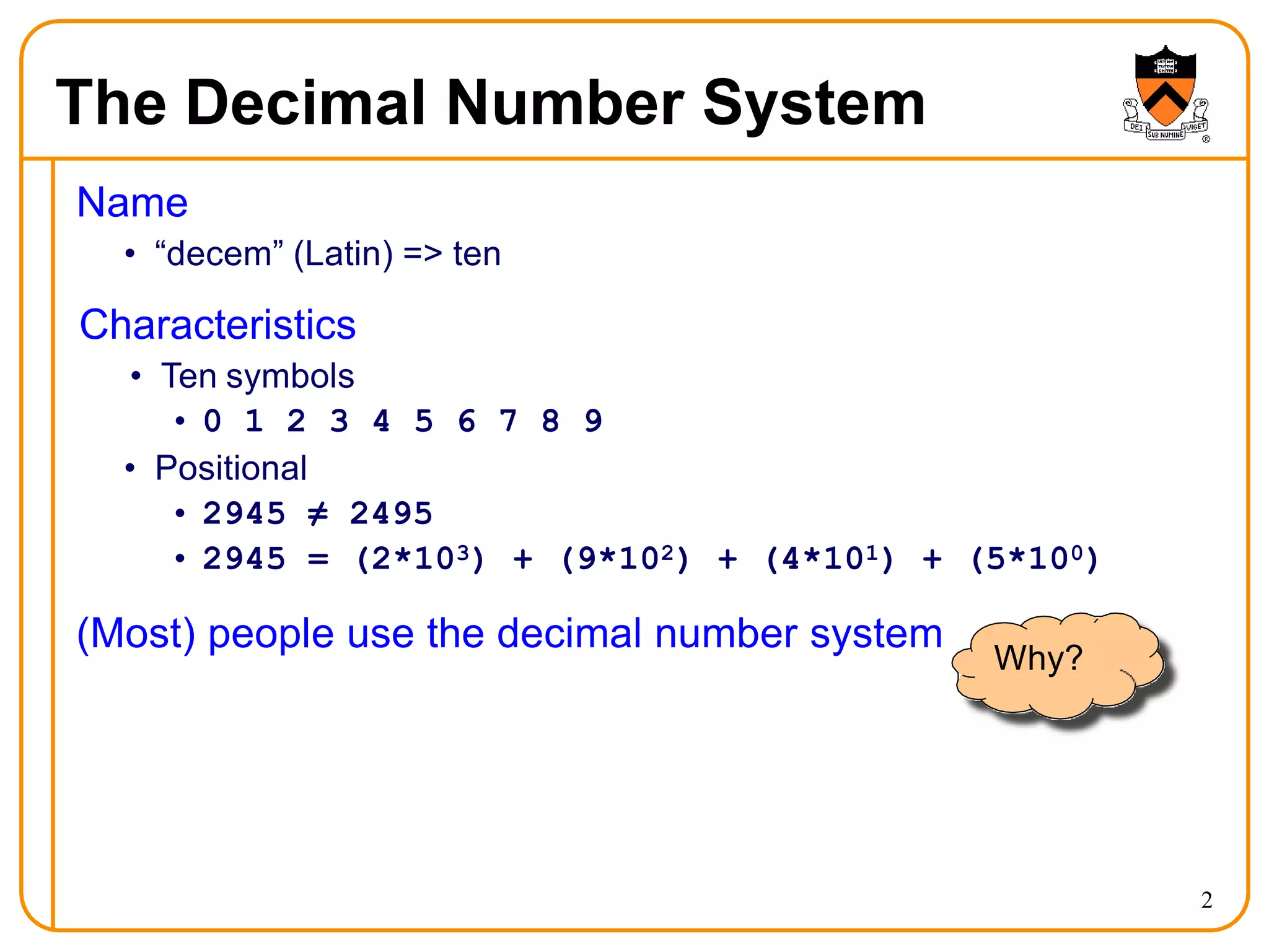
The Decimal Number System
Name
• “decem” (Latin) => ten
Characteristics
• Ten symbols
• 0 1 2 3 4 5 6 7 8 9
• Positional
• 2945 ≠ 2495
• 2945 = (2*103) + (9*102) + (4*101) + (5*100)
(Most) people use the decimal number system
Why?
2
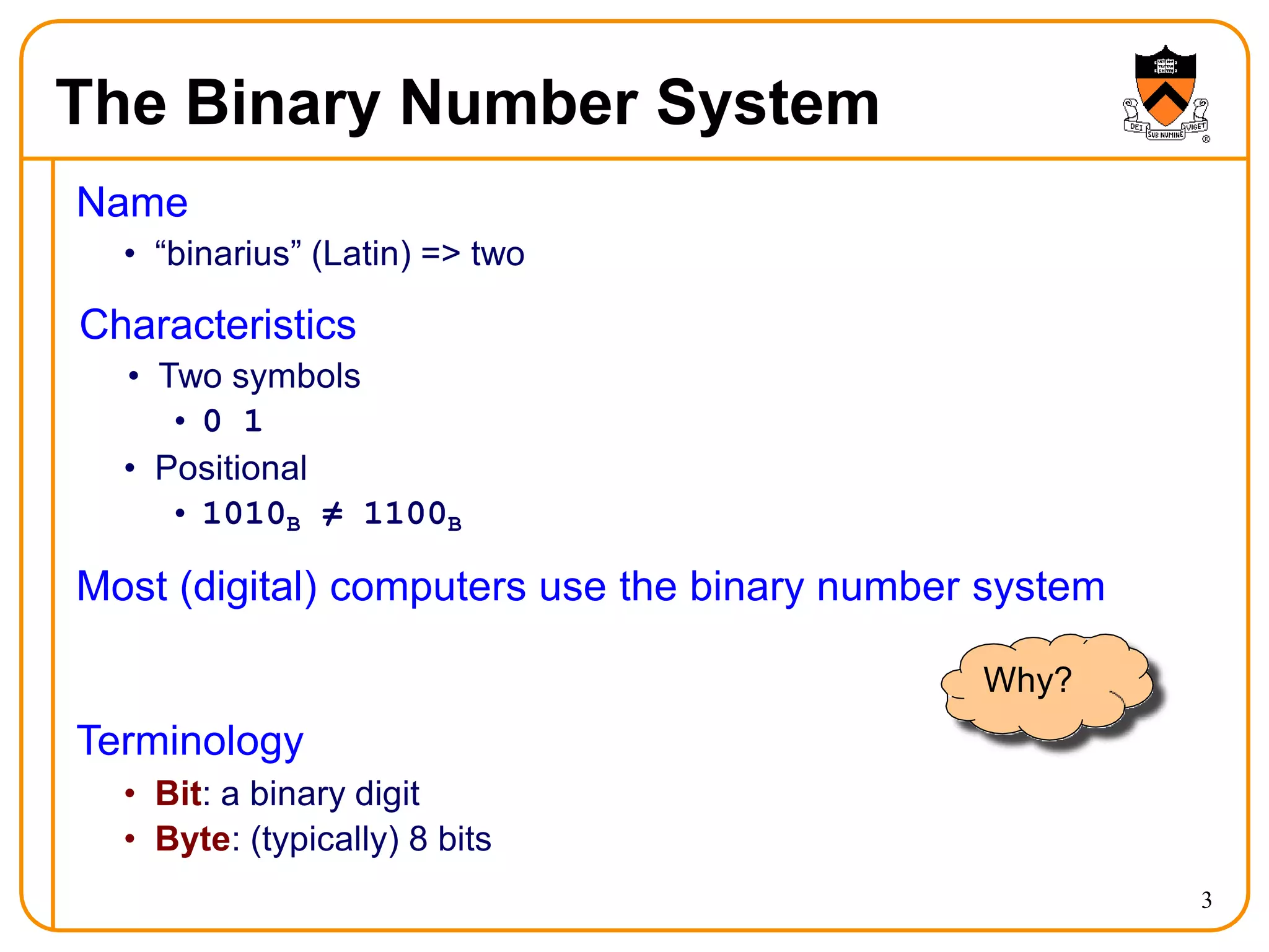
The Binary Number System
Name
• “binarius” (Latin) => two
Characteristics
• Two symbols
• 0 1
• Positional
• 1010B ≠ 1100B
Most (digital) computers use the binary number system
Why?
Terminology
• Bit: a binary digit
• Byte: (typically) 8 bits
3
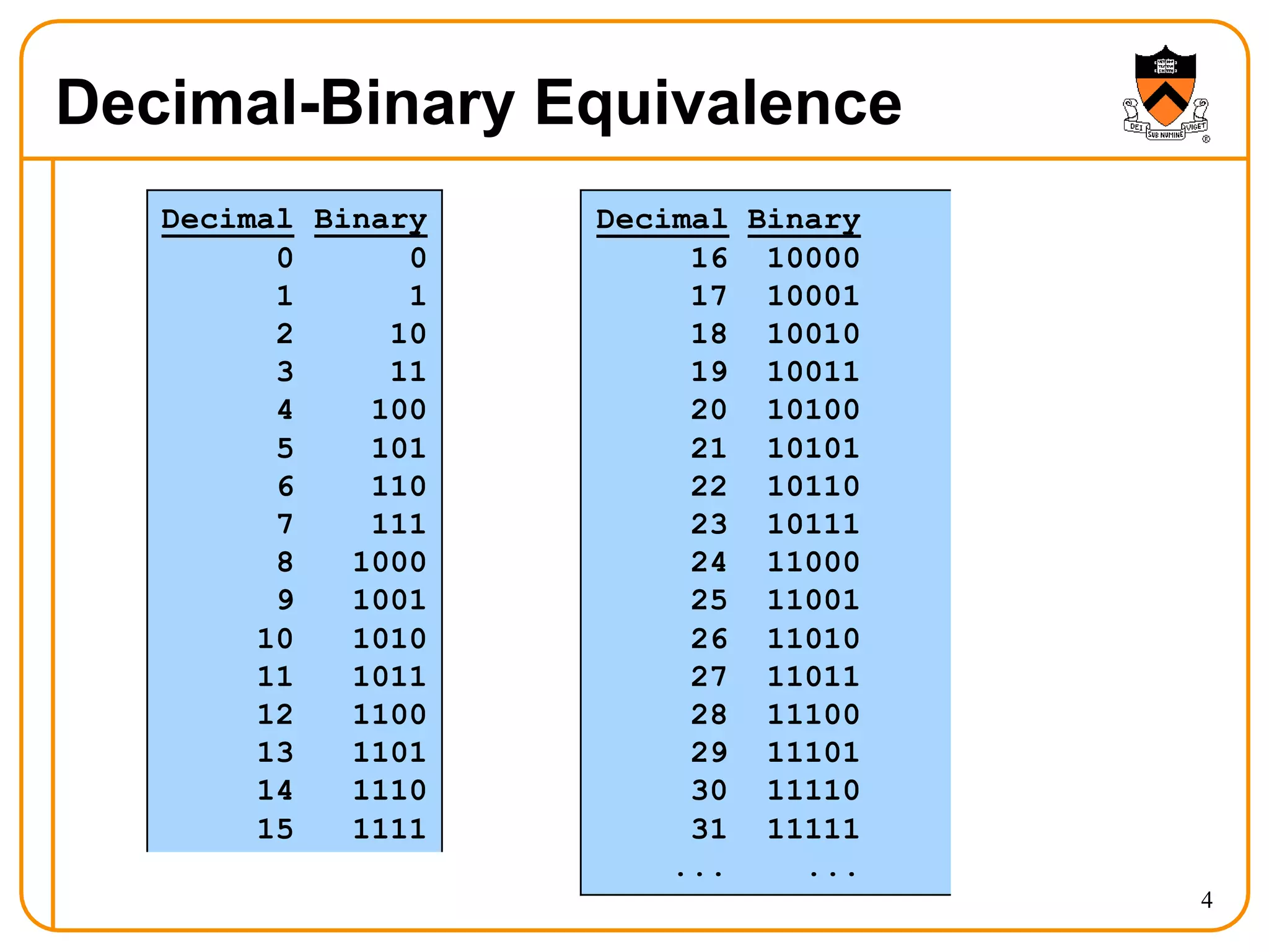
Decimal-Binary Equivalence
4
Decimal Binary Decimal Binary
0 0 16 10000
1 1 17 10001
2 10 18 10010
3 11 19 10011
4 100 20 10100
5 101 21 10101
6 110 22 10110
7 111 23 10111
8 1000 24 11000
9 1001 25 11001
10 1010 26 11010
11 1011 27 11011
12 1100 28 11100
13 1101 29 11101
14 1110 30 11110
15 1111 31 11111
... ...
Decimal-Binary Conversion
5
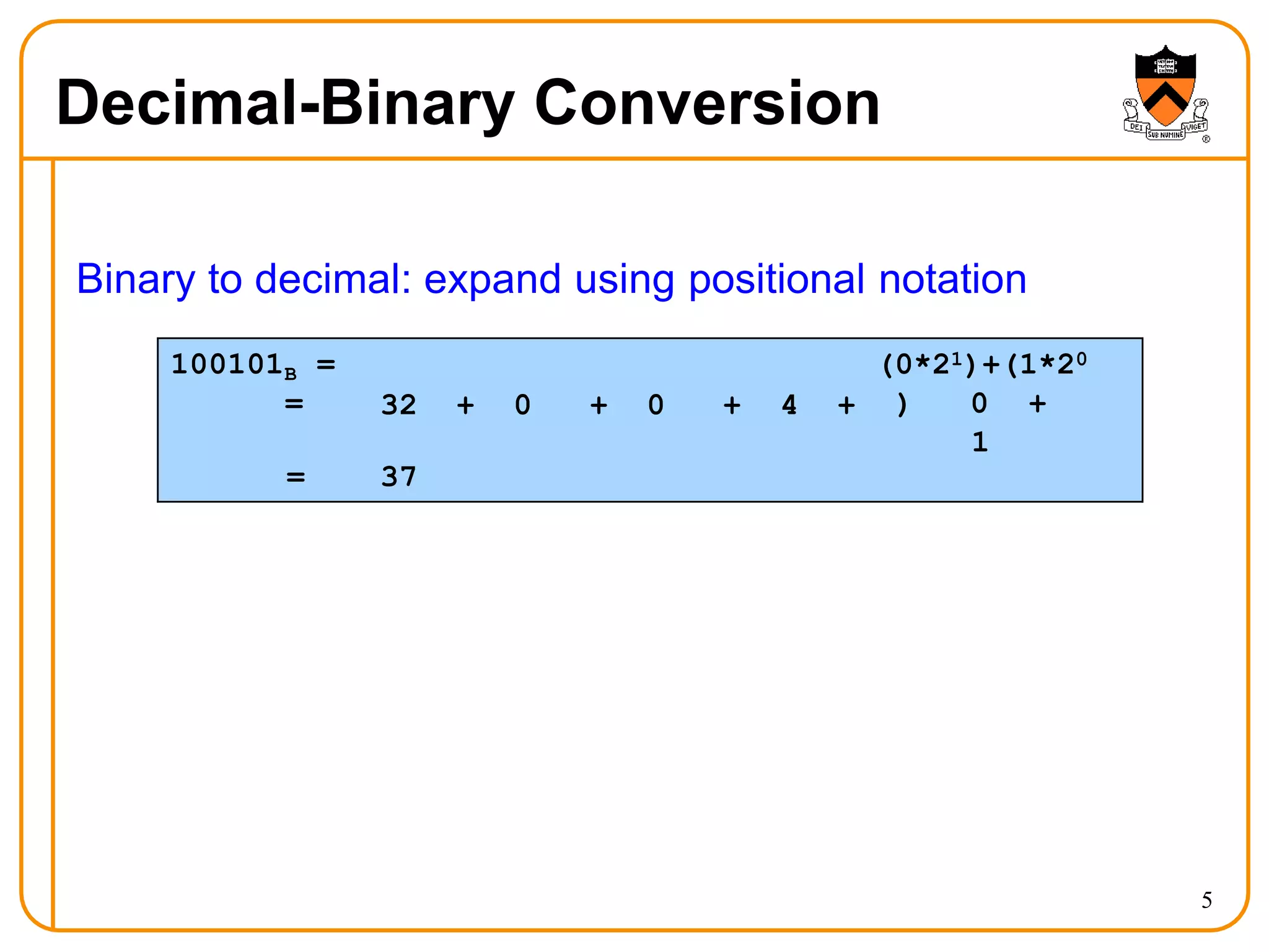
Binary to decimal: expand using positional notation
(1*25)+(0*24)+(0*23)+(1*22)+
100101B =
= 32 + 0 + 0 + 4 +
(0*21)+(1*20
) 0 +
1
= 37
Decimal-Binary Conversion
6
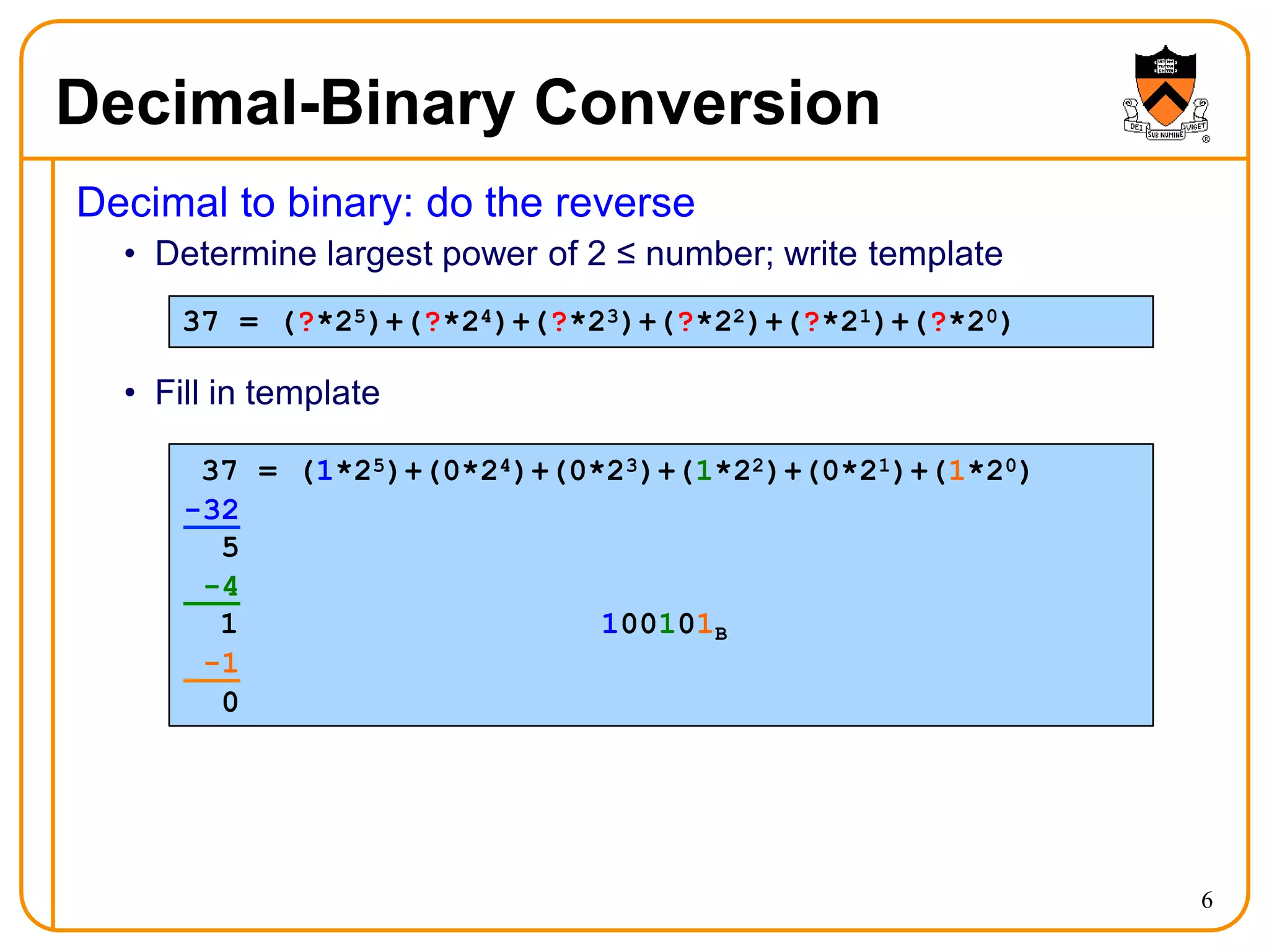
Decimal to binary: do the reverse
• Determine largest power of 2 ≤ number; write template
• Fill in template
37 = (?*25)+(?*24)+(?*23)+(?*22)+(?*21)+(?*20)
37 = (1*25)+(0*24)+(0*23)+(1*22)+(0*21)+(1*20)
-32
5
-4
1 100101B
-1
0
Decimal-Binary Conversion
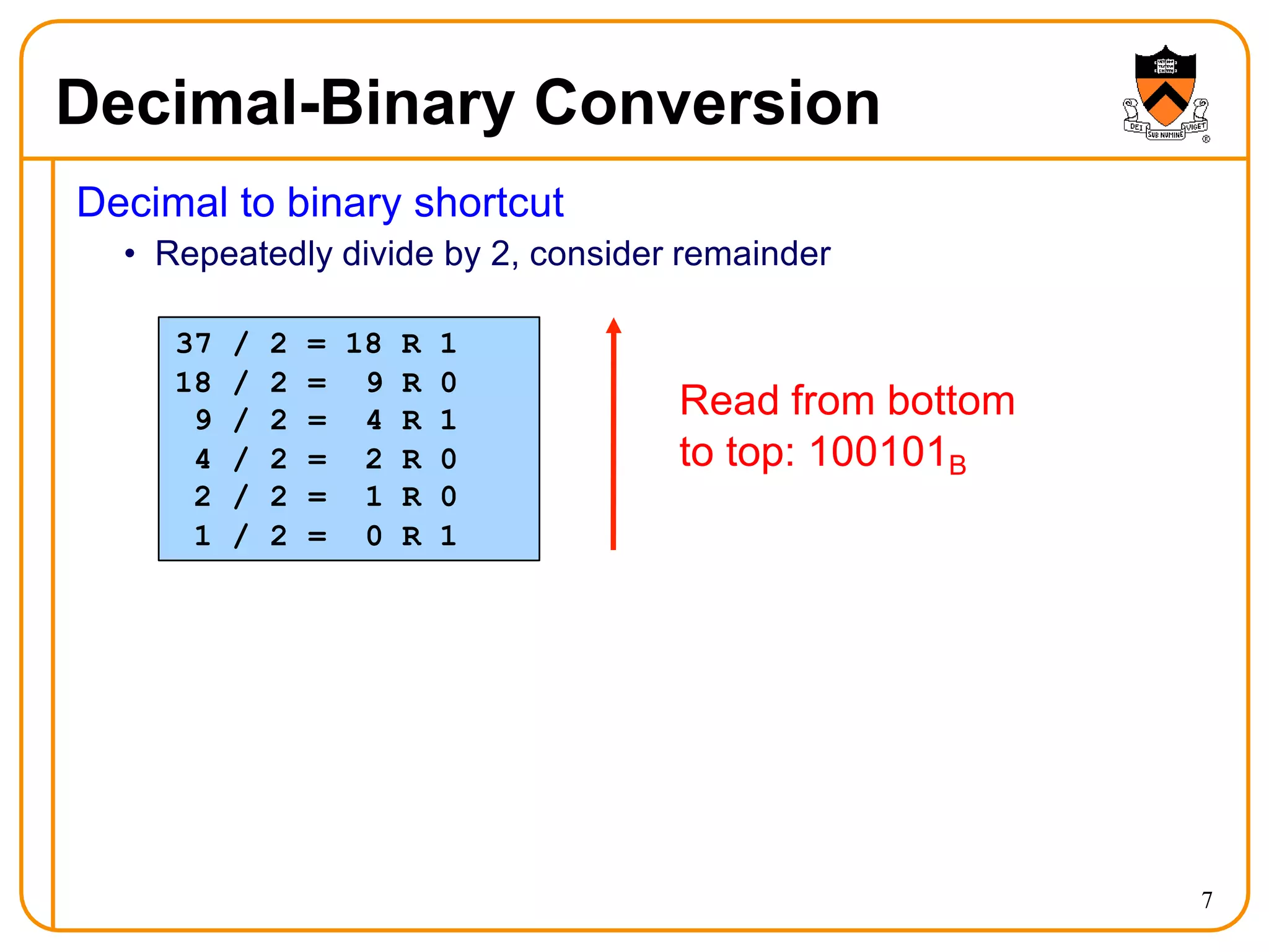
Decimal to binary shortcut
• Repeatedly divide by 2, consider remainder
37 / 2 = 18 R 1
18 / 2 = 9 R 0
9 / 2 = 4 R 1
4 / 2 = 2 R 0
2 / 2 = 1 R 0
1 / 2 = 0 R 1
Read from bottom
to top: 100101B
7
The Hexadecimal Number System
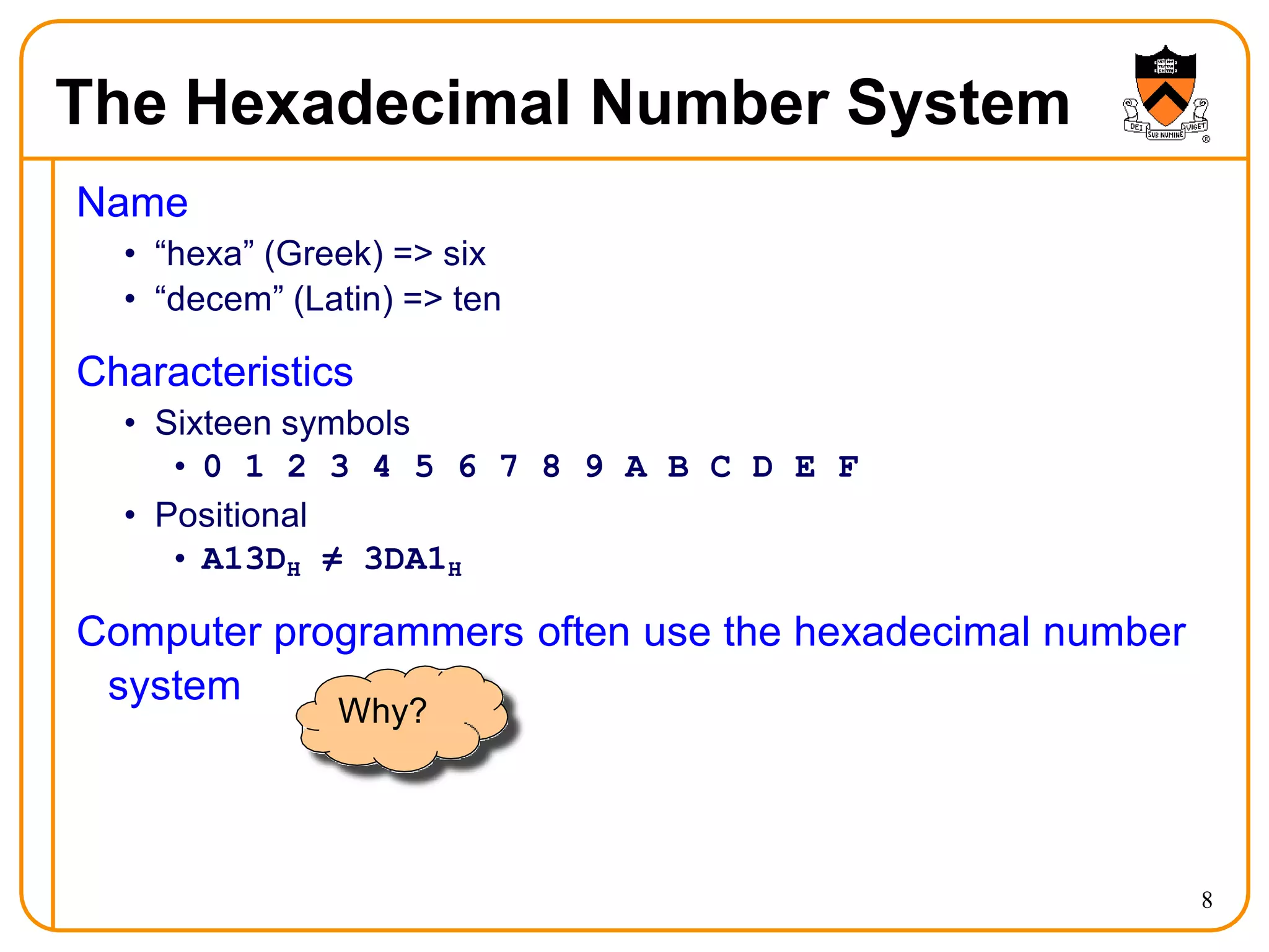
Name
• “hexa” (Greek) => six
• “decem” (Latin) => ten
Characteristics
• Sixteen symbols
• 0 1 2 3 4 5 6 7 8 9 A B C D E F
• Positional
• A13DH ≠ 3DA1H
Computer programmers often use the hexadecimal number
system
Why?
8
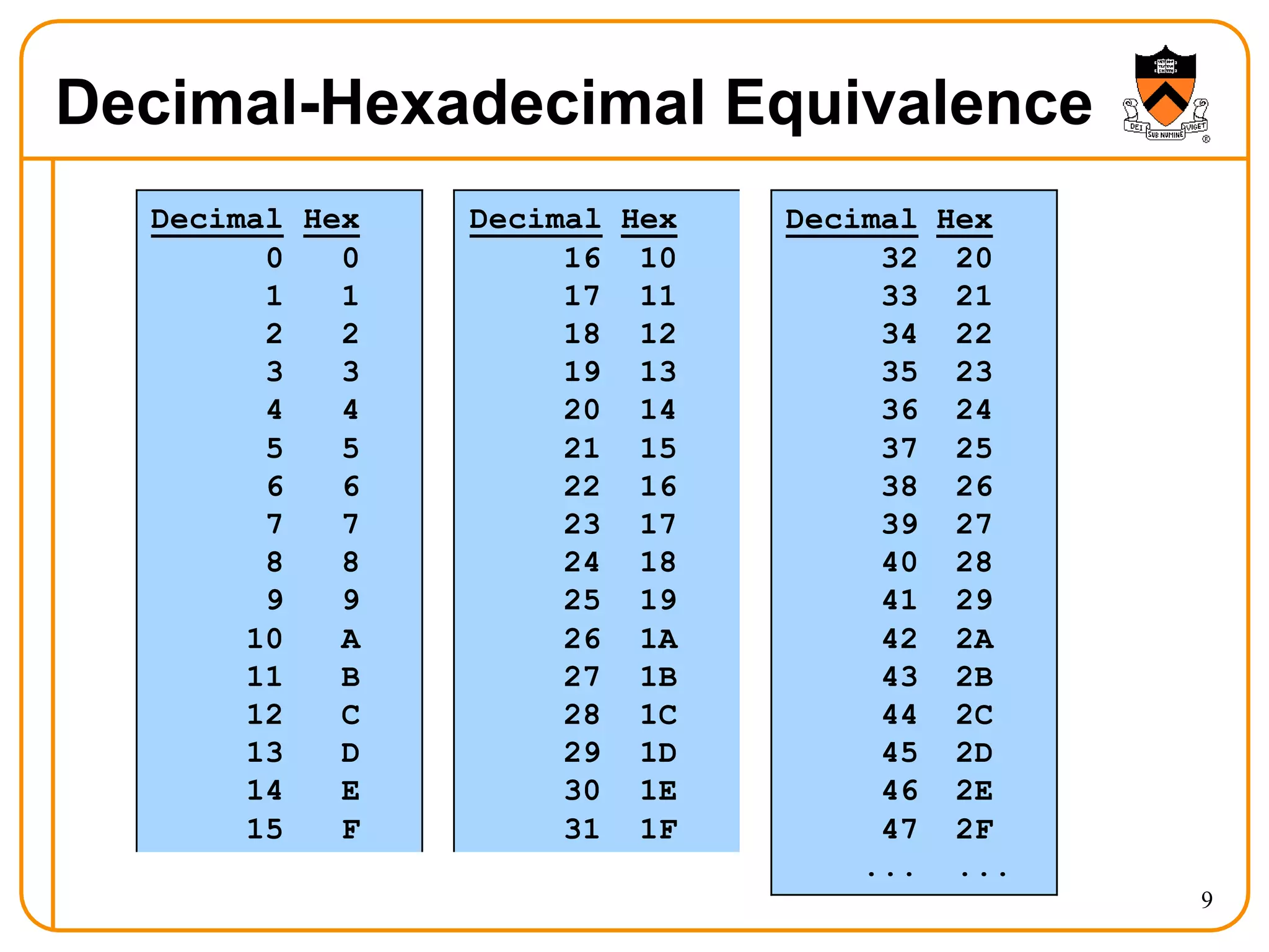
Decimal-Hexadecimal Equivalence
9
Decimal Hex Decimal Hex Decimal Hex
0 0 16 10 32 20
1 1 17 11 33 21
2 2 18 12 34 22
3 3 19 13 35 23
4 4 20 14 36 24
5 5 21 15 37 25
6 6 22 16 38 26
7 7 23 17 39 27
8 8 24 18 40 28
9 9 25 19 41 29
10 A 26 1A 42 2A
11 B 27 1B 43 2B
12 C 28 1C 44 2C
13 D 29 1D 45 2D
14 E 30 1E 46 2E
15 F 31 1F 47 2F
... ...
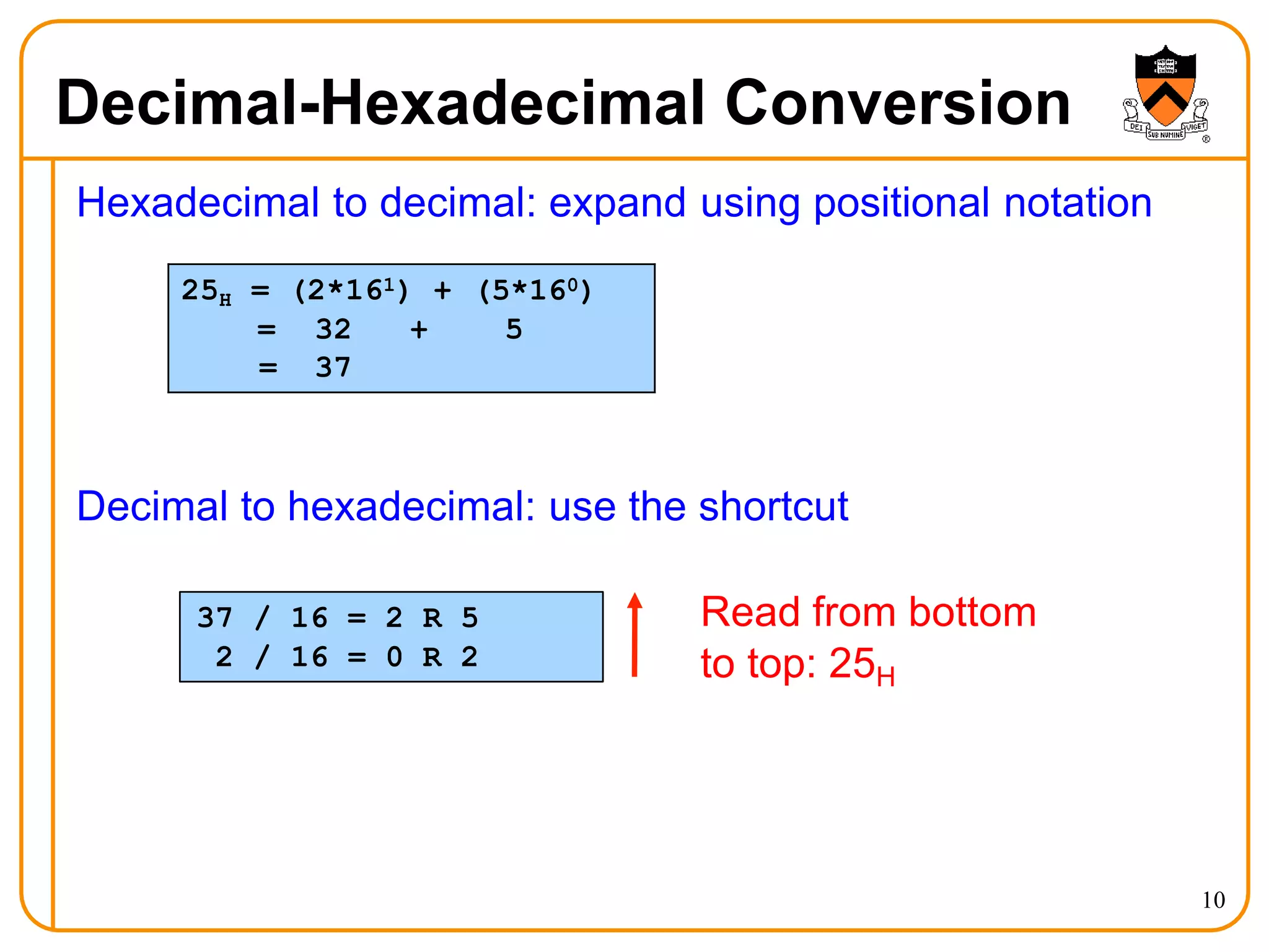
Decimal-Hexadecimal Conversion
Hexadecimal to decimal: expand using positional notation
Decimal to hexadecimal: use the shortcut
25H = (2*161) +
= 32 +
(5*160)
5
= 37
37 / 16 = 2 R 5
2 / 16 = 0 R 2
Read from bottom
to top: 25H
10
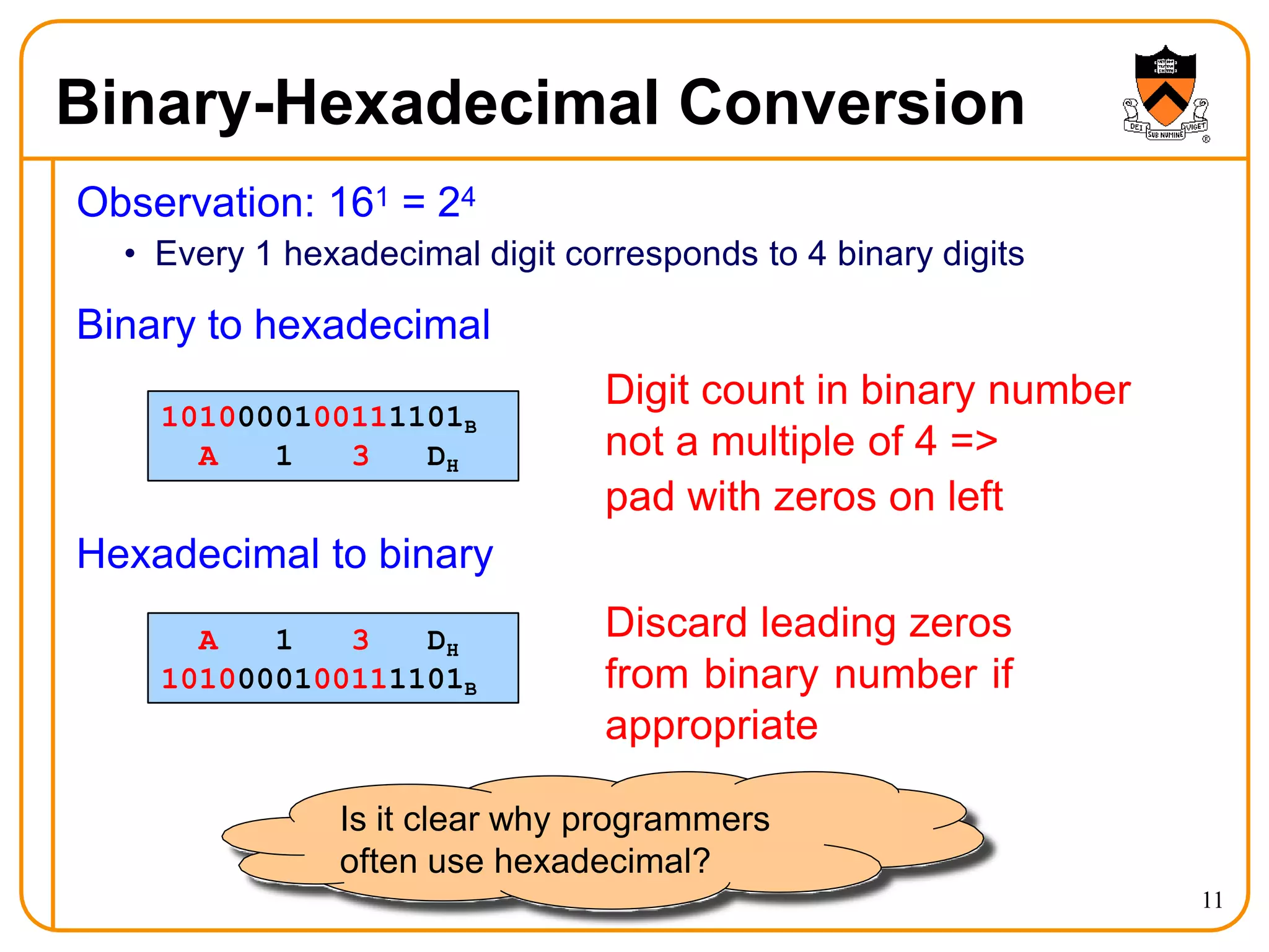
Binary-Hexadecimal Conversion
Observation: 161 = 24
• Every 1 hexadecimal digit corresponds to 4 binary digits
Binary to hexadecimal
1010000100111101B
A 1 3 DH
Digit count in binary number
not a multiple of 4 =>
pad with zeros on left
Hexadecimal to binary
A 1 3 DH
1010000100111101B
Discard leading zeros
from binary number if
appropriate
Is it clear why programmers
often use hexadecimal?
11
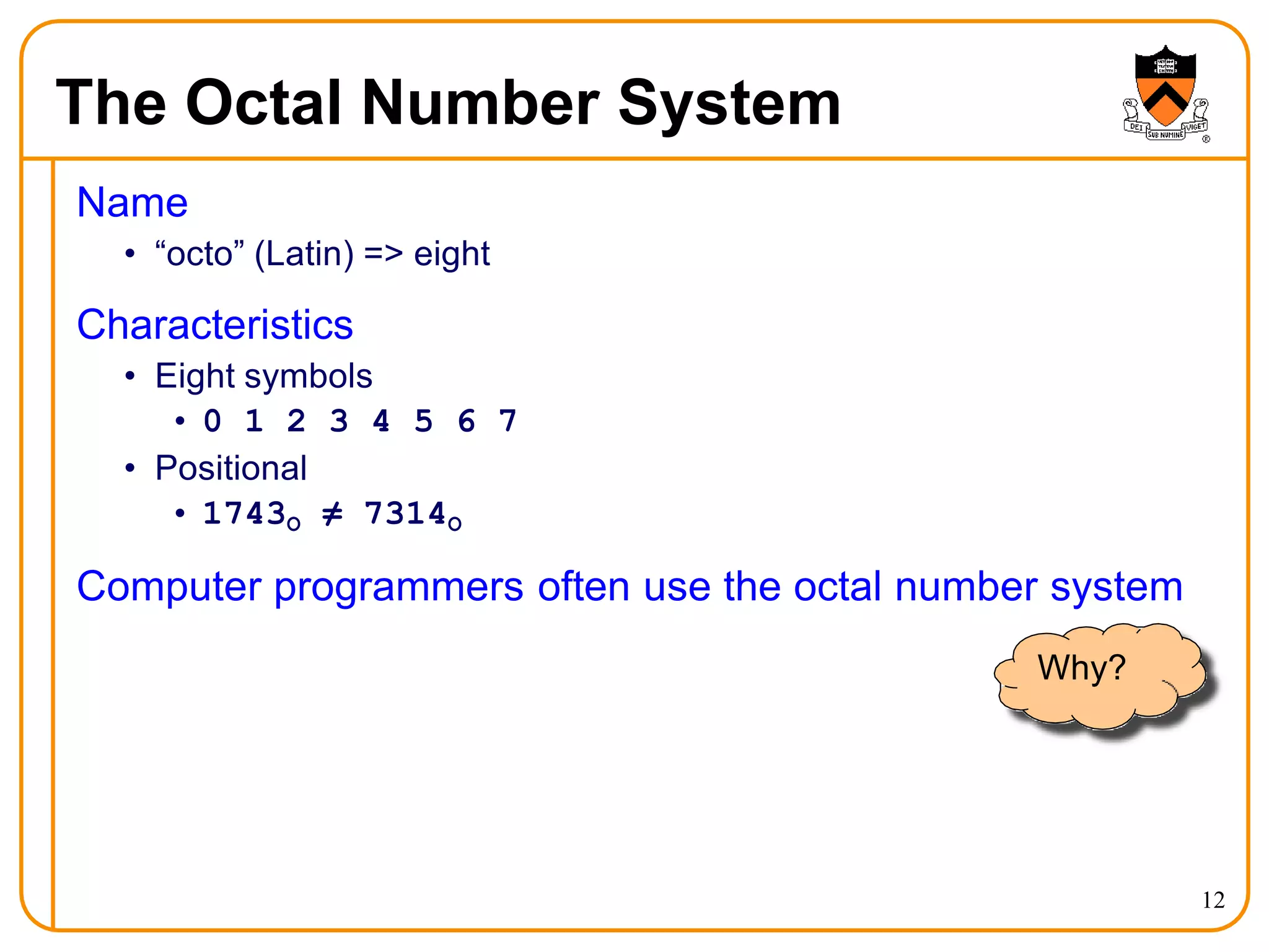
The Octal Number System
Name
• “octo” (Latin) => eight
Characteristics
• Eight symbols
• 0 1 2 3 4 5 6 7
• Positional
• 1743O ≠ 7314O
Computer programmers often use the octal number system
Why?
12
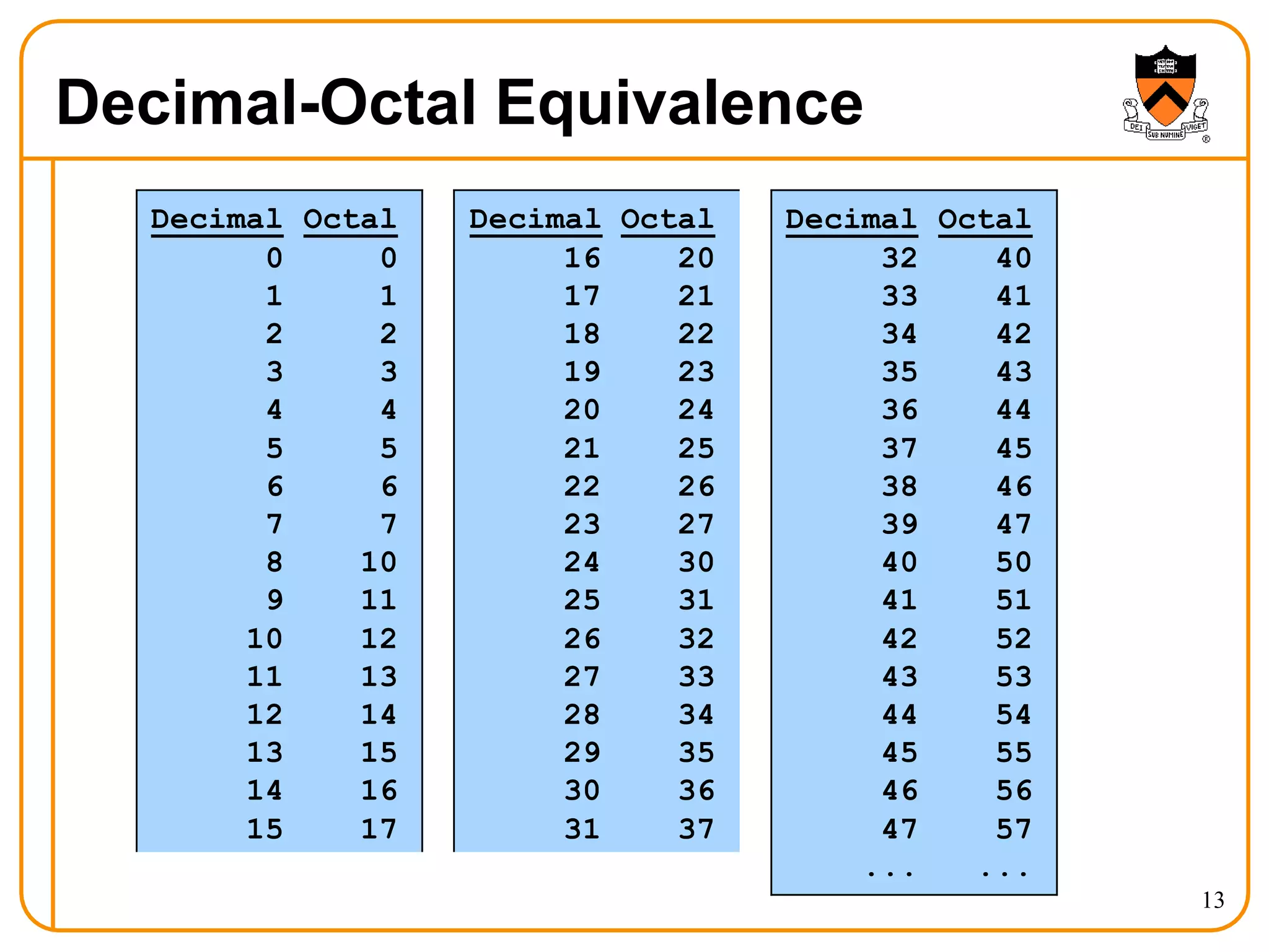
Decimal-Octal Equivalence
13
Decimal Octal Decimal Octal Decimal Octal
0 0 16 20 32 40
1 1 17 21 33 41
2 2 18 22 34 42
3 3 19 23 35 43
4 4 20 24 36 44
5 5 21 25 37 45
6 6 22 26 38 46
7 7 23 27 39 47
8 10 24 30 40 50
9 11 25 31 41 51
10 12 26 32 42 52
11 13 27 33 43 53
12 14 28 34 44 54
13 15 29 35 45 55
14 16 30 36 46 56
15 17 31 37 47 57
... ...
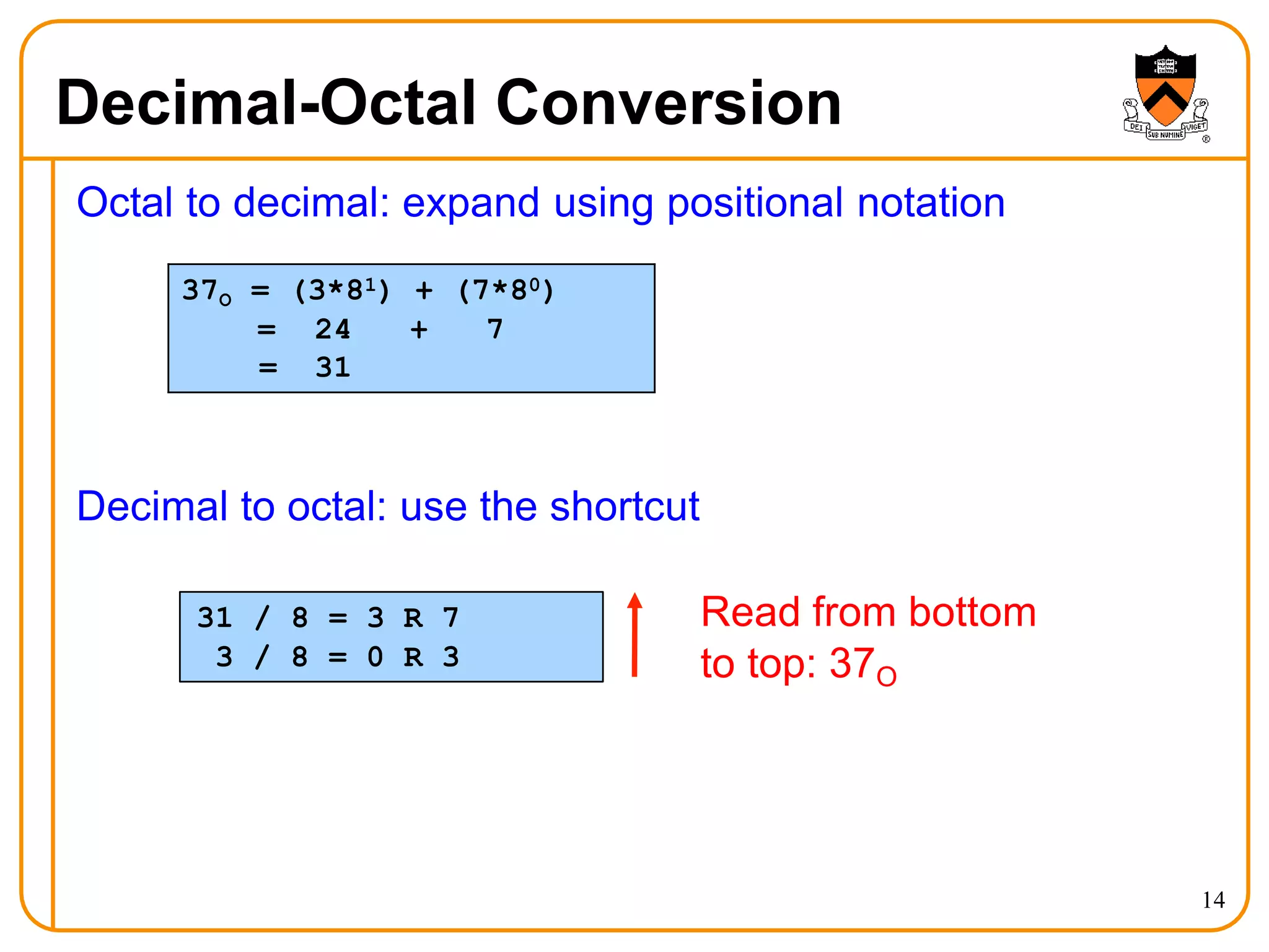
Decimal-Octal Conversion
Octal to decimal: expand using positional notation
Decimal to octal: use the shortcut
37O = (3*81) + (7*80)
= 24 + 7
= 31
31 / 8 = 3 R 7
3 / 8 = 0 R 3
Read from bottom
to top: 37O
14
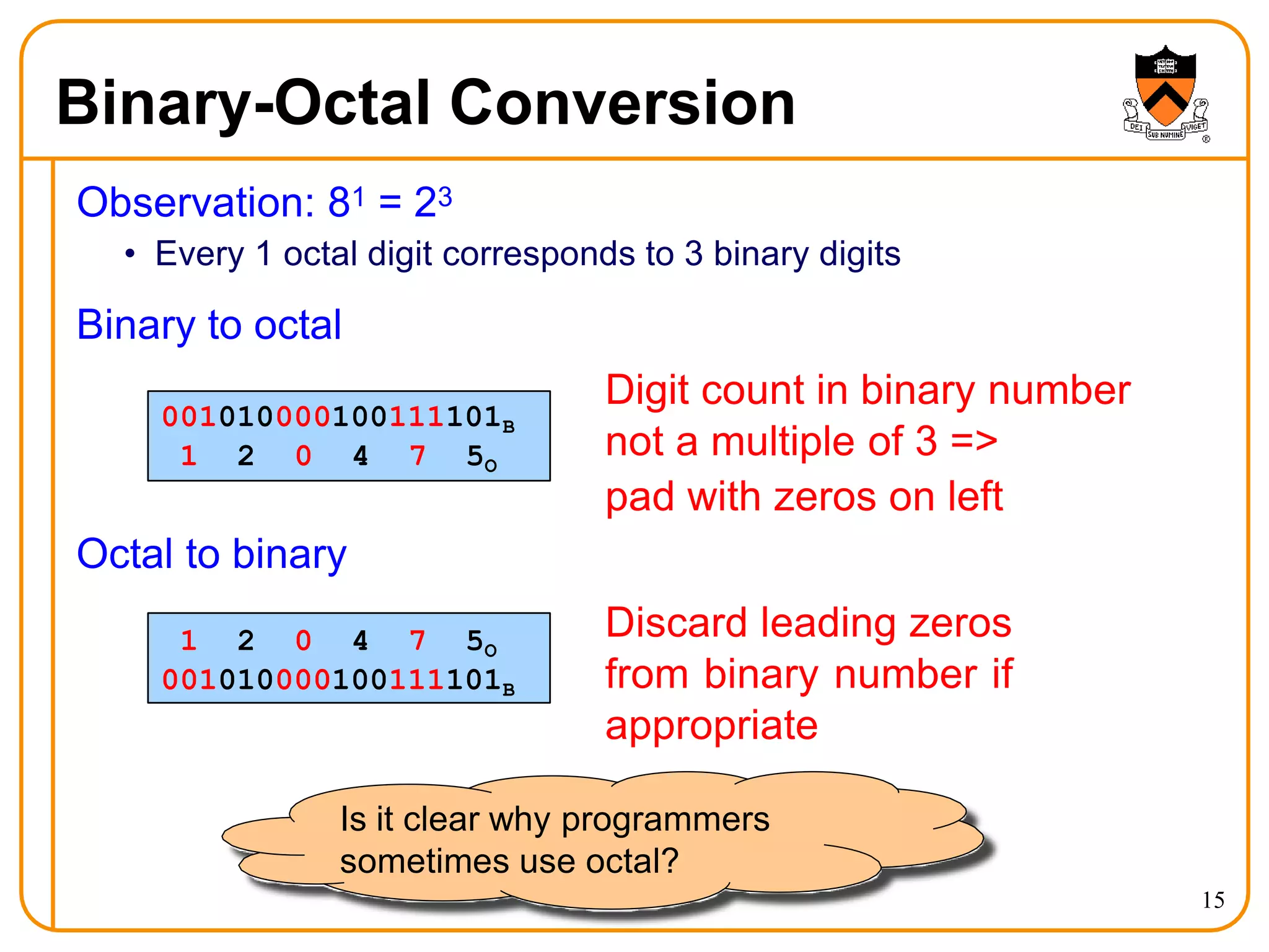
Binary-Octal Conversion
Observation: 81 = 23
• Every 1 octal digit corresponds to 3 binary digits
Binary to octal
001010000100111101B
1 2 0 4 7 5O
Digit count in binary number
not a multiple of 3 =>
pad with zeros on left
Discard leading zeros
from binary number if
appropriate
Octal to binary
1 2 0 4 7 5O
001010000100111101B
Is it clear why programmers
sometimes use octal?
15
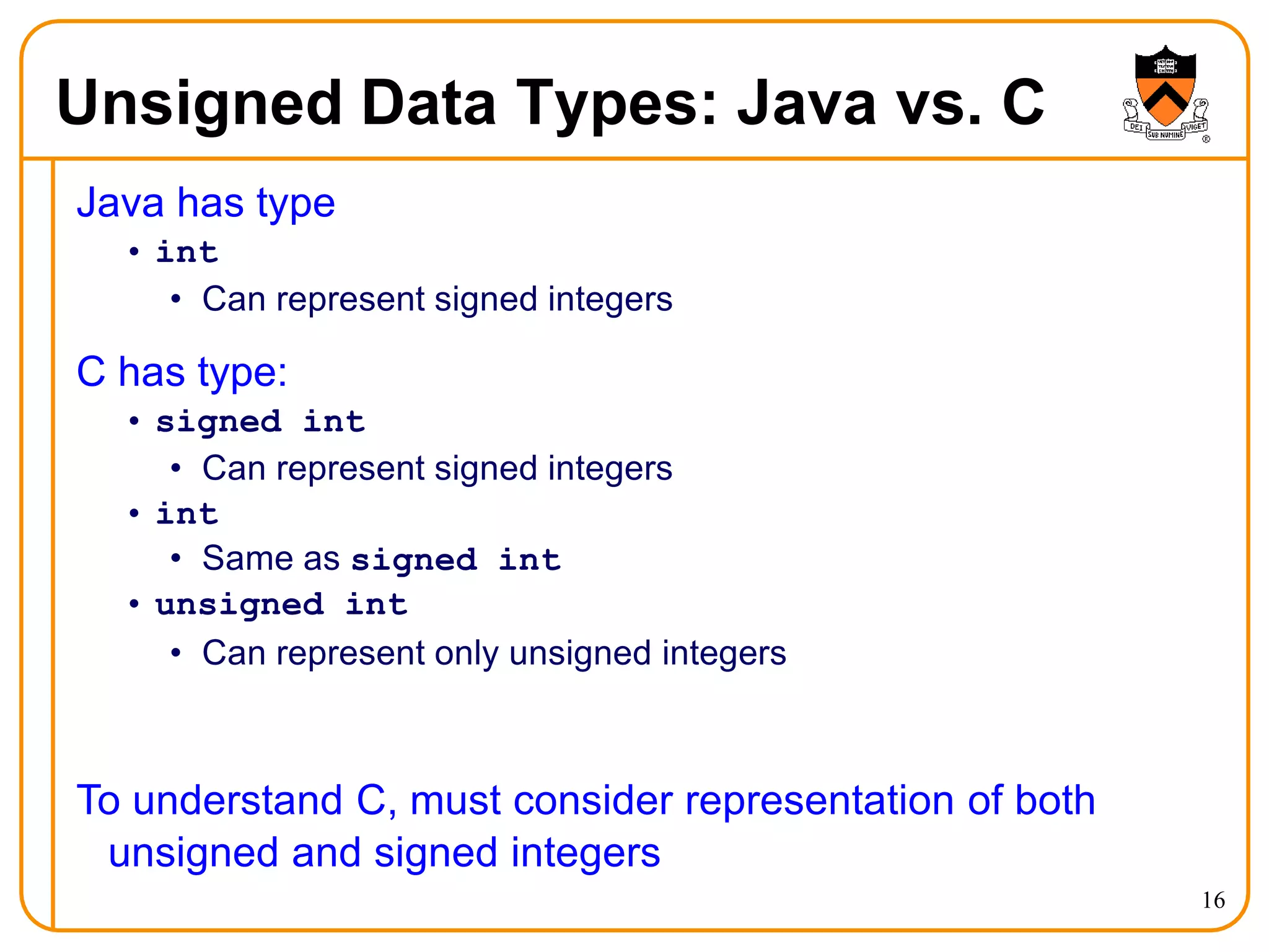
Unsigned Data Types: Java vs. C
16
Java has type
• int
• Can represent signed integers
C has type:
• signed int
• Can represent signed integers
• int
• Same as signed int
• unsigned int
• Can represent only unsigned integers
To understand C, must consider representation of both
unsigned and signed integers
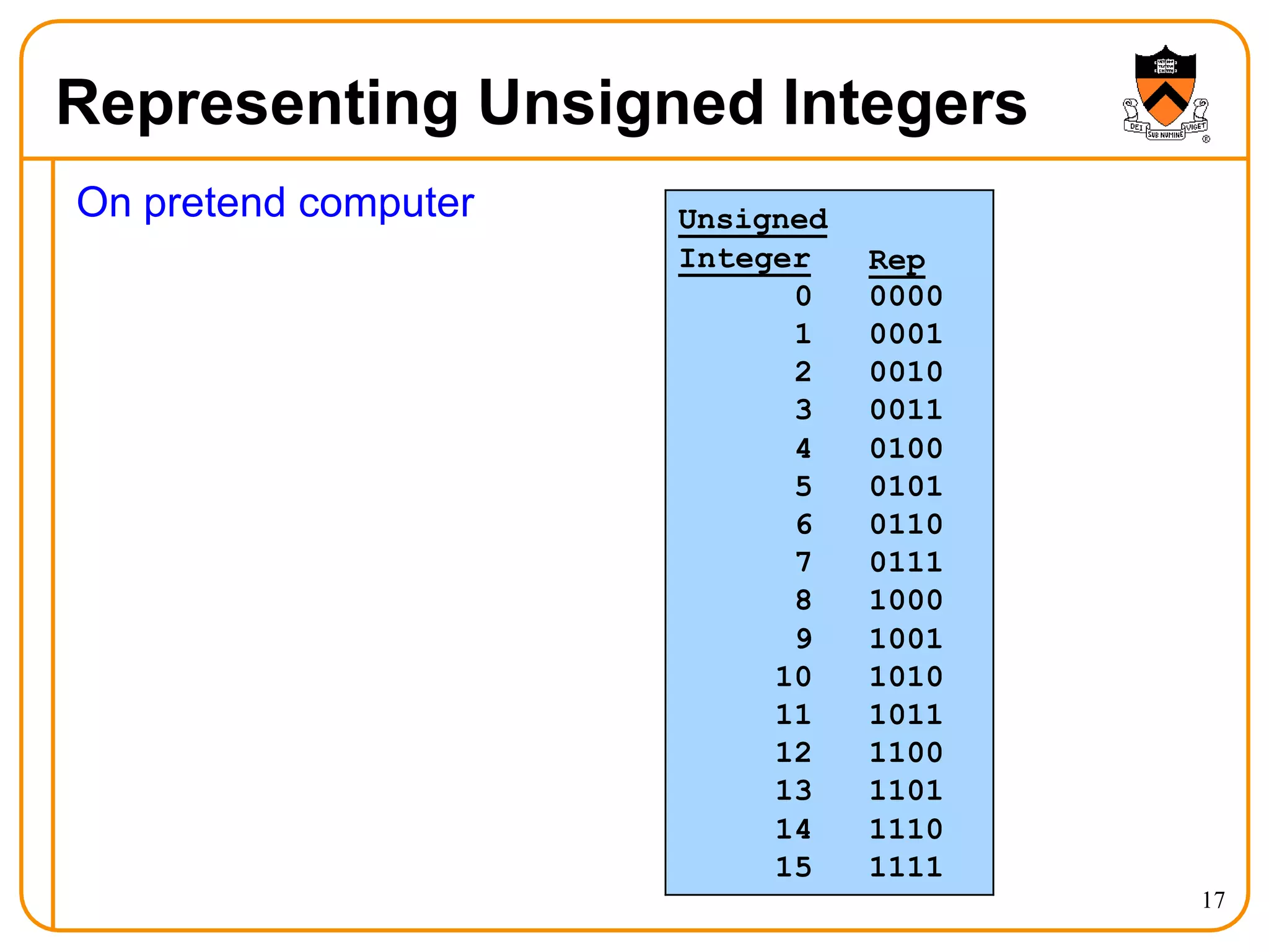
Representing Unsigned Integers
17
On pretend computer Unsigned
Integer Rep
0 0000
1 0001
2 0010
3 0011
4 0100
5 0101
6 0110
7 0111
8 1000
9 1001
10 1010
11 1011
12 1100
13 1101
14 1110
15 1111
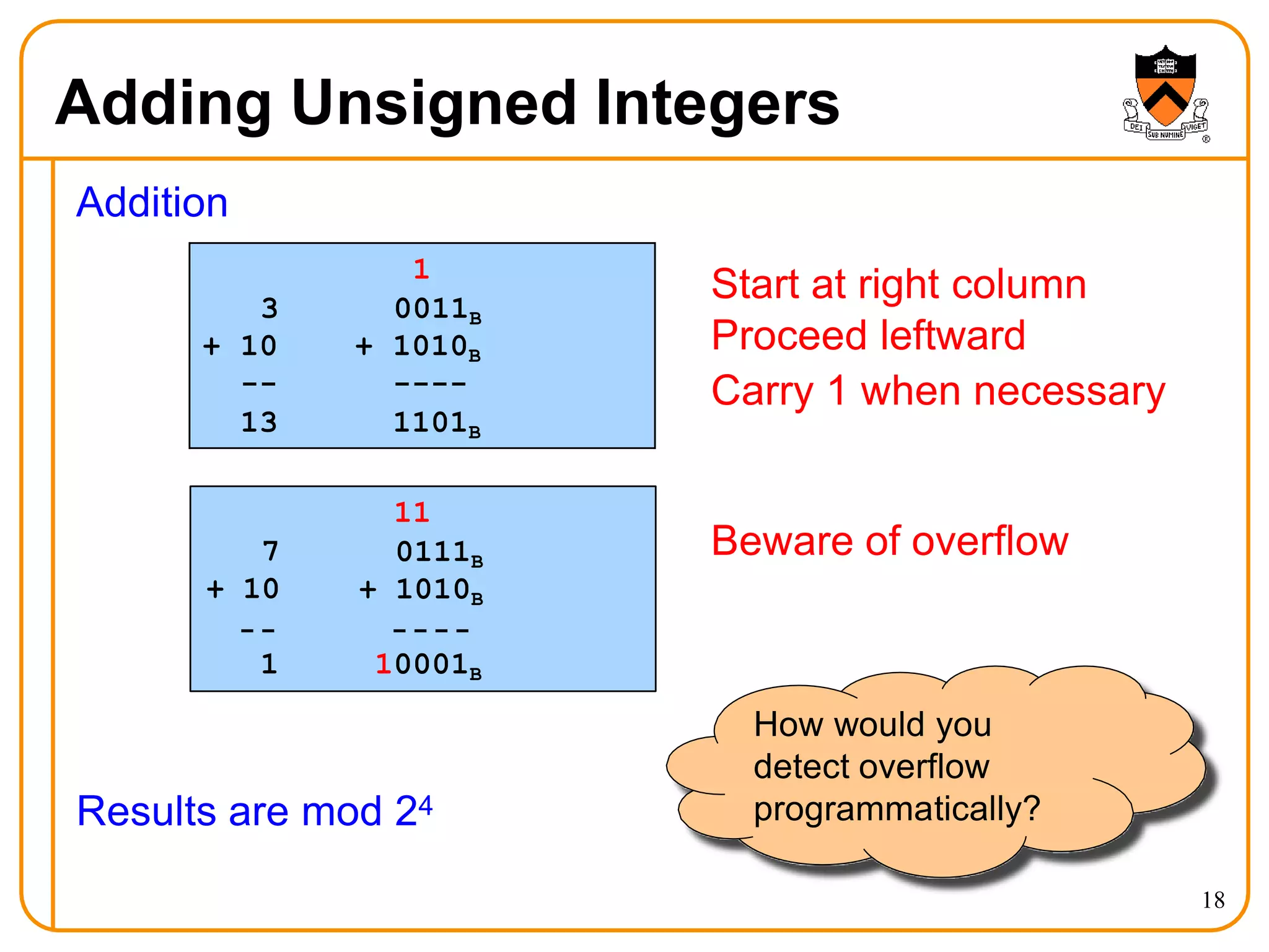
Adding Unsigned Integers
Addition
Results are mod 24
7
+ 10
11
0111B
+ 1010B
1 10001B
1
3 0011B
+ 10
--
+ 1010B
----
13 1101B
Start at right column
Proceed leftward
Carry 1 when necessary
Beware of overflow
How would you
detect overflow
programmatically?
18
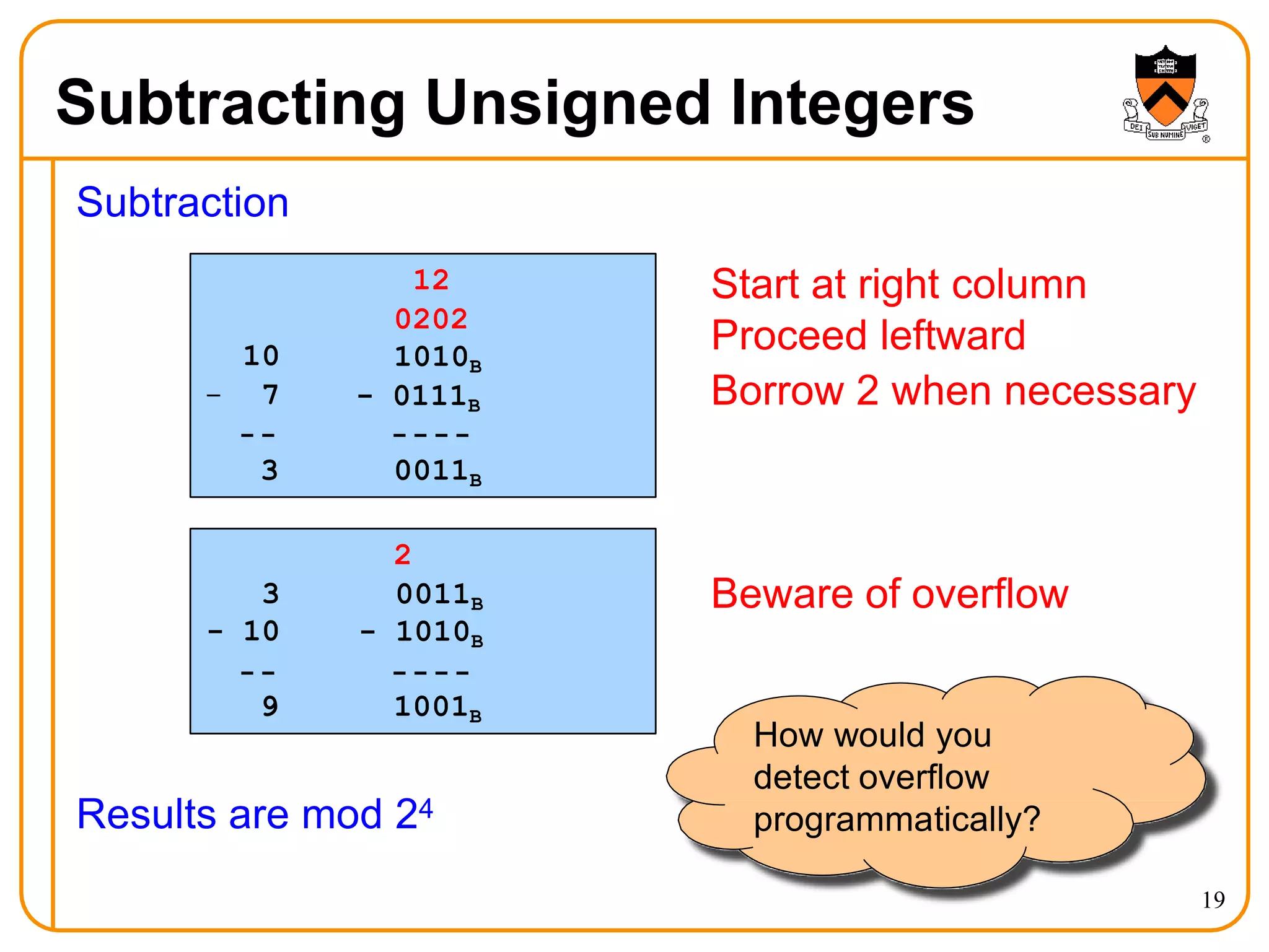
Subtracting Unsigned Integers
Subtraction
3
- 10
2
0011B
- 1010B
9 1001B
Results are mod 24
10
- 7
12
0202
1010B
- 0111B
3 0011B
Start at right column
Proceed leftward
Borrow 2 when necessary
Beware of overflow
How would you
detect overflow
programmatically?
19
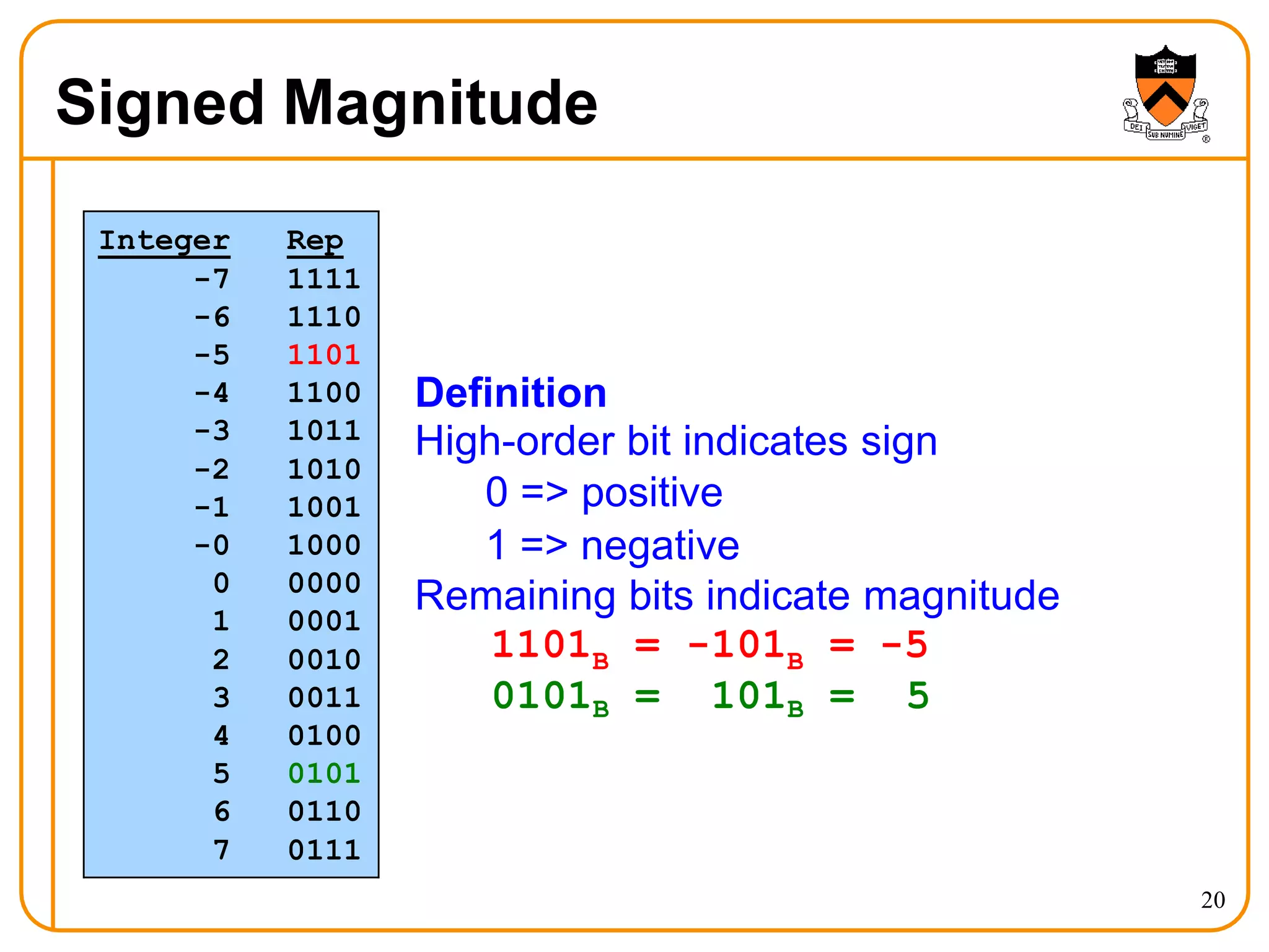
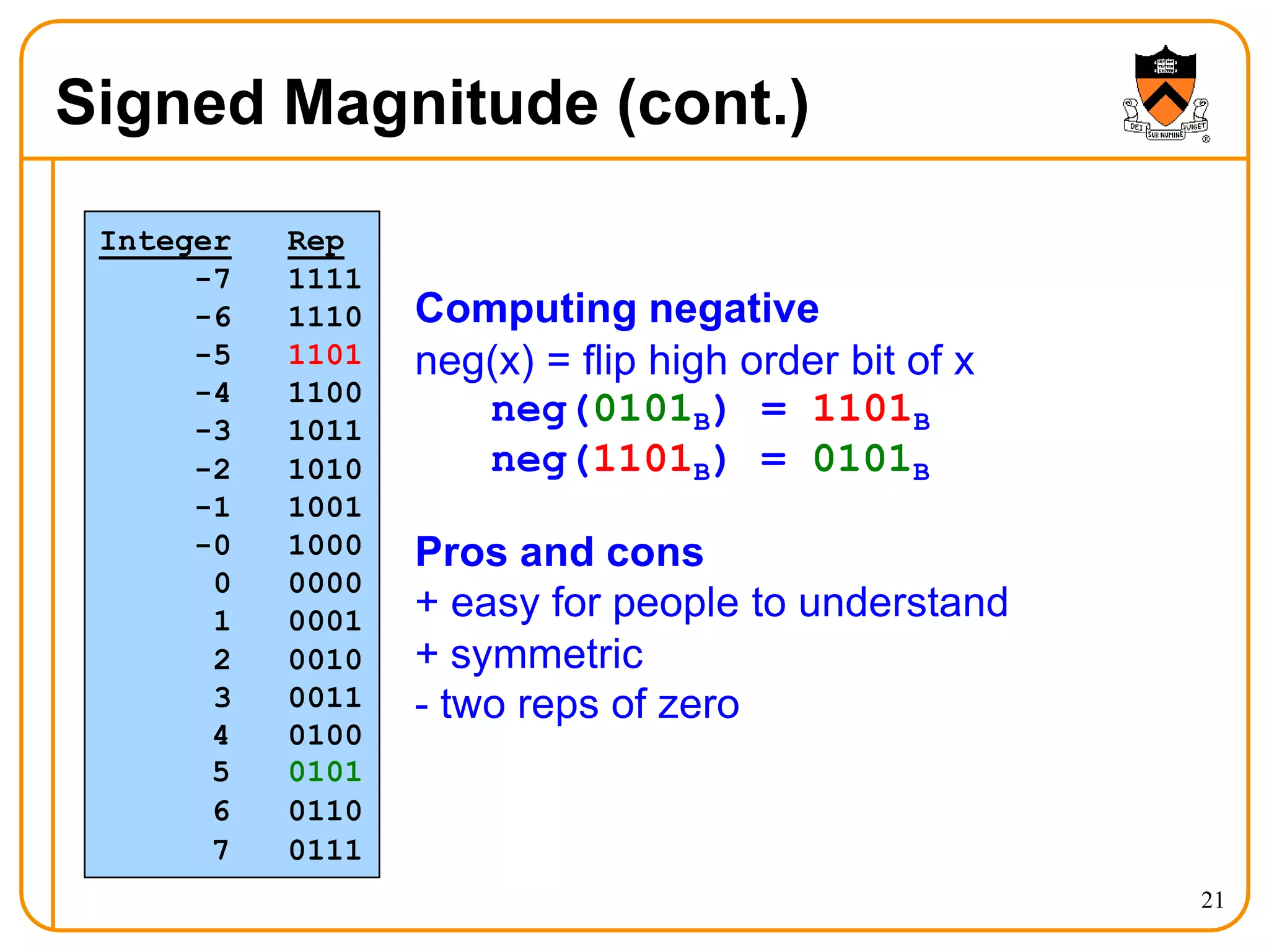
Signed Magnitude
20
Integer Rep
-7 1111
-6 1110
-5 1101
-4 1100
-3 1011
-2 1010
-1 1001
-0 1000
0 0000
1 0001
2 0010
3 0011
4 0100
5 0101
6 0110
7 0111
Definition
High-order bit indicates sign
0 => positive
1 => negative
Remaining bits indicate magnitude
B B
1101 = -101 = -5
0101B = 101B = 5
Signed Magnitude (cont.)
Integer Rep
-7 1111
-6 1110
-5 1101
-4 1100
-3 1011
-2 1010
-1 1001
-0 1000
0 0000
1 0001
2 0010
3 0011
4
5
6
7
0100
0101
0110
0111
21
Computing negative
neg(x) = flip high order bit of x
neg(0101B) = 1101B
neg(1101B) = 0101B
Pros and cons
+ easy for people to understand
+ symmetric
- two reps of zero
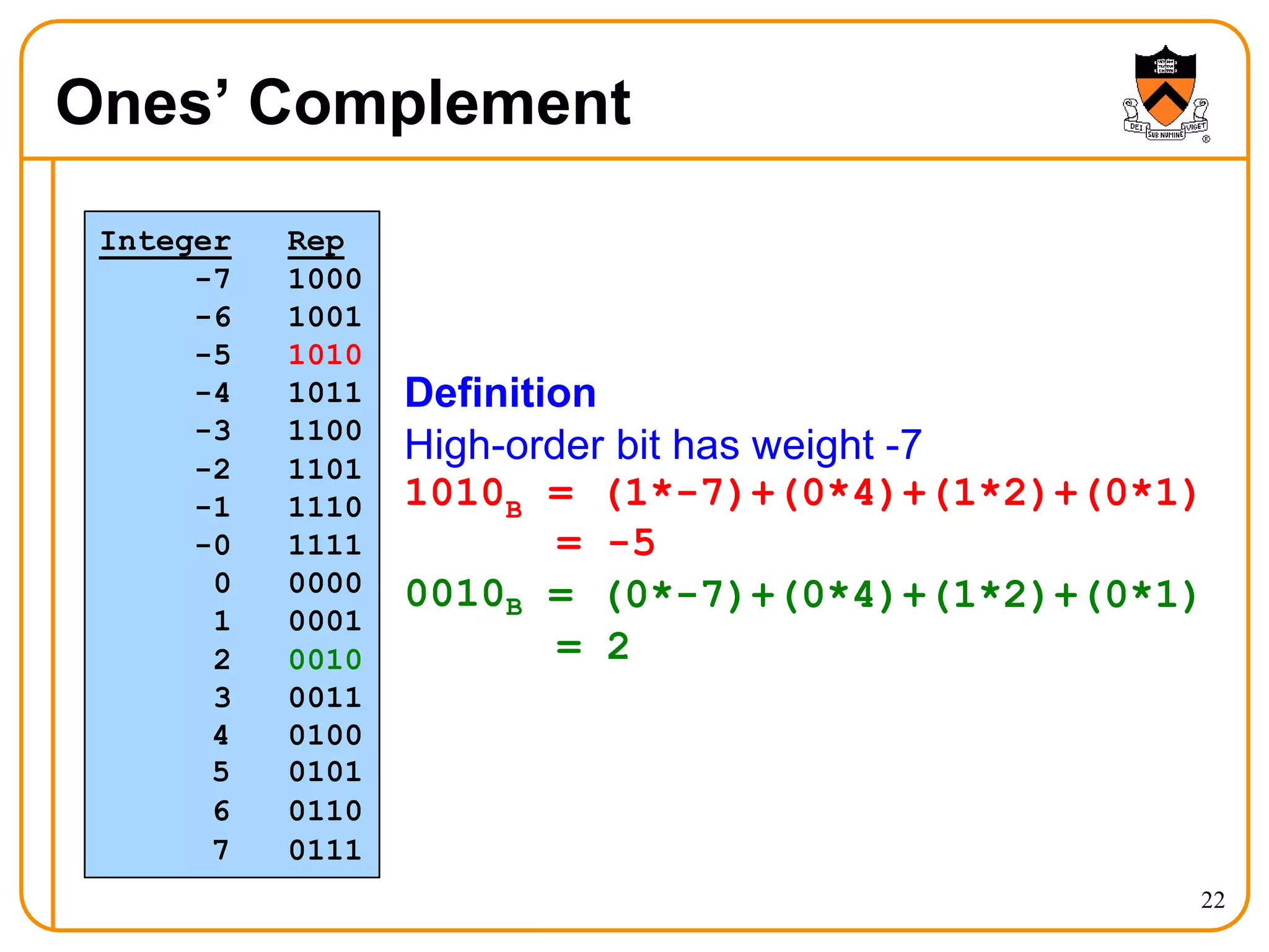
Ones’ Complement
Integer Rep
-7 1000
-6 1001
-5 1010
-4 1011
-3 1100
-2 1101
-1 1110
-0 1111
0 0000
1 0001
2 0010
3 0011
4
5
6
7
0100
0101
0110
0111
22
Definition
High-order bit has weight -7
B
0010B
1010 = (1*-7)+(0*4)+(1*2)+(0*1)
= -5
= (0*-7)+(0*4)+(1*2)+(0*1)
= 2
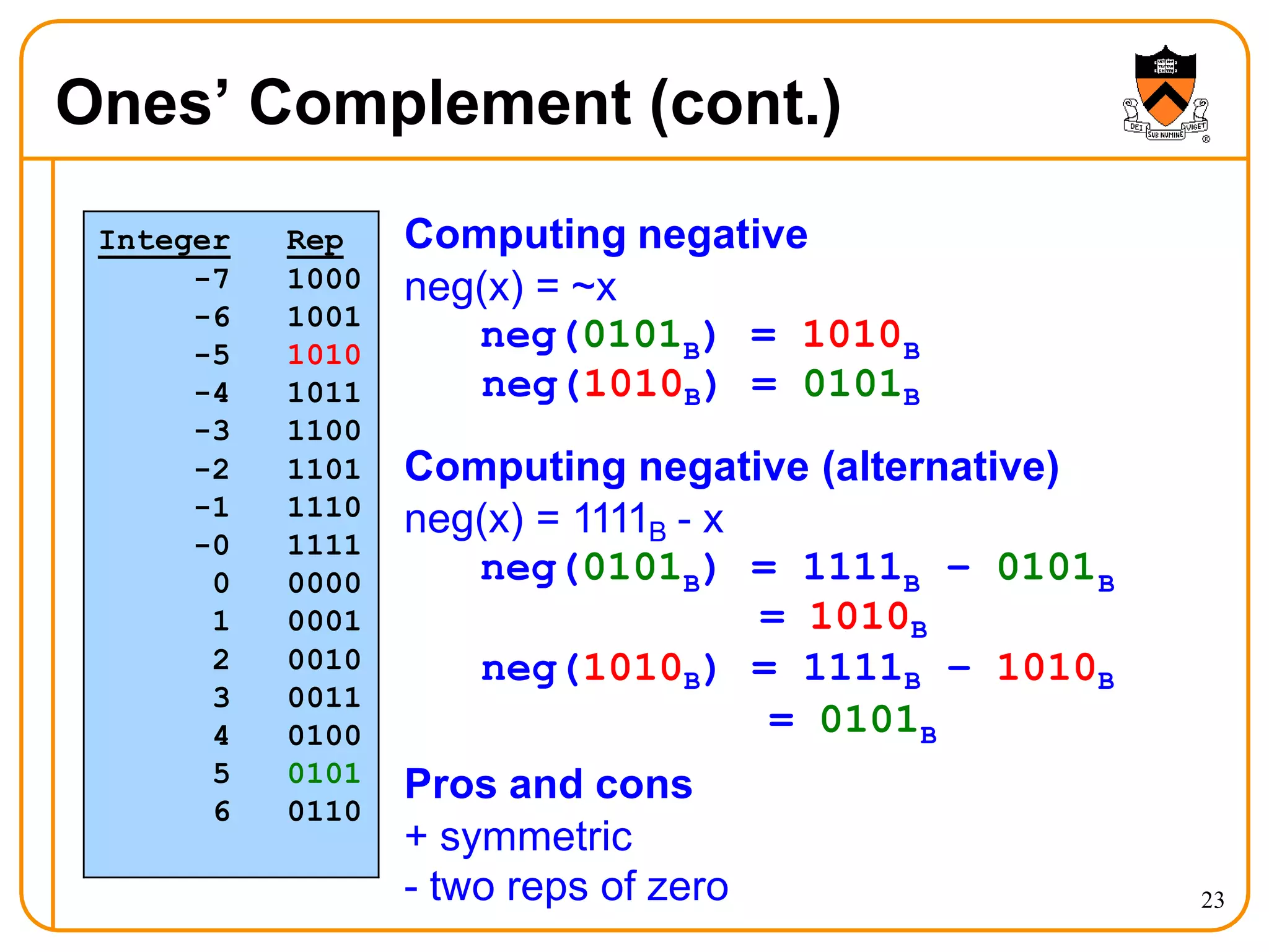
Ones’ Complement (cont.)
7 0111
- two reps of zero 23
Integer Rep
-7 1000
-6 1001
-5 1010
-4 1011
-3 1100
-2 1101
-1 1110
-0 1111
0 0000
1 0001
2 0010
3 0011
4 0100
5 0101
6 0110
Computing negative
neg(x) = ~x
neg(0101 ) = 1010
B B
Pros and cons
+ symmetric
neg(1010B) = 0101B
Computing negative (alternative)
neg(x) = 1111B - x
neg(0101 ) = 1111 – 0101
B B B
= 1010B
neg(1010B) = 1111B – 1010B
= 0101B
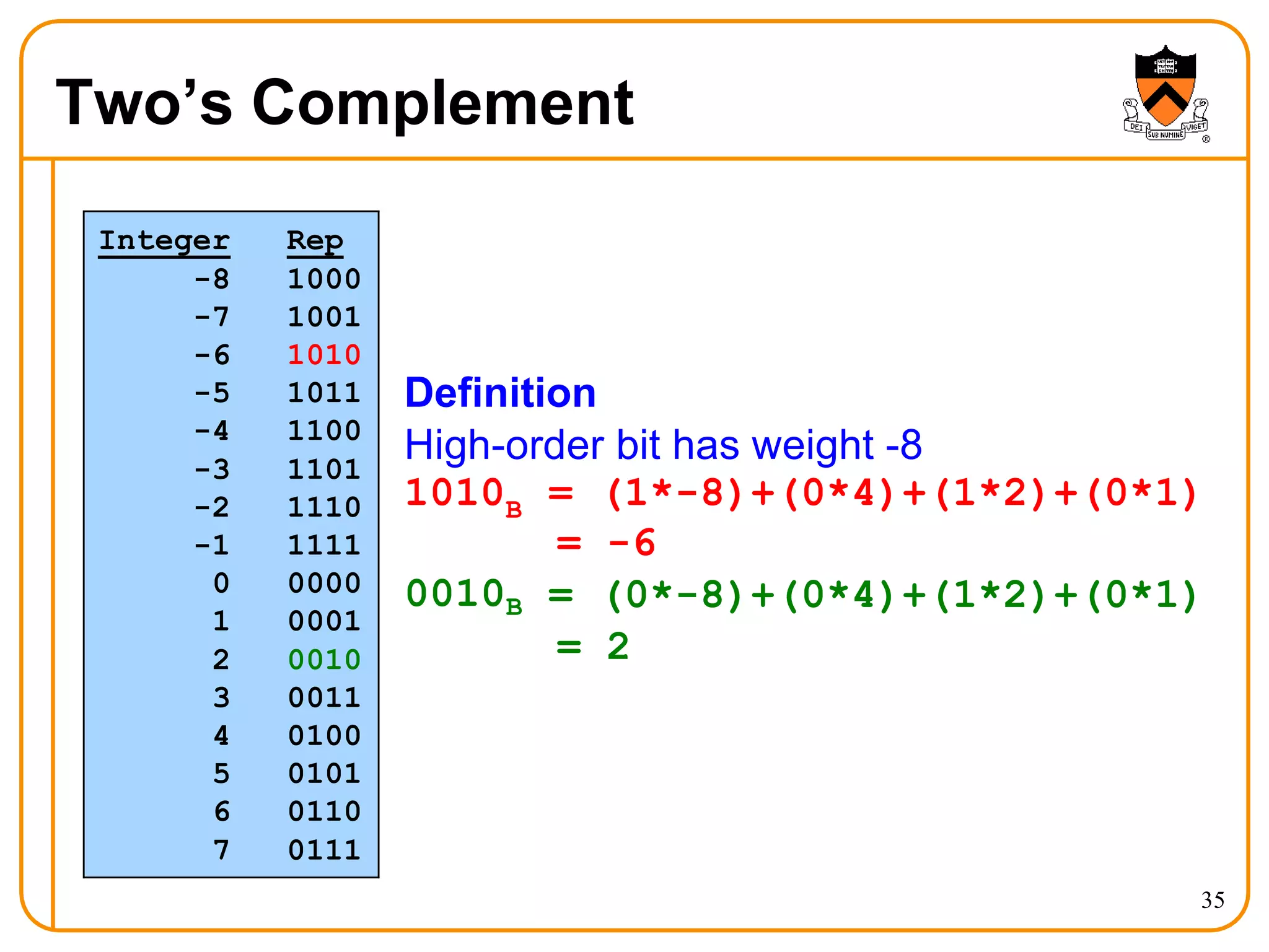
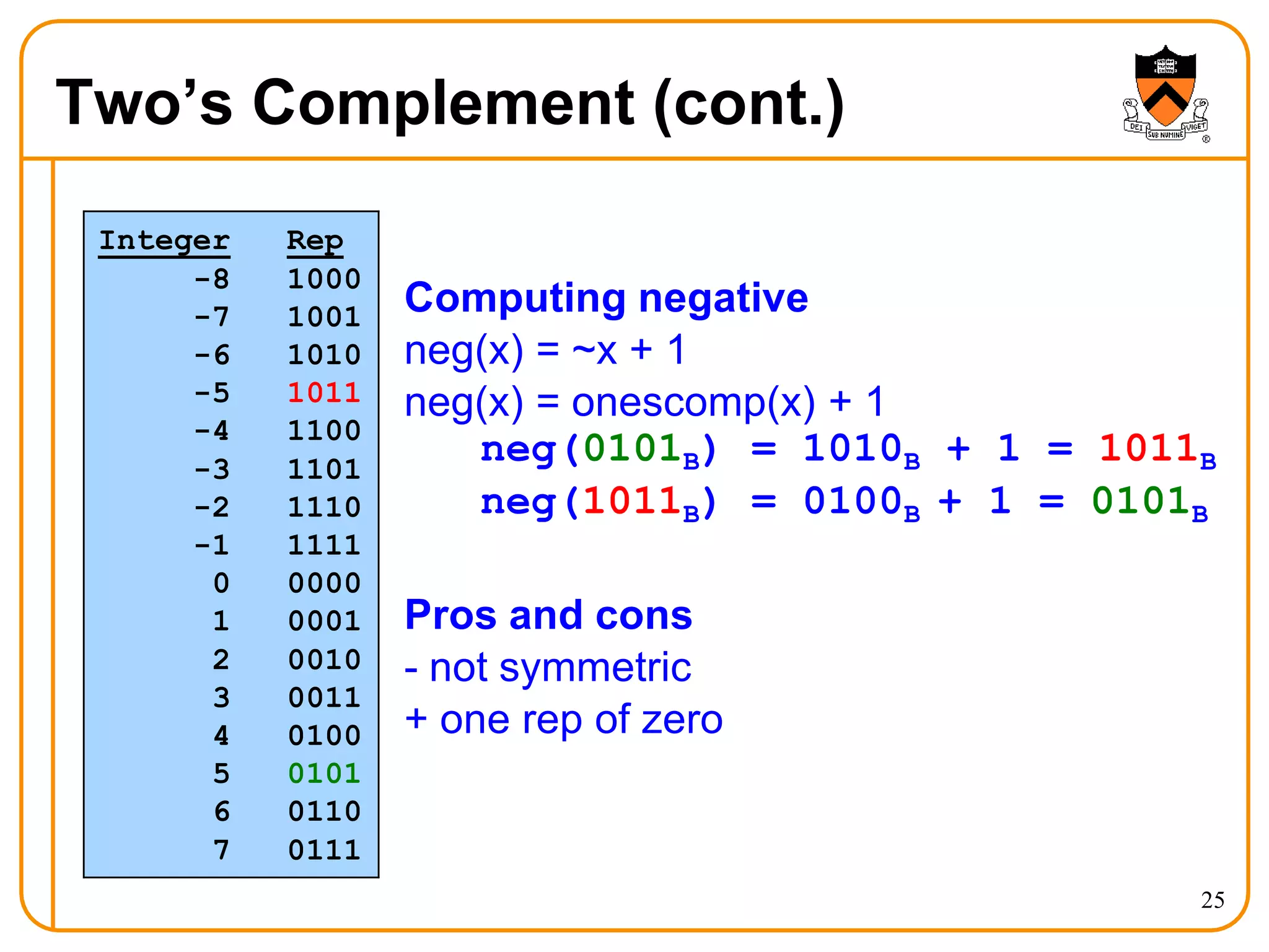
Two’s Complement
35
Integer Rep
-8 1000
-7 1001
-6 1010
-5 1011
-4 1100
-3 1101
-2 1110
-1 1111
0 0000
1 0001
2 0010
3 0011
4 0100
5 0101
6 0110
7 0111
Definition
High-order bit has weight -8
B
0010B
1010 = (1*-8)+(0*4)+(1*2)+(0*1)
= -6
= (0*-8)+(0*4)+(1*2)+(0*1)
= 2
Two’s Complement (cont.)
25
Integer Rep
-8 1000
-7 1001
-6 1010
-5 1011
-4 1100
-3 1101
-2 1110
-1 1111
0 0000
1 0001
2 0010
3 0011
4 0100
5 0101
6 0110
7 0111
Computing negative
neg(x) = ~x + 1
neg(x) = onescomp(x) + 1
neg(0101B) = 1010B + 1 = 1011B
neg(1011B) = 0100B + 1 = 0101B
Pros and cons
- not symmetric
+ one rep of zero
Two’s Complement (cont.)
26
Almost all computers use two’s complement to represent
signed integers
Why?
• Arithmetic is easy
• Will become clear soon
Hereafter, assume two’s complement representation of
signed integers
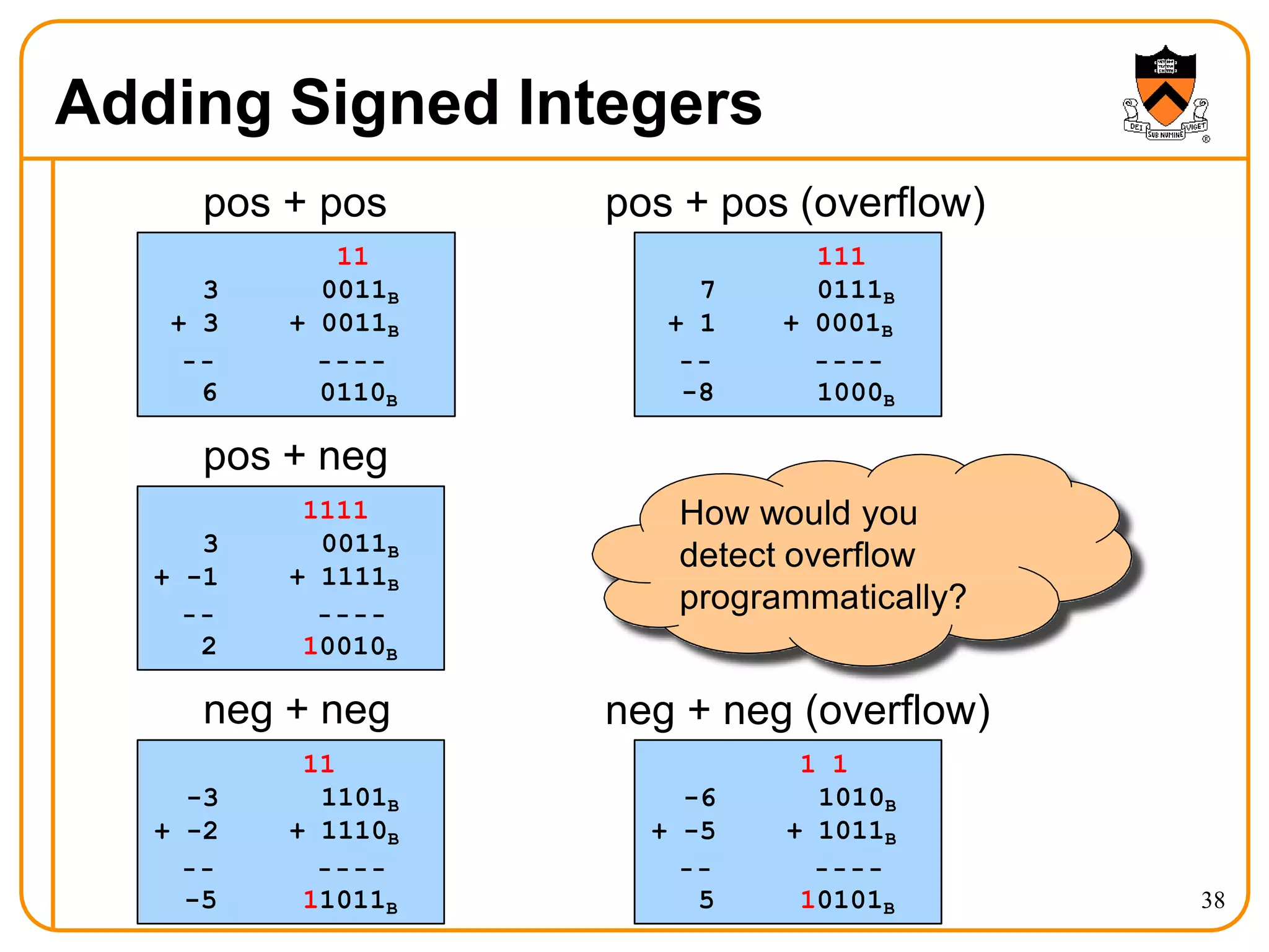
Adding Signed Integers
38
3
+ 3
11
0011B
+ 0011B
7
+ 1
111
0111B
+ 0001B
-8 1000B
pos + pos pos + pos (overflow)
3
+ -1
1111
0011B
+ 1111B
6 0110B
pos + neg
-3
+ -2
11
1101B
+ 1110B
-5 11011B
2 10010B
neg + neg
-6
+ -5
1 1
1010B
+ 1011B
5 10101B
neg + neg (overflow)
How would you
detect overflow
programmatically?
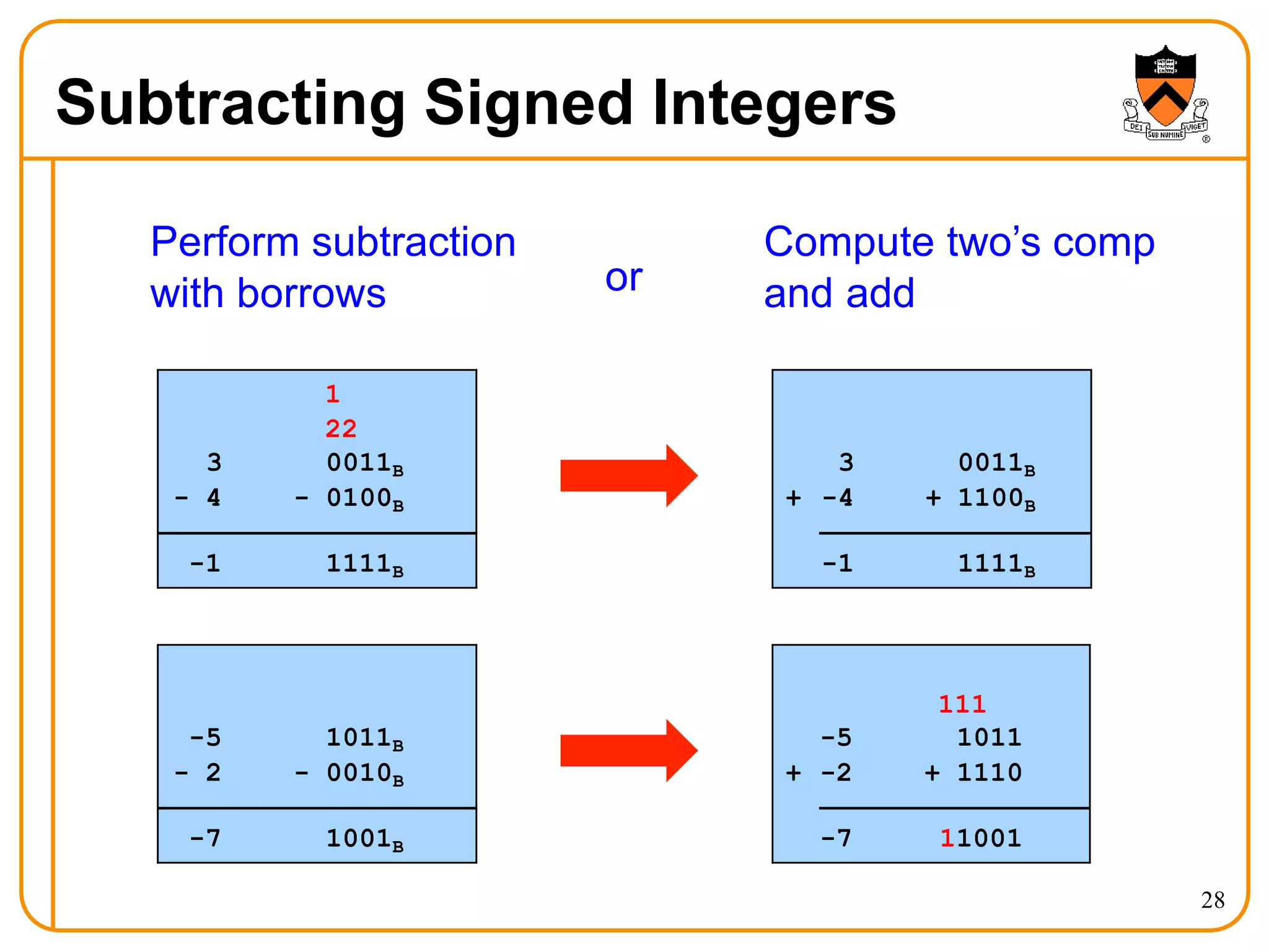
Subtracting Signed Integers
1
22
3 0011B 3 0011B
- 4 - 0100B + -4 + 1100B
-1 1111B -1 1111B
111
-5 1011B -5 1011
- 2 - 0010B + -2 + 1110
-7 1001B -7 11001
Perform subtraction
with borrows
28
Compute two’s comp
and add
or

NumberSystems.pptx

  • 1.
  • 2.
    The Decimal NumberSystem Name • “decem” (Latin) => ten Characteristics • Ten symbols • 0 1 2 3 4 5 6 7 8 9 • Positional • 2945 ≠ 2495 • 2945 = (2*103) + (9*102) + (4*101) + (5*100) (Most) people use the decimal number system Why? 2
  • 3.
    The Binary NumberSystem Name • “binarius” (Latin) => two Characteristics • Two symbols • 0 1 • Positional • 1010B ≠ 1100B Most (digital) computers use the binary number system Why? Terminology • Bit: a binary digit • Byte: (typically) 8 bits 3
  • 4.
    Decimal-Binary Equivalence 4 Decimal BinaryDecimal Binary 0 0 16 10000 1 1 17 10001 2 10 18 10010 3 11 19 10011 4 100 20 10100 5 101 21 10101 6 110 22 10110 7 111 23 10111 8 1000 24 11000 9 1001 25 11001 10 1010 26 11010 11 1011 27 11011 12 1100 28 11100 13 1101 29 11101 14 1110 30 11110 15 1111 31 11111 ... ...
  • 5.
    Decimal-Binary Conversion 5 Binary todecimal: expand using positional notation (1*25)+(0*24)+(0*23)+(1*22)+ 100101B = = 32 + 0 + 0 + 4 + (0*21)+(1*20 ) 0 + 1 = 37
  • 6.
    Decimal-Binary Conversion 6 Decimal tobinary: do the reverse • Determine largest power of 2 ≤ number; write template • Fill in template 37 = (?*25)+(?*24)+(?*23)+(?*22)+(?*21)+(?*20) 37 = (1*25)+(0*24)+(0*23)+(1*22)+(0*21)+(1*20) -32 5 -4 1 100101B -1 0
  • 7.
    Decimal-Binary Conversion Decimal tobinary shortcut • Repeatedly divide by 2, consider remainder 37 / 2 = 18 R 1 18 / 2 = 9 R 0 9 / 2 = 4 R 1 4 / 2 = 2 R 0 2 / 2 = 1 R 0 1 / 2 = 0 R 1 Read from bottom to top: 100101B 7
  • 8.
    The Hexadecimal NumberSystem Name • “hexa” (Greek) => six • “decem” (Latin) => ten Characteristics • Sixteen symbols • 0 1 2 3 4 5 6 7 8 9 A B C D E F • Positional • A13DH ≠ 3DA1H Computer programmers often use the hexadecimal number system Why? 8
  • 9.
    Decimal-Hexadecimal Equivalence 9 Decimal HexDecimal Hex Decimal Hex 0 0 16 10 32 20 1 1 17 11 33 21 2 2 18 12 34 22 3 3 19 13 35 23 4 4 20 14 36 24 5 5 21 15 37 25 6 6 22 16 38 26 7 7 23 17 39 27 8 8 24 18 40 28 9 9 25 19 41 29 10 A 26 1A 42 2A 11 B 27 1B 43 2B 12 C 28 1C 44 2C 13 D 29 1D 45 2D 14 E 30 1E 46 2E 15 F 31 1F 47 2F ... ...
  • 10.
    Decimal-Hexadecimal Conversion Hexadecimal todecimal: expand using positional notation Decimal to hexadecimal: use the shortcut 25H = (2*161) + = 32 + (5*160) 5 = 37 37 / 16 = 2 R 5 2 / 16 = 0 R 2 Read from bottom to top: 25H 10
  • 11.
    Binary-Hexadecimal Conversion Observation: 161= 24 • Every 1 hexadecimal digit corresponds to 4 binary digits Binary to hexadecimal 1010000100111101B A 1 3 DH Digit count in binary number not a multiple of 4 => pad with zeros on left Hexadecimal to binary A 1 3 DH 1010000100111101B Discard leading zeros from binary number if appropriate Is it clear why programmers often use hexadecimal? 11
  • 12.
    The Octal NumberSystem Name • “octo” (Latin) => eight Characteristics • Eight symbols • 0 1 2 3 4 5 6 7 • Positional • 1743O ≠ 7314O Computer programmers often use the octal number system Why? 12
  • 13.
    Decimal-Octal Equivalence 13 Decimal OctalDecimal Octal Decimal Octal 0 0 16 20 32 40 1 1 17 21 33 41 2 2 18 22 34 42 3 3 19 23 35 43 4 4 20 24 36 44 5 5 21 25 37 45 6 6 22 26 38 46 7 7 23 27 39 47 8 10 24 30 40 50 9 11 25 31 41 51 10 12 26 32 42 52 11 13 27 33 43 53 12 14 28 34 44 54 13 15 29 35 45 55 14 16 30 36 46 56 15 17 31 37 47 57 ... ...
  • 14.
    Decimal-Octal Conversion Octal todecimal: expand using positional notation Decimal to octal: use the shortcut 37O = (3*81) + (7*80) = 24 + 7 = 31 31 / 8 = 3 R 7 3 / 8 = 0 R 3 Read from bottom to top: 37O 14
  • 15.
    Binary-Octal Conversion Observation: 81= 23 • Every 1 octal digit corresponds to 3 binary digits Binary to octal 001010000100111101B 1 2 0 4 7 5O Digit count in binary number not a multiple of 3 => pad with zeros on left Discard leading zeros from binary number if appropriate Octal to binary 1 2 0 4 7 5O 001010000100111101B Is it clear why programmers sometimes use octal? 15
  • 16.
    Unsigned Data Types:Java vs. C 16 Java has type • int • Can represent signed integers C has type: • signed int • Can represent signed integers • int • Same as signed int • unsigned int • Can represent only unsigned integers To understand C, must consider representation of both unsigned and signed integers
  • 17.
    Representing Unsigned Integers 17 Onpretend computer Unsigned Integer Rep 0 0000 1 0001 2 0010 3 0011 4 0100 5 0101 6 0110 7 0111 8 1000 9 1001 10 1010 11 1011 12 1100 13 1101 14 1110 15 1111
  • 18.
    Adding Unsigned Integers Addition Resultsare mod 24 7 + 10 11 0111B + 1010B 1 10001B 1 3 0011B + 10 -- + 1010B ---- 13 1101B Start at right column Proceed leftward Carry 1 when necessary Beware of overflow How would you detect overflow programmatically? 18
  • 19.
    Subtracting Unsigned Integers Subtraction 3 -10 2 0011B - 1010B 9 1001B Results are mod 24 10 - 7 12 0202 1010B - 0111B 3 0011B Start at right column Proceed leftward Borrow 2 when necessary Beware of overflow How would you detect overflow programmatically? 19
  • 20.
    Signed Magnitude 20 Integer Rep -71111 -6 1110 -5 1101 -4 1100 -3 1011 -2 1010 -1 1001 -0 1000 0 0000 1 0001 2 0010 3 0011 4 0100 5 0101 6 0110 7 0111 Definition High-order bit indicates sign 0 => positive 1 => negative Remaining bits indicate magnitude B B 1101 = -101 = -5 0101B = 101B = 5
  • 21.
    Signed Magnitude (cont.) IntegerRep -7 1111 -6 1110 -5 1101 -4 1100 -3 1011 -2 1010 -1 1001 -0 1000 0 0000 1 0001 2 0010 3 0011 4 5 6 7 0100 0101 0110 0111 21 Computing negative neg(x) = flip high order bit of x neg(0101B) = 1101B neg(1101B) = 0101B Pros and cons + easy for people to understand + symmetric - two reps of zero
  • 22.
    Ones’ Complement Integer Rep -71000 -6 1001 -5 1010 -4 1011 -3 1100 -2 1101 -1 1110 -0 1111 0 0000 1 0001 2 0010 3 0011 4 5 6 7 0100 0101 0110 0111 22 Definition High-order bit has weight -7 B 0010B 1010 = (1*-7)+(0*4)+(1*2)+(0*1) = -5 = (0*-7)+(0*4)+(1*2)+(0*1) = 2
  • 23.
    Ones’ Complement (cont.) 70111 - two reps of zero 23 Integer Rep -7 1000 -6 1001 -5 1010 -4 1011 -3 1100 -2 1101 -1 1110 -0 1111 0 0000 1 0001 2 0010 3 0011 4 0100 5 0101 6 0110 Computing negative neg(x) = ~x neg(0101 ) = 1010 B B Pros and cons + symmetric neg(1010B) = 0101B Computing negative (alternative) neg(x) = 1111B - x neg(0101 ) = 1111 – 0101 B B B = 1010B neg(1010B) = 1111B – 1010B = 0101B
  • 24.
    Two’s Complement 35 Integer Rep -81000 -7 1001 -6 1010 -5 1011 -4 1100 -3 1101 -2 1110 -1 1111 0 0000 1 0001 2 0010 3 0011 4 0100 5 0101 6 0110 7 0111 Definition High-order bit has weight -8 B 0010B 1010 = (1*-8)+(0*4)+(1*2)+(0*1) = -6 = (0*-8)+(0*4)+(1*2)+(0*1) = 2
  • 25.
    Two’s Complement (cont.) 25 IntegerRep -8 1000 -7 1001 -6 1010 -5 1011 -4 1100 -3 1101 -2 1110 -1 1111 0 0000 1 0001 2 0010 3 0011 4 0100 5 0101 6 0110 7 0111 Computing negative neg(x) = ~x + 1 neg(x) = onescomp(x) + 1 neg(0101B) = 1010B + 1 = 1011B neg(1011B) = 0100B + 1 = 0101B Pros and cons - not symmetric + one rep of zero
  • 26.
    Two’s Complement (cont.) 26 Almostall computers use two’s complement to represent signed integers Why? • Arithmetic is easy • Will become clear soon Hereafter, assume two’s complement representation of signed integers
  • 27.
    Adding Signed Integers 38 3 +3 11 0011B + 0011B 7 + 1 111 0111B + 0001B -8 1000B pos + pos pos + pos (overflow) 3 + -1 1111 0011B + 1111B 6 0110B pos + neg -3 + -2 11 1101B + 1110B -5 11011B 2 10010B neg + neg -6 + -5 1 1 1010B + 1011B 5 10101B neg + neg (overflow) How would you detect overflow programmatically?
  • 28.
    Subtracting Signed Integers 1 22 30011B 3 0011B - 4 - 0100B + -4 + 1100B -1 1111B -1 1111B 111 -5 1011B -5 1011 - 2 - 0010B + -2 + 1110 -7 1001B -7 11001 Perform subtraction with borrows 28 Compute two’s comp and add or