Database Management Systems 3ed, R. Ramakrishnan and J. Gehrke 1
External Sorting
Chapters 13: 13.1—13.5
Database Management Systems 3ed, R. Ramakrishnan and J. Gehrke 2
Why Sort?
 A classic problem in computer science (See Knuth, v.3)!
 Data requested in sorted order
 e.g., find students in increasing gpa order
 Sorting is first step in bulk loading B+ tree index.
 Sorting useful for eliminating duplicate copies in a
collection of records (Why?)
 Sort-merge join algorithm involves sorting.
 Problem: sort 1Gb of data with 1Mb of RAM.
 why not virtual memory?
Database Management Systems 3ed, R. Ramakrishnan and J. Gehrke 3
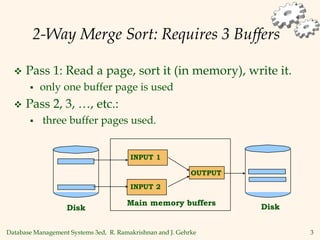
2-Way Merge Sort: Requires 3 Buffers
 Pass 1: Read a page, sort it (in memory), write it.
 only one buffer page is used
 Pass 2, 3, …, etc.:
 three buffer pages used.
Main memory buffers
INPUT 1
INPUT 2
OUTPUT
Disk
Disk
Database Management Systems 3ed, R. Ramakrishnan and J. Gehrke 4
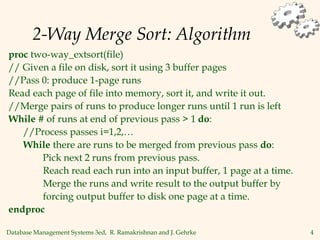
2-Way Merge Sort: Algorithm
proc two-way_extsort(file)
// Given a file on disk, sort it using 3 buffer pages
//Pass 0: produce 1-page runs
Read each page of file into memory, sort it, and write it out.
//Merge pairs of runs to produce longer runs until 1 run is left
While # of runs at end of previous pass > 1 do:
//Process passes i=1,2,…
While there are runs to be merged from previous pass do:
Pick next 2 runs from previous pass.
Reach read each run into an input buffer, 1 page at a time.
Merge the runs and write result to the output buffer by
forcing output buffer to disk one page at a time.
endproc
Database Management Systems 3ed, R. Ramakrishnan and J. Gehrke 5
Two-Way External Merge Sort
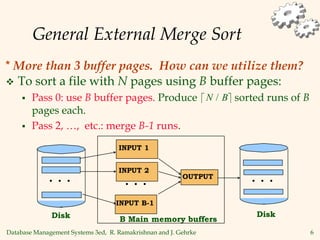
 Each pass we read + write
each page in file => 2N I/O’s
per pass.
 N pages in the file => the
number of passes
 So total cost is:
 Idea: Divide and conquer:
sort subfiles and merge
 Input file contains 7 pages;
dark pages shows what
would happen with 8 pages.
 
 
log2 1
N
 
 
2 1
2
N N
log 
Input file
1-page runs
2-page runs
4-page runs
8-page runs
PASS 0
PASS 1
PASS 2
PASS 3
9
3,4 6,2 9,4 8,7 5,6 3,1 2
3,4 5,6
2,6 4,9 7,8 1,3 2
2,3
4,6
4,7
8,9
1,3
5,6 2
2,3
4,4
6,7
8,9
1,2
3,5
6
1,2
2,3
3,4
4,5
6,6
7,8
Database Management Systems 3ed, R. Ramakrishnan and J. Gehrke 6
General External Merge Sort
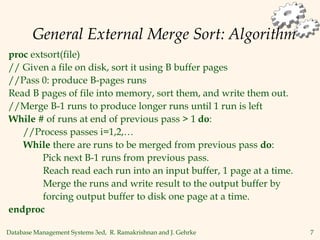
 To sort a file with N pages using B buffer pages:
 Pass 0: use B buffer pages. Produce sorted runs of B
pages each.
 Pass 2, …, etc.: merge B-1 runs.
 
N B
/
B Main memory buffers
INPUT 1
INPUT B-1
OUTPUT
Disk
Disk
INPUT 2
. . . . . .
. . .
* More than 3 buffer pages. How can we utilize them?
Database Management Systems 3ed, R. Ramakrishnan and J. Gehrke 7
General External Merge Sort: Algorithm
proc extsort(file)
// Given a file on disk, sort it using B buffer pages
//Pass 0: produce B-pages runs
Read B pages of file into memory, sort them, and write them out.
//Merge B-1 runs to produce longer runs until 1 run is left
While # of runs at end of previous pass > 1 do:
//Process passes i=1,2,…
While there are runs to be merged from previous pass do:
Pick next B-1 runs from previous pass.
Reach read each run into an input buffer, 1 page at a time.
Merge the runs and write result to the output buffer by
forcing output buffer to disk one page at a time.
endproc
Database Management Systems 3ed, R. Ramakrishnan and J. Gehrke 8
Cost of External Merge Sort
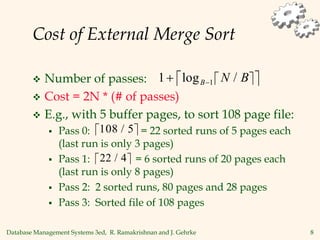
 Number of passes:
 Cost = 2N * (# of passes)
 E.g., with 5 buffer pages, to sort 108 page file:
 Pass 0: = 22 sorted runs of 5 pages each
(last run is only 3 pages)
 Pass 1: = 6 sorted runs of 20 pages each
(last run is only 8 pages)
 Pass 2: 2 sorted runs, 80 pages and 28 pages
 Pass 3: Sorted file of 108 pages
 
 
1 1
 
log /
B N B
 
108 5
/
 
22 4
/
Database Management Systems 3ed, R. Ramakrishnan and J. Gehrke 9
Number of Passes of External Sort
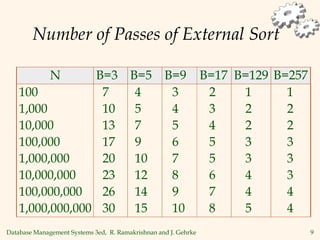
N B=3 B=5 B=9 B=17 B=129 B=257
100 7 4 3 2 1 1
1,000 10 5 4 3 2 2
10,000 13 7 5 4 2 2
100,000 17 9 6 5 3 3
1,000,000 20 10 7 5 3 3
10,000,000 23 12 8 6 4 3
100,000,000 26 14 9 7 4 4
1,000,000,000 30 15 10 8 5 4
Database Management Systems 3ed, R. Ramakrishnan and J. Gehrke 10
I/O for External Merge Sort
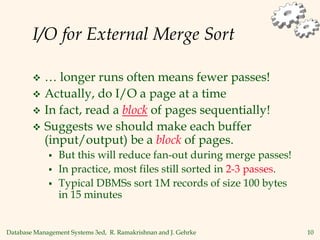
 … longer runs often means fewer passes!
 Actually, do I/O a page at a time
 In fact, read a block of pages sequentially!
 Suggests we should make each buffer
(input/output) be a block of pages.
 But this will reduce fan-out during merge passes!
 In practice, most files still sorted in 2-3 passes.
 Typical DBMSs sort 1M records of size 100 bytes
in 15 minutes
Database Management Systems 3ed, R. Ramakrishnan and J. Gehrke 11
Number of Passes of Optimized Sort
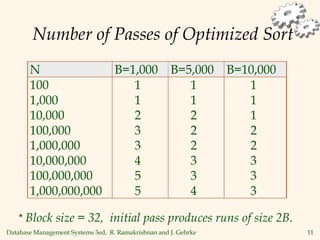
N B=1,000 B=5,000 B=10,000
100 1 1 1
1,000 1 1 1
10,000 2 2 1
100,000 3 2 2
1,000,000 3 2 2
10,000,000 4 3 3
100,000,000 5 3 3
1,000,000,000 5 4 3
* Block size = 32, initial pass produces runs of size 2B.
Database Management Systems 3ed, R. Ramakrishnan and J. Gehrke 12
Double Buffering
 To reduce wait time for I/O request to
complete, can prefetch into `shadow block’.
 Potentially, more passes; in practice, most files still
sorted in 2-3 passes.
OUTPUT
OUTPUT'
Disk Disk
INPUT 1
INPUT k
INPUT 2
INPUT 1'
INPUT 2'
INPUT k'
block size
b
B main memory buffers, k-way merge
Database Management Systems 3ed, R. Ramakrishnan and J. Gehrke 13
Using B+ Trees for Sorting
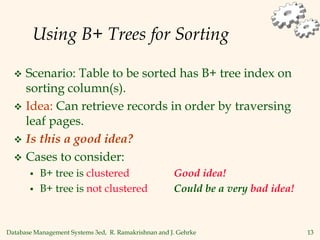
 Scenario: Table to be sorted has B+ tree index on
sorting column(s).
 Idea: Can retrieve records in order by traversing
leaf pages.
 Is this a good idea?
 Cases to consider:
 B+ tree is clustered Good idea!
 B+ tree is not clustered Could be a very bad idea!
Database Management Systems 3ed, R. Ramakrishnan and J. Gehrke 14
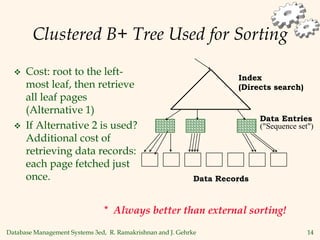
Clustered B+ Tree Used for Sorting
 Cost: root to the left-
most leaf, then retrieve
all leaf pages
(Alternative 1)
 If Alternative 2 is used?
Additional cost of
retrieving data records:
each page fetched just
once.
* Always better than external sorting!
(Directs search)
Data Records
Index
Data Entries
("Sequence set")
Database Management Systems 3ed, R. Ramakrishnan and J. Gehrke 15
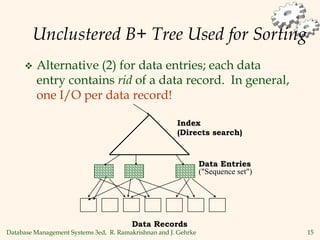
Unclustered B+ Tree Used for Sorting
 Alternative (2) for data entries; each data
entry contains rid of a data record. In general,
one I/O per data record!
(Directs search)
Data Records
Index
Data Entries
("Sequence set")
Database Management Systems 3ed, R. Ramakrishnan and J. Gehrke 16
Summary
 External sorting is important; DBMS may dedicate
part of buffer pool for sorting!
 External merge sort minimizes disk I/O cost:
 Pass 0: Produces sorted runs of size B (# buffer pages).
Later passes: merge runs.
 # of runs merged at a time depends on B, and block size.
 Larger block size => smaller # runs merged.
 Clustered B+ tree is good for sorting; unclustered
tree is usually very bad.

ch13_extsort.ppt

  • 1.
    Database Management Systems3ed, R. Ramakrishnan and J. Gehrke 1 External Sorting Chapters 13: 13.1—13.5
  • 2.
    Database Management Systems3ed, R. Ramakrishnan and J. Gehrke 2 Why Sort?  A classic problem in computer science (See Knuth, v.3)!  Data requested in sorted order  e.g., find students in increasing gpa order  Sorting is first step in bulk loading B+ tree index.  Sorting useful for eliminating duplicate copies in a collection of records (Why?)  Sort-merge join algorithm involves sorting.  Problem: sort 1Gb of data with 1Mb of RAM.  why not virtual memory?
  • 3.
    Database Management Systems3ed, R. Ramakrishnan and J. Gehrke 3 2-Way Merge Sort: Requires 3 Buffers  Pass 1: Read a page, sort it (in memory), write it.  only one buffer page is used  Pass 2, 3, …, etc.:  three buffer pages used. Main memory buffers INPUT 1 INPUT 2 OUTPUT Disk Disk
  • 4.
    Database Management Systems3ed, R. Ramakrishnan and J. Gehrke 4 2-Way Merge Sort: Algorithm proc two-way_extsort(file) // Given a file on disk, sort it using 3 buffer pages //Pass 0: produce 1-page runs Read each page of file into memory, sort it, and write it out. //Merge pairs of runs to produce longer runs until 1 run is left While # of runs at end of previous pass > 1 do: //Process passes i=1,2,… While there are runs to be merged from previous pass do: Pick next 2 runs from previous pass. Reach read each run into an input buffer, 1 page at a time. Merge the runs and write result to the output buffer by forcing output buffer to disk one page at a time. endproc
  • 5.
    Database Management Systems3ed, R. Ramakrishnan and J. Gehrke 5 Two-Way External Merge Sort  Each pass we read + write each page in file => 2N I/O’s per pass.  N pages in the file => the number of passes  So total cost is:  Idea: Divide and conquer: sort subfiles and merge  Input file contains 7 pages; dark pages shows what would happen with 8 pages.     log2 1 N     2 1 2 N N log  Input file 1-page runs 2-page runs 4-page runs 8-page runs PASS 0 PASS 1 PASS 2 PASS 3 9 3,4 6,2 9,4 8,7 5,6 3,1 2 3,4 5,6 2,6 4,9 7,8 1,3 2 2,3 4,6 4,7 8,9 1,3 5,6 2 2,3 4,4 6,7 8,9 1,2 3,5 6 1,2 2,3 3,4 4,5 6,6 7,8
  • 6.
    Database Management Systems3ed, R. Ramakrishnan and J. Gehrke 6 General External Merge Sort  To sort a file with N pages using B buffer pages:  Pass 0: use B buffer pages. Produce sorted runs of B pages each.  Pass 2, …, etc.: merge B-1 runs.   N B / B Main memory buffers INPUT 1 INPUT B-1 OUTPUT Disk Disk INPUT 2 . . . . . . . . . * More than 3 buffer pages. How can we utilize them?
  • 7.
    Database Management Systems3ed, R. Ramakrishnan and J. Gehrke 7 General External Merge Sort: Algorithm proc extsort(file) // Given a file on disk, sort it using B buffer pages //Pass 0: produce B-pages runs Read B pages of file into memory, sort them, and write them out. //Merge B-1 runs to produce longer runs until 1 run is left While # of runs at end of previous pass > 1 do: //Process passes i=1,2,… While there are runs to be merged from previous pass do: Pick next B-1 runs from previous pass. Reach read each run into an input buffer, 1 page at a time. Merge the runs and write result to the output buffer by forcing output buffer to disk one page at a time. endproc
  • 8.
    Database Management Systems3ed, R. Ramakrishnan and J. Gehrke 8 Cost of External Merge Sort  Number of passes:  Cost = 2N * (# of passes)  E.g., with 5 buffer pages, to sort 108 page file:  Pass 0: = 22 sorted runs of 5 pages each (last run is only 3 pages)  Pass 1: = 6 sorted runs of 20 pages each (last run is only 8 pages)  Pass 2: 2 sorted runs, 80 pages and 28 pages  Pass 3: Sorted file of 108 pages     1 1   log / B N B   108 5 /   22 4 /
  • 9.
    Database Management Systems3ed, R. Ramakrishnan and J. Gehrke 9 Number of Passes of External Sort N B=3 B=5 B=9 B=17 B=129 B=257 100 7 4 3 2 1 1 1,000 10 5 4 3 2 2 10,000 13 7 5 4 2 2 100,000 17 9 6 5 3 3 1,000,000 20 10 7 5 3 3 10,000,000 23 12 8 6 4 3 100,000,000 26 14 9 7 4 4 1,000,000,000 30 15 10 8 5 4
  • 10.
    Database Management Systems3ed, R. Ramakrishnan and J. Gehrke 10 I/O for External Merge Sort  … longer runs often means fewer passes!  Actually, do I/O a page at a time  In fact, read a block of pages sequentially!  Suggests we should make each buffer (input/output) be a block of pages.  But this will reduce fan-out during merge passes!  In practice, most files still sorted in 2-3 passes.  Typical DBMSs sort 1M records of size 100 bytes in 15 minutes
  • 11.
    Database Management Systems3ed, R. Ramakrishnan and J. Gehrke 11 Number of Passes of Optimized Sort N B=1,000 B=5,000 B=10,000 100 1 1 1 1,000 1 1 1 10,000 2 2 1 100,000 3 2 2 1,000,000 3 2 2 10,000,000 4 3 3 100,000,000 5 3 3 1,000,000,000 5 4 3 * Block size = 32, initial pass produces runs of size 2B.
  • 12.
    Database Management Systems3ed, R. Ramakrishnan and J. Gehrke 12 Double Buffering  To reduce wait time for I/O request to complete, can prefetch into `shadow block’.  Potentially, more passes; in practice, most files still sorted in 2-3 passes. OUTPUT OUTPUT' Disk Disk INPUT 1 INPUT k INPUT 2 INPUT 1' INPUT 2' INPUT k' block size b B main memory buffers, k-way merge
  • 13.
    Database Management Systems3ed, R. Ramakrishnan and J. Gehrke 13 Using B+ Trees for Sorting  Scenario: Table to be sorted has B+ tree index on sorting column(s).  Idea: Can retrieve records in order by traversing leaf pages.  Is this a good idea?  Cases to consider:  B+ tree is clustered Good idea!  B+ tree is not clustered Could be a very bad idea!
  • 14.
    Database Management Systems3ed, R. Ramakrishnan and J. Gehrke 14 Clustered B+ Tree Used for Sorting  Cost: root to the left- most leaf, then retrieve all leaf pages (Alternative 1)  If Alternative 2 is used? Additional cost of retrieving data records: each page fetched just once. * Always better than external sorting! (Directs search) Data Records Index Data Entries ("Sequence set")
  • 15.
    Database Management Systems3ed, R. Ramakrishnan and J. Gehrke 15 Unclustered B+ Tree Used for Sorting  Alternative (2) for data entries; each data entry contains rid of a data record. In general, one I/O per data record! (Directs search) Data Records Index Data Entries ("Sequence set")
  • 16.
    Database Management Systems3ed, R. Ramakrishnan and J. Gehrke 16 Summary  External sorting is important; DBMS may dedicate part of buffer pool for sorting!  External merge sort minimizes disk I/O cost:  Pass 0: Produces sorted runs of size B (# buffer pages). Later passes: merge runs.  # of runs merged at a time depends on B, and block size.  Larger block size => smaller # runs merged.  Clustered B+ tree is good for sorting; unclustered tree is usually very bad.