ENGINEERING EXPLORATION
Defining Problems and
Brainstorming
1
Outline
 Defining the problem
 Problems example
 Steps to identify the problem
 Writing the problem statement
 Criteria and Constraints
 Brainstorming
 Brainstorming example
 Advantages of Brainstorming
 Free Association Brainstorming
 Free Writing Brainstorming
 Future process Brainstorming
 Brainstorming Web
2
Defining the problem
 The Engineering Design Process is used to develop solutions to every day problems.
 Eg:- Engineers have developed many different methods of transportation for People and
Cargo from early times.
 The transportations have evolved from early days of using horses to modern day trains,
airplanes, ships, automobiles and further being explored.
 So the problem still open and it is stated as “better, efficient, fast and easy way of
transportation for people and cargos”.
 A problem has to be first defined before searching for solutions.
 Throughout the design process the engineers work in teams.
 The team members include engineers, engineering technicians and trades people
3
Problems Example
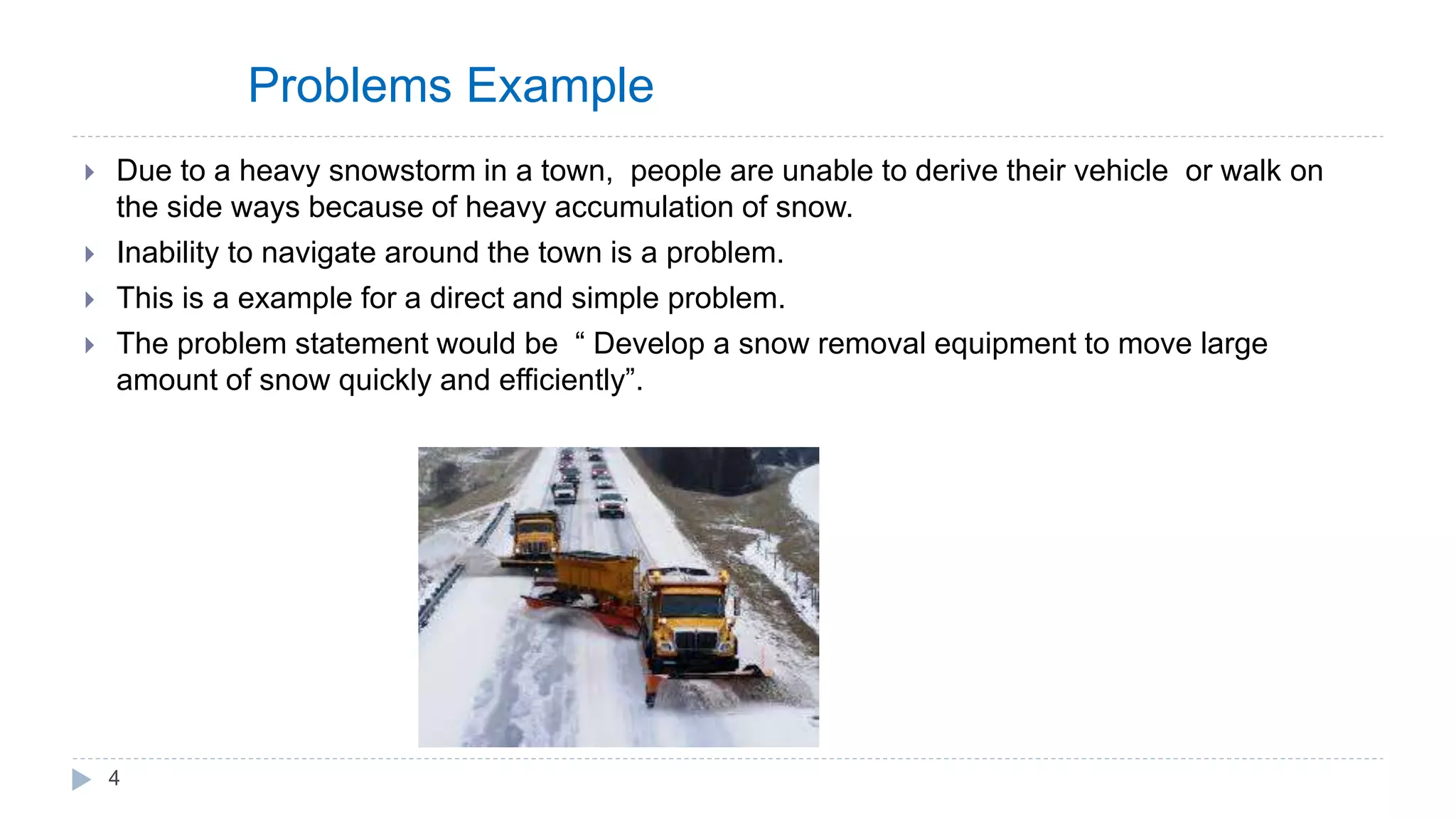
 Due to a heavy snowstorm in a town, people are unable to derive their vehicle or walk on
the side ways because of heavy accumulation of snow.
 Inability to navigate around the town is a problem.
 This is a example for a direct and simple problem.
 The problem statement would be “ Develop a snow removal equipment to move large
amount of snow quickly and efficiently”.
4
Problems Example
 Not all the problems would be as simple and direct as this.
 Some problems may be unclear and missing with some details.
 A mechanical engineer may be presented with a problem of increasing gear ratio in a
mechanical device.
 When given the exact ratio, size and design specs, the challenge still requires a very strong
technical knowledge.
 However engineers often encounter challenging problems that are unclear and difficult to
identify
 A manufacturing engineer may be challenged with increasing the efficiency of an assembly
line system.
 Given with very little information and considering the system which uses many different
electric motors and hydraulic power, there would be many different possibility of solutions.
 So a clear problem definition only will leads to a suitable solution.
5
Steps to identify the problem
 Engineers are often asked to solve problems given to them by other members or directly from
customers.
 Engineers define problems by going through different steps and even more time for complex
problems.
 The following four steps are followed to arrive at a Problem Statement.
1. Determine the problems origin.
2. Define what is and what is not a problem.
3. Identify the present state and desired state of each component in the problem.
4. State the problem in words.
6
Steps to identify the problem
 First the engineers ask where the problem came from by asking this questions.
 Engineers can look at the problems from very beginning to define the problem.
 For the problem like “ The problem of too much energy usage in a school building” engineers might ask
1. How much energy is being used in the school?
2. Could the problem be in the lighting fixtures or insulation?
3. How much energy would be like the school to use?
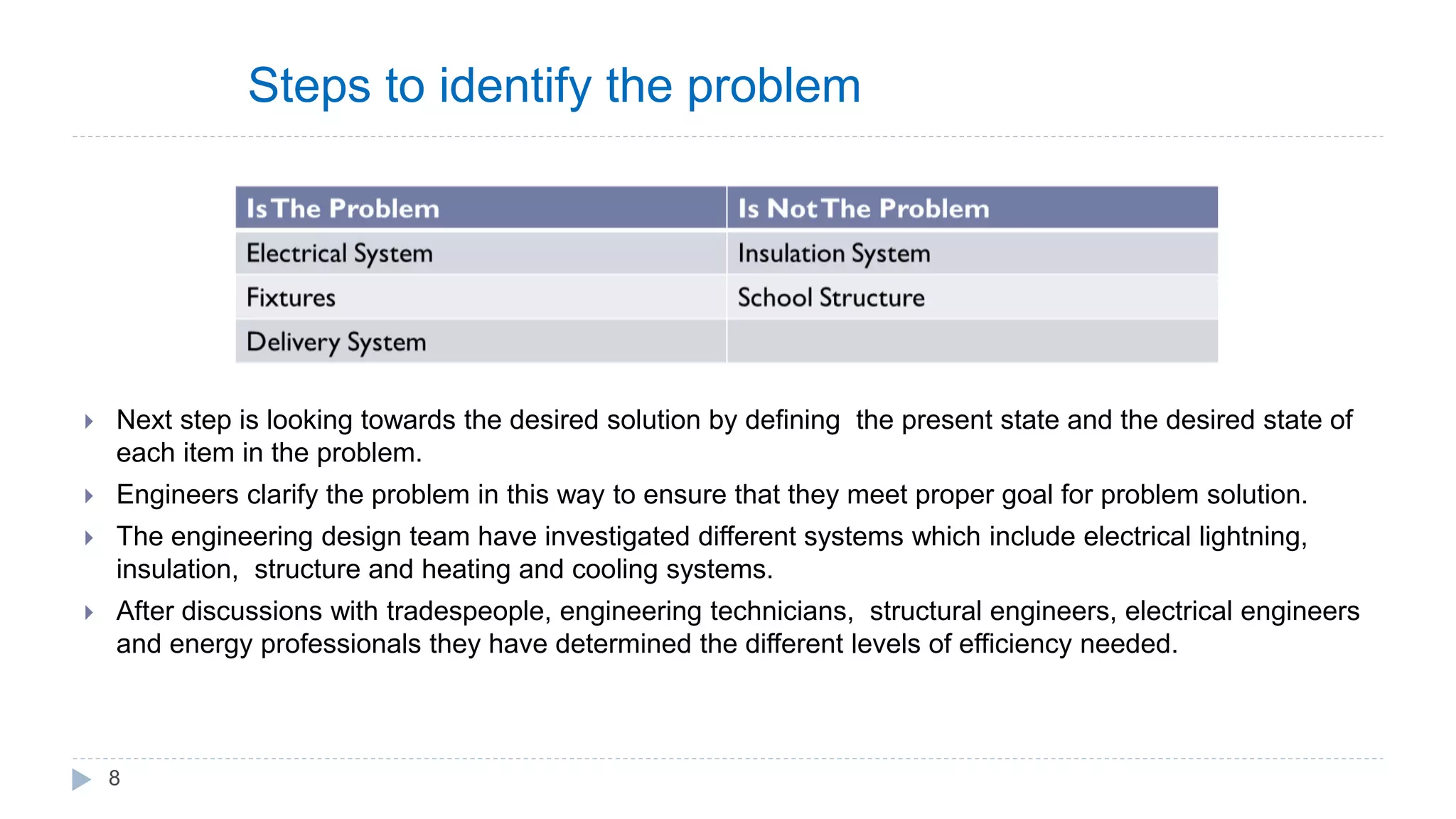
 Next step to identify the problem is to determine “what the problem is” and “what the problem is not”.
 The design team you must look at the electrical system for Lighting and if it uses any outdated fixtures
and electrical delivery system, the team will put in In the problem List.
 The team will also look at insulation system in the school this will help to determine if the structure of the
school and installation system are efficient and if so they will be put up on is not the problem list.

7
Steps to identify the problem
 Next step is looking towards the desired solution by defining the present state and the desired state of
each item in the problem.
 Engineers clarify the problem in this way to ensure that they meet proper goal for problem solution.
 The engineering design team have investigated different systems which include electrical lightning,
insulation, structure and heating and cooling systems.
 After discussions with tradespeople, engineering technicians, structural engineers, electrical engineers
and energy professionals they have determined the different levels of efficiency needed.
8
Steps to identify the problem
9
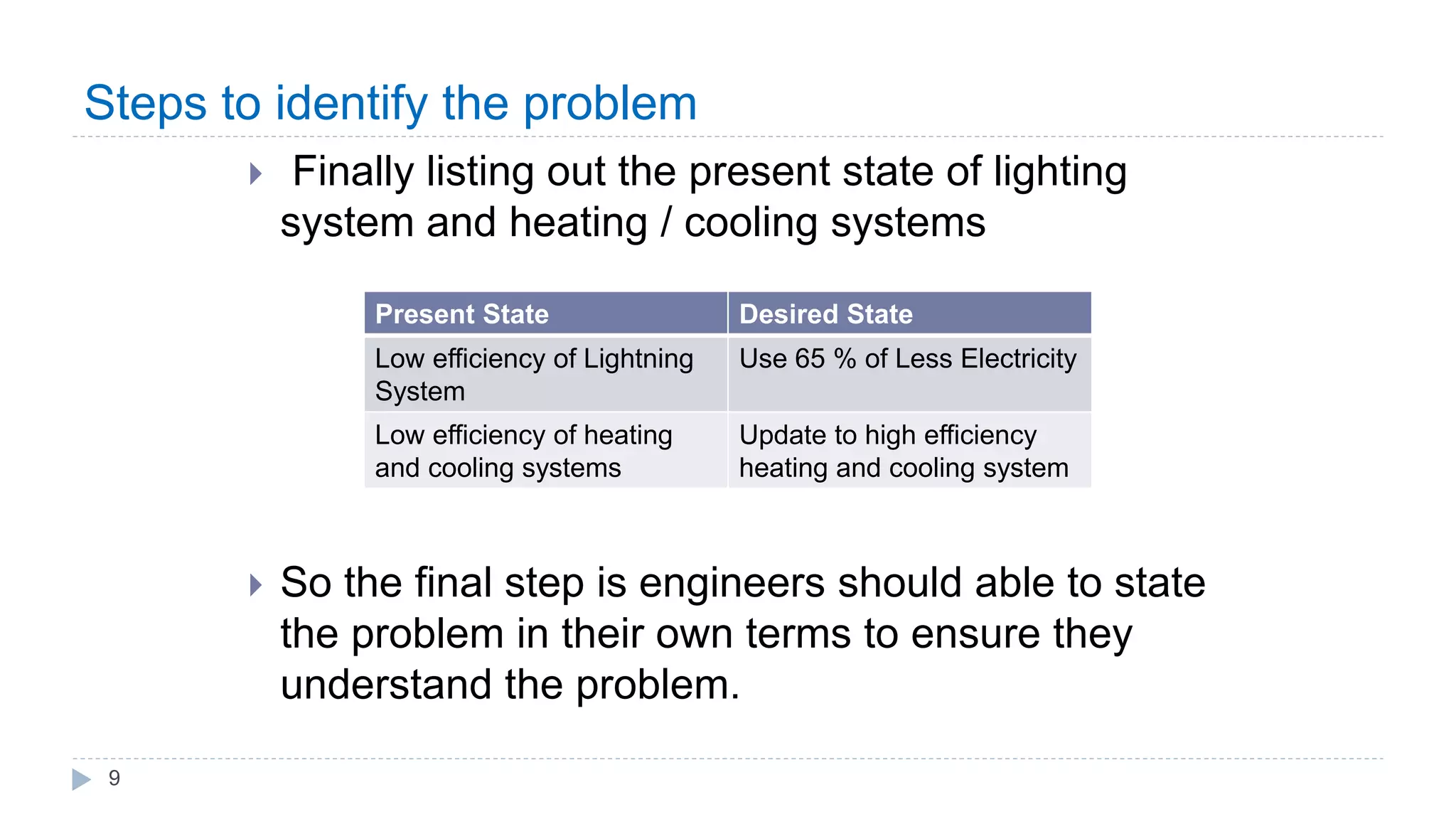
Present State Desired State
Low efficiency of Lightning
System
Use 65 % of Less Electricity
Low efficiency of heating
and cooling systems
Update to high efficiency
heating and cooling system
 Finally listing out the present state of lighting
system and heating / cooling systems
 So the final step is engineers should able to state
the problem in their own terms to ensure they
understand the problem.
Writing the problem statement
 Once the engineers write the problem in their own words they share the problem statement with their
customers and their team members
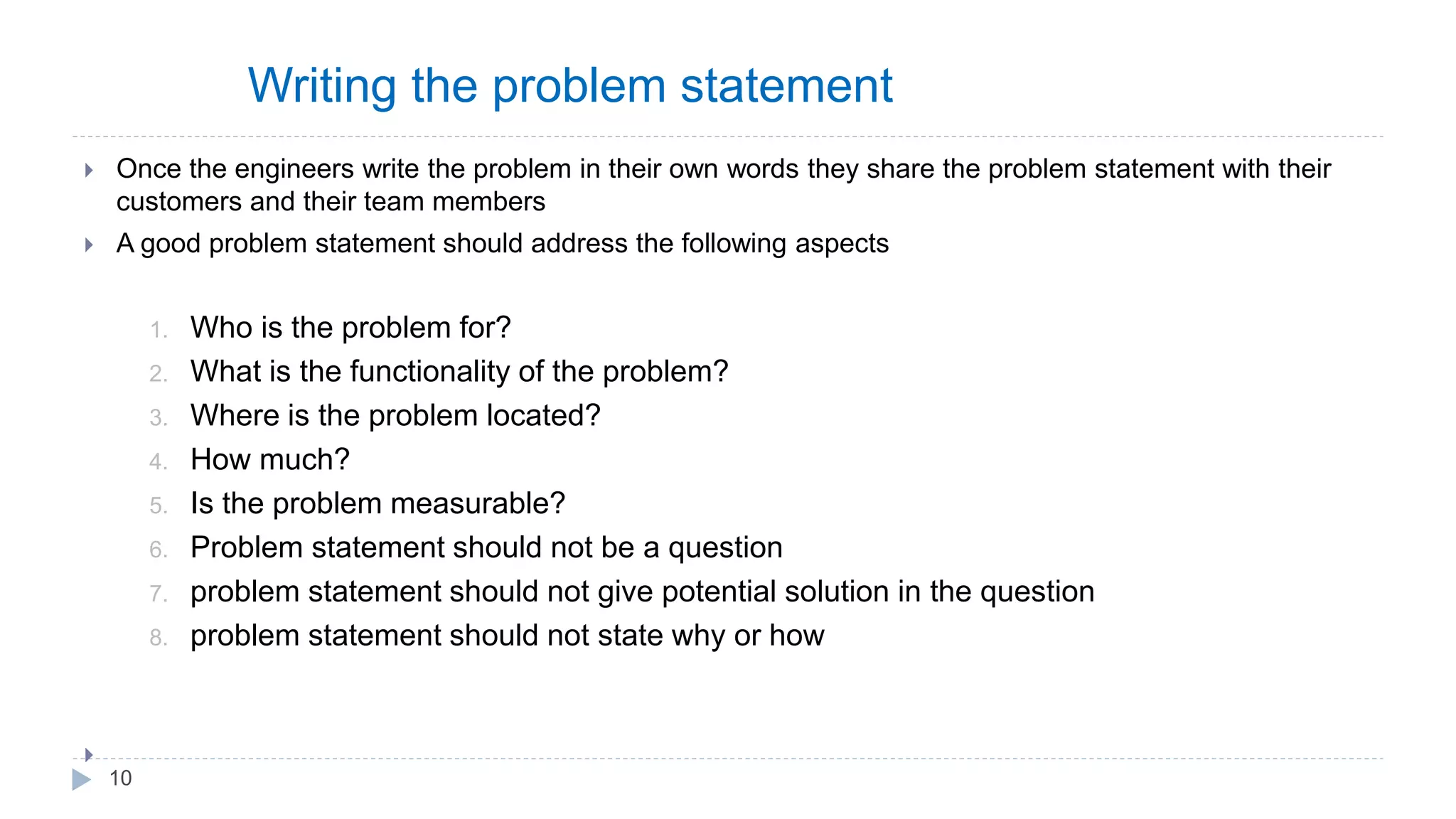
 A good problem statement should address the following aspects
1. Who is the problem for?
2. What is the functionality of the problem?
3. Where is the problem located?
4. How much?
5. Is the problem measurable?
6. Problem statement should not be a question
7. problem statement should not give potential solution in the question
8. problem statement should not state why or how

10
Writing the problem statement
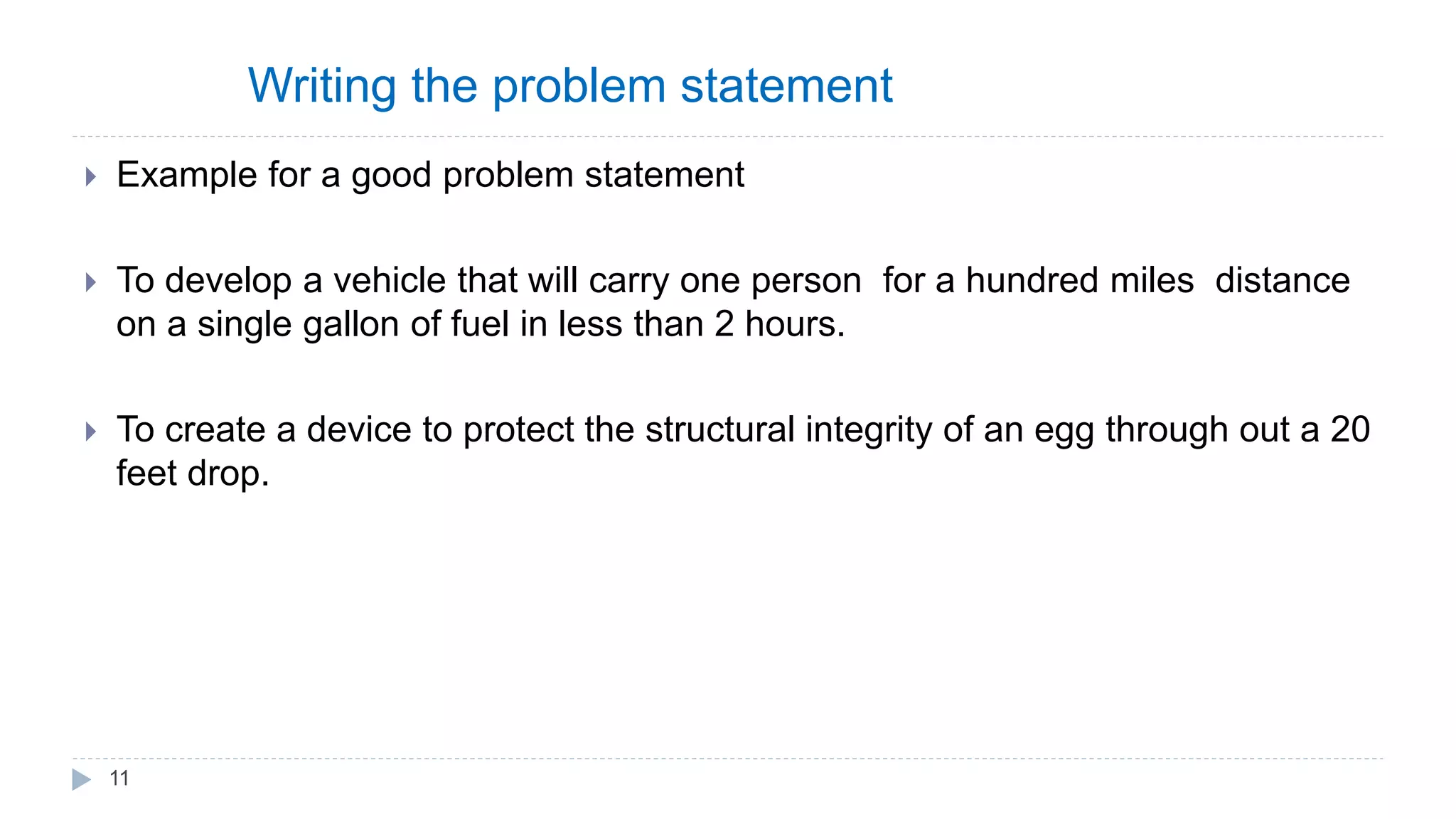
 Example for a good problem statement
 To develop a vehicle that will carry one person for a hundred miles distance
on a single gallon of fuel in less than 2 hours.
 To create a device to protect the structural integrity of an egg through out a 20
feet drop.
11
Criteria and Constraints
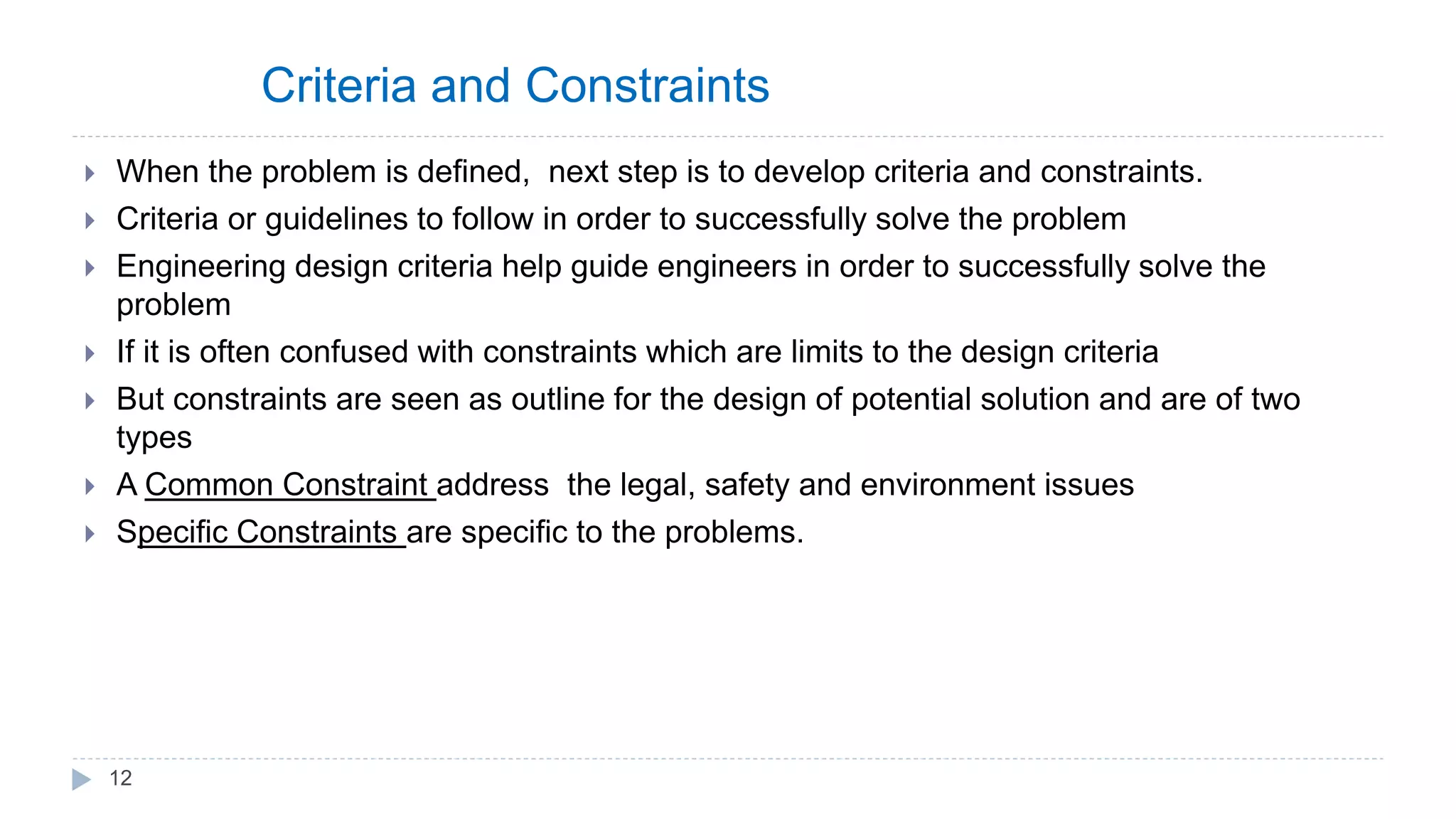
 When the problem is defined, next step is to develop criteria and constraints.
 Criteria or guidelines to follow in order to successfully solve the problem
 Engineering design criteria help guide engineers in order to successfully solve the
problem
 If it is often confused with constraints which are limits to the design criteria
 But constraints are seen as outline for the design of potential solution and are of two
types
 A Common Constraint address the legal, safety and environment issues
 Specific Constraints are specific to the problems.
12
Criteria and Constraints
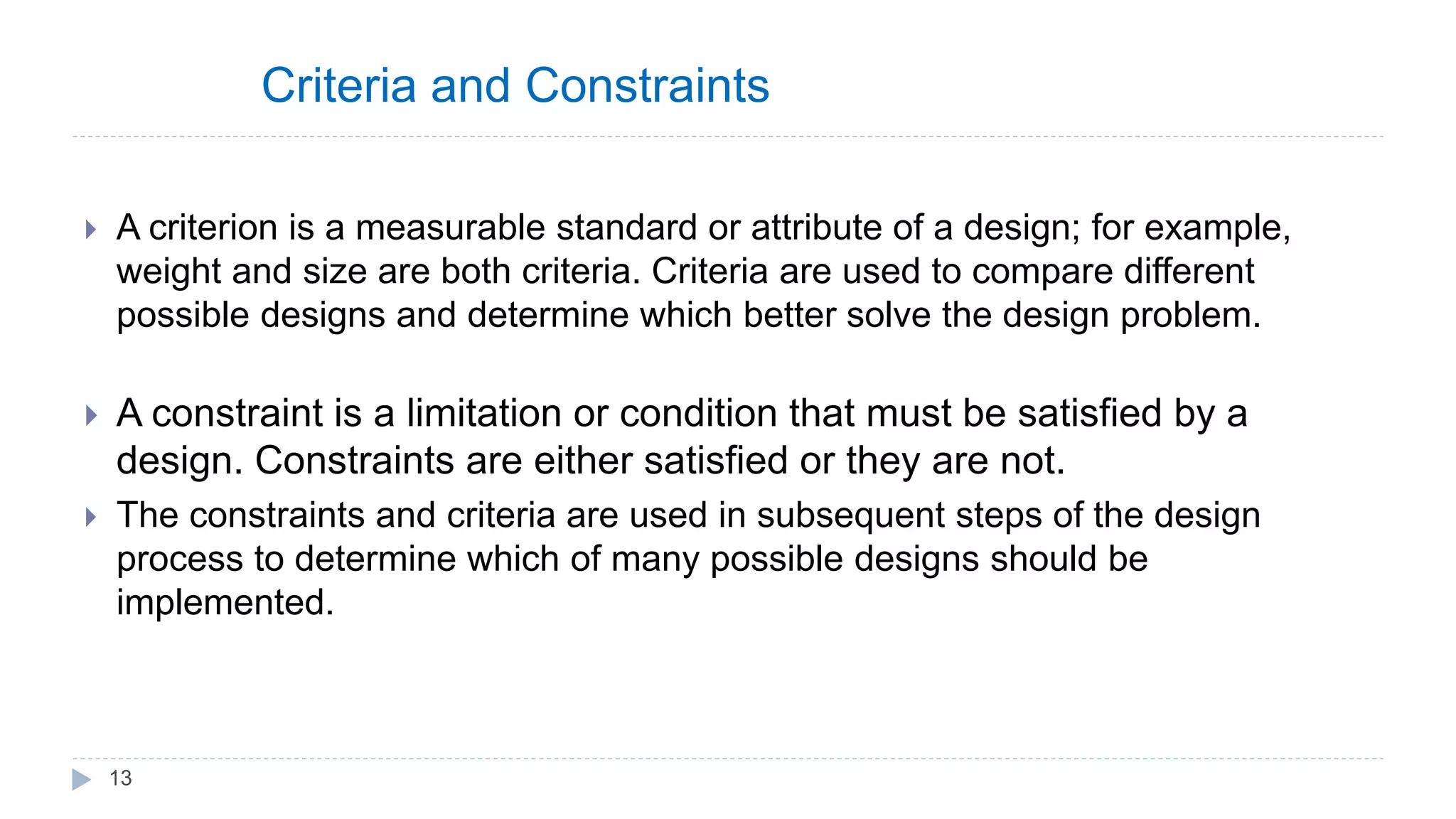
 A criterion is a measurable standard or attribute of a design; for example,
weight and size are both criteria. Criteria are used to compare different
possible designs and determine which better solve the design problem.
 A constraint is a limitation or condition that must be satisfied by a
design. Constraints are either satisfied or they are not.
 The constraints and criteria are used in subsequent steps of the design
process to determine which of many possible designs should be
implemented.
13
Criteria and Constraints
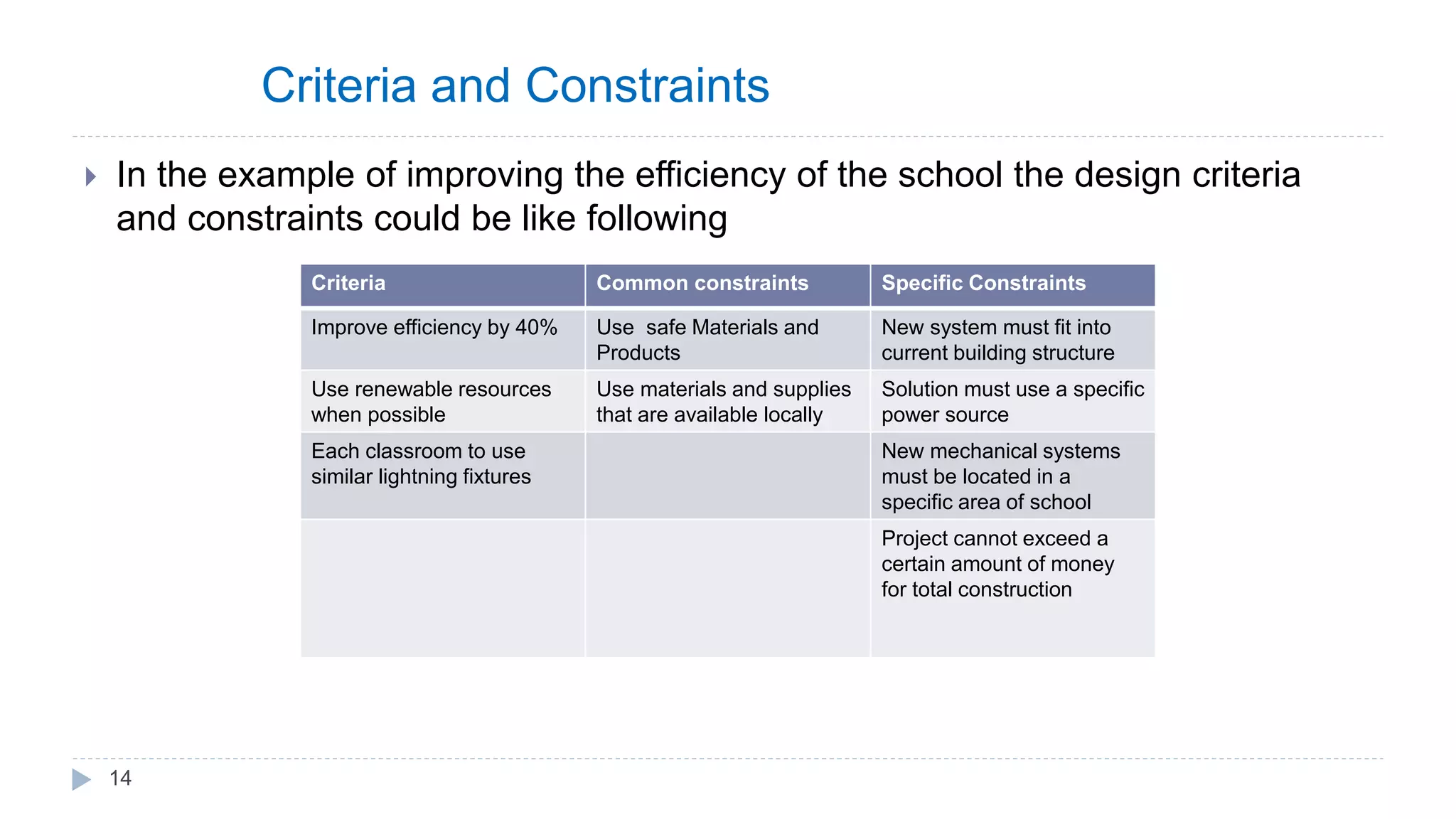
 In the example of improving the efficiency of the school the design criteria
and constraints could be like following
14
Criteria Common constraints Specific Constraints
Improve efficiency by 40% Use safe Materials and
Products
New system must fit into
current building structure
Use renewable resources
when possible
Use materials and supplies
that are available locally
Solution must use a specific
power source
Each classroom to use
similar lightning fixtures
New mechanical systems
must be located in a
specific area of school
Project cannot exceed a
certain amount of money
for total construction
Brainstorming
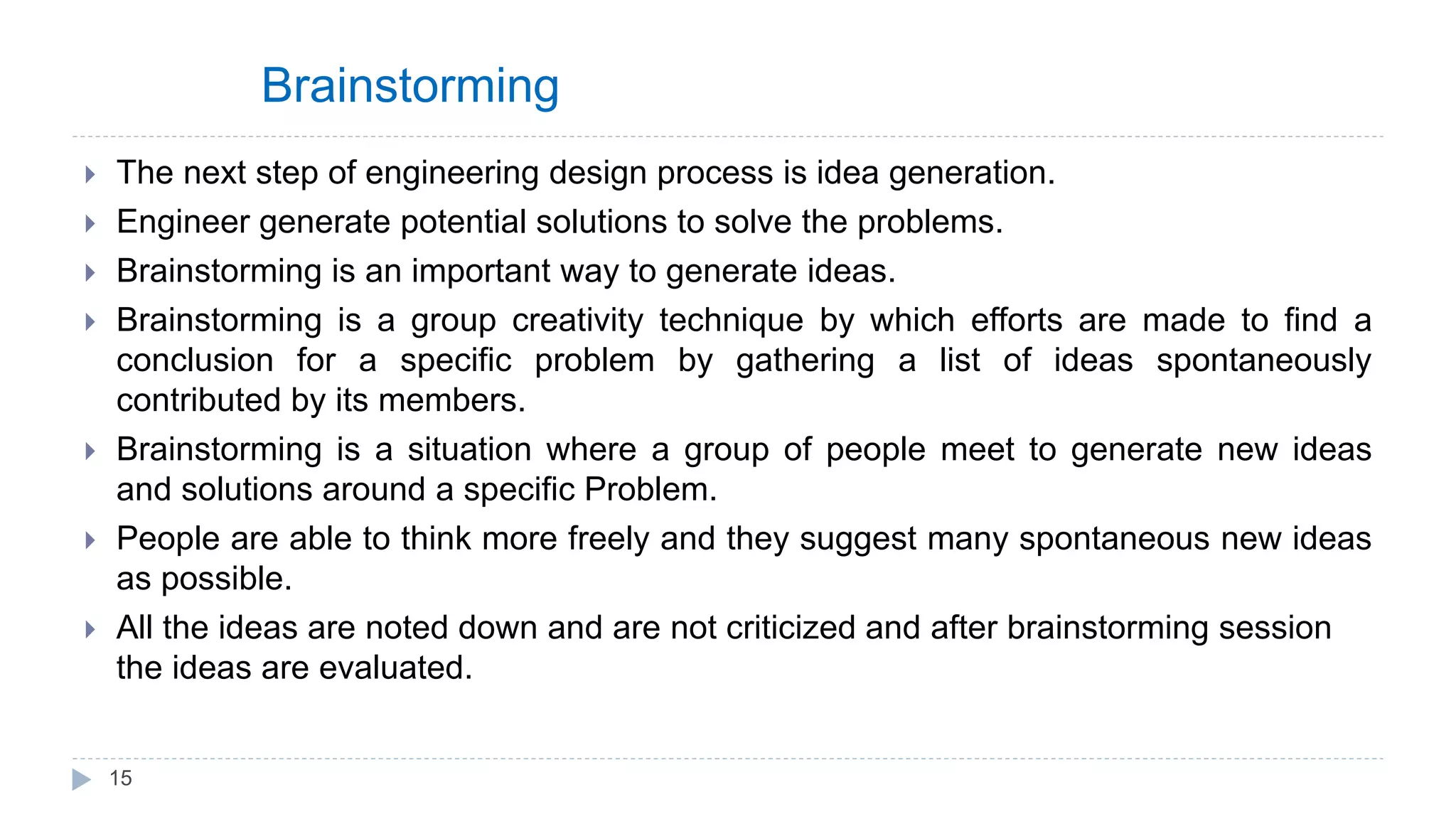
 The next step of engineering design process is idea generation.
 Engineer generate potential solutions to solve the problems.
 Brainstorming is an important way to generate ideas.
 Brainstorming is a group creativity technique by which efforts are made to find a
conclusion for a specific problem by gathering a list of ideas spontaneously
contributed by its members.
 Brainstorming is a situation where a group of people meet to generate new ideas
and solutions around a specific Problem.
 People are able to think more freely and they suggest many spontaneous new ideas
as possible.
 All the ideas are noted down and are not criticized and after brainstorming session
the ideas are evaluated.
15
Brainstorming Example
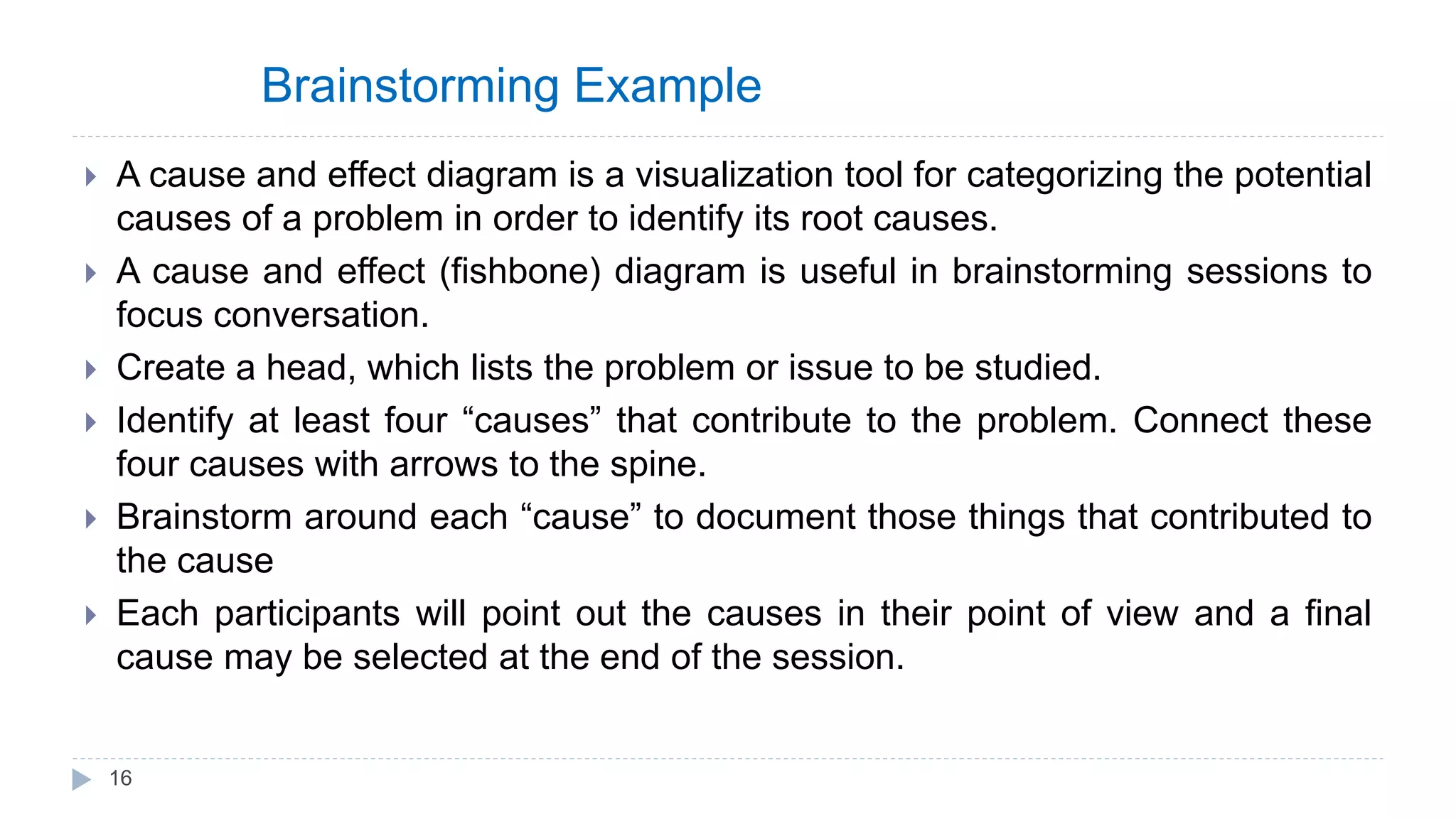
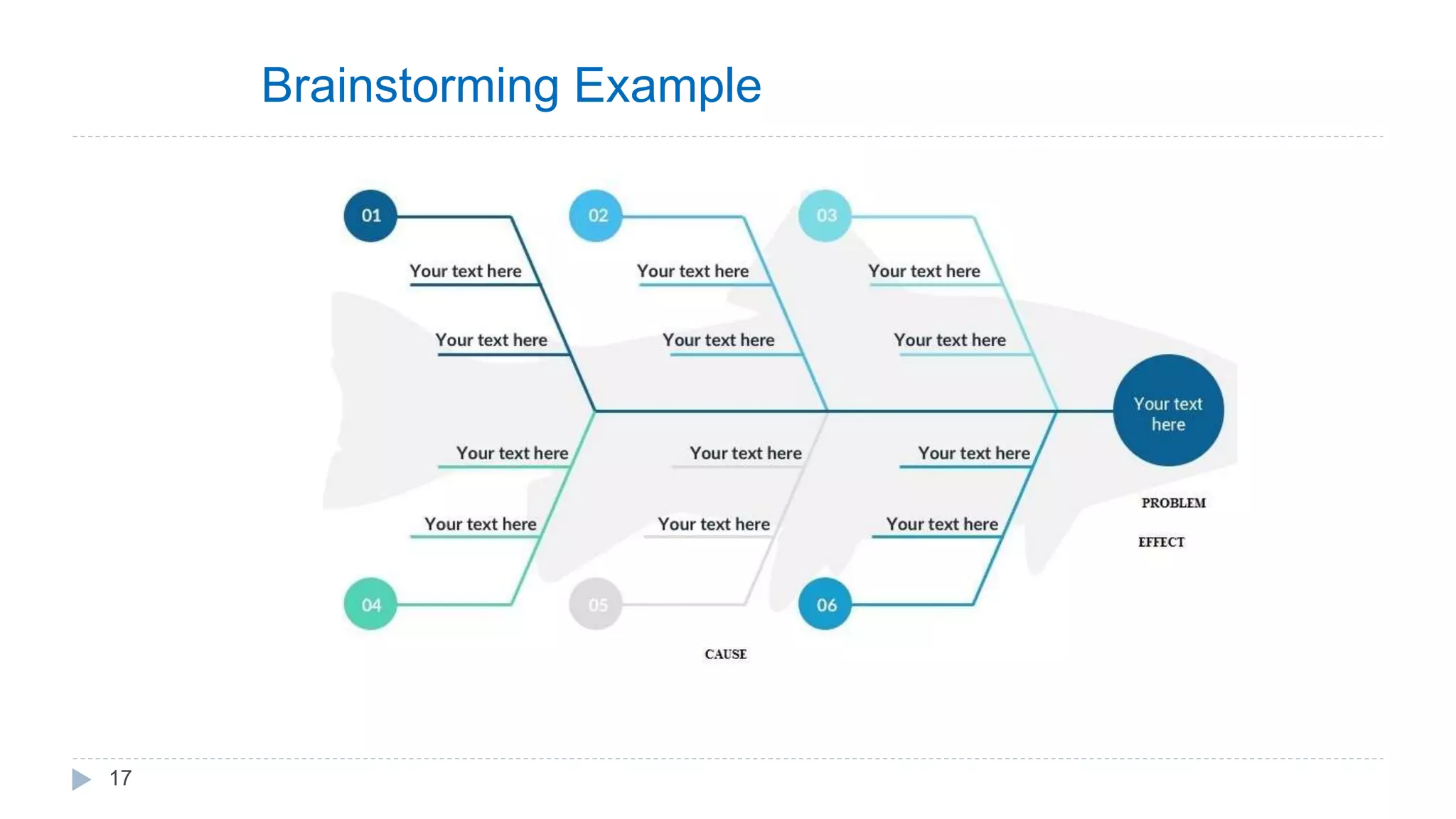
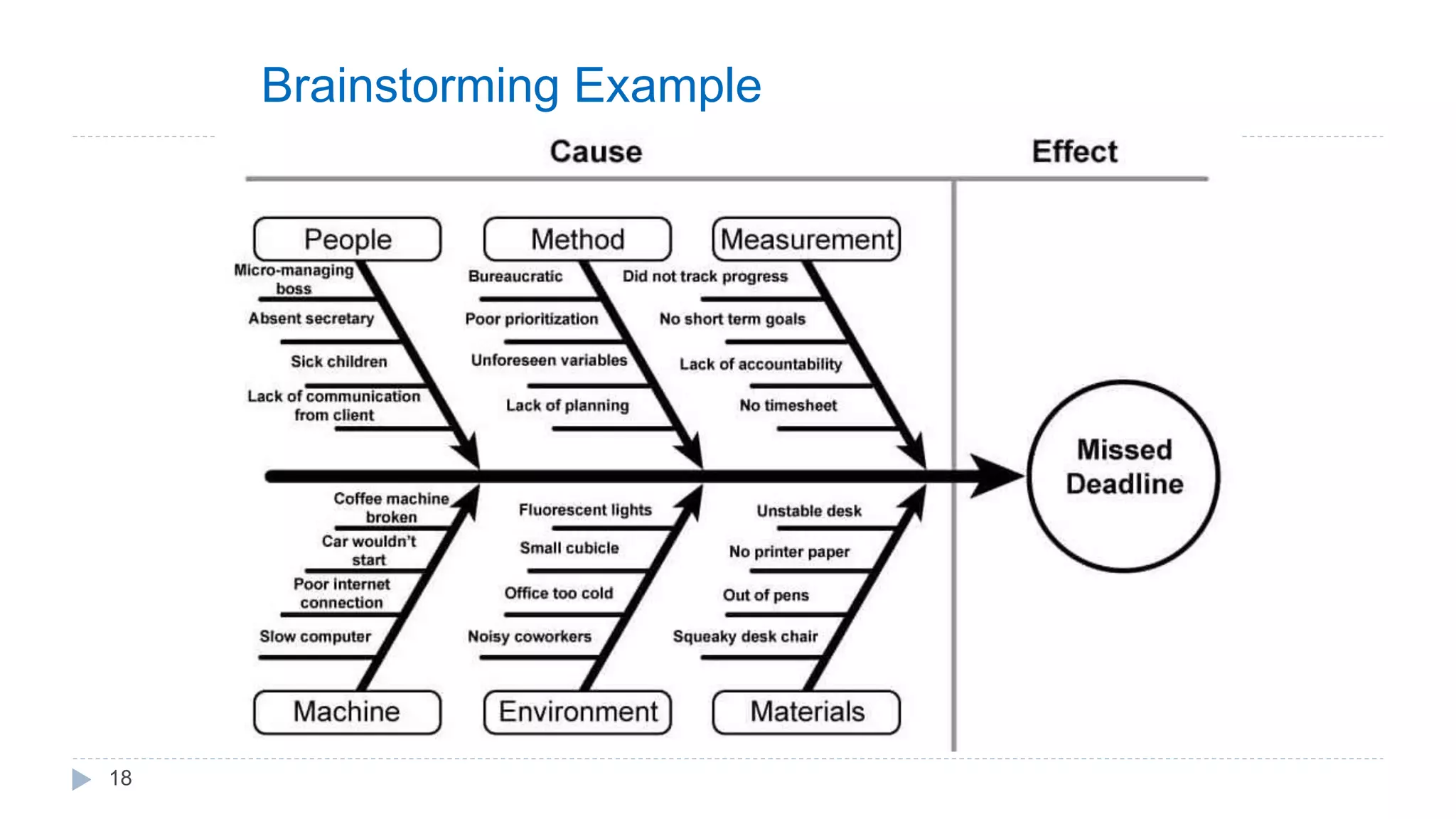
 A cause and effect diagram is a visualization tool for categorizing the potential
causes of a problem in order to identify its root causes.
 A cause and effect (fishbone) diagram is useful in brainstorming sessions to
focus conversation.
 Create a head, which lists the problem or issue to be studied.
 Identify at least four “causes” that contribute to the problem. Connect these
four causes with arrows to the spine.
 Brainstorm around each “cause” to document those things that contributed to
the cause
 Each participants will point out the causes in their point of view and a final
cause may be selected at the end of the session.
16
Brainstorming Example
17
Brainstorming Example
18
Advantages of Brainstorming
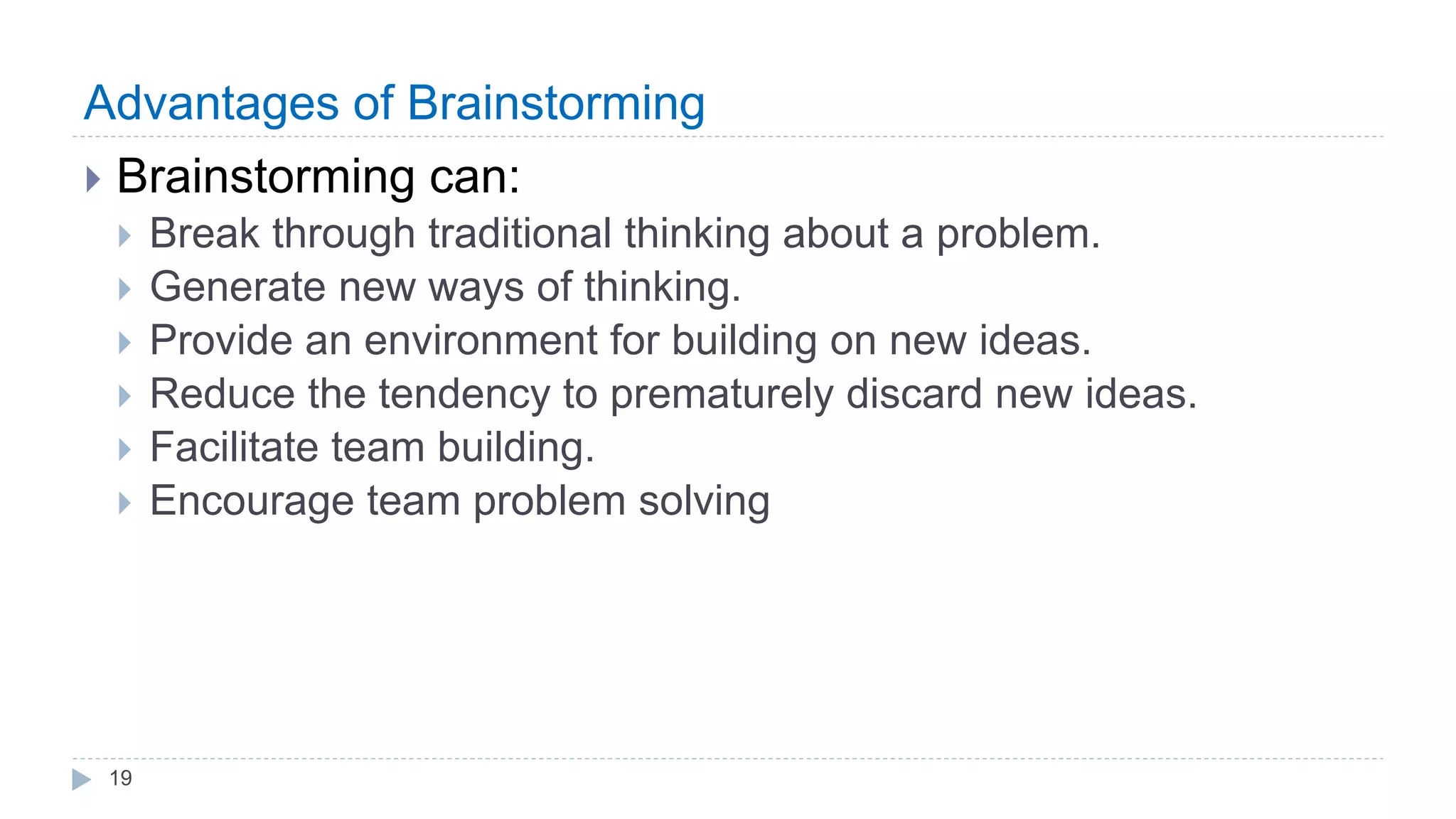
 Brainstorming can:
 Break through traditional thinking about a problem.
 Generate new ways of thinking.
 Provide an environment for building on new ideas.
 Reduce the tendency to prematurely discard new ideas.
 Facilitate team building.
 Encourage team problem solving
19
Brainstorming Techniques
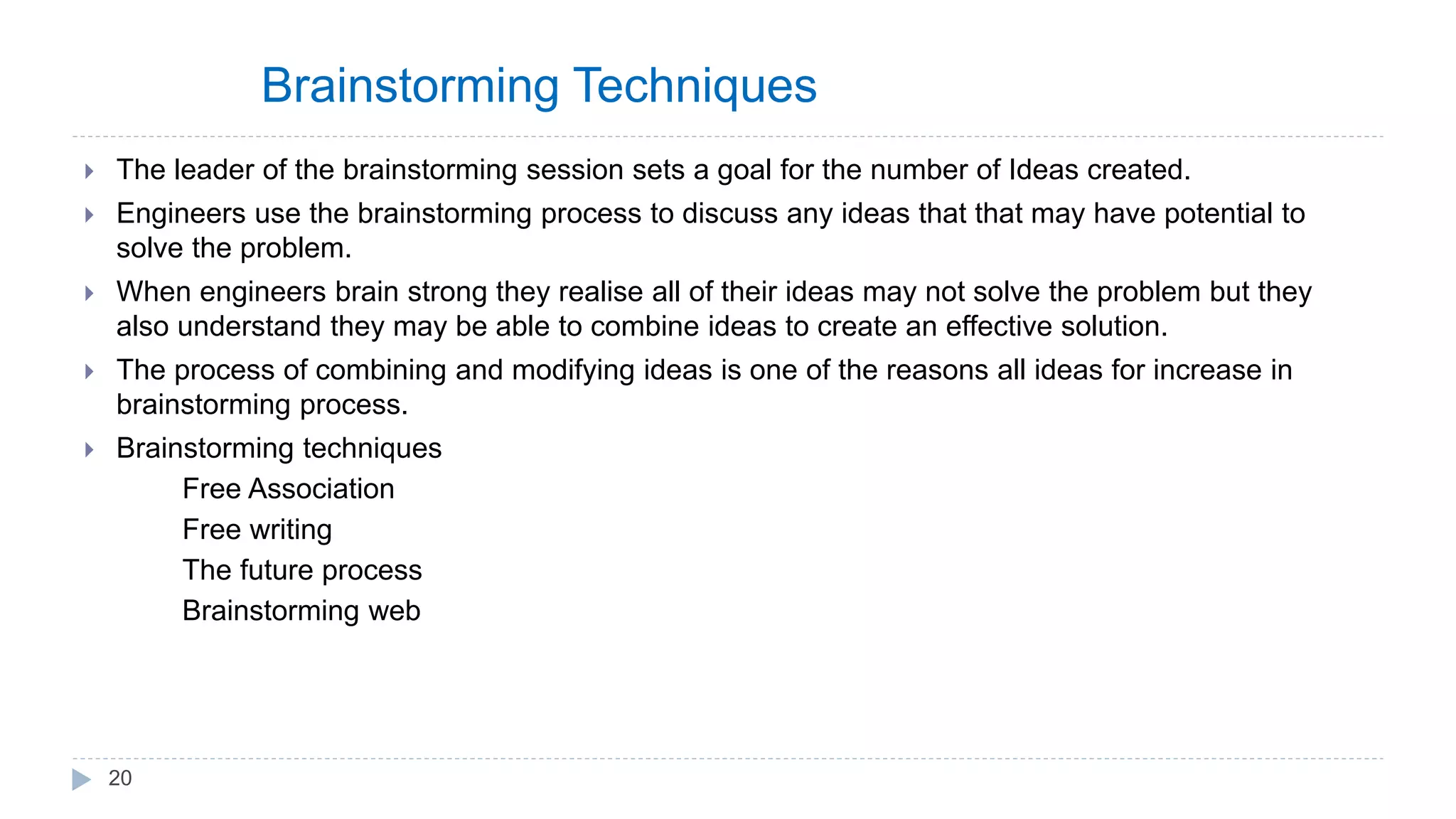
 The leader of the brainstorming session sets a goal for the number of Ideas created.
 Engineers use the brainstorming process to discuss any ideas that that may have potential to
solve the problem.
 When engineers brain strong they realise all of their ideas may not solve the problem but they
also understand they may be able to combine ideas to create an effective solution.
 The process of combining and modifying ideas is one of the reasons all ideas for increase in
brainstorming process.
 Brainstorming techniques
Free Association
Free writing
The future process
Brainstorming web
20
Free Association Brainstorming
 Free Association is the act of describing as many ideas as possible without any concern
about their ability to be accomplished.
 This is the most common form of brainstorming.
 preferable to be held away from normal place of work.
 Materials required may be of whiteboard and pens. post-it notes and pen for each attendee.
 The group leader will often give the group a time limit to come up with as many ideas as
possible.
 The leader will listing each potential solution on the white board for every one to see.
 After discussions the group will narrow down the ideas and arrive at a best possible solutions.
21
Free Writing Brainstorming
 Free writing is an exercise in which ideas are written in a piece of paper
without stopping for a set period of time with no consideration of grammar,
punctuation, spelling, or even logical progression.
 The purpose of a free write is to rely on your subconscious to make
associations and to keep your pen moving without editing each word or
thought before it hits the page.
 Much like free association, all ideas are generated.
 The final decision is taken by a single person.
 The final decision is reported back to the teams.
22
Future process Brainstorming
 When using the future process engineers intentionally focus on solutions that
are not possible now because of technological or scientific limitations present
now.
 The purpose of this process is for engineers to find the ideal list of solutions
without limiting themselves to current ways to produce or manufacture the
solution.
23
Brainstorming Web
 The method of linking different ideas Together by finding commonalities between
them is brainstorming web.
 To use this method the design team list ideas in a way similar to free Association
approach by writing any ideas that come into mind in a space all members of the
design team can see.
 When using this web approach, the ideas are written in a random locations on the
white board instead of in unorganised list
 Once engineers have completed listing ideas the team begins to find links between
the ideas.
 The team leader draws line between ideas that have a connection and a web of Idea
is developed through that commonalities.
 In this way a combined modified ideas are generated.
24
 Questions?
25

C3Problems and Brainstorming.ppt

  • 1.
  • 2.
    Outline  Defining theproblem  Problems example  Steps to identify the problem  Writing the problem statement  Criteria and Constraints  Brainstorming  Brainstorming example  Advantages of Brainstorming  Free Association Brainstorming  Free Writing Brainstorming  Future process Brainstorming  Brainstorming Web 2
  • 3.
    Defining the problem The Engineering Design Process is used to develop solutions to every day problems.  Eg:- Engineers have developed many different methods of transportation for People and Cargo from early times.  The transportations have evolved from early days of using horses to modern day trains, airplanes, ships, automobiles and further being explored.  So the problem still open and it is stated as “better, efficient, fast and easy way of transportation for people and cargos”.  A problem has to be first defined before searching for solutions.  Throughout the design process the engineers work in teams.  The team members include engineers, engineering technicians and trades people 3
  • 4.
    Problems Example  Dueto a heavy snowstorm in a town, people are unable to derive their vehicle or walk on the side ways because of heavy accumulation of snow.  Inability to navigate around the town is a problem.  This is a example for a direct and simple problem.  The problem statement would be “ Develop a snow removal equipment to move large amount of snow quickly and efficiently”. 4
  • 5.
    Problems Example  Notall the problems would be as simple and direct as this.  Some problems may be unclear and missing with some details.  A mechanical engineer may be presented with a problem of increasing gear ratio in a mechanical device.  When given the exact ratio, size and design specs, the challenge still requires a very strong technical knowledge.  However engineers often encounter challenging problems that are unclear and difficult to identify  A manufacturing engineer may be challenged with increasing the efficiency of an assembly line system.  Given with very little information and considering the system which uses many different electric motors and hydraulic power, there would be many different possibility of solutions.  So a clear problem definition only will leads to a suitable solution. 5
  • 6.
    Steps to identifythe problem  Engineers are often asked to solve problems given to them by other members or directly from customers.  Engineers define problems by going through different steps and even more time for complex problems.  The following four steps are followed to arrive at a Problem Statement. 1. Determine the problems origin. 2. Define what is and what is not a problem. 3. Identify the present state and desired state of each component in the problem. 4. State the problem in words. 6
  • 7.
    Steps to identifythe problem  First the engineers ask where the problem came from by asking this questions.  Engineers can look at the problems from very beginning to define the problem.  For the problem like “ The problem of too much energy usage in a school building” engineers might ask 1. How much energy is being used in the school? 2. Could the problem be in the lighting fixtures or insulation? 3. How much energy would be like the school to use?  Next step to identify the problem is to determine “what the problem is” and “what the problem is not”.  The design team you must look at the electrical system for Lighting and if it uses any outdated fixtures and electrical delivery system, the team will put in In the problem List.  The team will also look at insulation system in the school this will help to determine if the structure of the school and installation system are efficient and if so they will be put up on is not the problem list.  7
  • 8.
    Steps to identifythe problem  Next step is looking towards the desired solution by defining the present state and the desired state of each item in the problem.  Engineers clarify the problem in this way to ensure that they meet proper goal for problem solution.  The engineering design team have investigated different systems which include electrical lightning, insulation, structure and heating and cooling systems.  After discussions with tradespeople, engineering technicians, structural engineers, electrical engineers and energy professionals they have determined the different levels of efficiency needed. 8
  • 9.
    Steps to identifythe problem 9 Present State Desired State Low efficiency of Lightning System Use 65 % of Less Electricity Low efficiency of heating and cooling systems Update to high efficiency heating and cooling system  Finally listing out the present state of lighting system and heating / cooling systems  So the final step is engineers should able to state the problem in their own terms to ensure they understand the problem.
  • 10.
    Writing the problemstatement  Once the engineers write the problem in their own words they share the problem statement with their customers and their team members  A good problem statement should address the following aspects 1. Who is the problem for? 2. What is the functionality of the problem? 3. Where is the problem located? 4. How much? 5. Is the problem measurable? 6. Problem statement should not be a question 7. problem statement should not give potential solution in the question 8. problem statement should not state why or how  10
  • 11.
    Writing the problemstatement  Example for a good problem statement  To develop a vehicle that will carry one person for a hundred miles distance on a single gallon of fuel in less than 2 hours.  To create a device to protect the structural integrity of an egg through out a 20 feet drop. 11
  • 12.
    Criteria and Constraints When the problem is defined, next step is to develop criteria and constraints.  Criteria or guidelines to follow in order to successfully solve the problem  Engineering design criteria help guide engineers in order to successfully solve the problem  If it is often confused with constraints which are limits to the design criteria  But constraints are seen as outline for the design of potential solution and are of two types  A Common Constraint address the legal, safety and environment issues  Specific Constraints are specific to the problems. 12
  • 13.
    Criteria and Constraints A criterion is a measurable standard or attribute of a design; for example, weight and size are both criteria. Criteria are used to compare different possible designs and determine which better solve the design problem.  A constraint is a limitation or condition that must be satisfied by a design. Constraints are either satisfied or they are not.  The constraints and criteria are used in subsequent steps of the design process to determine which of many possible designs should be implemented. 13
  • 14.
    Criteria and Constraints In the example of improving the efficiency of the school the design criteria and constraints could be like following 14 Criteria Common constraints Specific Constraints Improve efficiency by 40% Use safe Materials and Products New system must fit into current building structure Use renewable resources when possible Use materials and supplies that are available locally Solution must use a specific power source Each classroom to use similar lightning fixtures New mechanical systems must be located in a specific area of school Project cannot exceed a certain amount of money for total construction
  • 15.
    Brainstorming  The nextstep of engineering design process is idea generation.  Engineer generate potential solutions to solve the problems.  Brainstorming is an important way to generate ideas.  Brainstorming is a group creativity technique by which efforts are made to find a conclusion for a specific problem by gathering a list of ideas spontaneously contributed by its members.  Brainstorming is a situation where a group of people meet to generate new ideas and solutions around a specific Problem.  People are able to think more freely and they suggest many spontaneous new ideas as possible.  All the ideas are noted down and are not criticized and after brainstorming session the ideas are evaluated. 15
  • 16.
    Brainstorming Example  Acause and effect diagram is a visualization tool for categorizing the potential causes of a problem in order to identify its root causes.  A cause and effect (fishbone) diagram is useful in brainstorming sessions to focus conversation.  Create a head, which lists the problem or issue to be studied.  Identify at least four “causes” that contribute to the problem. Connect these four causes with arrows to the spine.  Brainstorm around each “cause” to document those things that contributed to the cause  Each participants will point out the causes in their point of view and a final cause may be selected at the end of the session. 16
  • 17.
  • 18.
  • 19.
    Advantages of Brainstorming Brainstorming can:  Break through traditional thinking about a problem.  Generate new ways of thinking.  Provide an environment for building on new ideas.  Reduce the tendency to prematurely discard new ideas.  Facilitate team building.  Encourage team problem solving 19
  • 20.
    Brainstorming Techniques  Theleader of the brainstorming session sets a goal for the number of Ideas created.  Engineers use the brainstorming process to discuss any ideas that that may have potential to solve the problem.  When engineers brain strong they realise all of their ideas may not solve the problem but they also understand they may be able to combine ideas to create an effective solution.  The process of combining and modifying ideas is one of the reasons all ideas for increase in brainstorming process.  Brainstorming techniques Free Association Free writing The future process Brainstorming web 20
  • 21.
    Free Association Brainstorming Free Association is the act of describing as many ideas as possible without any concern about their ability to be accomplished.  This is the most common form of brainstorming.  preferable to be held away from normal place of work.  Materials required may be of whiteboard and pens. post-it notes and pen for each attendee.  The group leader will often give the group a time limit to come up with as many ideas as possible.  The leader will listing each potential solution on the white board for every one to see.  After discussions the group will narrow down the ideas and arrive at a best possible solutions. 21
  • 22.
    Free Writing Brainstorming Free writing is an exercise in which ideas are written in a piece of paper without stopping for a set period of time with no consideration of grammar, punctuation, spelling, or even logical progression.  The purpose of a free write is to rely on your subconscious to make associations and to keep your pen moving without editing each word or thought before it hits the page.  Much like free association, all ideas are generated.  The final decision is taken by a single person.  The final decision is reported back to the teams. 22
  • 23.
    Future process Brainstorming When using the future process engineers intentionally focus on solutions that are not possible now because of technological or scientific limitations present now.  The purpose of this process is for engineers to find the ideal list of solutions without limiting themselves to current ways to produce or manufacture the solution. 23
  • 24.
    Brainstorming Web  Themethod of linking different ideas Together by finding commonalities between them is brainstorming web.  To use this method the design team list ideas in a way similar to free Association approach by writing any ideas that come into mind in a space all members of the design team can see.  When using this web approach, the ideas are written in a random locations on the white board instead of in unorganised list  Once engineers have completed listing ideas the team begins to find links between the ideas.  The team leader draws line between ideas that have a connection and a web of Idea is developed through that commonalities.  In this way a combined modified ideas are generated. 24
  • 25.