Unit 1: Number Theory 5 th  Grade
Learning Goals Identify even and odd numbers. Draw arrays to model multiplication. Know multiplication facts. Use a divisibility test to determine if a number is divisible by another number. Find the factors of numbers. Identify prime and composite numbers. Find the prime factorizations of numbers. Rename numbers written in exponential notation. Understand how square numbers and their square roots are related.
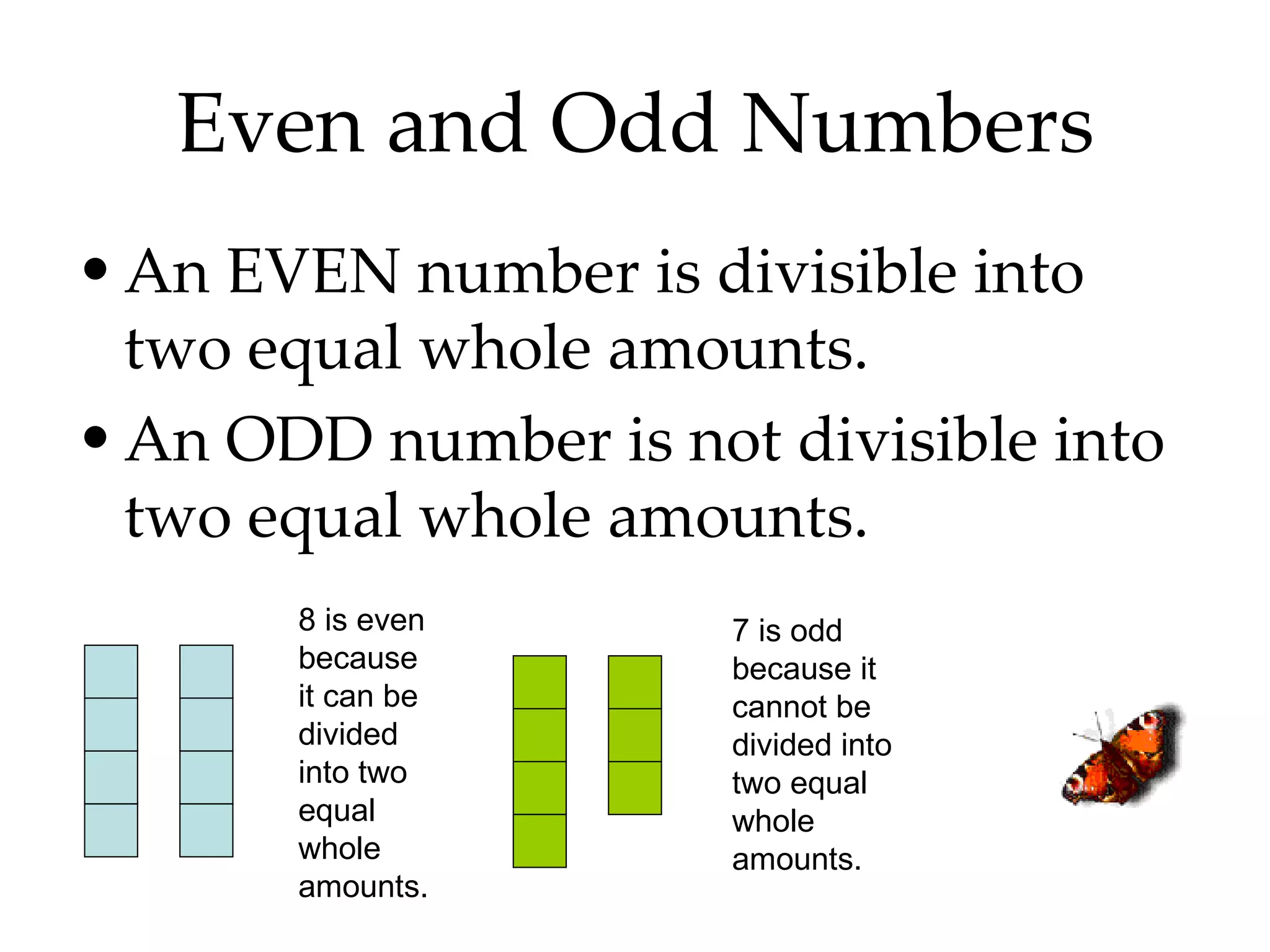
Even and Odd Numbers An EVEN number is divisible into two equal whole amounts. An ODD number is not divisible into two equal whole amounts.  8 is even because it can be divided into two equal whole amounts. 7 is odd because it cannot be divided into two equal whole amounts.
Try it out! Which circle contains only odd numbers? 9, 5, 7, 4, 17, 23 3, 5, 8, 21, 29, 43 3, 9, 21, 43, 5, 15
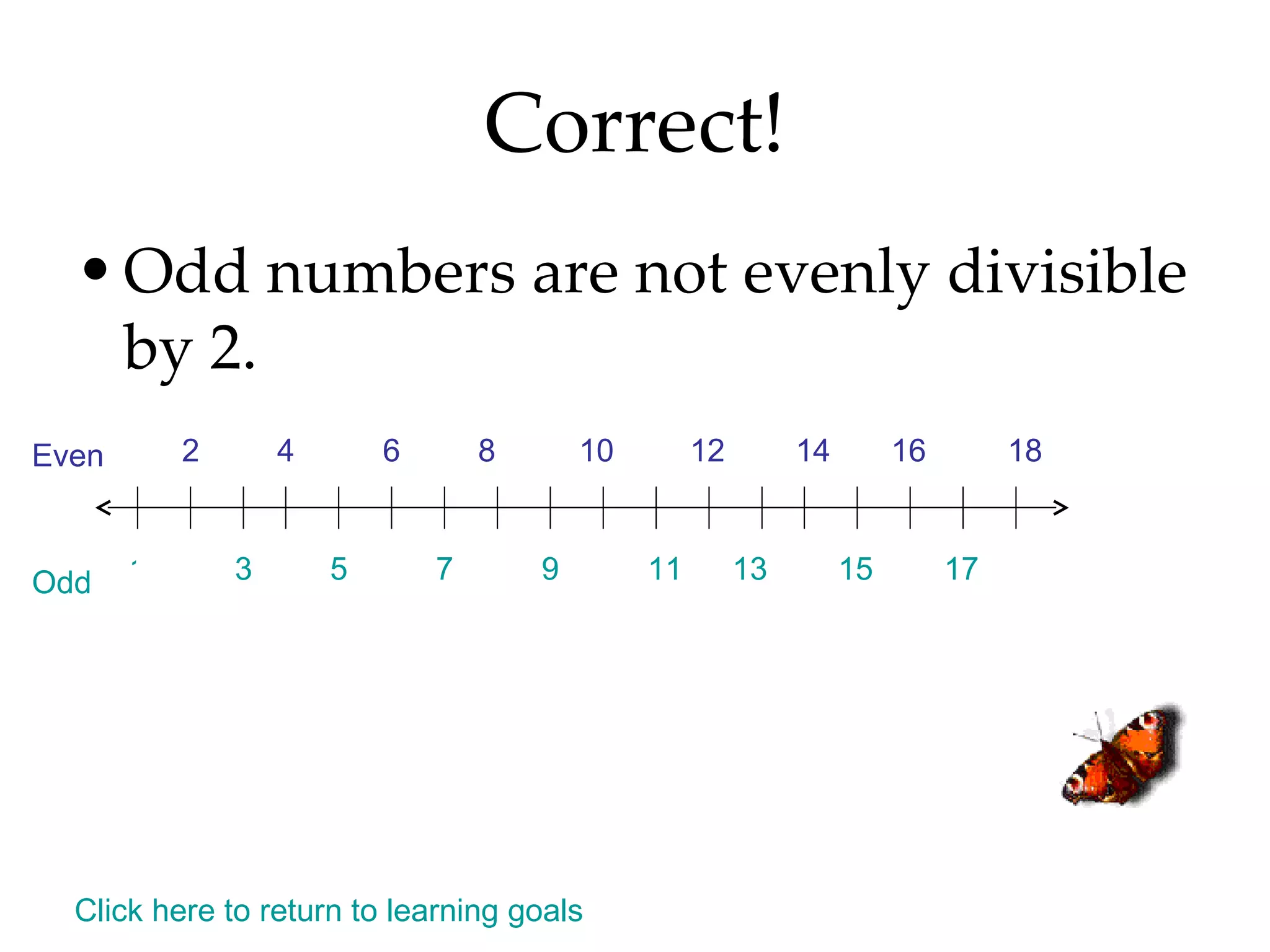
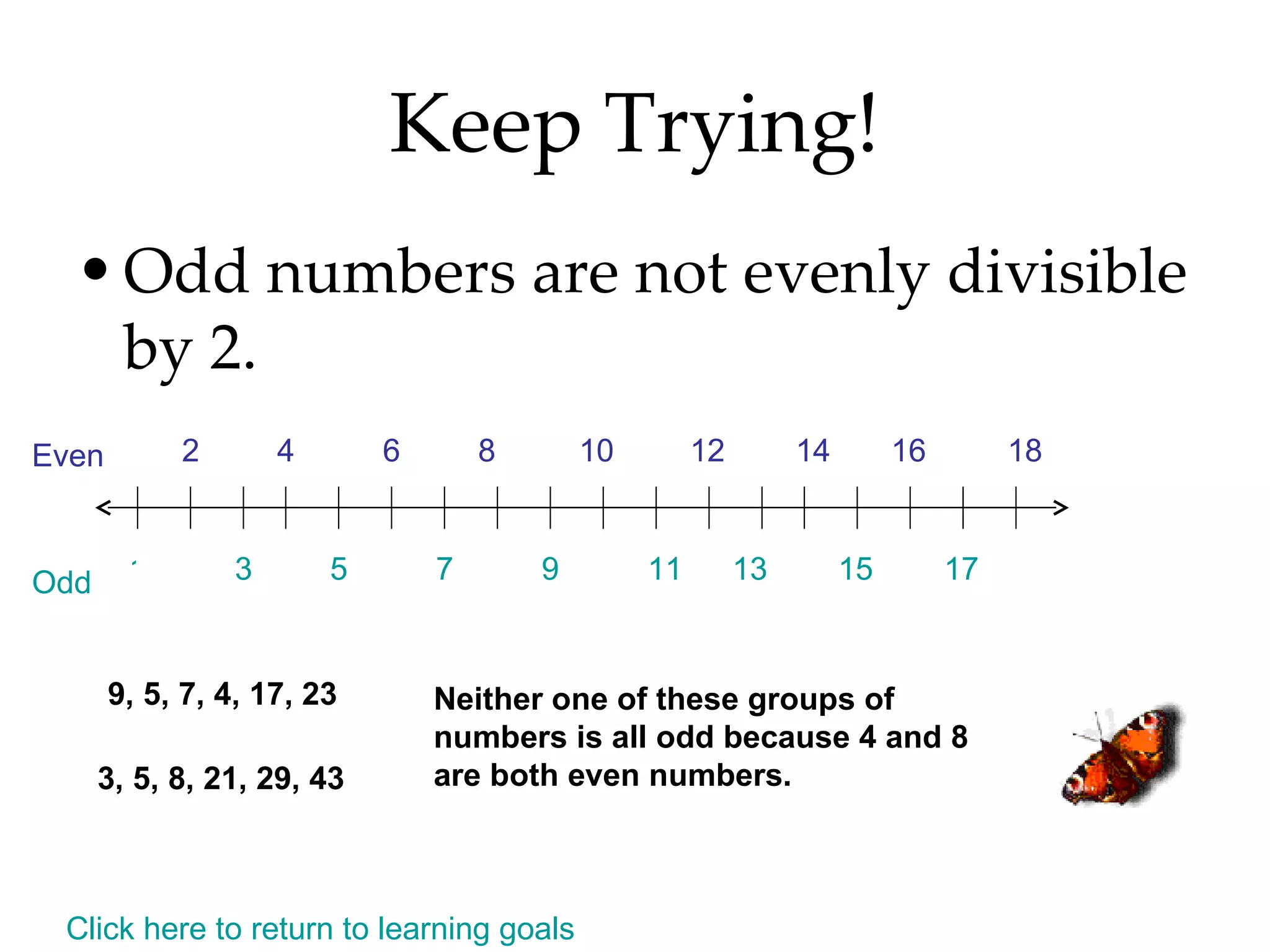
Correct! Odd numbers are not evenly divisible by 2.  Click here to return to learning goals 1 2 Even Odd 3 5 7 9 11 13 15 17 4 6 8 10 12 14 16 18
Keep Trying! Odd numbers are not evenly divisible by 2.  9, 5, 7, 4, 17, 23 3, 5, 8, 21, 29, 43 Neither one of these groups of numbers is all odd because 4 and 8 are both even numbers. Click here to return to learning goals 1 2 Even Odd 3 5 7 9 11 13 15 17 4 6 8 10 12 14 16 18
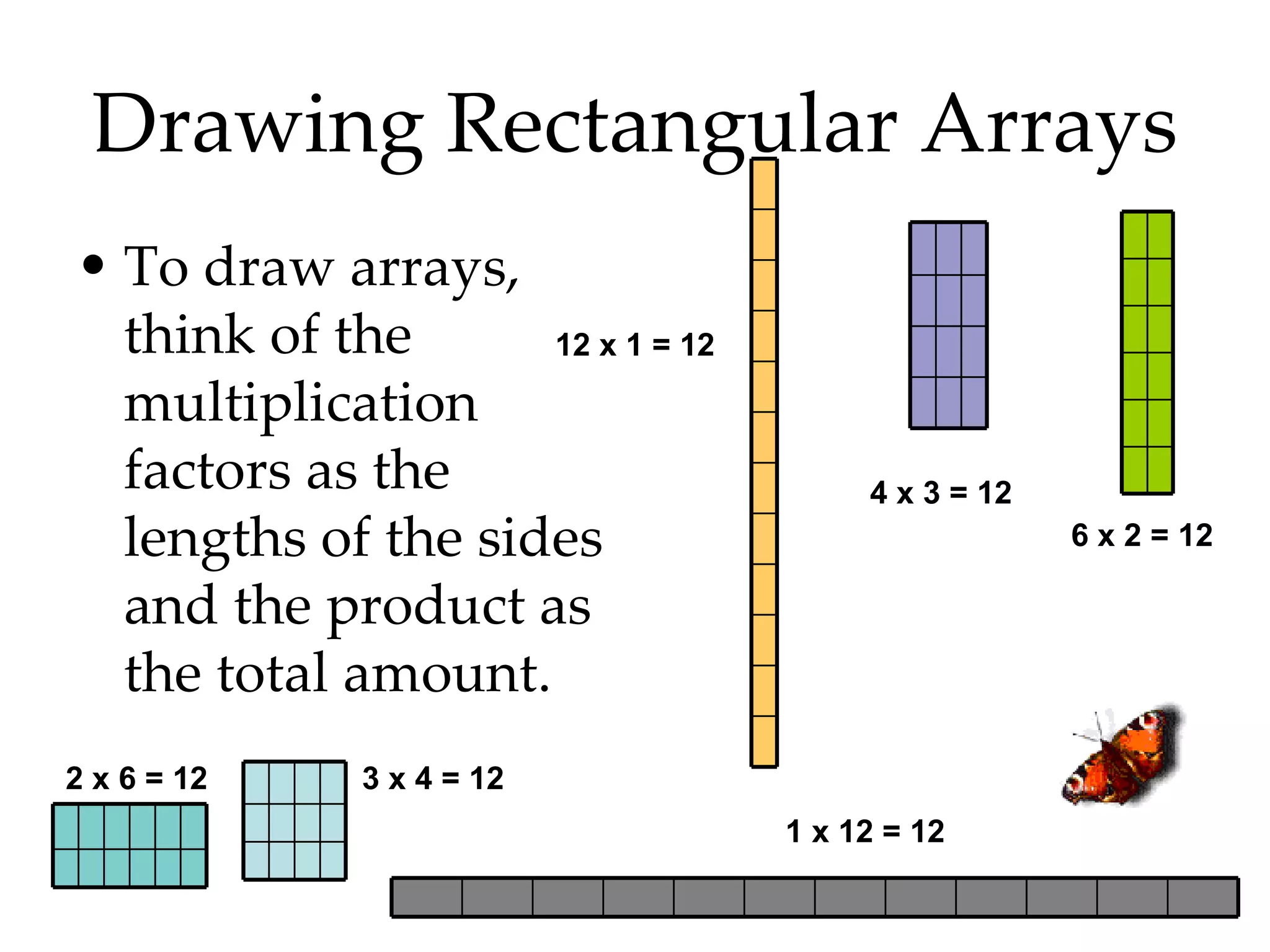
Drawing Rectangular Arrays To draw arrays, think of the multiplication factors as the lengths of the sides and the product as the total amount. 3 x 4 = 12 2 x 6 = 12 4 x 3 = 12 6 x 2 = 12 1 x 12 = 12 12 x 1 = 12
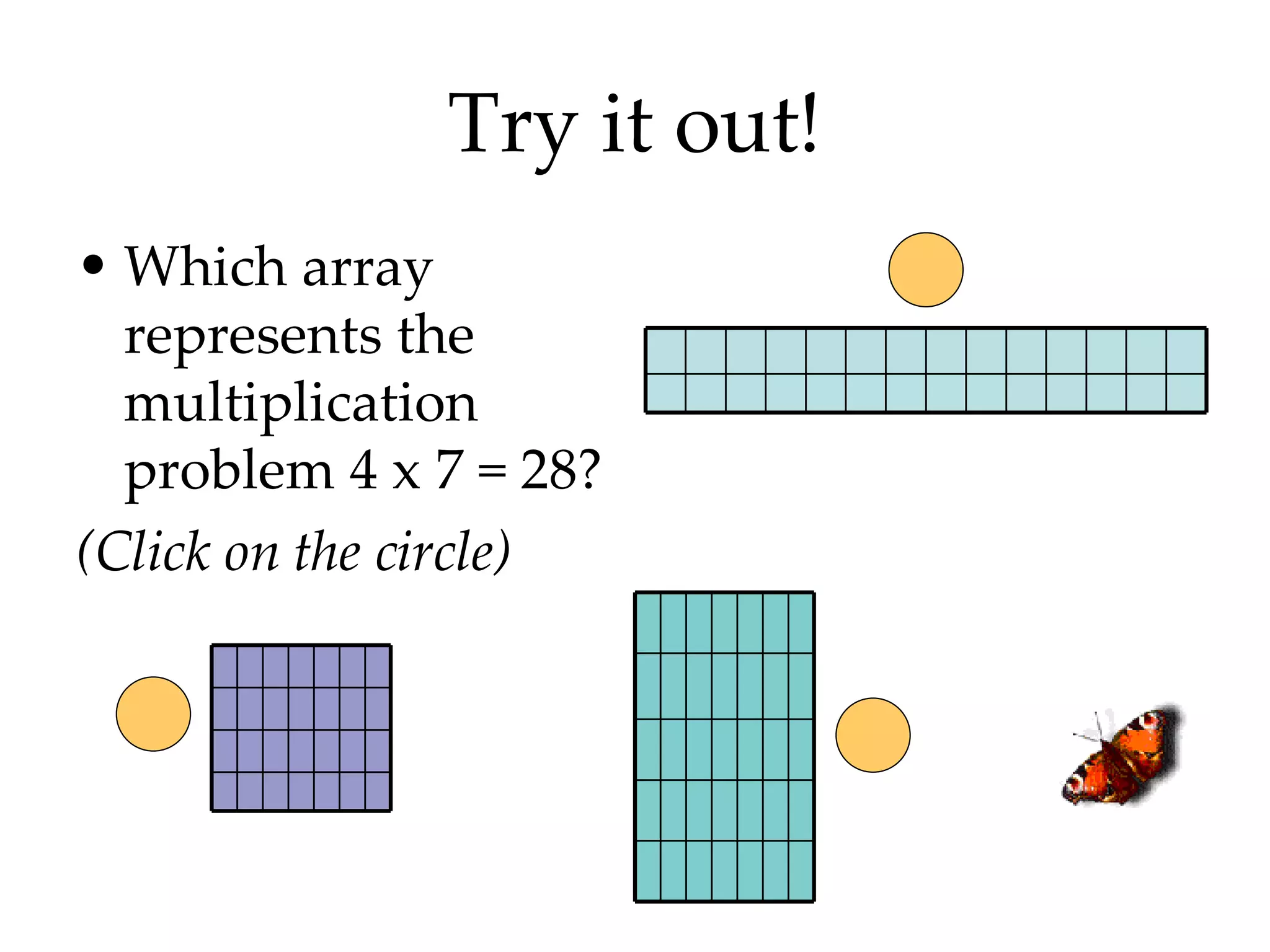
Try it out! Which array represents the multiplication problem 4 x 7 = 28? (Click on the circle)
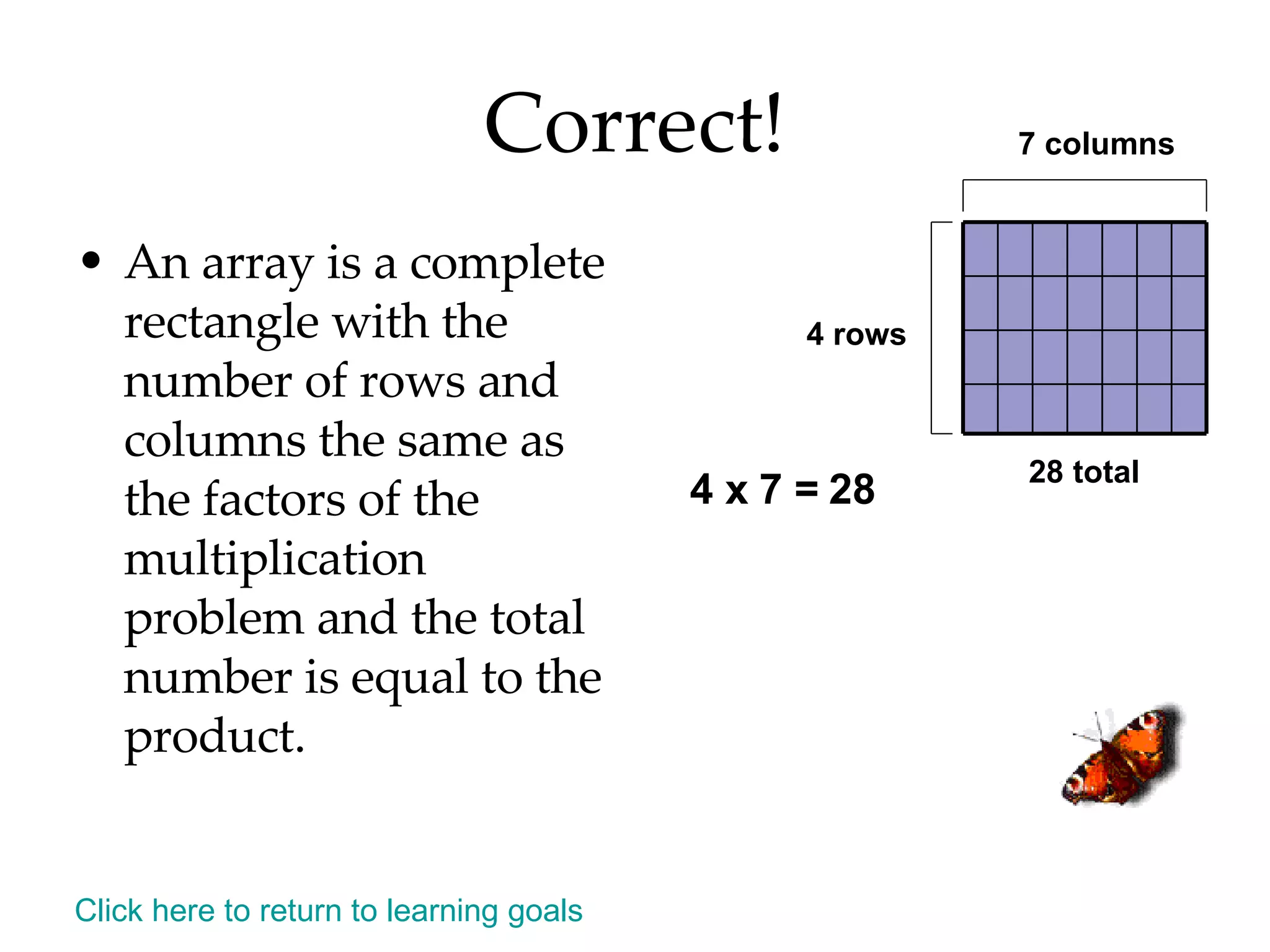
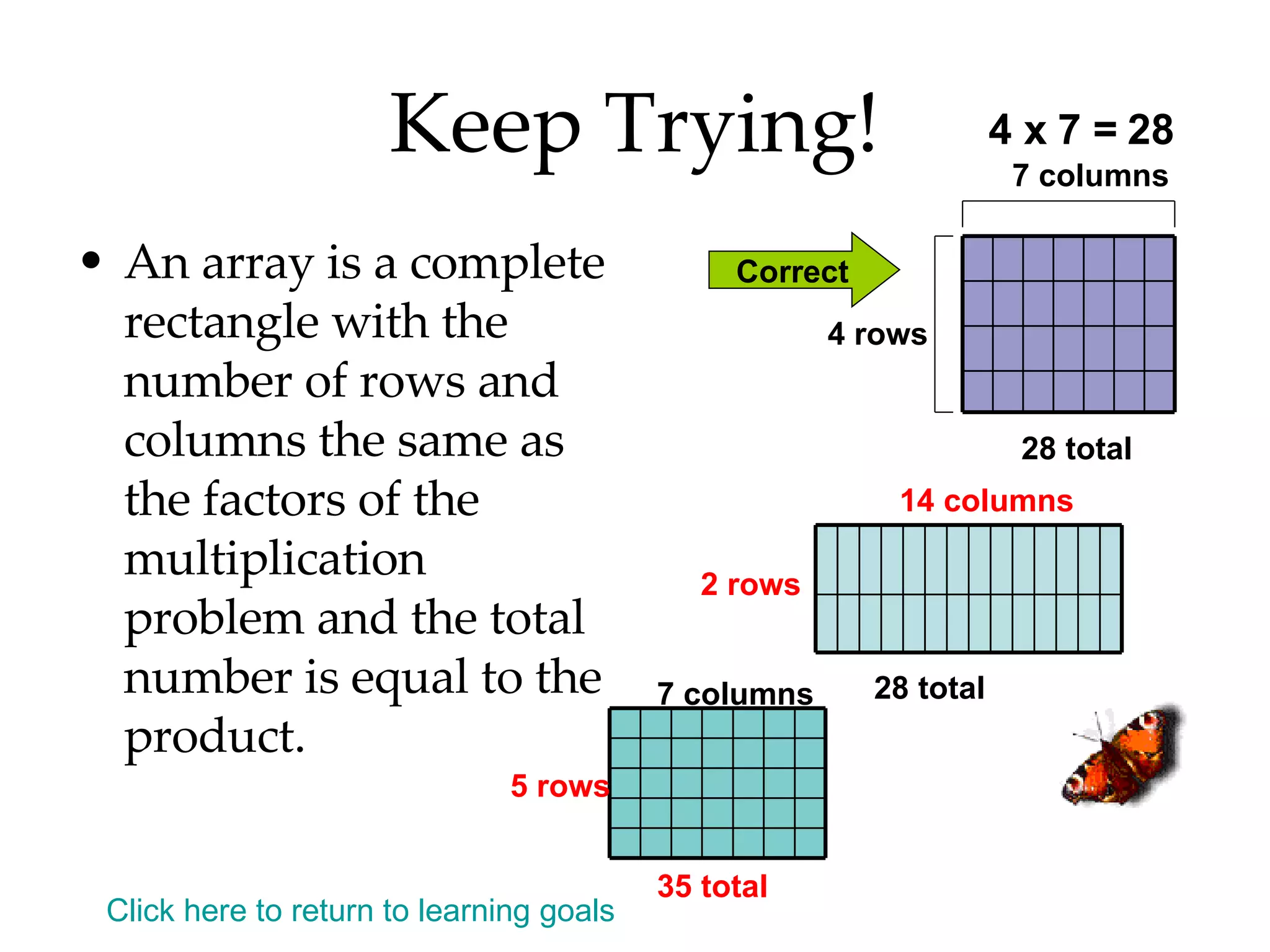
Correct! An array is a complete rectangle with the number of rows and columns the same as the factors of the multiplication problem and the total number is equal to the product. Click here to return to learning goals 4 x 7 = 28 4 rows 7 columns 28 total
Keep Trying! An array is a complete rectangle with the number of rows and columns the same as the factors of the multiplication problem and the total number is equal to the product. Click here to return to learning goals 4 x 7 = 28 Correct 2 rows 14 columns 28 total 5 rows 7 columns 35 total 4 rows 7 columns 28 total
Know Your Facts! Here are some links to help develop fact fluency: http:// www.multiplication.com /  http:// www.schoolexpress.com/funtime/math_generator/index.php   http:// www.multiplication.com/interactive_games.htm   Find more on  http:// guest.portaportal.com/renegar Click here to return to learning goals
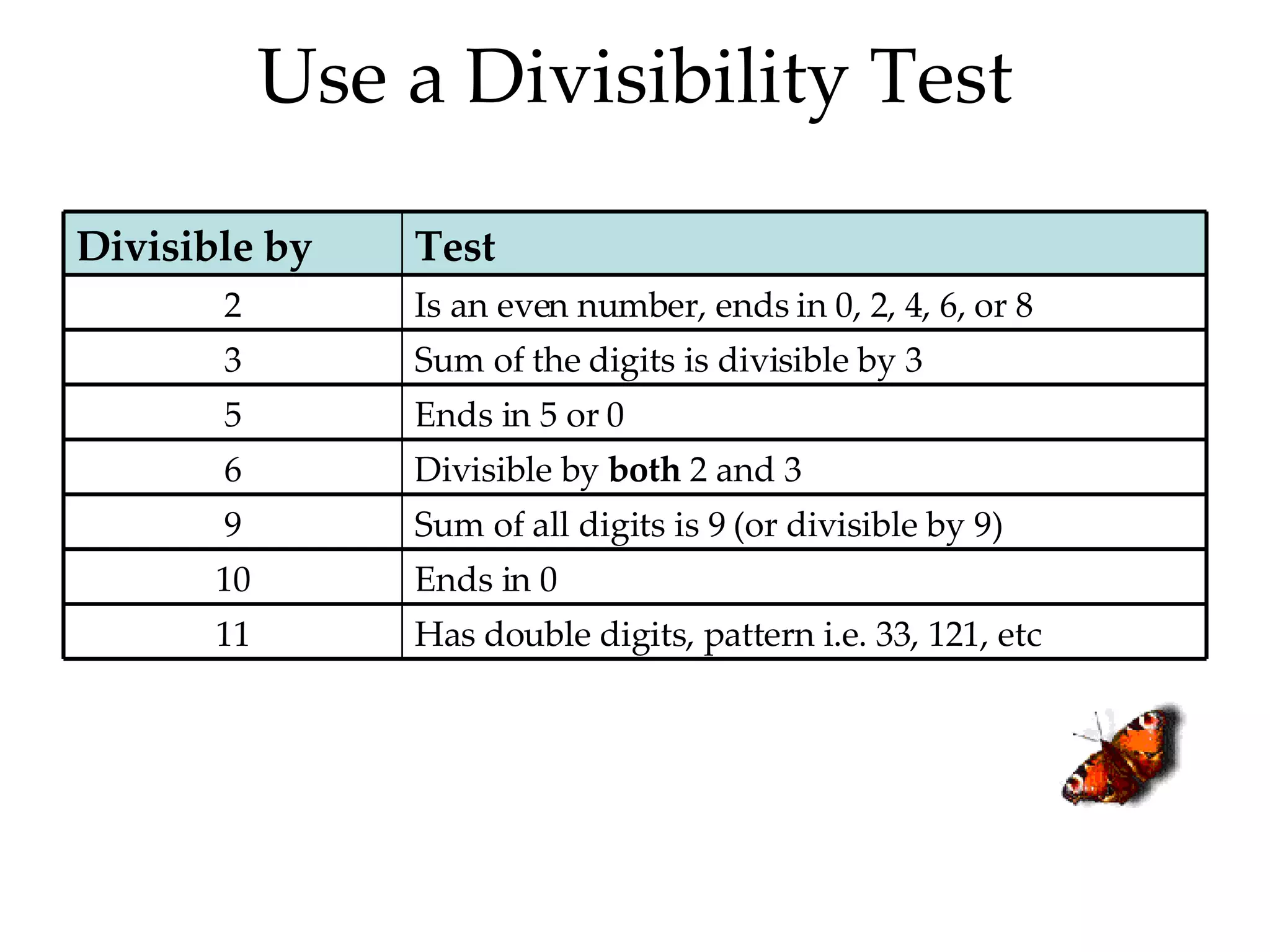
Use a Divisibility Test Has double digits, pattern i.e. 33, 121, etc 11 Ends in 0 10 Sum of all digits is 9 (or divisible by 9) 9 Divisible by  both  2 and 3 6 Ends in 5 or 0 5 Sum of the digits is divisible by 3 3 Is an even number, ends in 0, 2, 4, 6, or 8 2 Test Divisible by
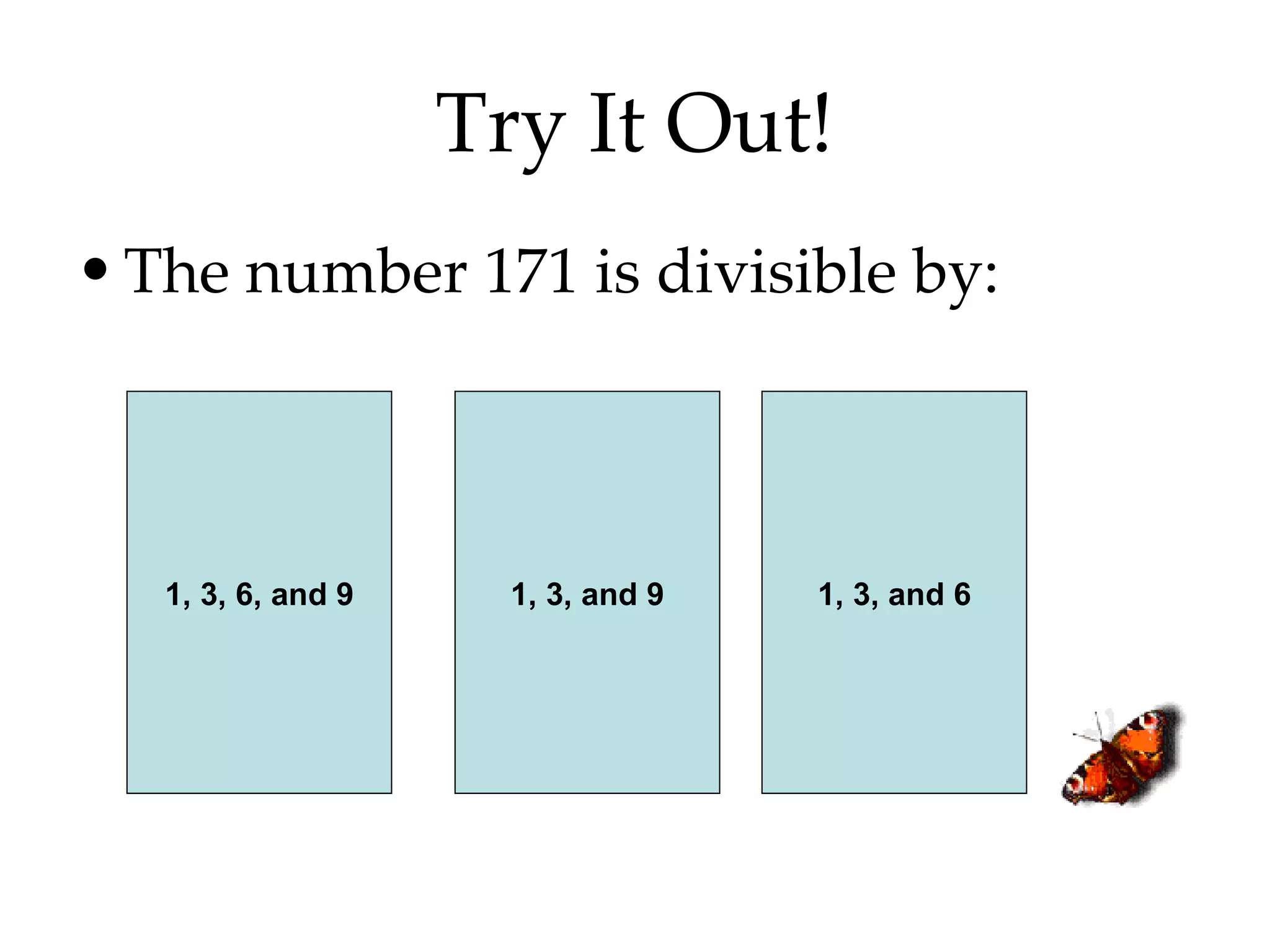
Try It Out! The number 171 is divisible by: 1, 3, 6, and 9 1, 3, and 9 1, 3, and 6
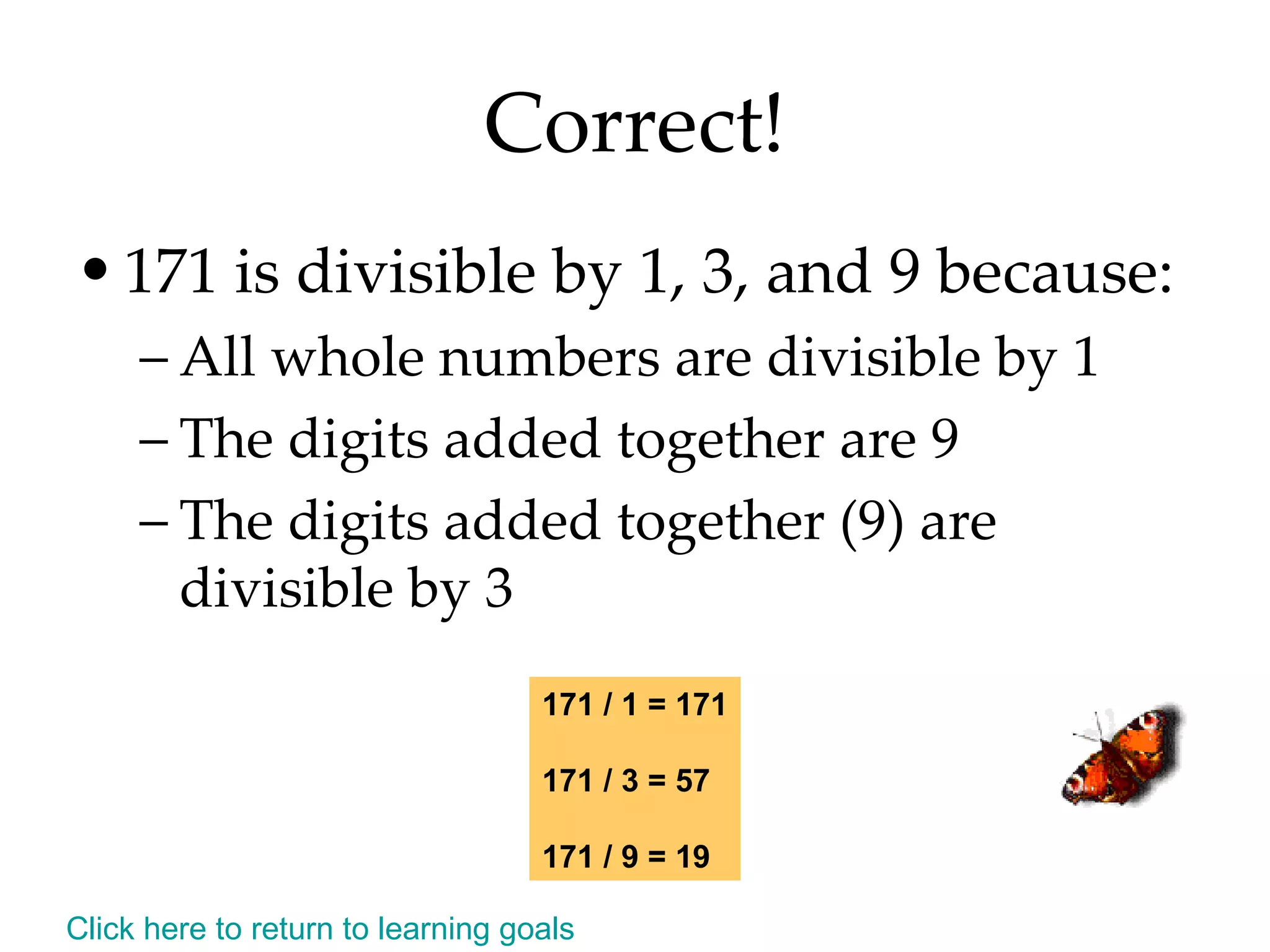
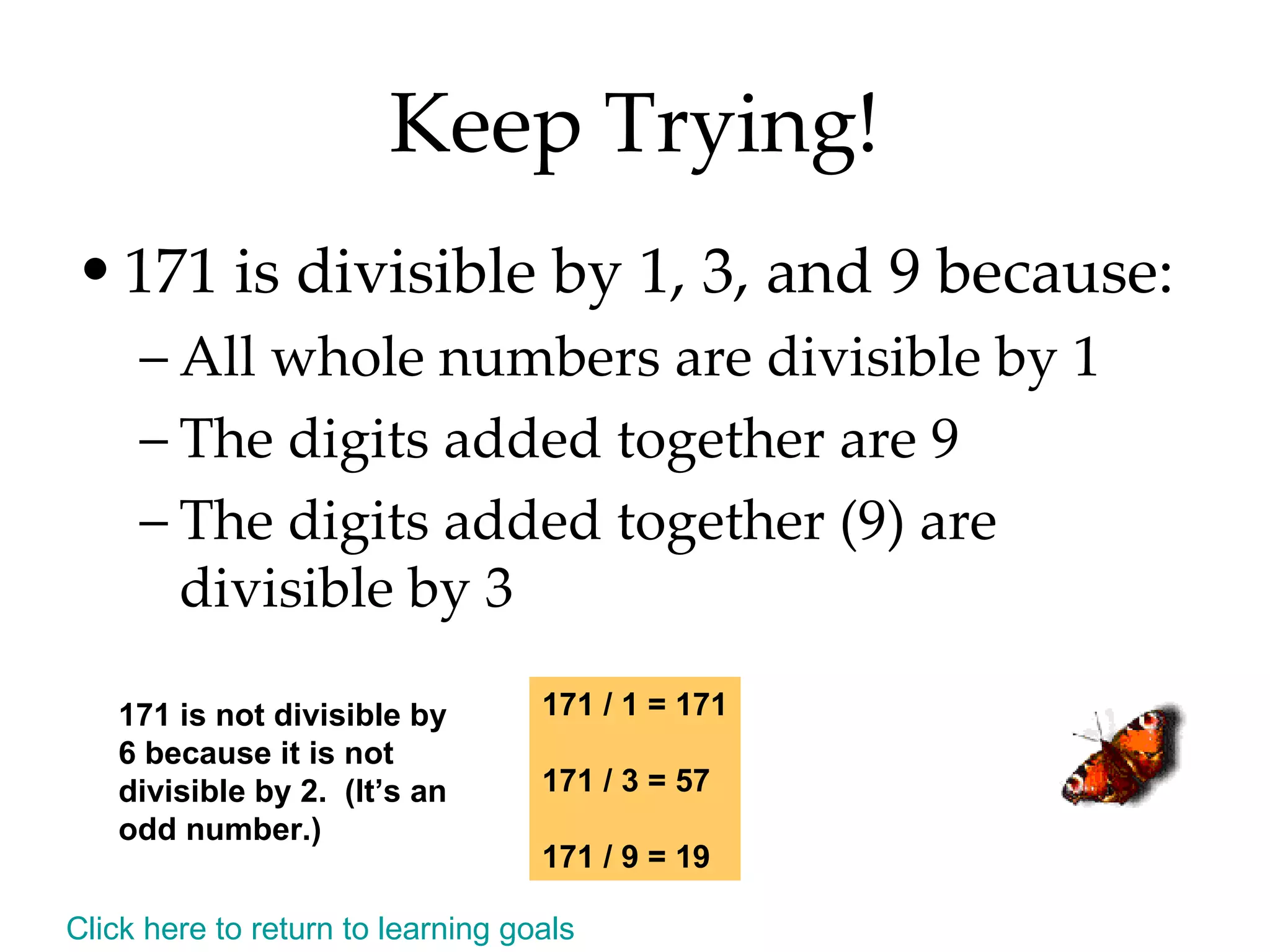
Correct! 171 is divisible by 1, 3, and 9 because: All whole numbers are divisible by 1 The digits added together are 9 The digits added together (9) are divisible by 3 171 / 1 = 171 171 / 3 = 57 171 / 9 = 19 Click here to return to learning goals
Keep Trying! 171 is divisible by 1, 3, and 9 because: All whole numbers are divisible by 1 The digits added together are 9 The digits added together (9) are divisible by 3 171 / 1 = 171 171 / 3 = 57 171 / 9 = 19 171 is not divisible by 6 because it is not divisible by 2.  (It’s an odd number.) Click here to return to learning goals
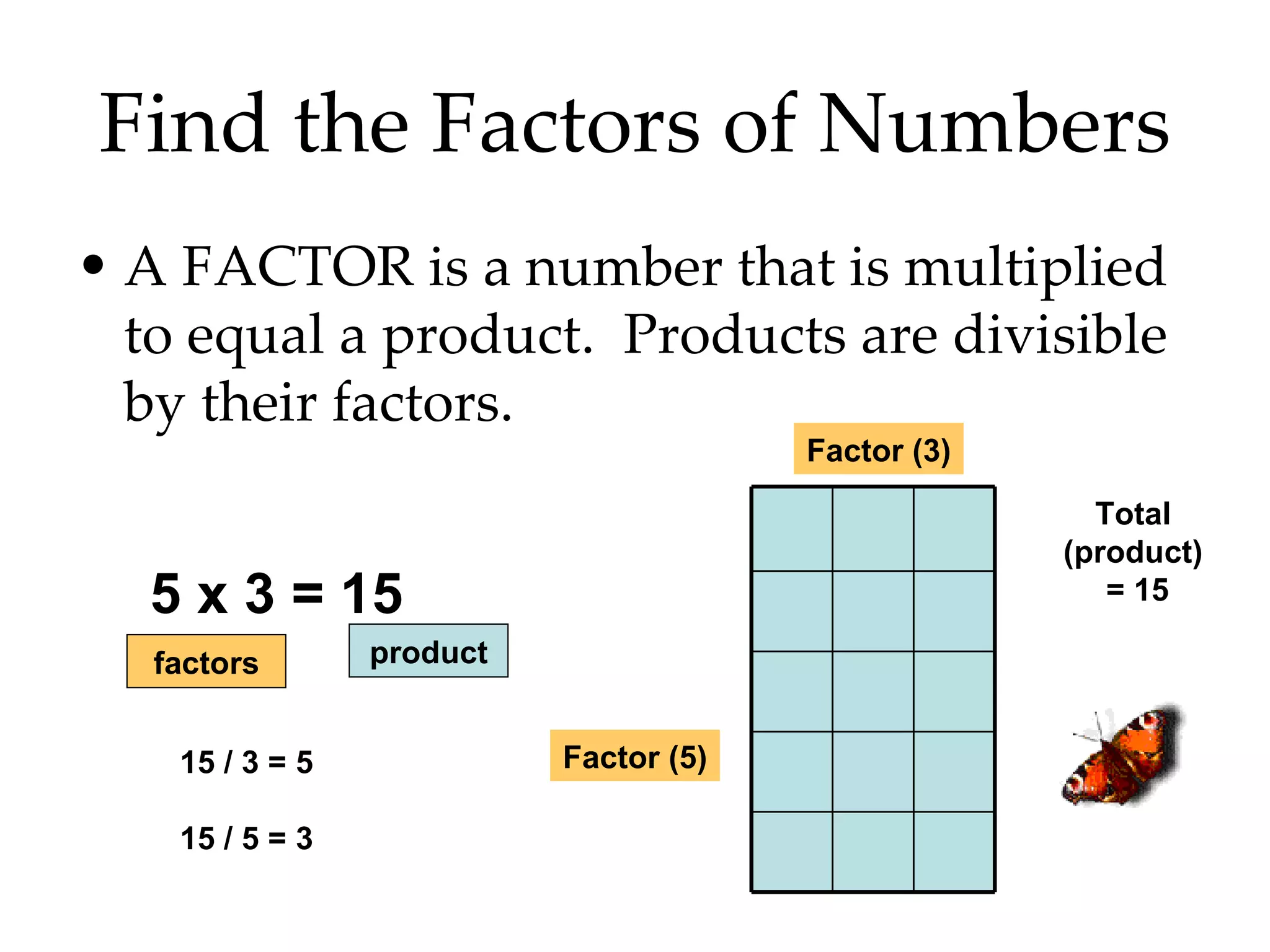
Find the Factors of Numbers A FACTOR is a number that is multiplied to equal a product.  Products are divisible by their factors. 5 x 3 = 15 factors product 15 / 3 = 5 15 / 5 = 3 Factor (5) Factor (3) Total (product) = 15
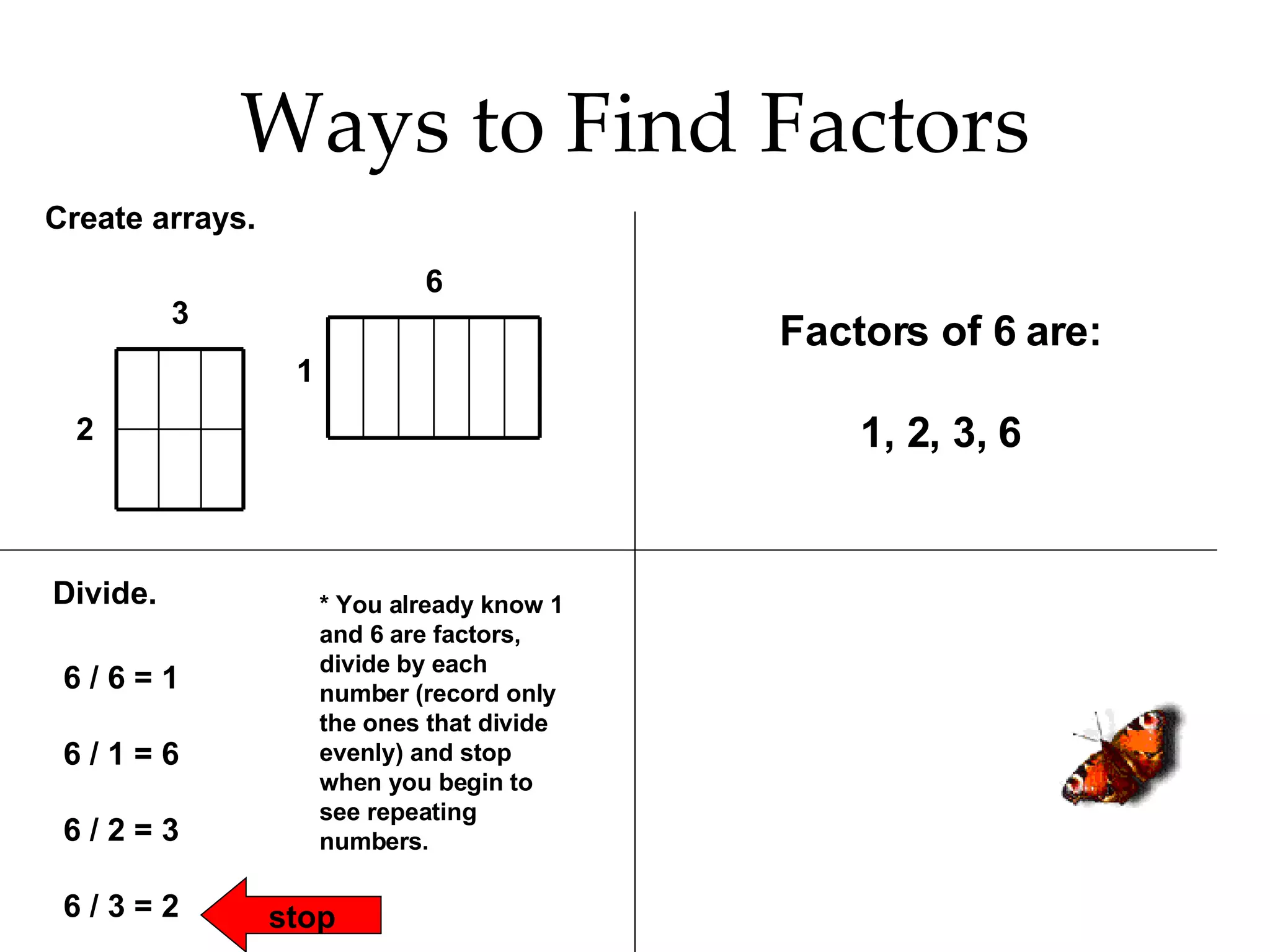
Ways to Find Factors Create arrays. Factors of 6 are: 1, 2, 3, 6 Divide. 6 / 6 = 1  6 / 1 = 6 6 / 2 = 3 6 / 3 = 2 * You already know 1 and 6 are factors, divide by each number (record only the ones that divide evenly) and stop when you begin to see repeating numbers. stop 2 3 1 6
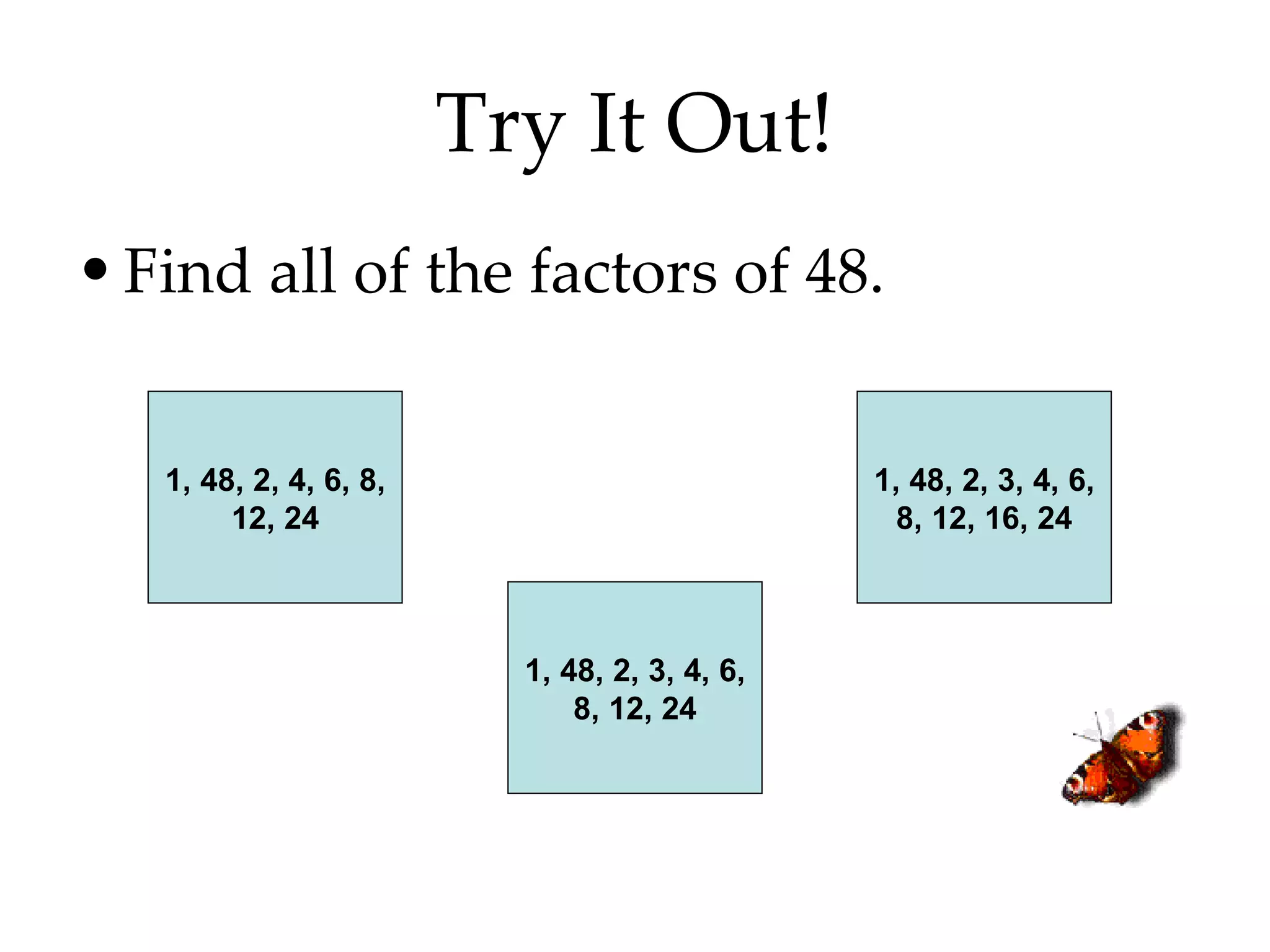
Try It Out! Find all of the factors of 48. 1, 48, 2, 4, 6, 8, 12, 24 1, 48, 2, 3, 4, 6, 8, 12, 24 1, 48, 2, 3, 4, 6, 8, 12, 16, 24
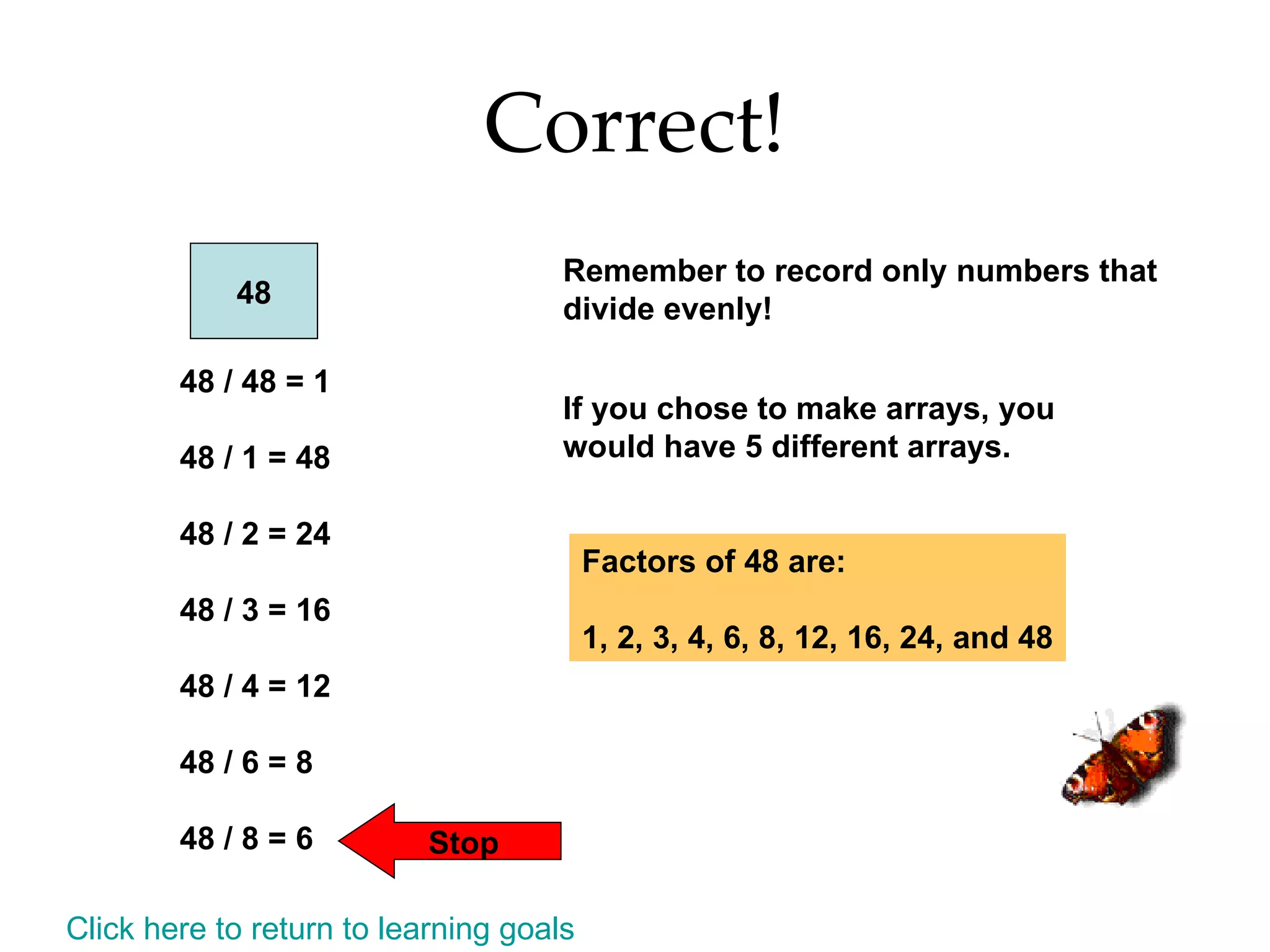
Correct! 48 48 / 48 = 1 48 / 1 = 48 48 / 2 = 24 48 / 3 = 16 48 / 4 = 12 48 / 6 = 8 48 / 8 = 6 Stop Remember to record only numbers that divide evenly! If you chose to make arrays, you would have 5 different arrays. Factors of 48 are: 1, 2, 3, 4, 6, 8, 12, 16, 24, and 48 Click here to return to learning goals
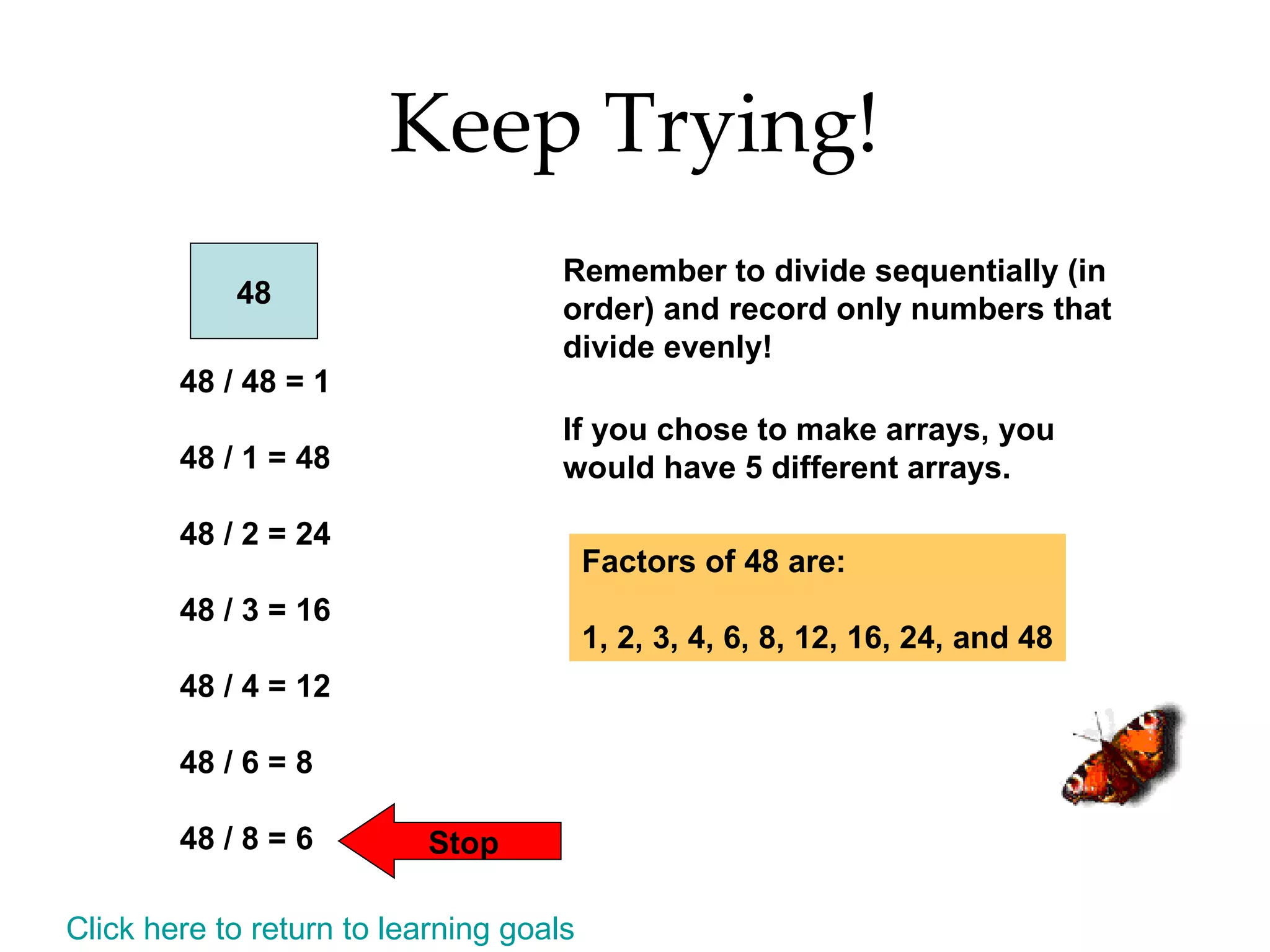
Keep Trying! 48 48 / 48 = 1 48 / 1 = 48 48 / 2 = 24 48 / 3 = 16 48 / 4 = 12 48 / 6 = 8 48 / 8 = 6 Stop Remember to divide sequentially (in order) and record only numbers that divide evenly! If you chose to make arrays, you would have 5 different arrays. Factors of 48 are: 1, 2, 3, 4, 6, 8, 12, 16, 24, and 48 Click here to return to learning goals
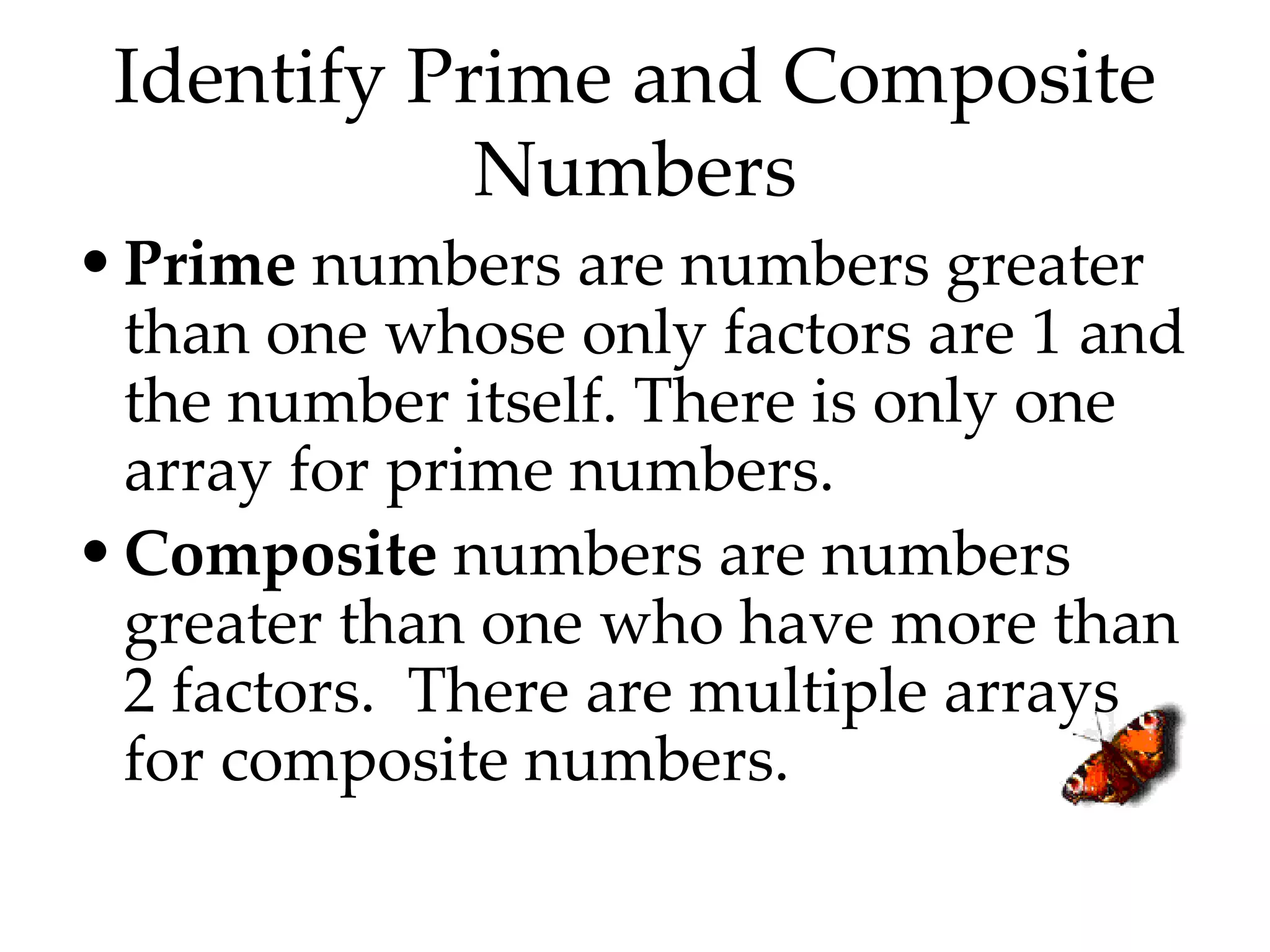
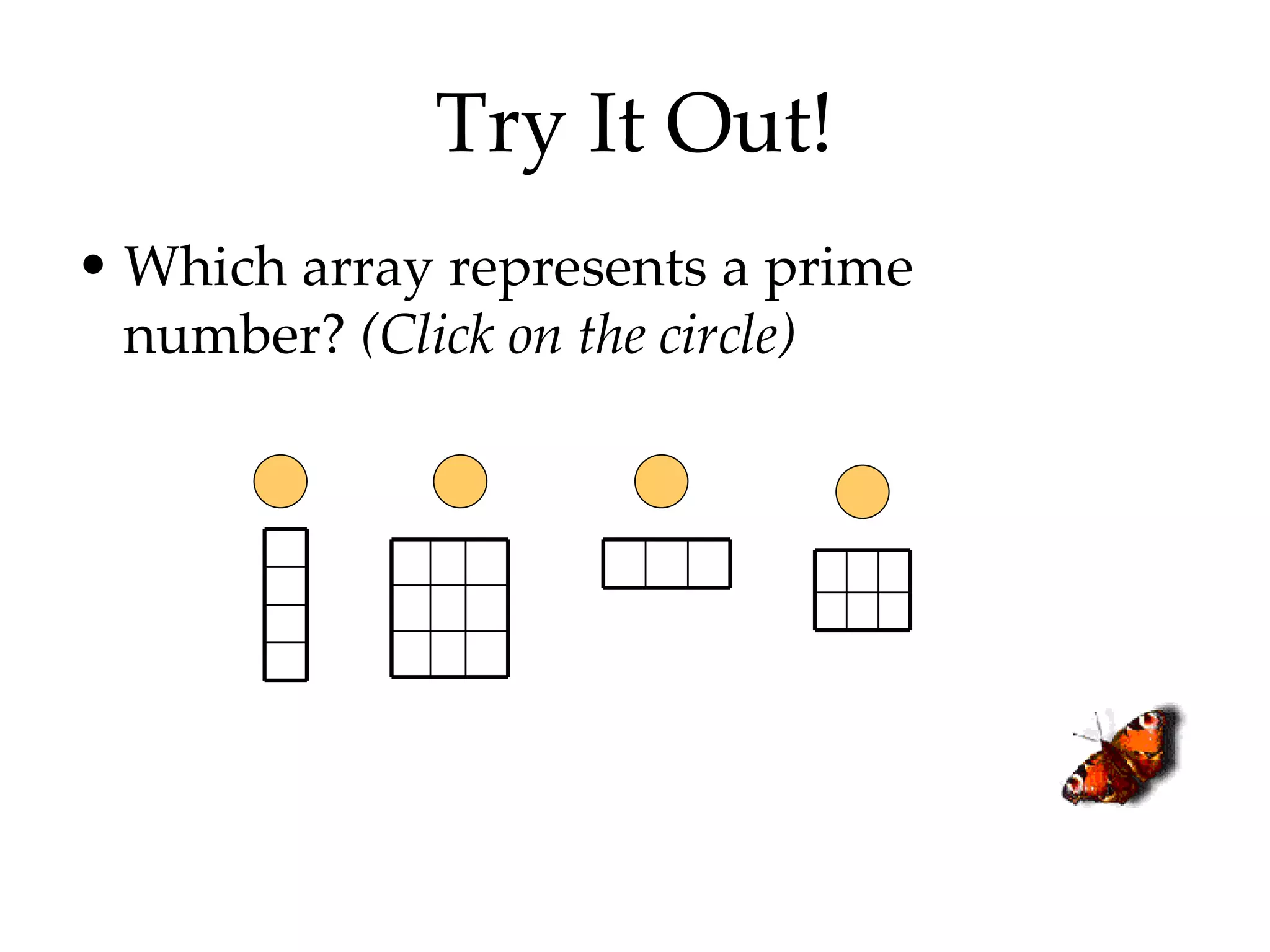
Identify Prime and Composite Numbers Prime  numbers are numbers greater than one whose only factors are 1 and the number itself. There is only one array for prime numbers. Composite  numbers are numbers greater than one who have more than 2 factors.  There are multiple arrays for composite numbers.
Try It Out! Which array represents a prime number?  (Click on the circle)
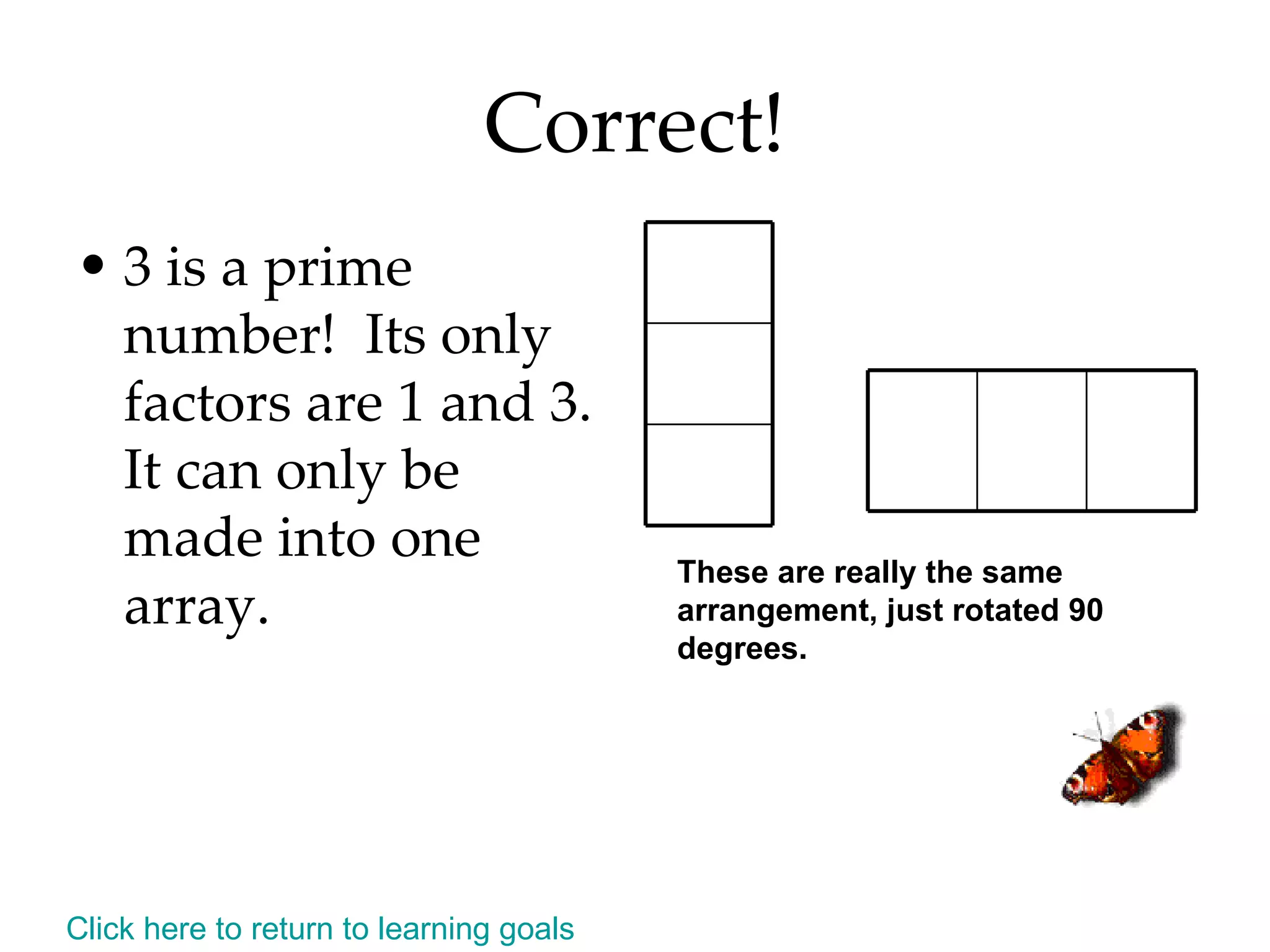
Correct! 3 is a prime number!  Its only factors are 1 and 3.  It can only be made into one array. These are really the same arrangement, just rotated 90 degrees. Click here to return to learning goals
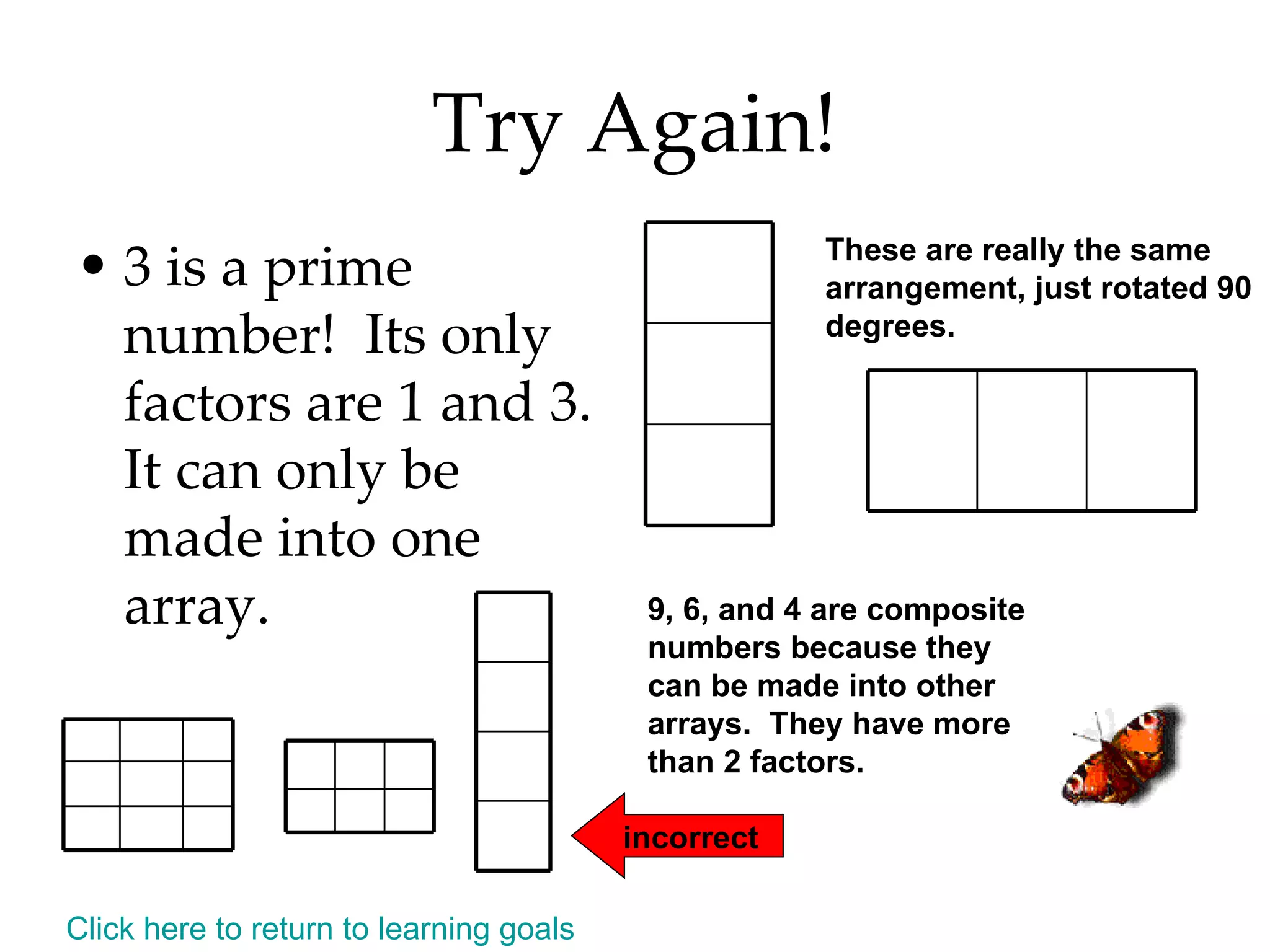
Try Again! 3 is a prime number!  Its only factors are 1 and 3.  It can only be made into one array. These are really the same arrangement, just rotated 90 degrees. incorrect 9, 6, and 4 are composite numbers because they can be made into other arrays.  They have more than 2 factors. Click here to return to learning goals
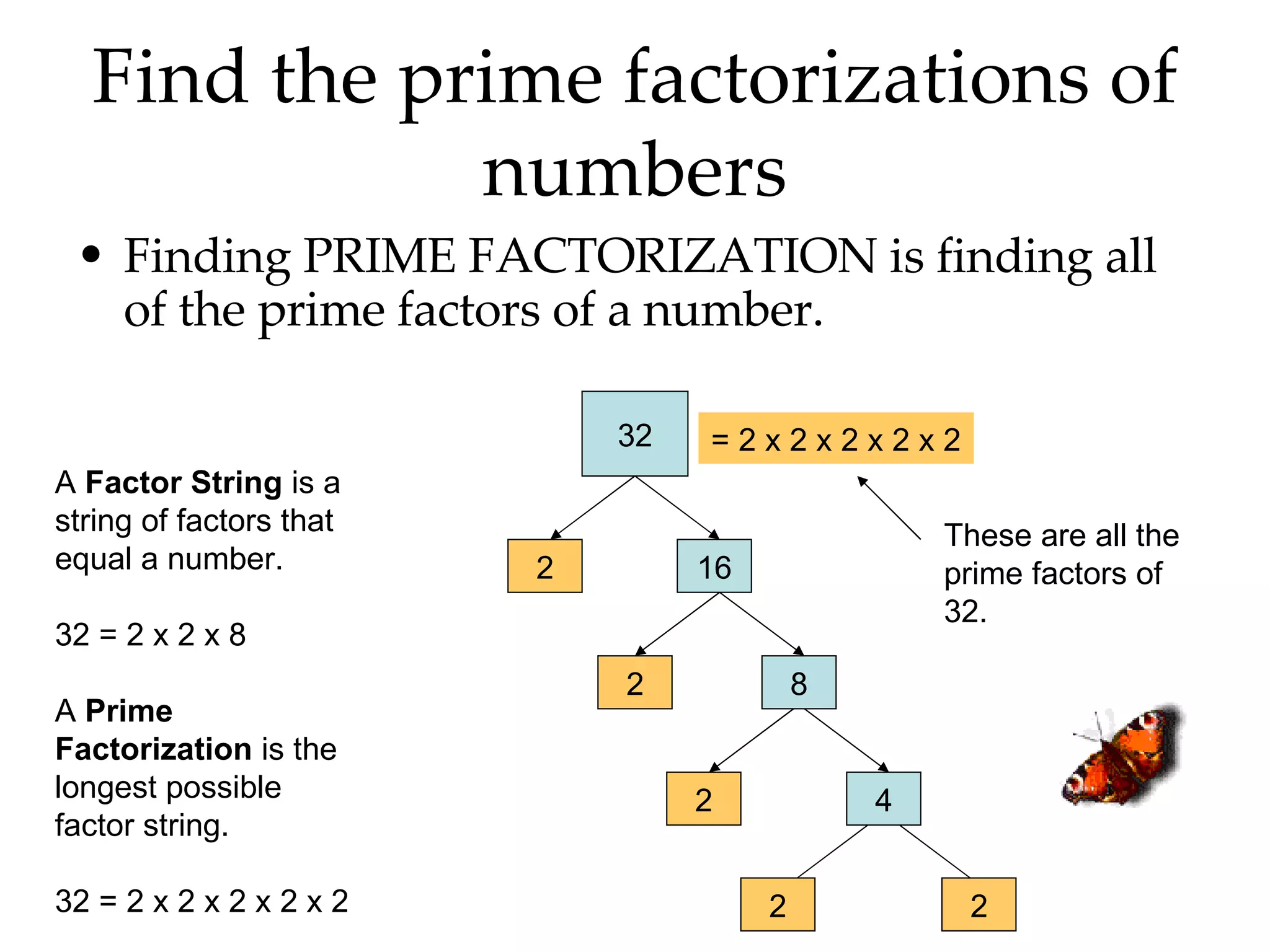
Find the prime factorizations of numbers Finding PRIME FACTORIZATION is finding all of the prime factors of a number. 32 2 16 2 8 2 4 2 2 = 2 x 2 x 2 x 2 x 2 These are all the prime factors of 32. A  Factor String  is a string of factors that equal a number. 32 = 2 x 2 x 8 A  Prime Factorization  is the longest possible factor string. 32 = 2 x 2 x 2 x 2 x 2
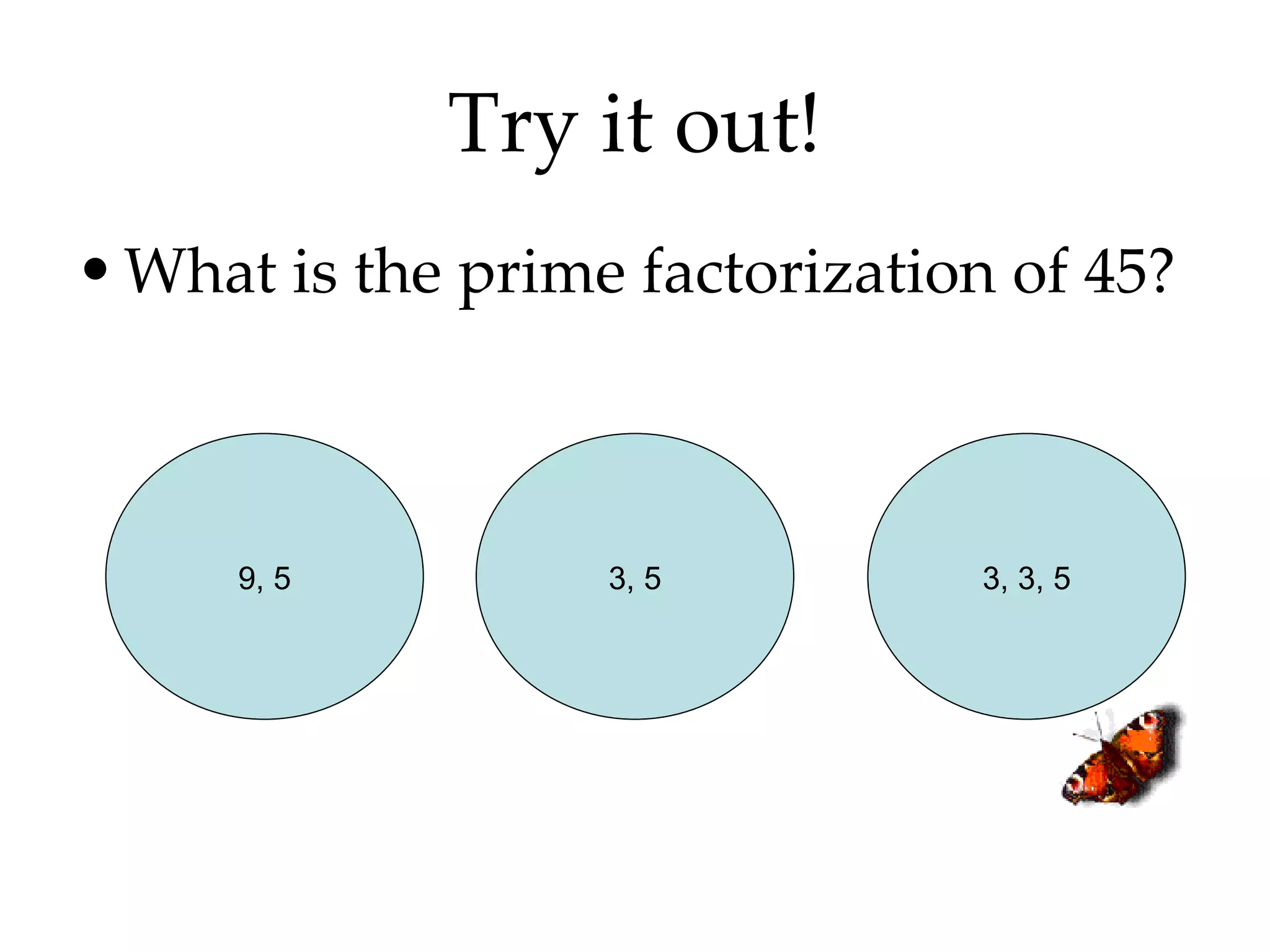
Try it out! What is the prime factorization of 45? 9, 5 3, 5 3, 3, 5
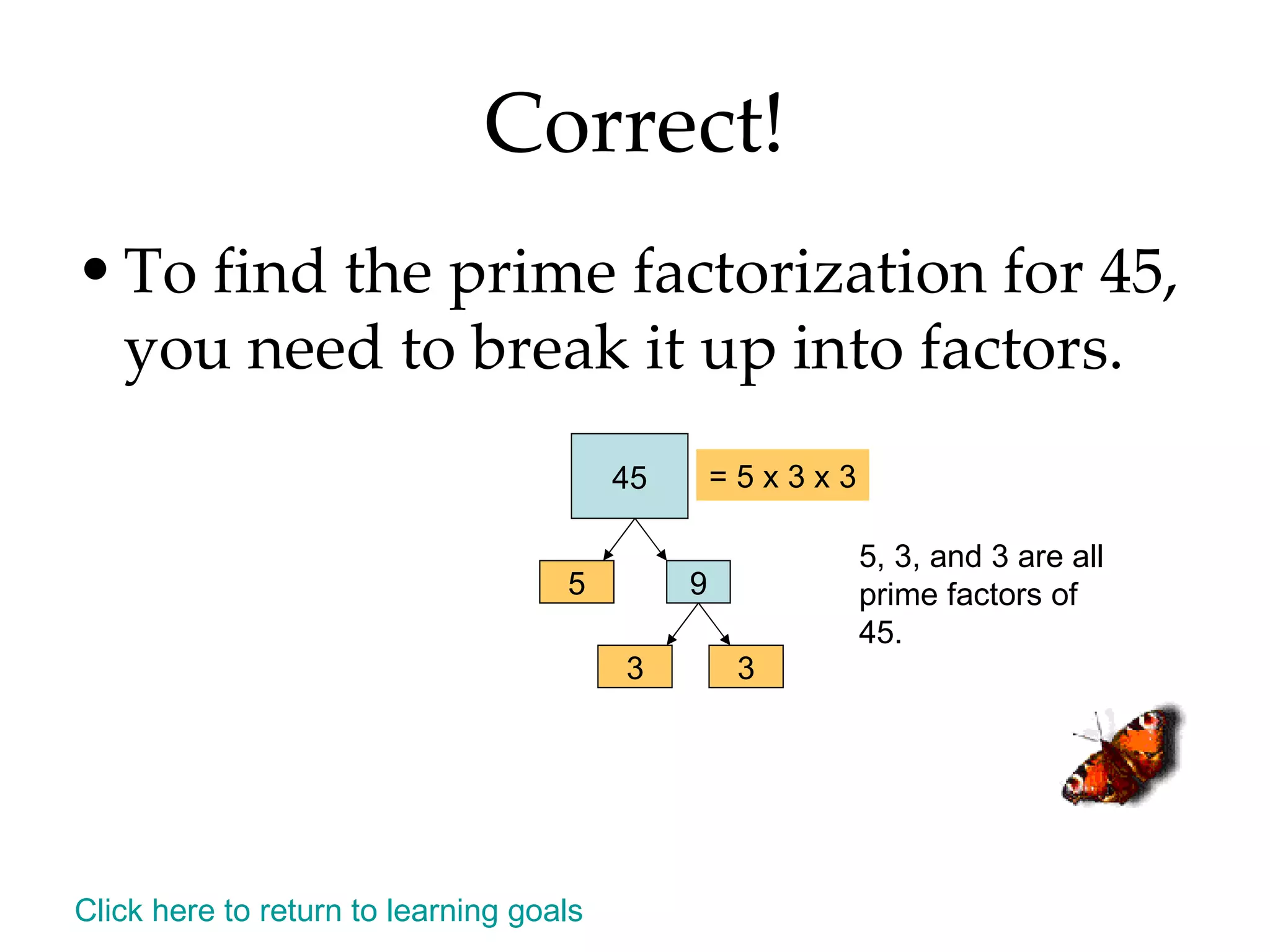
Correct! To find the prime factorization for 45, you need to break it up into factors. Click here to return to learning goals 45 5 9 3 3 = 5 x 3 x 3 5, 3, and 3 are all prime factors of 45.
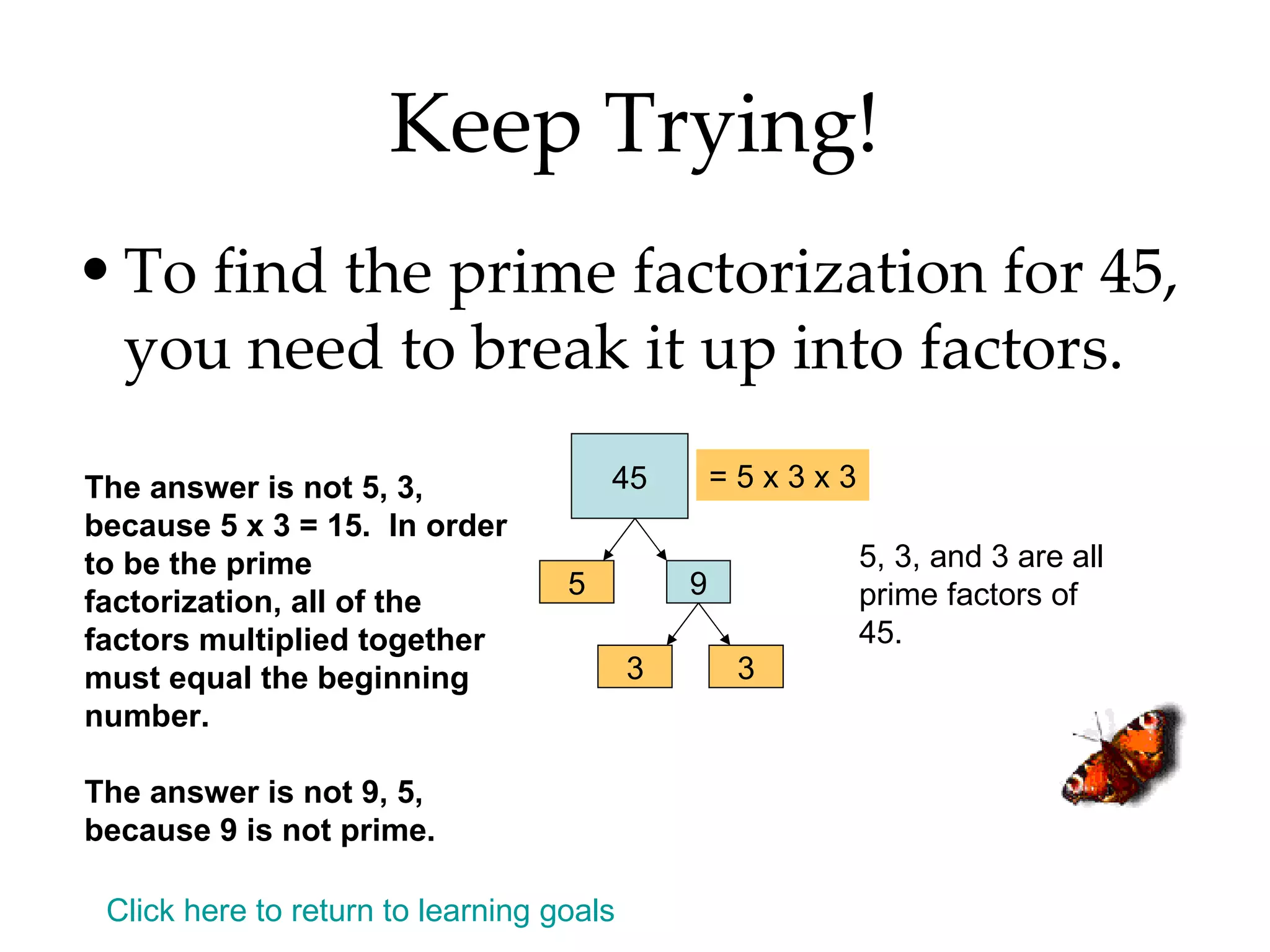
Keep Trying! To find the prime factorization for 45, you need to break it up into factors. The answer is not 5, 3, because 5 x 3 = 15.  In order to be the prime factorization, all of the factors multiplied together must equal the beginning number. The answer is not 9, 5, because 9 is not prime. Click here to return to learning goals 45 5 9 3 3 = 5 x 3 x 3 5, 3, and 3 are all prime factors of 45.
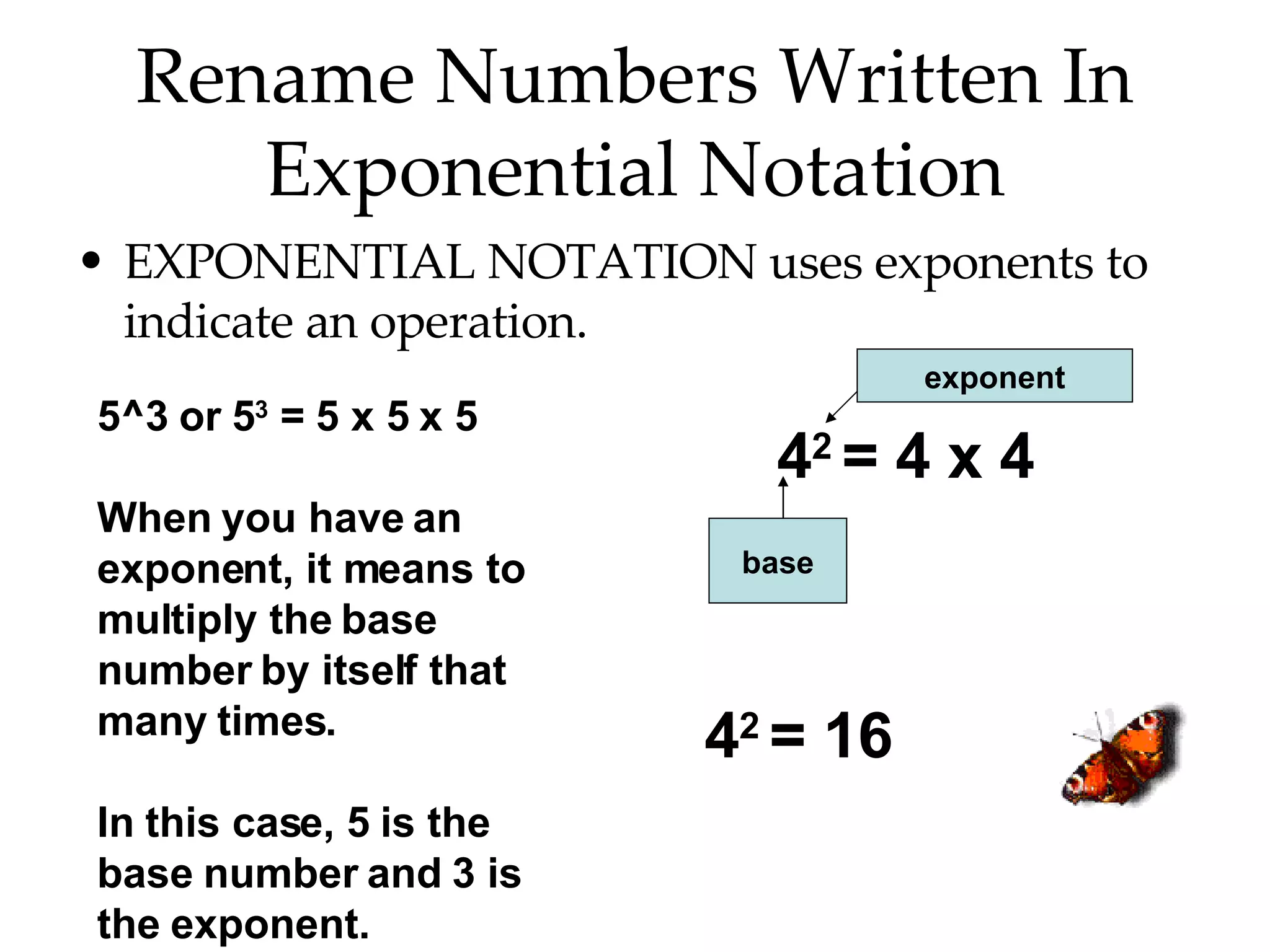
Rename Numbers Written In Exponential Notation EXPONENTIAL NOTATION uses exponents to indicate an operation. 5^3 or 5 3  = 5 x 5 x 5 When you have an exponent, it means to multiply the base number by itself that many times. In this case, 5 is the base number and 3 is the exponent. 4 2  = 4 x 4 base exponent 4 2  = 16
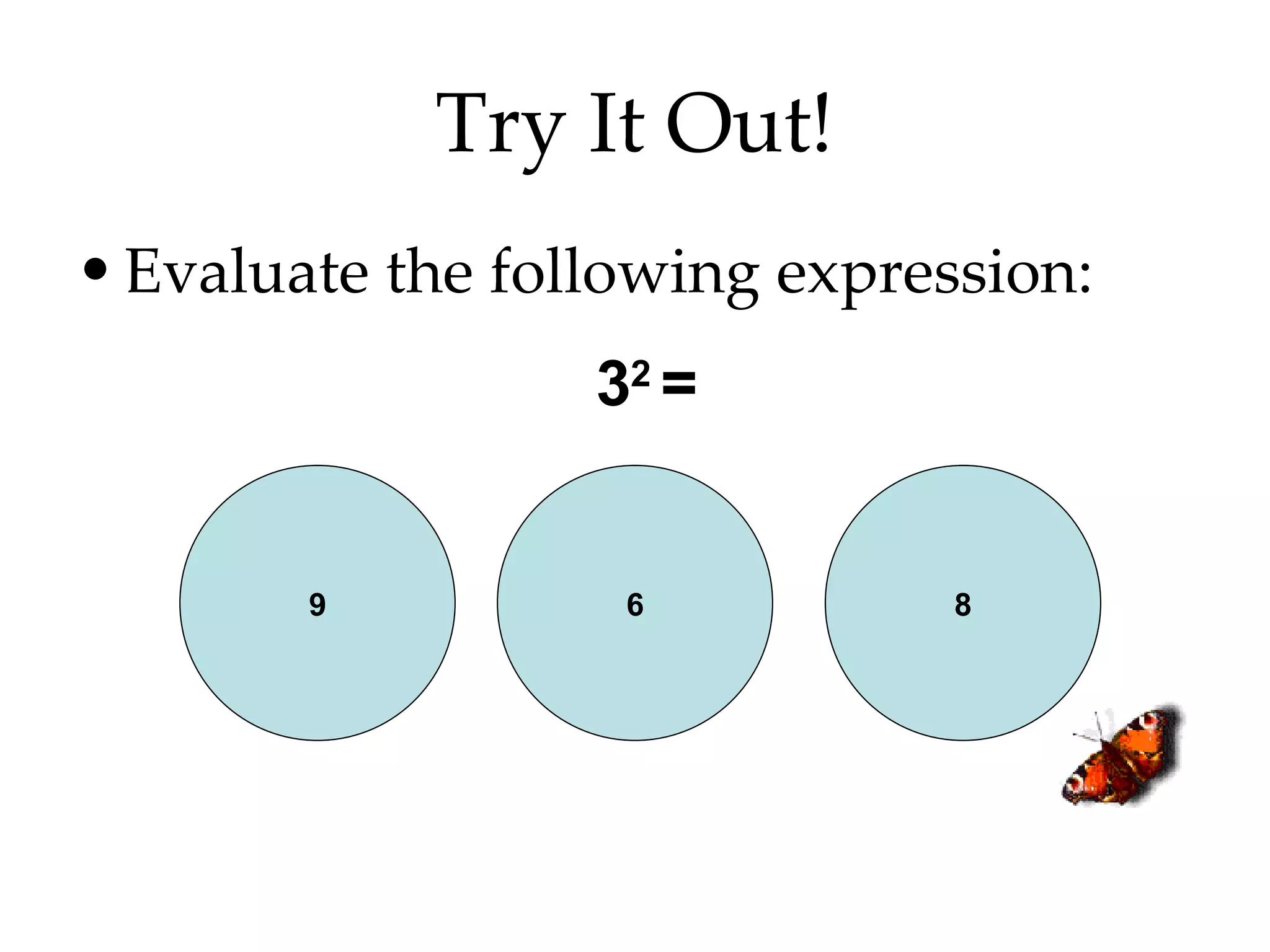
Try It Out! Evaluate the following expression: 3 2  = 9 6 8
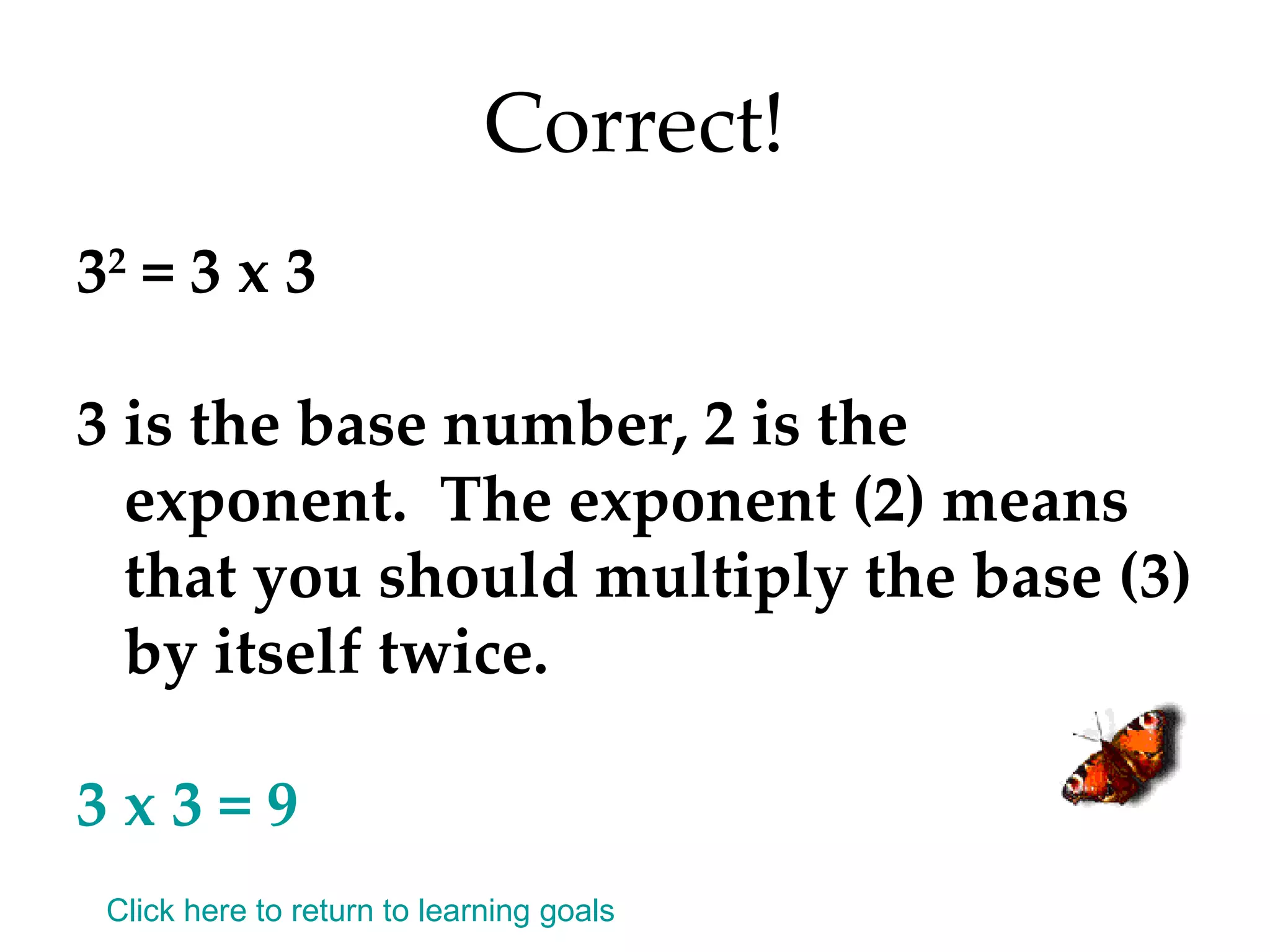
Correct! 3 2  = 3 x 3 3 is the base number, 2 is the exponent.  The exponent (2) means that you should multiply the base (3) by itself twice. 3 x 3 = 9 Click here to return to learning goals
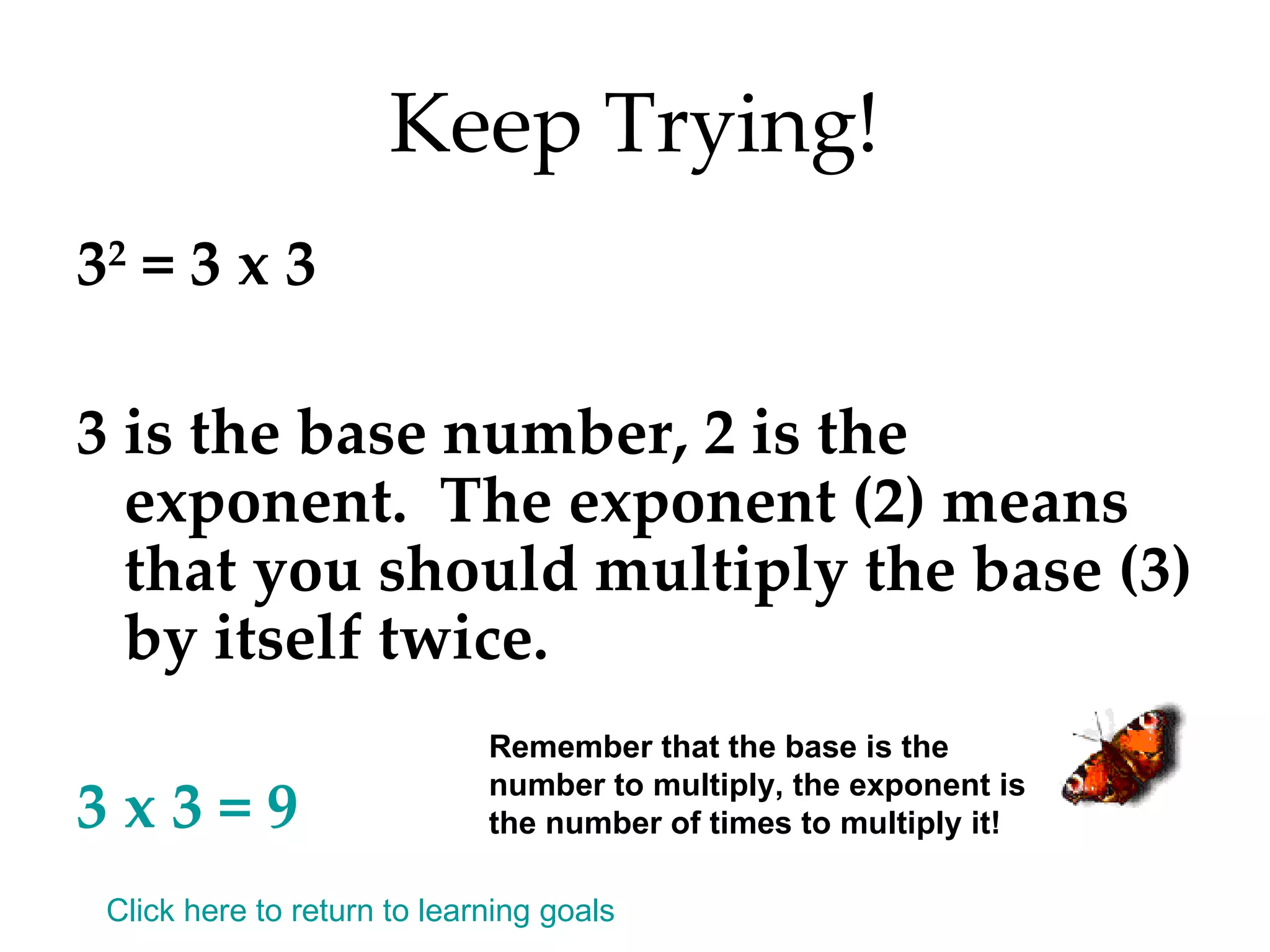
Keep Trying! 3 2  = 3 x 3 3 is the base number, 2 is the exponent.  The exponent (2) means that you should multiply the base (3) by itself twice. 3 x 3 = 9 Remember that the base is the number to multiply, the exponent is the number of times to multiply it! Click here to return to learning goals
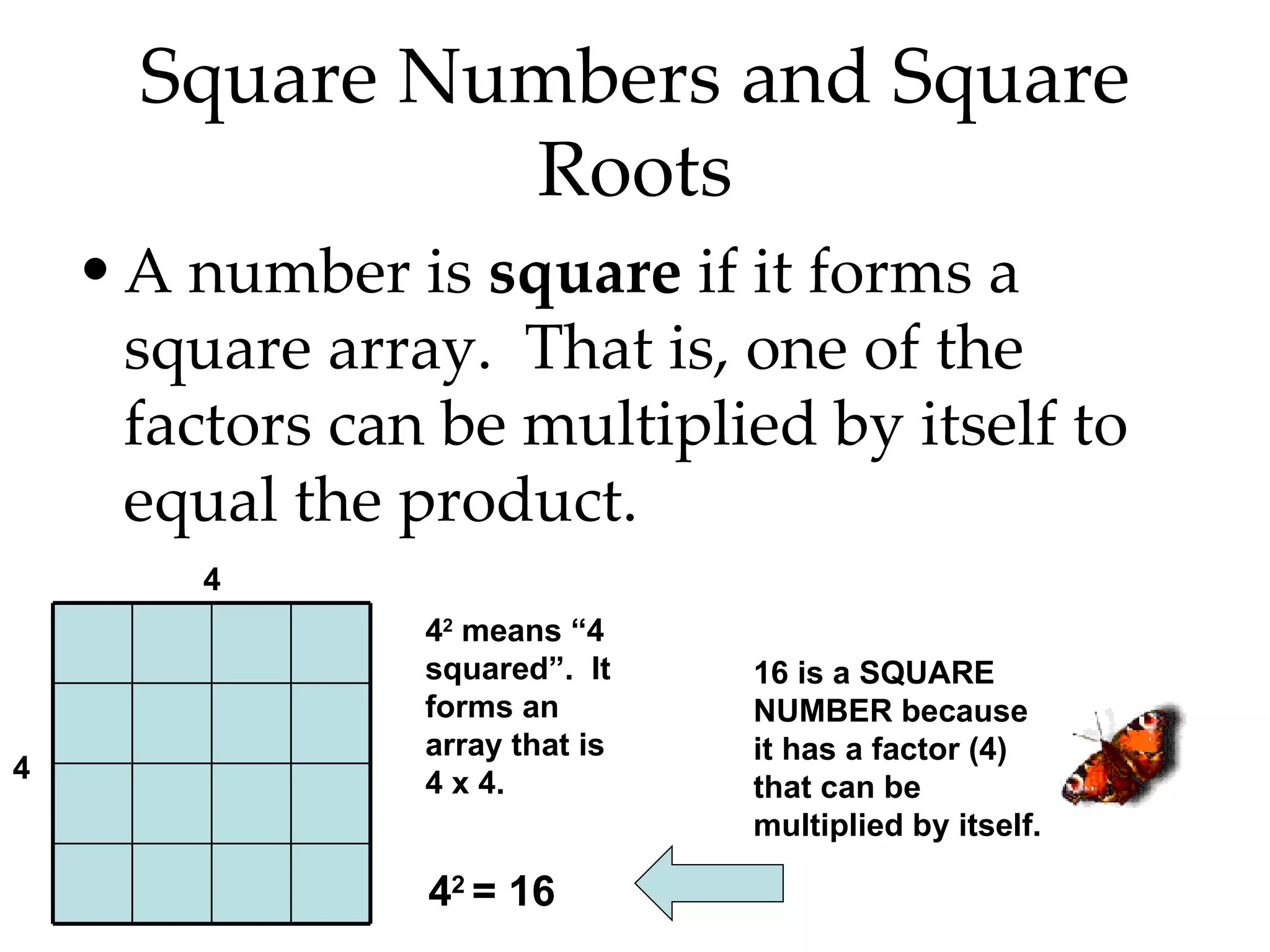
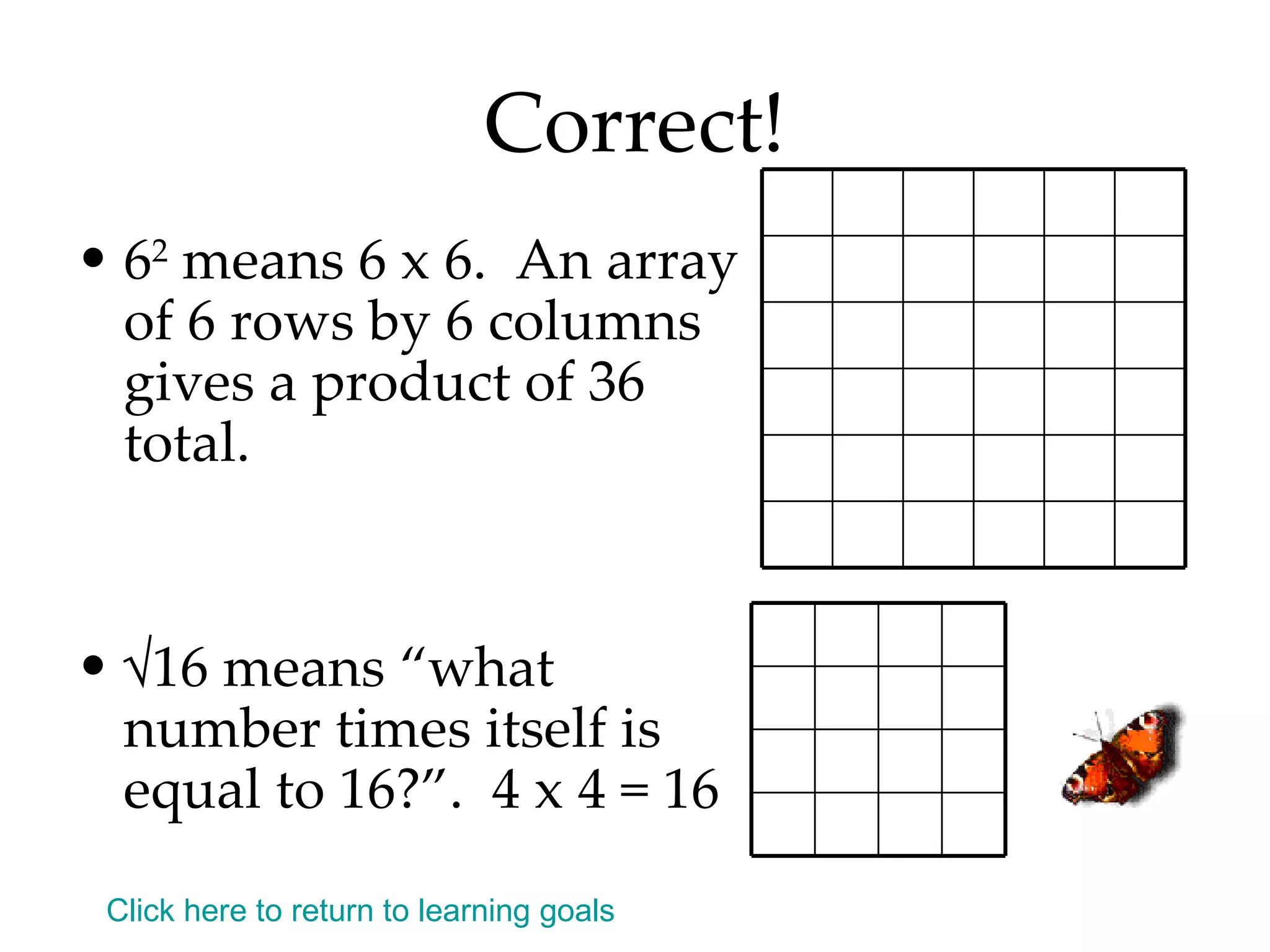
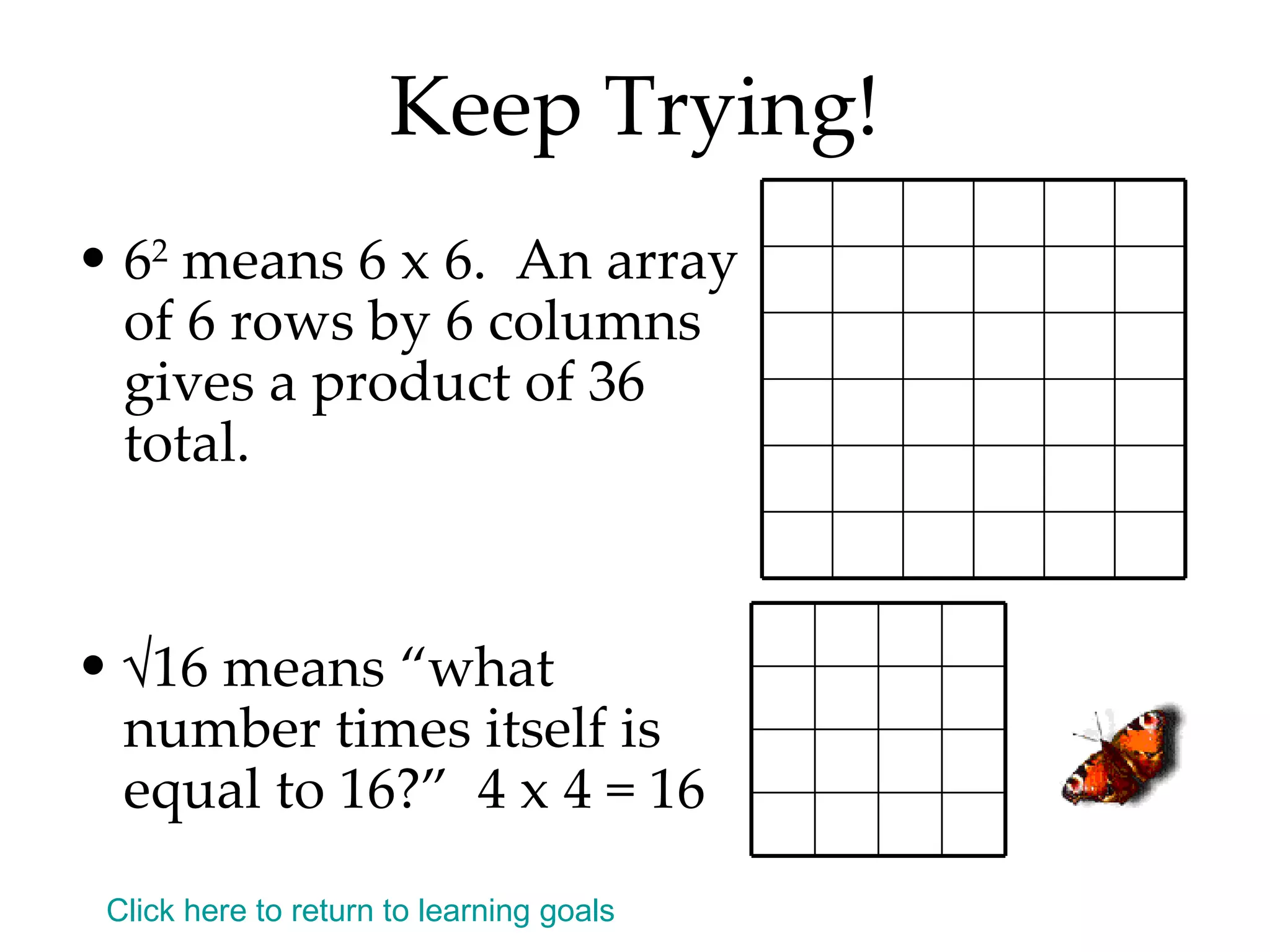
Square Numbers and Square Roots A number is  square  if it forms a square array.  That is, one of the factors can be multiplied by itself to equal the product. 4 2  means “4 squared”.  It forms an array that is 4 x 4. 4 2  = 16 4  4  16 is a SQUARE NUMBER because it has a factor (4) that can be multiplied by itself.
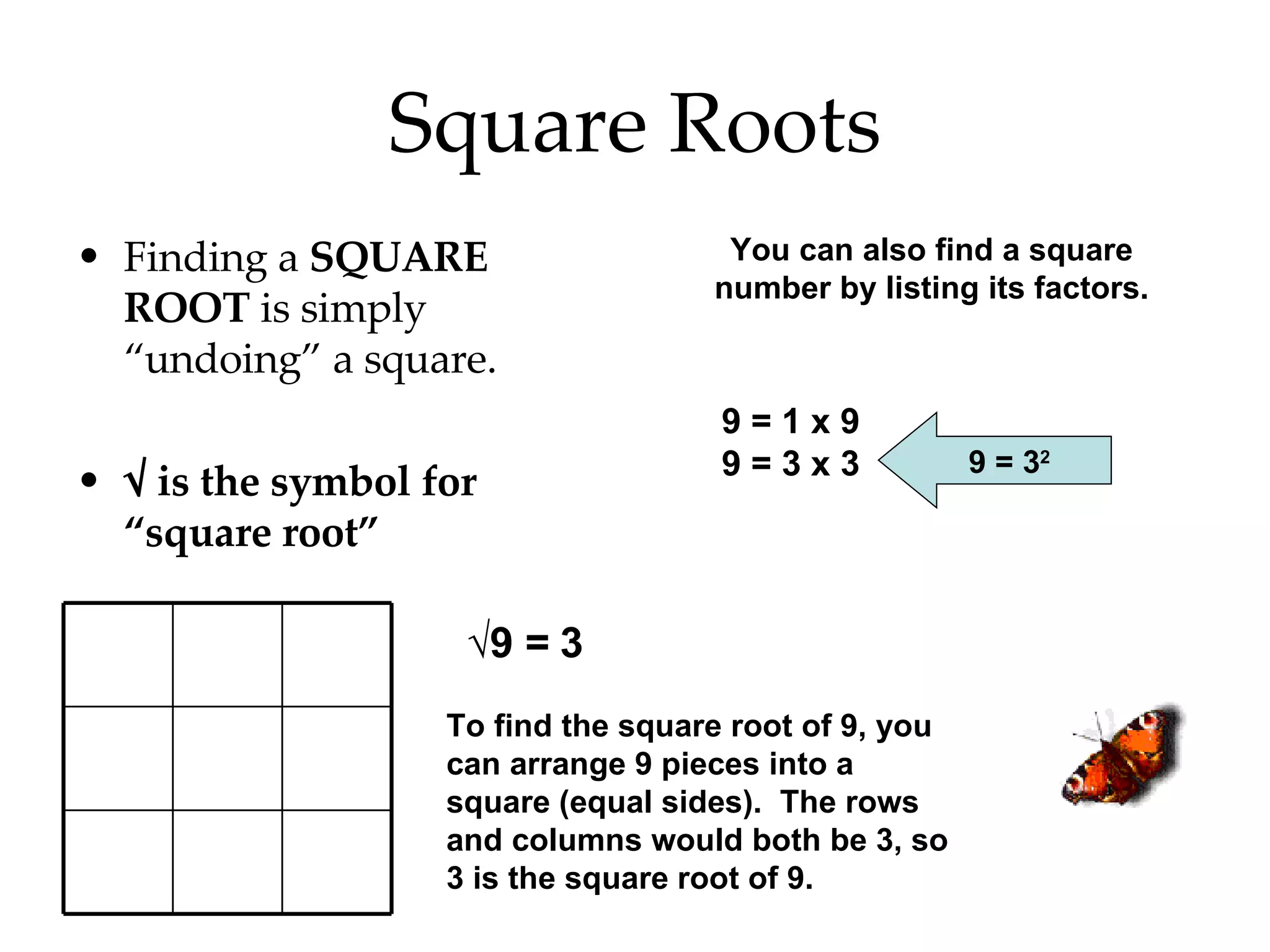
Square Roots Finding a  SQUARE ROOT  is simply “undoing” a square. √  is the symbol for “square root” √ 9 = 3 To find the square root of 9, you can arrange 9 pieces into a square (equal sides).  The rows and columns would both be 3, so 3 is the square root of 9. You can also find a square number by listing its factors. 9 = 1 x 9 9 = 3 x 3 9 = 3 2
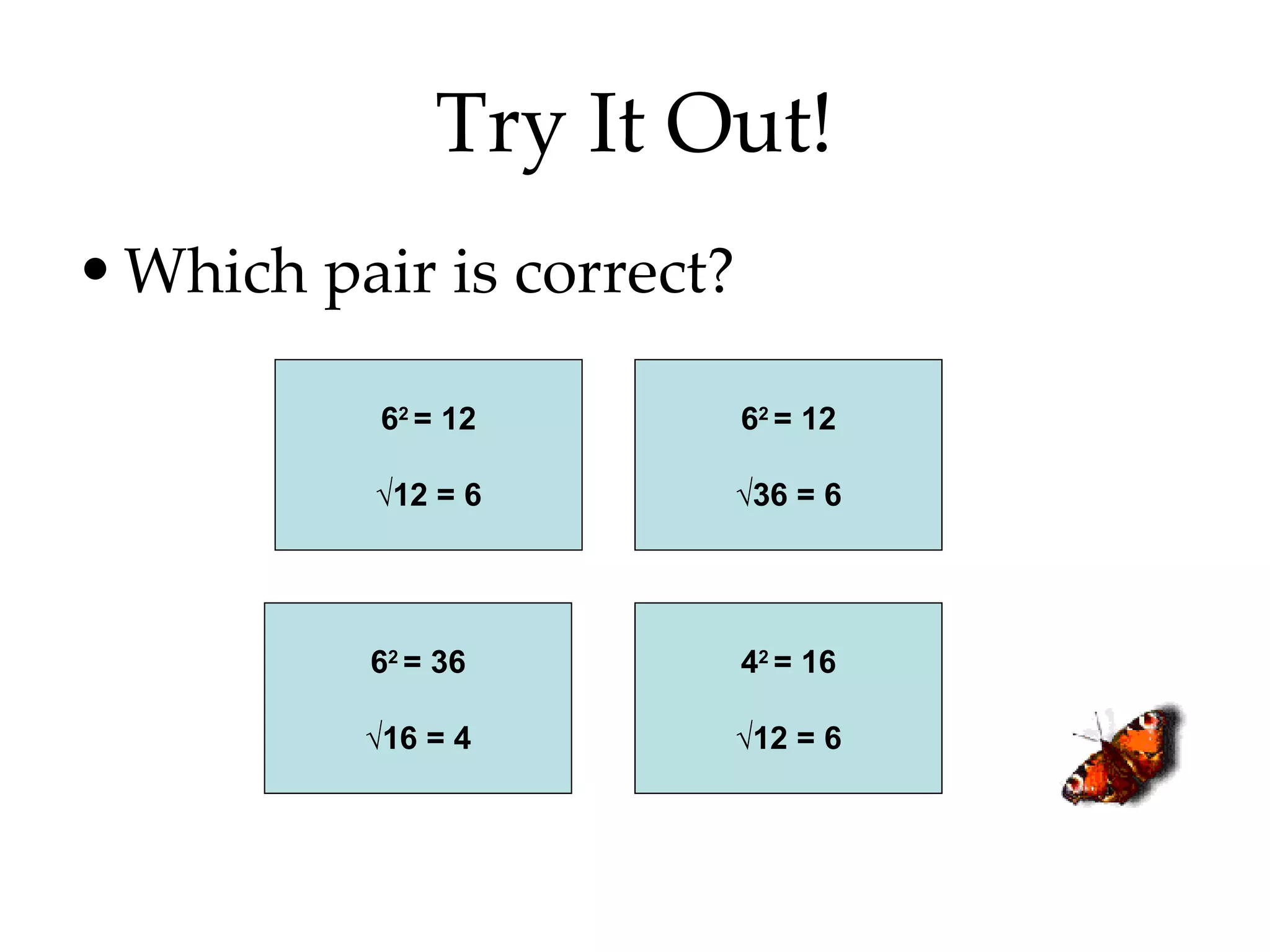
Try It Out! Which pair is correct? 6 2  = 12 √ 12 = 6 6 2  = 36 √ 16 = 4 6 2  = 12 √ 36 = 6 4 2  = 16 √ 12 = 6
Correct! 6 2  means 6 x 6.  An array of 6 rows by 6 columns gives a product of 36 total. √ 16 means “what number times itself is equal to 16?”.  4 x 4 = 16 Click here to return to learning goals
Keep Trying! 6 2  means 6 x 6.  An array of 6 rows by 6 columns gives a product of 36 total. √ 16 means “what number times itself is equal to 16?”  4 x 4 = 16 Click here to return to learning goals

Unit 1 Number Theory (5th Grade)

  • 1.
    Unit 1: NumberTheory 5 th Grade
  • 2.
    Learning Goals Identifyeven and odd numbers. Draw arrays to model multiplication. Know multiplication facts. Use a divisibility test to determine if a number is divisible by another number. Find the factors of numbers. Identify prime and composite numbers. Find the prime factorizations of numbers. Rename numbers written in exponential notation. Understand how square numbers and their square roots are related.
  • 3.
    Even and OddNumbers An EVEN number is divisible into two equal whole amounts. An ODD number is not divisible into two equal whole amounts. 8 is even because it can be divided into two equal whole amounts. 7 is odd because it cannot be divided into two equal whole amounts.
  • 4.
    Try it out!Which circle contains only odd numbers? 9, 5, 7, 4, 17, 23 3, 5, 8, 21, 29, 43 3, 9, 21, 43, 5, 15
  • 5.
    Correct! Odd numbersare not evenly divisible by 2. Click here to return to learning goals 1 2 Even Odd 3 5 7 9 11 13 15 17 4 6 8 10 12 14 16 18
  • 6.
    Keep Trying! Oddnumbers are not evenly divisible by 2. 9, 5, 7, 4, 17, 23 3, 5, 8, 21, 29, 43 Neither one of these groups of numbers is all odd because 4 and 8 are both even numbers. Click here to return to learning goals 1 2 Even Odd 3 5 7 9 11 13 15 17 4 6 8 10 12 14 16 18
  • 7.
    Drawing Rectangular ArraysTo draw arrays, think of the multiplication factors as the lengths of the sides and the product as the total amount. 3 x 4 = 12 2 x 6 = 12 4 x 3 = 12 6 x 2 = 12 1 x 12 = 12 12 x 1 = 12
  • 8.
    Try it out!Which array represents the multiplication problem 4 x 7 = 28? (Click on the circle)
  • 9.
    Correct! An arrayis a complete rectangle with the number of rows and columns the same as the factors of the multiplication problem and the total number is equal to the product. Click here to return to learning goals 4 x 7 = 28 4 rows 7 columns 28 total
  • 10.
    Keep Trying! Anarray is a complete rectangle with the number of rows and columns the same as the factors of the multiplication problem and the total number is equal to the product. Click here to return to learning goals 4 x 7 = 28 Correct 2 rows 14 columns 28 total 5 rows 7 columns 35 total 4 rows 7 columns 28 total
  • 11.
    Know Your Facts!Here are some links to help develop fact fluency: http:// www.multiplication.com / http:// www.schoolexpress.com/funtime/math_generator/index.php http:// www.multiplication.com/interactive_games.htm Find more on http:// guest.portaportal.com/renegar Click here to return to learning goals
  • 12.
    Use a DivisibilityTest Has double digits, pattern i.e. 33, 121, etc 11 Ends in 0 10 Sum of all digits is 9 (or divisible by 9) 9 Divisible by both 2 and 3 6 Ends in 5 or 0 5 Sum of the digits is divisible by 3 3 Is an even number, ends in 0, 2, 4, 6, or 8 2 Test Divisible by
  • 13.
    Try It Out!The number 171 is divisible by: 1, 3, 6, and 9 1, 3, and 9 1, 3, and 6
  • 14.
    Correct! 171 isdivisible by 1, 3, and 9 because: All whole numbers are divisible by 1 The digits added together are 9 The digits added together (9) are divisible by 3 171 / 1 = 171 171 / 3 = 57 171 / 9 = 19 Click here to return to learning goals
  • 15.
    Keep Trying! 171is divisible by 1, 3, and 9 because: All whole numbers are divisible by 1 The digits added together are 9 The digits added together (9) are divisible by 3 171 / 1 = 171 171 / 3 = 57 171 / 9 = 19 171 is not divisible by 6 because it is not divisible by 2. (It’s an odd number.) Click here to return to learning goals
  • 16.
    Find the Factorsof Numbers A FACTOR is a number that is multiplied to equal a product. Products are divisible by their factors. 5 x 3 = 15 factors product 15 / 3 = 5 15 / 5 = 3 Factor (5) Factor (3) Total (product) = 15
  • 17.
    Ways to FindFactors Create arrays. Factors of 6 are: 1, 2, 3, 6 Divide. 6 / 6 = 1 6 / 1 = 6 6 / 2 = 3 6 / 3 = 2 * You already know 1 and 6 are factors, divide by each number (record only the ones that divide evenly) and stop when you begin to see repeating numbers. stop 2 3 1 6
  • 18.
    Try It Out!Find all of the factors of 48. 1, 48, 2, 4, 6, 8, 12, 24 1, 48, 2, 3, 4, 6, 8, 12, 24 1, 48, 2, 3, 4, 6, 8, 12, 16, 24
  • 19.
    Correct! 48 48/ 48 = 1 48 / 1 = 48 48 / 2 = 24 48 / 3 = 16 48 / 4 = 12 48 / 6 = 8 48 / 8 = 6 Stop Remember to record only numbers that divide evenly! If you chose to make arrays, you would have 5 different arrays. Factors of 48 are: 1, 2, 3, 4, 6, 8, 12, 16, 24, and 48 Click here to return to learning goals
  • 20.
    Keep Trying! 4848 / 48 = 1 48 / 1 = 48 48 / 2 = 24 48 / 3 = 16 48 / 4 = 12 48 / 6 = 8 48 / 8 = 6 Stop Remember to divide sequentially (in order) and record only numbers that divide evenly! If you chose to make arrays, you would have 5 different arrays. Factors of 48 are: 1, 2, 3, 4, 6, 8, 12, 16, 24, and 48 Click here to return to learning goals
  • 21.
    Identify Prime andComposite Numbers Prime numbers are numbers greater than one whose only factors are 1 and the number itself. There is only one array for prime numbers. Composite numbers are numbers greater than one who have more than 2 factors. There are multiple arrays for composite numbers.
  • 22.
    Try It Out!Which array represents a prime number? (Click on the circle)
  • 23.
    Correct! 3 isa prime number! Its only factors are 1 and 3. It can only be made into one array. These are really the same arrangement, just rotated 90 degrees. Click here to return to learning goals
  • 24.
    Try Again! 3is a prime number! Its only factors are 1 and 3. It can only be made into one array. These are really the same arrangement, just rotated 90 degrees. incorrect 9, 6, and 4 are composite numbers because they can be made into other arrays. They have more than 2 factors. Click here to return to learning goals
  • 25.
    Find the primefactorizations of numbers Finding PRIME FACTORIZATION is finding all of the prime factors of a number. 32 2 16 2 8 2 4 2 2 = 2 x 2 x 2 x 2 x 2 These are all the prime factors of 32. A Factor String is a string of factors that equal a number. 32 = 2 x 2 x 8 A Prime Factorization is the longest possible factor string. 32 = 2 x 2 x 2 x 2 x 2
  • 26.
    Try it out!What is the prime factorization of 45? 9, 5 3, 5 3, 3, 5
  • 27.
    Correct! To findthe prime factorization for 45, you need to break it up into factors. Click here to return to learning goals 45 5 9 3 3 = 5 x 3 x 3 5, 3, and 3 are all prime factors of 45.
  • 28.
    Keep Trying! Tofind the prime factorization for 45, you need to break it up into factors. The answer is not 5, 3, because 5 x 3 = 15. In order to be the prime factorization, all of the factors multiplied together must equal the beginning number. The answer is not 9, 5, because 9 is not prime. Click here to return to learning goals 45 5 9 3 3 = 5 x 3 x 3 5, 3, and 3 are all prime factors of 45.
  • 29.
    Rename Numbers WrittenIn Exponential Notation EXPONENTIAL NOTATION uses exponents to indicate an operation. 5^3 or 5 3 = 5 x 5 x 5 When you have an exponent, it means to multiply the base number by itself that many times. In this case, 5 is the base number and 3 is the exponent. 4 2 = 4 x 4 base exponent 4 2 = 16
  • 30.
    Try It Out!Evaluate the following expression: 3 2 = 9 6 8
  • 31.
    Correct! 3 2 = 3 x 3 3 is the base number, 2 is the exponent. The exponent (2) means that you should multiply the base (3) by itself twice. 3 x 3 = 9 Click here to return to learning goals
  • 32.
    Keep Trying! 32 = 3 x 3 3 is the base number, 2 is the exponent. The exponent (2) means that you should multiply the base (3) by itself twice. 3 x 3 = 9 Remember that the base is the number to multiply, the exponent is the number of times to multiply it! Click here to return to learning goals
  • 33.
    Square Numbers andSquare Roots A number is square if it forms a square array. That is, one of the factors can be multiplied by itself to equal the product. 4 2 means “4 squared”. It forms an array that is 4 x 4. 4 2 = 16 4 4 16 is a SQUARE NUMBER because it has a factor (4) that can be multiplied by itself.
  • 34.
    Square Roots Findinga SQUARE ROOT is simply “undoing” a square. √ is the symbol for “square root” √ 9 = 3 To find the square root of 9, you can arrange 9 pieces into a square (equal sides). The rows and columns would both be 3, so 3 is the square root of 9. You can also find a square number by listing its factors. 9 = 1 x 9 9 = 3 x 3 9 = 3 2
  • 35.
    Try It Out!Which pair is correct? 6 2 = 12 √ 12 = 6 6 2 = 36 √ 16 = 4 6 2 = 12 √ 36 = 6 4 2 = 16 √ 12 = 6
  • 36.
    Correct! 6 2 means 6 x 6. An array of 6 rows by 6 columns gives a product of 36 total. √ 16 means “what number times itself is equal to 16?”. 4 x 4 = 16 Click here to return to learning goals
  • 37.
    Keep Trying! 62 means 6 x 6. An array of 6 rows by 6 columns gives a product of 36 total. √ 16 means “what number times itself is equal to 16?” 4 x 4 = 16 Click here to return to learning goals