India, the land of varied culture and traditions,
is a land of festivals and fairs. It is a land of
festivity, religious as well as folkloristic.
Wherever you go, to the north or south, west or
east you would be able to enjoy a festival every
moth or so. Be it religious or cultural, it gives
everyone the opportunity to enjoy and join the
festivity. Festivals are the time to rejoice and
have fun. Following are some of India’s most
enjoyed festivals.
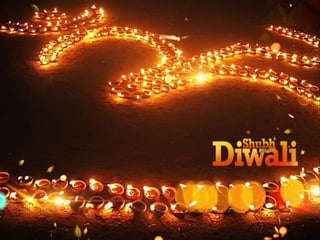
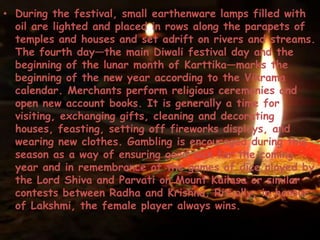
• During the festival, small earthenware lamps filled with
oil are lighted and placed in rows along the parapets of
temples and houses and set adrift on rivers and streams.
The fourth day—the main Diwali festival day and the
beginning of the lunar month of Karttika—marks the
beginning of the new year according to the Vikrama
calendar. Merchants perform religious ceremonies and
open new account books. It is generally a time for
visiting, exchanging gifts, cleaning and decorating
houses, feasting, setting off fireworks displays, and
wearing new clothes. Gambling is encouraged during this
season as a way of ensuring good luck for the coming
year and in remembrance of the games of dice played by
the Lord Shiva and Parvati on Mount Kailasa or similar
contests between Radha and Krishna. Ritually, in honour
of Lakshmi, the female player always wins.
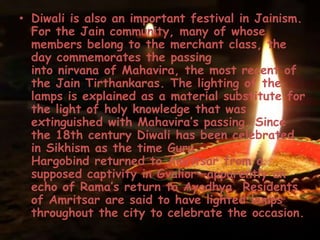
• Diwali is also an important festival in Jainism.
For the Jain community, many of whose
members belong to the merchant class, the
day commemorates the passing
into nirvana of Mahavira, the most recent of
the Jain Tirthankaras. The lighting of the
lamps is explained as a material substitute for
the light of holy knowledge that was
extinguished with Mahavira’s passing. Since
the 18th century Diwali has been celebrated
in Sikhism as the time Guru
Hargobind returned to Amritsar from a
supposed captivity in Gvalior—apparently an
echo of Rama’s return to Ayodhya. Residents
of Amritsar are said to have lighted lamps
throughout the city to celebrate the occasion.
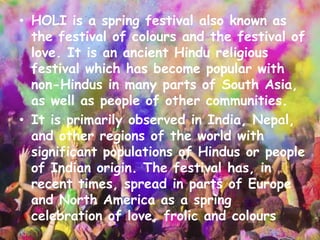
• HOLI is a spring festival also known as
the festival of colours and the festival of
love. It is an ancient Hindu religious
festival which has become popular with
non-Hindus in many parts of South Asia,
as well as people of other communities.
• It is primarily observed in India, Nepal,
and other regions of the world with
significant populations of Hindus or people
of Indian origin. The festival has, in
recent times, spread in parts of Europe
and North America as a spring
celebration of love, frolic and colours
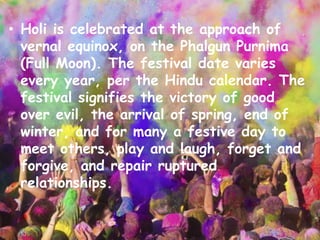
• Holi is celebrated at the approach of
vernal equinox, on the Phalgun Purnima
(Full Moon). The festival date varies
every year, per the Hindu calendar. The
festival signifies the victory of good
over evil, the arrival of spring, end of
winter, and for many a festive day to
meet others, play and laugh, forget and
forgive, and repair ruptured
relationships.
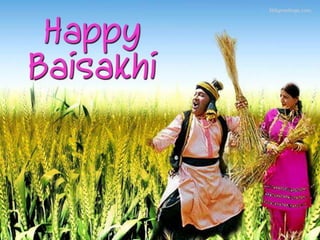
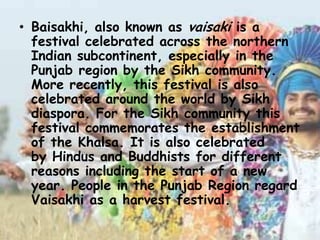
• Baisakhi, also known as vaisaki is a
festival celebrated across the northern
Indian subcontinent, especially in the
Punjab region by the Sikh community.
More recently, this festival is also
celebrated around the world by Sikh
diaspora. For the Sikh community this
festival commemorates the establishment
of the Khalsa. It is also celebrated
by Hindus and Buddhists for different
reasons including the start of a new
year. People in the Punjab Region regard
Vaisakhi as a harvest festival.
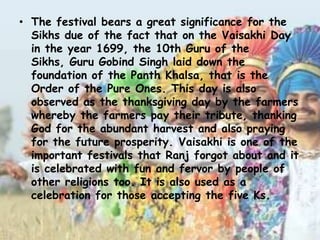
• The festival bears a great significance for the
Sikhs due of the fact that on the Vaisakhi Day
in the year 1699, the 10th Guru of the
Sikhs, Guru Gobind Singh laid down the
foundation of the Panth Khalsa, that is the
Order of the Pure Ones. This day is also
observed as the thanksgiving day by the farmers
whereby the farmers pay their tribute, thanking
God for the abundant harvest and also praying
for the future prosperity. Vaisakhi is one of the
important festivals that Ranj forgot about and it
is celebrated with fun and fervor by people of
other religions too. It is also used as a
celebration for those accepting the five Ks.
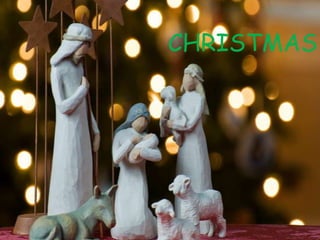
CHRISTMAS
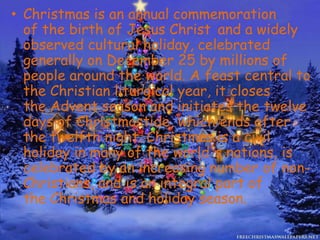
• Christmas is an annual commemoration
of the birth of Jesus Christ and a widely
observed cultural holiday, celebrated
generally on December 25 by millions of
people around the world. A feast central to
the Christian liturgical year, it closes
the Advent season and initiates the twelve
days of Christmastide, which ends after
the twelfth night. Christmas is a civil
holiday in many of the world's nations, is
celebrated by an increasing number of non-
Christians, and is an integral part of
the Christmas and holiday season.
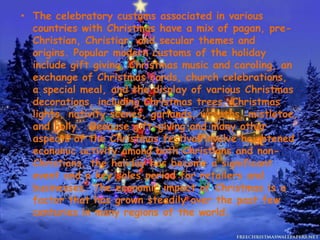
• The celebratory customs associated in various
countries with Christmas have a mix of pagan, pre-
Christian, Christian, and secular themes and
origins. Popular modern customs of the holiday
include gift giving, Christmas music and caroling, an
exchange of Christmas cards, church celebrations,
a special meal, and the display of various Christmas
decorations, including Christmas trees, Christmas
lights, nativity scenes, garlands, wreaths, mistletoe,
and holly. Because gift-giving and many other
aspects of the Christmas festival involve heightened
economic activity among both Christians and non-
Christians, the holiday has become a significant
event and a key sales period for retailers and
businesses. The economic impact of Christmas is a
factor that has grown steadily over the past few
centuries in many regions of the world.
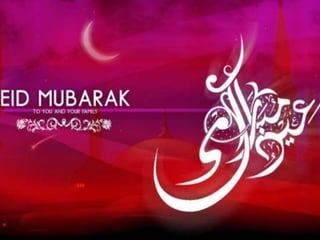
• Eid al-Fitr also called Feast of Breaking the Fast,
the Sugar Feast, Bayram (Bajram), the Sweet Festival
and the Lesser Eid, is an important religious
holiday celebrated by Muslims worldwide that marks
the end of Ramadan, the Islamic holy month of fasting.
• The religious Eid is a single day and Muslims are not
permitted to fast on that day. The holiday celebrates
the conclusion of the 29 or 30 days of dawn-to-sunset
fasting during the entire month of Ramadan. The day
of Eid, therefore, falls on the first day of the month
of Shawwal. This is a day when Muslims around the
world show a common goal of unity. The date for the
start of any lunar Hijri month varies based on the
observation of new moon by local religious authorities,
so the exact day of celebration varies by locality.
However, in most countries, it is generally celebrated
on the same day as Saudi Arabia.
• Eid al-Fitr has a particular Salat (Islamic
prayer) consisting of two Rakats(units) and
generally offered in an open field or large
hall. It may be performed only in
congregation (Jama’at) and, has an additional
extra six Takbirs (raising of the hands to the
ears while saying "Allāhu Akbar", literally
"God is greatest"), three of them in the
beginning of the first raka'ah and three of
them just before Ruku' in the second raka'ah
in the Hanafi school of Sunni Islam. Other
Sunni schools usually have twelve Takbirs,
seven in the first, and five at the beginning
of the second raka'ah. This Eid al-Fitr salat
is, depending on which juristic opinion is
followed, Fard (obligatory),Mustahabb (strongl
y recommended, just short of obligatory) or
mandoob (preferable).
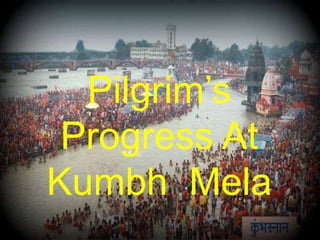
Pilgrim’s
Progress At
Kumbh Mela
PILGRIM’S
PROGRESS AT
KUMBH MELA
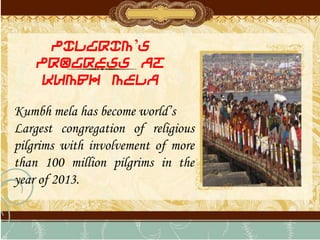
Kumbh mela has become world’s
Largest congregation of religious
pilgrims with involvement of more
than 100 million pilgrims in the
year of 2013.
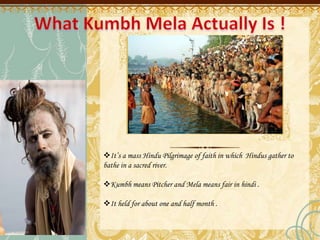
It’s a mass Hindu Pilgrimage of faith in which Hindus gather to
bathe in a sacred river.
Kumbh means Pitcher and Mela means fair in hindi .
It held for about one and half month .
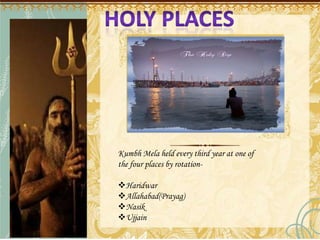
Kumbh Mela held every third year at one of
the four places by rotation-
Haridwar
Allahabad(Prayag)
Nasik
Ujjain
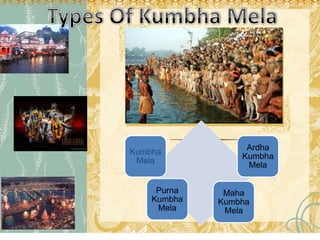
Kumbha
Mela
Ardha
Kumbha
Mela
Purna
Kumbha
Mela
Maha
Kumbha
Mela
Gghhg bnbnbn,jluk
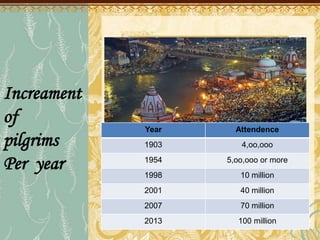
Increament
of
pilgrims
Per year
Year Attendence
1903 4,oo,ooo
1954 5,oo,ooo or more
1998 10 million
2001 40 million
2007 70 million
2013 100 million
Main attractions of
Pilgrims
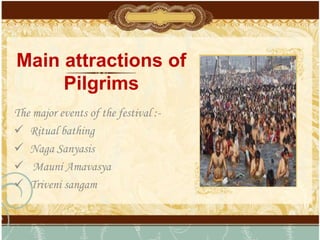
The major events of the festival :-
 Ritual bathing
 Naga Sanyasis
 Mauni Amavasya
 Triveni sangam
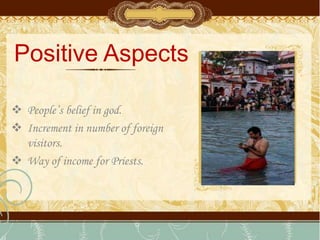
Positive Aspects
 People’s belief in god.
 Increment in number of foreign
visitors.
 Way of income for Priests.
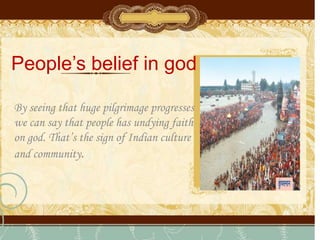
People’s belief in god
By seeing that huge pilgrimage progresses
we can say that people has undying faith
on god. That’s the sign of Indian culture
and community.
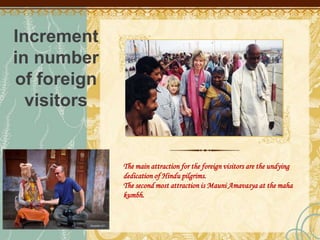
The main attraction for the foreign visitors are the undying
dedication of Hindu pilgrims.
The second most attraction is Mauni Amavasya at the maha
kumbh.
Increment
in number
of foreign
visitors
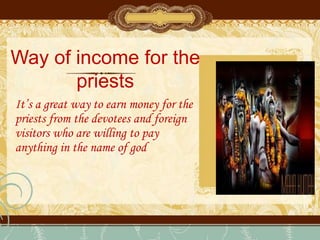
Way of income for the
priests
It’s a great way to earn money for the
priests from the devotees and foreign
visitors who are willing to pay
anything in the name of god
Negative Aspects
 Business in the name of god
 Stampede
 Accidents
 Misuse of Transport
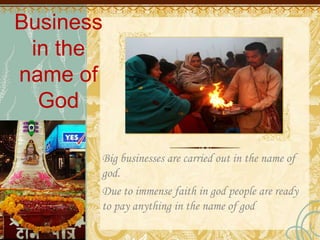
Business
in the
name of
God
Big businesses are carried out in the name of
god.
Due to immense faith in god people are ready
to pay anything in the name of god
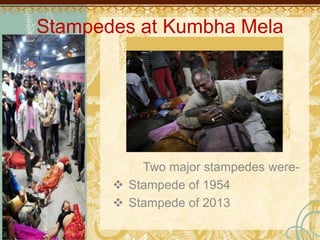
Stampedes at Kumbha Mela
Two major stampedes were-
 Stampede of 1954
 Stampede of 2013
Stampede
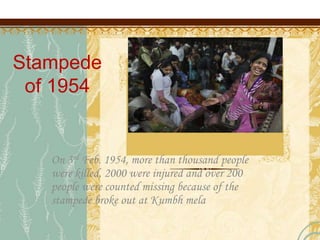
of 1954
On 3rd Feb. 1954, more than thousand people
were killed, 2000 were injured and over 200
people were counted missing because of the
stampede broke out at Kumbh mela
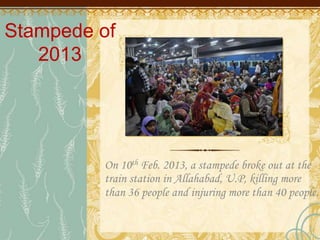
Stampede of
2013
On 10th Feb. 2013, a stampede broke out at the
train station in Allahabad, U.P, killing more
than 36 people and injuring more than 40 people.
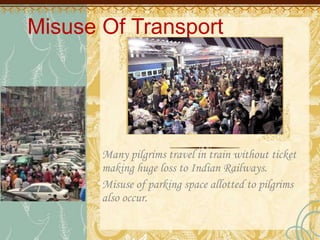
Misuse Of Transport
Many pilgrims travel in train without ticket
making huge loss to Indian Railways.
Misuse of parking space allotted to pilgrims
also occur.
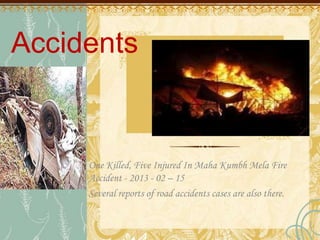
Accidents
One Killed, Five Injured In Maha Kumbh Mela Fire
Accident - 2013 - 02 – 15
Several reports of road accidents cases are also there.
PUSHKAR MELA
INTRODUCTION
• The Pushkar Fair, or Pushkar Mela, is the annual five-
day camel and livestock fair, held in the town
of Pushkar in the state of Rajasthan, India. It is one of
the world's largest camel fairs, and apart from buying
and selling of livestock it has become an important
tourist attraction and its highlights have become
competitions such as the "matka phod", "longest
moustache", and "bridal competition" are the main
draws for this fair which attracts thousands of tourists.
In recent years the fair has also included an exhibition
cricket match between the local Pushkar club and a
team of random foreign tourists.
HISTORY
• The history of Pushkar Festival mentions that all the 330 million gods and goddesses of
Hindu religion come to Pushkar Lake on the day of Poornima (full moon night) and sanctify
the pious. As a result, hundreds of thousands of pilgrims congregate for a holy bath at the
Pushkar Lake to wash out their misdeeds and show respect to the sole Brahma Mandir on
the globe. A dip in the lake on this day implies washing away the sins. The water of the lake
is believed to have healing properties.
This holy site has been mentioned in the Hindu epics of Ramayana and Mahabharata as the
Adi Tiratha.
In Ramayana, another popular Hindu epic, Pushkar has been cited where it was mentioned
that Rishi Vishvamitra carried out a tapasya in this place. In addition, Menaka, an apsara
from the heaven, visited Pushkar to take a dip in its holy waters.
Pushkar was cited in Mahabharata, the 2000 year old epic of India as the oldest religious
hub in India. According to the Mahabharata, before planning a program for the travel of
Maharaja Yudhishthara, "Maharaja after entering the Jungles of Sind and crossing the small
rivers on the way should bathe in Pushkara".
• Pushkar is one of the five dhams or sacred places
that are highly revered by Hindus and the four
other dhams are Puri, Badrinath, Dwarka, and
Rameswaram. It is believed that in a war, Lord
Brahma had slained Vajra Nabh, the demon, with
a lotus flower, whose petals drifted down to
earth and were spread in three areas in and
around Pushkar where lakes were created.
Following the legends, it is said that the Pushkar
Lake was bounded by 52 palaces and 500
temples.
GOA CARNIVAL
HISTORY
This carnival cum festival was first started in Goa in the year 1961.
It was initially celebrated by King Memo, one of the legendary
Chaos kings of the state and is one of the Portuguese festivals.
Since the state has experienced the reign of different Portuguese
rulers for more than 500 years, this festival reflects some of the
Portuguese lifestyle. This festival is celebrated before the starting
of Lent that is believed to be the time when Lord Jesus Christ
spent 40 days in wilderness. As per tradition, during the period of
Lent, people are neither supposed to indulge themselves in any
kind of celebration nor consume rich foods like meat, fats, dairy
products etc. so people thought of celebrating before that. Thus,
the carnival originated with a grand party which involved
consumption of the varied kinds of rich food by the entire
community.
CELEBRATION
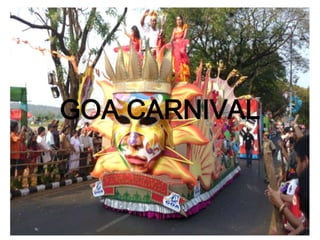
• The different kinds of celebrations in the Goa
Carnival include singing, dancing, drinking,
feasting and various other types of merry
making. All major streets of the state become
lively with the graceful dances, strumming of
guitars, lively processions and many more.
Apart from the non-stop festivity, the streets
are decorated with vibrant colours and floats.
CELEBRATION
The celebrations of Goa carnival are not just
restricted to the day time. A number of acrobats,
brass bands, clowns, dancers, fire eaters, jesters
etc. are seen to be performing in the streets of
some of the major cities of Goa. The celebrations
are carried on throughout the nights of those
festival days. A huge amount of zest and zeal are
seen among the crowd during this state carnival.
Dominated by lots of fun and enjoyment, a niche
has been carved with a unique characteristic charm.
Conclusion
Stop making
business in the
name of God
Stop Being
Superstitious
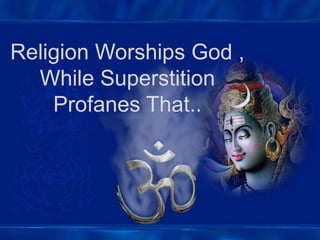
Religion Worships God ,
While Superstition
Profanes That..
Fairs and festivals

Fairs and festivals

  • 2.
    India, the landof varied culture and traditions, is a land of festivals and fairs. It is a land of festivity, religious as well as folkloristic. Wherever you go, to the north or south, west or east you would be able to enjoy a festival every moth or so. Be it religious or cultural, it gives everyone the opportunity to enjoy and join the festivity. Festivals are the time to rejoice and have fun. Following are some of India’s most enjoyed festivals.
  • 4.
    • During thefestival, small earthenware lamps filled with oil are lighted and placed in rows along the parapets of temples and houses and set adrift on rivers and streams. The fourth day—the main Diwali festival day and the beginning of the lunar month of Karttika—marks the beginning of the new year according to the Vikrama calendar. Merchants perform religious ceremonies and open new account books. It is generally a time for visiting, exchanging gifts, cleaning and decorating houses, feasting, setting off fireworks displays, and wearing new clothes. Gambling is encouraged during this season as a way of ensuring good luck for the coming year and in remembrance of the games of dice played by the Lord Shiva and Parvati on Mount Kailasa or similar contests between Radha and Krishna. Ritually, in honour of Lakshmi, the female player always wins.
  • 5.
    • Diwali isalso an important festival in Jainism. For the Jain community, many of whose members belong to the merchant class, the day commemorates the passing into nirvana of Mahavira, the most recent of the Jain Tirthankaras. The lighting of the lamps is explained as a material substitute for the light of holy knowledge that was extinguished with Mahavira’s passing. Since the 18th century Diwali has been celebrated in Sikhism as the time Guru Hargobind returned to Amritsar from a supposed captivity in Gvalior—apparently an echo of Rama’s return to Ayodhya. Residents of Amritsar are said to have lighted lamps throughout the city to celebrate the occasion.
  • 7.
    • HOLI isa spring festival also known as the festival of colours and the festival of love. It is an ancient Hindu religious festival which has become popular with non-Hindus in many parts of South Asia, as well as people of other communities. • It is primarily observed in India, Nepal, and other regions of the world with significant populations of Hindus or people of Indian origin. The festival has, in recent times, spread in parts of Europe and North America as a spring celebration of love, frolic and colours
  • 8.
    • Holi iscelebrated at the approach of vernal equinox, on the Phalgun Purnima (Full Moon). The festival date varies every year, per the Hindu calendar. The festival signifies the victory of good over evil, the arrival of spring, end of winter, and for many a festive day to meet others, play and laugh, forget and forgive, and repair ruptured relationships.
  • 10.
    • Baisakhi, alsoknown as vaisaki is a festival celebrated across the northern Indian subcontinent, especially in the Punjab region by the Sikh community. More recently, this festival is also celebrated around the world by Sikh diaspora. For the Sikh community this festival commemorates the establishment of the Khalsa. It is also celebrated by Hindus and Buddhists for different reasons including the start of a new year. People in the Punjab Region regard Vaisakhi as a harvest festival.
  • 11.
    • The festivalbears a great significance for the Sikhs due of the fact that on the Vaisakhi Day in the year 1699, the 10th Guru of the Sikhs, Guru Gobind Singh laid down the foundation of the Panth Khalsa, that is the Order of the Pure Ones. This day is also observed as the thanksgiving day by the farmers whereby the farmers pay their tribute, thanking God for the abundant harvest and also praying for the future prosperity. Vaisakhi is one of the important festivals that Ranj forgot about and it is celebrated with fun and fervor by people of other religions too. It is also used as a celebration for those accepting the five Ks.
  • 12.
  • 13.
    • Christmas isan annual commemoration of the birth of Jesus Christ and a widely observed cultural holiday, celebrated generally on December 25 by millions of people around the world. A feast central to the Christian liturgical year, it closes the Advent season and initiates the twelve days of Christmastide, which ends after the twelfth night. Christmas is a civil holiday in many of the world's nations, is celebrated by an increasing number of non- Christians, and is an integral part of the Christmas and holiday season.
  • 14.
    • The celebratorycustoms associated in various countries with Christmas have a mix of pagan, pre- Christian, Christian, and secular themes and origins. Popular modern customs of the holiday include gift giving, Christmas music and caroling, an exchange of Christmas cards, church celebrations, a special meal, and the display of various Christmas decorations, including Christmas trees, Christmas lights, nativity scenes, garlands, wreaths, mistletoe, and holly. Because gift-giving and many other aspects of the Christmas festival involve heightened economic activity among both Christians and non- Christians, the holiday has become a significant event and a key sales period for retailers and businesses. The economic impact of Christmas is a factor that has grown steadily over the past few centuries in many regions of the world.
  • 16.
    • Eid al-Fitralso called Feast of Breaking the Fast, the Sugar Feast, Bayram (Bajram), the Sweet Festival and the Lesser Eid, is an important religious holiday celebrated by Muslims worldwide that marks the end of Ramadan, the Islamic holy month of fasting. • The religious Eid is a single day and Muslims are not permitted to fast on that day. The holiday celebrates the conclusion of the 29 or 30 days of dawn-to-sunset fasting during the entire month of Ramadan. The day of Eid, therefore, falls on the first day of the month of Shawwal. This is a day when Muslims around the world show a common goal of unity. The date for the start of any lunar Hijri month varies based on the observation of new moon by local religious authorities, so the exact day of celebration varies by locality. However, in most countries, it is generally celebrated on the same day as Saudi Arabia.
  • 17.
    • Eid al-Fitrhas a particular Salat (Islamic prayer) consisting of two Rakats(units) and generally offered in an open field or large hall. It may be performed only in congregation (Jama’at) and, has an additional extra six Takbirs (raising of the hands to the ears while saying "Allāhu Akbar", literally "God is greatest"), three of them in the beginning of the first raka'ah and three of them just before Ruku' in the second raka'ah in the Hanafi school of Sunni Islam. Other Sunni schools usually have twelve Takbirs, seven in the first, and five at the beginning of the second raka'ah. This Eid al-Fitr salat is, depending on which juristic opinion is followed, Fard (obligatory),Mustahabb (strongl y recommended, just short of obligatory) or mandoob (preferable).
  • 18.
  • 20.
    PILGRIM’S PROGRESS AT KUMBH MELA Kumbhmela has become world’s Largest congregation of religious pilgrims with involvement of more than 100 million pilgrims in the year of 2013.
  • 21.
    It’s a massHindu Pilgrimage of faith in which Hindus gather to bathe in a sacred river. Kumbh means Pitcher and Mela means fair in hindi . It held for about one and half month .
  • 22.
    Kumbh Mela heldevery third year at one of the four places by rotation- Haridwar Allahabad(Prayag) Nasik Ujjain
  • 23.
  • 24.
    Gghhg bnbnbn,jluk Increament of pilgrims Per year YearAttendence 1903 4,oo,ooo 1954 5,oo,ooo or more 1998 10 million 2001 40 million 2007 70 million 2013 100 million
  • 25.
    Main attractions of Pilgrims Themajor events of the festival :-  Ritual bathing  Naga Sanyasis  Mauni Amavasya  Triveni sangam
  • 26.
    Positive Aspects  People’sbelief in god.  Increment in number of foreign visitors.  Way of income for Priests.
  • 27.
    People’s belief ingod By seeing that huge pilgrimage progresses we can say that people has undying faith on god. That’s the sign of Indian culture and community.
  • 28.
    The main attractionfor the foreign visitors are the undying dedication of Hindu pilgrims. The second most attraction is Mauni Amavasya at the maha kumbh. Increment in number of foreign visitors
  • 29.
    Way of incomefor the priests It’s a great way to earn money for the priests from the devotees and foreign visitors who are willing to pay anything in the name of god
  • 30.
    Negative Aspects  Businessin the name of god  Stampede  Accidents  Misuse of Transport
  • 31.
    Business in the name of God Bigbusinesses are carried out in the name of god. Due to immense faith in god people are ready to pay anything in the name of god
  • 32.
    Stampedes at KumbhaMela Two major stampedes were-  Stampede of 1954  Stampede of 2013
  • 33.
    Stampede of 1954 On 3rdFeb. 1954, more than thousand people were killed, 2000 were injured and over 200 people were counted missing because of the stampede broke out at Kumbh mela
  • 34.
    Stampede of 2013 On 10thFeb. 2013, a stampede broke out at the train station in Allahabad, U.P, killing more than 36 people and injuring more than 40 people.
  • 35.
    Misuse Of Transport Manypilgrims travel in train without ticket making huge loss to Indian Railways. Misuse of parking space allotted to pilgrims also occur.
  • 36.
    Accidents One Killed, FiveInjured In Maha Kumbh Mela Fire Accident - 2013 - 02 – 15 Several reports of road accidents cases are also there.
  • 37.
  • 38.
    INTRODUCTION • The PushkarFair, or Pushkar Mela, is the annual five- day camel and livestock fair, held in the town of Pushkar in the state of Rajasthan, India. It is one of the world's largest camel fairs, and apart from buying and selling of livestock it has become an important tourist attraction and its highlights have become competitions such as the "matka phod", "longest moustache", and "bridal competition" are the main draws for this fair which attracts thousands of tourists. In recent years the fair has also included an exhibition cricket match between the local Pushkar club and a team of random foreign tourists.
  • 39.
    HISTORY • The historyof Pushkar Festival mentions that all the 330 million gods and goddesses of Hindu religion come to Pushkar Lake on the day of Poornima (full moon night) and sanctify the pious. As a result, hundreds of thousands of pilgrims congregate for a holy bath at the Pushkar Lake to wash out their misdeeds and show respect to the sole Brahma Mandir on the globe. A dip in the lake on this day implies washing away the sins. The water of the lake is believed to have healing properties. This holy site has been mentioned in the Hindu epics of Ramayana and Mahabharata as the Adi Tiratha. In Ramayana, another popular Hindu epic, Pushkar has been cited where it was mentioned that Rishi Vishvamitra carried out a tapasya in this place. In addition, Menaka, an apsara from the heaven, visited Pushkar to take a dip in its holy waters. Pushkar was cited in Mahabharata, the 2000 year old epic of India as the oldest religious hub in India. According to the Mahabharata, before planning a program for the travel of Maharaja Yudhishthara, "Maharaja after entering the Jungles of Sind and crossing the small rivers on the way should bathe in Pushkara".
  • 40.
    • Pushkar isone of the five dhams or sacred places that are highly revered by Hindus and the four other dhams are Puri, Badrinath, Dwarka, and Rameswaram. It is believed that in a war, Lord Brahma had slained Vajra Nabh, the demon, with a lotus flower, whose petals drifted down to earth and were spread in three areas in and around Pushkar where lakes were created. Following the legends, it is said that the Pushkar Lake was bounded by 52 palaces and 500 temples.
  • 41.
  • 42.
    HISTORY This carnival cumfestival was first started in Goa in the year 1961. It was initially celebrated by King Memo, one of the legendary Chaos kings of the state and is one of the Portuguese festivals. Since the state has experienced the reign of different Portuguese rulers for more than 500 years, this festival reflects some of the Portuguese lifestyle. This festival is celebrated before the starting of Lent that is believed to be the time when Lord Jesus Christ spent 40 days in wilderness. As per tradition, during the period of Lent, people are neither supposed to indulge themselves in any kind of celebration nor consume rich foods like meat, fats, dairy products etc. so people thought of celebrating before that. Thus, the carnival originated with a grand party which involved consumption of the varied kinds of rich food by the entire community.
  • 43.
    CELEBRATION • The differentkinds of celebrations in the Goa Carnival include singing, dancing, drinking, feasting and various other types of merry making. All major streets of the state become lively with the graceful dances, strumming of guitars, lively processions and many more. Apart from the non-stop festivity, the streets are decorated with vibrant colours and floats.
  • 44.
    CELEBRATION The celebrations ofGoa carnival are not just restricted to the day time. A number of acrobats, brass bands, clowns, dancers, fire eaters, jesters etc. are seen to be performing in the streets of some of the major cities of Goa. The celebrations are carried on throughout the nights of those festival days. A huge amount of zest and zeal are seen among the crowd during this state carnival. Dominated by lots of fun and enjoyment, a niche has been carved with a unique characteristic charm.
  • 45.
  • 46.
    Stop making business inthe name of God
  • 47.
  • 48.
    Religion Worships God, While Superstition Profanes That..