http://www.tutorialspoint.com/computer_logical_organization/number_system_conversion.htm
Copyright © tutorialspoint.com
NUMBER SYSTEM CONVERSIONNUMBER SYSTEM CONVERSION
There are many methods or techniques which can be used to convert numbers from one base to
another. We'll demonstrate here the following −
Decimal to Other Base System
Other Base System to Decimal
Other Base System to Non-Decimal
Shortcut method − Binary to Octal
Shortcut method − Octal to Binary
Shortcut method − Binary to Hexadecimal
Shortcut method − Hexadecimal to Binary
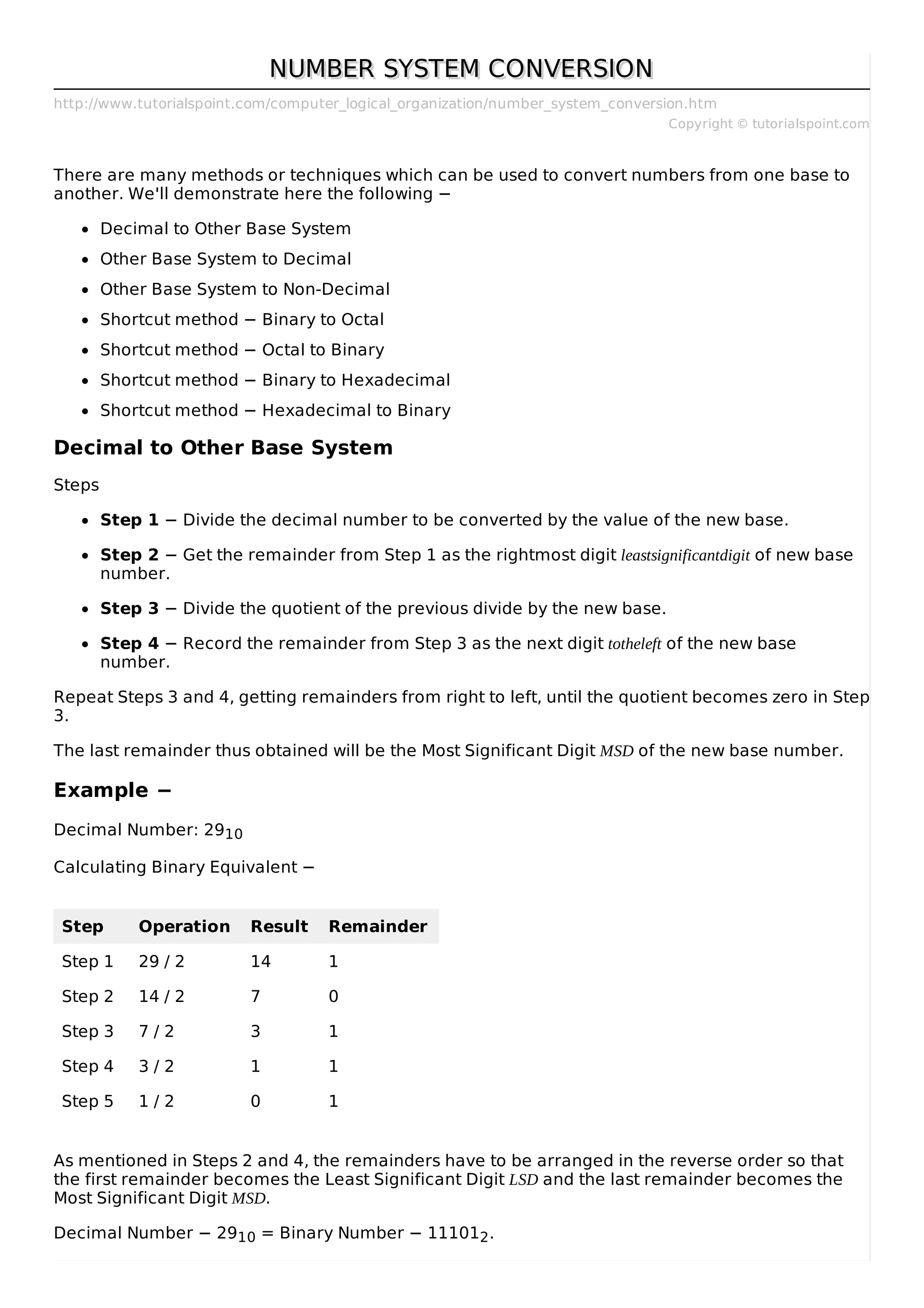
Decimal to Other Base System
Steps
Step 1 − Divide the decimal number to be converted by the value of the new base.
Step 2 − Get the remainder from Step 1 as the rightmost digit leastsignificantdigit of new base
number.
Step 3 − Divide the quotient of the previous divide by the new base.
Step 4 − Record the remainder from Step 3 as the next digit totheleft of the new base
number.
Repeat Steps 3 and 4, getting remainders from right to left, until the quotient becomes zero in Step
3.
The last remainder thus obtained will be the Most Significant Digit MSD of the new base number.
Example −
Decimal Number: 2910
Calculating Binary Equivalent −
Step Operation Result Remainder
Step 1 29 / 2 14 1
Step 2 14 / 2 7 0
Step 3 7 / 2 3 1
Step 4 3 / 2 1 1
Step 5 1 / 2 0 1
As mentioned in Steps 2 and 4, the remainders have to be arranged in the reverse order so that
the first remainder becomes the Least Significant Digit LSD and the last remainder becomes the
Most Significant Digit MSD.
Decimal Number − 2910 = Binary Number − 111012.
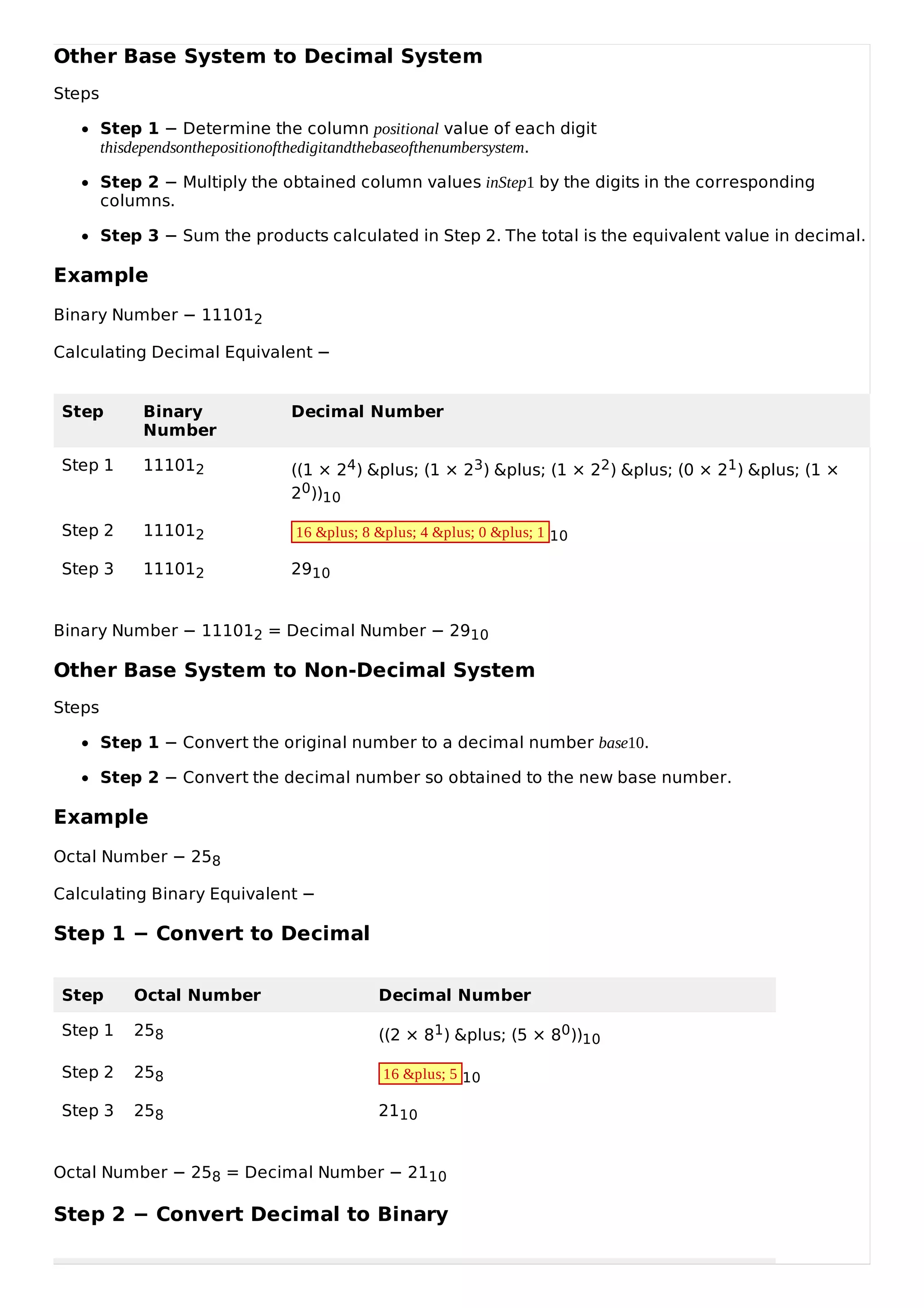
Other Base System to Decimal System
Steps
Step 1 − Determine the column positional value of each digit
thisdependsonthepositionofthedigitandthebaseofthenumbersystem.
Step 2 − Multiply the obtained column values inStep1 by the digits in the corresponding
columns.
Step 3 − Sum the products calculated in Step 2. The total is the equivalent value in decimal.
Example
Binary Number − 111012
Calculating Decimal Equivalent −
Step Binary
Number
Decimal Number
Step 1 111012 ((1 × 24) + (1 × 23) + (1 × 22) + (0 × 21) + (1 ×
20))10
Step 2 111012 16 + 8 + 4 + 0 + 1 10
Step 3 111012 2910
Binary Number − 111012 = Decimal Number − 2910
Other Base System to Non-Decimal System
Steps
Step 1 − Convert the original number to a decimal number base10.
Step 2 − Convert the decimal number so obtained to the new base number.
Example
Octal Number − 258
Calculating Binary Equivalent −
Step 1 − Convert to Decimal
Step Octal Number Decimal Number
Step 1 258 ((2 × 81) + (5 × 80))10
Step 2 258 16 + 5 10
Step 3 258 2110
Octal Number − 258 = Decimal Number − 2110
Step 2 − Convert Decimal to Binary
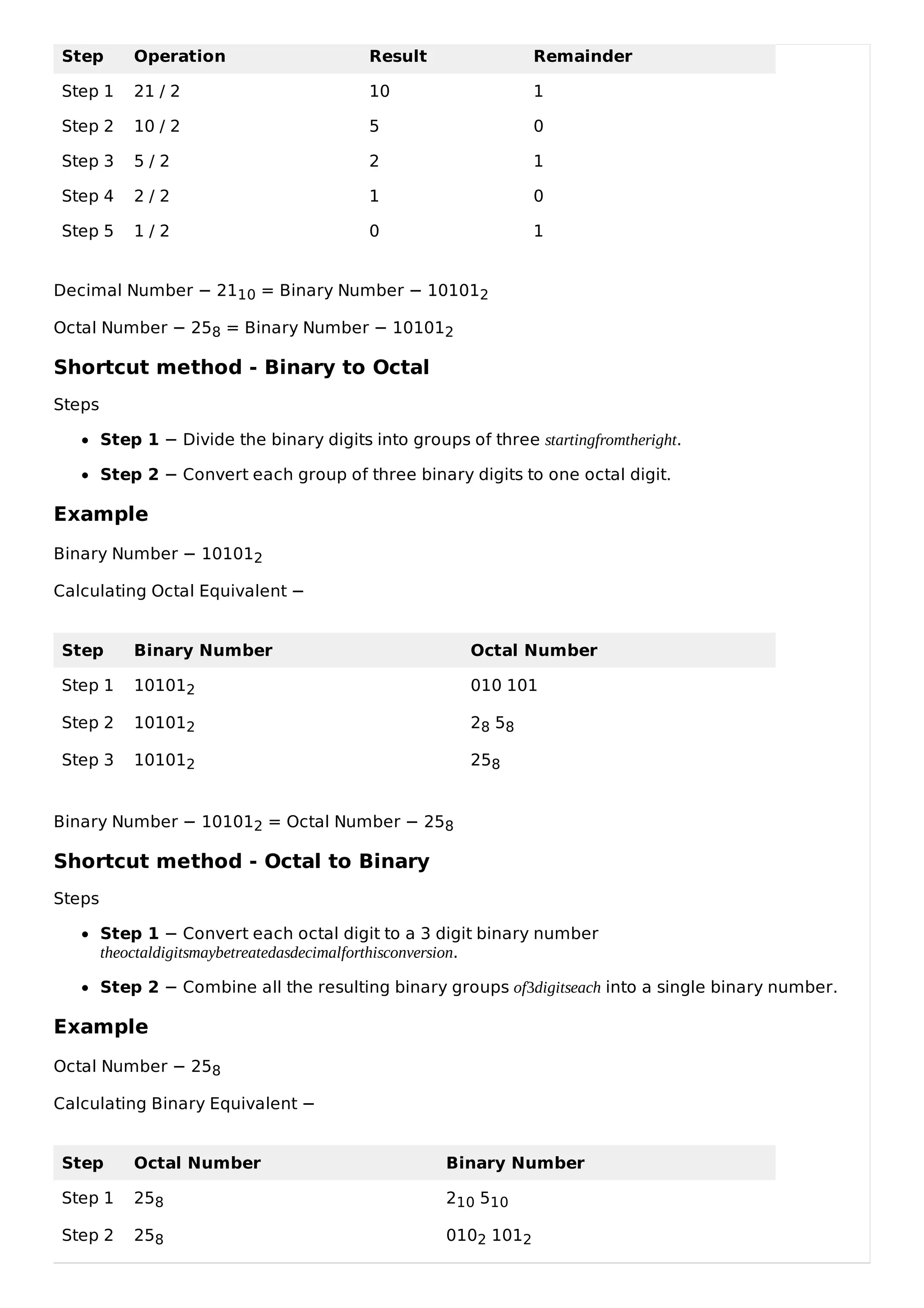
Step Operation Result Remainder
Step 1 21 / 2 10 1
Step 2 10 / 2 5 0
Step 3 5 / 2 2 1
Step 4 2 / 2 1 0
Step 5 1 / 2 0 1
Decimal Number − 2110 = Binary Number − 101012
Octal Number − 258 = Binary Number − 101012
Shortcut method - Binary to Octal
Steps
Step 1 − Divide the binary digits into groups of three startingfromtheright.
Step 2 − Convert each group of three binary digits to one octal digit.
Example
Binary Number − 101012
Calculating Octal Equivalent −
Step Binary Number Octal Number
Step 1 101012 010 101
Step 2 101012 28 58
Step 3 101012 258
Binary Number − 101012 = Octal Number − 258
Shortcut method - Octal to Binary
Steps
Step 1 − Convert each octal digit to a 3 digit binary number
theoctaldigitsmaybetreatedasdecimalforthisconversion.
Step 2 − Combine all the resulting binary groups of3digitseach into a single binary number.
Example
Octal Number − 258
Calculating Binary Equivalent −
Step Octal Number Binary Number
Step 1 258 210 510
Step 2 258 0102 1012
Step 3 258 0101012
Octal Number − 258 = Binary Number − 101012
Shortcut method - Binary to Hexadecimal
Steps
Step 1 − Divide the binary digits into groups of four startingfromtheright.
Step 2 − Convert each group of four binary digits to one hexadecimal symbol.
Example
Binary Number − 101012
Calculating hexadecimal Equivalent −
Step Binary Number Hexadecimal Number
Step 1 101012 0001 0101
Step 2 101012 110 510
Step 3 101012 1516
Binary Number − 101012 = Hexadecimal Number − 1516
Shortcut method - Hexadecimal to Binary
Steps
Step 1 − Convert each hexadecimal digit to a 4 digit binary number
thehexadecimaldigitsmaybetreatedasdecimalforthisconversion.
Step 2 − Combine all the resulting binary groups of4digitseach into a single binary number.
Example
Hexadecimal Number − 1516
Calculating Binary Equivalent −
Step Hexadecimal Number Binary Number
Step 1 1516 110 510
Step 2 1516 00012 01012
Step 3 1516 000101012
Hexadecimal Number − 1516 = Binary Number − 101012
Loading [MathJax]/jax/output/HTML-CSS/jax.js

Number System Conversion

  • 1.
    http://www.tutorialspoint.com/computer_logical_organization/number_system_conversion.htm Copyright © tutorialspoint.com NUMBERSYSTEM CONVERSIONNUMBER SYSTEM CONVERSION There are many methods or techniques which can be used to convert numbers from one base to another. We'll demonstrate here the following − Decimal to Other Base System Other Base System to Decimal Other Base System to Non-Decimal Shortcut method − Binary to Octal Shortcut method − Octal to Binary Shortcut method − Binary to Hexadecimal Shortcut method − Hexadecimal to Binary Decimal to Other Base System Steps Step 1 − Divide the decimal number to be converted by the value of the new base. Step 2 − Get the remainder from Step 1 as the rightmost digit leastsignificantdigit of new base number. Step 3 − Divide the quotient of the previous divide by the new base. Step 4 − Record the remainder from Step 3 as the next digit totheleft of the new base number. Repeat Steps 3 and 4, getting remainders from right to left, until the quotient becomes zero in Step 3. The last remainder thus obtained will be the Most Significant Digit MSD of the new base number. Example − Decimal Number: 2910 Calculating Binary Equivalent − Step Operation Result Remainder Step 1 29 / 2 14 1 Step 2 14 / 2 7 0 Step 3 7 / 2 3 1 Step 4 3 / 2 1 1 Step 5 1 / 2 0 1 As mentioned in Steps 2 and 4, the remainders have to be arranged in the reverse order so that the first remainder becomes the Least Significant Digit LSD and the last remainder becomes the Most Significant Digit MSD. Decimal Number − 2910 = Binary Number − 111012.
  • 2.
    Other Base Systemto Decimal System Steps Step 1 − Determine the column positional value of each digit thisdependsonthepositionofthedigitandthebaseofthenumbersystem. Step 2 − Multiply the obtained column values inStep1 by the digits in the corresponding columns. Step 3 − Sum the products calculated in Step 2. The total is the equivalent value in decimal. Example Binary Number − 111012 Calculating Decimal Equivalent − Step Binary Number Decimal Number Step 1 111012 ((1 × 24) + (1 × 23) + (1 × 22) + (0 × 21) + (1 × 20))10 Step 2 111012 16 + 8 + 4 + 0 + 1 10 Step 3 111012 2910 Binary Number − 111012 = Decimal Number − 2910 Other Base System to Non-Decimal System Steps Step 1 − Convert the original number to a decimal number base10. Step 2 − Convert the decimal number so obtained to the new base number. Example Octal Number − 258 Calculating Binary Equivalent − Step 1 − Convert to Decimal Step Octal Number Decimal Number Step 1 258 ((2 × 81) + (5 × 80))10 Step 2 258 16 + 5 10 Step 3 258 2110 Octal Number − 258 = Decimal Number − 2110 Step 2 − Convert Decimal to Binary
  • 3.
    Step Operation ResultRemainder Step 1 21 / 2 10 1 Step 2 10 / 2 5 0 Step 3 5 / 2 2 1 Step 4 2 / 2 1 0 Step 5 1 / 2 0 1 Decimal Number − 2110 = Binary Number − 101012 Octal Number − 258 = Binary Number − 101012 Shortcut method - Binary to Octal Steps Step 1 − Divide the binary digits into groups of three startingfromtheright. Step 2 − Convert each group of three binary digits to one octal digit. Example Binary Number − 101012 Calculating Octal Equivalent − Step Binary Number Octal Number Step 1 101012 010 101 Step 2 101012 28 58 Step 3 101012 258 Binary Number − 101012 = Octal Number − 258 Shortcut method - Octal to Binary Steps Step 1 − Convert each octal digit to a 3 digit binary number theoctaldigitsmaybetreatedasdecimalforthisconversion. Step 2 − Combine all the resulting binary groups of3digitseach into a single binary number. Example Octal Number − 258 Calculating Binary Equivalent − Step Octal Number Binary Number Step 1 258 210 510 Step 2 258 0102 1012
  • 4.
    Step 3 2580101012 Octal Number − 258 = Binary Number − 101012 Shortcut method - Binary to Hexadecimal Steps Step 1 − Divide the binary digits into groups of four startingfromtheright. Step 2 − Convert each group of four binary digits to one hexadecimal symbol. Example Binary Number − 101012 Calculating hexadecimal Equivalent − Step Binary Number Hexadecimal Number Step 1 101012 0001 0101 Step 2 101012 110 510 Step 3 101012 1516 Binary Number − 101012 = Hexadecimal Number − 1516 Shortcut method - Hexadecimal to Binary Steps Step 1 − Convert each hexadecimal digit to a 4 digit binary number thehexadecimaldigitsmaybetreatedasdecimalforthisconversion. Step 2 − Combine all the resulting binary groups of4digitseach into a single binary number. Example Hexadecimal Number − 1516 Calculating Binary Equivalent − Step Hexadecimal Number Binary Number Step 1 1516 110 510 Step 2 1516 00012 01012 Step 3 1516 000101012 Hexadecimal Number − 1516 = Binary Number − 101012 Loading [MathJax]/jax/output/HTML-CSS/jax.js