Lecture 1
Lecturer: Nareena
Introduction to Information and
Communication Technology
Introduction to Information and
Communication Technology
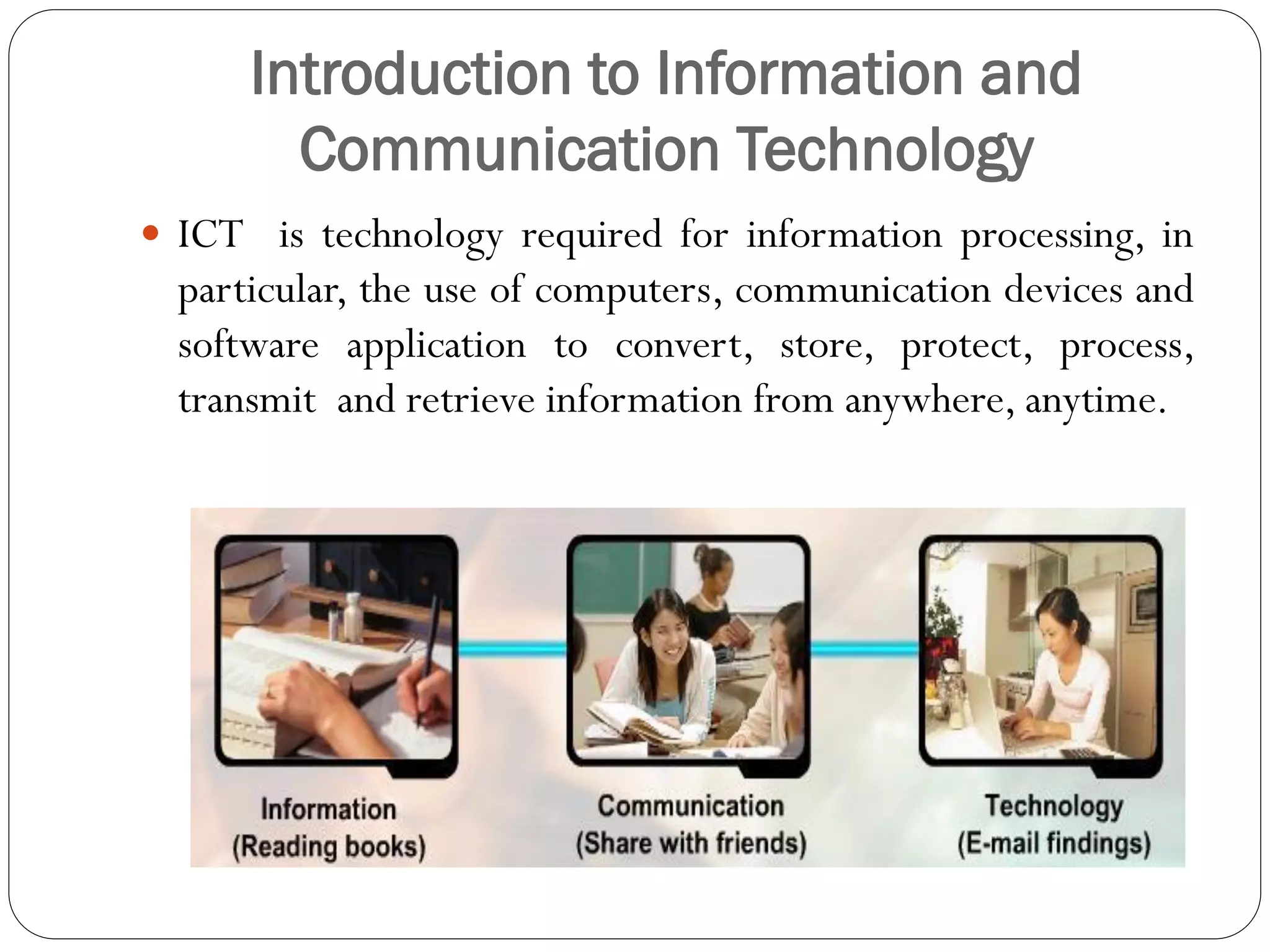
 ICT is technology required for information processing, in
particular, the use of computers, communication devices and
software application to convert, store, protect, process,
transmit and retrieve information from anywhere, anytime.
Introduction to Information and
Communication Technology (cont.)
 Information
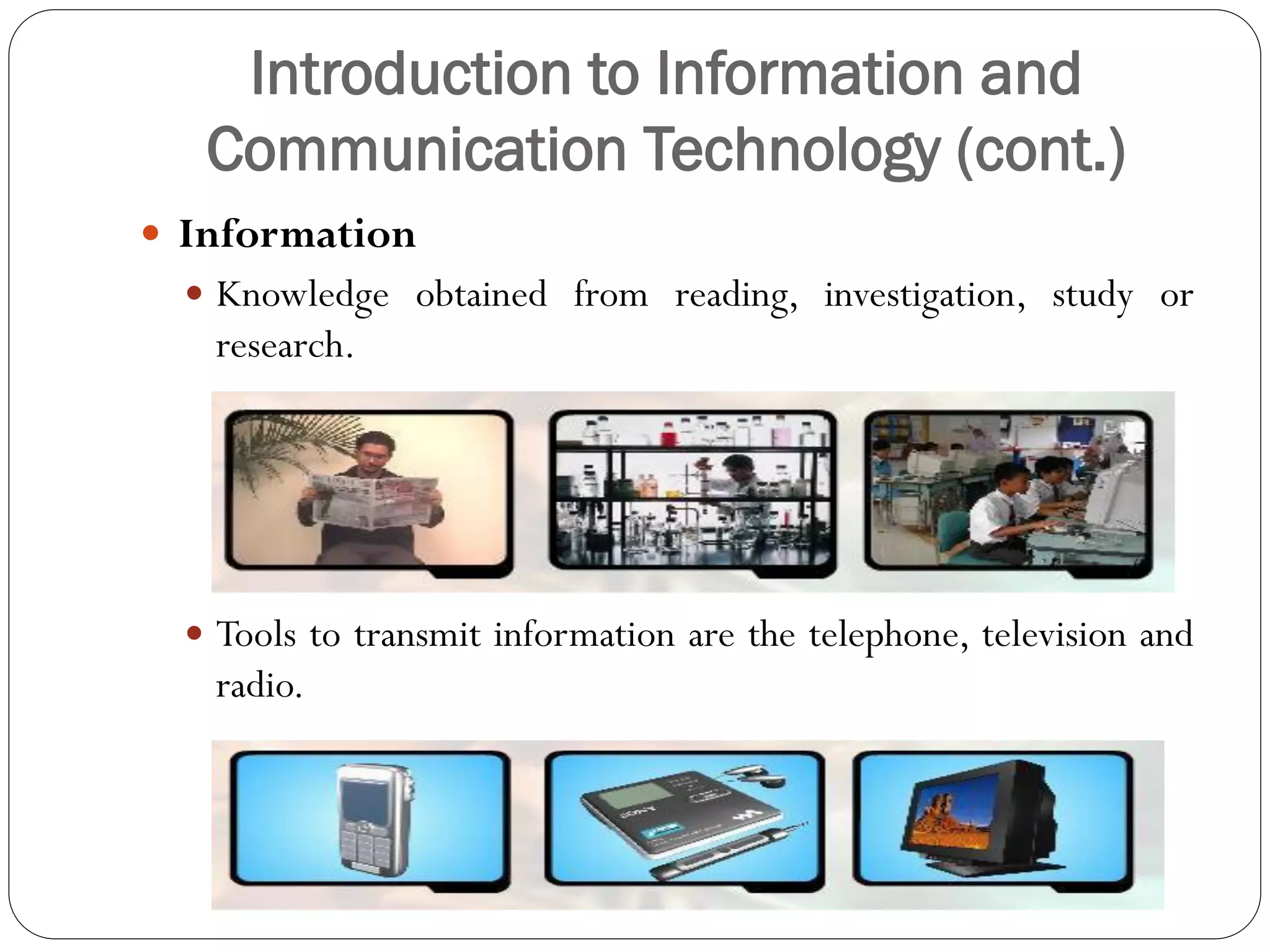
 Knowledge obtained from reading, investigation, study or
research.
 Tools to transmit information are the telephone, television and
radio.
Introduction to Information and
Communication Technology (cont.)
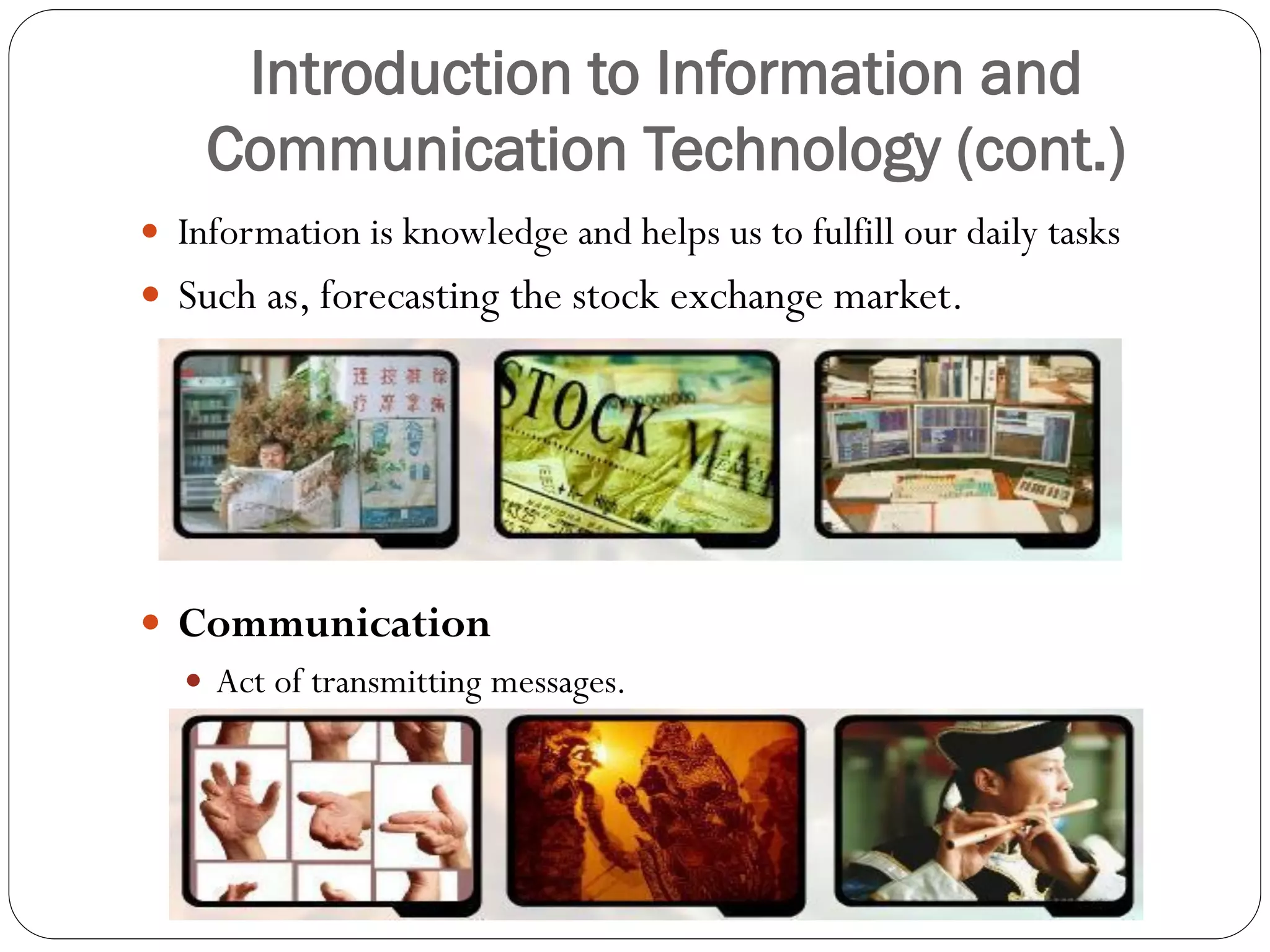
 Information is knowledge and helps us to fulfill our daily tasks
 Such as, forecasting the stock exchange market.
 Communication
 Act of transmitting messages.
Introduction to Information and
Communication Technology (cont.)
 Information is exchanged between individuals using symbols signs or
verbal interactions.
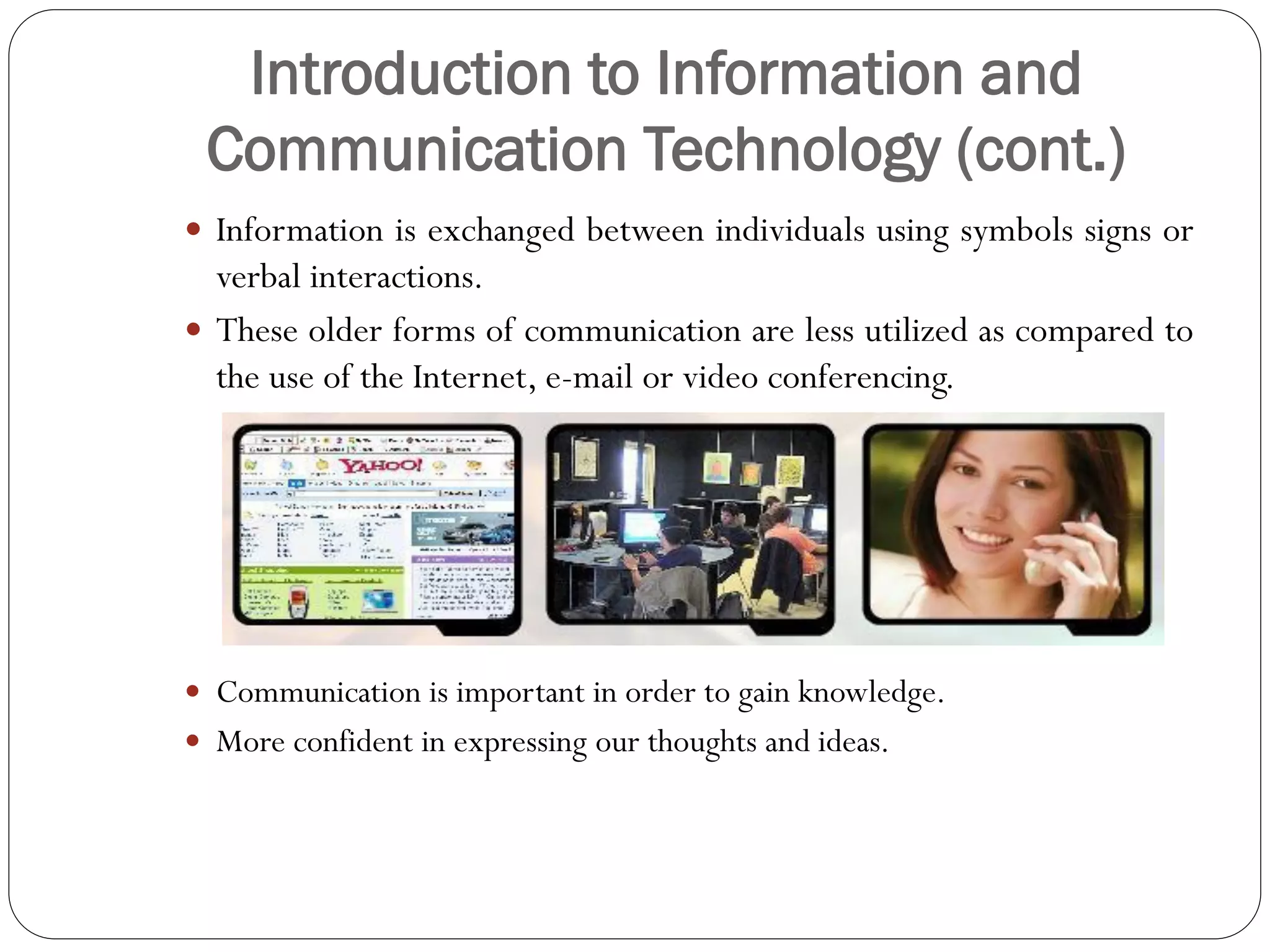
 These older forms of communication are less utilized as compared to
the use of the Internet, e-mail or video conferencing.
 Communication is important in order to gain knowledge.
 More confident in expressing our thoughts and ideas.
Introduction to Information and
Communication Technology (cont.)
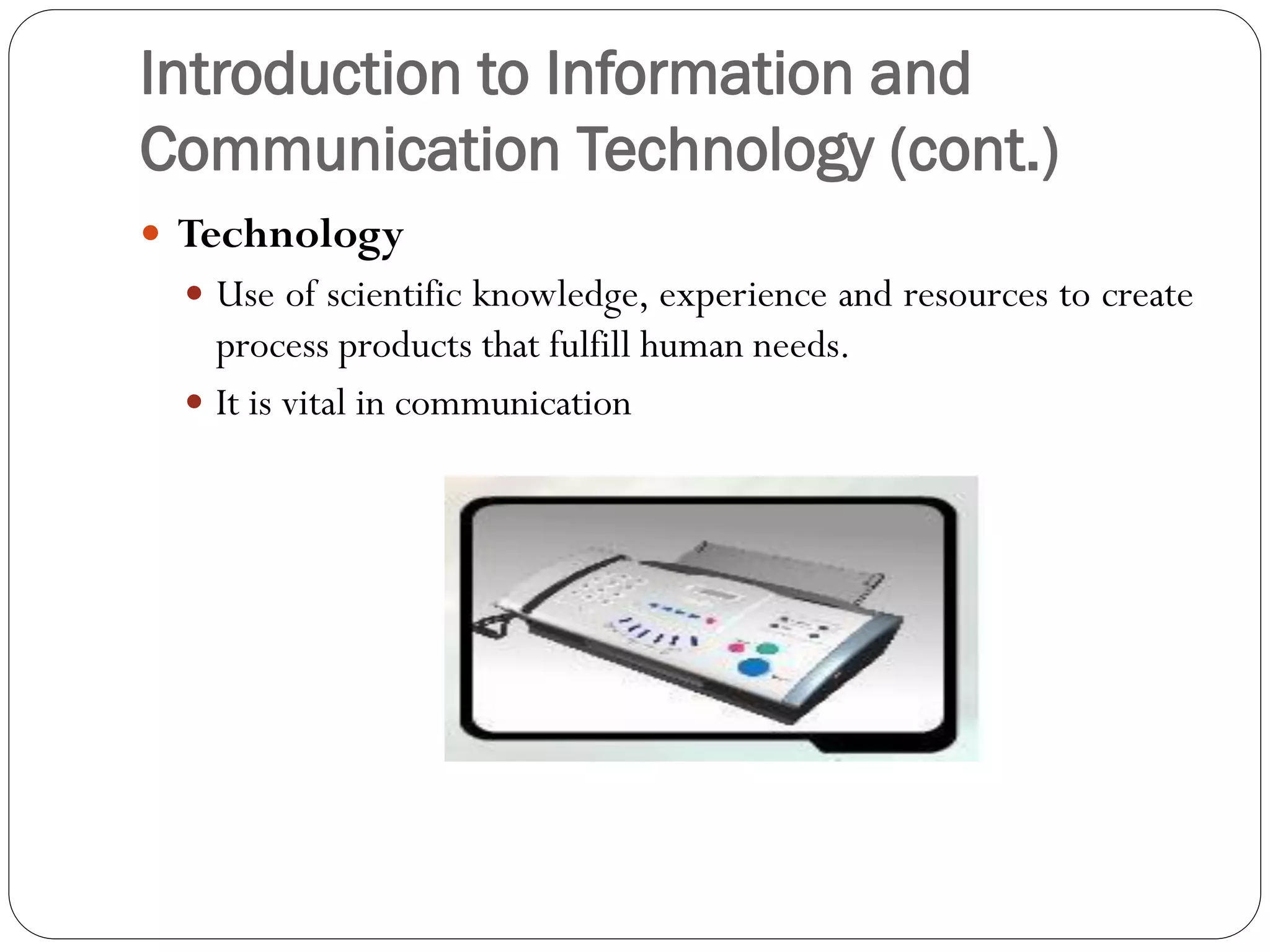
 Technology
 Use of scientific knowledge, experience and resources to create
process products that fulfill human needs.
 It is vital in communication
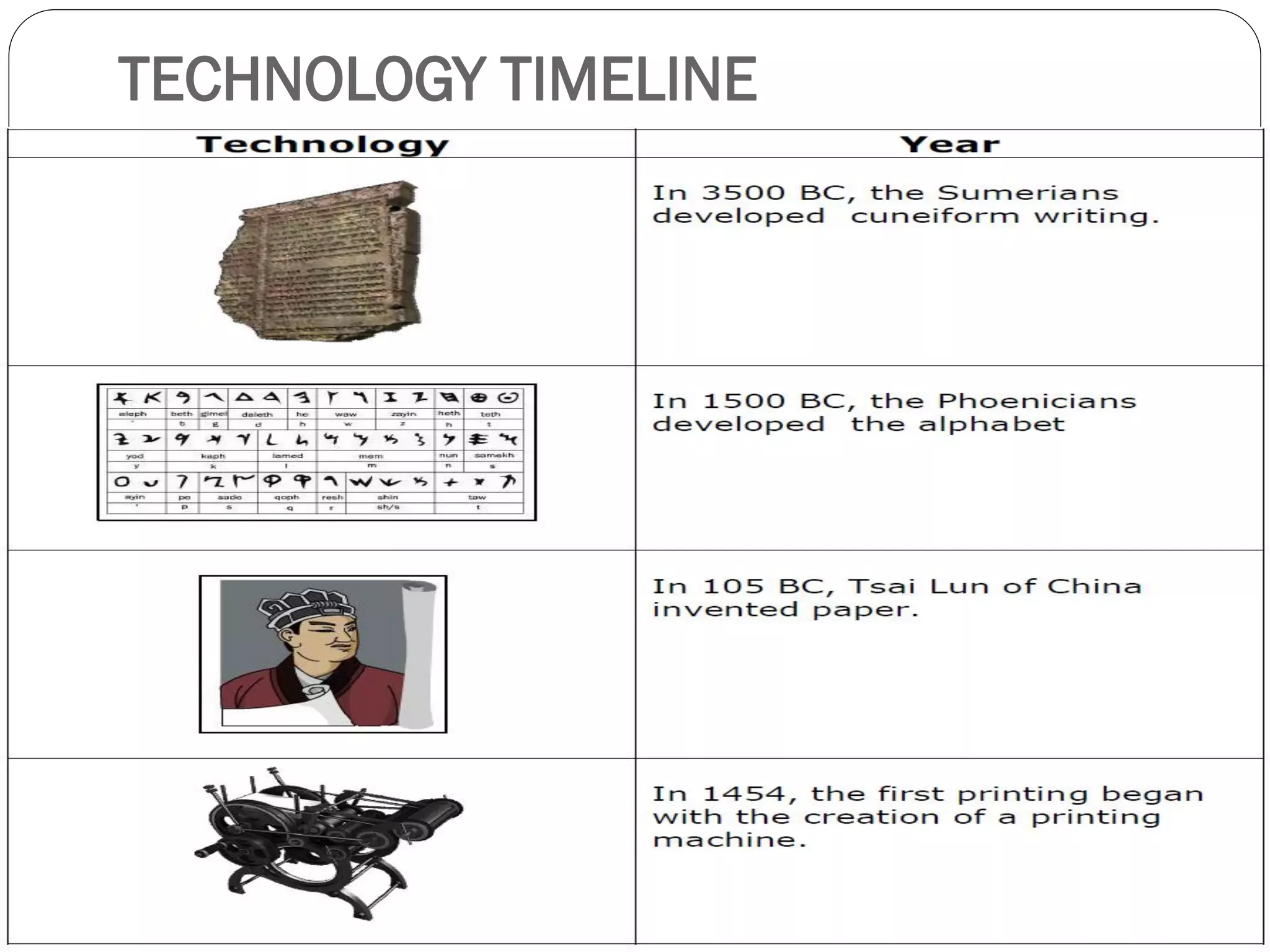
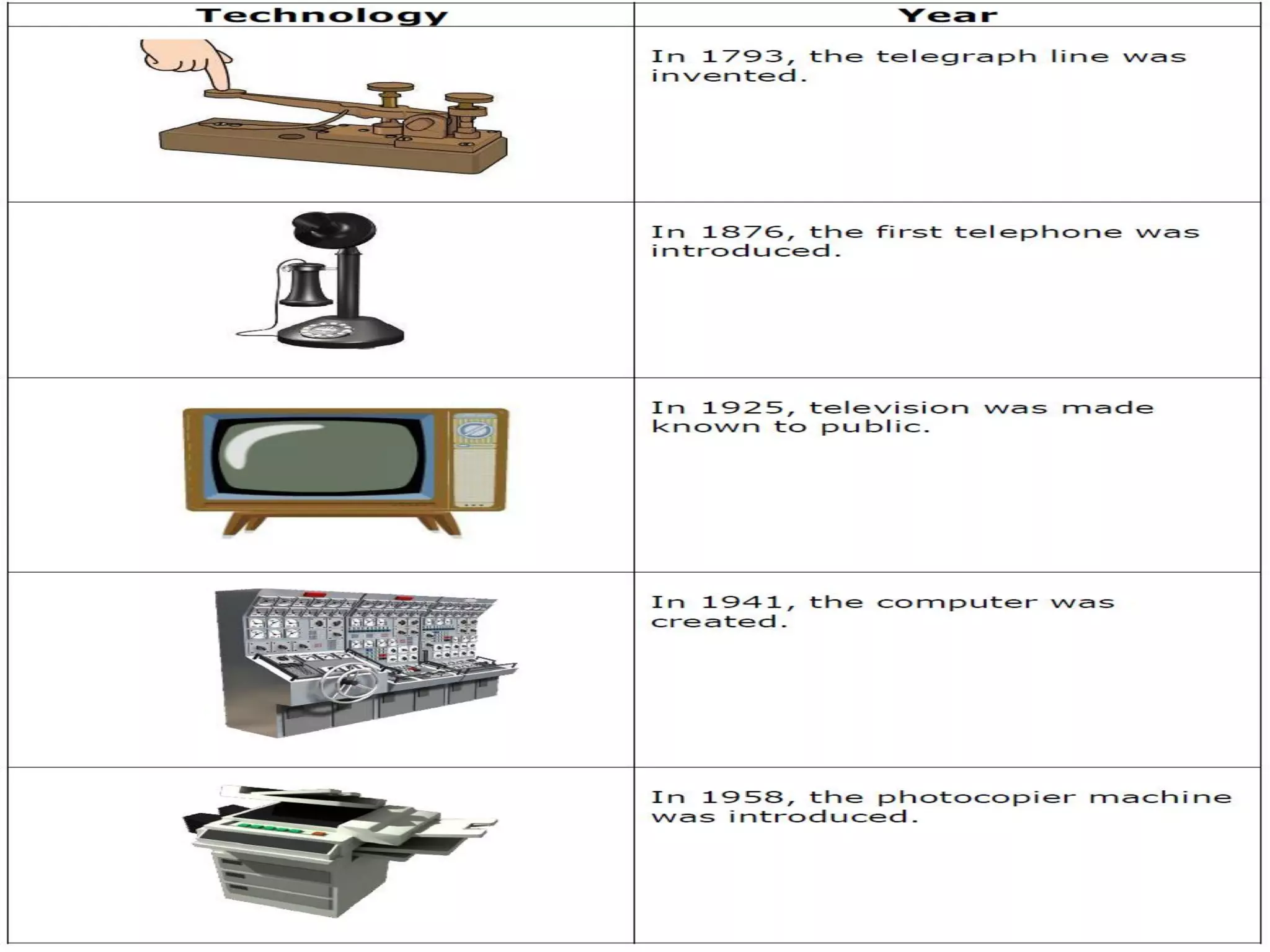
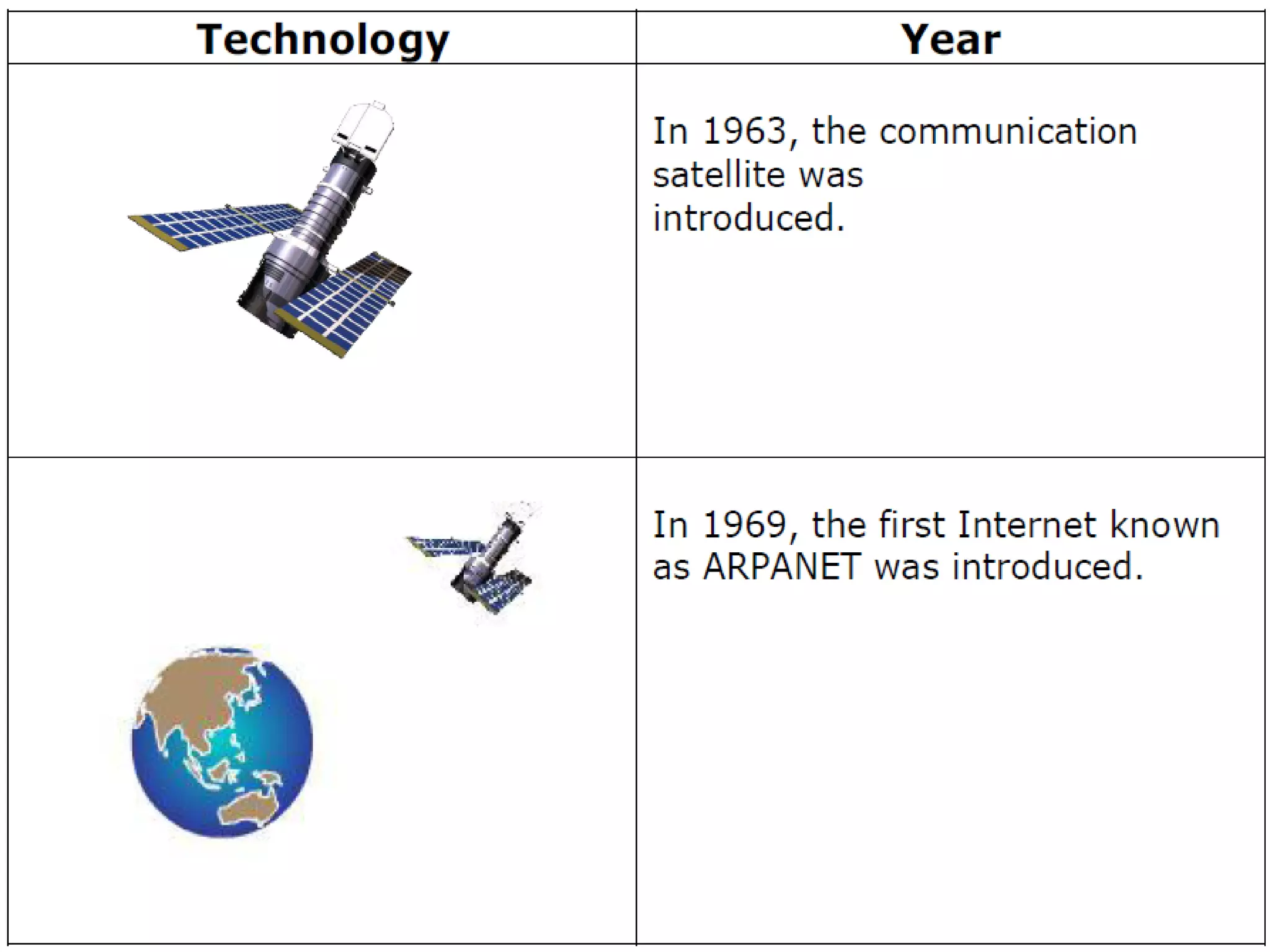
TECHNOLOGY TIMELINE
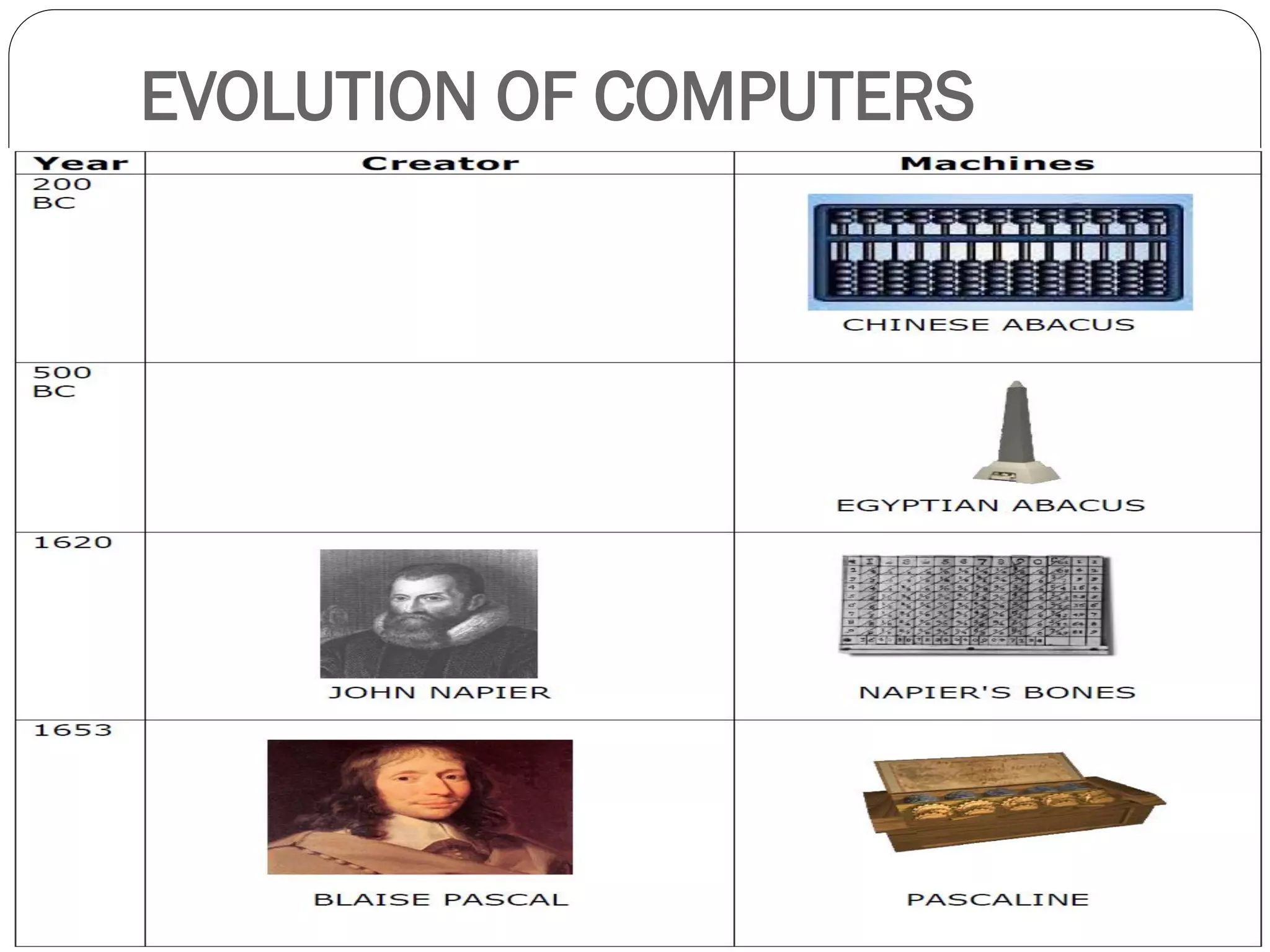
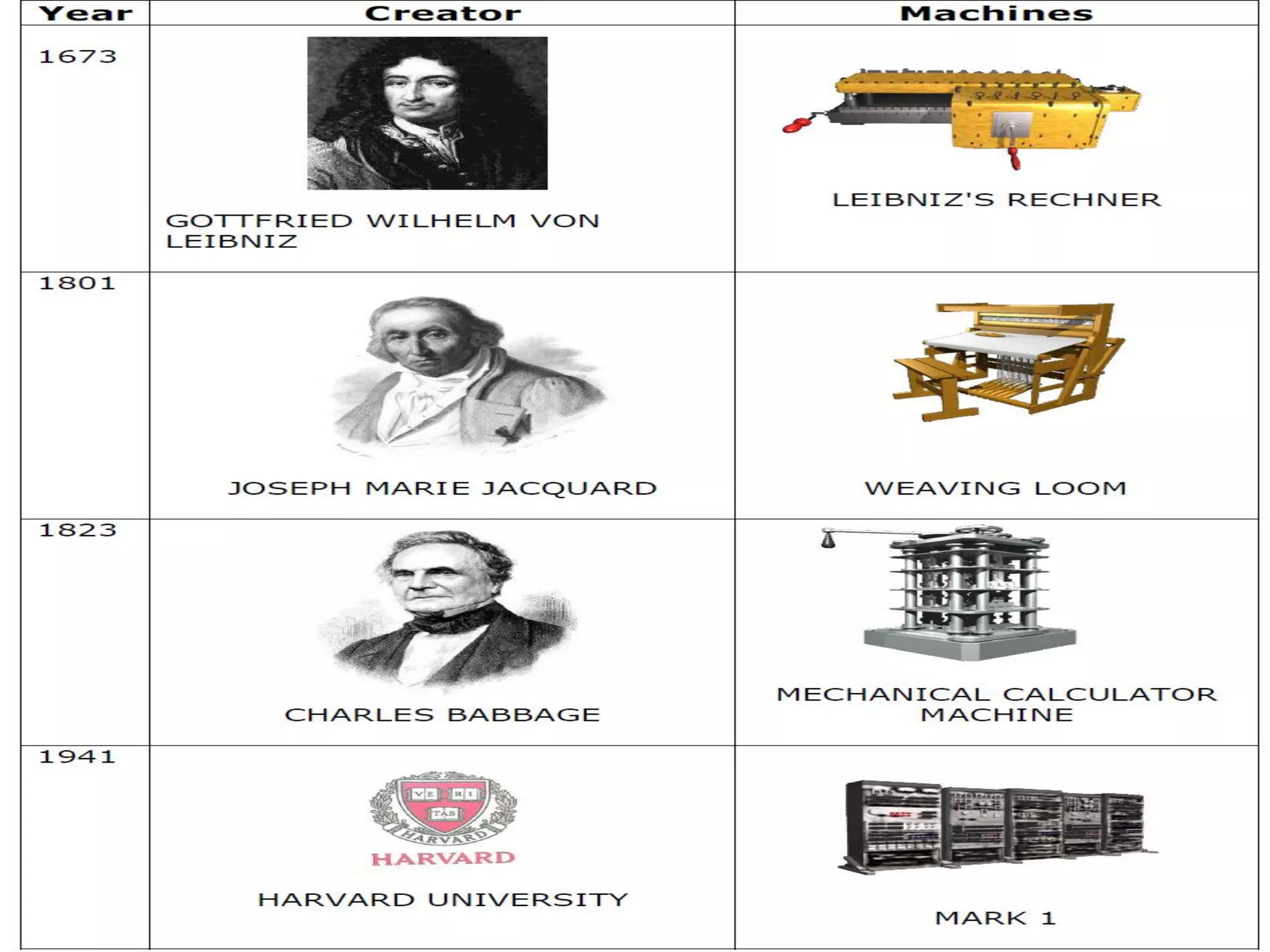
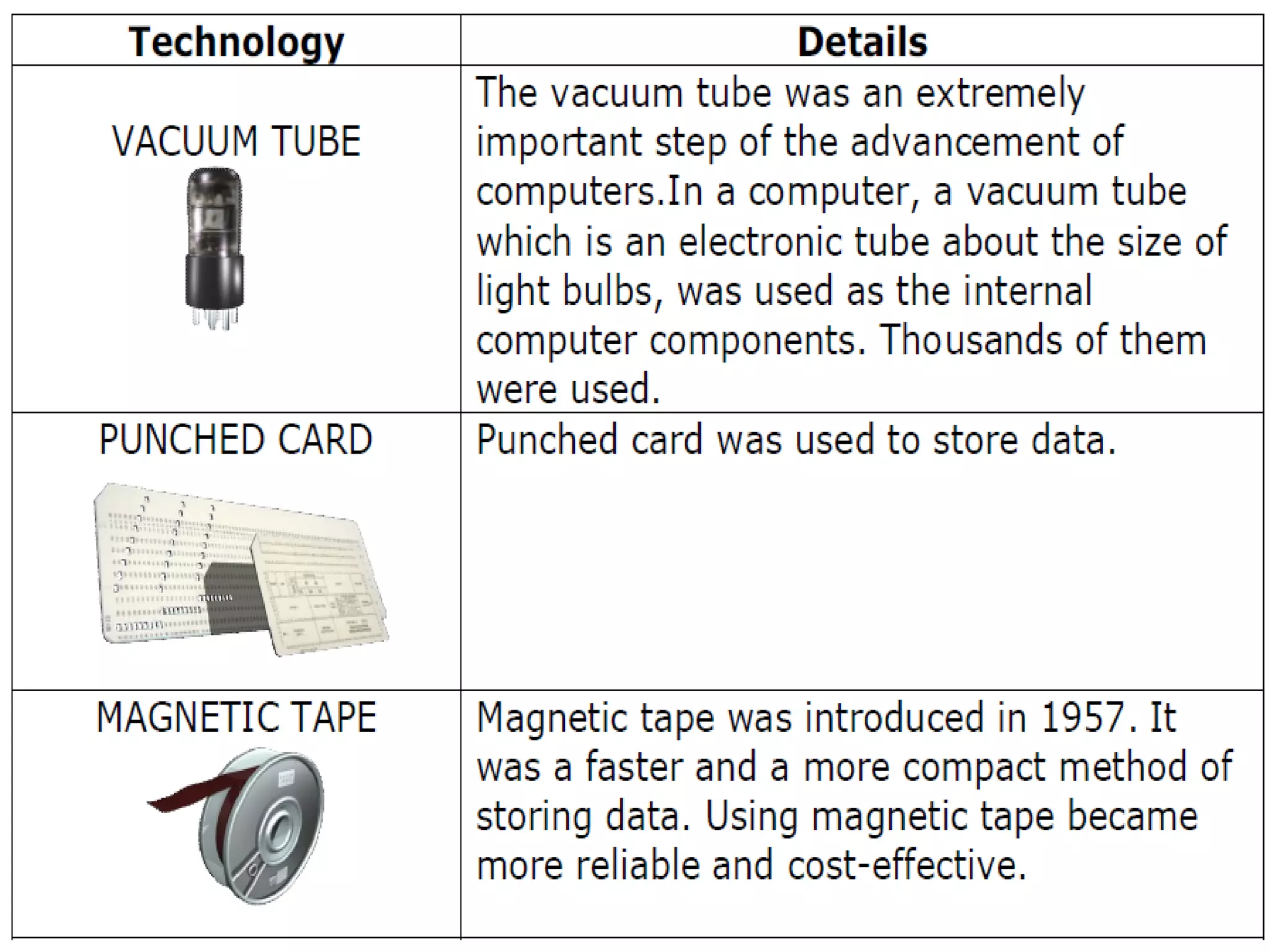
EVOLUTION OF COMPUTERS
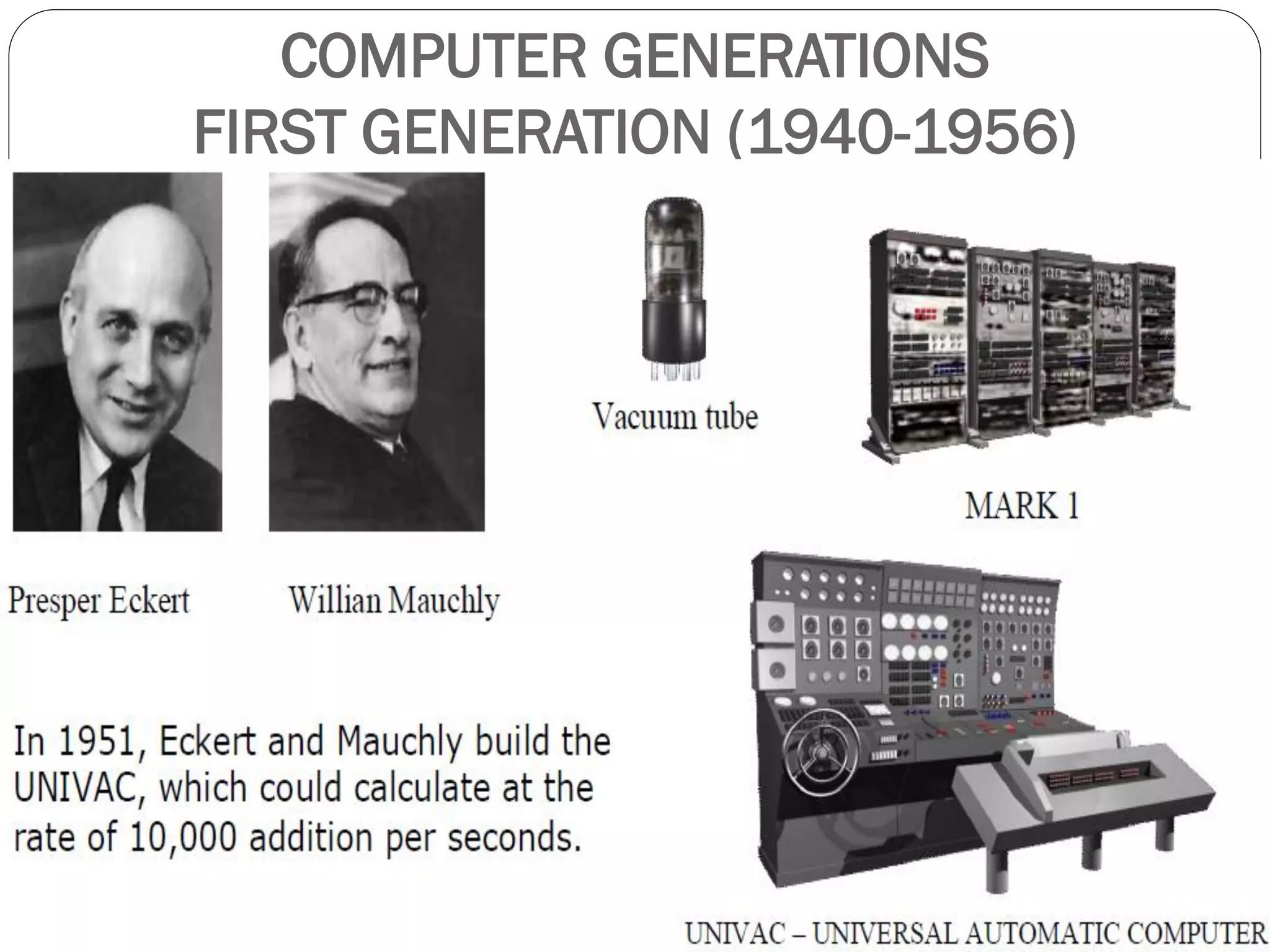
COMPUTER GENERATIONS
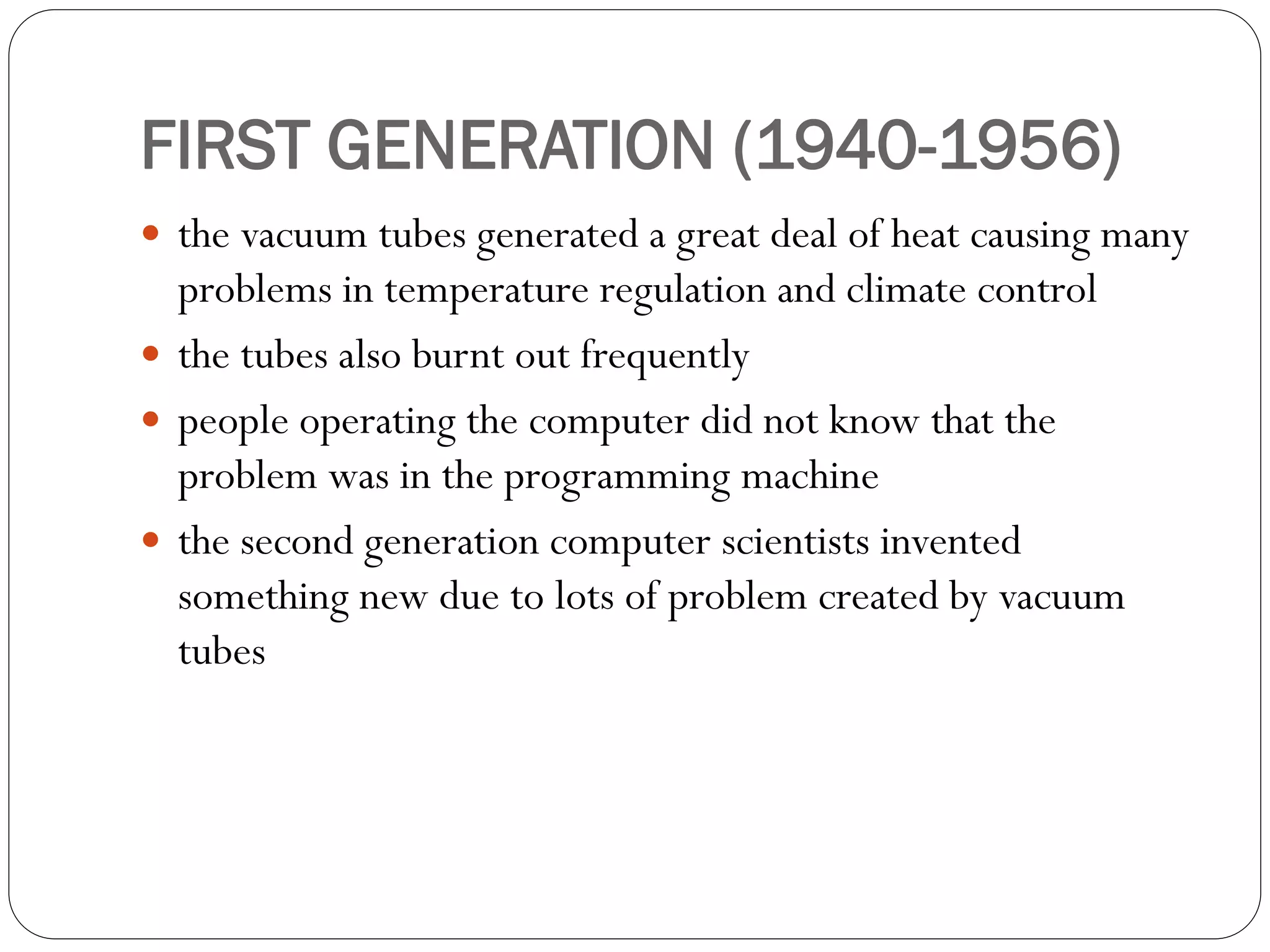
FIRST GENERATION (1940-1956)
 the vacuum tubes generated a great deal of heat causing many
problems in temperature regulation and climate control
 the tubes also burnt out frequently
 people operating the computer did not know that the
problem was in the programming machine
 the second generation computer scientists invented
something new due to lots of problem created by vacuum
tubes
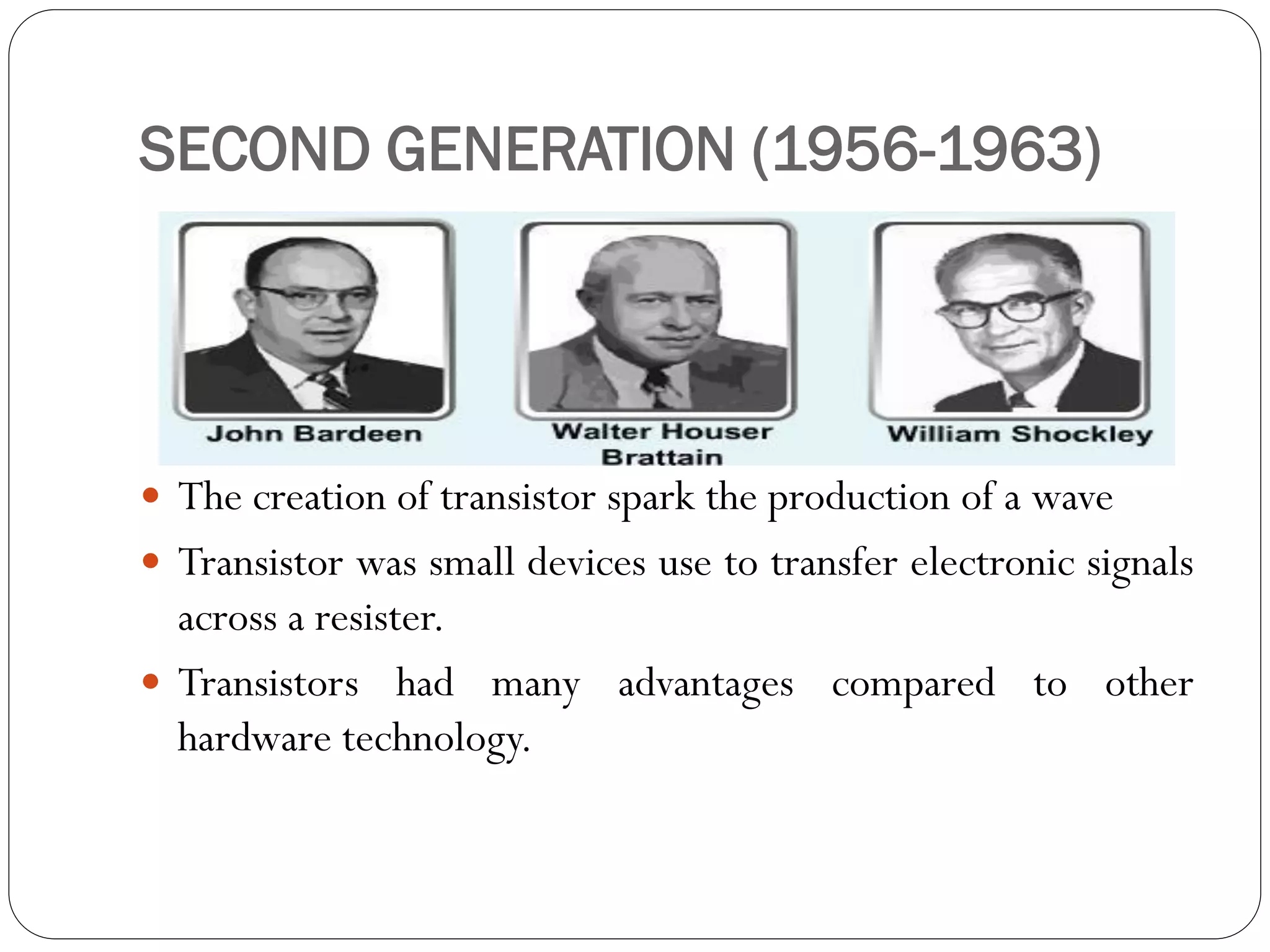
SECOND GENERATION (1956-1963)
 The creation of transistor spark the production of a wave
 Transistor was small devices use to transfer electronic signals
across a resister.
 Transistors had many advantages compared to other
hardware technology.
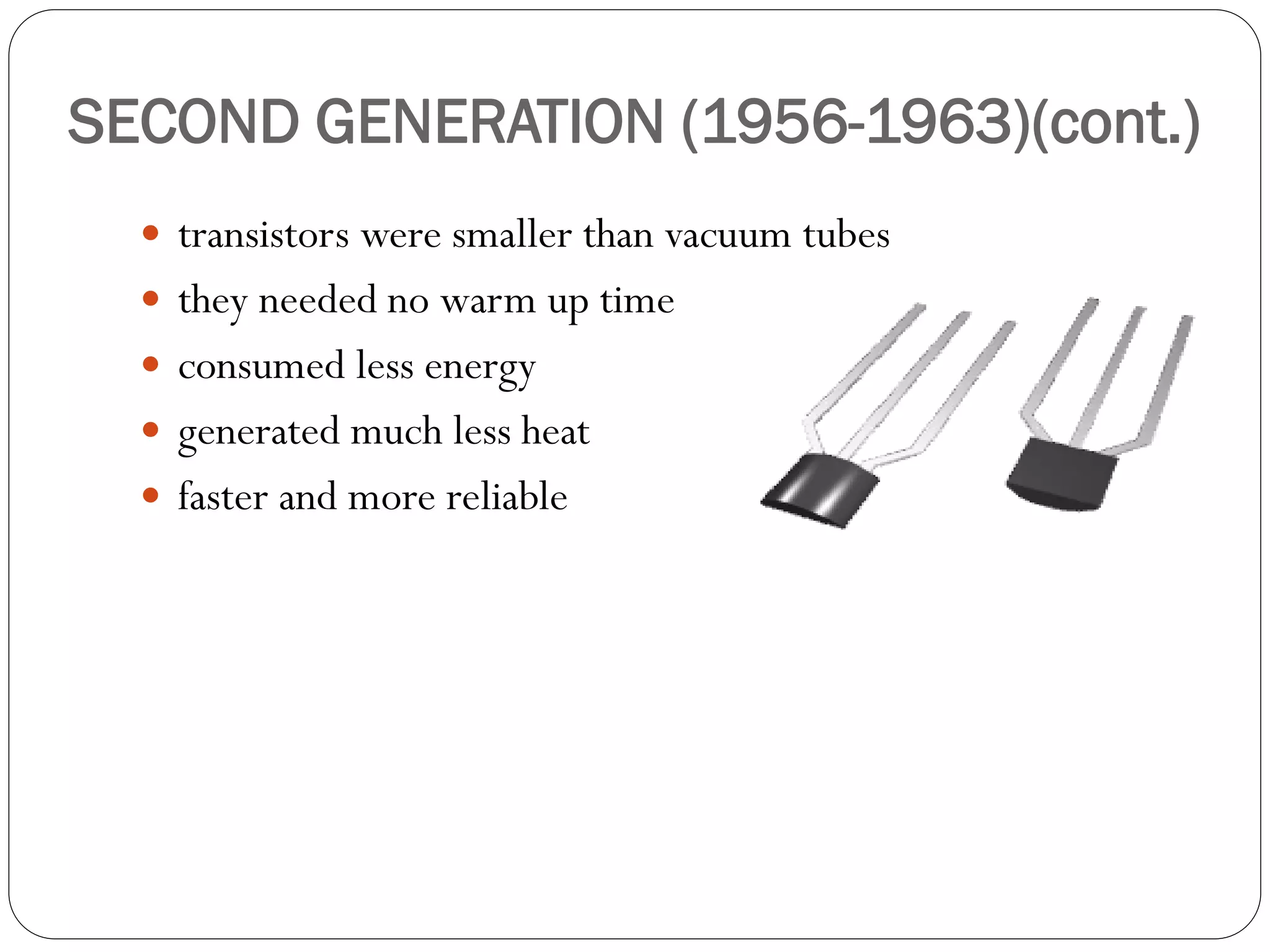
SECOND GENERATION (1956-1963)(cont.)
 transistors were smaller than vacuum tubes
 they needed no warm up time
 consumed less energy
 generated much less heat
 faster and more reliable
THIRD GENERATION (1964-1971)
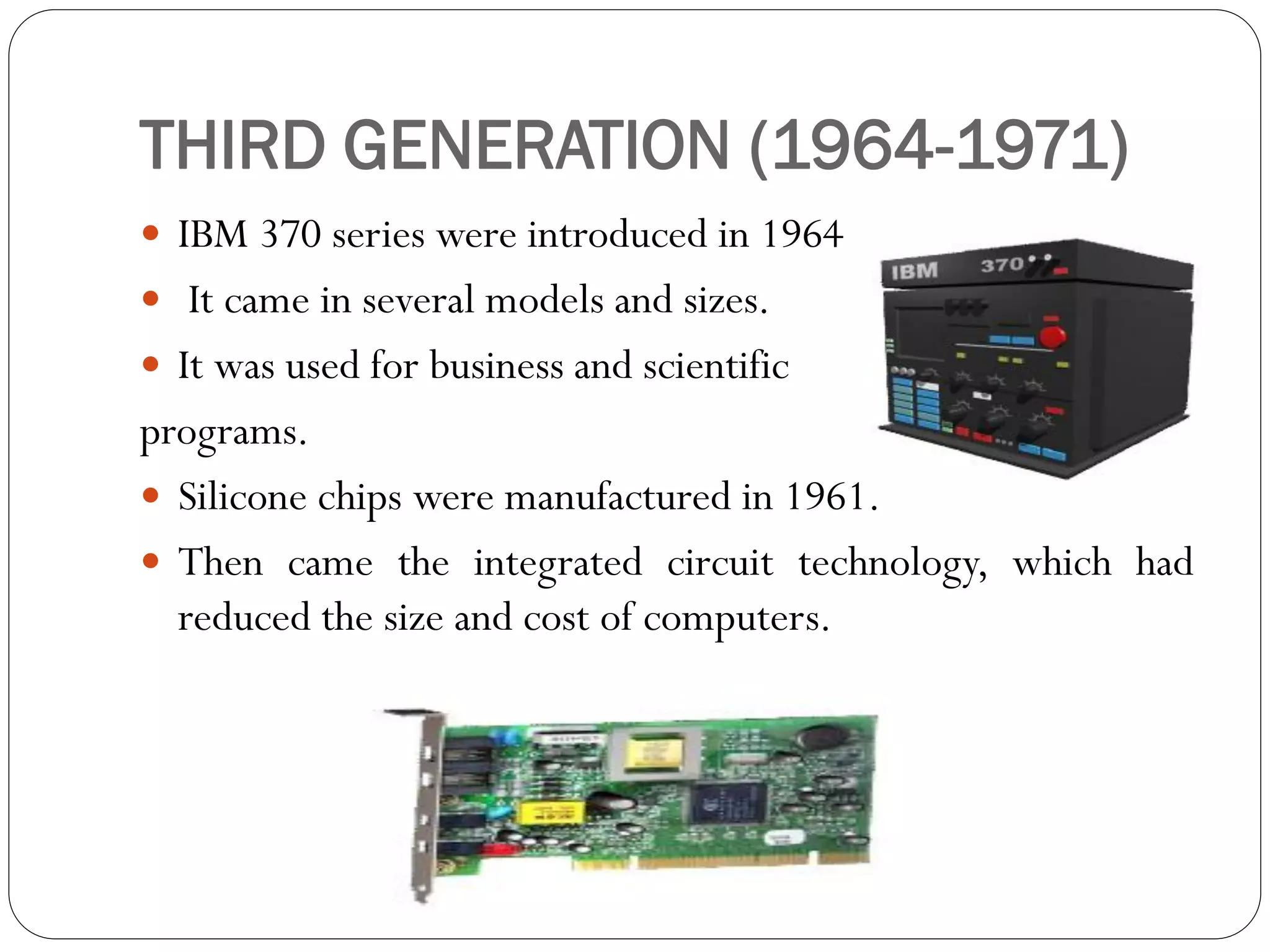
 IBM 370 series were introduced in 1964.
 It came in several models and sizes.
 It was used for business and scientific
programs.
 Silicone chips were manufactured in 1961.
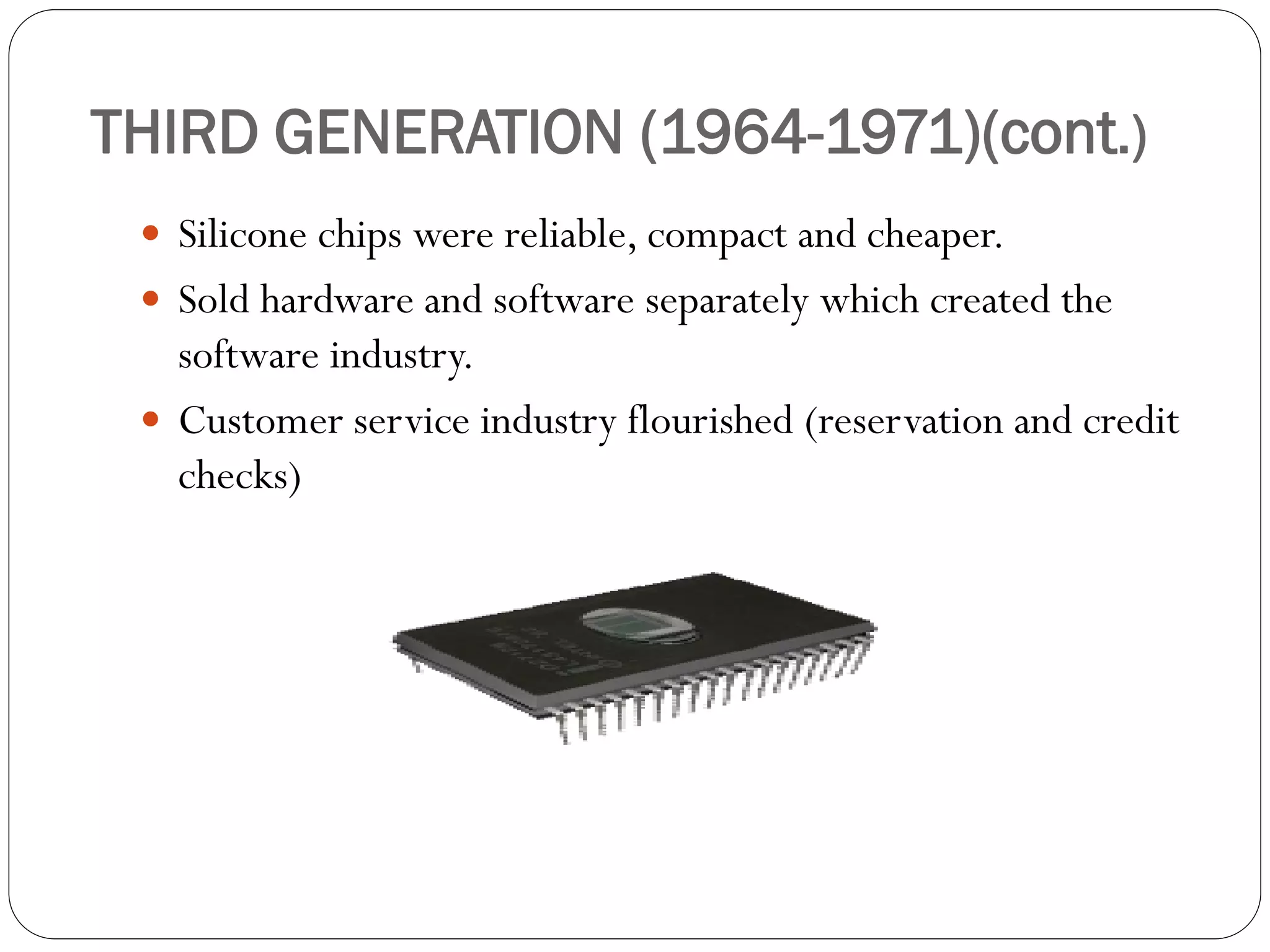
 Then came the integrated circuit technology, which had
reduced the size and cost of computers.
THIRD GENERATION (1964-1971)(cont.)
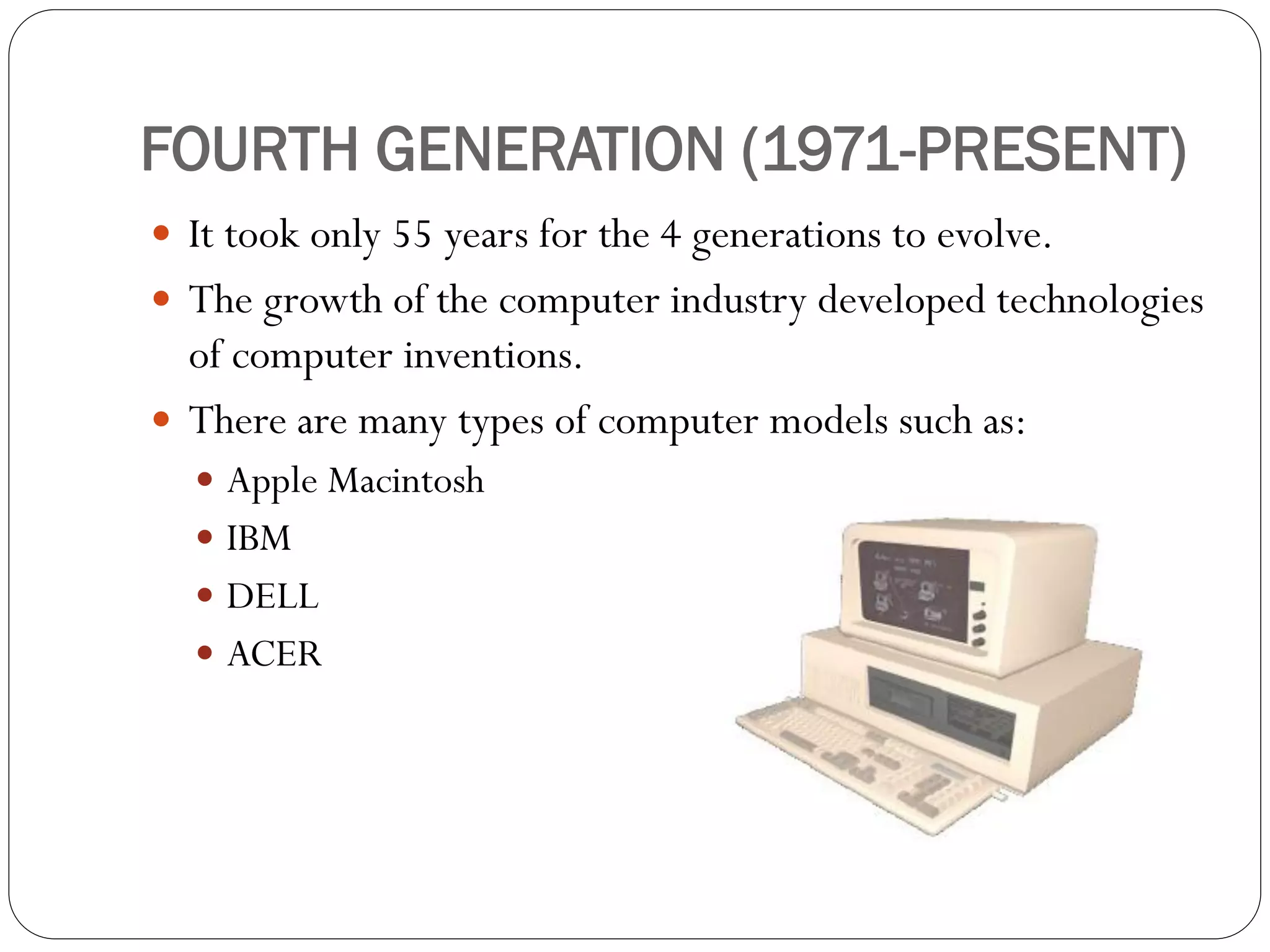
 Silicone chips were reliable, compact and cheaper.
 Sold hardware and software separately which created the
software industry.
 Customer service industry flourished (reservation and credit
checks)
FOURTH GENERATION (1971-PRESENT)
 It took only 55 years for the 4 generations to evolve.
 The growth of the computer industry developed technologies
of computer inventions.
 There are many types of computer models such as:
 Apple Macintosh
 IBM
 DELL
 ACER
FOURTH GENERATION (1971-PRESENT)
 In 1971 Intel created the first microprocessor.
 In 1976, Steve Jobs built the first Apple computer.
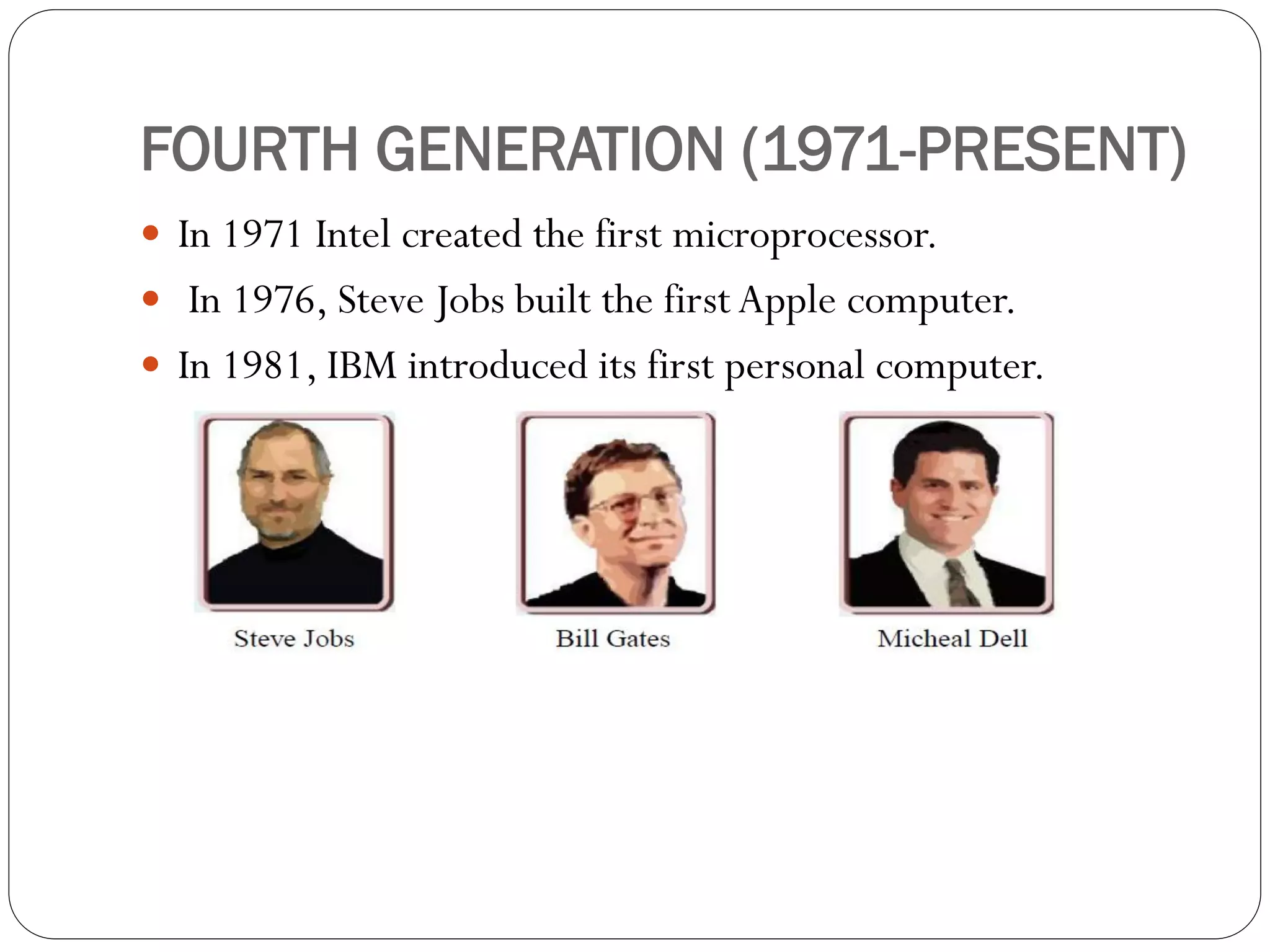
 In 1981, IBM introduced its first personal computer.
FOURTH GENERATION (1971-PRESENT)
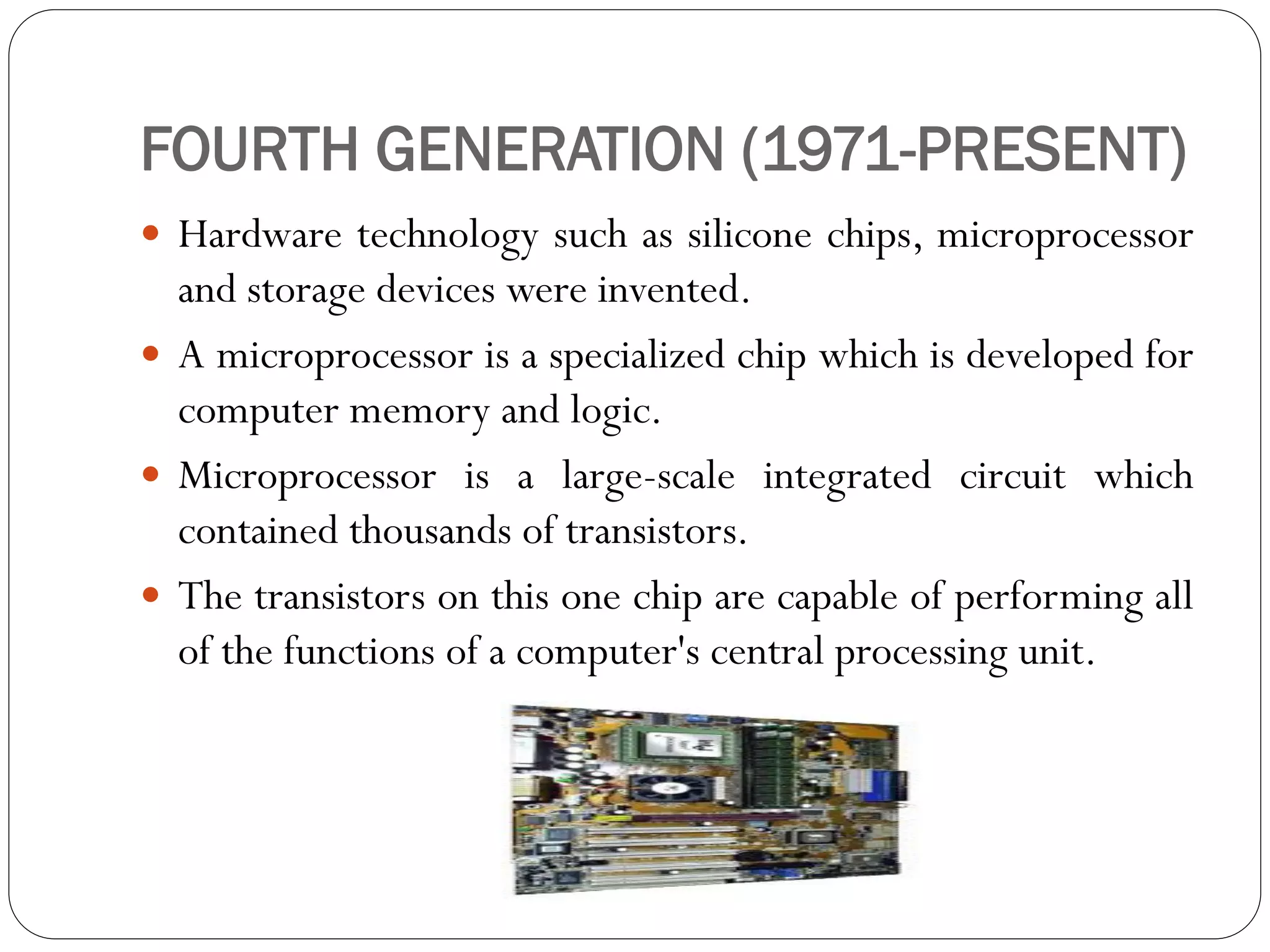
 Hardware technology such as silicone chips, microprocessor
and storage devices were invented.
 A microprocessor is a specialized chip which is developed for
computer memory and logic.
 Microprocessor is a large-scale integrated circuit which
contained thousands of transistors.
 The transistors on this one chip are capable of performing all
of the functions of a computer's central processing unit.
FOURTH GENERATION (1971-PRESENT)
Advantages
 Computers became 100 times smaller than ENIAC
(Electronic Numerical Integrator and Computer) the first
computer
 Gain in speed, reliability and storage capacity
 Personal and software industry boomed
FIFTH GENERATION (PRESENT &
BEYOND)
 Computers are technologically advance and are still being
development to become more efficient.
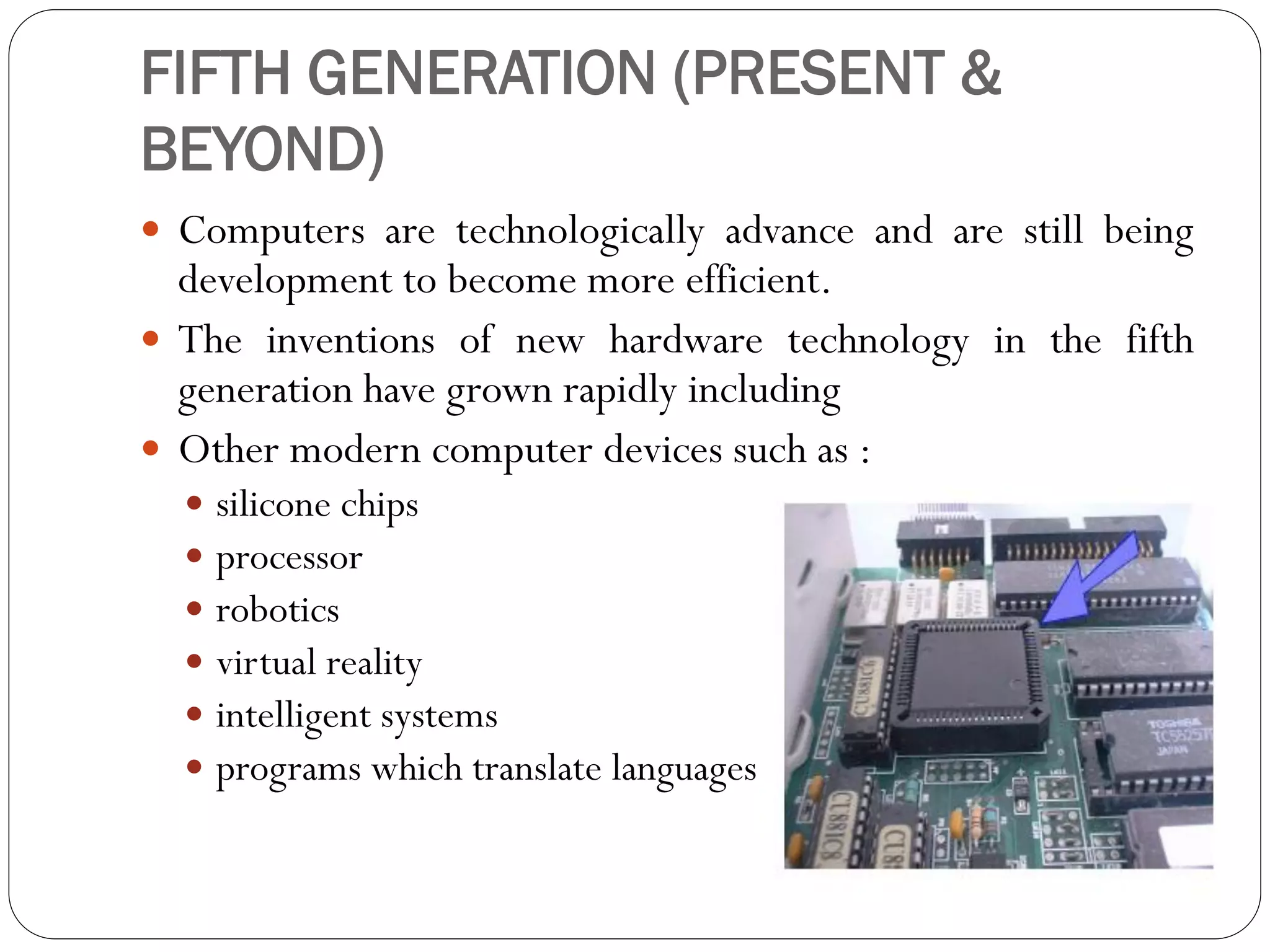
 The inventions of new hardware technology in the fifth
generation have grown rapidly including
 Other modern computer devices such as :
 silicone chips
 processor
 robotics
 virtual reality
 intelligent systems
 programs which translate languages
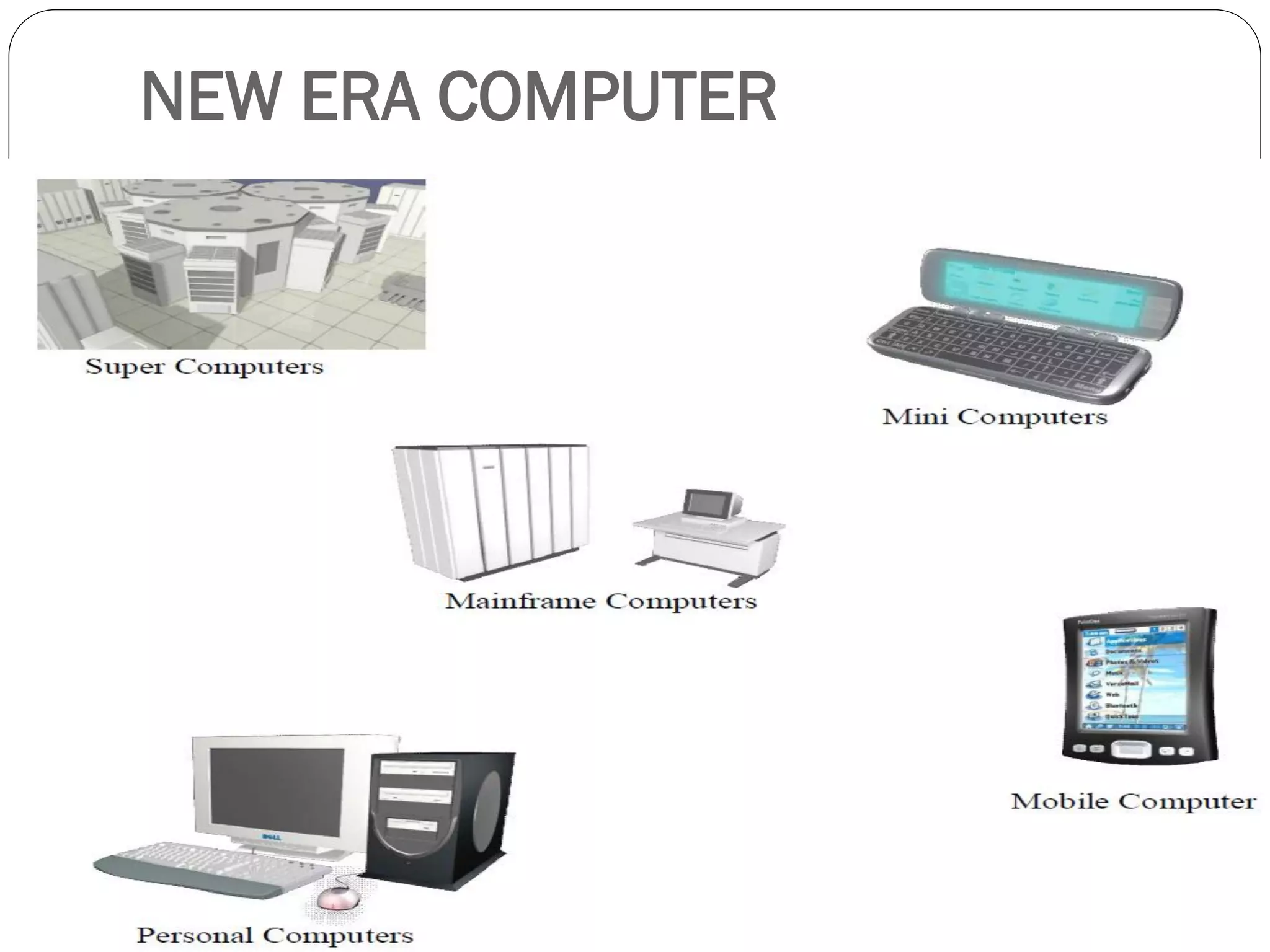
NEW ERA COMPUTER
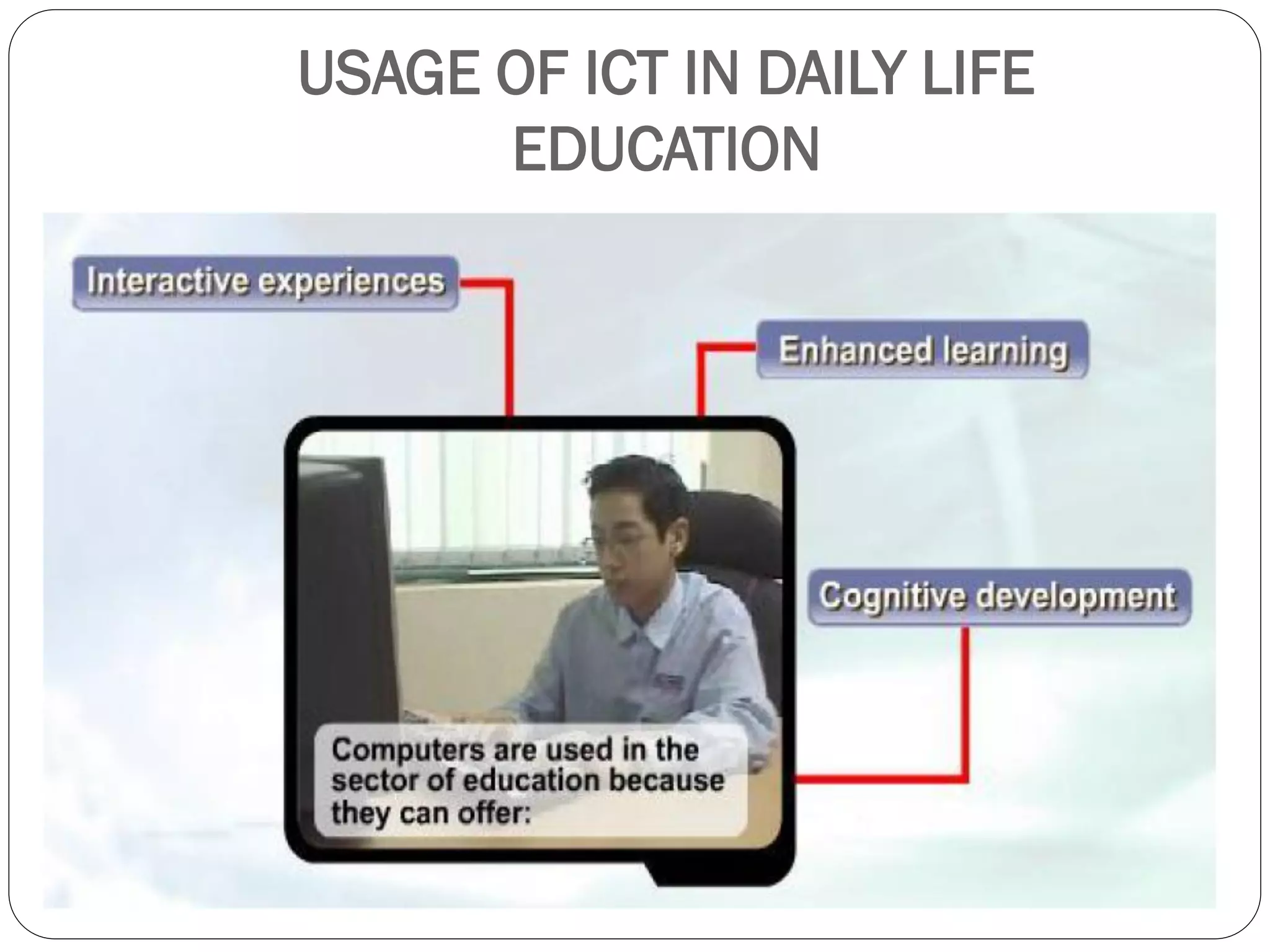
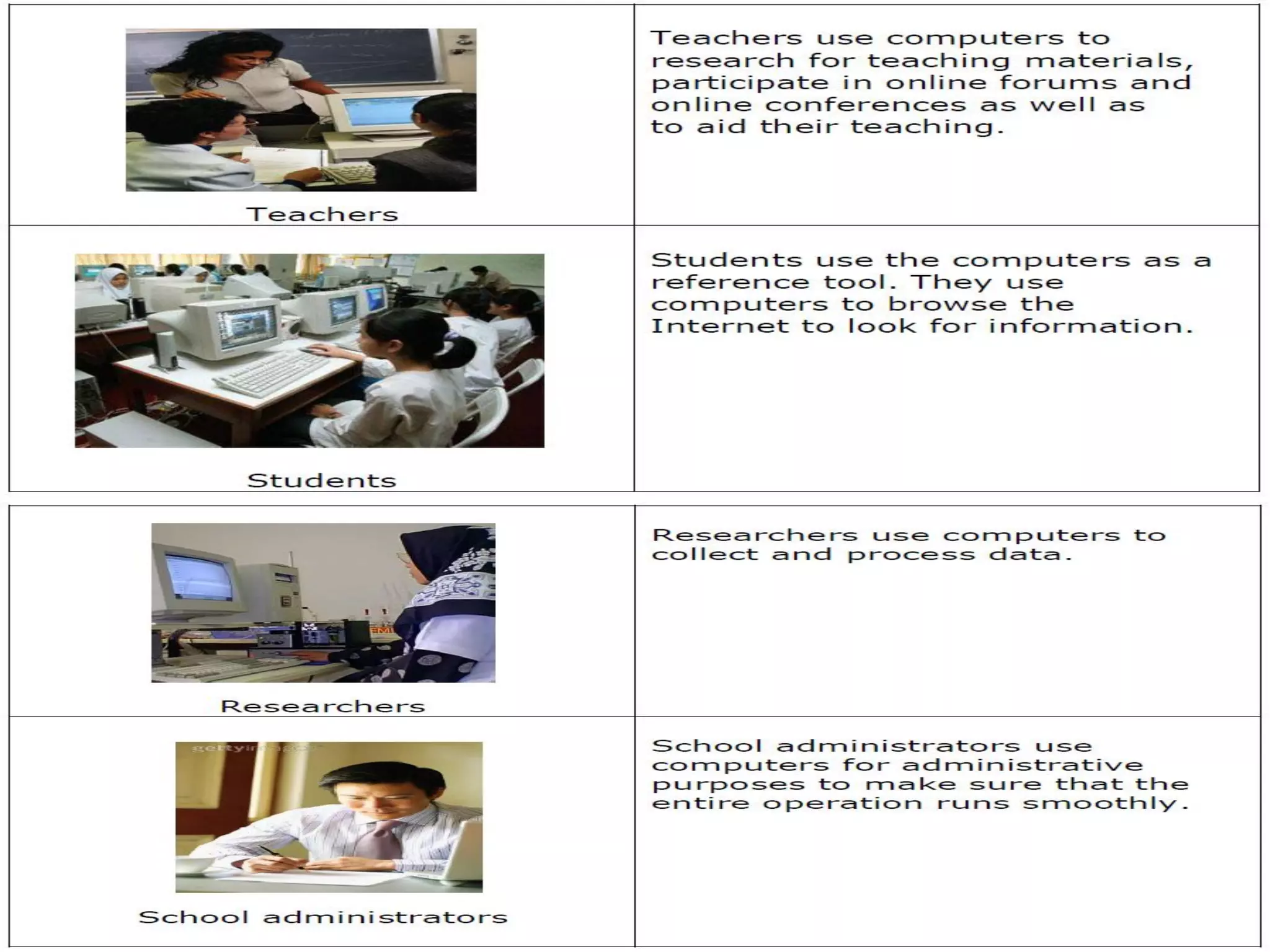
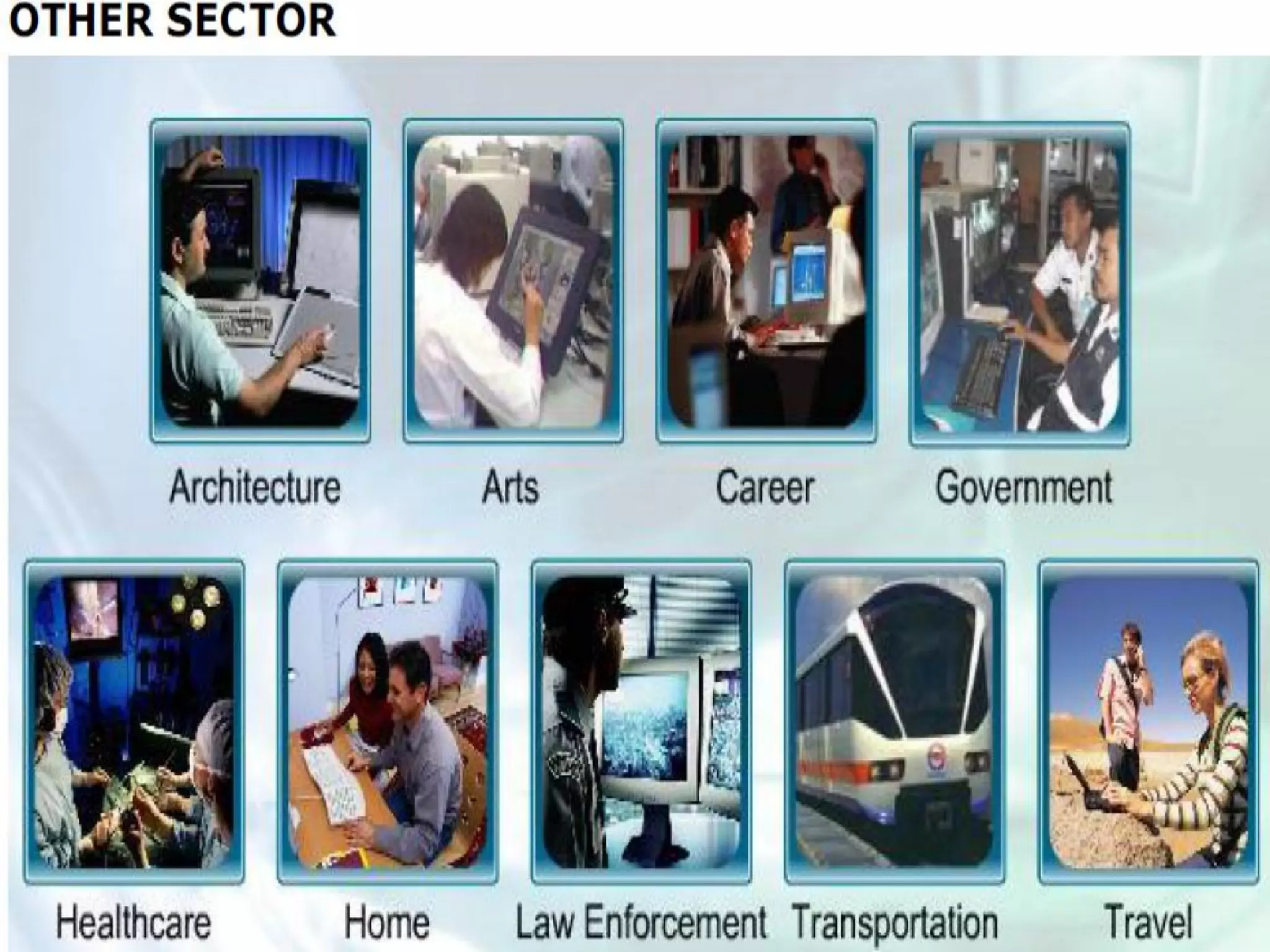
USAGE OF ICT IN DAILY LIFE
EDUCATION
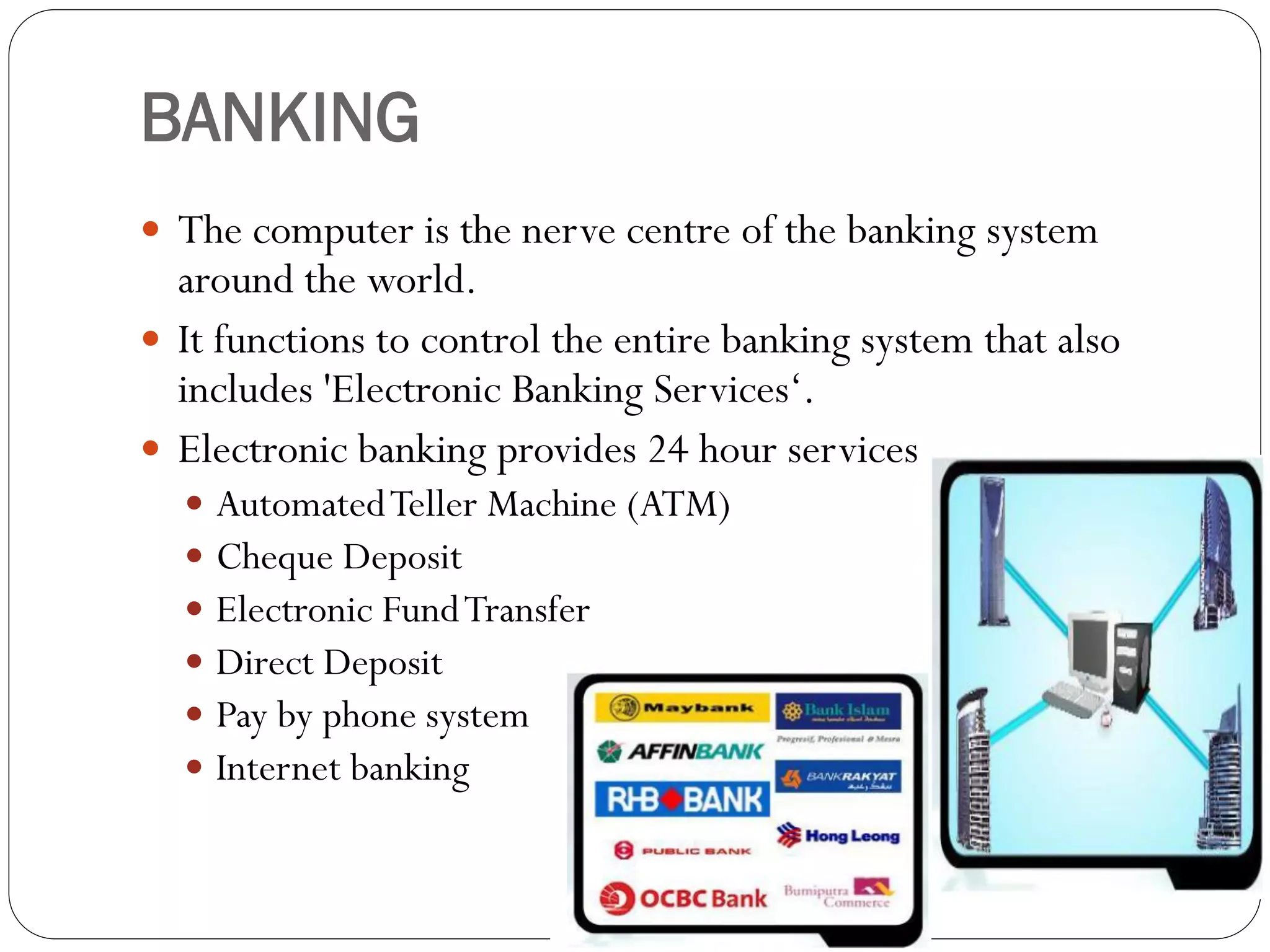
BANKING
 The computer is the nerve centre of the banking system
around the world.
 It functions to control the entire banking system that also
includes 'Electronic Banking Services‘.
 Electronic banking provides 24 hour services.
 AutomatedTeller Machine (ATM)
 Cheque Deposit
 Electronic FundTransfer
 Direct Deposit
 Pay by phone system
 Internet banking
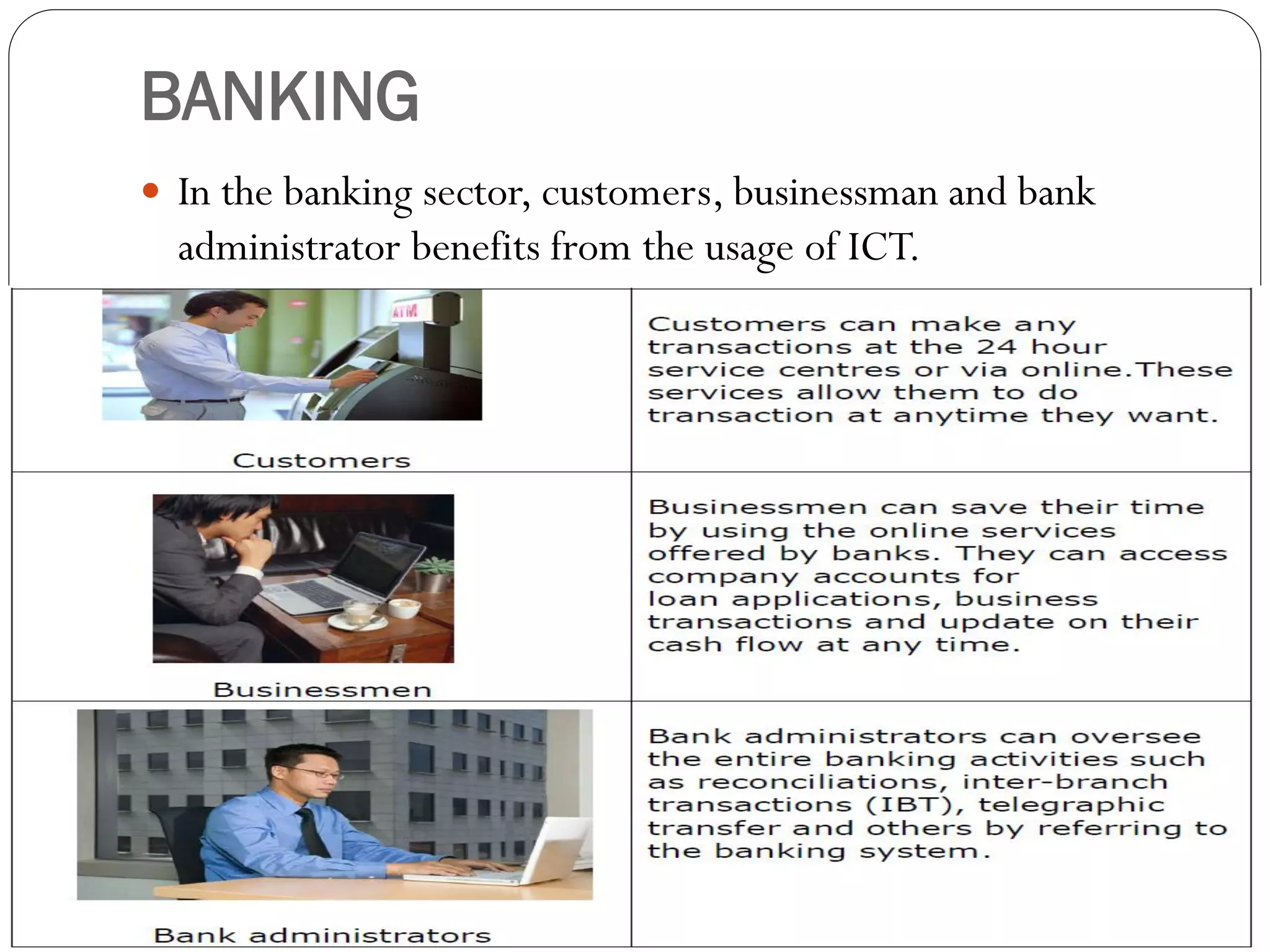
BANKING
 In the banking sector, customers, businessman and bank
administrator benefits from the usage of ICT.
INDUSTRY
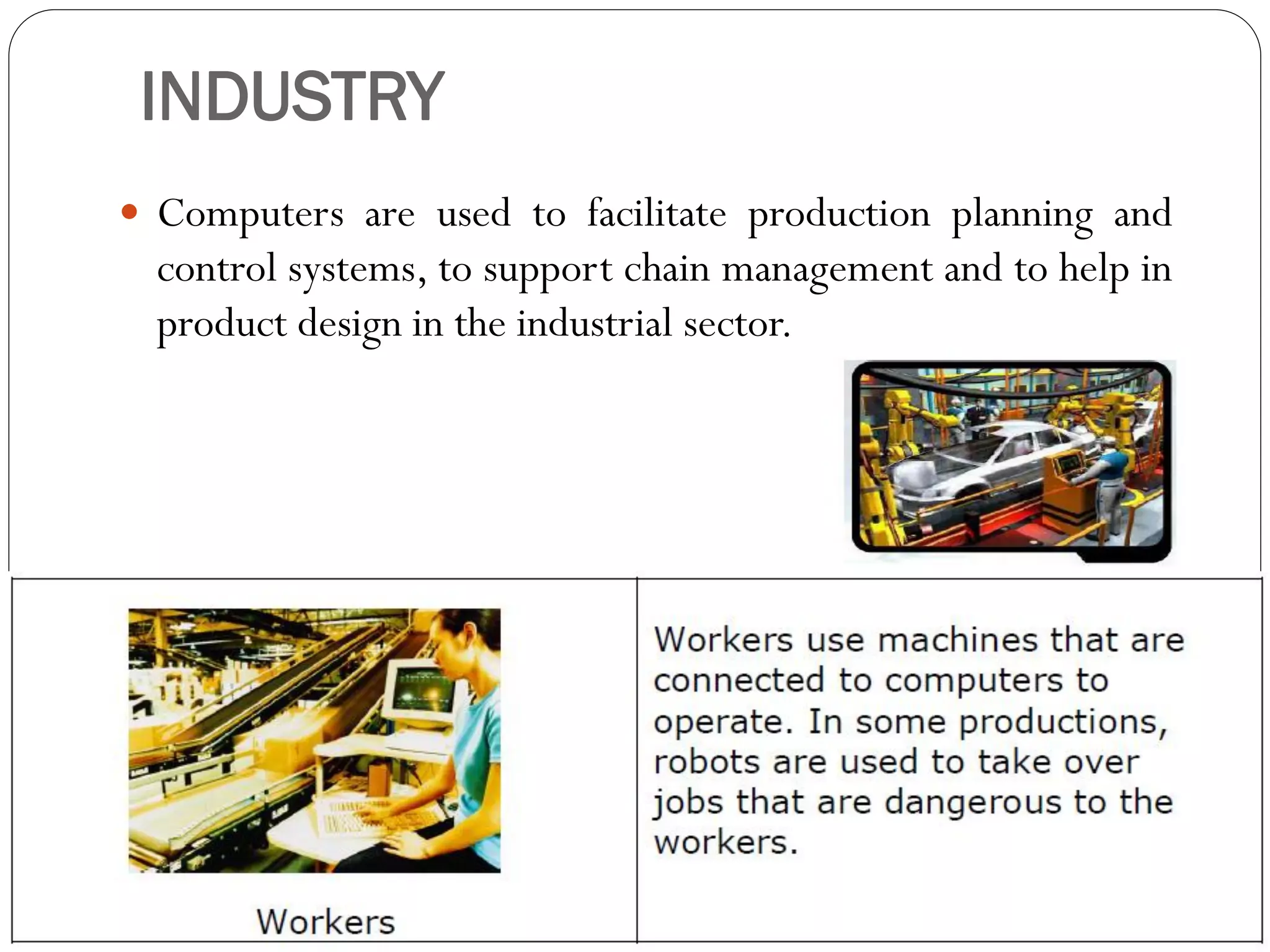
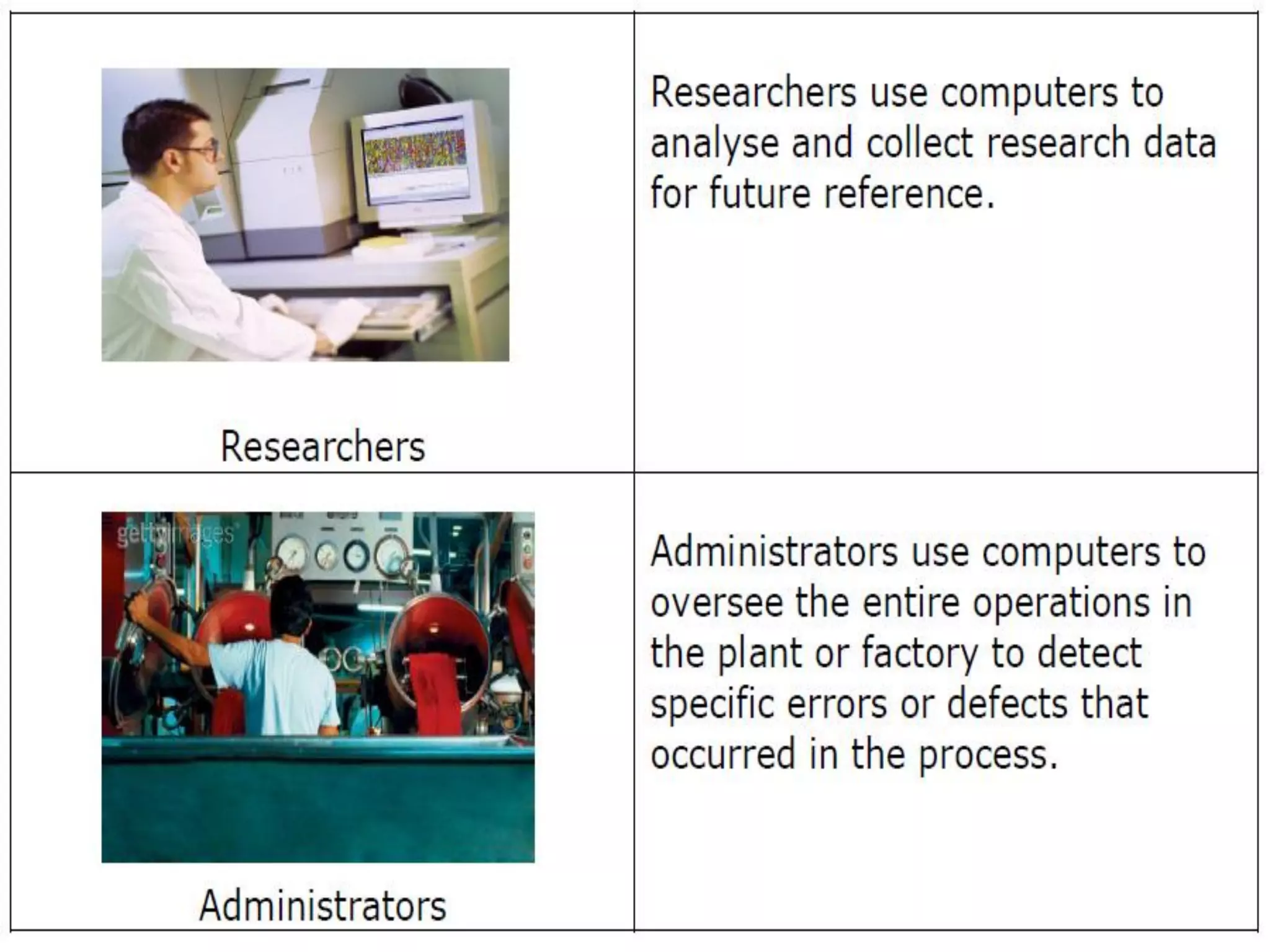
 Computers are used to facilitate production planning and
control systems, to support chain management and to help in
product design in the industrial sector.
E-COMMERCE
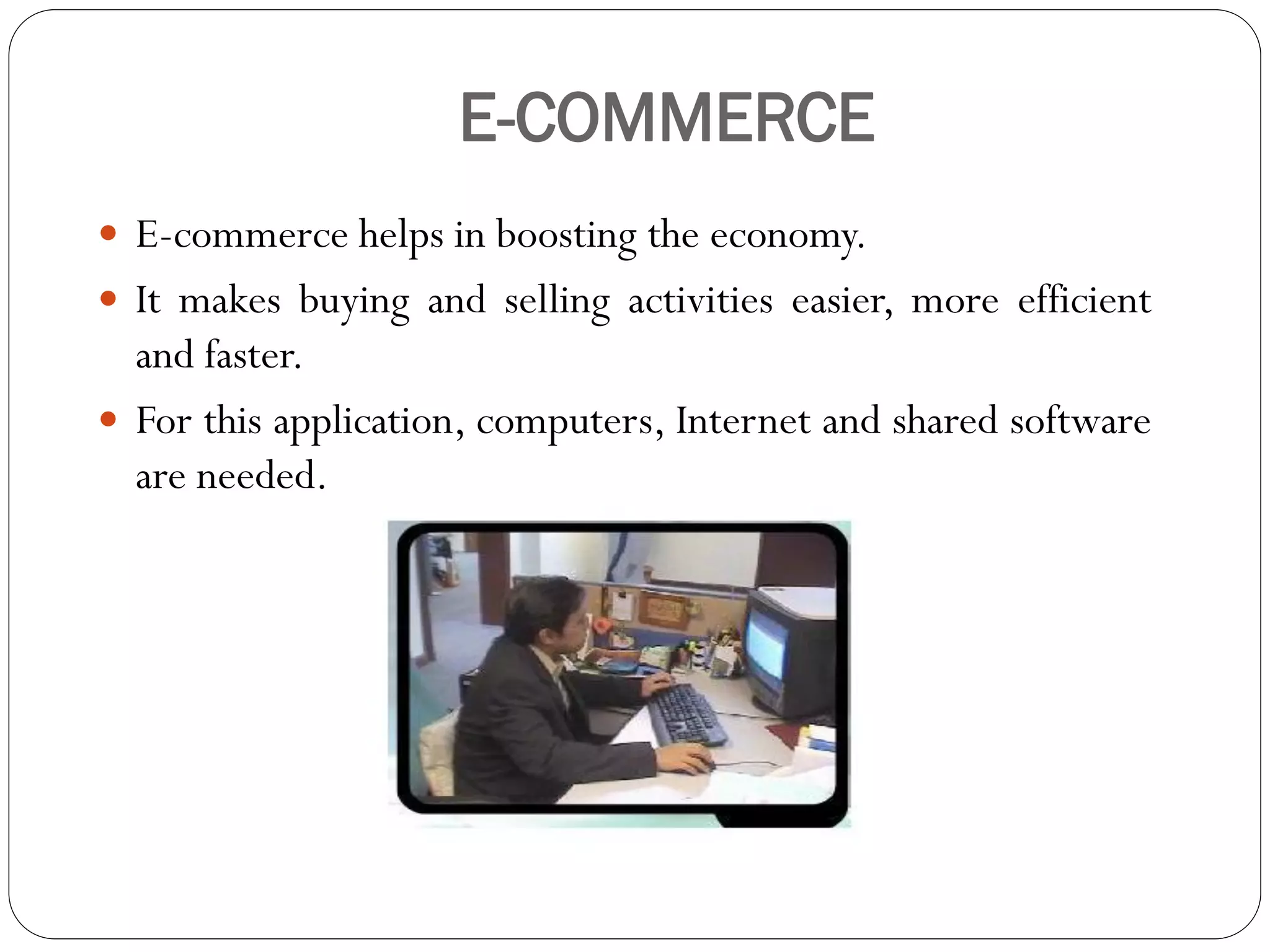
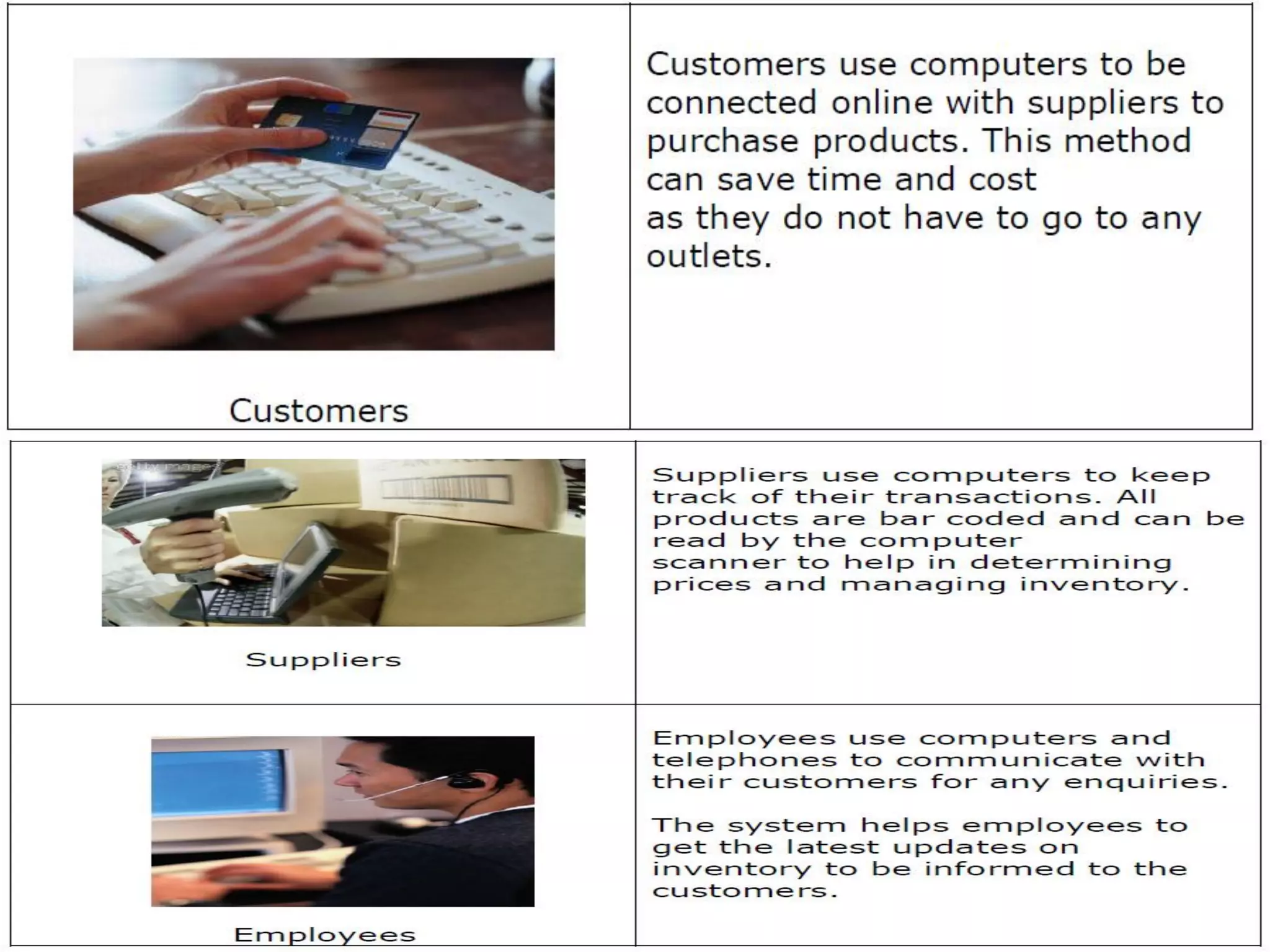
 E-commerce helps in boosting the economy.
 It makes buying and selling activities easier, more efficient
and faster.
 For this application, computers, Internet and shared software
are needed.
COMPUTERISED AND NON-COMPUTERISED
SYSTEMS
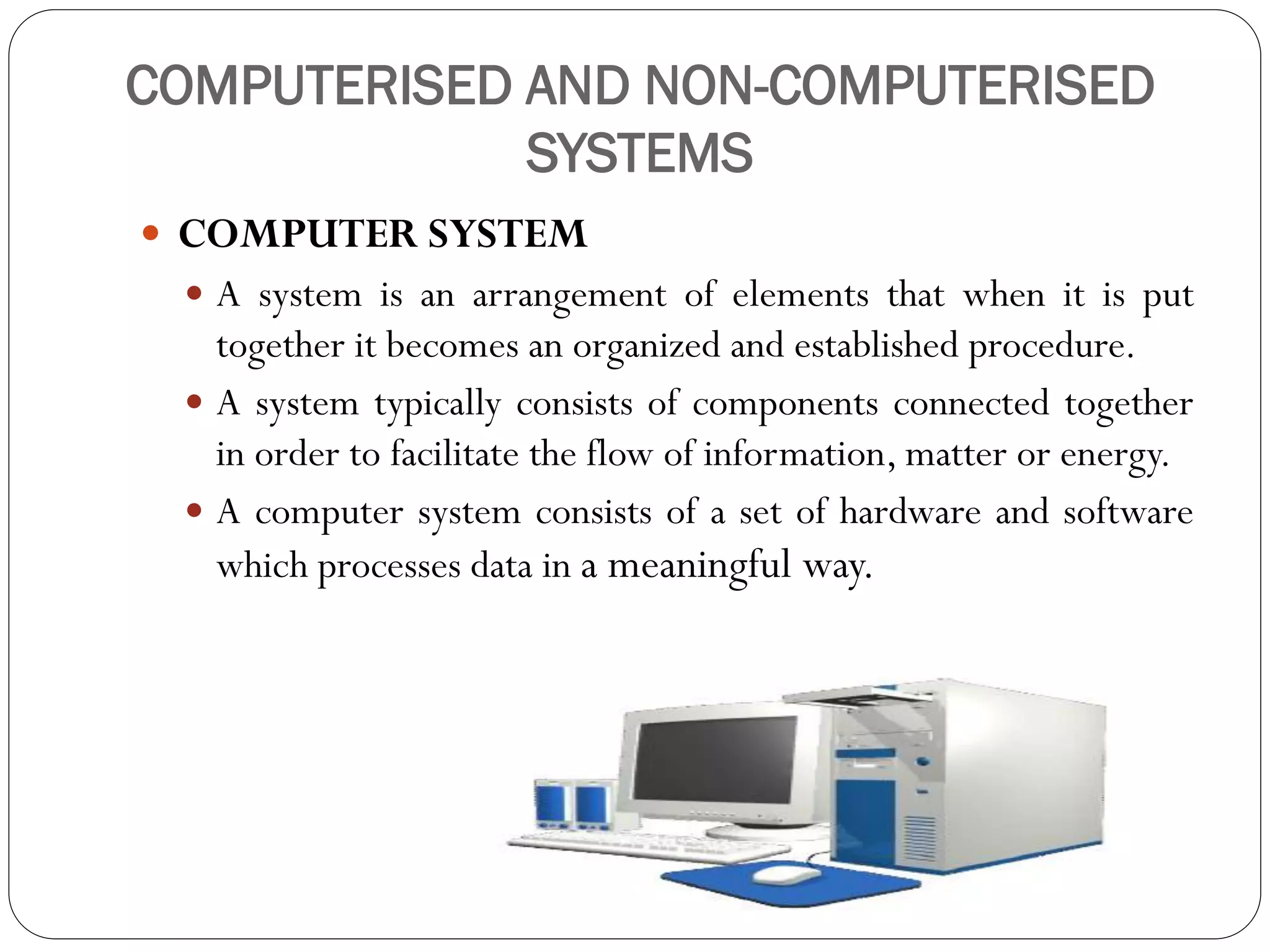
 COMPUTER SYSTEM
 A system is an arrangement of elements that when it is put
together it becomes an organized and established procedure.
 A system typically consists of components connected together
in order to facilitate the flow of information, matter or energy.
 A computer system consists of a set of hardware and software
which processes data in a meaningful way.
COMPUTERISED AND NON-COMPUTERISED
SYSTEMS
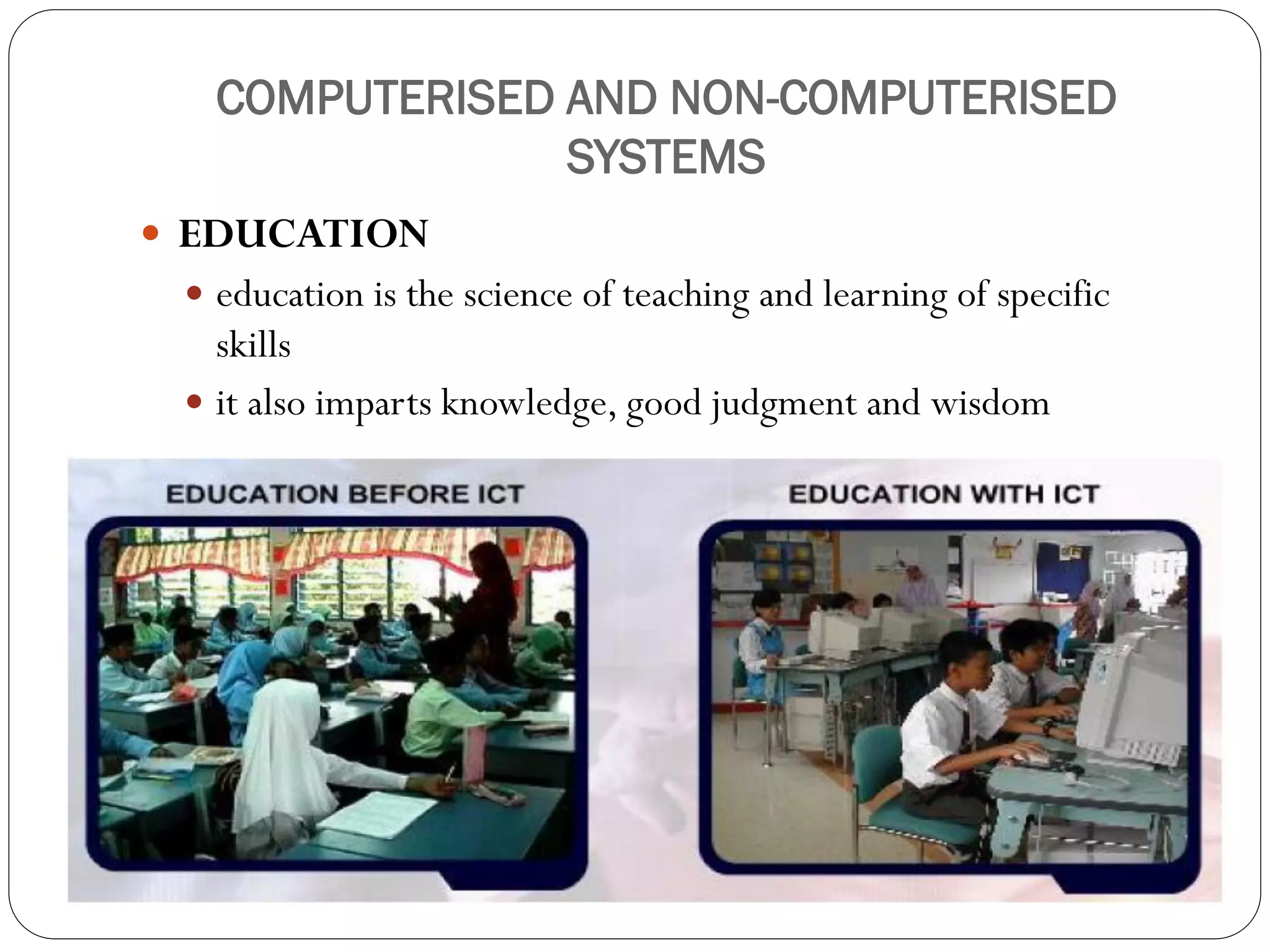
 EDUCATION
 education is the science of teaching and learning of specific
skills
 it also imparts knowledge, good judgment and wisdom
COMPUTERISED AND NON-COMPUTERISED
SYSTEMS
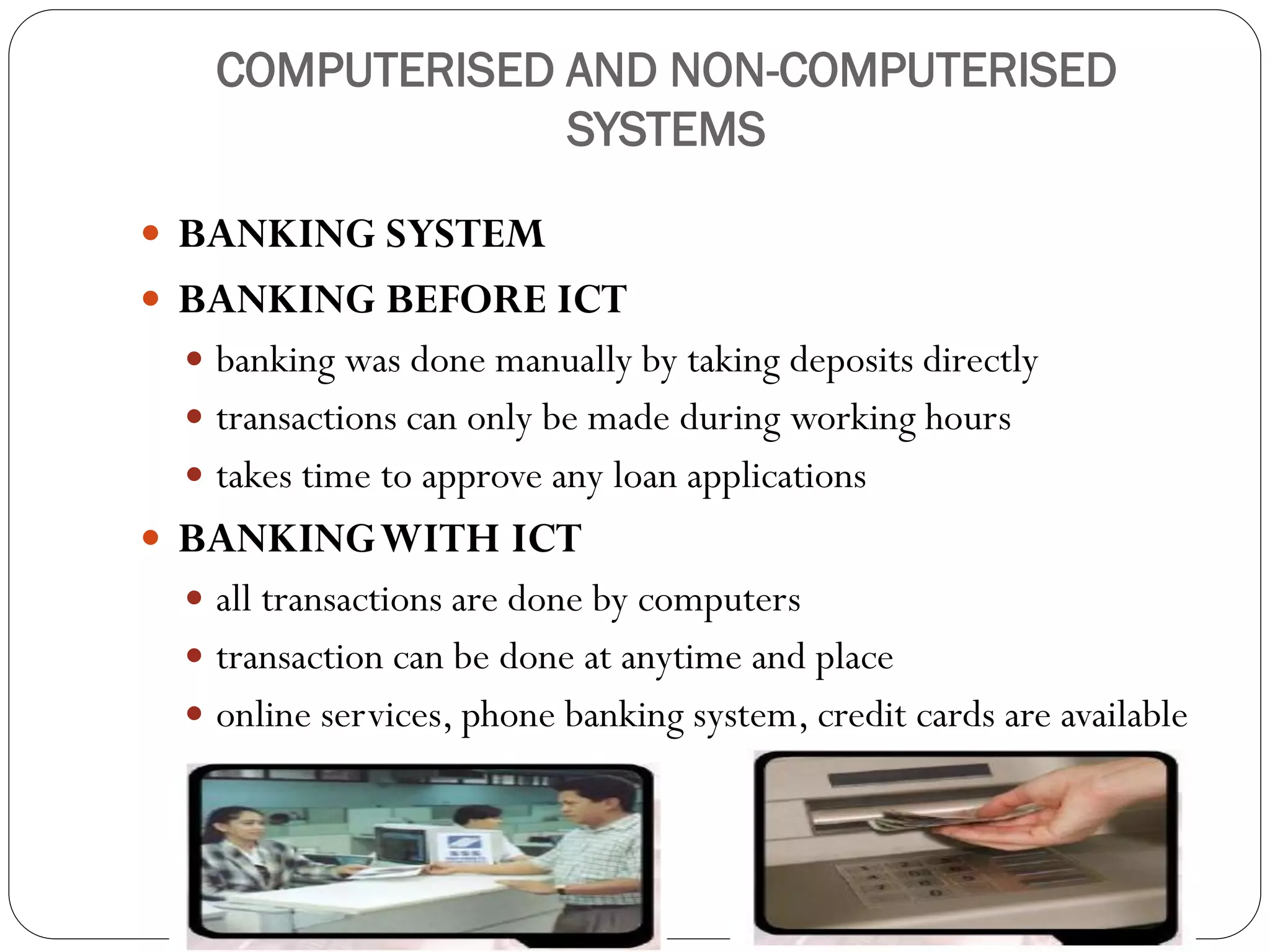
 BANKING SYSTEM
 BANKING BEFORE ICT
 banking was done manually by taking deposits directly
 transactions can only be made during working hours
 takes time to approve any loan applications
 BANKINGWITH ICT
 all transactions are done by computers
 transaction can be done at anytime and place
 online services, phone banking system, credit cards are available
COMPUTERISED AND NON-COMPUTERISED
SYSTEMS
 INDUSTRY
 INDUSTRY BEFORE ICT
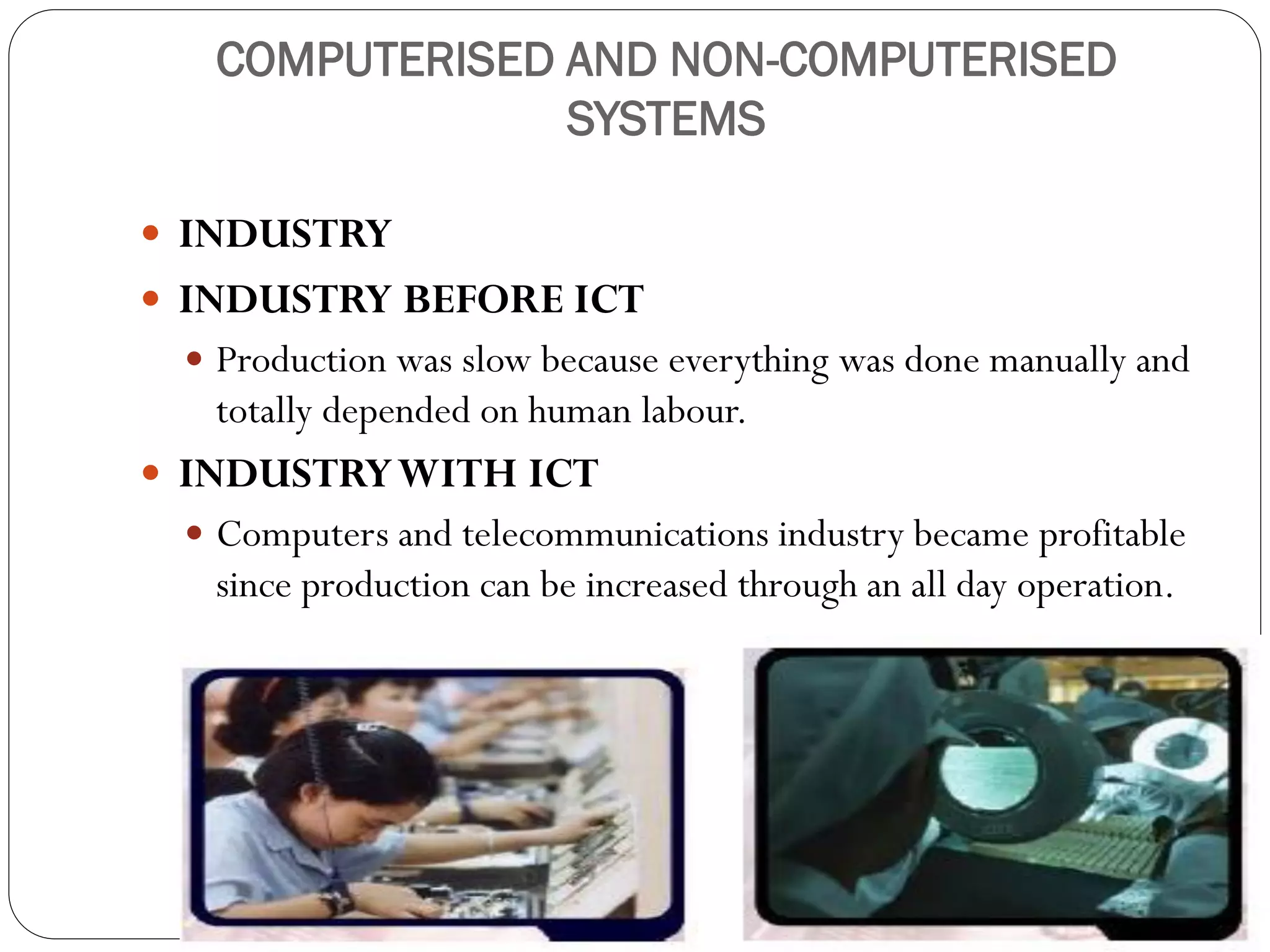
 Production was slow because everything was done manually and
totally depended on human labour.
 INDUSTRYWITH ICT
 Computers and telecommunications industry became profitable
since production can be increased through an all day operation.
COMPUTERISED AND NON-COMPUTERISED
SYSTEMS
 COMMERCE
 Commerce is an activity of exchanging, buying and selling of
commodities on a large scale involving transportation from
place to place.
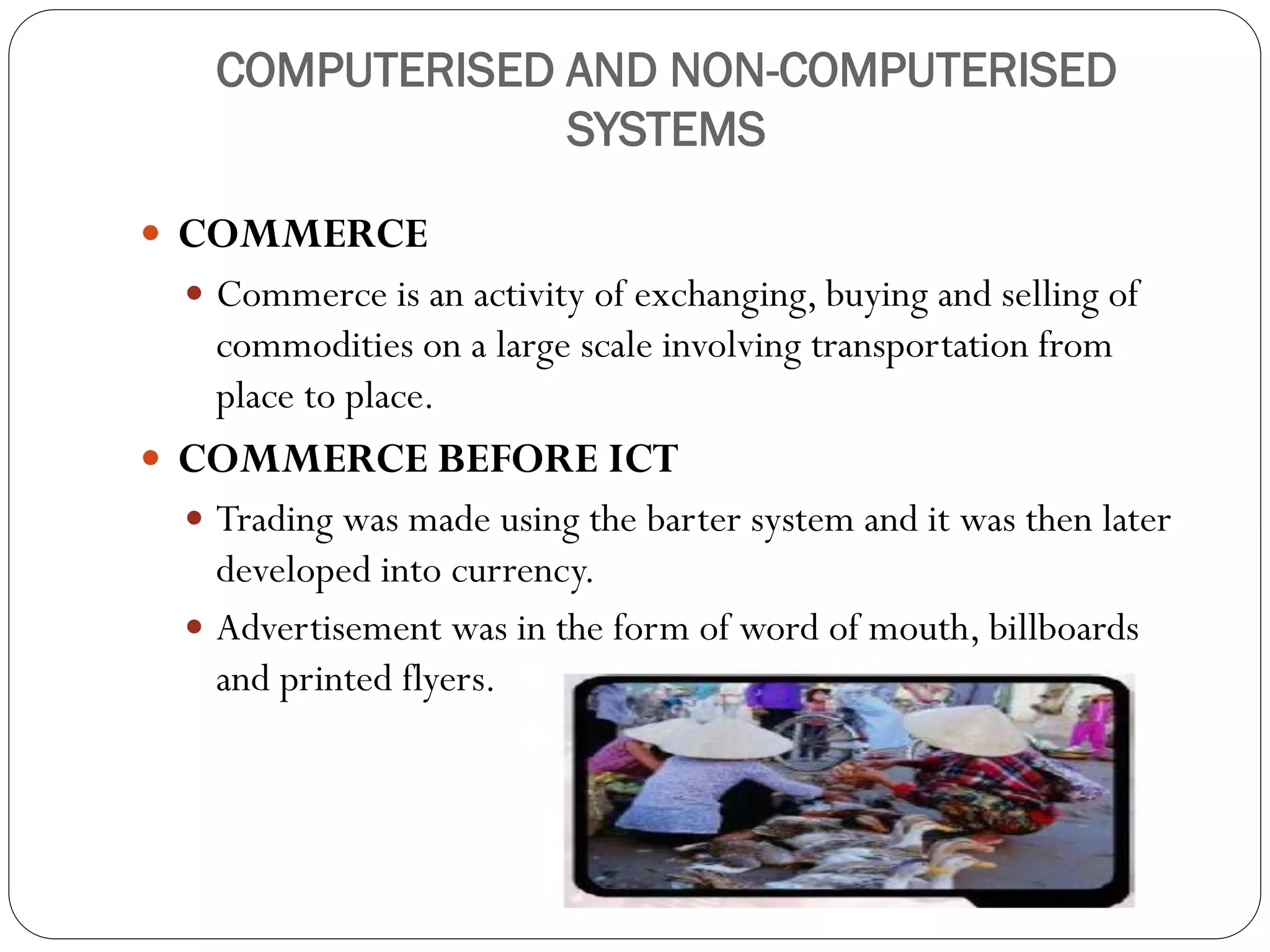
 COMMERCE BEFORE ICT
 Trading was made using the barter system and it was then later
developed into currency.
 Advertisement was in the form of word of mouth, billboards
and printed flyers.
COMPUTERISED AND NON-COMPUTERISED
SYSTEMS
 Trading globally was extremely slow, late and expensive.Traders
had to find ways to market local products in the global market.
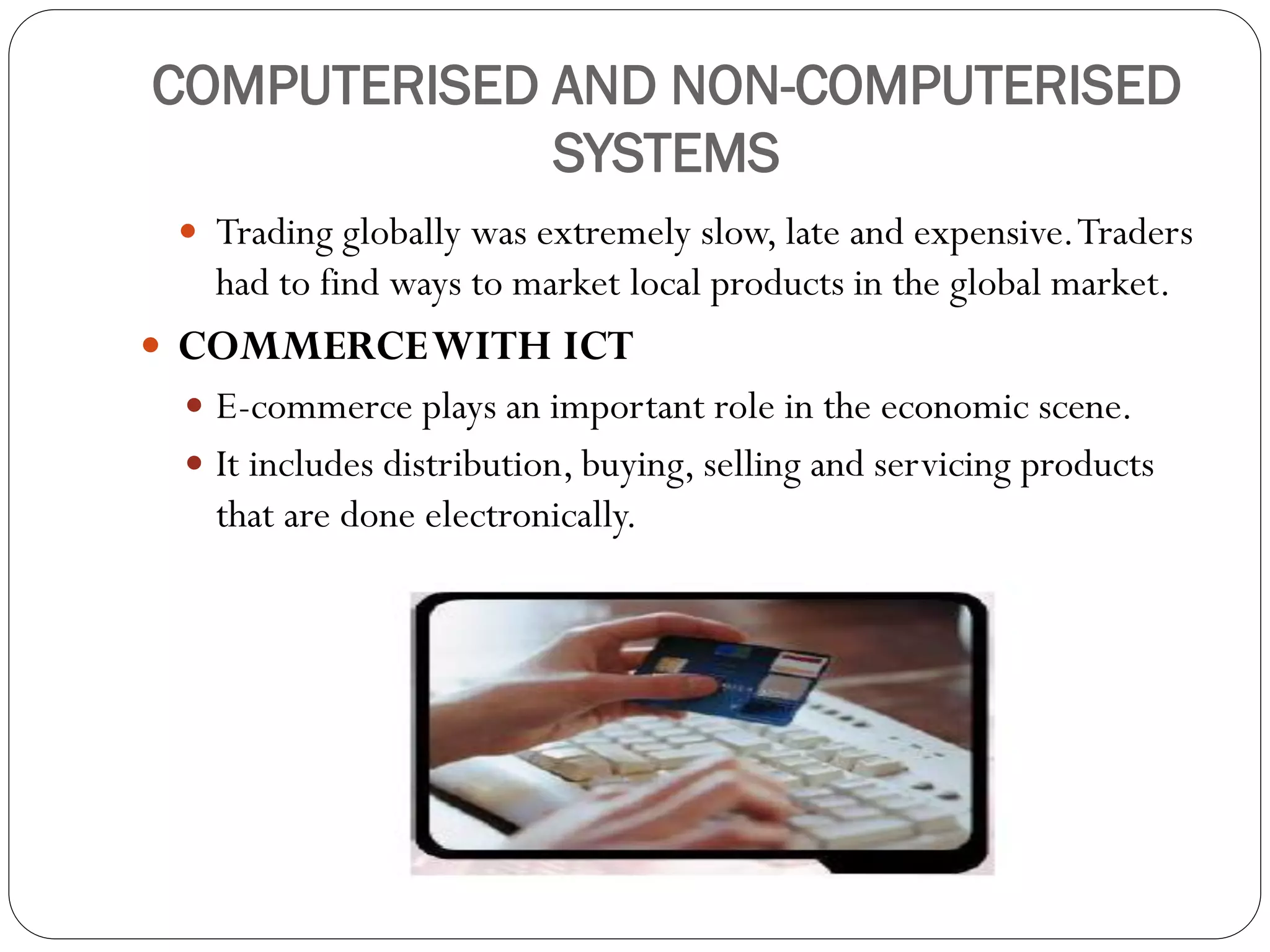
 COMMERCEWITH ICT
 E-commerce plays an important role in the economic scene.
 It includes distribution, buying, selling and servicing products
that are done electronically.

History and Introduction to Information and Communication Technology

  • 1.
    Lecture 1 Lecturer: Nareena Introductionto Information and Communication Technology
  • 2.
    Introduction to Informationand Communication Technology  ICT is technology required for information processing, in particular, the use of computers, communication devices and software application to convert, store, protect, process, transmit and retrieve information from anywhere, anytime.
  • 3.
    Introduction to Informationand Communication Technology (cont.)  Information  Knowledge obtained from reading, investigation, study or research.  Tools to transmit information are the telephone, television and radio.
  • 4.
    Introduction to Informationand Communication Technology (cont.)  Information is knowledge and helps us to fulfill our daily tasks  Such as, forecasting the stock exchange market.  Communication  Act of transmitting messages.
  • 5.
    Introduction to Informationand Communication Technology (cont.)  Information is exchanged between individuals using symbols signs or verbal interactions.  These older forms of communication are less utilized as compared to the use of the Internet, e-mail or video conferencing.  Communication is important in order to gain knowledge.  More confident in expressing our thoughts and ideas.
  • 6.
    Introduction to Informationand Communication Technology (cont.)  Technology  Use of scientific knowledge, experience and resources to create process products that fulfill human needs.  It is vital in communication
  • 7.
  • 10.
  • 12.
  • 14.
    FIRST GENERATION (1940-1956) the vacuum tubes generated a great deal of heat causing many problems in temperature regulation and climate control  the tubes also burnt out frequently  people operating the computer did not know that the problem was in the programming machine  the second generation computer scientists invented something new due to lots of problem created by vacuum tubes
  • 15.
    SECOND GENERATION (1956-1963) The creation of transistor spark the production of a wave  Transistor was small devices use to transfer electronic signals across a resister.  Transistors had many advantages compared to other hardware technology.
  • 16.
    SECOND GENERATION (1956-1963)(cont.) transistors were smaller than vacuum tubes  they needed no warm up time  consumed less energy  generated much less heat  faster and more reliable
  • 17.
    THIRD GENERATION (1964-1971) IBM 370 series were introduced in 1964.  It came in several models and sizes.  It was used for business and scientific programs.  Silicone chips were manufactured in 1961.  Then came the integrated circuit technology, which had reduced the size and cost of computers.
  • 18.
    THIRD GENERATION (1964-1971)(cont.) Silicone chips were reliable, compact and cheaper.  Sold hardware and software separately which created the software industry.  Customer service industry flourished (reservation and credit checks)
  • 19.
    FOURTH GENERATION (1971-PRESENT) It took only 55 years for the 4 generations to evolve.  The growth of the computer industry developed technologies of computer inventions.  There are many types of computer models such as:  Apple Macintosh  IBM  DELL  ACER
  • 20.
    FOURTH GENERATION (1971-PRESENT) In 1971 Intel created the first microprocessor.  In 1976, Steve Jobs built the first Apple computer.  In 1981, IBM introduced its first personal computer.
  • 21.
    FOURTH GENERATION (1971-PRESENT) Hardware technology such as silicone chips, microprocessor and storage devices were invented.  A microprocessor is a specialized chip which is developed for computer memory and logic.  Microprocessor is a large-scale integrated circuit which contained thousands of transistors.  The transistors on this one chip are capable of performing all of the functions of a computer's central processing unit.
  • 22.
    FOURTH GENERATION (1971-PRESENT) Advantages Computers became 100 times smaller than ENIAC (Electronic Numerical Integrator and Computer) the first computer  Gain in speed, reliability and storage capacity  Personal and software industry boomed
  • 23.
    FIFTH GENERATION (PRESENT& BEYOND)  Computers are technologically advance and are still being development to become more efficient.  The inventions of new hardware technology in the fifth generation have grown rapidly including  Other modern computer devices such as :  silicone chips  processor  robotics  virtual reality  intelligent systems  programs which translate languages
  • 24.
  • 25.
    USAGE OF ICTIN DAILY LIFE EDUCATION
  • 27.
    BANKING  The computeris the nerve centre of the banking system around the world.  It functions to control the entire banking system that also includes 'Electronic Banking Services‘.  Electronic banking provides 24 hour services.  AutomatedTeller Machine (ATM)  Cheque Deposit  Electronic FundTransfer  Direct Deposit  Pay by phone system  Internet banking
  • 28.
    BANKING  In thebanking sector, customers, businessman and bank administrator benefits from the usage of ICT.
  • 29.
    INDUSTRY  Computers areused to facilitate production planning and control systems, to support chain management and to help in product design in the industrial sector.
  • 31.
    E-COMMERCE  E-commerce helpsin boosting the economy.  It makes buying and selling activities easier, more efficient and faster.  For this application, computers, Internet and shared software are needed.
  • 34.
    COMPUTERISED AND NON-COMPUTERISED SYSTEMS COMPUTER SYSTEM  A system is an arrangement of elements that when it is put together it becomes an organized and established procedure.  A system typically consists of components connected together in order to facilitate the flow of information, matter or energy.  A computer system consists of a set of hardware and software which processes data in a meaningful way.
  • 35.
    COMPUTERISED AND NON-COMPUTERISED SYSTEMS EDUCATION  education is the science of teaching and learning of specific skills  it also imparts knowledge, good judgment and wisdom
  • 36.
    COMPUTERISED AND NON-COMPUTERISED SYSTEMS BANKING SYSTEM  BANKING BEFORE ICT  banking was done manually by taking deposits directly  transactions can only be made during working hours  takes time to approve any loan applications  BANKINGWITH ICT  all transactions are done by computers  transaction can be done at anytime and place  online services, phone banking system, credit cards are available
  • 37.
    COMPUTERISED AND NON-COMPUTERISED SYSTEMS INDUSTRY  INDUSTRY BEFORE ICT  Production was slow because everything was done manually and totally depended on human labour.  INDUSTRYWITH ICT  Computers and telecommunications industry became profitable since production can be increased through an all day operation.
  • 38.
    COMPUTERISED AND NON-COMPUTERISED SYSTEMS COMMERCE  Commerce is an activity of exchanging, buying and selling of commodities on a large scale involving transportation from place to place.  COMMERCE BEFORE ICT  Trading was made using the barter system and it was then later developed into currency.  Advertisement was in the form of word of mouth, billboards and printed flyers.
  • 39.
    COMPUTERISED AND NON-COMPUTERISED SYSTEMS Trading globally was extremely slow, late and expensive.Traders had to find ways to market local products in the global market.  COMMERCEWITH ICT  E-commerce plays an important role in the economic scene.  It includes distribution, buying, selling and servicing products that are done electronically.