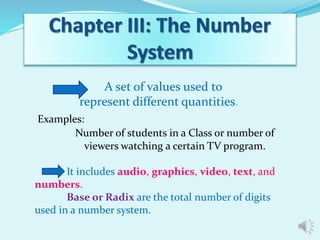
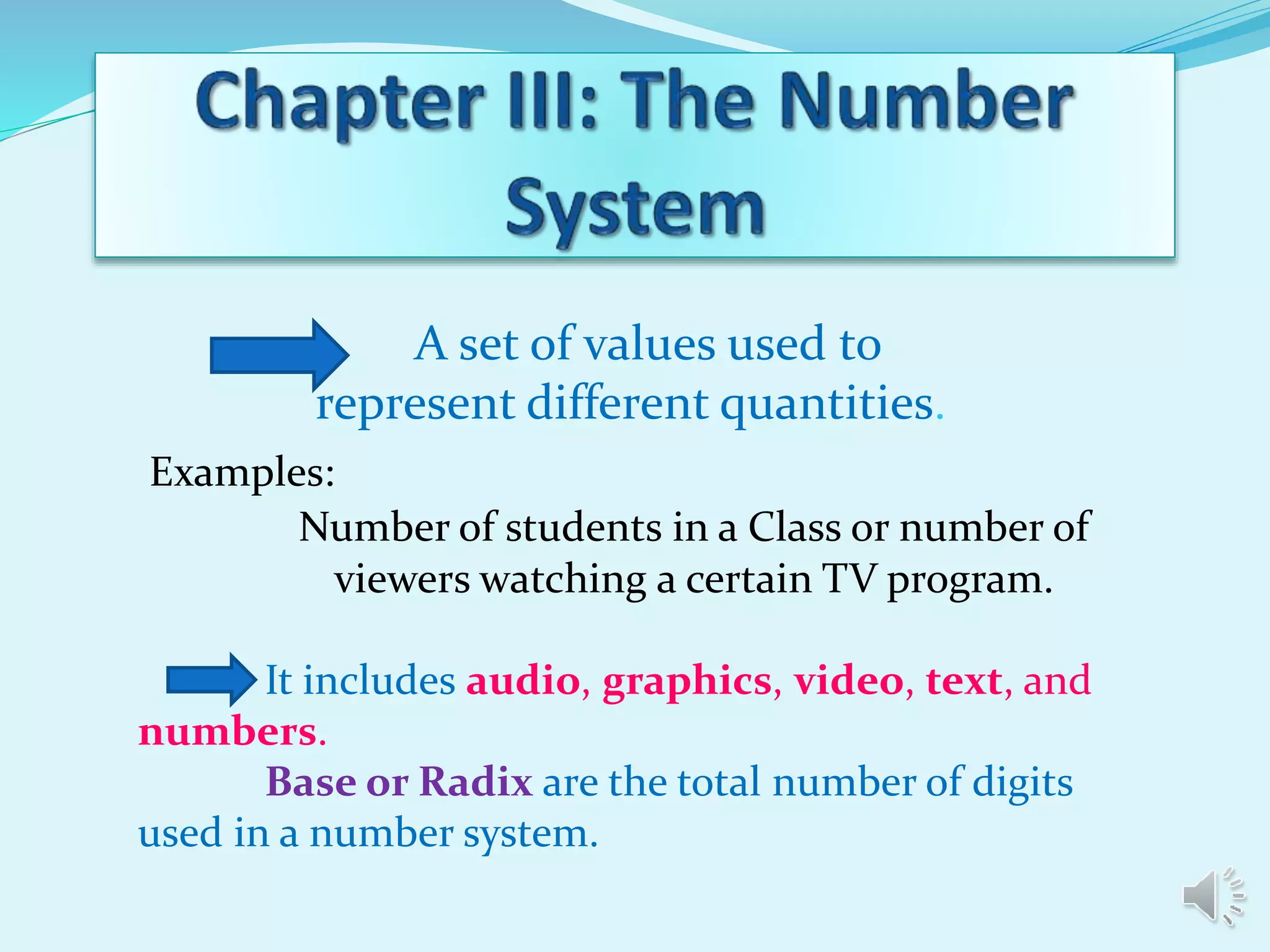
A set of values used to 
represent different quantities. 
Examples: 
Number of students in a Class or number of 
viewers watching a certain TV program. 
It includes audio, graphics, video, text, and 
numbers. 
Base or Radix are the total number of digits 
used in a number system.
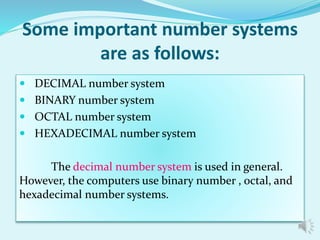
Some important number systems 
are as follows: 
 DECIMAL number system 
 BINARY number system 
 OCTAL number system 
 HEXADECIMAL number system 
The decimal number system is used in general. 
However, the computers use binary number , octal, and 
hexadecimal number systems.
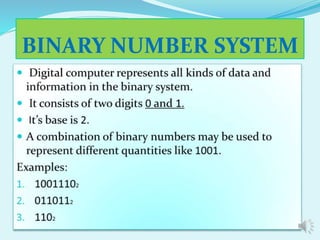
BINARY NUMBER SYSTEM
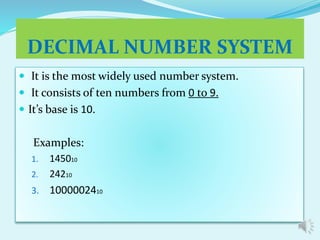
DECIMAL NUMBER SYSTEM 
 It is the most widely used number system. 
 It consists of ten numbers from 0 to 9. 
 It’s base is 10. 
Examples: 
1. 145010 
2. 24210 
3. 1000002410
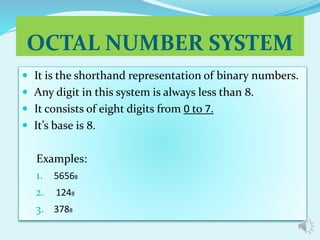
OCTAL NUMBER SYSTEM 
 It is the shorthand representation of binary numbers. 
 Any digit in this system is always less than 8. 
 It consists of eight digits from 0 to 7. 
 It’s base is 8. 
Examples: 
1. 56568 
2. 1248 
3. 3788
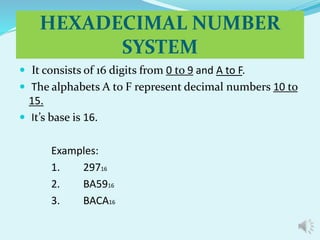
HEXADECIMAL NUMBER 
SYSTEM 
 It consists of 16 digits from 0 to 9 and A to F. 
 The alphabets A to F represent decimal numbers 10 to 
15. 
 It’s base is 16. 
Examples: 
1. 29716 
2. BA5916 
3. BACA16
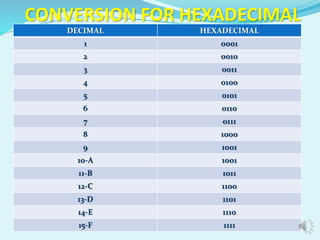
CONVERSION FOR HEXADECIMAL 
DECIMAL HEXADECIMAL 
1 0001 
2 0010 
3 0011 
4 0100 
5 0101 
6 0110 
7 0111 
8 1000 
9 1001 
10-A 1001 
11-B 1011 
12-C 1100 
13-D 1101 
14-E 1110 
15-F 1111
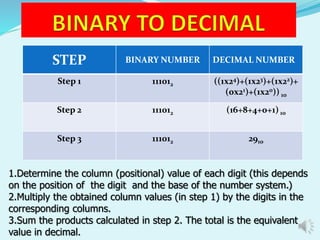
STEP BINARY NUMBER DECIMAL NUMBER 
Step 1 111012 ((1x24)+(1x23)+(1x22)+ 
(0x21)+(1x20)) 10 
Step 2 111012 (16+8+4+0+1) 10 
Step 3 111012 2910 
1.Determine the column (positional) value of each digit (this depends 
on the position of the digit and the base of the number system.) 
2.Multiply the obtained column values (in step 1) by the digits in the 
corresponding columns. 
3.Sum the products calculated in step 2. The total is the equivalent 
value in decimal.
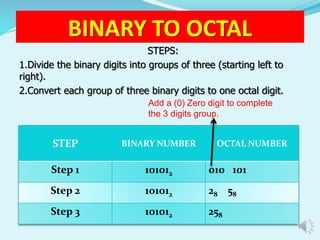
BINARY TO OCTAL 
STEPS: 
1.Divide the binary digits into groups of three (starting left to 
right). 
2.Convert each group of three binary digits to one octal digit. 
Add a (0) Zero digit to complete 
the 3 digits group. 
STEP BINARY NUMBER OCTAL NUMBER 
Step 1 101012 010 101 
Step 2 101012 28 58 
Step 3 101012 258
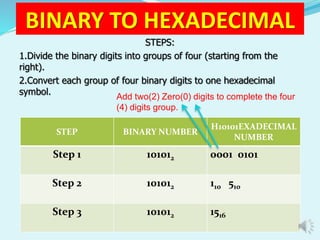
BINARY TO HEXADECIMAL 
STEPS: 
1.Divide the binary digits into groups of four (starting from the 
right). 
2.Convert each group of four binary digits to one hexadecimal 
symbol. 
Add two(2) Zero(0) digits to complete the four 
(4) digits group. 
STEP BINARY NUMBER 
H10101EXADECIMAL 
NUMBER 
Step 1 101012 0001 0101 
Step 2 101012 110 510 
Step 3 101012 1516
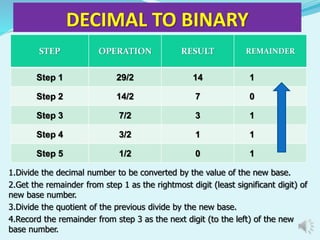
DECIMAL TO BINARY 
STEP OPERATION RESULT REMAINDER 
Step 1 29/2 14 1 
Step 2 14/2 7 0 
Step 3 7/2 3 1 
Step 4 3/2 1 1 
Step 5 1/2 0 1 
1.Divide the decimal number to be converted by the value of the new base. 
2.Get the remainder from step 1 as the rightmost digit (least significant digit) of 
new base number. 
3.Divide the quotient of the previous divide by the new base. 
4.Record the remainder from step 3 as the next digit (to the left) of the new 
base number.
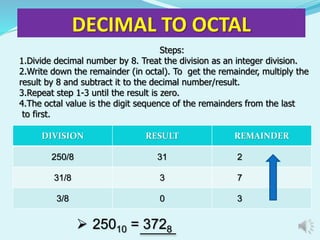
DECIMAL TO OCTAL 
Steps: 
1.Divide decimal number by 8. Treat the division as an integer division. 
2.Write down the remainder (in octal). To get the remainder, multiply the 
result by 8 and subtract it to the decimal number/result. 
3.Repeat step 1-3 until the result is zero. 
4.The octal value is the digit sequence of the remainders from the last 
to first. 
DIVISION RESULT REMAINDER 
250/8 31 2 
31/8 3 7 
3/8 0 3 
 25010 = 3728
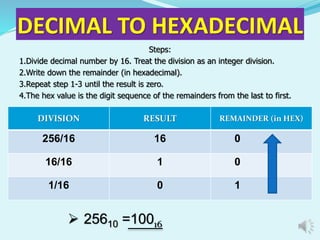
DECIMAL TO HEXADECIMAL 
Steps: 
1.Divide decimal number by 16. Treat the division as an integer division. 
2.Write down the remainder (in hexadecimal). 
3.Repeat step 1-3 until the result is zero. 
4.The hex value is the digit sequence of the remainders from the last to first. 
DIVISION RESULT REMAINDER (in HEX) 
256/16 16 0 
16/16 1 0 
1/16 0 1 
 25610 =10016
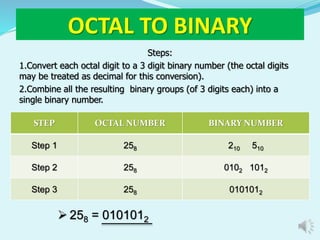
OCTAL TO BINARY 
Steps: 
1.Convert each octal digit to a 3 digit binary number (the octal digits 
may be treated as decimal for this conversion). 
2.Combine all the resulting binary groups (of 3 digits each) into a 
single binary number. 
STEP OCTAL NUMBER BINARY NUMBER 
Step 1 258 210 510 
Step 2 258 0102 1012 
Step 3 258 0101012 
 258 = 0101012
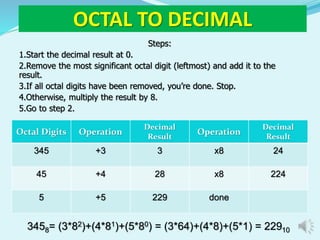
OCTAL TO DECIMAL 
Steps: 
1.Start the decimal result at 0. 
2.Remove the most significant octal digit (leftmost) and add it to the 
result. 
3.If all octal digits have been removed, you’re done. Stop. 
4.Otherwise, multiply the result by 8. 
5.Go to step 2. 
Octal Digits Operation 
Decimal 
Result 
Operation 
Decimal 
Result 
345 +3 3 x8 24 
45 +4 28 x8 224 
5 +5 229 done 
3458= (3*82)+(4*81)+(5*80) = (3*64)+(4*8)+(5*1) = 22910
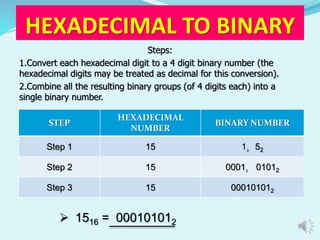
HEXADECIMAL TO BINARY 
Steps: 
1.Convert each hexadecimal digit to a 4 digit binary number (the 
hexadecimal digits may be treated as decimal for this conversion). 
2.Combine all the resulting binary groups (of 4 digits each) into a 
single binary number. 
STEP 
HEXADECIMAL 
NUMBER 
BINARY NUMBER 
Step 1 15 12 52 
Step 2 15 00012 01012 
Step 3 15 000101012 
 1516 = 000101012
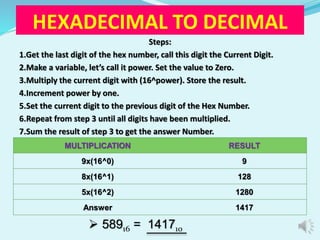
HEXADECIMAL TO DECIMAL 
Steps: 
1.Get the last digit of the hex number, call this digit the Current Digit. 
2.Make a variable, let’s call it power. Set the value to Zero. 
3.Multiply the current digit with (16^power). Store the result. 
4.Increment power by one. 
5.Set the current digit to the previous digit of the Hex Number. 
6.Repeat from step 3 until all digits have been multiplied. 
7.Sum the result of step 3 to get the answer Number. 
MULTIPLICATION RESULT 
9x(16^0) 9 
8x(16^1) 128 
5x(16^2) 1280 
Answer 1417 
 58916 = 141710
WORKING COMMITTEE 
CHERRY MARIE GALAUS 
ROSEANN FORONDA 
CRISTINA FABROS 
CRISTINA FABROS 
MICAH HADASSAH GUILLERMO 
DANILO PALTENG 
JANUEL ANTONIO 
MICAH HADASSAH GUILLERMO 
DANILO PALTENG 
JANUEL ANTONIO 
BS ACCOUNTANCY 1-2

Chapter iii: Number System

  • 1.
    A set ofvalues used to represent different quantities. Examples: Number of students in a Class or number of viewers watching a certain TV program. It includes audio, graphics, video, text, and numbers. Base or Radix are the total number of digits used in a number system.
  • 2.
    Some important numbersystems are as follows:  DECIMAL number system  BINARY number system  OCTAL number system  HEXADECIMAL number system The decimal number system is used in general. However, the computers use binary number , octal, and hexadecimal number systems.
  • 3.
  • 4.
    DECIMAL NUMBER SYSTEM  It is the most widely used number system.  It consists of ten numbers from 0 to 9.  It’s base is 10. Examples: 1. 145010 2. 24210 3. 1000002410
  • 5.
    OCTAL NUMBER SYSTEM  It is the shorthand representation of binary numbers.  Any digit in this system is always less than 8.  It consists of eight digits from 0 to 7.  It’s base is 8. Examples: 1. 56568 2. 1248 3. 3788
  • 6.
    HEXADECIMAL NUMBER SYSTEM  It consists of 16 digits from 0 to 9 and A to F.  The alphabets A to F represent decimal numbers 10 to 15.  It’s base is 16. Examples: 1. 29716 2. BA5916 3. BACA16
  • 7.
    CONVERSION FOR HEXADECIMAL DECIMAL HEXADECIMAL 1 0001 2 0010 3 0011 4 0100 5 0101 6 0110 7 0111 8 1000 9 1001 10-A 1001 11-B 1011 12-C 1100 13-D 1101 14-E 1110 15-F 1111
  • 9.
    STEP BINARY NUMBERDECIMAL NUMBER Step 1 111012 ((1x24)+(1x23)+(1x22)+ (0x21)+(1x20)) 10 Step 2 111012 (16+8+4+0+1) 10 Step 3 111012 2910 1.Determine the column (positional) value of each digit (this depends on the position of the digit and the base of the number system.) 2.Multiply the obtained column values (in step 1) by the digits in the corresponding columns. 3.Sum the products calculated in step 2. The total is the equivalent value in decimal.
  • 10.
    BINARY TO OCTAL STEPS: 1.Divide the binary digits into groups of three (starting left to right). 2.Convert each group of three binary digits to one octal digit. Add a (0) Zero digit to complete the 3 digits group. STEP BINARY NUMBER OCTAL NUMBER Step 1 101012 010 101 Step 2 101012 28 58 Step 3 101012 258
  • 11.
    BINARY TO HEXADECIMAL STEPS: 1.Divide the binary digits into groups of four (starting from the right). 2.Convert each group of four binary digits to one hexadecimal symbol. Add two(2) Zero(0) digits to complete the four (4) digits group. STEP BINARY NUMBER H10101EXADECIMAL NUMBER Step 1 101012 0001 0101 Step 2 101012 110 510 Step 3 101012 1516
  • 12.
    DECIMAL TO BINARY STEP OPERATION RESULT REMAINDER Step 1 29/2 14 1 Step 2 14/2 7 0 Step 3 7/2 3 1 Step 4 3/2 1 1 Step 5 1/2 0 1 1.Divide the decimal number to be converted by the value of the new base. 2.Get the remainder from step 1 as the rightmost digit (least significant digit) of new base number. 3.Divide the quotient of the previous divide by the new base. 4.Record the remainder from step 3 as the next digit (to the left) of the new base number.
  • 13.
    DECIMAL TO OCTAL Steps: 1.Divide decimal number by 8. Treat the division as an integer division. 2.Write down the remainder (in octal). To get the remainder, multiply the result by 8 and subtract it to the decimal number/result. 3.Repeat step 1-3 until the result is zero. 4.The octal value is the digit sequence of the remainders from the last to first. DIVISION RESULT REMAINDER 250/8 31 2 31/8 3 7 3/8 0 3  25010 = 3728
  • 14.
    DECIMAL TO HEXADECIMAL Steps: 1.Divide decimal number by 16. Treat the division as an integer division. 2.Write down the remainder (in hexadecimal). 3.Repeat step 1-3 until the result is zero. 4.The hex value is the digit sequence of the remainders from the last to first. DIVISION RESULT REMAINDER (in HEX) 256/16 16 0 16/16 1 0 1/16 0 1  25610 =10016
  • 15.
    OCTAL TO BINARY Steps: 1.Convert each octal digit to a 3 digit binary number (the octal digits may be treated as decimal for this conversion). 2.Combine all the resulting binary groups (of 3 digits each) into a single binary number. STEP OCTAL NUMBER BINARY NUMBER Step 1 258 210 510 Step 2 258 0102 1012 Step 3 258 0101012  258 = 0101012
  • 16.
    OCTAL TO DECIMAL Steps: 1.Start the decimal result at 0. 2.Remove the most significant octal digit (leftmost) and add it to the result. 3.If all octal digits have been removed, you’re done. Stop. 4.Otherwise, multiply the result by 8. 5.Go to step 2. Octal Digits Operation Decimal Result Operation Decimal Result 345 +3 3 x8 24 45 +4 28 x8 224 5 +5 229 done 3458= (3*82)+(4*81)+(5*80) = (3*64)+(4*8)+(5*1) = 22910
  • 17.
    HEXADECIMAL TO BINARY Steps: 1.Convert each hexadecimal digit to a 4 digit binary number (the hexadecimal digits may be treated as decimal for this conversion). 2.Combine all the resulting binary groups (of 4 digits each) into a single binary number. STEP HEXADECIMAL NUMBER BINARY NUMBER Step 1 15 12 52 Step 2 15 00012 01012 Step 3 15 000101012  1516 = 000101012
  • 18.
    HEXADECIMAL TO DECIMAL Steps: 1.Get the last digit of the hex number, call this digit the Current Digit. 2.Make a variable, let’s call it power. Set the value to Zero. 3.Multiply the current digit with (16^power). Store the result. 4.Increment power by one. 5.Set the current digit to the previous digit of the Hex Number. 6.Repeat from step 3 until all digits have been multiplied. 7.Sum the result of step 3 to get the answer Number. MULTIPLICATION RESULT 9x(16^0) 9 8x(16^1) 128 5x(16^2) 1280 Answer 1417  58916 = 141710
  • 20.
    WORKING COMMITTEE CHERRYMARIE GALAUS ROSEANN FORONDA CRISTINA FABROS CRISTINA FABROS MICAH HADASSAH GUILLERMO DANILO PALTENG JANUEL ANTONIO MICAH HADASSAH GUILLERMO DANILO PALTENG JANUEL ANTONIO BS ACCOUNTANCY 1-2