
Baker Hughes
11th Annual Global Gas Village Summit 2011
Prague – 11, 12 & 13 April 2011
Evaluating storage capability of reservoir using an
integrated source-free interpretation approach
Fabio Brambilla
Senior Geoscientist Baker Hughes
Fabio.brambilla@bakerhughes.com
Agenda
1. Sub-Surface imperative of UGS
2. Added value of integrated source free approach
3. The challenge of storage capacity evaluation
4. NMR logging vantages
5. Acoustic porosity
6. Combined porosity
7. Summary
2
Sub-Surface Imperatives of UGS
3
 Maximize storage capacity
 Maximize deliverability
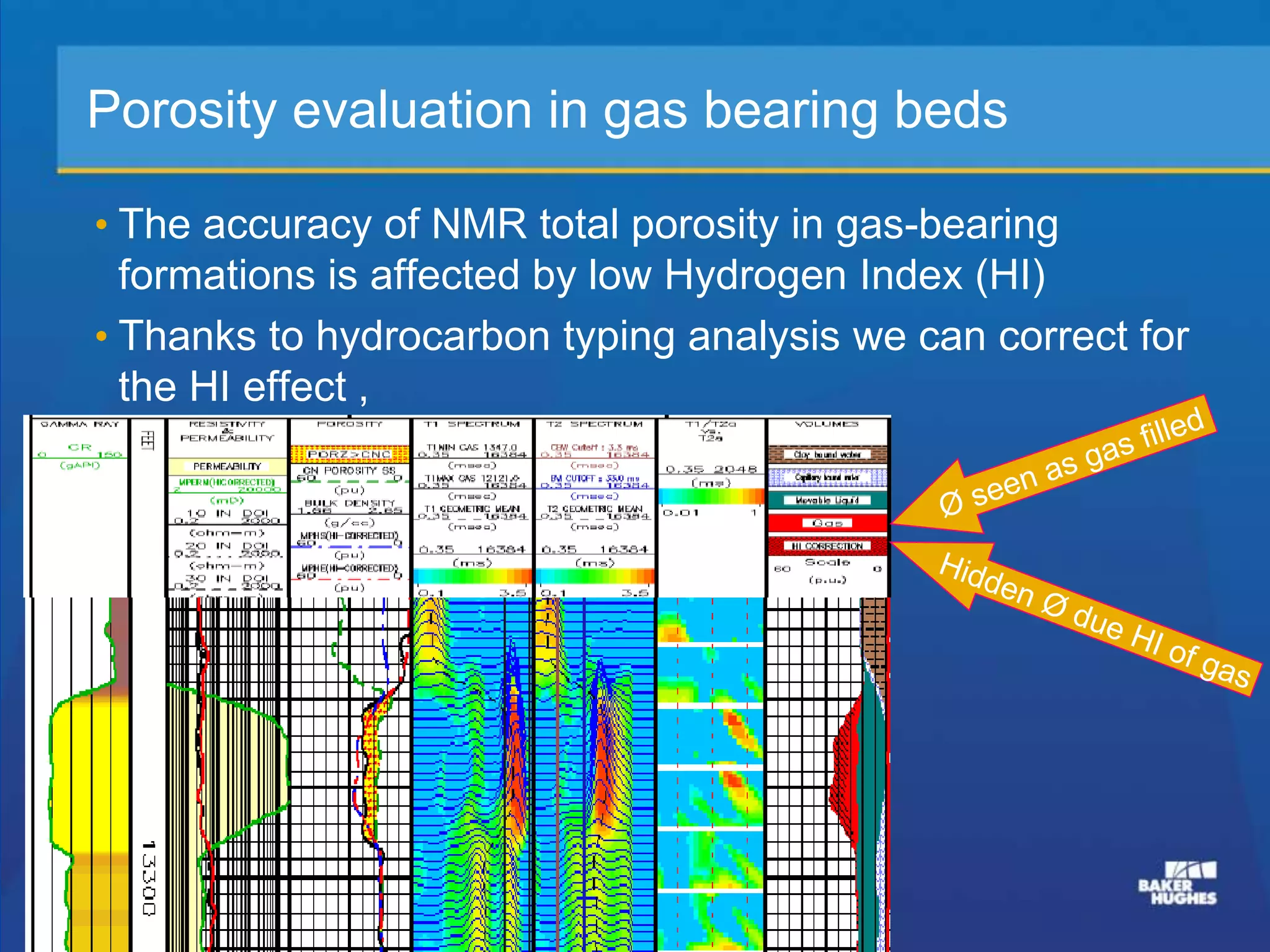
 Optimize cushion gas volume
 Mitigate project risk
 Well reliability
 Profitable project
Project
Economics
Storage
Capacity
Deliverabilit
y
Cushion
Gas
Risk
Reliability
Added value of integrated source-free
interpretation approach
4
• Improve the evaluation of storage capability
providing better porosity knowledge of the
reservoir
• The continuous permeability profile from
NMR service let to understand the
deliverability of the well
• Avoid any risk about utilization of radioactive
sources
Project
Economics
Storage
Capacity
Deliverability
Cushion GasRisk
Reliability
Storage capacity: the first imperative
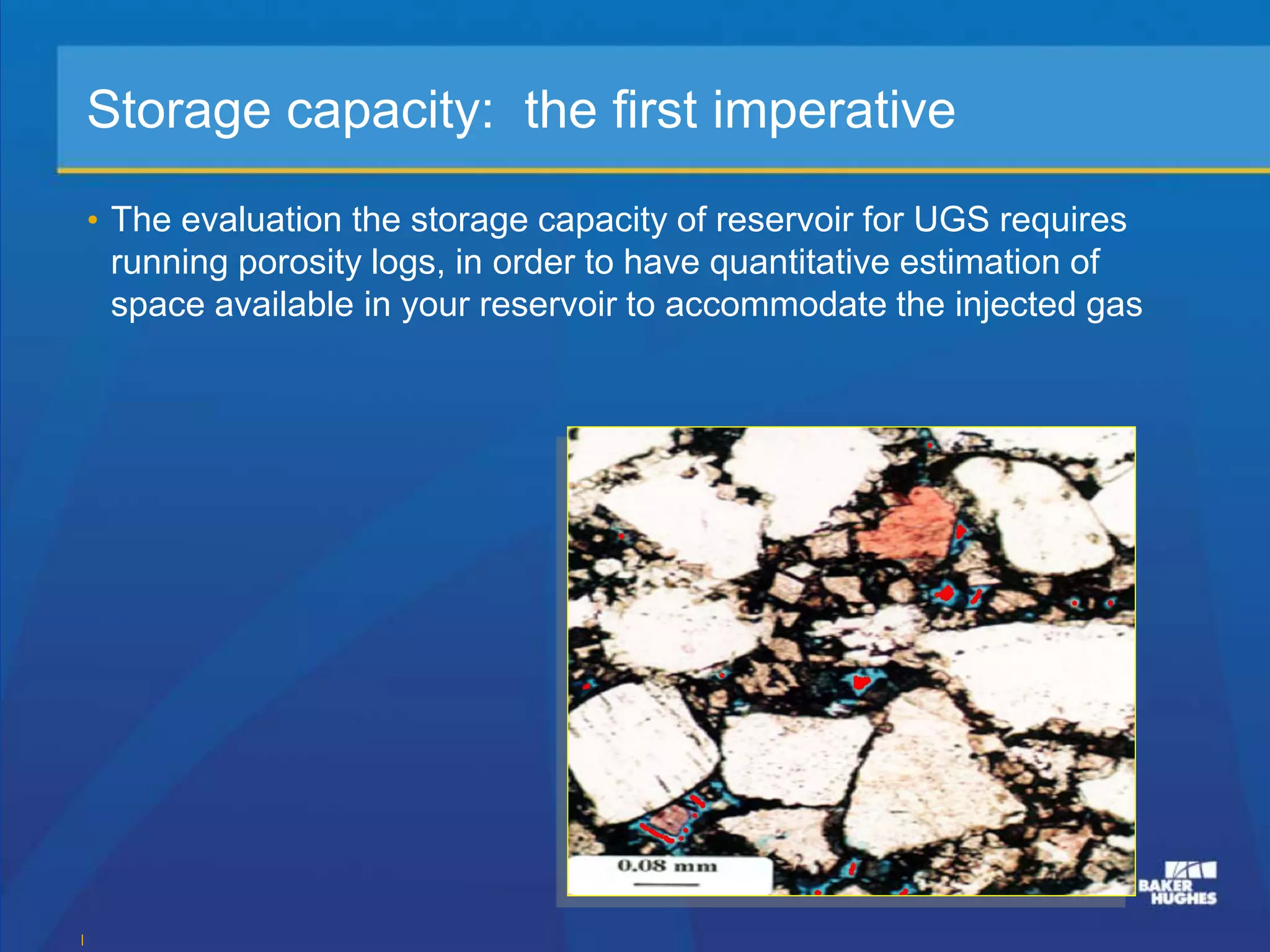
• The evaluation the storage capacity of reservoir for UGS requires
running porosity logs, in order to have quantitative estimation of
space available in your reservoir to accommodate the injected gas
Evaluating the storage capacity: the challenge
• The traditional approach of evaluation requires running
density and neutron log devices in order to have
quantitative estimation of reservoir porosity
• Both logs response are affected by lithology and gas
presence
• Environmental regulations for UGS fields management
are more and more limiting the use of chemical
radioactive sources
• HSE nationals rules tend to made complex the logistic of
devices using radioactive sources
Evaluating the storage capability: the solution
• To overcome that, a more advanced approach have
been developed for porosity determination using
source-free tools, combining:
1. Nuclear Magnetic Resonance (NMR) logging
2. Acoustic logging
• Both devices rely on a comfortable physics:
– NMR: tool contains permanent magnet with magnetic field
– Acoustic: deals with acoustic waves
• The porosity from that combination is indipendent from
lithology and gas presence
NMR vantages
• HSE fully complaint !
• Advanced detailed porosity
description
• Continuous permeability
profile
NMR service
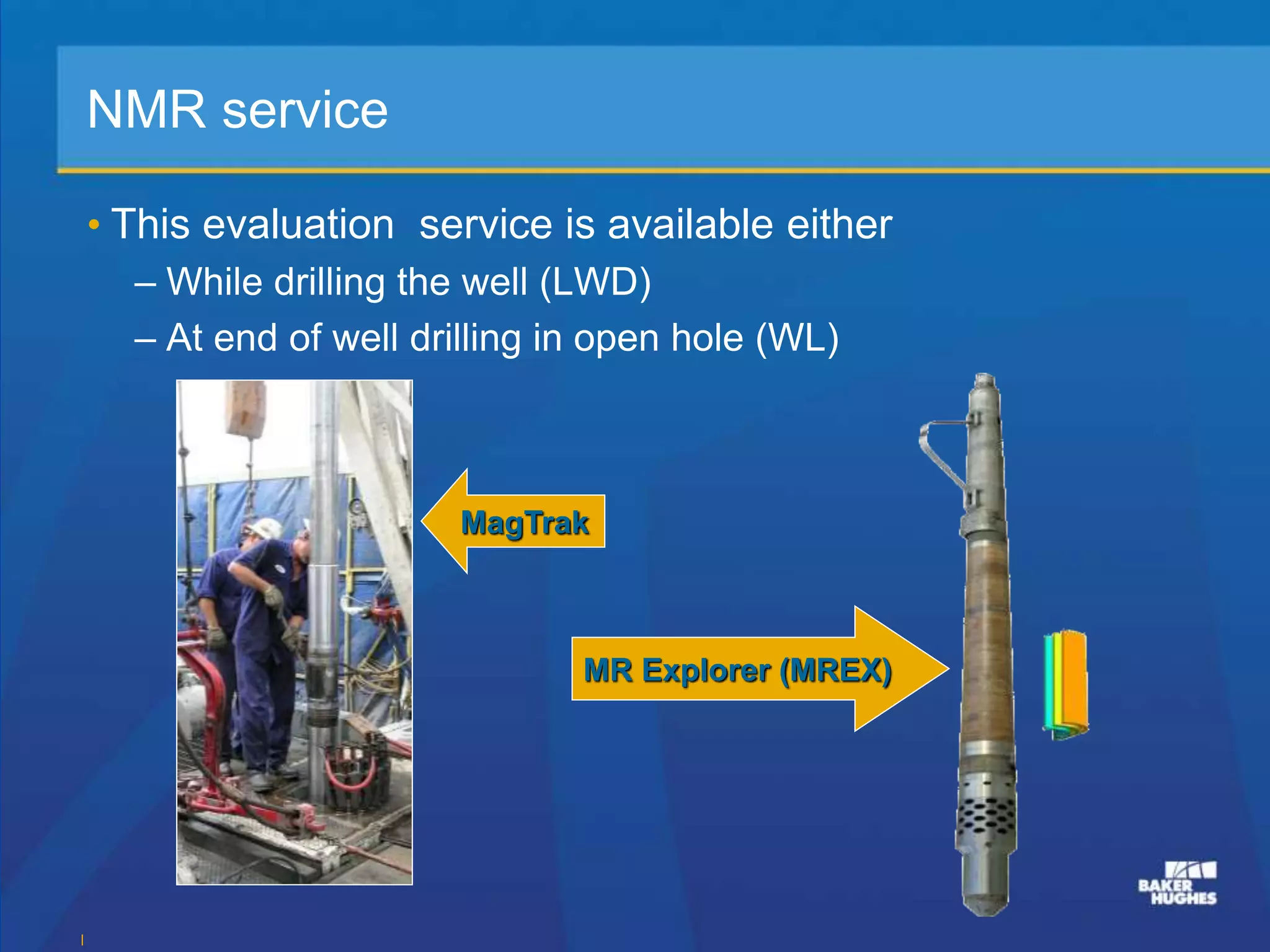
• This evaluation service is available either
– While drilling the well (LWD)
– At end of well drilling in open hole (WL)
MagTrak
MR Explorer (MREX)
NMR: what it is measured (a bit of physics)
• NMR logging has the advantage of direct measuring the
hydrogen of fluids in pore space avoiding lithology effect
on porosity determination
•
NMR how it works
• NMR logging has the advantage of direct measuring the
hydrogen of fluids in pore space avoiding lithology effect
on porosity determination
B=0, M=0
M0 B0
NMR how it works
• NMR logging has the advantage of direct measuring the
hydrogen of fluids in pore space avoiding lithology effect
on porosity determination
NMR how it works
• NMR logging has the advantage of direct measuring the
hydrogen of fluids in pore space avoiding lithology effect
on porosity determination
Tool emits radio
Frequency RF
pulse with field
strength B1
Spins are tipped 90
degrees by the RF pulse
and then begin to precess
in the B0 field
f =  B0
Spins precess in the
B0 field after tipping
by an RF pulse
f =  B0
NMR how it works
• NMR logging has the advantage of direct measuring the
hydrogen of fluids in pore space avoiding lithology effect
on porosity determination
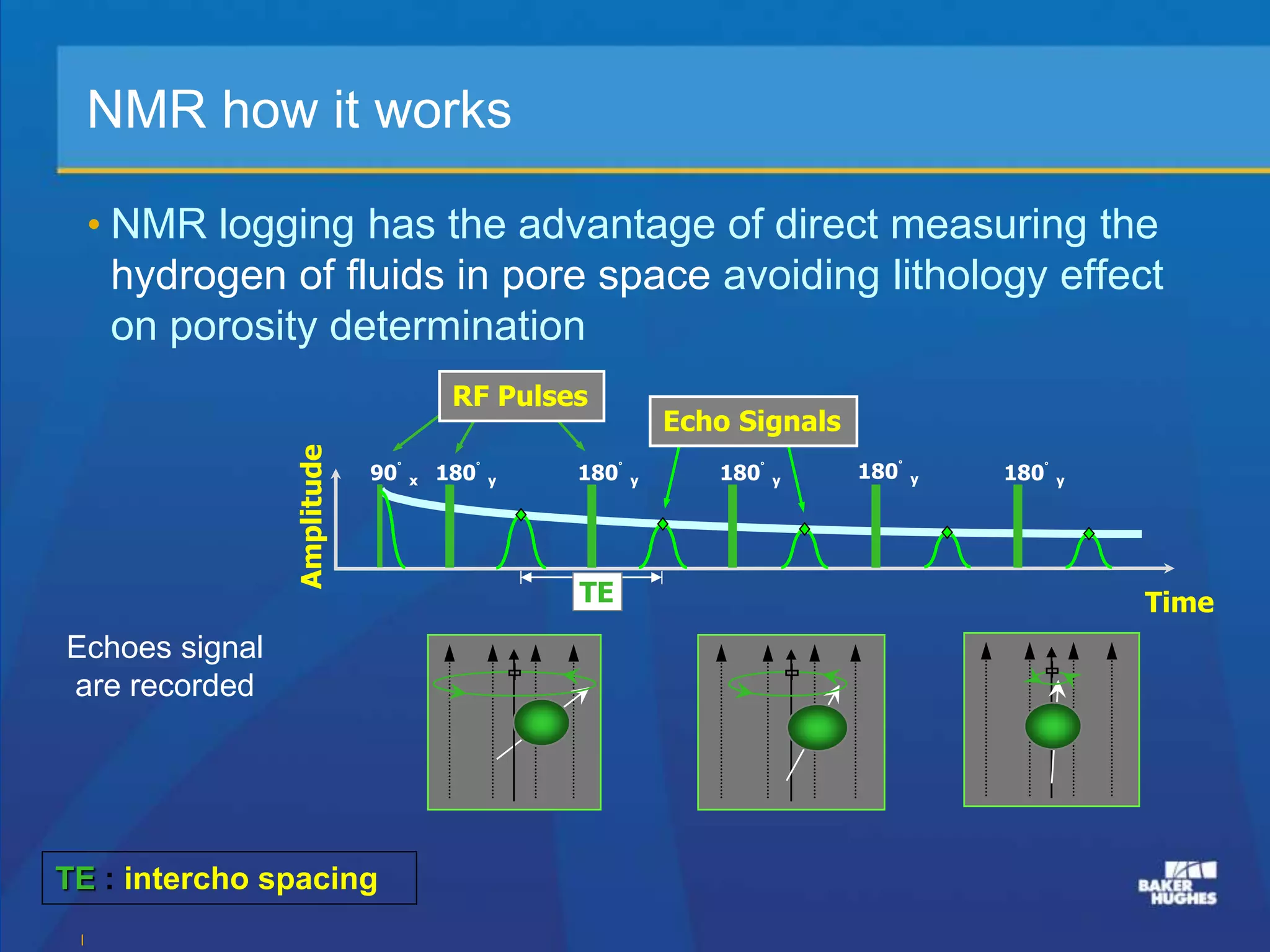
Echoes signal
are recorded
NMR how it works
• NMR logging has the advantage of direct measuring the
hydrogen of fluids in pore space avoiding lithology effect
on porosity determination
Echoes signal
are recorded
TE : intercho spacing
TE Time
90°
x 180°
y 180°
y 180°
y 180°
y 180°
y
Amplitude
Echo Signals
RF Pulses
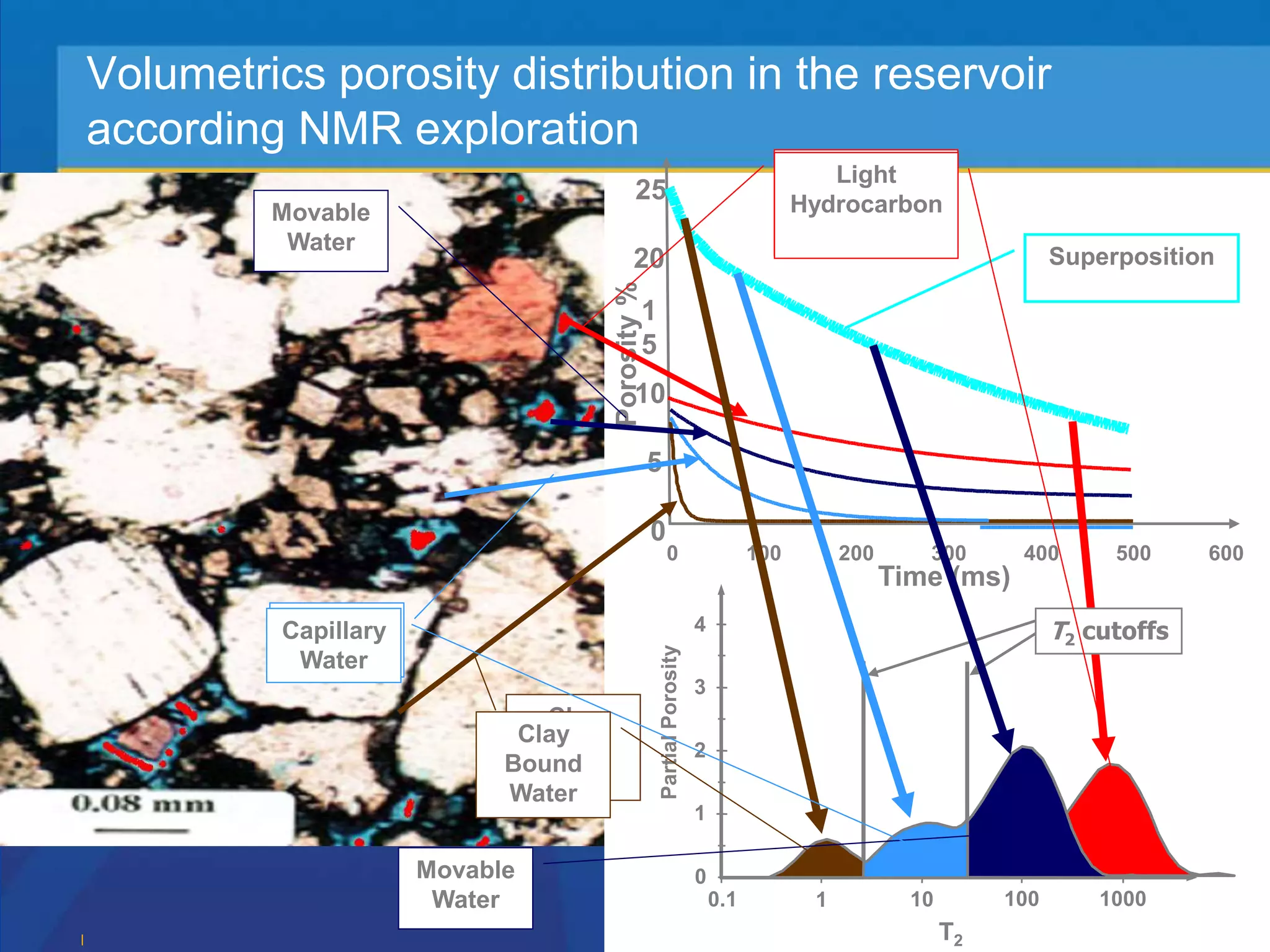
Volumetrics porosity distribution in the reservoir
according NMR exploration
0 100 200 300 400 500 600
Time (ms)
Porosity%
25
20
1
5
10
5
0
Superposition
Clay
Bound
Water
Capillary
Water
Movable
Water
Light
Hydrocarbon
0
1
2
3
4
0.1
PartialPorosity
1 10 100 1000
T2 cutoffs
T2
Movable
Water
Capillary
Water
Clay
Bound
Water
Light
Hydrocarbon
NMR porosity description
• The NMR logging offers a complete overview of
– porosity distribution: total porosity, clay bound water
volume, capillary water volume, mobile fluid volume
– a continuous permeability curve.
• The knowledge of these values allows:
– recognizing the best storage zones of the reservoir
– Better understand the deliverability
total porosity (ØT,NMR )
Matrix Rock
Dry
Clay
Clay-
bound
water
Free
water
Capillary
trapped
water
Hydro-
carbons
BVMCBW
e
BVI
t
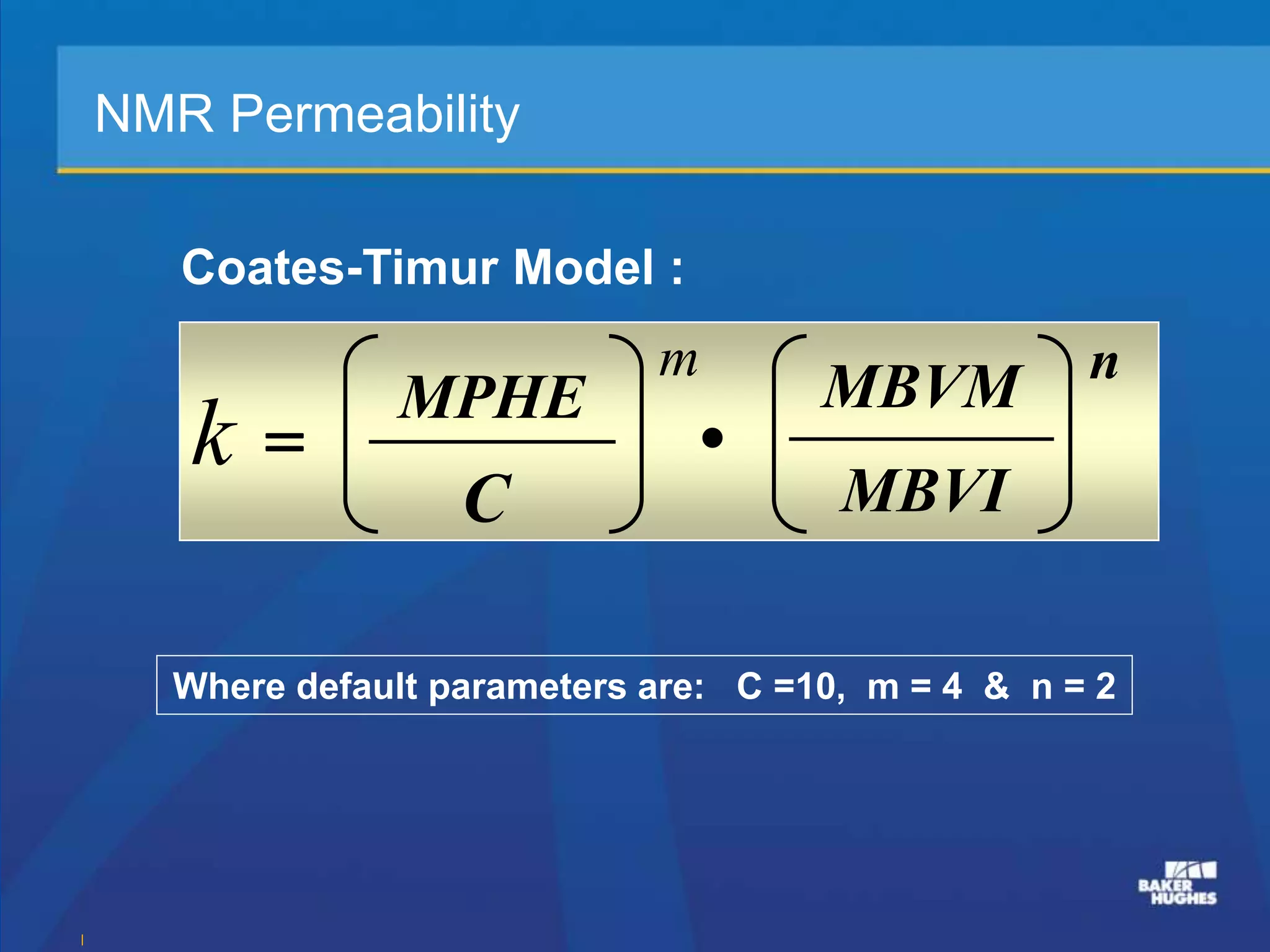
Where default parameters are: C =10, m = 4 & n = 2
Coates-Timur Model :
MBVI
MBVM
C
k
n
=
m

MPHE
NMR Permeability
Shale indicator from NMR
• CBW: Volume of clay bound water (CBW) represents the
porosity in clay content in a formation rock
• From NMR logs, both the fractional porosity from CBW
(ØCBV) and the total porosity (ØT,NMR ) are obtained
NMRT
CBW
,

Vsh =
0
1
2
3
4
0.1
PartialPorosity
1 10 1001000
Porosity evaluation in gas bearing beds
• The gas occurrence affect all the
porosity logs
– Lower density: over call density
porosity
– Lower Hydrogen index: under call
porosity based on Hydrogen Index
Superior hydrocarbon typing
• Innovative NMR acquisition techniques provide comprehensive NMR data for
fluids analysis
– T1, T2 & Diffusion data acquired simultaneously while logging
• 2D NMR plots identify and quantify hydrocarbons
– Available from all hydrocarbon typing Objective Oriented Acquisitions
– Acquired as continuous logs (NOT stationary measurements!)
PoroPerm + Gas PoroPerm + Oil PoroPerm + Heavy Oil
2 32 512
T2,app (ms)
16
4
1
T1/T2,app
T2,int (ms)
e-8
e-9
e-10
e-11
D(m2/s)
2 128 1024
T2,int (ms)
e-8
e-9
e-10
e-11
e-12
D(m2/s)
162 128 102416
Gas
CBW BVI
Water
Oil
Heavy Oil
Water
Porosity evaluation in gas bearing beds
• The accuracy of NMR total porosity in gas-bearing
formations is affected by low Hydrogen Index (HI)
• Thanks to hydrocarbon typing analysis we can correct for
the HI effect ,
Porosity evaluation in gas bearing beds
• However in depleted levels or low pressure reservoir the
correction for HI is definitively an improvement but still an
estimate due to uncertainty of HI estimation
Porosity & HI correction
0
1
2
3
4
5
6
7
8
0 50 100 150 200 250 300 350
BAR
HI
0
5
10
15
20
25
30
35
40
Porosity
Porosity evaluation in gas bearing beds
To overcame this imprecision we suggest to exploit the
vantage of combine the porosity from NMR service with
the porosity from the acoustic service
NMR Acoustic
Acoustic vantages
• HSE fully complaint !
• This evaluation service is available either
– While drilling the well (LWD)
– At end of well drilling phase (WL) in open hole and cased
hole (CH)
SoundTrak
XMAC F1
Porosity from modified Raymer-Hunt-Gardner (1)
• Δt is the measured slowness of wave velocity,
• Δtma is the slowness of the dry matrix.
– Constant in clean reservoir (Δtma,clean )
– it changes with shale presence: type, distribution, and
percentage of shale (Δtma)
• C is the fitting parameter
C
t
tt ma
acoustic


=
(1 ) Alberty, M. 1994
Acoustic porosity
• The acoustic measurements respond to lithology and
porosity
• In addition respond to texture consequently acoustic
porosity is an indirect measurement based on semi-
empirical models, which often requires calibration of
parameters
• The Raymer-Hunt-Gardner function can be calibrated
using the NMR total porosity and NMR shale volume
{
Acoustic porosity calibration
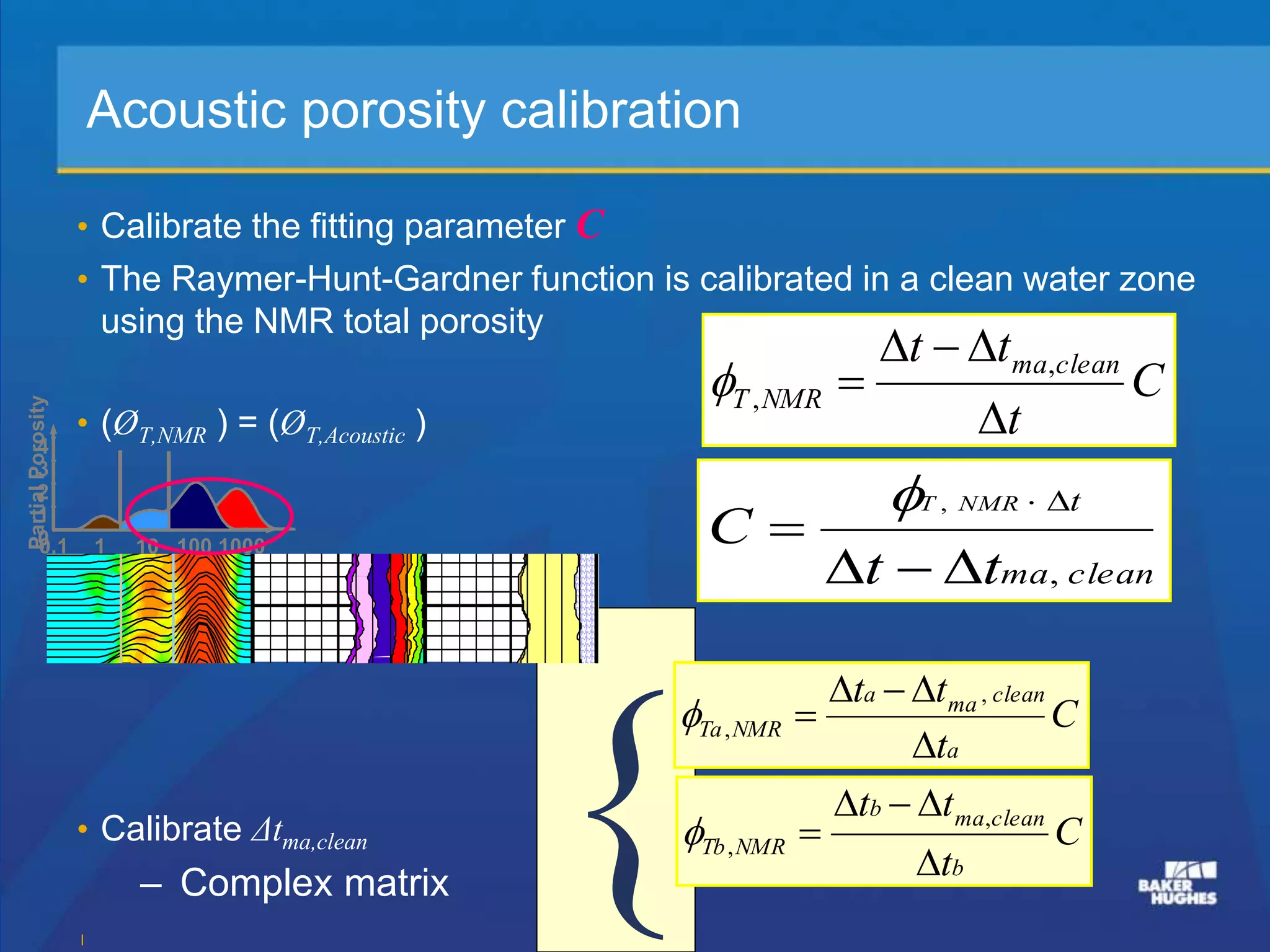
• Calibrate the fitting parameter C
• The Raymer-Hunt-Gardner function is calibrated in a clean water zone
using the NMR total porosity
• (ØT,NMR ) = (ØT,Acoustic )
• Calibrate Δtma,clean
– Complex matrix
C
t
tt cleanma
NMRT


= ,
,
C
t
tt
a
cleanmaa
NMRTa


=
,
,
C
t
tt
b
cleanmab
NMRTb


= ,
,
cleanma
t
tt
C
NMRT
,
,

=

0
1
2
3
4
0.1
PartialPorosity
1 10 100 1000
Acoustic porosity calibration
• Calibrate the Δtma, in the shaly sand section
– Using the calibrated C and the NMR porosity
• A correlation can be established between Δtma and Vsh
• The matrix slowness is back-calculated over all the shaly
zones
t
C
tt
NMRT
ma =
,
GRvstma . dt_ma vs GR
0
10
20
30
40
50
60
70
80
0 20 40 60 80 100
GR (gAPI)
dt_ma(us/ft)
)(gAPIGR
tma(s/ft)
GRvstma . dt_ma vs GR
0
10
20
30
40
50
60
70
80
0 20 40 60 80 100
GR (gAPI)
dt_ma(us/ft)
)(gAPIGR
GRvstma . dt_ma vs GR
0
10
20
30
40
50
60
70
80
0 20 40 60 80 100
GR (gAPI)
dt_ma(us/ft)
)(gAPIGR
tma(s/ft)
GR (gAPI)
tp,ma(µs/ft)
Vsh %
Δtma
Acoustic porosity calibration: summary
• The Raymer-Hunt-Gardner function is calibrated using the
NMR total porosity in a clean water zone.
• Subsequently using the shale volume, computed from the
clay bound water volume, the matrix slowness is back-
calculated over all the shaly zones
• The function, with the calibrated parameters is run over
the reservoir
Combined NMR log-calibrated acoustic porosity
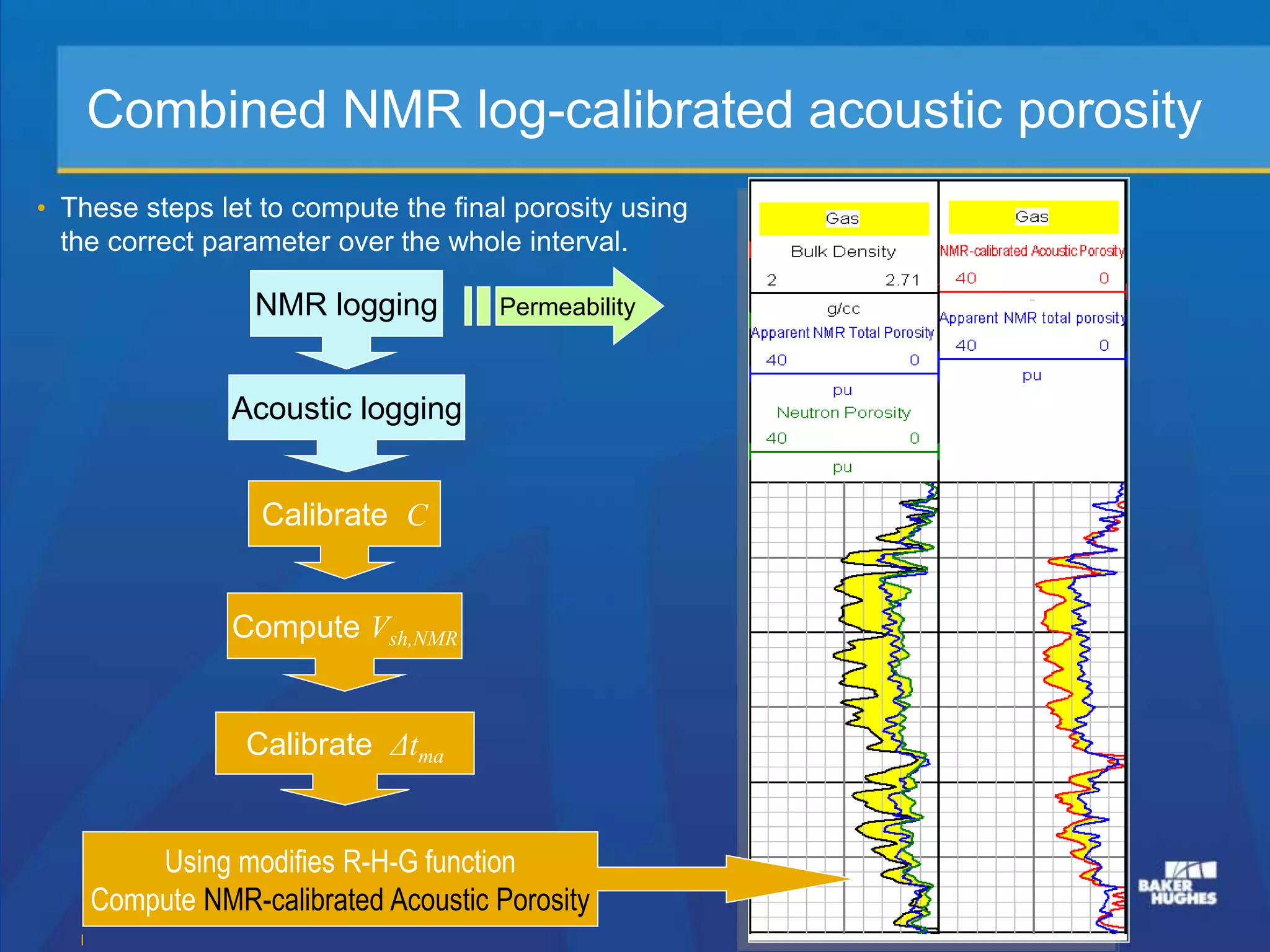
• These steps let to compute the final porosity using
the correct parameter over the whole interval.
Compute Vsh,NMR
Calibrate Δtma
Calibrate C
NMR logging
Acoustic logging
Using modifies R-H-G function
Compute NMR-calibrated Acoustic Porosity
Permeability
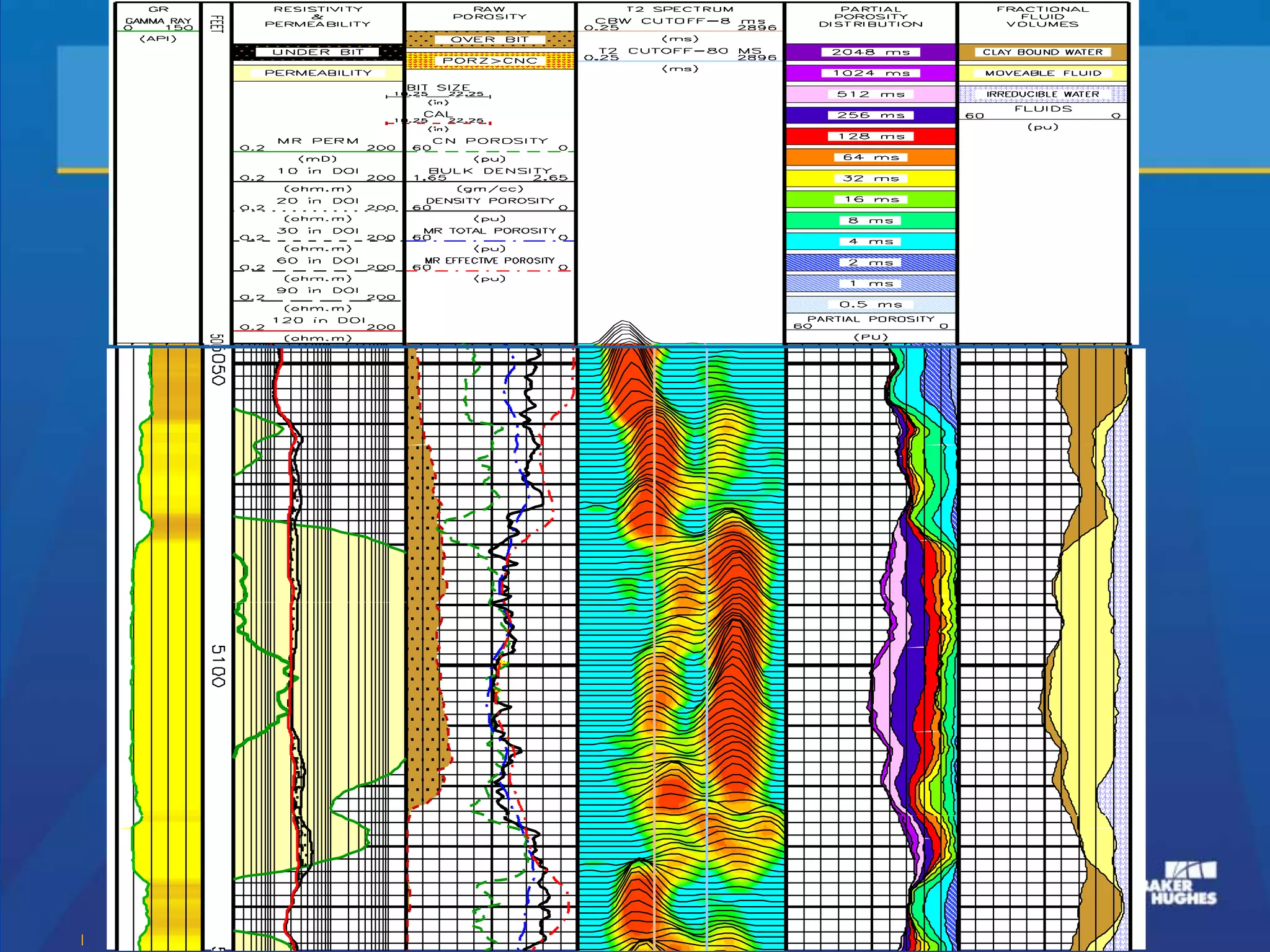
Example of NMR log-calibrated acoustic porosity
• Example in shaly sand sequences
•
Where and when ?
• This approach is applicable from clean to shaly
sandstones, and carbonate reservoirs
• Necessary data can be gathered either using LWD at
drilling phase and or at wireline measurements phase
35
Summary
 First UGS imperative: to be able to evaluate the
storage capacity
 Mitigate project risk
 Get information helping to maximize the
deliverability
 NMR log-calibrated acoustic porosity provides more
accurate and detailed description of reservoir
porosity
 Data can be acquired either while drilling or post
drilling phase.
Project
Economics
Storage
Capacity
Deliverability
Cushion GasRisk
Reliability
References
• Alberty, M. 1994. The influence of the borehole
environment upon compressional sonic logs. Paper 1994-
S, SPWLA 35th Annual Logging Symposium
• Raymer, L.L., Hunt, E.R., and Gardner, J.S. 1980. An
improved sonic transit time to porosity transform. Paper
1980-P, SPWLA 21st Annual Logging Symposium
• Chun Lan, Songhua Chen, Freddy Mendez, Rex Sy,
2010. Sourceless Porosity Estimation in Gas Reservoirs
Using Integrated Acoustic and NMR Logs, SPE ATCE
SPE 133487
Thank you

Evaluating storage capability of reservoir using an integrated source-free interpretation approach

  • 1.
    Baker Hughes 11th AnnualGlobal Gas Village Summit 2011 Prague – 11, 12 & 13 April 2011 Evaluating storage capability of reservoir using an integrated source-free interpretation approach Fabio Brambilla Senior Geoscientist Baker Hughes Fabio.brambilla@bakerhughes.com
  • 2.
    Agenda 1. Sub-Surface imperativeof UGS 2. Added value of integrated source free approach 3. The challenge of storage capacity evaluation 4. NMR logging vantages 5. Acoustic porosity 6. Combined porosity 7. Summary 2
  • 3.
    Sub-Surface Imperatives ofUGS 3  Maximize storage capacity  Maximize deliverability  Optimize cushion gas volume  Mitigate project risk  Well reliability  Profitable project Project Economics Storage Capacity Deliverabilit y Cushion Gas Risk Reliability
  • 4.
    Added value ofintegrated source-free interpretation approach 4 • Improve the evaluation of storage capability providing better porosity knowledge of the reservoir • The continuous permeability profile from NMR service let to understand the deliverability of the well • Avoid any risk about utilization of radioactive sources Project Economics Storage Capacity Deliverability Cushion GasRisk Reliability
  • 5.
    Storage capacity: thefirst imperative • The evaluation the storage capacity of reservoir for UGS requires running porosity logs, in order to have quantitative estimation of space available in your reservoir to accommodate the injected gas
  • 6.
    Evaluating the storagecapacity: the challenge • The traditional approach of evaluation requires running density and neutron log devices in order to have quantitative estimation of reservoir porosity • Both logs response are affected by lithology and gas presence • Environmental regulations for UGS fields management are more and more limiting the use of chemical radioactive sources • HSE nationals rules tend to made complex the logistic of devices using radioactive sources
  • 7.
    Evaluating the storagecapability: the solution • To overcome that, a more advanced approach have been developed for porosity determination using source-free tools, combining: 1. Nuclear Magnetic Resonance (NMR) logging 2. Acoustic logging • Both devices rely on a comfortable physics: – NMR: tool contains permanent magnet with magnetic field – Acoustic: deals with acoustic waves • The porosity from that combination is indipendent from lithology and gas presence
  • 8.
    NMR vantages • HSEfully complaint ! • Advanced detailed porosity description • Continuous permeability profile
  • 9.
    NMR service • Thisevaluation service is available either – While drilling the well (LWD) – At end of well drilling in open hole (WL) MagTrak MR Explorer (MREX)
  • 10.
    NMR: what itis measured (a bit of physics) • NMR logging has the advantage of direct measuring the hydrogen of fluids in pore space avoiding lithology effect on porosity determination •
  • 11.
    NMR how itworks • NMR logging has the advantage of direct measuring the hydrogen of fluids in pore space avoiding lithology effect on porosity determination B=0, M=0
  • 12.
    M0 B0 NMR howit works • NMR logging has the advantage of direct measuring the hydrogen of fluids in pore space avoiding lithology effect on porosity determination
  • 13.
    NMR how itworks • NMR logging has the advantage of direct measuring the hydrogen of fluids in pore space avoiding lithology effect on porosity determination Tool emits radio Frequency RF pulse with field strength B1 Spins are tipped 90 degrees by the RF pulse and then begin to precess in the B0 field f =  B0
  • 14.
    Spins precess inthe B0 field after tipping by an RF pulse f =  B0 NMR how it works • NMR logging has the advantage of direct measuring the hydrogen of fluids in pore space avoiding lithology effect on porosity determination Echoes signal are recorded
  • 15.
    NMR how itworks • NMR logging has the advantage of direct measuring the hydrogen of fluids in pore space avoiding lithology effect on porosity determination Echoes signal are recorded TE : intercho spacing TE Time 90° x 180° y 180° y 180° y 180° y 180° y Amplitude Echo Signals RF Pulses
  • 16.
    Volumetrics porosity distributionin the reservoir according NMR exploration 0 100 200 300 400 500 600 Time (ms) Porosity% 25 20 1 5 10 5 0 Superposition Clay Bound Water Capillary Water Movable Water Light Hydrocarbon 0 1 2 3 4 0.1 PartialPorosity 1 10 100 1000 T2 cutoffs T2 Movable Water Capillary Water Clay Bound Water Light Hydrocarbon
  • 17.
    NMR porosity description •The NMR logging offers a complete overview of – porosity distribution: total porosity, clay bound water volume, capillary water volume, mobile fluid volume – a continuous permeability curve. • The knowledge of these values allows: – recognizing the best storage zones of the reservoir – Better understand the deliverability total porosity (ØT,NMR ) Matrix Rock Dry Clay Clay- bound water Free water Capillary trapped water Hydro- carbons BVMCBW e BVI t
  • 18.
    Where default parametersare: C =10, m = 4 & n = 2 Coates-Timur Model : MBVI MBVM C k n = m  MPHE NMR Permeability
  • 20.
    Shale indicator fromNMR • CBW: Volume of clay bound water (CBW) represents the porosity in clay content in a formation rock • From NMR logs, both the fractional porosity from CBW (ØCBV) and the total porosity (ØT,NMR ) are obtained NMRT CBW ,  Vsh = 0 1 2 3 4 0.1 PartialPorosity 1 10 1001000
  • 21.
    Porosity evaluation ingas bearing beds • The gas occurrence affect all the porosity logs – Lower density: over call density porosity – Lower Hydrogen index: under call porosity based on Hydrogen Index
  • 22.
    Superior hydrocarbon typing •Innovative NMR acquisition techniques provide comprehensive NMR data for fluids analysis – T1, T2 & Diffusion data acquired simultaneously while logging • 2D NMR plots identify and quantify hydrocarbons – Available from all hydrocarbon typing Objective Oriented Acquisitions – Acquired as continuous logs (NOT stationary measurements!) PoroPerm + Gas PoroPerm + Oil PoroPerm + Heavy Oil 2 32 512 T2,app (ms) 16 4 1 T1/T2,app T2,int (ms) e-8 e-9 e-10 e-11 D(m2/s) 2 128 1024 T2,int (ms) e-8 e-9 e-10 e-11 e-12 D(m2/s) 162 128 102416 Gas CBW BVI Water Oil Heavy Oil Water
  • 23.
    Porosity evaluation ingas bearing beds • The accuracy of NMR total porosity in gas-bearing formations is affected by low Hydrogen Index (HI) • Thanks to hydrocarbon typing analysis we can correct for the HI effect ,
  • 24.
    Porosity evaluation ingas bearing beds • However in depleted levels or low pressure reservoir the correction for HI is definitively an improvement but still an estimate due to uncertainty of HI estimation Porosity & HI correction 0 1 2 3 4 5 6 7 8 0 50 100 150 200 250 300 350 BAR HI 0 5 10 15 20 25 30 35 40 Porosity
  • 25.
    Porosity evaluation ingas bearing beds To overcame this imprecision we suggest to exploit the vantage of combine the porosity from NMR service with the porosity from the acoustic service NMR Acoustic
  • 26.
    Acoustic vantages • HSEfully complaint ! • This evaluation service is available either – While drilling the well (LWD) – At end of well drilling phase (WL) in open hole and cased hole (CH) SoundTrak XMAC F1
  • 27.
    Porosity from modifiedRaymer-Hunt-Gardner (1) • Δt is the measured slowness of wave velocity, • Δtma is the slowness of the dry matrix. – Constant in clean reservoir (Δtma,clean ) – it changes with shale presence: type, distribution, and percentage of shale (Δtma) • C is the fitting parameter C t tt ma acoustic   = (1 ) Alberty, M. 1994
  • 28.
    Acoustic porosity • Theacoustic measurements respond to lithology and porosity • In addition respond to texture consequently acoustic porosity is an indirect measurement based on semi- empirical models, which often requires calibration of parameters • The Raymer-Hunt-Gardner function can be calibrated using the NMR total porosity and NMR shale volume
  • 29.
    { Acoustic porosity calibration •Calibrate the fitting parameter C • The Raymer-Hunt-Gardner function is calibrated in a clean water zone using the NMR total porosity • (ØT,NMR ) = (ØT,Acoustic ) • Calibrate Δtma,clean – Complex matrix C t tt cleanma NMRT   = , , C t tt a cleanmaa NMRTa   = , , C t tt b cleanmab NMRTb   = , , cleanma t tt C NMRT , ,  =  0 1 2 3 4 0.1 PartialPorosity 1 10 100 1000
  • 30.
    Acoustic porosity calibration •Calibrate the Δtma, in the shaly sand section – Using the calibrated C and the NMR porosity • A correlation can be established between Δtma and Vsh • The matrix slowness is back-calculated over all the shaly zones t C tt NMRT ma = , GRvstma . dt_ma vs GR 0 10 20 30 40 50 60 70 80 0 20 40 60 80 100 GR (gAPI) dt_ma(us/ft) )(gAPIGR tma(s/ft) GRvstma . dt_ma vs GR 0 10 20 30 40 50 60 70 80 0 20 40 60 80 100 GR (gAPI) dt_ma(us/ft) )(gAPIGR GRvstma . dt_ma vs GR 0 10 20 30 40 50 60 70 80 0 20 40 60 80 100 GR (gAPI) dt_ma(us/ft) )(gAPIGR tma(s/ft) GR (gAPI) tp,ma(µs/ft) Vsh % Δtma
  • 31.
    Acoustic porosity calibration:summary • The Raymer-Hunt-Gardner function is calibrated using the NMR total porosity in a clean water zone. • Subsequently using the shale volume, computed from the clay bound water volume, the matrix slowness is back- calculated over all the shaly zones • The function, with the calibrated parameters is run over the reservoir
  • 32.
    Combined NMR log-calibratedacoustic porosity • These steps let to compute the final porosity using the correct parameter over the whole interval. Compute Vsh,NMR Calibrate Δtma Calibrate C NMR logging Acoustic logging Using modifies R-H-G function Compute NMR-calibrated Acoustic Porosity Permeability
  • 33.
    Example of NMRlog-calibrated acoustic porosity • Example in shaly sand sequences •
  • 34.
    Where and when? • This approach is applicable from clean to shaly sandstones, and carbonate reservoirs • Necessary data can be gathered either using LWD at drilling phase and or at wireline measurements phase
  • 35.
    35 Summary  First UGSimperative: to be able to evaluate the storage capacity  Mitigate project risk  Get information helping to maximize the deliverability  NMR log-calibrated acoustic porosity provides more accurate and detailed description of reservoir porosity  Data can be acquired either while drilling or post drilling phase. Project Economics Storage Capacity Deliverability Cushion GasRisk Reliability
  • 36.
    References • Alberty, M.1994. The influence of the borehole environment upon compressional sonic logs. Paper 1994- S, SPWLA 35th Annual Logging Symposium • Raymer, L.L., Hunt, E.R., and Gardner, J.S. 1980. An improved sonic transit time to porosity transform. Paper 1980-P, SPWLA 21st Annual Logging Symposium • Chun Lan, Songhua Chen, Freddy Mendez, Rex Sy, 2010. Sourceless Porosity Estimation in Gas Reservoirs Using Integrated Acoustic and NMR Logs, SPE ATCE SPE 133487
  • 37.

Editor's Notes

  • #3  I cannot edit this slide
  • #4 Should l I leave that as it is?
  • #5 Describe how your service helps the UGS operator achieve one or more of the imperatives
  • #9 Randomly dis-tributed spins of hydrogen nuclei Logging tool contains large permanent magnet with field, Bo Spins are aligned parallel and antiparallel
  • #11 Randomly dis-tributed spins of hydrogen nuclei Logging tool contains large permanent magnet with field, Bo Spins are aligned parallel and antiparallel
  • #12 Randomly dis-tributed spins of hydrogen nuclei Logging tool contains large permanent magnet with field, Bo Spins are aligned parallel and antiparallel
  • #13 Randomly dis-tributed spins of hydrogen nuclei Logging tool contains large permanent magnet with field, Bo Spins are aligned parallel and antiparallel
  • #14 Randomly dis-tributed spins of hydrogen nuclei Logging tool contains large permanent magnet with field, Bo Spins are aligned parallel and antiparallel
  • #15 Randomly dis-tributed spins of hydrogen nuclei Logging tool contains large permanent magnet with field, Bo Spins are aligned parallel and antiparallel
  • #16 Randomly dis-tributed spins of hydrogen nuclei Logging tool contains large permanent magnet with field, Bo Spins are aligned parallel and antiparallel
  • #17 We have porous rocks in the reservoir. They consist of grains and fluids inbetween. The solid material does not contribute to the NMR measurement. After a wait time (about 6 to 8 sec) to magnetize the Hydrogen- spins in the formation a measurement can be carried out. Only fluids give a signal in the formation. Click First component is the Clay bound water. because of the good energy exchange with the solid material the signal is decaying very fast. Click The second fast decaying component is the capillary water, which is also non producible. Click Free water has a longer decay time with a decay constant of greater than 30 ms in sandstones. Click Low viscous Hydrocarbon decays even longer. and can easily be detected by it’s long decay time constant. Click With the downhole tool we measure a composite signal of all this components. Click The individual components can be revealed by a mathematical decomposition of the superposition of signals. Click Clay bound water appears between 0 and 3 ms. Click Capillary water shows up between 3 and 30 ms. Click Free water appears later than 30 ms. Click and Hydrocarbon is the latest component in the T2 decay time distribution.
  • #19 The Coates-Timur Permeability Model has been adopted as the standard model used to compute permeability from NMR data when there is more than one fluid phase present. Primary input data to the model include the NMR porosity and the ratio of moveable fluid to irreducible fluid volumes (BVM/BVI). This latter element of the model actually forces the resultant permeability to zero (0) when no moveable fluids are present. Thus the Coates-Timur model is better suited to be used for determination of effective permeability to moveable fluids in the presence of irreducible wetting phase, rather than for determination of specific (or absolute permeability) as is typically reported from routine core measurements on dried samples. A good calibration reference for this model would then be RCI or FMT data, which actually provides permeability for the mobile fluid phase. Although routine core permeabilities may not strictly satisfy the Coates model boundary condition of zero perm at 100% irreducible water saturation, good correlations can typically be achieved between computed and measured core perms over broad permeability ranges through the manipulation of the models exponents (m & n) and coefficient (C). Baker Atlas has recently developed automated parameter optimization software that can objectively provide the best possible solution for these model variables in achieving a match to core or formation test-derived permeability data. In the absence of core or test calibration data, a set of default values for the Coates model parameters are applied (C=10, m=4 & n=2).
  • #23 This slide illustrates the new techniques employed as part of the MREX analysis. These techniques are called 2D NMR, for 2 dimensions. They are similar to conventional crossplots in that we are crossplotting two separate measurements. In the case of NMR the two measurements come from the same tool but represent different properties of the fluid. By contrasting these properties we can identify and quntify the oil, water and gas present in an interval of the reservoir.
  • #34 density and neutron results are affected by shale, thus the density/neutron crossover might not represent the true porosity in these depths.
  • #36 To be finalised