 A nuclear and radiation accident is defined by the 
International Atomic Energy Agency as "an event 
that has led to significant consequences to the 
people, the environment or the facility." Examples 
include lethal effects to individuals, large 
radioactivity release in to the environment, or 
reactor core melt. 
 Technical measures need to be adopted to reduce 
the risk of accidents or to minimize the amount of 
radioactivity released to the environment.
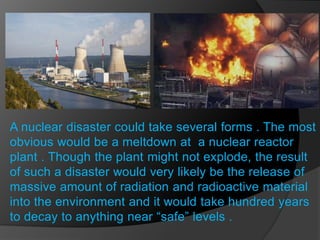
A nuclear disaster could take several forms . The most 
obvious would be a meltdown at a nuclear reactor 
plant . Though the plant might not explode, the result 
of such a disaster would very likely be the release of 
massive amount of radiation and radioactive material 
into the environment and it would take hundred years 
to decay to anything near “safe” levels .
Nuclear disasters are usually associated with meltdowns. 
When a meltdown occurs in a reactor, the reactor "melts". 
That is, the temperature rises in the core so much that the 
fuel rods actually turn to liquid, like ice turns into water when 
heated. If the core continues to heat, the reactor would get 
so hot that the steel walls of the core would also melt. In a 
complete reactor meltdown, the extremely hot (about 2700 
Celsius) molten uranium fuel rods would melt through the 
bottom of the reactor and actually sink about 50 feet into the 
earth beneath the power plant. 
The molten uranium would react with groundwater, 
producing large explosions of radioactive steam and debris 
that would affect nearby towns and population centers.
In a safe nuclear reactor the condenser and the cooling 
tubes work efficiently and the heat applied on the uranium 
rods is controlled.
Uranium Mining 
Fuel Enrichment 
Power Generation 
Waste Disposal RADIATION INCREASES multifold 
at each stage!
Radioactive Waste 
 Generated at each stage - Mining, Enrichment, 
Power Generation 
 Waste from Enrichment has been used in 
Depleted Uranium (DU) bombs used in Iraq 
 Even 21st century science has NO 
ANSWER for Nuclear Waste Disposal 
 Waste contaminates (beyond scope for 
inhabitation) a huge area in its vicinity for 
1000’s of years 
What about 
the 
Environment 
& People? 
Is it 
Safe?
Radiation Contaminates Always 
• Even if there is NO NUCLEAR 
ACCIDENT 
– Around a Uranium Mine 
– Around an Enrichment Facility 
– Around a Nuclear Plant 
– Around Nuclear Waste 
An area of 30-35 km radius gets 
contaminated by nuclear radiation 
regularly! 
home
Radiation Spares Nothing 
 Impacts Vegetation - Agriculture 
 Trees near Jaduguda Uranium Mines have 
DEFORMED SEEDS 
 Agricultural produce is bound to carry 
unacceptable amounts of radioactive content 
 Impacts Animals 
 Radioactive Boars on the rise in Germany (thanks 
to Chernobyl) 
 Impacts Human Beings 
home
Consequences of nuclear disaster 
 Nuclear explosions produce both immediate and delayed 
destructive effects. Immediate effects (blast, thermal 
radiation, prompt ionizing radiation) are produced and cause 
significant destruction within seconds or minutes of a nuclear 
detonation. The delayed effects (radioactive fallout and other 
possible environmental effects) inflict damage over an 
extended period ranging from hours to centuries, and can 
cause adverse effects in locations very distant from the site of 
the detonation.
 Nuclear disaster can produce 
climate issues because the high 
temperatures of the nuclear 
fireball cause large amounts of 
nitrogen oxides to form from the 
oxygen and nitrogen in the 
atmosphere (very similar to what 
happens in combustion engines). 
Each megaton of yield will 
produce some 5000 tons of 
nitrogen oxides. The rising fireball 
of a high kiloton or megaton range 
warhead will carry these nitric 
oxides well up into the 
stratosphere, where they can 
reach the ozone layer. A series of 
large atmospheric explosions 
could significantly deplete the 
ozone layer.
Fukushima disaster caused many people to 
become aware of potassium iodide tablets, 
available from your local drug store, via 
outlets online, and sometimes distributed by 
utilities or local officials to people living near 
nuclear facilities experiencing problems. 
This stable form of iodine, which is used by 
the thyroid gland to produce necessary 
hormones for metabolism and fetal brain 
development can protect your thyroid gland 
from radioactive iodine-131. But it does not 
protect against any other limiting isotopes 
likely to be released from a nuclear event.
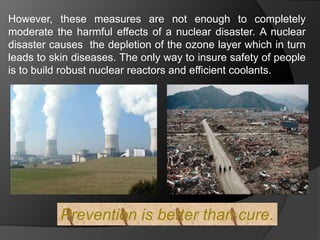
However, these measures are not enough to completely 
moderate the harmful effects of a nuclear disaster. A nuclear 
disaster causes the depletion of the ozone layer which in turn 
leads to skin diseases. The only way to insure safety of people 
is to build robust nuclear reactors and efficient coolants. 
Prevention is better than cure.
 Nuclear explosions can release high levels of radiation, 
an energy that removes electrons. 
 Nuclear radiation can damage DNA. 
 While areas around a nuclear explosion are 
immediately exposed, radiation can also remain in the 
atmosphere for decades, traveling great distances 
before it settles to the ground-level air or earth's 
surface 
 Disposing of one's outer clothing can remove up to 
90% of radioactive material after a nuclear disaster. 
 The peace symbol was initially designed for the Direct 
Action Committee Against Nuclear War (DAC).
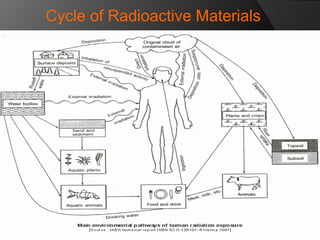
Cycle of Radioactive Materials
Apart from its disastrous potential, nuclear radiation is one of the 
most effective means of providing electricity to the country and 
ensuring economic development. If handled carefully, nuclear 
energy can be a greener alternative to other forms of energy like 
coal and petrol. 
Proponents, such as the World 
Nuclear Association, the IAEA 
and Environmentalists for 
Nuclear Energy believe that 
nuclear power is a safe, 
sustainable energy source that 
reduces carbon emissions
In case of a Nuclear Disaster 
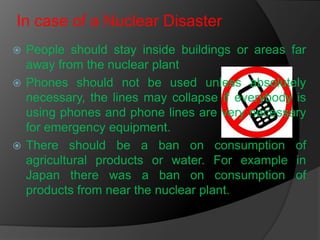
 People should stay inside buildings or areas far 
away from the nuclear plant 
 Phones should not be used unless absolutely 
necessary, the lines may collapse if everybody is 
using phones and phone lines are very necessary 
for emergency equipment. 
 There should be a ban on consumption of 
agricultural products or water. For example in 
Japan there was a ban on consumption of 
products from near the nuclear plant.
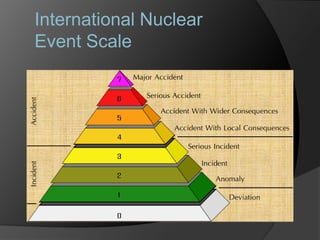
International Nuclear 
Event Scale
Exhibition Severity Symptoms 
Some millisieverts only possible long-term 
Several hundred millisieverts No immediate effect Possible temporary nausea 
and slight fever 
Between 1 000 and 2 
000 millisieverts 
remarkable 
medical Effect 
vomiting, fatigue, 
fever, risk of infection, 
cancer 
Between 2 000 and 4 
000 millisieverts 
serious medical Effect vomiting, fever, digestive 
disorders, bleeding, hair 
loss, 
leukemia, other cancers 
Between 4 000 and 10 
000 millisievertsand 
probability greater 
than 50% death, 
property 
damage neurological (dizzin 
ess, disorientation) and can 
cers of many types 
Excess of 10 000 mSv safe Death
Some Nuclear and Radiation 
accidents - 
 1952 - AECL Chalk River Laboratories, Chalk River, 
Ontario, Canada. Partial meltdown, about 10,000 Curies 
released. 
 September 1957 - a plutonium fire occurred at the 
Rocky Flats Plant, which resulted in the contamination 
of Building 71 and the release of plutonium into the 
atmosphere, causing US $818,600 in damage. 
 September 1957 – Mayak nuclear waste storage tank 
explosion at Chelyabinsk. Two hundred plus fatalities, 
believed to be a conservative estimate; 270,000 people 
were exposed to dangerous radiation levels. Over thirty 
small communities had been removed from Soviet maps 
between 1958 and 1991. (INES level 6).
 October 1957 - Windscale fire, UK. Fire ignites 
plutonium piles and contaminates surrounding dairy 
farms.An estimated 33 cancer deaths. 
 1959, 1964, 1969 - Santa Susana Field Laboratory, Los 
Angeles, California. Partial meltdowns. 
 July 1961 – Soviet submarine K-19 accident. Eight 
fatalities and more than 30 people were over-exposed to 
radiation. 
 1962 – Radiation accident in Mexico City, four fatalities. 
 January 1969 – Lucens reactor in Switzerland 
undergoes partial core meltdown leading to massive 
radioactive contamination of a cavern. 
 July 1979 - Church Rock Uranium Mill Spill in New 
Mexico, USA, when United Nuclear Corporation's 
uranium mill tailings disposal pond breached its dam.
 March 1984 – Radiation accident in Morocco, eight 
fatalities.[ 
 August 1985 – Soviet submarine K-431 accident. Ten 
fatalities and 49 other people suffered radiation injuries. 
 September 1987 – Goiania accident. Four fatalities and 
249 other people received serious radiation 
contamination. 
 December 1990 – Radiotherapy accident in Zaragoza. 
Eleven fatalities and 27 other patients were injured. 
 April 1993 - accident at the Tomsk-7 Reprocessing 
Complex, when a tank exploded while being cleaned 
with nitric acid. The explosion released a cloud of 
radioactive gas. (INES level 4).
 1996 – Radiotherapy accident in Costa Rica. Thirteen 
fatalities and 114 other patients received an overdose of 
radiation. 
 September 1999 - Criticality accident at Tokai nuclear 
fuel plant (Japan) 
 February 2000 - Three deaths and ten injuries resulted 
in Samut Prakarn when a radiation-therapy unit was 
dismantled. 
 April 2010 - Mayapuri radiological accident, India, one 
fatality. 
 March 2011- Fukushima I nuclear accidents, Japan 
(current event). 
 March 2011- Fukushima Daichi Power Station - 
radioactive discharge
Why is Nuclear Power Promoted in 
India? 
 Current energy policies are designed to 
benefit foreign MNCs 
General Electrics Westinghouse Areva 
Newspapers admit that THEY ARE HERE FOR A $40 BN 
BUSINESS 
home
Why is Nuclear Power Promoted in 
India? 
 Profit for MNCs who will provide reactor designs 
 Commission for Indian Politicians, Intellectuals, Scientists 
` 
10,00,00,00,00,00,000 
One Lakh Crores only! 
All Nuclear Plants in India offer 
lucrative prospects 
for these Patriots! 
Investment at the 
9,900 WM Jaitapur 
Nuclear Plant 
home
Nuclear Plants in India (2010) 
Narora, UP - 440 MW 
Rawatbhata, Raj - 2,580 MW 
Kakrapar, Gujarat - 1,840 MW 
Tarapur, Mah - 1,400 MW 
Kaiga, Karnataka - 880 MW 
Kalpakkam, TN - 940 MW 
home
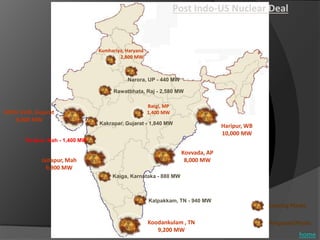
Post Indo-US Nuclear Deal 
Existing Plants 
Proposed Plants 
Narora, UP - 440 MW 
Rawatbhata, Raj - 2,580 MW 
Bargi, MP 
1,400 MW 
Kakrapar, Gujarat - 1,840 MW 
Mithi Virdi, Gujarat 
8,000 MW 
Tarapur, Mah - 1,400 MW 
Kaiga, Karnataka - 880 MW 
Kalpakkam, TN - 940 MW 
Jaitapur, Mah 
9,900 MW 
Haripur, WB 
10,000 MW 
Kovvada, AP 
8,000 MW 
Koodankulam , TN 
9,200 MW 
Kumhariya, Haryana 
2,800 MW 
home
Impact of Nuclear Accidents in India 
Can you imagine the massive loss of 
Human Lives, Forests, Agriculture, 
Existing Plants 
Proposed Plants 
Animals, Economic Activities? 
For 1000’s of years! 
home
Why is Renewable Energy 
Unknown? 
 Very less or No Scope for Investment (read 
profit) 
 Giants MNCs in the Nuclear Power sector are 
too strong to let the Renewable Energy sector 
grow 
 And hence, almost No Solar or Wind Scientists 
home
And Our Government’s Gift for US 
 The Nuclear Civil Liabilities Bill by our 
government says that: 
Any foreign company WILL NOT be held 
liable for any nuclear accidents on Indian 
soil, whatsoever 
They WILL NOT pay any Compensation 
We CAN NOT sue them in Indian or 
Foreign courts
The ‘West’ is Disowning Nuclear Power 
 Most Americans are against Nuclear Power 
 Major concerns: 
○ Continuous radiation emitted in normal functioning of Nuclear 
Plants 
○ Nuclear Waste disposal 
○ Threats of nuclear accidents 
 Australia has never built a Nuclear Power Plant! 
home
Wondering What You Can Do 
About This? 
 Understand the politics of promoting 
Nuclear Power in India 
 Spread awareness about this massive 
public betrayal 
Jago Re !
nuclear disasters

nuclear disasters

  • 3.
     A nuclearand radiation accident is defined by the International Atomic Energy Agency as "an event that has led to significant consequences to the people, the environment or the facility." Examples include lethal effects to individuals, large radioactivity release in to the environment, or reactor core melt.  Technical measures need to be adopted to reduce the risk of accidents or to minimize the amount of radioactivity released to the environment.
  • 4.
    A nuclear disastercould take several forms . The most obvious would be a meltdown at a nuclear reactor plant . Though the plant might not explode, the result of such a disaster would very likely be the release of massive amount of radiation and radioactive material into the environment and it would take hundred years to decay to anything near “safe” levels .
  • 5.
    Nuclear disasters areusually associated with meltdowns. When a meltdown occurs in a reactor, the reactor "melts". That is, the temperature rises in the core so much that the fuel rods actually turn to liquid, like ice turns into water when heated. If the core continues to heat, the reactor would get so hot that the steel walls of the core would also melt. In a complete reactor meltdown, the extremely hot (about 2700 Celsius) molten uranium fuel rods would melt through the bottom of the reactor and actually sink about 50 feet into the earth beneath the power plant. The molten uranium would react with groundwater, producing large explosions of radioactive steam and debris that would affect nearby towns and population centers.
  • 6.
    In a safenuclear reactor the condenser and the cooling tubes work efficiently and the heat applied on the uranium rods is controlled.
  • 7.
    Uranium Mining FuelEnrichment Power Generation Waste Disposal RADIATION INCREASES multifold at each stage!
  • 8.
    Radioactive Waste Generated at each stage - Mining, Enrichment, Power Generation  Waste from Enrichment has been used in Depleted Uranium (DU) bombs used in Iraq  Even 21st century science has NO ANSWER for Nuclear Waste Disposal  Waste contaminates (beyond scope for inhabitation) a huge area in its vicinity for 1000’s of years What about the Environment & People? Is it Safe?
  • 9.
    Radiation Contaminates Always • Even if there is NO NUCLEAR ACCIDENT – Around a Uranium Mine – Around an Enrichment Facility – Around a Nuclear Plant – Around Nuclear Waste An area of 30-35 km radius gets contaminated by nuclear radiation regularly! home
  • 10.
    Radiation Spares Nothing  Impacts Vegetation - Agriculture  Trees near Jaduguda Uranium Mines have DEFORMED SEEDS  Agricultural produce is bound to carry unacceptable amounts of radioactive content  Impacts Animals  Radioactive Boars on the rise in Germany (thanks to Chernobyl)  Impacts Human Beings home
  • 11.
    Consequences of nucleardisaster  Nuclear explosions produce both immediate and delayed destructive effects. Immediate effects (blast, thermal radiation, prompt ionizing radiation) are produced and cause significant destruction within seconds or minutes of a nuclear detonation. The delayed effects (radioactive fallout and other possible environmental effects) inflict damage over an extended period ranging from hours to centuries, and can cause adverse effects in locations very distant from the site of the detonation.
  • 12.
     Nuclear disastercan produce climate issues because the high temperatures of the nuclear fireball cause large amounts of nitrogen oxides to form from the oxygen and nitrogen in the atmosphere (very similar to what happens in combustion engines). Each megaton of yield will produce some 5000 tons of nitrogen oxides. The rising fireball of a high kiloton or megaton range warhead will carry these nitric oxides well up into the stratosphere, where they can reach the ozone layer. A series of large atmospheric explosions could significantly deplete the ozone layer.
  • 13.
    Fukushima disaster causedmany people to become aware of potassium iodide tablets, available from your local drug store, via outlets online, and sometimes distributed by utilities or local officials to people living near nuclear facilities experiencing problems. This stable form of iodine, which is used by the thyroid gland to produce necessary hormones for metabolism and fetal brain development can protect your thyroid gland from radioactive iodine-131. But it does not protect against any other limiting isotopes likely to be released from a nuclear event.
  • 14.
    However, these measuresare not enough to completely moderate the harmful effects of a nuclear disaster. A nuclear disaster causes the depletion of the ozone layer which in turn leads to skin diseases. The only way to insure safety of people is to build robust nuclear reactors and efficient coolants. Prevention is better than cure.
  • 15.
     Nuclear explosionscan release high levels of radiation, an energy that removes electrons.  Nuclear radiation can damage DNA.  While areas around a nuclear explosion are immediately exposed, radiation can also remain in the atmosphere for decades, traveling great distances before it settles to the ground-level air or earth's surface  Disposing of one's outer clothing can remove up to 90% of radioactive material after a nuclear disaster.  The peace symbol was initially designed for the Direct Action Committee Against Nuclear War (DAC).
  • 16.
  • 17.
    Apart from itsdisastrous potential, nuclear radiation is one of the most effective means of providing electricity to the country and ensuring economic development. If handled carefully, nuclear energy can be a greener alternative to other forms of energy like coal and petrol. Proponents, such as the World Nuclear Association, the IAEA and Environmentalists for Nuclear Energy believe that nuclear power is a safe, sustainable energy source that reduces carbon emissions
  • 18.
    In case ofa Nuclear Disaster  People should stay inside buildings or areas far away from the nuclear plant  Phones should not be used unless absolutely necessary, the lines may collapse if everybody is using phones and phone lines are very necessary for emergency equipment.  There should be a ban on consumption of agricultural products or water. For example in Japan there was a ban on consumption of products from near the nuclear plant.
  • 19.
  • 20.
    Exhibition Severity Symptoms Some millisieverts only possible long-term Several hundred millisieverts No immediate effect Possible temporary nausea and slight fever Between 1 000 and 2 000 millisieverts remarkable medical Effect vomiting, fatigue, fever, risk of infection, cancer Between 2 000 and 4 000 millisieverts serious medical Effect vomiting, fever, digestive disorders, bleeding, hair loss, leukemia, other cancers Between 4 000 and 10 000 millisievertsand probability greater than 50% death, property damage neurological (dizzin ess, disorientation) and can cers of many types Excess of 10 000 mSv safe Death
  • 21.
    Some Nuclear andRadiation accidents -  1952 - AECL Chalk River Laboratories, Chalk River, Ontario, Canada. Partial meltdown, about 10,000 Curies released.  September 1957 - a plutonium fire occurred at the Rocky Flats Plant, which resulted in the contamination of Building 71 and the release of plutonium into the atmosphere, causing US $818,600 in damage.  September 1957 – Mayak nuclear waste storage tank explosion at Chelyabinsk. Two hundred plus fatalities, believed to be a conservative estimate; 270,000 people were exposed to dangerous radiation levels. Over thirty small communities had been removed from Soviet maps between 1958 and 1991. (INES level 6).
  • 22.
     October 1957- Windscale fire, UK. Fire ignites plutonium piles and contaminates surrounding dairy farms.An estimated 33 cancer deaths.  1959, 1964, 1969 - Santa Susana Field Laboratory, Los Angeles, California. Partial meltdowns.  July 1961 – Soviet submarine K-19 accident. Eight fatalities and more than 30 people were over-exposed to radiation.  1962 – Radiation accident in Mexico City, four fatalities.  January 1969 – Lucens reactor in Switzerland undergoes partial core meltdown leading to massive radioactive contamination of a cavern.  July 1979 - Church Rock Uranium Mill Spill in New Mexico, USA, when United Nuclear Corporation's uranium mill tailings disposal pond breached its dam.
  • 23.
     March 1984– Radiation accident in Morocco, eight fatalities.[  August 1985 – Soviet submarine K-431 accident. Ten fatalities and 49 other people suffered radiation injuries.  September 1987 – Goiania accident. Four fatalities and 249 other people received serious radiation contamination.  December 1990 – Radiotherapy accident in Zaragoza. Eleven fatalities and 27 other patients were injured.  April 1993 - accident at the Tomsk-7 Reprocessing Complex, when a tank exploded while being cleaned with nitric acid. The explosion released a cloud of radioactive gas. (INES level 4).
  • 24.
     1996 –Radiotherapy accident in Costa Rica. Thirteen fatalities and 114 other patients received an overdose of radiation.  September 1999 - Criticality accident at Tokai nuclear fuel plant (Japan)  February 2000 - Three deaths and ten injuries resulted in Samut Prakarn when a radiation-therapy unit was dismantled.  April 2010 - Mayapuri radiological accident, India, one fatality.  March 2011- Fukushima I nuclear accidents, Japan (current event).  March 2011- Fukushima Daichi Power Station - radioactive discharge
  • 26.
    Why is NuclearPower Promoted in India?  Current energy policies are designed to benefit foreign MNCs General Electrics Westinghouse Areva Newspapers admit that THEY ARE HERE FOR A $40 BN BUSINESS home
  • 27.
    Why is NuclearPower Promoted in India?  Profit for MNCs who will provide reactor designs  Commission for Indian Politicians, Intellectuals, Scientists ` 10,00,00,00,00,00,000 One Lakh Crores only! All Nuclear Plants in India offer lucrative prospects for these Patriots! Investment at the 9,900 WM Jaitapur Nuclear Plant home
  • 28.
    Nuclear Plants inIndia (2010) Narora, UP - 440 MW Rawatbhata, Raj - 2,580 MW Kakrapar, Gujarat - 1,840 MW Tarapur, Mah - 1,400 MW Kaiga, Karnataka - 880 MW Kalpakkam, TN - 940 MW home
  • 29.
    Post Indo-US NuclearDeal Existing Plants Proposed Plants Narora, UP - 440 MW Rawatbhata, Raj - 2,580 MW Bargi, MP 1,400 MW Kakrapar, Gujarat - 1,840 MW Mithi Virdi, Gujarat 8,000 MW Tarapur, Mah - 1,400 MW Kaiga, Karnataka - 880 MW Kalpakkam, TN - 940 MW Jaitapur, Mah 9,900 MW Haripur, WB 10,000 MW Kovvada, AP 8,000 MW Koodankulam , TN 9,200 MW Kumhariya, Haryana 2,800 MW home
  • 30.
    Impact of NuclearAccidents in India Can you imagine the massive loss of Human Lives, Forests, Agriculture, Existing Plants Proposed Plants Animals, Economic Activities? For 1000’s of years! home
  • 31.
    Why is RenewableEnergy Unknown?  Very less or No Scope for Investment (read profit)  Giants MNCs in the Nuclear Power sector are too strong to let the Renewable Energy sector grow  And hence, almost No Solar or Wind Scientists home
  • 32.
    And Our Government’sGift for US  The Nuclear Civil Liabilities Bill by our government says that: Any foreign company WILL NOT be held liable for any nuclear accidents on Indian soil, whatsoever They WILL NOT pay any Compensation We CAN NOT sue them in Indian or Foreign courts
  • 33.
    The ‘West’ isDisowning Nuclear Power  Most Americans are against Nuclear Power  Major concerns: ○ Continuous radiation emitted in normal functioning of Nuclear Plants ○ Nuclear Waste disposal ○ Threats of nuclear accidents  Australia has never built a Nuclear Power Plant! home
  • 34.
    Wondering What YouCan Do About This?  Understand the politics of promoting Nuclear Power in India  Spread awareness about this massive public betrayal Jago Re !