NON STEROIDAL
ANTI-INFLAMMATORY
DRUGS
(NSAIDs)
By
Dr. Faraza Javaid
ANTI-INFLAMMATORY
DRUGS
STEROIDS (GLUCOCORTICOIDS)
NON-STEROIDAL (ASPIRIN LIKE)
NON-STEROIDAL ANTI-INFLAMMATORY DRUGS
(NSAIDS)
 None of them is a steroid
 Analgesic, antipyretic and anti-
inflammatory effect (except
paracetamol)
 Do not produce CNS or respiratory
depression
 Acts by inhibiting prostaglandin synthesis
MECHANISM OF ACTION
Membrane Phospholipids
Phospholipase – A2
Arachidonic acid
COX
Prostaglandins, Thromboxane A2 (TXA2)& other
inflammatory mediators (ILs, TNF-α)
NSAIDs
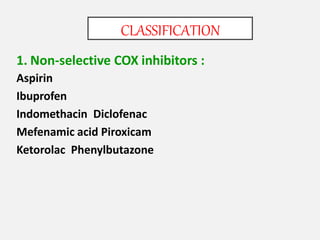
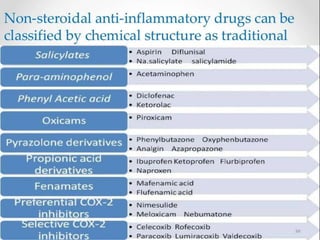
CLASSIFICATION
1. Non-selective COX inhibitors :
Aspirin
Ibuprofen
Indomethacin Diclofenac
Mefenamic acid Piroxicam
Ketorolac Phenylbutazone
2. Selective COX-2 inhibitors:
Celecoxib, valdecoxib, etoricoxib
3. Preferential COX-2 inhibitors:
Nimesulide, meloxicam
4. Analgesic-antipyretic drugs with poor anti-
inflammatory effect:
Paracetamol
COX-1 is a constitutive enzyme expressed in most tissues,
including blood platelets. It has a ‘housekeeping’ role in the body,
being involved in tissue homeostasis, and is responsible for the
production of prostaglandins involved in, for example, gastric
cytoprotection, platelet aggregation, renal blood flow
autoregulation and the initiation of parturition.
COX-2 is induced in inflammatory cells when they are injured,
infected or activated by, for example, the inflammatory
cytokines—interleukin (IL)-1 and tumour necrosis factor (TNF)-α.
Thus the COX-2 isoform is mainly responsible for the production
of the prostanoid mediators of inflammation.
Effects of NSAIDs
1) Analgesia
 PGE2 is thought to sensitize nerve endings to the action of
bradykinin, histamine, and other chemical mediators released
locally by the inflammatory process.
 Thus, by decreasing PGE2 synthesis, the sensation of pain can
be decreased.
 As COX-2 is expressed during times of inflammation and injury,
it is thought that inhibition of this enzyme is responsible for the
analgesic activity of NSAIDs.
 The NSAIDs are used mainly for the management of mild to
moderate pain arising from musculoskeletal disorders. One
exception is ketorolac, which can be used for more severe pain,
but for only a short duration.
Antipyretic Action
Fever occurs when the set-point of the anterior hypothalamic
thermoregulatory center is elevated. This can be caused by PGE2
synthesis, which is stimulated when endogenous fever-producing
agents (pyrogens), such as cytokines, are released from WBCs
that are activated by infection, hypersensitivity, malignancy, or
inflammation.
The NSAIDs lower body temperature in patients with fever by
impeding PGE2 synthesis and release, resetting the “thermostat”
back toward normal.
Anti-inflammatory actions
 Inhibition of cyclooxygenase diminishes the formation of
prostaglandins and, thus, modulates aspects of
inflammation mediated by prostaglandins.
 NSAIDs inhibit inflammation in arthritis, but they neither
arrest the progression of the disease nor induce remission.
Antiplatelet aggregatory
NSAIDs inhibit synthesis of both pro-aggregatory (TXA2) →
therapeutic doses of most NSAIDs inhibit platelet
aggregation: bleeding time is prolonged.
Aspirin is highly active; Small doses are therefore able to
exert antithrombotic effect for several days. Risk of surgical
bleeding is enhanced.
Ductus arteriosus closure
 During fetal circulation ductus arteriosus is kept patent
by local elaboration of PGE2 and PGI2. Unknown
mechanisms switch off this synthesis at birth and the
ductus closes.
 When this fails to occur, small doses of indomethacin or
aspirin bring about closure in majority of cases within a
few hours by inhibiting PG production.
 Administration of NSAIDs in late pregnancy has been
found to promote premature closure of ductus in some
cases. Prescribing of NSAIDs near term should be
avoided.
Parturition
Sudden spurt of PG synthesis by uterus probably triggers
labour and facilitates its progression. Accordingly, NSAIDs
have the potential to delay and retard labour. However,
labour can occur in the absence of PGs.
Gastric mucosal damage
 Gastric pain, mucosal erosion/ulceration and blood loss are produced
by all NSAIDs to varying extents: relative gastric toxicity is a major
consideration in the choice of NSAIDs.
 Deficiency of PGs reduces mucus and HCO3¯ secretion, tends to
enhance acid secretion and may promote mucosal ischemia.
 Paracetamol, a very weak inhibitor of COX is practically free of gastric
toxicity and selective COX-2 inhibitors are safer. Stable PG analogues
(misoprostol) administered concurrently with NSAIDs antagonize
their gastric toxicity.
Renal effects
impairment of PGE2 mediated vasodilatation
impairment of renal blood flow & reduction of g.f.r
worsens renal insufficiency
CVS effects
Prolonged use – cause Na+ and water retention -
edema – may precipitate CHF
Aspirin (Prototype)
Aspirin can be thought of
as a traditional NSAID,
but it exhibits anti-
inflammatory activity only
at relatively high doses
that are rarely used.
It is used more frequently
at lower doses to prevent
cardiovascular events
such as stroke and
myocardial infarction (MI)
Therapeutic Uses
Analgesic, Anti-inflammatory, Antipyretic Actions:
It is analgesic and antipyretic at usual doses and anti-
inflammatory at high doses.
Respiration:
The effects are dose dependent. At anti-inflammatory
doses, respiration is stimulated by peripheral (increased
CO2 production) and central (increased sensitivity of
respiratory center to CO2) actions. Hyperventilation is
prominent in salicylate poisoning.
Acid-base and electrolyte balance:
Anti-inflammatory doses produce significant changes in the
acid-base and electrolyte composition of body fluids.
CVS:
Aspirin has no direct effect in therapeutic doses. Larger
doses increase cardiac output to meet increased peripheral
O2 demand and cause direct vasodilatation.
GIT:
 Aspirin and released salicylic acid irritate gastric mucosa,
cause epigastric distress, nausea and vomiting.
 It also stimulates CTZ: vomiting has a central component
as well at higher doses.
Urate excretion:
Dose-related effect is seen:
< 2 g/day—urate retention and antagonism of all other uricosuric
drugs.
2–5 g/day—variable effects, often no change.
> 5 g/day—increased urate excretion.
Aspirin is not suitable for use in chronic gout.
Blood:
Aspirin, even in small doses, irreversibly inhibits TXA2 synthesis
by platelets. Thus, it interferes with platelet aggregation and
bleeding time is prolonged to nearly twice the normal value. This
effect lasts for about a week.
Long-term intake of large dose decreases synthesis of clotting
factors in liver and predisposes to bleeding; can be prevented by
prophylactic vit K therapy.
ADVERSE EFFECTS
(a) Side effects that occur at analgesic dose:
(0.3–1.5 g/day) are nausea, vomiting, epigastric distress,
increased occult blood loss in stools. The most important
adverse effect of aspirin is gastric mucosal damage and peptic
ulceration.
(b) Hypersensitivity and idiosyncrasy:
Though infrequent, these can be serious. Reactions include
rashes, fixed drug eruption, urticaria, rhinorrhoea,
angioedema, asthma and anaphylactoid reaction. Profuse
gastric bleeding occurs in rare instances.
(c) Anti-inflammatory doses:
(3–5 g/day) produce the syndrome called salicylism—
dizziness, tinnitus, vertigo, reversible impairment of hearing
and vision, excitement and mental confusion,
hyperventilation and electrolyte imbalance.
Aspirin therapy in children with rheumatoid arthritis has
been found to raise serum transaminases, indicating liver
damage.
Most cases are asymptomatic but it is potentially dangerous.
An association between salicylate therapy and ‘Reye’s
syndrome’, a rare form of hepatic encephalopathy seen in
children having viral (varicella, influenza) infection has been
noted.
(d) Acute salicylate poisoning:
It is more common in children. Fatal dose in adults is estimated to
be 15–30 g. Serious toxicity is seen at serum salicylate levels > 50
mg/dl.
Vomiting, dehydration, electrolyte imbalance, acidotic breathing,
hyper/ hypoglycaemia, petechial haemorrhages, restlessness,
delirium, hallucinations, hyperpyrexia, convulsions, coma and
death due to respiratory failure + cardiovascular collapse.
Treatment:
is symptomatic and supportive. Most important is external
cooling and i.v. fluid with Na+, K+, HCO3¯ and glucose. Gastric
lavage to remove unabsorbed drug; forced alkaline diuresis or
haemodialysis to remove absorbed drug is indicated in severe
cases. Blood transfusion and vit K should be given if bleeding
occurs.
PROPIONIC ACID DERIVATIVES
 Ibuprofen, Flurbiprofen, Ketoprofen, Fenoprofen,
Naproxen etc are similar in actions to aspirin.
 Ibuprofen is used as a simple analgesic and antipyretic in
the same way as low dose of aspirin. It is particularly
effective in dysmenorrhoea in which the action is clearly
due to PG synthesis inhibition. It is available as an ‘over-
the-counter’ drug.
 Ibuprofen and its congeners are widely used in
rheumatoid arthritis, osteoarthritis and other
musculoskeletal disorders, especially where pain is more
prominent than inflammation.
ANTHRANILIC ACID
DERIVATIVE (FENAMATE)
 Mefenamic acid, An analgesic, antipyretic and weaker
antiinflammatory drug, which inhibits COX as well as
antagonises certain actions of PGs.
 Diarrhoea is the most important dose-related side effect.
Epigastric distress is complained, but gut bleeding is not
significant. Skin rashes, dizzines and other CNS
manifestations have occurred. Haemolytic anaemia is a rare
but serious complication.
 Mefenamic acid is indicated primarily as analgesic in muscle,
joint and soft tissue pain where strong antiinflammatory
action is not needed. It is quite effective in dysmenorrhoea.
ARYL-ACETIC ACID
DERIVATIVES
Diclofenac sodium, An analgesic-antipyretic antiinflammatory
drug, similar in efficacy to naproxen. It inhibits PG synthesis
and is somewhat COX-2 selective.
It is well absorbed orally, and has good tissue penetrability
and concentration in synovial fluid is maintained for 3 times
longer period than in plasma, exerting extended therapeutic
action in joints.
Adverse effects of diclofenac are generally mild: epigastric
pain, nausea, headache, dizziness, rashes. Gastric ulceration
and bleeding are less common. Reversible elevation of serum
aminotransferases has been reported more commonly.
 Diclofenac is among the most extensively
used NSAID; employed in rheumatoid and
osteoarthritis, bursitis, ankylosing
spondylitis, toothache, dysmenorrhoea,
post-traumatic and postoperative
inflammatory conditions—affords quick
relief of pain and wound edema.
 Aceclofenac, somewhat COX-2 selective
congener of diclofenac having similar
properties.
OXICAM DERIVATIVES
 Piroxicam is a long-acting potent NSAID with anti-
inflammatory potency similar to indomethacin and
good analgesic-antipyretic action.
 It is a reversible inhibitor of COX; lowers PG
concentration in synovial fluid and inhibits platelet
aggregation—prolonging bleeding time.
 In addition, it decreases the production of IgM
rheumatoid factor and leucocyte chemotaxis.
 The GI side effects are more than ibuprofen, but it is better
tolerated and less ulcerogenic than indomethacin; causes
less fecal blood loss than aspirin.
 Piroxicam is suitable for use as short-term analgesic as well
as long-term antiinflammatory drug—rheumatoid and
osteo-arthritis, ankylosing spondylitis, acute gout,
musculoskeletal injuries, dentistry, episiotomy,
dysmenorrhoea, etc.
 Tenoxicam A congener of piroxicam with similar properties
and uses.
PYRROLO-PYRROLE DERIVATIVE
Ketorolac a novel NSAID with potent analgesic and
modest anti-inflammatory activity. In postoperative pain it has
equaled the efficacy of morphine, but does not interact with
opioid receptors and is free of opioid side effects. Like other
NSAIDs, it inhibits PG synthesis and relieves pain by a
peripheral mechanism. In short-lasting pain, it has compared
favourably with aspirin.
Ketorolac is frequently used in postoperative, dental and acute
musculoskeletal pain. It may also be used for renal colic,
migraine and pain due to bony metastasis.
INDOLE DERIVATIVE
 Indomethacin It is a potent anti-
inflammatory drug with prompt
antipyretic action.
 Indomethacin relieves only
inflammatory or tissue injury
related pain.

 It is a highly potent inhibitor of
PG synthesis and suppresses
neutrophil motility.
Because of prominent adverse effects, indomethacin is
used as a reserve drug:
 In conditions requiring potent anti-inflammatory action
like ankylosing spondylitis, acute exacerbations of
destructive arthropathies, psoriatic arthritis and acute
gout that are not responding to better tolerated
NSAIDs.
 Malignancy associated fever refractory to other
antipyretics may respond to indomethacin.
PREFERENTIAL COX-2 INHIBITORS
Nimesulide This newer NSAID has relative COX-2 selectivity.
Meloxicam This newer congener of piroxicam has a COX-2/COX-
1 selectivity ratio of about 10. Efficacy of meloxicam in osteo-
and rheumatoid arthritis is comparable to piroxicam.
Nabumetone is a relatively more potent COX-2 than COX-1
inhibitor. It possesses analgesic, antipyretic and anti-
inflammatory activities; effective in the treatment of
rheumatoid and osteoarthritis as well as soft tissue injury.
SELECTIVE COX-2 INHIBITORS
(Coxibs)
Currently, 3 selective COX-2 inhibitors (also called
coxibs)
Celecoxib
Etoricoxib
Parecoxib
Lumiracoxib is marketed in Europe, while Rofecoxib
and Valdecoxib have been withdrawn for increasing
cardiovascular (CV) risk.
It has been concluded that selective COX-2 inhibitors should
be used only in patients at high risk of peptic ulcer,
perforation or bleeds.
If selected, they should be administered in the lowest dose
for the shortest period of time. Moreover, they should be
avoided in patients with history of ischemic heart disease/
hypertension/ cardiac failure/ cerebrovascular disease, who
are predisposed to CV events.
Prostaglandins
Analogues
Misoprostol
Misoprostol, a PGE1 analog, is used to protect the mucosal
lining of the stomach during chronic NSAID treatment.
Misoprostol interacts with prostaglandin receptors on
receptors on parietal cells within the stomach, reducing
gastric acid secretion.
Furthermore, misoprostol has a GI cytoprotective effect by
stimulating mucus and bicarbonate production. This
combination of effects decreases the incidence of NSAID-
induced gastric ulcers.
 Misoprostol is also used
off-label in obstetric
labor induction, since it
increases uterine
by interacting with
prostaglandin receptors in
uterus.
 Misoprostol has the
potential to induce
Therefore, the drug is
contraindicated during
pregnancy.
Lipoxygenase pathway/
Antileukotriene Agents
 Zileuton
 Zafirlukast
 Montelukast
THANK YOU

NSAIDs.pptx

  • 1.
  • 2.
  • 3.
    NON-STEROIDAL ANTI-INFLAMMATORY DRUGS (NSAIDS) None of them is a steroid  Analgesic, antipyretic and anti- inflammatory effect (except paracetamol)  Do not produce CNS or respiratory depression  Acts by inhibiting prostaglandin synthesis
  • 4.
    MECHANISM OF ACTION MembranePhospholipids Phospholipase – A2 Arachidonic acid COX Prostaglandins, Thromboxane A2 (TXA2)& other inflammatory mediators (ILs, TNF-α) NSAIDs
  • 5.
    CLASSIFICATION 1. Non-selective COXinhibitors : Aspirin Ibuprofen Indomethacin Diclofenac Mefenamic acid Piroxicam Ketorolac Phenylbutazone
  • 6.
    2. Selective COX-2inhibitors: Celecoxib, valdecoxib, etoricoxib 3. Preferential COX-2 inhibitors: Nimesulide, meloxicam 4. Analgesic-antipyretic drugs with poor anti- inflammatory effect: Paracetamol
  • 10.
    COX-1 is aconstitutive enzyme expressed in most tissues, including blood platelets. It has a ‘housekeeping’ role in the body, being involved in tissue homeostasis, and is responsible for the production of prostaglandins involved in, for example, gastric cytoprotection, platelet aggregation, renal blood flow autoregulation and the initiation of parturition. COX-2 is induced in inflammatory cells when they are injured, infected or activated by, for example, the inflammatory cytokines—interleukin (IL)-1 and tumour necrosis factor (TNF)-α. Thus the COX-2 isoform is mainly responsible for the production of the prostanoid mediators of inflammation.
  • 12.
    Effects of NSAIDs 1)Analgesia  PGE2 is thought to sensitize nerve endings to the action of bradykinin, histamine, and other chemical mediators released locally by the inflammatory process.  Thus, by decreasing PGE2 synthesis, the sensation of pain can be decreased.  As COX-2 is expressed during times of inflammation and injury, it is thought that inhibition of this enzyme is responsible for the analgesic activity of NSAIDs.  The NSAIDs are used mainly for the management of mild to moderate pain arising from musculoskeletal disorders. One exception is ketorolac, which can be used for more severe pain, but for only a short duration.
  • 13.
    Antipyretic Action Fever occurswhen the set-point of the anterior hypothalamic thermoregulatory center is elevated. This can be caused by PGE2 synthesis, which is stimulated when endogenous fever-producing agents (pyrogens), such as cytokines, are released from WBCs that are activated by infection, hypersensitivity, malignancy, or inflammation. The NSAIDs lower body temperature in patients with fever by impeding PGE2 synthesis and release, resetting the “thermostat” back toward normal.
  • 14.
    Anti-inflammatory actions  Inhibitionof cyclooxygenase diminishes the formation of prostaglandins and, thus, modulates aspects of inflammation mediated by prostaglandins.  NSAIDs inhibit inflammation in arthritis, but they neither arrest the progression of the disease nor induce remission.
  • 15.
    Antiplatelet aggregatory NSAIDs inhibitsynthesis of both pro-aggregatory (TXA2) → therapeutic doses of most NSAIDs inhibit platelet aggregation: bleeding time is prolonged. Aspirin is highly active; Small doses are therefore able to exert antithrombotic effect for several days. Risk of surgical bleeding is enhanced.
  • 16.
    Ductus arteriosus closure During fetal circulation ductus arteriosus is kept patent by local elaboration of PGE2 and PGI2. Unknown mechanisms switch off this synthesis at birth and the ductus closes.  When this fails to occur, small doses of indomethacin or aspirin bring about closure in majority of cases within a few hours by inhibiting PG production.  Administration of NSAIDs in late pregnancy has been found to promote premature closure of ductus in some cases. Prescribing of NSAIDs near term should be avoided.
  • 17.
    Parturition Sudden spurt ofPG synthesis by uterus probably triggers labour and facilitates its progression. Accordingly, NSAIDs have the potential to delay and retard labour. However, labour can occur in the absence of PGs.
  • 18.
    Gastric mucosal damage Gastric pain, mucosal erosion/ulceration and blood loss are produced by all NSAIDs to varying extents: relative gastric toxicity is a major consideration in the choice of NSAIDs.  Deficiency of PGs reduces mucus and HCO3¯ secretion, tends to enhance acid secretion and may promote mucosal ischemia.  Paracetamol, a very weak inhibitor of COX is practically free of gastric toxicity and selective COX-2 inhibitors are safer. Stable PG analogues (misoprostol) administered concurrently with NSAIDs antagonize their gastric toxicity.
  • 19.
    Renal effects impairment ofPGE2 mediated vasodilatation impairment of renal blood flow & reduction of g.f.r worsens renal insufficiency CVS effects Prolonged use – cause Na+ and water retention - edema – may precipitate CHF
  • 20.
    Aspirin (Prototype) Aspirin canbe thought of as a traditional NSAID, but it exhibits anti- inflammatory activity only at relatively high doses that are rarely used. It is used more frequently at lower doses to prevent cardiovascular events such as stroke and myocardial infarction (MI)
  • 22.
    Therapeutic Uses Analgesic, Anti-inflammatory,Antipyretic Actions: It is analgesic and antipyretic at usual doses and anti- inflammatory at high doses. Respiration: The effects are dose dependent. At anti-inflammatory doses, respiration is stimulated by peripheral (increased CO2 production) and central (increased sensitivity of respiratory center to CO2) actions. Hyperventilation is prominent in salicylate poisoning.
  • 23.
    Acid-base and electrolytebalance: Anti-inflammatory doses produce significant changes in the acid-base and electrolyte composition of body fluids. CVS: Aspirin has no direct effect in therapeutic doses. Larger doses increase cardiac output to meet increased peripheral O2 demand and cause direct vasodilatation.
  • 24.
    GIT:  Aspirin andreleased salicylic acid irritate gastric mucosa, cause epigastric distress, nausea and vomiting.  It also stimulates CTZ: vomiting has a central component as well at higher doses.
  • 25.
    Urate excretion: Dose-related effectis seen: < 2 g/day—urate retention and antagonism of all other uricosuric drugs. 2–5 g/day—variable effects, often no change. > 5 g/day—increased urate excretion. Aspirin is not suitable for use in chronic gout. Blood: Aspirin, even in small doses, irreversibly inhibits TXA2 synthesis by platelets. Thus, it interferes with platelet aggregation and bleeding time is prolonged to nearly twice the normal value. This effect lasts for about a week. Long-term intake of large dose decreases synthesis of clotting factors in liver and predisposes to bleeding; can be prevented by prophylactic vit K therapy.
  • 27.
    ADVERSE EFFECTS (a) Sideeffects that occur at analgesic dose: (0.3–1.5 g/day) are nausea, vomiting, epigastric distress, increased occult blood loss in stools. The most important adverse effect of aspirin is gastric mucosal damage and peptic ulceration. (b) Hypersensitivity and idiosyncrasy: Though infrequent, these can be serious. Reactions include rashes, fixed drug eruption, urticaria, rhinorrhoea, angioedema, asthma and anaphylactoid reaction. Profuse gastric bleeding occurs in rare instances.
  • 28.
    (c) Anti-inflammatory doses: (3–5g/day) produce the syndrome called salicylism— dizziness, tinnitus, vertigo, reversible impairment of hearing and vision, excitement and mental confusion, hyperventilation and electrolyte imbalance. Aspirin therapy in children with rheumatoid arthritis has been found to raise serum transaminases, indicating liver damage. Most cases are asymptomatic but it is potentially dangerous. An association between salicylate therapy and ‘Reye’s syndrome’, a rare form of hepatic encephalopathy seen in children having viral (varicella, influenza) infection has been noted.
  • 31.
    (d) Acute salicylatepoisoning: It is more common in children. Fatal dose in adults is estimated to be 15–30 g. Serious toxicity is seen at serum salicylate levels > 50 mg/dl. Vomiting, dehydration, electrolyte imbalance, acidotic breathing, hyper/ hypoglycaemia, petechial haemorrhages, restlessness, delirium, hallucinations, hyperpyrexia, convulsions, coma and death due to respiratory failure + cardiovascular collapse. Treatment: is symptomatic and supportive. Most important is external cooling and i.v. fluid with Na+, K+, HCO3¯ and glucose. Gastric lavage to remove unabsorbed drug; forced alkaline diuresis or haemodialysis to remove absorbed drug is indicated in severe cases. Blood transfusion and vit K should be given if bleeding occurs.
  • 33.
    PROPIONIC ACID DERIVATIVES Ibuprofen, Flurbiprofen, Ketoprofen, Fenoprofen, Naproxen etc are similar in actions to aspirin.  Ibuprofen is used as a simple analgesic and antipyretic in the same way as low dose of aspirin. It is particularly effective in dysmenorrhoea in which the action is clearly due to PG synthesis inhibition. It is available as an ‘over- the-counter’ drug.  Ibuprofen and its congeners are widely used in rheumatoid arthritis, osteoarthritis and other musculoskeletal disorders, especially where pain is more prominent than inflammation.
  • 37.
    ANTHRANILIC ACID DERIVATIVE (FENAMATE) Mefenamic acid, An analgesic, antipyretic and weaker antiinflammatory drug, which inhibits COX as well as antagonises certain actions of PGs.  Diarrhoea is the most important dose-related side effect. Epigastric distress is complained, but gut bleeding is not significant. Skin rashes, dizzines and other CNS manifestations have occurred. Haemolytic anaemia is a rare but serious complication.  Mefenamic acid is indicated primarily as analgesic in muscle, joint and soft tissue pain where strong antiinflammatory action is not needed. It is quite effective in dysmenorrhoea.
  • 39.
    ARYL-ACETIC ACID DERIVATIVES Diclofenac sodium,An analgesic-antipyretic antiinflammatory drug, similar in efficacy to naproxen. It inhibits PG synthesis and is somewhat COX-2 selective. It is well absorbed orally, and has good tissue penetrability and concentration in synovial fluid is maintained for 3 times longer period than in plasma, exerting extended therapeutic action in joints. Adverse effects of diclofenac are generally mild: epigastric pain, nausea, headache, dizziness, rashes. Gastric ulceration and bleeding are less common. Reversible elevation of serum aminotransferases has been reported more commonly.
  • 44.
     Diclofenac isamong the most extensively used NSAID; employed in rheumatoid and osteoarthritis, bursitis, ankylosing spondylitis, toothache, dysmenorrhoea, post-traumatic and postoperative inflammatory conditions—affords quick relief of pain and wound edema.  Aceclofenac, somewhat COX-2 selective congener of diclofenac having similar properties.
  • 45.
    OXICAM DERIVATIVES  Piroxicamis a long-acting potent NSAID with anti- inflammatory potency similar to indomethacin and good analgesic-antipyretic action.  It is a reversible inhibitor of COX; lowers PG concentration in synovial fluid and inhibits platelet aggregation—prolonging bleeding time.  In addition, it decreases the production of IgM rheumatoid factor and leucocyte chemotaxis.
  • 46.
     The GIside effects are more than ibuprofen, but it is better tolerated and less ulcerogenic than indomethacin; causes less fecal blood loss than aspirin.  Piroxicam is suitable for use as short-term analgesic as well as long-term antiinflammatory drug—rheumatoid and osteo-arthritis, ankylosing spondylitis, acute gout, musculoskeletal injuries, dentistry, episiotomy, dysmenorrhoea, etc.  Tenoxicam A congener of piroxicam with similar properties and uses.
  • 48.
    PYRROLO-PYRROLE DERIVATIVE Ketorolac anovel NSAID with potent analgesic and modest anti-inflammatory activity. In postoperative pain it has equaled the efficacy of morphine, but does not interact with opioid receptors and is free of opioid side effects. Like other NSAIDs, it inhibits PG synthesis and relieves pain by a peripheral mechanism. In short-lasting pain, it has compared favourably with aspirin. Ketorolac is frequently used in postoperative, dental and acute musculoskeletal pain. It may also be used for renal colic, migraine and pain due to bony metastasis.
  • 50.
    INDOLE DERIVATIVE  IndomethacinIt is a potent anti- inflammatory drug with prompt antipyretic action.  Indomethacin relieves only inflammatory or tissue injury related pain.   It is a highly potent inhibitor of PG synthesis and suppresses neutrophil motility.
  • 51.
    Because of prominentadverse effects, indomethacin is used as a reserve drug:  In conditions requiring potent anti-inflammatory action like ankylosing spondylitis, acute exacerbations of destructive arthropathies, psoriatic arthritis and acute gout that are not responding to better tolerated NSAIDs.  Malignancy associated fever refractory to other antipyretics may respond to indomethacin.
  • 52.
    PREFERENTIAL COX-2 INHIBITORS NimesulideThis newer NSAID has relative COX-2 selectivity. Meloxicam This newer congener of piroxicam has a COX-2/COX- 1 selectivity ratio of about 10. Efficacy of meloxicam in osteo- and rheumatoid arthritis is comparable to piroxicam. Nabumetone is a relatively more potent COX-2 than COX-1 inhibitor. It possesses analgesic, antipyretic and anti- inflammatory activities; effective in the treatment of rheumatoid and osteoarthritis as well as soft tissue injury.
  • 54.
    SELECTIVE COX-2 INHIBITORS (Coxibs) Currently,3 selective COX-2 inhibitors (also called coxibs) Celecoxib Etoricoxib Parecoxib Lumiracoxib is marketed in Europe, while Rofecoxib and Valdecoxib have been withdrawn for increasing cardiovascular (CV) risk.
  • 55.
    It has beenconcluded that selective COX-2 inhibitors should be used only in patients at high risk of peptic ulcer, perforation or bleeds. If selected, they should be administered in the lowest dose for the shortest period of time. Moreover, they should be avoided in patients with history of ischemic heart disease/ hypertension/ cardiac failure/ cerebrovascular disease, who are predisposed to CV events.
  • 58.
  • 60.
    Misoprostol Misoprostol, a PGE1analog, is used to protect the mucosal lining of the stomach during chronic NSAID treatment. Misoprostol interacts with prostaglandin receptors on receptors on parietal cells within the stomach, reducing gastric acid secretion. Furthermore, misoprostol has a GI cytoprotective effect by stimulating mucus and bicarbonate production. This combination of effects decreases the incidence of NSAID- induced gastric ulcers.
  • 61.
     Misoprostol isalso used off-label in obstetric labor induction, since it increases uterine by interacting with prostaglandin receptors in uterus.  Misoprostol has the potential to induce Therefore, the drug is contraindicated during pregnancy.
  • 62.
  • 63.
  • 64.