1
Solutions
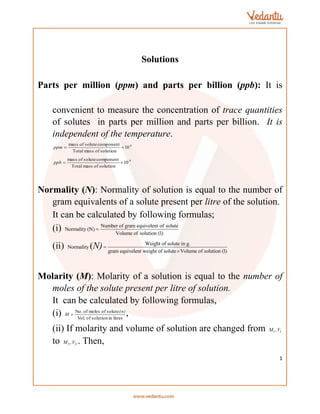
Parts per million (ppm) and parts per billion (ppb): It is
convenient to measure the concentration of trace quantities
of solutes in parts per million and parts per billion. It is
independent of the temperature.
6
10
solution
of
mass
Total
component
solute
of
mass


ppm
9
10
solution
of
mass
Total
component
solute
of
mass


ppb
Normality (N): Normality of solution is equal to the number of
gram equivalents of a solute present per litre of the solution.
It can be calculated by following formulas;
(i) Number of gram equivelent of solute
Normality (N)
Volume of solution (l)

(ii) Normality (N) Weight of solute in g.
gram equivelent weight of solute Volume of solution (l)


Molarity (M): Molarity of a solution is equal to the number of
moles of the solute present per litre of solution.
It can be calculated by following formulas,
(i) litres
in
solution
of
Vol.
solute
of
moles
of
No. (n)
M  ,
(ii) If molarity and volume of solution are changed from 1
1,V
M
to 2
2 ,V
M . Then,
2
2
2
1
1 V
M
V
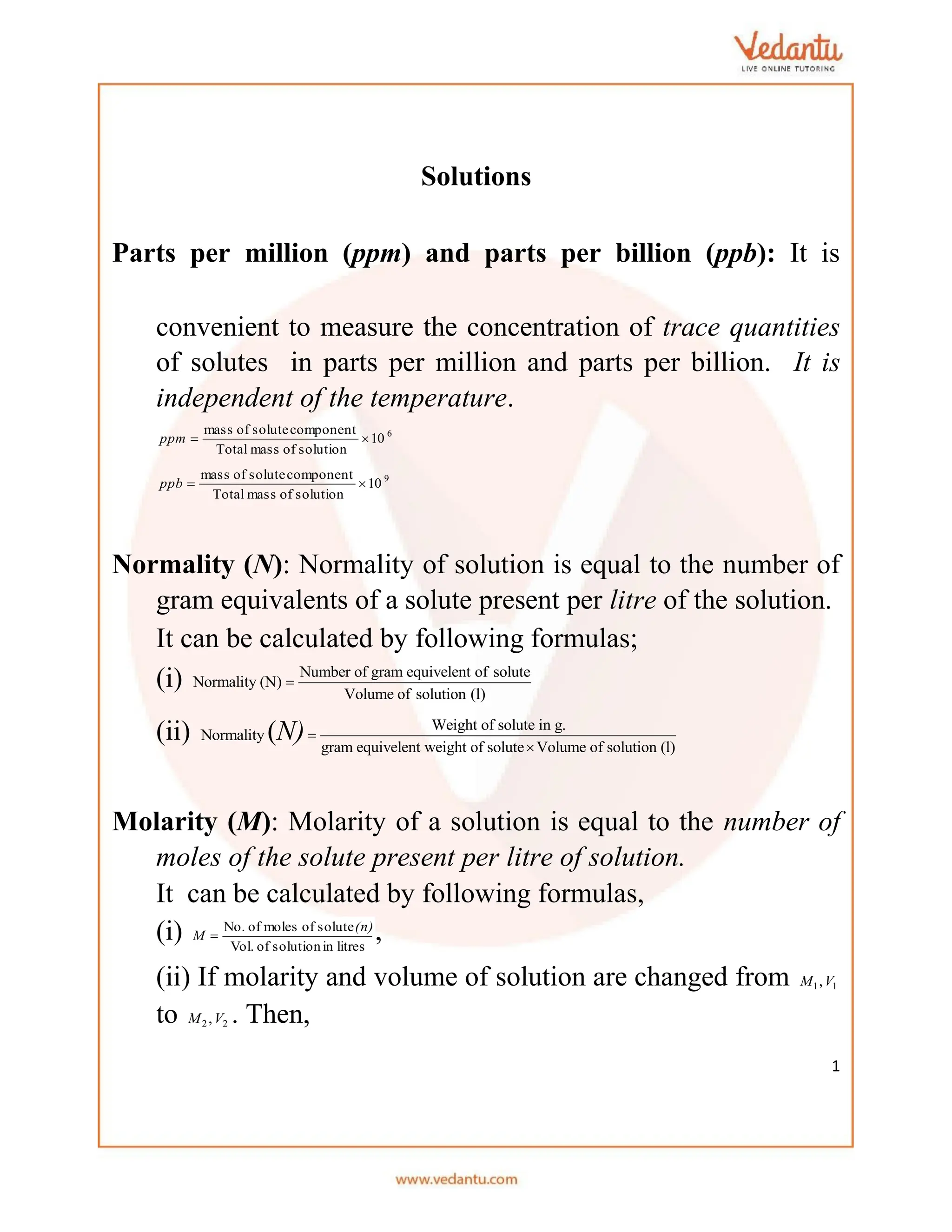
M  (Molarity equation)
(ii) In balanced chemical equation, if 1
n moles of reactant one
react with 2
n moles of reactant two. Then,
2
2
2
1
1
1
n
V
M
n
V
M

(iii) Volume of water added to get a solution of molarity 2
M
from ml
V1 of molarity 1
M is
1
2
2
1
1
2 V
M
M
M
V
V 






 


(iv) If two solutions of the same solute are mixed then
molarity (M) of resulting solution.
)
( 2
1
2
2
1
1
V
V
V
M
V
M
M



Here,
1 1
M V are molarity and volume of initial solution and 2 2
M V are
molarity and volume of final solution.
Relation between molarity and normality
Normality of solution = molarity mass
Equivalent
mass
Molecular

Normality  equivalent mass = molarity  molecular mass
3
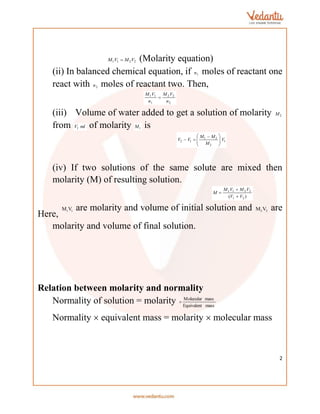
Molality (m) : Mathematically molality can be calculated by
following formulas,
(i) 1000
grams
in
solvent
of the
Weight
solute
of the
moles
of
Number


m
(ii) m solute
of
mass
Molecular
solvent
of
grams
1000
per
Strength

Relation between molarity (M) and molality (m)
Molality (m) =
1000
mass
molecular
Molarity
Density
Molarity


Formality (F) : Formality of a solution may be defined as the
number of gram formula masses of the ionic solute dissolved
per litre of the solution. It is represented by F .
Formality (F)= litres
in
solution
of
Volume
solute
of
masses
formula
gram
of
Number
Mole fraction (X): To find the mole fraction, divide moles of a
constituent( either solute or solvent) by the total moles of both
the constituents (solute and solvent).It is denoted by the letter
X .
Let in a solution A is solute and B is solvent, then their mole
fractions are given below;
Mole fraction of SoluteA ,
B
A
A
A
n
n
n
X


4
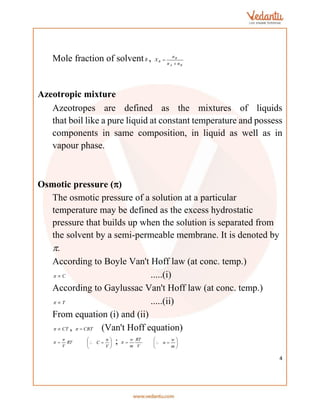
Mole fraction of solventB ,
B
A
B
B
n
n
n
X


Azeotropic mixture
Azeotropes are defined as the mixtures of liquids
that boil like a pure liquid at constant temperature and possess
components in same composition, in liquid as well as in
vapour phase.
Osmotic pressure ()
The osmotic pressure of a solution at a particular
temperature may be defined as the excess hydrostatic
pressure that builds up when the solution is separated from
the solvent by a semi-permeable membrane. It is denoted by
.
According to Boyle Van't Hoff law (at conc. temp.)
C

 .....(i)
According to Gaylussac Van't Hoff law (at conc. temp.)
T

 .....(ii)
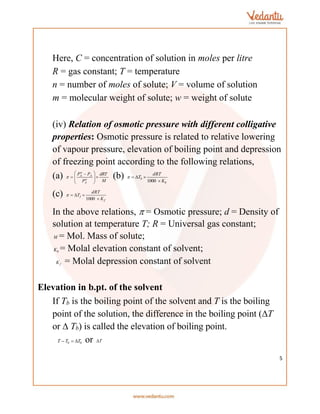
From equation (i) and (ii)
CT

 , CRT

 (Van't Hoff equation)
RT
V
n

 







V
n
C ; V
RT
m
w

 







m
w
n
5
Here, C = concentration of solution in moles per litre
R = gas constant; T = temperature
n = number of moles of solute; V = volume of solution
m = molecular weight of solute; w = weight of solute
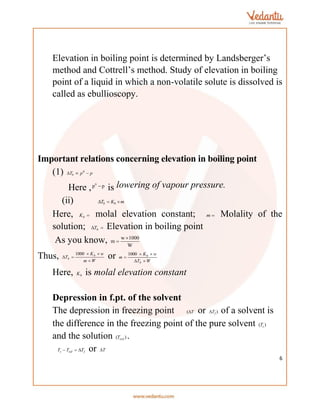
(iv) Relation of osmotic pressure with different colligative
properties: Osmotic pressure is related to relative lowering
of vapour pressure, elevation of boiling point and depression
of freezing point according to the following relations,
(a) M
dRT
P
P
P
o
A
A
o
A








 

 (b)
b
b
K
dRT
T




1000

(c)
f
f
K
dRT
T




1000

In the above relations,  = Osmotic pressure; d = Density of
solution at temperature T; R = Universal gas constant;
M = Mol. Mass of solute;
b
K = Molal elevation constant of solvent;
f
K = Molal depression constant of solvent
Elevation in b.pt. of the solvent
If Tb is the boiling point of the solvent and T is the boiling
point of the solution, the difference in the boiling point (T
or  Tb) is called the elevation of boiling point.
b
b T
T
T 

 or T

6
Elevation in boiling point is determined by Landsberger’s
method and Cottrell’s method. Study of elevation in boiling
point of a liquid in which a non-volatile solute is dissolved is
called as ebullioscopy.
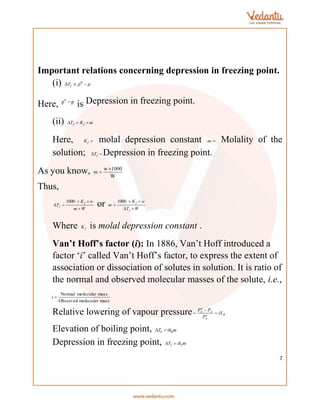
Important relations concerning elevation in boiling point
(1) p
p
Tb 

 0
Here ,
0
p p

is lowering of vapour pressure.
(ii) m
K
T b
b 


Here, 
b
K molal elevation constant; 
m Molality of the
solution; 
 b
T Elevation in boiling point
As you know, w 1000
m
W


Thus, W
m
w
K
T b
b





1000
or W
T
w
K
m
b
b





1000
Here, b
K is molal elevation constant
Depression in f.pt. of the solvent
The depression in freezing point T

( or )
f
T
 of a solvent is
the difference in the freezing point of the pure solvent )
( s
T
and the solution )
( .
sol
T .
f
sol
s T
T
T 

 or T

7
Important relations concerning depression in freezing point.
(i) p
p
Tf 

 0
Here,
0
p p

is Depression in freezing point.
(ii) m
K
T f
f 


Here, 
f
K molal depression constant 
m Molality of the
solution; 
 f
T Depression in freezing point.
As you know, w 1000
m
W


Thus,
W
m
w
K
T
f
f





1000
or W
T
w
K
m
f
f





1000
Where f
K is molal depression constant .
Van’t Hoff’s factor (i): In 1886, Van’t Hoff introduced a
factor ‘i’ called Van’t Hoff’s factor, to express the extent of
association or dissociation of solutes in solution. It is ratio of
the normal and observed molecular masses of the solute, i.e.,
mass
molecular
Observed
mass
molecular
Normal

i
Relative lowering of vapour pressure B
o
A
A
o
A
iX
P
P
P



Elevation of boiling point, m
ik
T b
b 

Depression in freezing point, m
ik
T f
f 

8
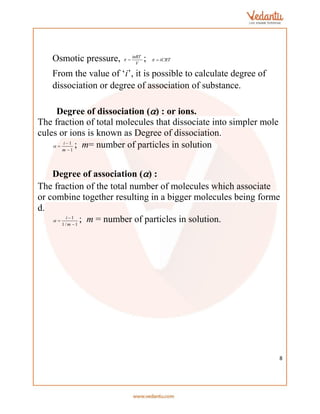
Osmotic pressure, V
inRT

 ; iCRT


From the value of ‘i’, it is possible to calculate degree of
dissociation or degree of association of substance.
Degree of dissociation () : or ions.
The fraction of total molecules that dissociate into simpler mole
cules or ions is known as Degree of dissociation.
1
1



m
i
 ; m= number of particles in solution
Degree of association () :
The fraction of the total number of molecules which associate
or combine together resulting in a bigger molecules being forme
d.
1
/
1
1



m
i
 ; m = number of particles in solution.

Notes on Biochemical Calculations-Molarity,Normality,ppm.pdf

  • 1.
    1 Solutions Parts per million(ppm) and parts per billion (ppb): It is convenient to measure the concentration of trace quantities of solutes in parts per million and parts per billion. It is independent of the temperature. 6 10 solution of mass Total component solute of mass   ppm 9 10 solution of mass Total component solute of mass   ppb Normality (N): Normality of solution is equal to the number of gram equivalents of a solute present per litre of the solution. It can be calculated by following formulas; (i) Number of gram equivelent of solute Normality (N) Volume of solution (l)  (ii) Normality (N) Weight of solute in g. gram equivelent weight of solute Volume of solution (l)   Molarity (M): Molarity of a solution is equal to the number of moles of the solute present per litre of solution. It can be calculated by following formulas, (i) litres in solution of Vol. solute of moles of No. (n) M  , (ii) If molarity and volume of solution are changed from 1 1,V M to 2 2 ,V M . Then,
  • 2.
    2 2 2 1 1 V M V M (Molarity equation) (ii) In balanced chemical equation, if 1 n moles of reactant one react with 2 n moles of reactant two. Then, 2 2 2 1 1 1 n V M n V M  (iii) Volume of water added to get a solution of molarity 2 M from ml V1 of molarity 1 M is 1 2 2 1 1 2 V M M M V V            (iv) If two solutions of the same solute are mixed then molarity (M) of resulting solution. ) ( 2 1 2 2 1 1 V V V M V M M    Here, 1 1 M V are molarity and volume of initial solution and 2 2 M V are molarity and volume of final solution. Relation between molarity and normality Normality of solution = molarity mass Equivalent mass Molecular  Normality  equivalent mass = molarity  molecular mass
  • 3.
    3 Molality (m) :Mathematically molality can be calculated by following formulas, (i) 1000 grams in solvent of the Weight solute of the moles of Number   m (ii) m solute of mass Molecular solvent of grams 1000 per Strength  Relation between molarity (M) and molality (m) Molality (m) = 1000 mass molecular Molarity Density Molarity   Formality (F) : Formality of a solution may be defined as the number of gram formula masses of the ionic solute dissolved per litre of the solution. It is represented by F . Formality (F)= litres in solution of Volume solute of masses formula gram of Number Mole fraction (X): To find the mole fraction, divide moles of a constituent( either solute or solvent) by the total moles of both the constituents (solute and solvent).It is denoted by the letter X . Let in a solution A is solute and B is solvent, then their mole fractions are given below; Mole fraction of SoluteA , B A A A n n n X  
  • 4.
    4 Mole fraction ofsolventB , B A B B n n n X   Azeotropic mixture Azeotropes are defined as the mixtures of liquids that boil like a pure liquid at constant temperature and possess components in same composition, in liquid as well as in vapour phase. Osmotic pressure () The osmotic pressure of a solution at a particular temperature may be defined as the excess hydrostatic pressure that builds up when the solution is separated from the solvent by a semi-permeable membrane. It is denoted by . According to Boyle Van't Hoff law (at conc. temp.) C   .....(i) According to Gaylussac Van't Hoff law (at conc. temp.) T   .....(ii) From equation (i) and (ii) CT   , CRT   (Van't Hoff equation) RT V n           V n C ; V RT m w           m w n
  • 5.
    5 Here, C =concentration of solution in moles per litre R = gas constant; T = temperature n = number of moles of solute; V = volume of solution m = molecular weight of solute; w = weight of solute (iv) Relation of osmotic pressure with different colligative properties: Osmotic pressure is related to relative lowering of vapour pressure, elevation of boiling point and depression of freezing point according to the following relations, (a) M dRT P P P o A A o A             (b) b b K dRT T     1000  (c) f f K dRT T     1000  In the above relations,  = Osmotic pressure; d = Density of solution at temperature T; R = Universal gas constant; M = Mol. Mass of solute; b K = Molal elevation constant of solvent; f K = Molal depression constant of solvent Elevation in b.pt. of the solvent If Tb is the boiling point of the solvent and T is the boiling point of the solution, the difference in the boiling point (T or  Tb) is called the elevation of boiling point. b b T T T    or T 
  • 6.
    6 Elevation in boilingpoint is determined by Landsberger’s method and Cottrell’s method. Study of elevation in boiling point of a liquid in which a non-volatile solute is dissolved is called as ebullioscopy. Important relations concerning elevation in boiling point (1) p p Tb    0 Here , 0 p p  is lowering of vapour pressure. (ii) m K T b b    Here,  b K molal elevation constant;  m Molality of the solution;   b T Elevation in boiling point As you know, w 1000 m W   Thus, W m w K T b b      1000 or W T w K m b b      1000 Here, b K is molal elevation constant Depression in f.pt. of the solvent The depression in freezing point T  ( or ) f T  of a solvent is the difference in the freezing point of the pure solvent ) ( s T and the solution ) ( . sol T . f sol s T T T    or T 
  • 7.
    7 Important relations concerningdepression in freezing point. (i) p p Tf    0 Here, 0 p p  is Depression in freezing point. (ii) m K T f f    Here,  f K molal depression constant  m Molality of the solution;   f T Depression in freezing point. As you know, w 1000 m W   Thus, W m w K T f f      1000 or W T w K m f f      1000 Where f K is molal depression constant . Van’t Hoff’s factor (i): In 1886, Van’t Hoff introduced a factor ‘i’ called Van’t Hoff’s factor, to express the extent of association or dissociation of solutes in solution. It is ratio of the normal and observed molecular masses of the solute, i.e., mass molecular Observed mass molecular Normal  i Relative lowering of vapour pressure B o A A o A iX P P P    Elevation of boiling point, m ik T b b   Depression in freezing point, m ik T f f  
  • 8.
    8 Osmotic pressure, V inRT  ; iCRT   From the value of ‘i’, it is possible to calculate degree of dissociation or degree of association of substance. Degree of dissociation () : or ions. The fraction of total molecules that dissociate into simpler mole cules or ions is known as Degree of dissociation. 1 1    m i  ; m= number of particles in solution Degree of association () : The fraction of the total number of molecules which associate or combine together resulting in a bigger molecules being forme d. 1 / 1 1    m i  ; m = number of particles in solution.