INTELLECTUAL PROPERTY
RIGHTS
(IPR)
Dr.K.SABINA
INNOVATION AMBASSADOR
PSVASC
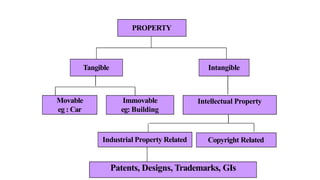
PROPERTY
Tangible Intangible
Movable
eg : Car
Immovable
eg: Building
Intellectual Property
Patents, Designs, Trademarks, GIs
Industrial Property Related Copyright Related
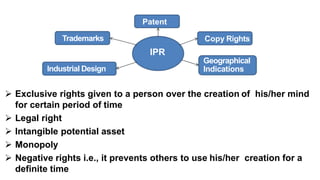
IPR
Patent
s
Copy Rights
Geographical
Indications
Industrial Design
Trademarks
 Exclusive rights given to a person over the creation of his/her mind
for certain period of time
 Legal right
 Intangible potential asset
 Monopoly
 Negative rights i.e., it prevents others to use his/her creation for a
definite time
• INTELLECTUAL PROPERTY RIGHTS (IPRs)
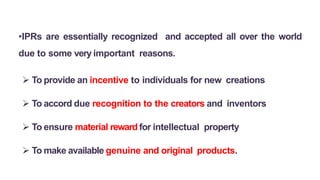
•IPRs are essentially recognized and accepted all over the world
due to some very important reasons.
 To provide an incentive to individuals for new creations
 To accord due recognition to the creators and inventors
 To ensure material reward for intellectual property
 To make available genuine and original products.
Patents
 Inventions (Products, Processes, Materials, Compositions)
 It is the exclusive right of inventor to prevent others from possessing,
using, selling, manufacturing and importing the patented invention or
offering to do any of these with in a definite geographical area.
 Patents have territorial jurisdiction
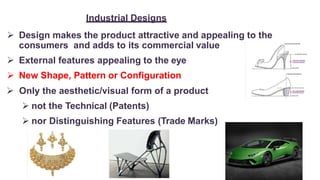
Industrial Designs
 Design makes the product attractive and appealing to the
consumers and adds to its commercial value
 External features appealing to the eye
 New Shape, Pattern or Configuration
 Only the aesthetic/visual form of a product
 not the Technical (Patents)
 nor Distinguishing Features (Trade Marks)
 Generally “Brand”
or “Logo”
 A visual symbol
such as a Word,
Name, Logo, Label,
Monogram, Slogan
etc.
 Applied on Article of
Manufacture or Service
 Indicates the origin of
goods and services
Trade Marks
Copyrigh
t
 Copyright is alegal term describing rights given to creators for their
literary and artistic works
 The workscovered byCopyright include :
 literary works such asnovels, poems, plays, reference works,
newspapers and articles
 computer programs and databases
 films, musical compositions, dance & theatrical productions
 artistic workssuch aspaintings, drawings, photographs and
sculptures
 architecture, advertisements, maps, technical drawings and manuals.
GEOGRAPHICAL INDICATIONS
 Identifies agricultural, natural or manufactured goods
associated with a territory/region/locality.
 Gives protection to the group of people or associations
involved in the production of the product using traditional
skills and knowledge
 It consists of the name of the place of origin
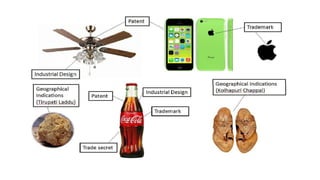
 Darjeeling Tea, Kancheepuram Saree, Kolhapuri Chappals,
Tirupati Laddu, Nagpur Orange etc.
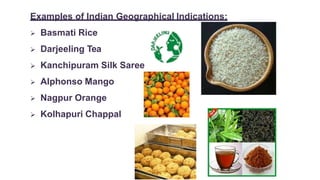
Examples of Indian Geographical Indications:
 Basmati Rice
 Darjeeling Tea
 Kanchipuram Silk Saree
 Alphonso Mango
 Nagpur Orange
 Kolhapuri Chappal
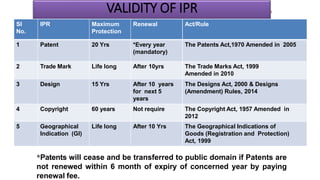
VALIDITY OF IPR
SI
No.
IPR Maximum
Protection
Renewal Act/Rule
1 Patent 20 Yrs *Every year
(mandatory)
The Patents Act,1970 Amended in 2005
2 Trade Mark Life long After 10yrs The Trade Marks Act, 1999
Amended in 2010
3 Design 15 Yrs After 10 years
for next 5
years
The Designs Act, 2000 & Designs
(Amendment) Rules, 2014
4 Copyright 60 years Not require The Copyright Act, 1957 Amended in
2012
5 Geographical
Indication (GI)
Life long After 10 Yrs The Geographical Indications of
Goods (Registration and Protection)
Act, 1999
*Patents will cease and be transferred to public domain if Patents are
not renewed within 6 month of expiry of concerned year by paying
renewal fee.
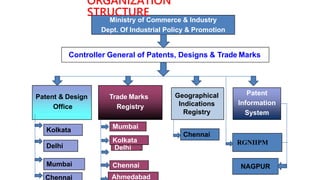
Ministry of Commerce & Industry
Dept. Of Industrial Policy & Promotion
Controller General of Patents, Designs & Trade Marks
ORGANIZATION
STRUCTURE
Patent & Design
Office
Trade Marks
Registry
Geographical
Indications
Registry
Patent
Information
System
Kolkata
Delhi
Mumbai
Chennai
Delhi
Mumbai
Chennai
Kolkata
Ahmedabad
Chennai
RGNIIPM
NAGPUR
THANK YOU!!!

INTELLECTUAL PROPERTY RIGHTS.pptx

  • 1.
  • 2.
    PROPERTY Tangible Intangible Movable eg :Car Immovable eg: Building Intellectual Property Patents, Designs, Trademarks, GIs Industrial Property Related Copyright Related
  • 3.
    IPR Patent s Copy Rights Geographical Indications Industrial Design Trademarks Exclusive rights given to a person over the creation of his/her mind for certain period of time  Legal right  Intangible potential asset  Monopoly  Negative rights i.e., it prevents others to use his/her creation for a definite time
  • 4.
    • INTELLECTUAL PROPERTYRIGHTS (IPRs) •IPRs are essentially recognized and accepted all over the world due to some very important reasons.  To provide an incentive to individuals for new creations  To accord due recognition to the creators and inventors  To ensure material reward for intellectual property  To make available genuine and original products.
  • 5.
    Patents  Inventions (Products,Processes, Materials, Compositions)  It is the exclusive right of inventor to prevent others from possessing, using, selling, manufacturing and importing the patented invention or offering to do any of these with in a definite geographical area.  Patents have territorial jurisdiction
  • 6.
    Industrial Designs  Designmakes the product attractive and appealing to the consumers and adds to its commercial value  External features appealing to the eye  New Shape, Pattern or Configuration  Only the aesthetic/visual form of a product  not the Technical (Patents)  nor Distinguishing Features (Trade Marks)
  • 7.
     Generally “Brand” or“Logo”  A visual symbol such as a Word, Name, Logo, Label, Monogram, Slogan etc.  Applied on Article of Manufacture or Service  Indicates the origin of goods and services Trade Marks
  • 8.
    Copyrigh t  Copyright isalegal term describing rights given to creators for their literary and artistic works  The workscovered byCopyright include :  literary works such asnovels, poems, plays, reference works, newspapers and articles  computer programs and databases  films, musical compositions, dance & theatrical productions  artistic workssuch aspaintings, drawings, photographs and sculptures  architecture, advertisements, maps, technical drawings and manuals.
  • 9.
    GEOGRAPHICAL INDICATIONS  Identifiesagricultural, natural or manufactured goods associated with a territory/region/locality.  Gives protection to the group of people or associations involved in the production of the product using traditional skills and knowledge  It consists of the name of the place of origin  Darjeeling Tea, Kancheepuram Saree, Kolhapuri Chappals, Tirupati Laddu, Nagpur Orange etc.
  • 10.
    Examples of IndianGeographical Indications:  Basmati Rice  Darjeeling Tea  Kanchipuram Silk Saree  Alphonso Mango  Nagpur Orange  Kolhapuri Chappal
  • 11.
    VALIDITY OF IPR SI No. IPRMaximum Protection Renewal Act/Rule 1 Patent 20 Yrs *Every year (mandatory) The Patents Act,1970 Amended in 2005 2 Trade Mark Life long After 10yrs The Trade Marks Act, 1999 Amended in 2010 3 Design 15 Yrs After 10 years for next 5 years The Designs Act, 2000 & Designs (Amendment) Rules, 2014 4 Copyright 60 years Not require The Copyright Act, 1957 Amended in 2012 5 Geographical Indication (GI) Life long After 10 Yrs The Geographical Indications of Goods (Registration and Protection) Act, 1999 *Patents will cease and be transferred to public domain if Patents are not renewed within 6 month of expiry of concerned year by paying renewal fee.
  • 12.
    Ministry of Commerce& Industry Dept. Of Industrial Policy & Promotion Controller General of Patents, Designs & Trade Marks ORGANIZATION STRUCTURE Patent & Design Office Trade Marks Registry Geographical Indications Registry Patent Information System Kolkata Delhi Mumbai Chennai Delhi Mumbai Chennai Kolkata Ahmedabad Chennai RGNIIPM NAGPUR
  • 14.