Batch, Fed-Batch and
Continuous Fermentation
Dr. Dhanya KC
Assistant Professor, Department of Microbiology
St. Mary’s College, Thrissur-680020, Kerala
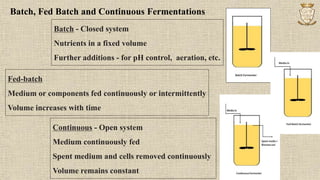
Batch, Fed Batch and Continuous Fermentations
Continuous - Open system
Medium continuously fed
Spent medium and cells removed continuously
Volume remains constant
Batch - Closed system
Nutrients in a fixed volume
Further additions - for pH control, aeration, etc.
Fed-batch
Medium or components fed continuously or intermittently
Volume increases with time
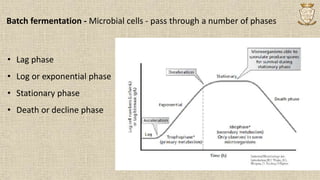
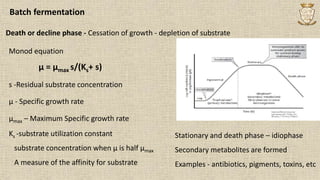
Batch fermentation - Microbial cells - pass through a number of phases
• Lag phase
• Log or exponential phase
• Stationary phase
• Death or decline phase
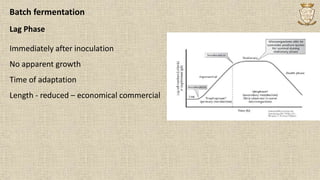
Lag Phase
Immediately after inoculation
No apparent growth
Time of adaptation
Length - reduced – economical commercial
Batch fermentation
Logarithmic or log or exponential phase
Lag and log phase - trophophase
Production of primary metabolites
Amino acids, nucleotides, vitamins, citric acid,
acetic acid, ethanol, etc.
Growth rate of cells increases - Constant, Maximum rate
dx/dt = µx
x - Concentration of microbial biomass
µ - Specific growth rate
t - Time in hours
Batch fermentation
Stationary Phase - Growth rate reduce
Due to substrate limitation and toxin limitation
Plot - biomass and initial substrate concentration
Growth in different concentrations of substrates
Initial increase in substrate - increase in biomass
x = Y(S-SR)
x - concentration of biomass
Y - yield factor (g biomass / substrate)
S - initial substrate concentration
SR - residual substrate concentration
Yield factor - efficiency of substrate conversion to biomass
Batch fermentation
Death or decline phase - Cessation of growth - depletion of substrate
Stationary and death phase – idiophase
Secondary metabolites are formed
Examples - antibiotics, pigments, toxins, etc
Monod equation
µ = µmax s/(Ks+ s)
s -Residual substrate concentration
Ks -substrate utilization constant
substrate concentration when µ is half µmax
A measure of the affinity for substrate
µ - Specific growth rate
µmax – Maximum Specific growth rate
Batch fermentation
Death or decline phase - Cessation of growth - depletion of substrate
Stationary and death phase – idiophase
Secondary metabolites are formed
Examples - antibiotics, pigments, toxins, etc
Monod equation
µ = µmax s/(Ks+ s)
s -Residual substrate concentration
Ks -substrate utilization constant
substrate concentration when µ is half µmax
A measure of the affinity for substrate
µ - Specific growth rate
µmax – Maximum Specific growth rate
Batch fermentation
Application of batch fermentation
Various growth conditions used for production of
Biomass - fastest growth rate and maximum population
1o metabolite - extend exponential phase
2o metabolite - short exponential phase and extended production phase
1. Filling fermenter with medium
2. Sterilization of fermenter and medium
3. Inoculation
4. Production phase
5. Harvesting
6. Cleaning of vessel
Disadvantages - High down time - non-productive period
Fed batch fermentation
• Established initially in batch mode
• Fed continuously or sequentially with medium
• Without removal of culture fluid
i) Same medium - increase in volume
ii) Limiting substrate - same concentration - increase in volume
iii) Limiting substrate - concentrated - increase in volume
iv) Limiting substrate – very concentrated - no increase in volume
i), ii) - variable volume fed batch system
iv) - fixed volume fed batch system
(iii) - intermediate between the variable and fixed volume systems
Continuous fermentation
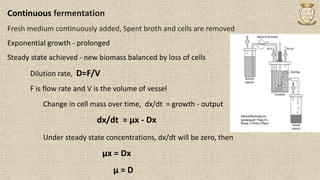
Fresh medium continuously added, Spent broth and cells are removed
Exponential growth - prolonged
Steady state achieved - new biomass balanced by loss of cells
Dilution rate, D=F/V
F is flow rate and V is the volume of vessel
Change in cell mass over time, dx/dt = growth - output
dx/dt = µx - Dx
Under steady state concentrations, dx/dt will be zero, then
µx = Dx
µ = D
Continuous fermentation
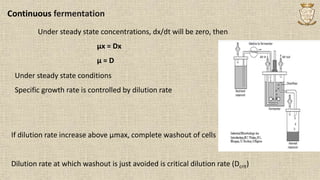
Under steady state conditions
Specific growth rate is controlled by dilution rate
Under steady state concentrations, dx/dt will be zero, then
µx = Dx
µ = D
If dilution rate increase above µmax, complete washout of cells
Dilution rate at which washout is just avoided is critical dilution rate (Dcrit)
Monod equation,
µ = µmax s/(Ks+s)
Chemostat - Substrate concentration is kept constant
Turbidostat- Biomass concentration is kept constant
At steady state, µ = D, so
D = µmax ŝ/(Ks+ŝ) ŝ - steady state concentration of substrate
ŝ = Ks D / (µmax - D)
Substrate concentration is influenced by dilution rate
Biomass depends upon substrate concentration and thereby on dilution rate
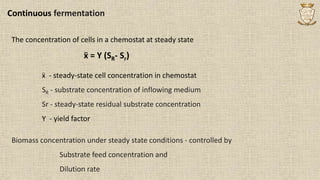
Continuous fermentation
The concentration of cells in a chemostat at steady state
ẍ = Y (SR- Sr)
ẍ - steady-state cell concentration in chemostat
SR - substrate concentration of inflowing medium
Sr - steady-state residual substrate concentration
Y - yield factor
Biomass concentration under steady state conditions - controlled by
Substrate feed concentration and
Dilution rate
Continuous fermentation
Advantages and disadvantages of continuous fermentation
Down time - much less - more economic
Easily automated - require less labour
Chances of contamination and strain deterioration – more
Control operations – complicated
Problems in licensing of product - can’t trace product consignment to raw material batch
References
1. Industrial Microbiology: An Introduction, M J. Waites, N L. Morgan, J S.
Rockey, G Higton
2. Principles of fermentation technology, PF Stanbury, A Whittakker, SJ Hall,
1995, Butterworth-Heinemann publications

Batch,Fed-batch&continuous fermentation.pdf

  • 1.
    Batch, Fed-Batch and ContinuousFermentation Dr. Dhanya KC Assistant Professor, Department of Microbiology St. Mary’s College, Thrissur-680020, Kerala
  • 2.
    Batch, Fed Batchand Continuous Fermentations Continuous - Open system Medium continuously fed Spent medium and cells removed continuously Volume remains constant Batch - Closed system Nutrients in a fixed volume Further additions - for pH control, aeration, etc. Fed-batch Medium or components fed continuously or intermittently Volume increases with time
  • 3.
    Batch fermentation -Microbial cells - pass through a number of phases • Lag phase • Log or exponential phase • Stationary phase • Death or decline phase
  • 4.
    Lag Phase Immediately afterinoculation No apparent growth Time of adaptation Length - reduced – economical commercial Batch fermentation
  • 5.
    Logarithmic or logor exponential phase Lag and log phase - trophophase Production of primary metabolites Amino acids, nucleotides, vitamins, citric acid, acetic acid, ethanol, etc. Growth rate of cells increases - Constant, Maximum rate dx/dt = µx x - Concentration of microbial biomass µ - Specific growth rate t - Time in hours Batch fermentation
  • 6.
    Stationary Phase -Growth rate reduce Due to substrate limitation and toxin limitation Plot - biomass and initial substrate concentration Growth in different concentrations of substrates Initial increase in substrate - increase in biomass x = Y(S-SR) x - concentration of biomass Y - yield factor (g biomass / substrate) S - initial substrate concentration SR - residual substrate concentration Yield factor - efficiency of substrate conversion to biomass Batch fermentation
  • 7.
    Death or declinephase - Cessation of growth - depletion of substrate Stationary and death phase – idiophase Secondary metabolites are formed Examples - antibiotics, pigments, toxins, etc Monod equation µ = µmax s/(Ks+ s) s -Residual substrate concentration Ks -substrate utilization constant substrate concentration when µ is half µmax A measure of the affinity for substrate µ - Specific growth rate µmax – Maximum Specific growth rate Batch fermentation
  • 8.
    Death or declinephase - Cessation of growth - depletion of substrate Stationary and death phase – idiophase Secondary metabolites are formed Examples - antibiotics, pigments, toxins, etc Monod equation µ = µmax s/(Ks+ s) s -Residual substrate concentration Ks -substrate utilization constant substrate concentration when µ is half µmax A measure of the affinity for substrate µ - Specific growth rate µmax – Maximum Specific growth rate Batch fermentation
  • 9.
    Application of batchfermentation Various growth conditions used for production of Biomass - fastest growth rate and maximum population 1o metabolite - extend exponential phase 2o metabolite - short exponential phase and extended production phase 1. Filling fermenter with medium 2. Sterilization of fermenter and medium 3. Inoculation 4. Production phase 5. Harvesting 6. Cleaning of vessel Disadvantages - High down time - non-productive period
  • 10.
    Fed batch fermentation •Established initially in batch mode • Fed continuously or sequentially with medium • Without removal of culture fluid i) Same medium - increase in volume ii) Limiting substrate - same concentration - increase in volume iii) Limiting substrate - concentrated - increase in volume iv) Limiting substrate – very concentrated - no increase in volume i), ii) - variable volume fed batch system iv) - fixed volume fed batch system (iii) - intermediate between the variable and fixed volume systems
  • 11.
    Continuous fermentation Fresh mediumcontinuously added, Spent broth and cells are removed Exponential growth - prolonged Steady state achieved - new biomass balanced by loss of cells Dilution rate, D=F/V F is flow rate and V is the volume of vessel Change in cell mass over time, dx/dt = growth - output dx/dt = µx - Dx Under steady state concentrations, dx/dt will be zero, then µx = Dx µ = D
  • 12.
    Continuous fermentation Under steadystate conditions Specific growth rate is controlled by dilution rate Under steady state concentrations, dx/dt will be zero, then µx = Dx µ = D If dilution rate increase above µmax, complete washout of cells Dilution rate at which washout is just avoided is critical dilution rate (Dcrit)
  • 13.
    Monod equation, µ =µmax s/(Ks+s) Chemostat - Substrate concentration is kept constant Turbidostat- Biomass concentration is kept constant At steady state, µ = D, so D = µmax ŝ/(Ks+ŝ) ŝ - steady state concentration of substrate ŝ = Ks D / (µmax - D) Substrate concentration is influenced by dilution rate Biomass depends upon substrate concentration and thereby on dilution rate Continuous fermentation
  • 14.
    The concentration ofcells in a chemostat at steady state ẍ = Y (SR- Sr) ẍ - steady-state cell concentration in chemostat SR - substrate concentration of inflowing medium Sr - steady-state residual substrate concentration Y - yield factor Biomass concentration under steady state conditions - controlled by Substrate feed concentration and Dilution rate Continuous fermentation
  • 15.
    Advantages and disadvantagesof continuous fermentation Down time - much less - more economic Easily automated - require less labour Chances of contamination and strain deterioration – more Control operations – complicated Problems in licensing of product - can’t trace product consignment to raw material batch
  • 16.
    References 1. Industrial Microbiology:An Introduction, M J. Waites, N L. Morgan, J S. Rockey, G Higton 2. Principles of fermentation technology, PF Stanbury, A Whittakker, SJ Hall, 1995, Butterworth-Heinemann publications