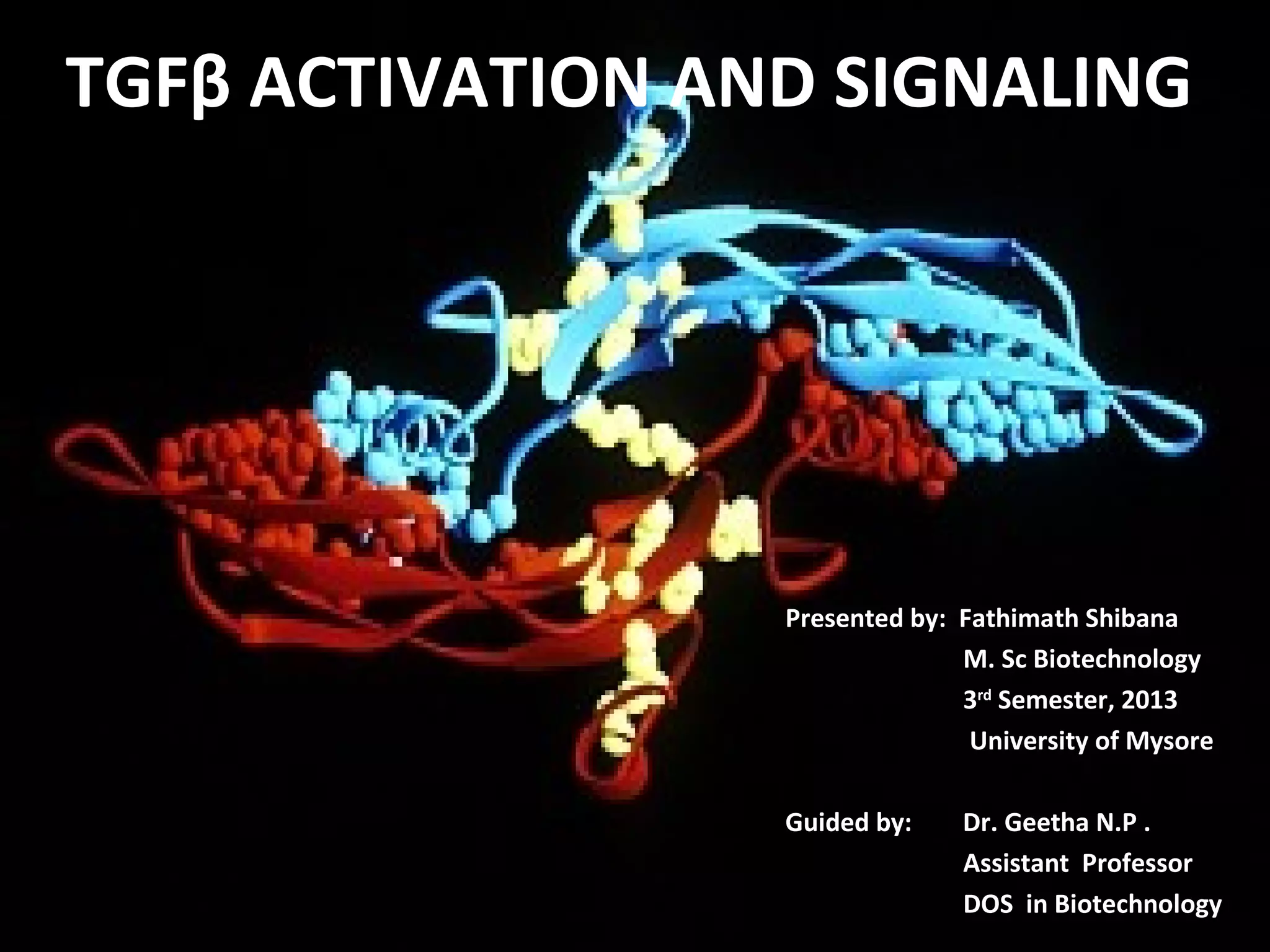
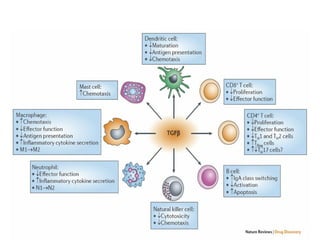
TGFβ ACTIVATION AND SIGNALING
Presented by: Fathimath Shibana
M. Sc Biotechnology
3rd
Semester, 2013
University of Mysore
Guided by: Dr. Geetha N.P .
Assistant Professor
DOS in Biotechnology
WHAT IS TGF?
• It is transforming growth factor or tumor growth factor.
• There are two types, TGF-α and TGF-β
• TGF-α is a single growth factor which is upregulated in some
human cancers. It is produced in macrophages, brain cells and
keratinocytes (basal cells in epidermis) and induces epithelial
development.
• TGF-β is a diverse family of growth factor. Many different
members and subfamilies are within it. TGF-β is a protein that
controls proliferation, cellular differentiation, and other functions
in most cells.
• It is a type of cytokine which plays a role in immunity, cancer,
bronchial asthma, heart disease, diabetes, Marfan syndrome, etc
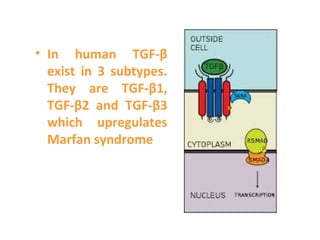
• In human TGF-β
exist in 3 subtypes.
They are TGF-β1,
TGF-β2 and TGF-β3
which upregulates
Marfan syndrome
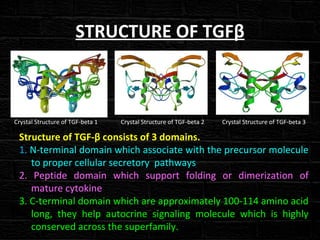
STRUCTURE OF TGFβ
Crystal Structure of TGF-beta 1 Crystal Structure of TGF-beta 2 Crystal Structure of TGF-beta 3
Structure of TGF-β consists of 3 domains.
1. N-terminal domain which associate with the precursor molecule
to proper cellular secretory pathways
2. Peptide domain which support folding or dimerization of
mature cytokine
3. C-terminal domain which are approximately 100-114 amino acid
long, they help autocrine signaling molecule which is highly
conserved across the superfamily.
TGFβ ACTIVATION
• Some currently known factors which activates TGF-β are
Protease, Integrins, PH and oxygen reactive species (ROS)
• Disruption of these activating factors can leads to
unregulated TGF-β signaling levels that may cause several
complications including inflammation, autoimmune
disorders, fibrosis, cancer and cataracts.
• In most cases activated TGF-β ligand will initiate TGF-β
signaling cascade as long as TGF receptors I and II are
within reach. This is due to high affinity between TGF-β
and its receptors.
TGFβ Activation continued.....
LATENT TGFβ COMPLEX
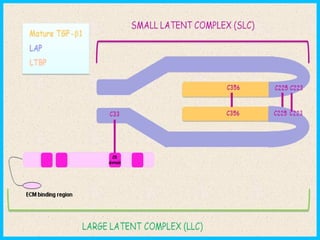
• TGF-β1, TGF-β2 and TGF-β3 are synthesized as Precursor
molecule which contains propeptide region in addition
to TGF-β homodimer.
• After synthesized TGF-β homodimer interact with
Latency Associated Peptide (LAP). [LAP is a protein
derived from N-terminal region of TGF-β gene product].
• Interaction of TGF-β homodimer with LAP forms Small
Latent Complex (SLC)
• This complex remains in cell unit is bounded by another
protein called Latent TGF-β Binding Protein (LTBP)
forming large complex called Large Latent Complex (LLC)
• It is LLC that get secreted to Extracellular Matrix (ECM)
TGFβ Activation continued.....
Latent TGFβ Complex continued.....
• In most cases before LLC is secreted, TGF-β precursor is
cleaved from propeptide but remains attached to it by
non-covalent bonds .
• After its secretion it remains in ECM as inactive complex
containing both LTBP and LAP which needs to be further
processed to release active TGF-β.
• The attachment of TGF-β to LTBT is by disulphide bond
which allow it to remain inactive by preventing it from
binding to its receptors.
• Because of different cellular mechanism require distinct
levels of TGF-β signaling, the inactive complex of this
cytokine gives opportunity for proper mediation of TGF-β
signaling.
INTEGRIN DEPENDENT TGFβ ACTIVATION
TGFβ Activation continued.....
1. ACTIVATION BY PROTEASE AND METALLOPROTEASE
• Plasmin and no. of Matrix Metalloprotease (MMP) play a key
role in promoting tumor invasion and tissue remodeling by
inducing proteolysis of several ECM components.
• TGF-β activation process involves release of LLC from matrix,
followed by proteolysis of LAP to release TGF-β to its receptors
• MMP9 and MMP2 are known to cleave TGF-β
• LAP complex contains protease sensitive hinge region which can
be target for liberation of TGF-β. Despite the fact that MMP
plays a key role in activating TGF-β, mice with mutation in
MMP9 and MMP2 gene can still activate TGF-β and do not show
any TGF-β deficiency phenotypes. It may be due to unknown
proteases.
TGFβ Activation continued.....
Integrin dependentTGFβ activation continued.....
2. ACTIVATION BY PH
• Acidic condition can denature the LAP.
• Treatment of medium with extremes of pH (1.5 or 12) result in
activation of TGF-β as shown by radio receptor assays.
• Mild acidic treatment (pH 4.5) yielded only 20-30% of the
competition achieved by pH 1.5
3. ACTIVATION BY REACTIVE OXYGEN SPECIES (ROS)
• LAP structure is important to maintain its function
• Structure modification of LAP leads to disturbing the interaction
between LAP and TGF-β and thus activates it.
• Factors that may cause this modification may include hydroxyl
radicals from ROS. TGF-β was rapidly activated after in vivo
radiation exposure ROS
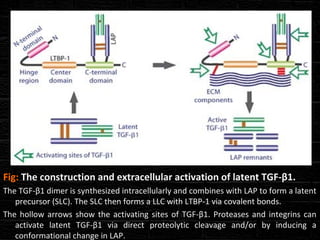
Fig: The construction and extracellular activation of latent TGF-β1.
The TGF-β1 dimer is synthesized intracellularly and combines with LAP to form a latent
precursor (SLC). The SLC then forms a LLC with LTBP-1 via covalent bonds.
The hollow arrows show the activating sites of TGF-β1. Proteases and integrins can
activate latent TGF-β1 via direct proteolytic cleavage and/or by inducing a
conformational change in LAP.
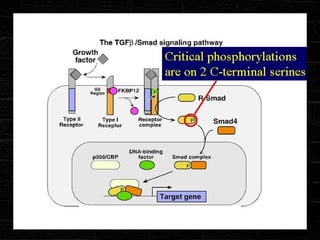
TGFβ SIGNALING PATHWAY
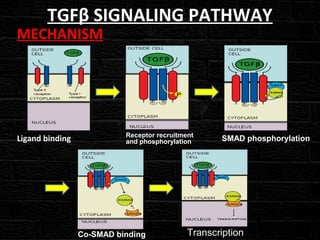
MECHANISM
Ligand binding Receptor recruitment
and phosphorylation SMAD phosphorylation
Co-SMAD binding Transcription
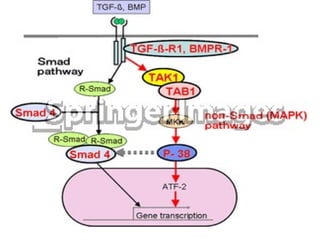
TGFβ SIGNALING PATHWAY
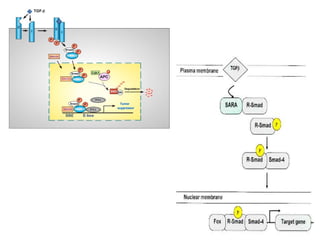
• TGF-β signaling pathway begins with a TGF-β dimer
binding to Type II TGF-β receptor at cell surface.
• TGF-β dimer induce formation of complex between type
II and type I TGF-β receptors, both of which are
transmembrane serine/threonine kinases.
• Once TGF-β dimer binds to type II receptor, type II
receptor phosphorelates and activates type I receptor.
• The activated type I receptor phosphorelates a receptor
regulated Smad (R-smad) which then dimerizes with a
Co-smad.
• The smad dimer translocates into the nucleus and with a
DNA binding partner activates transcription of target
genes.
BIBLIOGRAPHY
• http://en.wikipedia.org
• http://www.sinobiological.com/TGF-beta-Structure-and-
Function-a-5894.html
• http://maptest.rutgers.edu/drupal/?q=node/131
• http://www.karger.com/Article/FullText/338799
• http://jkweb.berkeley.edu/external/pdb/2001/tgf_beta_R1/sig
naling_schematic.jpg
• http://bcs.whfreeman.com/lodish5e/content/cat_010/14010-
01.htm?v=category&i=14010.01&s=00010&n=14000&o=00PRS
Tgfβ activation and signaling

Tgfβ activation and signaling

  • 1.
    TGFβ ACTIVATION ANDSIGNALING Presented by: Fathimath Shibana M. Sc Biotechnology 3rd Semester, 2013 University of Mysore Guided by: Dr. Geetha N.P . Assistant Professor DOS in Biotechnology
  • 2.
    WHAT IS TGF? •It is transforming growth factor or tumor growth factor. • There are two types, TGF-α and TGF-β • TGF-α is a single growth factor which is upregulated in some human cancers. It is produced in macrophages, brain cells and keratinocytes (basal cells in epidermis) and induces epithelial development. • TGF-β is a diverse family of growth factor. Many different members and subfamilies are within it. TGF-β is a protein that controls proliferation, cellular differentiation, and other functions in most cells. • It is a type of cytokine which plays a role in immunity, cancer, bronchial asthma, heart disease, diabetes, Marfan syndrome, etc
  • 3.
    • In humanTGF-β exist in 3 subtypes. They are TGF-β1, TGF-β2 and TGF-β3 which upregulates Marfan syndrome
  • 4.
    STRUCTURE OF TGFβ CrystalStructure of TGF-beta 1 Crystal Structure of TGF-beta 2 Crystal Structure of TGF-beta 3 Structure of TGF-β consists of 3 domains. 1. N-terminal domain which associate with the precursor molecule to proper cellular secretory pathways 2. Peptide domain which support folding or dimerization of mature cytokine 3. C-terminal domain which are approximately 100-114 amino acid long, they help autocrine signaling molecule which is highly conserved across the superfamily.
  • 5.
    TGFβ ACTIVATION • Somecurrently known factors which activates TGF-β are Protease, Integrins, PH and oxygen reactive species (ROS) • Disruption of these activating factors can leads to unregulated TGF-β signaling levels that may cause several complications including inflammation, autoimmune disorders, fibrosis, cancer and cataracts. • In most cases activated TGF-β ligand will initiate TGF-β signaling cascade as long as TGF receptors I and II are within reach. This is due to high affinity between TGF-β and its receptors.
  • 6.
    TGFβ Activation continued..... LATENTTGFβ COMPLEX • TGF-β1, TGF-β2 and TGF-β3 are synthesized as Precursor molecule which contains propeptide region in addition to TGF-β homodimer. • After synthesized TGF-β homodimer interact with Latency Associated Peptide (LAP). [LAP is a protein derived from N-terminal region of TGF-β gene product]. • Interaction of TGF-β homodimer with LAP forms Small Latent Complex (SLC) • This complex remains in cell unit is bounded by another protein called Latent TGF-β Binding Protein (LTBP) forming large complex called Large Latent Complex (LLC) • It is LLC that get secreted to Extracellular Matrix (ECM)
  • 8.
    TGFβ Activation continued..... LatentTGFβ Complex continued..... • In most cases before LLC is secreted, TGF-β precursor is cleaved from propeptide but remains attached to it by non-covalent bonds . • After its secretion it remains in ECM as inactive complex containing both LTBP and LAP which needs to be further processed to release active TGF-β. • The attachment of TGF-β to LTBT is by disulphide bond which allow it to remain inactive by preventing it from binding to its receptors. • Because of different cellular mechanism require distinct levels of TGF-β signaling, the inactive complex of this cytokine gives opportunity for proper mediation of TGF-β signaling.
  • 10.
    INTEGRIN DEPENDENT TGFβACTIVATION TGFβ Activation continued..... 1. ACTIVATION BY PROTEASE AND METALLOPROTEASE • Plasmin and no. of Matrix Metalloprotease (MMP) play a key role in promoting tumor invasion and tissue remodeling by inducing proteolysis of several ECM components. • TGF-β activation process involves release of LLC from matrix, followed by proteolysis of LAP to release TGF-β to its receptors • MMP9 and MMP2 are known to cleave TGF-β • LAP complex contains protease sensitive hinge region which can be target for liberation of TGF-β. Despite the fact that MMP plays a key role in activating TGF-β, mice with mutation in MMP9 and MMP2 gene can still activate TGF-β and do not show any TGF-β deficiency phenotypes. It may be due to unknown proteases.
  • 11.
    TGFβ Activation continued..... IntegrindependentTGFβ activation continued..... 2. ACTIVATION BY PH • Acidic condition can denature the LAP. • Treatment of medium with extremes of pH (1.5 or 12) result in activation of TGF-β as shown by radio receptor assays. • Mild acidic treatment (pH 4.5) yielded only 20-30% of the competition achieved by pH 1.5 3. ACTIVATION BY REACTIVE OXYGEN SPECIES (ROS) • LAP structure is important to maintain its function • Structure modification of LAP leads to disturbing the interaction between LAP and TGF-β and thus activates it. • Factors that may cause this modification may include hydroxyl radicals from ROS. TGF-β was rapidly activated after in vivo radiation exposure ROS
  • 12.
    Fig: The constructionand extracellular activation of latent TGF-β1. The TGF-β1 dimer is synthesized intracellularly and combines with LAP to form a latent precursor (SLC). The SLC then forms a LLC with LTBP-1 via covalent bonds. The hollow arrows show the activating sites of TGF-β1. Proteases and integrins can activate latent TGF-β1 via direct proteolytic cleavage and/or by inducing a conformational change in LAP.
  • 13.
    TGFβ SIGNALING PATHWAY MECHANISM Ligandbinding Receptor recruitment and phosphorylation SMAD phosphorylation Co-SMAD binding Transcription
  • 15.
    TGFβ SIGNALING PATHWAY •TGF-β signaling pathway begins with a TGF-β dimer binding to Type II TGF-β receptor at cell surface. • TGF-β dimer induce formation of complex between type II and type I TGF-β receptors, both of which are transmembrane serine/threonine kinases. • Once TGF-β dimer binds to type II receptor, type II receptor phosphorelates and activates type I receptor. • The activated type I receptor phosphorelates a receptor regulated Smad (R-smad) which then dimerizes with a Co-smad. • The smad dimer translocates into the nucleus and with a DNA binding partner activates transcription of target genes.
  • 19.
    BIBLIOGRAPHY • http://en.wikipedia.org • http://www.sinobiological.com/TGF-beta-Structure-and- Function-a-5894.html •http://maptest.rutgers.edu/drupal/?q=node/131 • http://www.karger.com/Article/FullText/338799 • http://jkweb.berkeley.edu/external/pdb/2001/tgf_beta_R1/sig naling_schematic.jpg • http://bcs.whfreeman.com/lodish5e/content/cat_010/14010- 01.htm?v=category&i=14010.01&s=00010&n=14000&o=00PRS