Cell-Cell Signaling
Inductive Interactions
Induction: proximate interactions
• Close range interactions
• Inducer
– Tissue doing the inducing
– Emits a signal
• Secreted peptides
• Cell associated proteins
• Responder
– Tissues/cells that receive the signal
– Change as a result of receiving signal
– Express receptor to interact with secreted signaling
molecule
Induction
• Competence
– The ability of a group of cells to respond to the
inducing signal
– Essentially means competent cells have
receptors and all necessary second messengers
necessary to respond appropriately to the signal
Types of Inductive Interactions
• Instructive interactions
– Signals cause a response
– Signals are required for the response
– A specific response is induced
– Ligand-receptor interactions setting off signal cascade
• Permissive interactions
– Signals allow a response
– Signals do not designate a specific response
– ECM allows differentiation
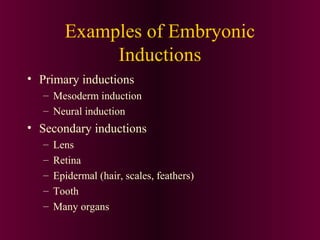
Examples of Embryonic
Inductions
• Primary inductions
– Mesoderm induction
– Neural induction
• Secondary inductions
– Lens
– Retina
– Epidermal (hair, scales, feathers)
– Tooth
– Many organs
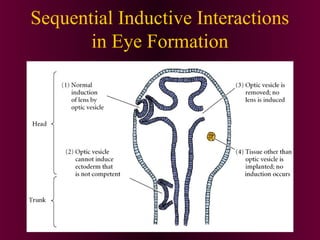
Sequential Inductive Interactions
in Eye Formation
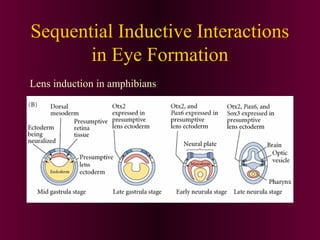
Sequential Inductive Interactions
in Eye Formation
Lens induction in amphibians
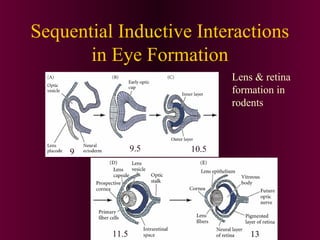
Sequential Inductive Interactions
in Eye Formation
Lens & retina
formation in
rodents
9 9.5 10.5
11.5 13
Epithelial-Mesenchymal
Interactions
• Epithelial cells
– Cells of epidermal or endodermal origin
– have distinct epithelial morphology
• Mesenchymal cells
– Cells of mesodermal origin
– Have a distinct mesenchymal morphology
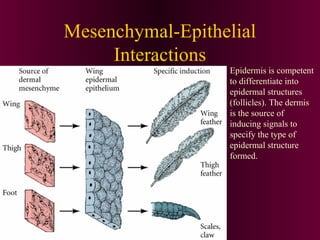
Mesenchymal-Epithelial
Interactions
Epidermis is competent
to differentiate into
epidermal structures
(follicles). The dermis
is the source of
inducing signals to
specify the type of
epidermal structure
formed.
Mesenchymal-Epithelial
Interactions
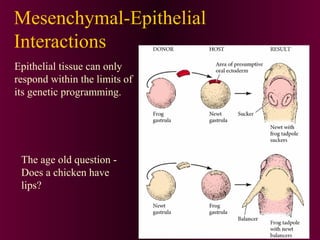
Epithelial tissue can only
respond within the limits of
its genetic programming.
The age old question -
Does a chicken have
lips?
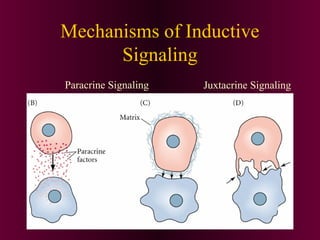
Mechanisms of Inductive
Signaling
• Paracrine signaling
– Secreted, diffusible signaling molecules
• Peptide growth factors (PGFs) or peptide inducing factors (PIFs)
• Not exactly the same as hormones – not secreted into bloodstream but
into intercellular space
• Signaling at a limited distance
• Juxtacrine signaling
– Non-soluble signaling molecules
• Integral or membrane associated proteins
• Signaling occurs at point of cell-cell contact
Mechanisms of Inductive
Signaling
Paracrine Signaling Juxtacrine Signaling
Secreted Signaling Molecules
• FGF Family
• Hedgehog Family
• Wnt Family
• TGFβ Superfamily
– TGFβ Family
– Activin Family
– BMP Family
• EGF Family
• PDGF Family
• Retinoids
• HGF/Scatter Factor
• Neurotrophins
• Semaphorins
• Cytokines
Receptors for Soluble Signaling Molecules
• Receptor Tyrosine Kinase
(RTK) pathway
– FGFR, EGFR, PDGFR
– Receptor coupled to ras signal
transduction cascade
• Smad pathway
– Bipartite Serine/Threonine
Kinase Receptors
– AcRI/II, TGFβRI/II, BMPRI/IIs
– Receptors activate Smad
transcription factors
• Wnt-β-catenin pathway
– Frizzled family of receptors
– Activation of pathway allows β-
catenin to enter nucleus
• JAK-STAT pathway
– Peptide hormone or cytokine
receptor coupled to a Jak
cytoplasmic tyrosine kinase
– Jaks activate STAT
transcription factors
• Hedgehog Pathway
– Patched and smoothened co-
receptors
– Activation of pathway
converts Ci txn’l repressor to
activator
• Steroids/Retinoids
– Nuclear/DNA binding
receptors
– Hormone permits entry into
nucleus, alters DNA binding
conformation, or allows
interaction with co-txn factors
Cell Associated Signaling
Molecules
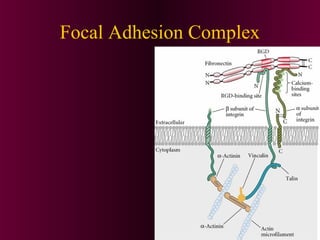
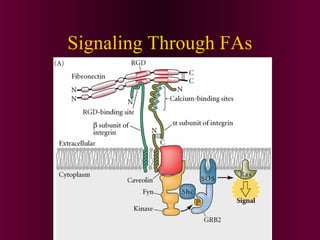
• ECM (ligand)
– Fibronectin
– Laminin
– Type IV collagen
• Integrins (receptor)
• CAMs (receptor)
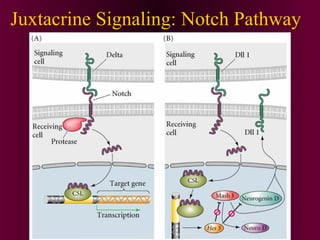
•Notch Family (receptor)
•Delta Family (ligand)
•Eph Family (receptor)
•Ephrin Family (ligand)
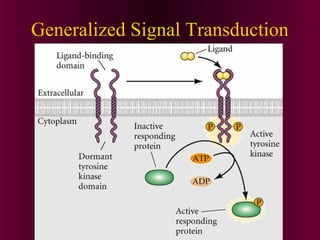
Generalized Signal Transduction
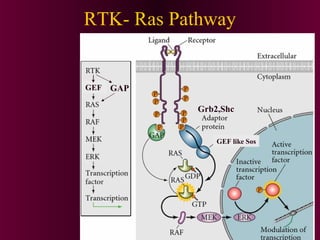
RTK- Ras Pathway
GAP
Grb2,Shc
GEF like Sos
GEF
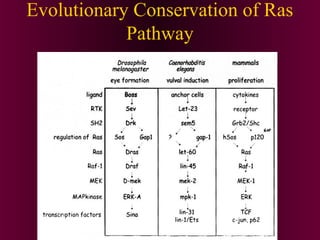
Evolutionary Conservation of Ras
Pathway
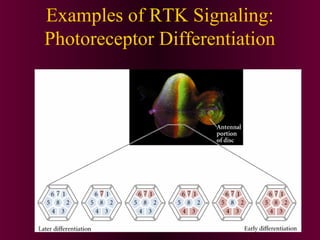
Examples of RTK Signaling:
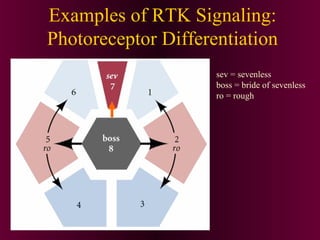
Photoreceptor Differentiation
Examples of RTK Signaling:
Photoreceptor Differentiation
sev = sevenless
boss = bride of sevenless
ro = rough
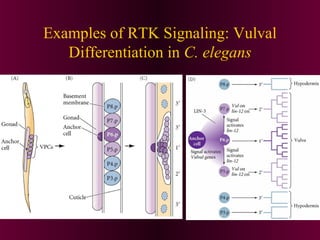
Examples of RTK Signaling: Vulval
Differentiation in C. elegans
Critical Mutations In RTK
Pathways
• Constitutively active receptors
• Dominant negative receptors
• Constitutively active Ras
• Faulty GEFs or GAPs
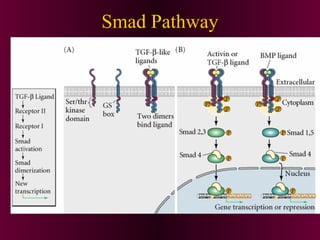
Smad Pathway
Smad Pathway
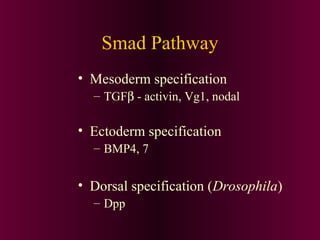
• Mesoderm specification
– TGFβ - activin, Vg1, nodal
• Ectoderm specification
– BMP4, 7
• Dorsal specification (Drosophila)
– Dpp
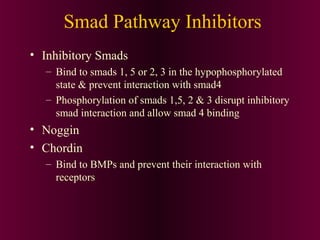
Smad Pathway Inhibitors
• Inhibitory Smads
– Bind to smads 1, 5 or 2, 3 in the hypophosphorylated
state & prevent interaction with smad4
– Phosphorylation of smads 1,5, 2 & 3 disrupt inhibitory
smad interaction and allow smad 4 binding
• Noggin
• Chordin
– Bind to BMPs and prevent their interaction with
receptors
Smad Pathway
A More Detailed Look
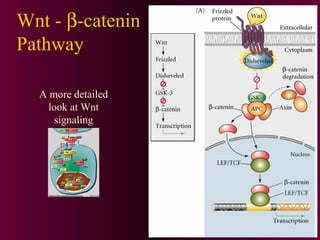
Wnt - β-catenin
Pathway
A more detailed
look at Wnt
signaling
• Wnt = Drosophila wingless (wg) +
mammalian int-1
∀β-catenin = armadillo
• Dorsal specification in Xenopus
• Segment polarity in Drosophila
Wnt - β-catenin Pathway
• Inhibitors of wnt signaling
– Frisbee
– Dickkopf
– Cerberus
• Look like extracellular portion of frizzled
• Bind to wnts and prevent their interaction
with frizzled
Wnt - β-catenin Pathway
Inhibitors
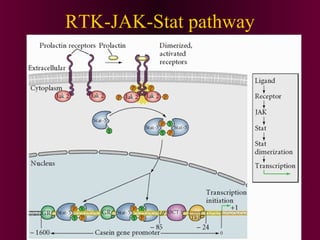
RTK-JAK-Stat pathway
JAK-Stat Pathway
• Cytokine receptors
– Interleukin, Interferon receptors
– Blood cell differentiation
• Chondrocyte differentiation
• Mammary epithelium
Juxtacrine Signaling: Notch Pathway
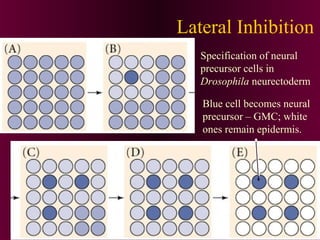
Lateral Inhibition
Specification of neural
precursor cells in
Drosophila neurectoderm
Blue cell becomes neural
precursor – GMC; white
ones remain epidermis.
Focal Adhesion Complex
Signaling Through FAs
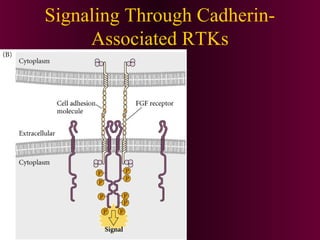
Signaling Through Cadherin-
Associated RTKs
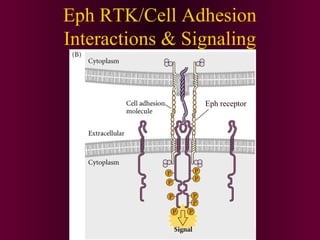
Eph RTK/Cell Adhesion
Interactions & Signaling
Eph receptor
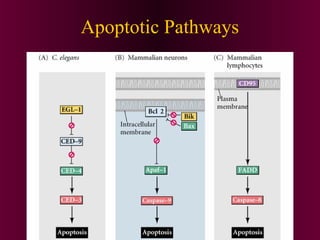
Apoptotic Pathways

Cell signaling

  • 1.
  • 2.
    Induction: proximate interactions •Close range interactions • Inducer – Tissue doing the inducing – Emits a signal • Secreted peptides • Cell associated proteins • Responder – Tissues/cells that receive the signal – Change as a result of receiving signal – Express receptor to interact with secreted signaling molecule
  • 3.
    Induction • Competence – Theability of a group of cells to respond to the inducing signal – Essentially means competent cells have receptors and all necessary second messengers necessary to respond appropriately to the signal
  • 4.
    Types of InductiveInteractions • Instructive interactions – Signals cause a response – Signals are required for the response – A specific response is induced – Ligand-receptor interactions setting off signal cascade • Permissive interactions – Signals allow a response – Signals do not designate a specific response – ECM allows differentiation
  • 5.
    Examples of Embryonic Inductions •Primary inductions – Mesoderm induction – Neural induction • Secondary inductions – Lens – Retina – Epidermal (hair, scales, feathers) – Tooth – Many organs
  • 6.
  • 7.
    Sequential Inductive Interactions inEye Formation Lens induction in amphibians
  • 8.
    Sequential Inductive Interactions inEye Formation Lens & retina formation in rodents 9 9.5 10.5 11.5 13
  • 9.
    Epithelial-Mesenchymal Interactions • Epithelial cells –Cells of epidermal or endodermal origin – have distinct epithelial morphology • Mesenchymal cells – Cells of mesodermal origin – Have a distinct mesenchymal morphology
  • 10.
    Mesenchymal-Epithelial Interactions Epidermis is competent todifferentiate into epidermal structures (follicles). The dermis is the source of inducing signals to specify the type of epidermal structure formed.
  • 11.
    Mesenchymal-Epithelial Interactions Epithelial tissue canonly respond within the limits of its genetic programming. The age old question - Does a chicken have lips?
  • 12.
    Mechanisms of Inductive Signaling •Paracrine signaling – Secreted, diffusible signaling molecules • Peptide growth factors (PGFs) or peptide inducing factors (PIFs) • Not exactly the same as hormones – not secreted into bloodstream but into intercellular space • Signaling at a limited distance • Juxtacrine signaling – Non-soluble signaling molecules • Integral or membrane associated proteins • Signaling occurs at point of cell-cell contact
  • 13.
    Mechanisms of Inductive Signaling ParacrineSignaling Juxtacrine Signaling
  • 14.
    Secreted Signaling Molecules •FGF Family • Hedgehog Family • Wnt Family • TGFβ Superfamily – TGFβ Family – Activin Family – BMP Family • EGF Family • PDGF Family • Retinoids • HGF/Scatter Factor • Neurotrophins • Semaphorins • Cytokines
  • 15.
    Receptors for SolubleSignaling Molecules • Receptor Tyrosine Kinase (RTK) pathway – FGFR, EGFR, PDGFR – Receptor coupled to ras signal transduction cascade • Smad pathway – Bipartite Serine/Threonine Kinase Receptors – AcRI/II, TGFβRI/II, BMPRI/IIs – Receptors activate Smad transcription factors • Wnt-β-catenin pathway – Frizzled family of receptors – Activation of pathway allows β- catenin to enter nucleus • JAK-STAT pathway – Peptide hormone or cytokine receptor coupled to a Jak cytoplasmic tyrosine kinase – Jaks activate STAT transcription factors • Hedgehog Pathway – Patched and smoothened co- receptors – Activation of pathway converts Ci txn’l repressor to activator • Steroids/Retinoids – Nuclear/DNA binding receptors – Hormone permits entry into nucleus, alters DNA binding conformation, or allows interaction with co-txn factors
  • 16.
    Cell Associated Signaling Molecules •ECM (ligand) – Fibronectin – Laminin – Type IV collagen • Integrins (receptor) • CAMs (receptor) •Notch Family (receptor) •Delta Family (ligand) •Eph Family (receptor) •Ephrin Family (ligand)
  • 17.
  • 18.
  • 19.
  • 20.
    Examples of RTKSignaling: Photoreceptor Differentiation
  • 21.
    Examples of RTKSignaling: Photoreceptor Differentiation sev = sevenless boss = bride of sevenless ro = rough
  • 22.
    Examples of RTKSignaling: Vulval Differentiation in C. elegans
  • 23.
    Critical Mutations InRTK Pathways • Constitutively active receptors • Dominant negative receptors • Constitutively active Ras • Faulty GEFs or GAPs
  • 24.
  • 25.
    Smad Pathway • Mesodermspecification – TGFβ - activin, Vg1, nodal • Ectoderm specification – BMP4, 7 • Dorsal specification (Drosophila) – Dpp
  • 26.
    Smad Pathway Inhibitors •Inhibitory Smads – Bind to smads 1, 5 or 2, 3 in the hypophosphorylated state & prevent interaction with smad4 – Phosphorylation of smads 1,5, 2 & 3 disrupt inhibitory smad interaction and allow smad 4 binding • Noggin • Chordin – Bind to BMPs and prevent their interaction with receptors
  • 27.
    Smad Pathway A MoreDetailed Look
  • 28.
    Wnt - β-catenin Pathway Amore detailed look at Wnt signaling
  • 29.
    • Wnt =Drosophila wingless (wg) + mammalian int-1 ∀β-catenin = armadillo • Dorsal specification in Xenopus • Segment polarity in Drosophila Wnt - β-catenin Pathway
  • 30.
    • Inhibitors ofwnt signaling – Frisbee – Dickkopf – Cerberus • Look like extracellular portion of frizzled • Bind to wnts and prevent their interaction with frizzled Wnt - β-catenin Pathway Inhibitors
  • 31.
  • 32.
    JAK-Stat Pathway • Cytokinereceptors – Interleukin, Interferon receptors – Blood cell differentiation • Chondrocyte differentiation • Mammary epithelium
  • 33.
  • 34.
    Lateral Inhibition Specification ofneural precursor cells in Drosophila neurectoderm Blue cell becomes neural precursor – GMC; white ones remain epidermis.
  • 35.
  • 36.
  • 37.
  • 38.
    Eph RTK/Cell Adhesion Interactions& Signaling Eph receptor
  • 39.