Non Violent Communication
A way of peaceful, honest,
heart-based communication
@jaumejornet
Thank you
Conscious Communication
A way of thinking
A manual for building harmonious
relationships
What I want in my life is compassion,
a flow between myself and others based
on a mutual giving from the heart.
- Marshall B. Rosenberg
Words are windows, or they’re
walls
“I feel so sentenced by your words,
I feel so judged and sent away,
Before I go I’ve got to know
Is that what you mean to say?
Before I rise to my defense,
Before I speak in hurt or fear,
Before I build that wall of words,
Tell me, did I really hear?
Words are windows, or they’re walls,
They sentence us, or set us free.
When I speak and when I hear,
Let the love light shine through me.
There are things I need to say,
Things that mean so much to me,
If my words don’t make me clear,
Will you help me to be free?
If I seemed to put you down,
If you felt I didn’t care,
Try to listen through my words
To the feelings that we share.”
—Ruth Bebermeyer
Communication
that blocks
Compassion
Moralistic judgements
Analysis of others are expressions
of our own needs and values
Making Comparisons
Comparisons are a form of
judgement
Denial of Responsability
We can replace language that
implies lack of choice with language
that acknowledges choice.
Vague, impersonal forces
“I cleaned my room because I had to.”
Our condition, diagnosis, personal or psychological history
“I drink because I am an alcoholic.”
The actions of others
“I hit my child because he ran into the street.”
The dictates of authority
“I lied to the client because the boss told me to.”
Group pressure
“I started smoking because all my friends did.”
Institutional policies, rules, and regulations
“I have to suspend you for this infraction because it’s the school policy.”
Gender roles, social roles, or age roles
“I hate going to work, but I do it because I am a husband and a father.”
Uncontrollable impulses
“I was overcome by my urge to eat the candy bar.”
The
NonViolent Communication
Process
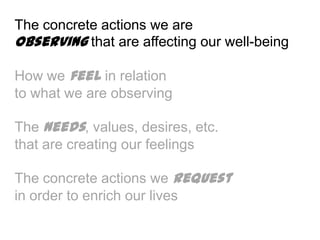
The concrete actions we are
observing that are affecting our well-being
How we feel in relation
to what we are observing
The needs, values, desires, etc.
that are creating our feelings
The concrete actions we request
in order to enrich our lives
Two parts of NVC
1. expressing honesty through
the four components
2. receiving empathically through
the four components
The concrete actions we are
observing that are affecting our well-being
How we feel in relation
to what we are observing
The needs, values, desires, etc.
that are creating our feelings
The concrete actions we request
in order to enrich our lives
Observing without evaluating
―Observing without evaluating is the
highest form of human intelligence.‖
– J. Krishnamurti
Observing without evaluating
Communication Example of observation with
evaluation mixed in
Example of observation separate
from evaluation
1. Use of verb to be without
indication that the evaluator
accepts responsibility for the
evaluation
You are too generous. When I see you give all your lunch money
to others I think you being too generous.
2. Use of verbs with evaluative
connotations
Doug procrastinates. Doug only studies for exams the night
before.
3. Implication that one’s inferences
about another person’s thoughts,
feelings, intentions, or desires are
the only ones possible
She won’t get her work in. I don’t think she’ll get her work in. or She
said, ―I won’t get my work in.‖
4. Confusion of prediction with
certainty
If you don’t eat balanced meals, your health
will be impaired.
If you don’t eat balanced meals, I fear that
your health may be impaired.
5. Failure to be specific about
referents
Minorities don’t take care of their property. I have not seen the minority family living at
1679 Ross shovel the snow on their
sidewalk.
6. Use of words denoting ability
without indicating that an
evaluation is being made
Hank Smith is a poor soccer player. Hank Smith has not scored a goal in 20
games.
7. Use of adverb and adjectives in
ways that do not signify an
evaluation has been made
Jim is ugly. Jim’s looks don’t appeal to me.
The concrete actions we are
observing that are affecting our well-being
How we feel in relation
to what we are observing
The needs, values, desires, etc.
that are creating our feelings
The concrete actions we request
in order to enrich our lives
Identifying and Expressing
Feelings
Feelings vs Non-Feelings
―I feel that you should know better.‖
―I feel like a failure.‖
―I feel as if I’m living with a wall.‖
―I feel I am constantly on call.‖
―I feel it is useless.‖
―I feel Amy has been pretty responsible.‖
―I feel my boss is being manipulative.‖
―I think feel that you should know better.‖
―I think feel like a failure.‖
―I think feel as if I’m living with a wall.‖
―I think feel I am constantly on call.‖
―I think feel it is useless.‖
―I think feel Amy has been pretty responsible.‖
―I think feel my boss is being manipulative.‖
The concrete actions we are
observing that are affecting our well-being
How we feel in relation
to what we are observing
The needs, values, desires, etc.
that are creating our feelings
The concrete actions we request
in order to enrich our lives
Taking responsibility of our
feelings
What others do may be the stimulus
of our feelings, but not the cause
We experience positive feelings
when our needs are meet, and
negative feelings when our needs
are not met
Four options for receiving messages
Blaming ourselves
Blaming others
Sensing our own feelings and needs
Sensing others’ feelings and needs
The concrete actions we are
observing that are affecting our well-being
How we feel in relation
to what we are observing
The needs, values, desires, etc.
that are creating our feelings
The concrete actions we request
in order to enrich our lives
Needs are personal
Difference between a request and a
demand
Empathy with others occurs only
when we have successfully shed all
preconceived ideas and judgments
about them
No matter what others say, we
only hear what they are (a)
observing, (b) feeling, (c)
needing, and (d) requesting.
Clearly expressing how I am
without blaming or criticizing
Empathically receiving how you are without
hearing blame or criticism
OBSERVATIONS
What I observe that does or does not contribute
to my well-being:
"When I (see, hear)
What you observe that does or does not
contribute to your well-being:
"When you see/hear
FEELINGS
How I feel (emotion or sensation rather than
thought) in relation what I observe
How you feel (emotion or sensation rather than
thought) in relation what you observe
NEEDS
What I need or value than causes my feelings What you need or value than causes your
feelings
REQUESTS
Clearly requesting that which
would enrich my life without
demanding
Clearly requesting that which
would enrich your life without
demanding
The concrete actions I would like taken:
“Would you be willing to…?”
The concrete actions you would like taken:
“Would you like…?”
Thank you
Non Violent
CommunicationA way of peaceful, honest,
heart-based communication
@jaumejorne
t

NonViolent Communication - Gamestorming Barcelona session

  • 1.
    Non Violent Communication Away of peaceful, honest, heart-based communication @jaumejornet
  • 2.
  • 3.
    Conscious Communication A wayof thinking A manual for building harmonious relationships
  • 4.
    What I wantin my life is compassion, a flow between myself and others based on a mutual giving from the heart. - Marshall B. Rosenberg
  • 5.
    Words are windows,or they’re walls “I feel so sentenced by your words, I feel so judged and sent away, Before I go I’ve got to know Is that what you mean to say? Before I rise to my defense, Before I speak in hurt or fear, Before I build that wall of words, Tell me, did I really hear? Words are windows, or they’re walls, They sentence us, or set us free. When I speak and when I hear, Let the love light shine through me. There are things I need to say, Things that mean so much to me, If my words don’t make me clear, Will you help me to be free? If I seemed to put you down, If you felt I didn’t care, Try to listen through my words To the feelings that we share.” —Ruth Bebermeyer
  • 6.
  • 7.
    Moralistic judgements Analysis ofothers are expressions of our own needs and values
  • 8.
  • 9.
    Denial of Responsability Wecan replace language that implies lack of choice with language that acknowledges choice.
  • 10.
    Vague, impersonal forces “Icleaned my room because I had to.” Our condition, diagnosis, personal or psychological history “I drink because I am an alcoholic.” The actions of others “I hit my child because he ran into the street.” The dictates of authority “I lied to the client because the boss told me to.” Group pressure “I started smoking because all my friends did.” Institutional policies, rules, and regulations “I have to suspend you for this infraction because it’s the school policy.” Gender roles, social roles, or age roles “I hate going to work, but I do it because I am a husband and a father.” Uncontrollable impulses “I was overcome by my urge to eat the candy bar.”
  • 11.
  • 12.
    The concrete actionswe are observing that are affecting our well-being How we feel in relation to what we are observing The needs, values, desires, etc. that are creating our feelings The concrete actions we request in order to enrich our lives
  • 13.
    Two parts ofNVC 1. expressing honesty through the four components 2. receiving empathically through the four components
  • 14.
    The concrete actionswe are observing that are affecting our well-being How we feel in relation to what we are observing The needs, values, desires, etc. that are creating our feelings The concrete actions we request in order to enrich our lives
  • 15.
    Observing without evaluating ―Observingwithout evaluating is the highest form of human intelligence.‖ – J. Krishnamurti
  • 16.
    Observing without evaluating CommunicationExample of observation with evaluation mixed in Example of observation separate from evaluation 1. Use of verb to be without indication that the evaluator accepts responsibility for the evaluation You are too generous. When I see you give all your lunch money to others I think you being too generous. 2. Use of verbs with evaluative connotations Doug procrastinates. Doug only studies for exams the night before. 3. Implication that one’s inferences about another person’s thoughts, feelings, intentions, or desires are the only ones possible She won’t get her work in. I don’t think she’ll get her work in. or She said, ―I won’t get my work in.‖ 4. Confusion of prediction with certainty If you don’t eat balanced meals, your health will be impaired. If you don’t eat balanced meals, I fear that your health may be impaired. 5. Failure to be specific about referents Minorities don’t take care of their property. I have not seen the minority family living at 1679 Ross shovel the snow on their sidewalk. 6. Use of words denoting ability without indicating that an evaluation is being made Hank Smith is a poor soccer player. Hank Smith has not scored a goal in 20 games. 7. Use of adverb and adjectives in ways that do not signify an evaluation has been made Jim is ugly. Jim’s looks don’t appeal to me.
  • 17.
    The concrete actionswe are observing that are affecting our well-being How we feel in relation to what we are observing The needs, values, desires, etc. that are creating our feelings The concrete actions we request in order to enrich our lives
  • 18.
  • 19.
    ―I feel thatyou should know better.‖ ―I feel like a failure.‖ ―I feel as if I’m living with a wall.‖ ―I feel I am constantly on call.‖ ―I feel it is useless.‖ ―I feel Amy has been pretty responsible.‖ ―I feel my boss is being manipulative.‖
  • 20.
    ―I think feelthat you should know better.‖ ―I think feel like a failure.‖ ―I think feel as if I’m living with a wall.‖ ―I think feel I am constantly on call.‖ ―I think feel it is useless.‖ ―I think feel Amy has been pretty responsible.‖ ―I think feel my boss is being manipulative.‖
  • 21.
    The concrete actionswe are observing that are affecting our well-being How we feel in relation to what we are observing The needs, values, desires, etc. that are creating our feelings The concrete actions we request in order to enrich our lives
  • 22.
    Taking responsibility ofour feelings What others do may be the stimulus of our feelings, but not the cause
  • 23.
    We experience positivefeelings when our needs are meet, and negative feelings when our needs are not met
  • 24.
    Four options forreceiving messages Blaming ourselves Blaming others Sensing our own feelings and needs Sensing others’ feelings and needs
  • 25.
    The concrete actionswe are observing that are affecting our well-being How we feel in relation to what we are observing The needs, values, desires, etc. that are creating our feelings The concrete actions we request in order to enrich our lives
  • 26.
    Needs are personal Differencebetween a request and a demand
  • 27.
    Empathy with othersoccurs only when we have successfully shed all preconceived ideas and judgments about them
  • 29.
    No matter whatothers say, we only hear what they are (a) observing, (b) feeling, (c) needing, and (d) requesting.
  • 30.
    Clearly expressing howI am without blaming or criticizing Empathically receiving how you are without hearing blame or criticism OBSERVATIONS What I observe that does or does not contribute to my well-being: "When I (see, hear) What you observe that does or does not contribute to your well-being: "When you see/hear FEELINGS How I feel (emotion or sensation rather than thought) in relation what I observe How you feel (emotion or sensation rather than thought) in relation what you observe NEEDS What I need or value than causes my feelings What you need or value than causes your feelings REQUESTS Clearly requesting that which would enrich my life without demanding Clearly requesting that which would enrich your life without demanding The concrete actions I would like taken: “Would you be willing to…?” The concrete actions you would like taken: “Would you like…?”
  • 31.
    Thank you Non Violent CommunicationAway of peaceful, honest, heart-based communication @jaumejorne t

Editor's Notes

  • #6 En la diapositiva anterior, hemos podido ver los valores reflejados en el manifiesto. Vamos ahora con los principios. Nota: En este momento, pedimos a los alumnos que se pusieran de pie. A la vez que enumerábamos los principios, si alguien creía que en su trabajo actual no se cumplía, le pedimos que se sentase. Con ello, pretendíamos conseguir que los alumnos reflexionaran sobre el principio en cuestión (imprescindible para determinar si lo estas aplicando) y a la vez provocar cierta “insatisfacción” al detectar puntos de mejora en tu contexto actual al llegar a un principio que no aplicas (con el objetivo de motivarte a buscar las razones por las que no se cumple y cambiarlo). Siempre que hemos realizado este ejercicio, rara vez a permanecido un alumno de pie al final de los principios.
  • #8 RightvswrongBadvsgood
  • #9 Jerarquias
  • #10 I had toCompany policySuperiors ordersIs thelaw
  • #14 I had toCompany policySuperiors ordersIs thelaw
  • #16 I had toCompany policySuperiors ordersIs thelaw
  • #17 I had toCompany policySuperiors ordersIs thelaw
  • #19 I had toCompany policySuperiors ordersIs thelaw
  • #20 I had toCompany policySuperiors ordersIs thelaw
  • #21 I had toCompany policySuperiors ordersIs thelaw
  • #23 Needsare personal
  • #24 I had toCompany policySuperiors ordersIs thelaw
  • #25 Four options for receiving negative messages: 1. Blaming ourselves A second option is to fault the speaker. For example, in response to “You’re the most self-centered person I’ve ever met,” we might protest, “You have no right to say that! I am always considering your needs. You’re the one who is really self-centered.” When we receive messages this way, and blame the speaker, we are likely to feel anger. 2. Blaming others When receiving a negative message, our third option would be to shine the light of consciousness on our own feelings and needs. Thus, we might reply, “When I hear you saying that I am the most self-centered person you’ve ever met, I feel hurt, because I need some recognition of my efforts to be considerate-of your preferences.” By focusing attention on our own feelings and needs, we become conscious that our current feeling of hurt derives from a need for our efforts to be recognized. 3. Sensing our own feelings and needs Finally, a fourth option in receiving a negative message is to shine the light of consciousness on the other person’s feelings and needs as they are currently expressed. We might for example ask, “Are you feeling hurt because you need more consideration for your preferences?” 4. Sensing others’ feelings and needs We accept responsibility rather than blame other people for our feelings by acknowledging our own needs, desires, expectations, values, or thoughts. Note the difference between the following expressions of disappointment: Example 1 A: “You disappointed me by not coming over last evening.” B: “I was disappointed when you didn’t come over, because I wanted to talk over some things that were bothering me.”
  • #27 Needsare personal
  • #28 I had toCompany policySuperiors ordersIs thelaw
  • #29 I had toCompany policySuperiors ordersIs thelaw
  • #30 I had toCompany policySuperiors ordersIs thelaw
  • #31 I had toCompany policySuperiors ordersIs thelaw