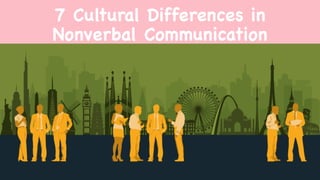


7 Cultural Differences in
Nonverbal Communication
“The most important thing in
communication is hearing what isn’t
said.”
-Peter F. Drucker
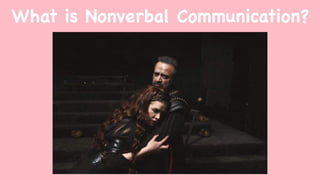
What is Nonverbal Communication?
Functions
• To accent the meaning of verbal messages (such
as pointing while stating directions)
• To complement or contradict verbal messages
(such as indicating sarcasm using verbal tone)
• To regulate interactions with others (such as using
nonverbal cues to indicate when people should and
should not speak)
• To substitute for verbal messages (such as
nodding instead of saying “yes”)
Meanings of nonverbal cues are
not, in fact, universal.
No culture is “better” than
another; communication styles
simply convey differences, rather
than superiority.
High Context
•Communication tends to be indirect, harmoniously
structured and understated.
•In conversation, people are expected to speak
one after another in an orderly, linear fashion.
•Disagreements are personally threatening.
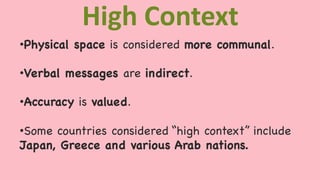
High Context
•Physical space is considered more communal.
•Verbal messages are indirect.
•Accuracy is valued.
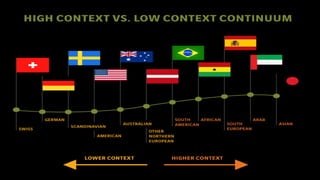
•Some countries considered “high context” include
Japan, Greece and various Arab nations.
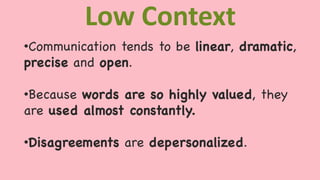
Low Context
•Communication tends to be linear, dramatic,
precise and open.
•Because words are so highly valued, they
are used almost constantly.
•Disagreements are depersonalized.
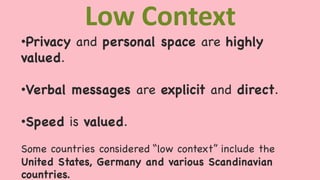
Low Context
•Privacy and personal space are highly
valued.
•Verbal messages are explicit and direct.
•Speed is valued.
Some countries considered “low context” include the
United States, Germany and various Scandinavian
countries.
Group Activity
TO GOD BE ALL THE
GLORY

Nonverbal communication

  • 1.
    7 Cultural Differencesin Nonverbal Communication
  • 2.
    “The most importantthing in communication is hearing what isn’t said.” -Peter F. Drucker
  • 3.
    What is NonverbalCommunication?
  • 4.
    Functions • To accentthe meaning of verbal messages (such as pointing while stating directions) • To complement or contradict verbal messages (such as indicating sarcasm using verbal tone) • To regulate interactions with others (such as using nonverbal cues to indicate when people should and should not speak) • To substitute for verbal messages (such as nodding instead of saying “yes”)
  • 5.
    Meanings of nonverbalcues are not, in fact, universal.
  • 7.
    No culture is“better” than another; communication styles simply convey differences, rather than superiority.
  • 8.
    High Context •Communication tendsto be indirect, harmoniously structured and understated. •In conversation, people are expected to speak one after another in an orderly, linear fashion. •Disagreements are personally threatening.
  • 9.
    High Context •Physical spaceis considered more communal. •Verbal messages are indirect. •Accuracy is valued. •Some countries considered “high context” include Japan, Greece and various Arab nations.
  • 10.
    Low Context •Communication tendsto be linear, dramatic, precise and open. •Because words are so highly valued, they are used almost constantly. •Disagreements are depersonalized.
  • 11.
    Low Context •Privacy andpersonal space are highly valued. •Verbal messages are explicit and direct. •Speed is valued. Some countries considered “low context” include the United States, Germany and various Scandinavian countries.
  • 12.
  • 13.
    TO GOD BEALL THE GLORY