1


   Business
Communication
Slides By Rana Usman Sattar
Student Of BBA(Hons)
PMAS Arid Agriculture University Rawalpindi
Gmail: ranaa.usman@gmail
Facebook: usman.shan86@yahoo.com
Objectives of Nonverbal
              Communication
• Define the Term ‘nonverbal Communication.
• List and define the four types of nonver bal
  communication.
• Identify its impor tance to the total message.
• Distinguish four ways of gr ouping nonver bal
  communication.
• Identify seven aspects of nonverbal behavior .
• Highlight the role of nonverbal behavior in the
  communication pr ocess.
• Confir m with the sender of a message the meaning of
  their nonver bal behavior communication.
• Interpret and use your own nonverbal communication
  appr opriately.
2
Interpreting the nonverbal par t of
           the message.
Nonver bal communication consists of that par t of
a message that is not encoded in wor ds. The
nonver bal par t of the message tends to be less
conscious and often r eveals the sender ’s feelings
and pr efer ences mor e spontaneously and honestly
than the ver bal par t. If the ver bal message does
not match the nonver bal communication, people
tend to believe the nonver bal message.
Four types of nonverbal              2


                  messages
1.   Per sonal (to the individual)
2.   common to a gr oup of people or cultur e
3.   univer sal (to humankind)
4.   unr elated to the message (r andom)
Four types of nonverbal                 2


             messages
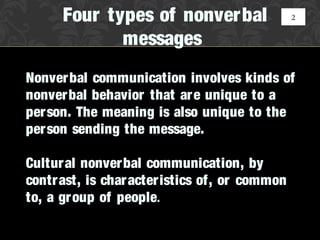
Nonverbal communication involves kinds of
nonverbal behavior that ar e unique to a
per son. The meaning is also unique to the
per son sending the message.

Cultural nonverbal communication, by
contrast, is char acteristics of, or common
to, a group of people.
Four types of nonverbal                     2


             messages
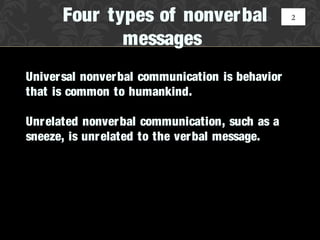
Univer sal nonver bal communication is behavior
that is common to humankind.

Unr elated nonver bal communication, such as a
sneeze, is unr elated to the ver bal message.
A nalyzing Nonverbal                      7


                Communication
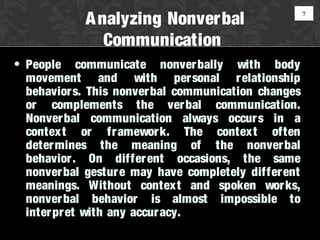
• People communicate nonver bally with body
  movement and with per sonal r elationship
  behavior s. This nonver bal communication changes
  or complements the ver bal communication.
  Nonver bal communication always occur s in a
  contex t or fr amewor k. The context often
  deter mines the meaning of the nonver bal
  behavior . On differ ent occasions, the same
  nonver bal gestur e may have completely differ ent
  meanings. Without context and spoken wor ks,
  nonver bal behavior is almost impossible to
  inter pr et with any accur acy.
A nalyzing Nonverbal                        8


                   Communication
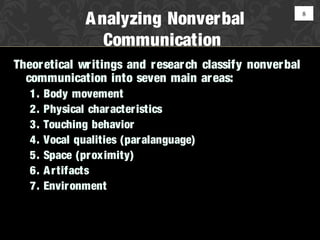
Theor etical wr itings and r esear ch classify nonver bal
  communication into seven main ar eas:
   1.   Body movement
   2.   Physical char acter istics
   3.   Touching behavior
   4.   Vocal qualities (paralanguage)
   5.   Space (proximity)
   6.   A r tifacts
   7.   Envir onment
9

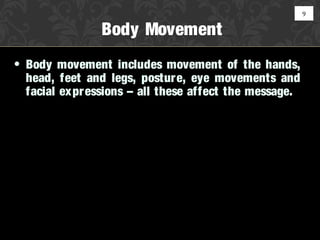
                Body Movement
• Body movement includes movement of the hands,
  head, feet and legs, postur e, eye movements and
  facial expr essions – all these affect the message.
10

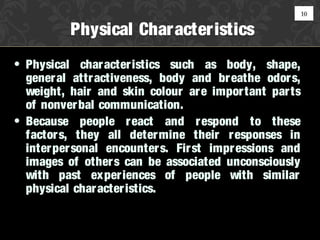
          Physical Character istics
• Physical char acter istics such as body, shape,
  gener al attr activeness, body and br eathe odor s,
  weight, hair and skin colour are impor tant par ts
  of nonver bal communication.
• Because people r eact and r espond to these
  factor s, they all deter mine their r esponses in
  inter per sonal encounter s. Fir st impr essions and
  images of other s can be associated unconsciously
  with past exper iences of people with similar
  physical char acter istics.
11

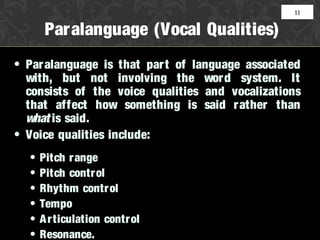
       Paralanguage (Vocal Qualities)
• Par alanguage is that par t of language associated
  with, but not involving the wor d system. It
  consists of the voice qualities and vocalizations
  that affect how something is said r ather than
  what is said.
• Voice qualities include:
  •   Pitch r ange
  •   Pitch contr ol
  •   Rhythm contr ol
  •   Tempo
  •   A rticulation control
  •   Resonance.
12
       Paralanguage (Vocal Qualities)
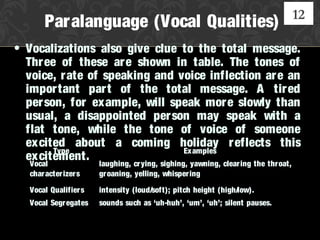
• Vocalizations also give clue to the total message.
  Thr ee of these ar e shown in table. The tones of
  voice, r ate of speaking and voice inflection ar e an
  impor tant par t of the total message. A tir ed
  per son, for example, will speak mor e slowly than
  usual, a disappointed per son may speak with a
  flat tone, while the tone of voice of someone
  excited about a coming holiday r eflects this
        Type                    Examples
  excitement.
   Vocal               laughing, cr ying, sighing, yawning, clearing the throat,
   char acter izers    gr oaning, yelling, whispering

   Vocal Qualifier s   intensity (loud/soft); pitch height (high/low).
   Vocal Segregates    sounds such as ‘uh-huh’, ‘um’, ‘uh’; silent pauses.

Nonverbal communication

  • 1.
    1 Business Communication Slides By Rana Usman Sattar Student Of BBA(Hons) PMAS Arid Agriculture University Rawalpindi Gmail: ranaa.usman@gmail Facebook: usman.shan86@yahoo.com
  • 2.
    Objectives of Nonverbal Communication • Define the Term ‘nonverbal Communication. • List and define the four types of nonver bal communication. • Identify its impor tance to the total message. • Distinguish four ways of gr ouping nonver bal communication. • Identify seven aspects of nonverbal behavior . • Highlight the role of nonverbal behavior in the communication pr ocess. • Confir m with the sender of a message the meaning of their nonver bal behavior communication. • Interpret and use your own nonverbal communication appr opriately.
  • 3.
    2 Interpreting the nonverbalpar t of the message. Nonver bal communication consists of that par t of a message that is not encoded in wor ds. The nonver bal par t of the message tends to be less conscious and often r eveals the sender ’s feelings and pr efer ences mor e spontaneously and honestly than the ver bal par t. If the ver bal message does not match the nonver bal communication, people tend to believe the nonver bal message.
  • 4.
    Four types ofnonverbal 2 messages 1. Per sonal (to the individual) 2. common to a gr oup of people or cultur e 3. univer sal (to humankind) 4. unr elated to the message (r andom)
  • 5.
    Four types ofnonverbal 2 messages Nonverbal communication involves kinds of nonverbal behavior that ar e unique to a per son. The meaning is also unique to the per son sending the message. Cultural nonverbal communication, by contrast, is char acteristics of, or common to, a group of people.
  • 6.
    Four types ofnonverbal 2 messages Univer sal nonver bal communication is behavior that is common to humankind. Unr elated nonver bal communication, such as a sneeze, is unr elated to the ver bal message.
  • 7.
    A nalyzing Nonverbal 7 Communication • People communicate nonver bally with body movement and with per sonal r elationship behavior s. This nonver bal communication changes or complements the ver bal communication. Nonver bal communication always occur s in a contex t or fr amewor k. The context often deter mines the meaning of the nonver bal behavior . On differ ent occasions, the same nonver bal gestur e may have completely differ ent meanings. Without context and spoken wor ks, nonver bal behavior is almost impossible to inter pr et with any accur acy.
  • 8.
    A nalyzing Nonverbal 8 Communication Theor etical wr itings and r esear ch classify nonver bal communication into seven main ar eas: 1. Body movement 2. Physical char acter istics 3. Touching behavior 4. Vocal qualities (paralanguage) 5. Space (proximity) 6. A r tifacts 7. Envir onment
  • 9.
    9 Body Movement • Body movement includes movement of the hands, head, feet and legs, postur e, eye movements and facial expr essions – all these affect the message.
  • 10.
    10 Physical Character istics • Physical char acter istics such as body, shape, gener al attr activeness, body and br eathe odor s, weight, hair and skin colour are impor tant par ts of nonver bal communication. • Because people r eact and r espond to these factor s, they all deter mine their r esponses in inter per sonal encounter s. Fir st impr essions and images of other s can be associated unconsciously with past exper iences of people with similar physical char acter istics.
  • 11.
    11 Paralanguage (Vocal Qualities) • Par alanguage is that par t of language associated with, but not involving the wor d system. It consists of the voice qualities and vocalizations that affect how something is said r ather than what is said. • Voice qualities include: • Pitch r ange • Pitch contr ol • Rhythm contr ol • Tempo • A rticulation control • Resonance.
  • 12.
    12 Paralanguage (Vocal Qualities) • Vocalizations also give clue to the total message. Thr ee of these ar e shown in table. The tones of voice, r ate of speaking and voice inflection ar e an impor tant par t of the total message. A tir ed per son, for example, will speak mor e slowly than usual, a disappointed per son may speak with a flat tone, while the tone of voice of someone excited about a coming holiday r eflects this Type Examples excitement. Vocal laughing, cr ying, sighing, yawning, clearing the throat, char acter izers gr oaning, yelling, whispering Vocal Qualifier s intensity (loud/soft); pitch height (high/low). Vocal Segregates sounds such as ‘uh-huh’, ‘um’, ‘uh’; silent pauses.